
Are your Ford F-350’s tires struggling to keep up with the demands of heavy loads, rough terrain, or challenging weather conditions? With a truck capable of towing over 35,000 pounds and handling massive payloads, choosing the wrong tires can compromise safety, comfort, and performance when you need it most. The right set of tires transforms your Super Duty from merely capable to virtually unstoppable.
Most F-350 owners face the dilemma of balancing durability with comfort, off-road capability with highway manners, and premium performance with budget constraints. Whether you’re a contractor navigating construction sites, a rancher traversing rough terrain, or someone who regularly tows heavy equipment, your specific needs demand specialized tire characteristics.
This comprehensive guide examines the 11 best tires for Ford F-350 trucks, analyzing each option’s strengths, limitations, and ideal applications. You’ll discover which tires excel in durability, traction, comfort, and value, helping you make an informed decision that maximizes your truck’s capabilities while addressing your unique driving requirements.
From premium all-terrain options to specialized highway tires and budget-friendly alternatives, we’ll explore everything you need to know to outfit your F-350 with the perfect set of tires for your specific needs.
- 11 Best Tires for Ford F-350: Ultimate Guide for Heavy-Duty Performance
- Best Tires for Ford F-350: Complete Guide to Optimal Performance and Comfort
- Aggressive All-Terrain Tires for Your Ford F-350: Conquering the Roughest Terrain
- Winter Tires for Ford F-350: Conquering Cold Weather Challenges
- High-Performance Tires for Your Ford F-350: Complete Guide
- Value-Priced Alternatives: Finding Quality Tires Without Breaking the Bank
- How Tire Selection Impacts Your Ford F-350’s Performance
- Understanding Tire Load Range E vs F for Your Ford F-350
- Maintaining Your Ford F-350 Tires: Essential Care Guide
- Tackling Ford F-350 Tire Problems: From Uneven Wear to Vibrations
- Understanding Plus-Sizing for Ford F-350 Tires
- Best Tire Brands for Ford F-350: Reputation, Warranty, and Performance
- Balancing Cost vs Performance: How to Choose the Right F-350 Tires
- Conclusion: Choosing the Right Tire for Your Ford F-350
- FAQs About Ford F-350 Tires
11 Best Tires for Ford F-350: Ultimate Guide for Heavy-Duty Performance
The Ford F-350 Super Duty is a workhorse that demands tires capable of handling heavy loads, challenging terrains, and varying weather conditions. Whether you use your truck for work, towing, off-roading adventures, or daily driving, selecting the right set of tires is crucial for optimal performance and safety.
This comprehensive guide examines the 11 best tires for your Ford F-350, highlighting their strengths, limitations, and ideal use cases to help you make an informed decision.
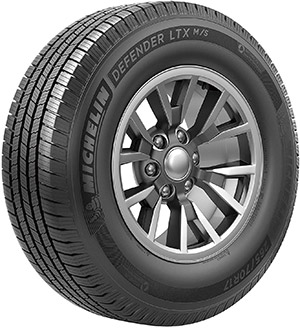
Michelin Defender LTX M/S
Best Overall Highway Tire
- It is best for a wet road
- It is super comfortable and quiet on the road
- It has an extended tread life
- Boasts of a good braking system
- Good tread pattern
- It is available in different sizes
- Ideal for all-season operation
- Very strong and durable
- Compatible with many car models
Price Check
Check the price of this tire at the following retailers:
TireRack SimpleTire PriorityTire DiscountedWheelWarehouse AmazonDon’t know the correct size tire to purchase? Start here!
The Michelin Defender LTX M/S stands out as a premium highway tire designed specifically for trucks and SUVs like the Ford F-350. This tire excels in providing a comfortable ride with minimal road noise while maintaining excellent traction across various conditions.
Pros:
- Exceptional tread life with a 70,000-mile warranty
- Superior wet traction and hydroplaning resistance
- Comfortable and quiet highway performance
- Reliable light snow handling capabilities
- Fuel-efficient design with low rolling resistance
Cons:
- Premium price point higher than many competitors
- Not designed for serious off-road use
- Winter performance adequate but not specialized
The Defender LTX M/S utilizes Michelin’s EverTread compound, engineered to withstand the demands of heavy vehicles. Its symmetric tread pattern with stable shoulder blocks provides excellent stability when carrying heavy loads or towing, making it ideal for F-350 owners who primarily drive on paved roads but occasionally encounter adverse weather conditions.
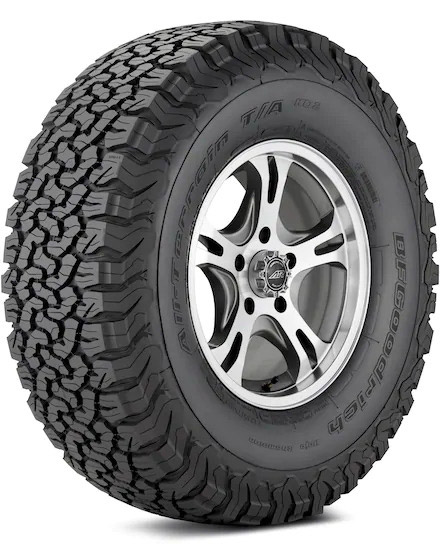
BFGoodrich All-Terrain T/A KO2
Best All-Terrain Tire
- Highly popular all-terrain tire known for its performance both on and off-road
- It has an aggressive tread pattern designed for traction in various conditions
- Off-road performance is exceptional, with high traction on loose surfaces like dirt, gravel, and mud
- On-road handling is impressive, offering responsive handling, strong grip on both dry and wet pavement, and minimal road noise
- Ride comfort is also good, with the tire providing a smooth and quiet ride on city streets and highways
Price Check
Check the price of this tire at the following retailers:
TireRack SimpleTire PriorityTire DiscountedWheelWarehouse AmazonDon’t know the correct size tire to purchase? Start here!
The BFGoodrich All-Terrain T/A KO2 represents the gold standard in all-terrain tires, offering F-350 owners a perfect balance between on-road comfort and off-road capability. This tire earned its reputation through proven performance in challenging environments.
Pros:
- Exceptional off-road traction in mud, gravel, and rocky terrain
- Tough sidewall construction resistant to cuts and punctures
- Impressive 50,000-mile tread warranty
- Three-peak mountain snowflake rating for winter performance
- Relatively quiet for an aggressive all-terrain tire
Cons:
- Slightly stiffer ride on highways compared to highway-terrain tires
- Moderate impact on fuel economy due to aggressive tread
- Can produce some road noise at highway speeds
The KO2 features BFGoodrich’s CoreGard technology with tough sidewall rubber and extended shoulder rubber to prevent sidewall splitting and bruising. The interlocking tread design provides stability for heavy loads while the serrated shoulder design enhances traction in soft soil and snow, making it perfect for F-350 owners who regularly venture off the beaten path.
Goodyear Wrangler DuraTrac

Best for Mixed Terrain
- All-terrain tire for trucks and SUVs, balancing off-road performance with on-road comfort
- Aggressive tread design for superior traction on loose surfaces
- Reinforced construction for enhanced durability and puncture resistance
- Excellent off-road capabilities in mud, rocks, and sand
- Surprisingly comfortable and quiet on-road performance
- Competes well against other popular all-terrain tires
Price Check
Check the price of this tire at the following retailers:
TireRack SimpleTire PriorityTire AmazonDon’t know the correct size tire to purchase? Start here!
The Goodyear Wrangler DuraTrac offers F-350 owners a versatile option that performs admirably across multiple surfaces. This tire bridges the gap between all-terrain and mud-terrain categories, providing excellent traction without excessive highway noise.
Pros:
- Self-cleaning tread design that sheds mud and snow effectively
- TractiveGroove Technology for enhanced snow traction
- Severe snow certification (mountain snowflake symbol)
- Rim protector helps guard against curb damage
- Good balance of on-road comfort and off-road capability
Cons:
- Shorter tread life than some competitors (typically 40,000-50,000 miles)
- Can be noisy at highway speeds compared to highway tires
- Wet braking distances longer than premium competitors
With its highly angled center tread blocks and zigzag sipes, the DuraTrac provides excellent traction in loose soil, gravel, and snow. The tire’s robust construction handles the weight of the F-350 well, making it suitable for contractors and outdoor enthusiasts who regularly encounter unpaved job sites or recreation areas.
Firestone Destination M/T2

Best Mud-Terrain Tire
- All-terrain, mud-terrain tire for trucks, SUVs, and off-road enthusiasts
- Aggressive tread pattern with deep, interlocking blocks for superior off-road traction
- Reinforced construction for durability and puncture resistance
- Relatively quiet and comfortable on-road performance
- Excellent for muddy trails, rocky paths, and loose gravel
- Balances off-road capability with daily driving performance
Price Check
Check the price of this tire at the following retailers:
TireRack SimpleTire PriorityTire DiscountedWheelWarehouse AmazonDon’t know the correct size tire to purchase? Start here!
For F-350 owners who frequently tackle serious off-road challenges, the Firestone Destination M/T2 delivers exceptional performance in mud, rocks, and other demanding terrains. This aggressive mud-terrain tire is built to handle extreme conditions.
Pros:
- Aggressive tread pattern excels in deep mud and loose surfaces
- Stone and mud rejectors prevent debris buildup
- 3-ply sidewall construction offers excellent puncture resistance
- Good self-cleaning properties
- Surprisingly manageable road noise for its category
Cons:
- Shorter tread life compared to all-terrain or highway tires
- Compromised comfort and noise levels on highways
- Less than ideal fuel economy
- Average wet pavement performance
The Destination M/T2 features 23-degree attack angles on the shoulder lugs, providing exceptional pulling power in soft surfaces. Its 3D sipes improve stability during towing and hauling, while the mud and stone rejectors help maintain traction in challenging conditions. This tire is ideal for F-350 owners who prioritize off-road capability over highway comfort.
Cooper Discoverer AT3 XLT
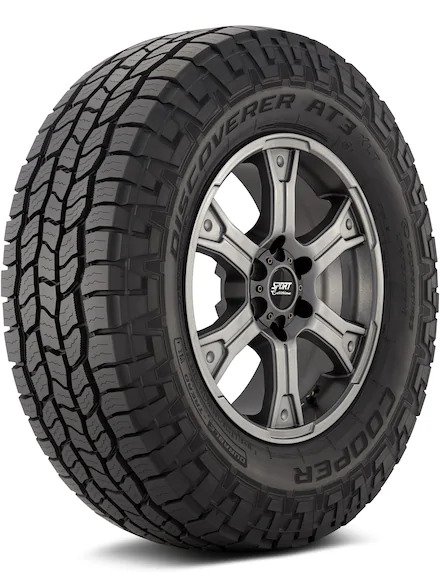
Best Value All-Terrain
- All-terrain tire for pickup trucks, SUVs, and light-duty vehicles
- Aggressive tread pattern for on-road and off-road performance
- Armor-Tek3 construction for enhanced durability and cut/chip resistance
- Stable-Trac technology for improved stability and handling
- Good on-road performance in dry and wet conditions
- Relatively quiet and comfortable for an all-terrain tire
- Excellent off-road capability in mud, rocks, and dirt
- Decent snow and ice performance, but not a dedicated winter tire
Price Check
Check the price of this tire at the following retailers:
TireRack PriorityTire SimpleTire AmazonDon’t know the correct size tire to purchase? Start here!
The Cooper Discoverer AT3 XLT offers F-350 owners an excellent balance of performance and value. This all-terrain tire provides impressive capability across various conditions without the premium price of some competitors.
Pros:
- Excellent value proposition with lower price point than premium brands
- Durable construction with cut and chip resistant tread compound
- 60,000-mile tread warranty
- Effective stone ejectors prevent damage and maintain traction
- Good balance of on and off-road performance
Cons:
- Winter performance good but not best-in-class
- Slightly louder on highways than premium competitors
- Wet braking distances average for the category
The AT3 XLT features Cooper’s Durable-Tread Technology, which resists wear from high torque applications common with heavy-duty trucks. Its Whisper Grooves help reduce road noise, while the rugged tread design provides reliable traction in dirt, gravel, and light snow. The tire’s Secure-Grip technology enhances traction on wet roads, making it a well-rounded option for F-350 owners seeking value without sacrificing performance.
Nitto Ridge Grappler

Best Hybrid Terrain Tire
- Versatile all-terrain tire for light trucks, SUVs, and crossovers
- Performs well in various conditions: wet roads, muddy trails, snow, and ice
- Comfortable and quiet ride despite aggressive design
- Durable construction with reinforced sidewalls and cut-chip resistant compound
- Good balance of off-road capability and on-road manners
- Handles well in mud, rocks, sand, and snow
Price Check
Check the price of this tire at the following retailers:
TireRack SimpleTire PriorityTire DiscountedWheelWarehouse AmazonDon’t know the correct size tire to purchase? Start here!
The Nitto Ridge Grappler represents a new category of “hybrid terrain” tires, blending attributes of all-terrain and mud-terrain designs. For F-350 owners who want aggressive looks without excessive noise penalties, this tire offers an appealing compromise.
Pros:
- Aggressive appearance with functional off-road performance
- Quieter than traditional mud-terrain tires
- Excellent traction in sand, mud, and rocky terrain
- Reinforced shoulder grooves enhance off-road capability
- Dynamic hybrid tread pattern balances on and off-road needs
Cons:
- No official tread life warranty
- Higher price point than standard all-terrain options
- Not as comfortable on highways as conventional all-terrain tires
The Ridge Grappler features alternating shoulder blocks that enhance off-road traction while maintaining on-road stability. Its variable pitch tread pattern helps reduce road noise, while the reinforced sidewall lugs provide additional protection and traction in challenging terrain. This tire is perfect for F-350 owners who want aggressive styling and capability without the full compromise of a dedicated mud-terrain tire.
Continental TerrainContact A/T

Best Comfort-Focused All-Terrain
- It provides balanced performance for both on-road and off-road driving
- The tire features TractionPlus technology which ensures superior grip and control on various surfaces, including mud and gravel
- EcoPlus technology enhances fuel economy
- ComfortRide technology guarantees a comfortable and smooth ride
- It is equipped with full-depth sipes, enabling it to maintain its performance as the tread wears down over time
Price Check
Check the price of this tire at the following retailers:
TireRack SimpleTire PriorityTire DiscountedWheelWarehouse AmazonDon’t know the correct size tire to purchase? Start here!
The Continental TerrainContact A/T provides F-350 owners with all-terrain capability while prioritizing on-road comfort, quiet performance, and fuel efficiency. This tire is ideal for those who spend most time on highways but occasionally venture onto unpaved roads.
Pros:
- Exceptionally quiet for an all-terrain tire
- Excellent wet traction and hydroplaning resistance
- 60,000-mile tread warranty
- Good fuel efficiency compared to more aggressive designs
- Comfortable ride quality even with heavy loads
Cons:
- Less aggressive off-road capability than competitors
- Average performance in deep mud
- Premium price point
Continental’s TractionPlus Technology creates open shoulder lugs for off-road traction while maintaining on-road stability. The +Silane enhanced tread compound improves wet traction and tread life, while the traction grooves provide additional biting edges for snow performance. This tire is perfect for F-350 owners who prioritize highway comfort but still need occasional dirt road capability.
Toyo Open Country R/T

Best Rugged Terrain Option
- All-terrain tire designed for trucks, SUVs, and light trucks
- Balances on-road comfort with off-road capability
- Aggressive tread pattern for superior traction on various terrains
- Reinforced construction for enhanced durability and puncture resistance
- Optimized for reduced road noise and vibrations
- Features stone ejectors and mud scoops for self-cleaning
- Excellent off-road capabilities on mud, gravel, and rocky terrain
Price Check
Check the price of this tire at the following retailers:
TireRack SimpleTire PriorityTire AmazonDon’t know the correct size tire to purchase? Start here!
The Toyo Open Country R/T occupies the middle ground between all-terrain and mud-terrain categories, offering F-350 owners rugged capability with reasonable on-road manners. This “rugged terrain” tire provides aggressive styling with functional performance.
Pros:
- Aggressive styling with functional off-road performance
- More comfortable on-road than dedicated mud-terrain tires
- 45,000-mile tread warranty
- Excellent traction in mud, sand, and snow
- Good stone and mud ejection properties
Cons:
- Noisier than conventional all-terrain tires
- Fuel economy penalty compared to highway tires
- Higher price point than some competitors
The Open Country R/T features scalloped shoulder blocks that enhance off-road traction while providing additional sidewall protection. Its dual-compound construction balances on-road wear with off-road durability, while the polyester construction helps maintain ride comfort despite the aggressive tread design. This tire suits F-350 owners who want serious capability without the full compromise of a dedicated mud tire.
Falken Wildpeak A/T3W

Best Winter-Capable All-Terrain
- All-terrain tire for trucks, SUVs, and off-road vehicles
- Balances on-road comfort with off-road capability
- Advanced tread compound resists cutting, chipping, and tearing
- Deep interlocking sipes and grooves for enhanced traction
- Reinforced construction with 3-ply sidewall for durability
- Excellent performance in mud, rock, sand, and dirt
- Good on-road handling and wet traction
- Quiet and comfortable ride for an all-terrain tire
Price Check
Check the price of this tire at the following retailers:
TireRack PriorityTire SimpleTire AmazonDon’t know the correct size tire to purchase? Start here!
The Falken Wildpeak A/T3W offers F-350 owners exceptional all-terrain performance with particular emphasis on winter capability. This tire carries the three-peak mountain snowflake rating, indicating serious snow performance.
Pros:
- Excellent winter traction with severe snow service rating
- 55,000-mile tread warranty
- Heat diffuser technology in the lower sidewall protects internal components
- Deep tread depth provides long-lasting performance
- Competitive pricing compared to premium brands
Cons:
- Slightly stiffer ride than premium highway tires
- Some road noise at highway speeds
- Wet braking distances good but not best-in-class
The Wildpeak A/T3W features Falken’s patented 3D Canyon sipe technology that increases tread block rigidity and prevents wear from heavy torque. Its silica-enriched compound maintains flexibility in cold temperatures, while the aggressive upper sidewall provides additional traction and protection off-road. This tire is ideal for F-350 owners in regions with severe winter conditions who need year-round performance without changing to dedicated winter tires.
Yokohama Geolandar X-AT
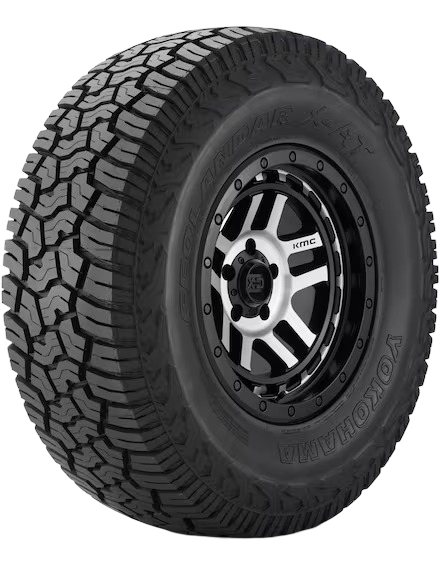
- Aggressive all-terrain tire balancing off-road capability with on-road comfort
- GEO-SHIELD technology features 3-ply sidewalls for exceptional puncture resistance
- Variable pitch tread design reduces highway noise compared to competitors
- Triple-polymer compound with silica and orange oil stays flexible in cold
- Surprisingly quiet for an aggressive AT – low rumble instead of whine
- Excellent wet traction with wide grooves preventing hydroplaning
Price Check
Check the price of this tire at the following retailers:
TireRack SimpleTire PriorityTire AmazonDon’t know the correct size tire to purchase? Start here!
The Yokohama Geolandar X-AT represents a premium option in the growing “extreme all-terrain” category, offering F-350 owners aggressive capability with reasonable on-road manners. This tire bridges the performance gap between traditional all-terrains and mud-terrains.
Pros:
- Excellent off-road traction in multiple terrain types
- 45,000-mile tread warranty
- GEO-SHIELD technology with multiple sidewall plies for durability
- Aggressive styling with functional performance benefits
- Relatively controlled road noise for its category
Cons:
- Premium price point
- Fuel economy penalty compared to highway tires
- Not as comfortable on-road as conventional all-terrains
The Geolandar X-AT features Yokohama’s HD2 compound for cut and chip resistance in rough terrain. Its aggressive sidewall design and shoulder blocks enhance off-road traction while providing additional protection against rocks and debris. The tire’s optimized tread pattern balances off-road capability with on-road stability, making it suitable for F-350 owners who regularly encounter challenging terrain but still need reasonable highway manners.
General Grabber APT

Best Budget-Friendly All-Purpose Tire
- Versatile all-terrain tires designed for balanced on-road comfort and off-road capability
- Offers good traction on various surfaces, including mud, gravel, and light snow
- Engineered for smooth on-road performance and reduced road noise
- Provides good handling and stability in both dry and wet conditions
- Decent performance in light snow, but not a dedicated winter tire
- Excels in off-road conditions like loose surfaces, rock crawling, and mud
- Balances fuel efficiency with off-road capability
Price Check
Check the price of this tire at the following retailers:
TireRack SimpleTire PriorityTire AmazonDon’t know the correct size tire to purchase? Start here!
The General Grabber APT (All-Purpose Terrain) offers F-350 owners a cost-effective option that performs well across multiple surfaces and conditions. This tire provides a good balance of highway comfort, all-season capability, and light off-road performance.
Pros:
- Excellent value with lower price point than premium brands
- 60,000-mile tread warranty
- Comfort Balance Technology for improved ride quality
- StabiliTread Technology enhances tread life and handling
- Good all-season performance including light snow
Cons:
- Less aggressive off-road capability than dedicated all-terrains
- Average performance in deep mud or snow
- Wet braking distances longer than premium competitors
The Grabber APT features General’s DuraGen Technology that enhances cut and chip resistance while maintaining good on-road manners. Its Comfort Balance Technology creates a cushioned layer that absorbs road vibrations, while the optimized tread pattern provides good all-season traction. This tire is perfect for F-350 owners on a budget who need a versatile tire for primarily on-road use with occasional light off-road excursions.
Best Tires for Ford F-350: Complete Guide to Optimal Performance and Comfort
The Ford F-350 Super Duty demands tires that can handle its impressive capabilities while delivering comfort, efficiency, and longevity. Whether you’re hauling heavy loads, tackling off-road terrain, or simply commuting on highways, choosing the right tires for your F-350 is crucial for optimal performance and safety. This comprehensive guide explores the top tire options available for your Ford F-350, considering factors like road performance, comfort, noise reduction, fuel efficiency, and overall durability.
As a heavy-duty truck, the F-350 requires tires specifically designed to support its weight and towing capacity while providing the ride quality you desire. Many owners struggle to find the perfect balance between rugged performance and everyday comfort. The right tire choice can significantly impact your driving experience, fuel consumption, and maintenance costs over time.
From all-terrain options for occasional off-road adventures to highway-terrain tires for those who primarily stick to paved roads, we’ve researched and compiled the 11 best tires that deliver exceptional performance for various driving needs. Each recommendation includes detailed insights into their strengths, limitations, and ideal use cases to help you make an informed decision for your specific requirements.
Aggressive All-Terrain Tires for Your Ford F-350: Conquering the Roughest Terrain
When you own a Ford F-350, you need tires that can match its rugged capabilities, especially if you frequently venture off the beaten path. Aggressive all-terrain tires are specifically designed to handle the most challenging conditions while still providing reasonable on-road performance. These tires feature distinctive characteristics that set them apart from standard highway tires.
The aggressive tread patterns on these tires are immediately noticeable, with deep, wide grooves and large tread blocks that bite into loose surfaces like mud, gravel, and sand. Many feature staggered shoulder blocks that extend down the sidewall, providing additional traction when traversing deep ruts or when the tire is partially deflated for extreme off-road situations.
Off-road capability is the primary focus of these tires, with designs that excel in various challenging environments. The multi-angle tread blocks provide forward, lateral, and diagonal grip, ensuring your F-350 maintains traction regardless of the terrain angle or composition. Stone ejectors built into the tread grooves prevent rocks from becoming embedded, which could otherwise cause damage over time.
Self-cleaning features are crucial for maintaining performance in muddy or snowy conditions. The strategic spacing between tread blocks allows mud, snow, and debris to be expelled as the tire rotates, preventing buildup that would otherwise reduce traction. This self-cleaning action ensures consistent performance even in continuously changing terrain.
Durability in extreme conditions is another hallmark of aggressive all-terrain tires. They typically feature reinforced sidewalls with cut and chip-resistant rubber compounds that withstand impacts from rocks and other obstacles. Many incorporate three-ply sidewall construction rather than the standard two-ply found on highway tires, providing extra protection against punctures when traversing sharp rocks or debris.
While these tires excel off-road, they do make some compromises in on-road comfort, noise levels, and fuel efficiency. However, for F-350 owners who regularly tackle challenging terrain, the trade-off is well worth it for the confidence and capability these tires provide when venturing where standard tires fear to tread.
Winter Tires for Ford F-350: Conquering Cold Weather Challenges
When temperatures drop and snow begins to fall, your Ford F-350’s tire needs change dramatically. Winter driving in a heavy-duty truck presents unique challenges that require specialized tires designed specifically for cold weather performance.
The Ford F-350’s substantial weight and torque demand winter tires with exceptional load ratings and durability. Unlike all-season options, true winter tires utilize specialized rubber compounds that remain flexible in freezing temperatures, providing crucial grip when roads become treacherous.
The best winter tires for F-350 trucks feature aggressive tread patterns with deep sipes (tiny slits in the tread blocks) that bite into snow and ice. These designs actively work to evacuate slush and water while maintaining contact with the road surface. Many premium options include multi-directional tread patterns that provide stability during acceleration, braking, and cornering on slippery surfaces.
Ice traction is perhaps the most critical safety feature in winter tires. Look for models with microbit technology—tiny studdable points or embedded silica particles that create friction against ice. Some manufacturers incorporate crushed walnut shells or other natural materials into the rubber compound to enhance grip on glassy surfaces.
Snow clearing capabilities are equally important for F-350 owners who frequently drive in unplowed conditions. The best winter tires feature wide, deep grooves between tread blocks that channel snow away from the contact patch. Self-cleaning treads prevent snow from packing between blocks, maintaining the tire’s biting edges for consistent performance throughout the winter season.
Winter safety considerations extend beyond just traction. Quality winter tires for the F-350 provide shorter stopping distances on snow and ice—often reducing braking distance by 30-40% compared to all-season alternatives. This improved stopping power can be the difference between a close call and a serious accident when road conditions deteriorate.
For F-350 owners who frequently drive in extreme winter conditions, studded or studdable tire options provide the ultimate in ice traction. However, be aware that many jurisdictions restrict or prohibit studded tires during certain months, so check your local regulations before making this choice.
High-Performance Tires for Your Ford F-350: Complete Guide
When it comes to equipping your Ford F-350 with the right tires, the decision carries significant weight—literally and figuratively. As a heavy-duty truck designed for serious work, the F-350 demands tires that can handle substantial loads while delivering reliability across diverse conditions. Whether you’re hauling construction materials across rough terrain or towing a massive trailer on highways, your tire choice directly impacts your truck’s performance, safety, and operational costs.
The market offers numerous options specifically engineered for heavy-duty trucks like the F-350. These tires vary in design, tread patterns, durability features, and price points. Some excel in off-road settings, while others are optimized for highway driving. Many modern options strike a balance, providing versatility for drivers who regularly transition between different environments.
In this comprehensive guide, we’ll examine the 11 best tires for the Ford F-350, highlighting their strengths and limitations. We’ll explore options that deliver high mileage, superior puncture resistance, exceptional load capacity, and cost efficiency for commercial applications. By the end, you’ll have the knowledge to select tires that perfectly complement your F-350’s capabilities and your specific driving requirements.
Value-Priced Alternatives: Finding Quality Tires Without Breaking the Bank
When it comes to outfitting your Ford F-350 with new tires, you don’t always have to spend top dollar to get reliable performance. Value-priced alternatives offer a strategic balance between cost and quality that many F-350 owners find appealing.
The heavy-duty nature of the F-350 means that even budget-friendly options need to deliver on fundamental performance metrics. Fortunately, several manufacturers have developed tires that hit the sweet spot between affordability and capability.
Brands like Ironman, Atturo, and Lexani have made significant strides in producing durable truck tires that cost substantially less than premium options while still offering respectable tread life and performance. These manufacturers achieve cost savings through streamlined production processes and fewer marketing expenses, not necessarily by compromising on essential construction elements.
When shopping in this category, look for tires that offer the core features you need most. For example, if you primarily drive on highways, prioritize tires with good stability and lower road noise over extreme off-road capabilities that you might rarely use.
Many value-priced tires now incorporate technologies that were once exclusive to premium brands. Features like optimized siping patterns for wet traction, computer-designed tread blocks for reduced noise, and specialized rubber compounds for improved wear resistance have trickled down to more affordable options.
The performance gap between mid-range and premium tires has narrowed considerably in recent years. While top-tier options still hold advantages in extreme conditions, the everyday performance difference may be negligible for many F-350 owners, especially those who use their trucks primarily for regular work duties rather than extreme towing or off-roading.
Warranty considerations become particularly important in this segment. While value-priced tires may offer shorter treadwear warranties than premium alternatives, many still provide reasonable coverage that reflects manufacturer confidence. A 50,000-mile warranty on a tire costing 30% less than a premium option with a 70,000-mile warranty often represents better overall value for cost-conscious buyers.
Remember that proper maintenance becomes even more crucial with value-priced options. Regular rotation, alignment checks, and maintaining correct inflation pressures will help ensure you maximize the lifespan of these tires and get the best return on your investment.
How Tire Selection Impacts Your Ford F-350’s Performance
Selecting the right tires for your Ford F-350 goes far beyond simply finding rubber that fits your wheels. The tires you choose dramatically influence nearly every aspect of your truck’s performance and driving experience. As the sole contact point between your heavy-duty pickup and the road, tires play a crucial role in determining how your F-350 handles, rides, and responds in various conditions.
When it comes to driving dynamics, tire selection can transform your truck’s personality on the road. All-terrain tires with aggressive tread patterns provide excellent traction on loose surfaces but may create more road noise and slightly reduce fuel efficiency on highways. Highway terrain tires, conversely, deliver smoother on-road performance with better fuel economy but sacrifice some off-road capability. The sidewall stiffness of your chosen tires also significantly impacts how your truck handles during cornering and emergency maneuvers.
Ride quality is perhaps where tire selection makes its most noticeable difference. Premium tires with advanced construction techniques and materials can dramatically reduce the harsh impacts and vibrations that reach the cabin. For F-350 owners who spend long hours on the road, the difference between budget tires and quality options can mean arriving at your destination feeling refreshed instead of fatigued. Load range E tires, while necessary for heavy loads, typically deliver a firmer ride when unladen compared to load range D options.
Handling characteristics vary significantly between tire models and types. Tires with stiffer sidewalls provide more precise steering response and better stability when towing heavy loads. However, this comes at the expense of ride comfort. The tread compound also matters—softer compounds offer better grip but wear faster, while harder compounds last longer but may sacrifice some traction, especially in wet conditions. For F-350 owners who frequently tow or haul heavy loads, finding tires with the right balance of stability and comfort becomes essential.
Road noise reduction is another critical factor affected by tire choice. The tread pattern design directly influences how much noise is generated as your tires roll over pavement. Tires with continuous ribs in the center typically produce less noise than those with aggressive, chunky tread blocks. Many premium tire manufacturers now incorporate noise-reducing technologies like specialized tread patterns, sound-absorbing foam inserts, or optimized pitch sequences that vary the size and spacing of tread blocks to minimize harmonic noise patterns. For a quieter cabin on long highway drives, these features are worth considering despite the higher initial cost.
Understanding Tire Load Range E vs F for Your Ford F-350
When selecting tires for your Ford F-350, one of the most critical specifications to understand is the load range. For heavy-duty trucks like the F-350, you’ll typically be choosing between Load Range E and Load Range F tires. This distinction goes far beyond a simple letter designation—it directly impacts your truck’s performance, safety, and capability.
Load Range E tires are rated for 10-ply construction (though they don’t necessarily have 10 physical plies) and can typically handle maximum inflation pressures of 80 PSI. These tires generally have a load capacity between 3,000-3,500 pounds per tire, making them suitable for many F-350 applications, particularly if you’re not regularly hauling or towing at maximum capacity.
Load Range F tires, on the other hand, feature a 12-ply rating and can handle inflation pressures up to 95 PSI. This translates to a significantly higher load capacity—often 3,750-4,000+ pounds per tire. For F-350 owners who frequently carry heavy payloads or tow substantial trailers, this additional capacity provides a crucial safety margin.
The weight carrying capacity difference between these load ranges can be substantial. A set of four Load Range F tires might provide 2,000+ pounds of additional total load capacity compared to Load Range E tires of the same size. This extra capacity becomes particularly important when you’re operating near your truck’s GVWR (Gross Vehicle Weight Rating) or GCWR (Gross Combined Weight Rating).
Inflation pressure requirements also differ significantly between these load ranges. While E-rated tires typically max out at 80 PSI, F-rated tires can be safely inflated to 95 PSI. This higher pressure is what enables the greater load capacity, but it also means you’ll need to be diligent about maintaining proper inflation. Underinflated heavy-duty tires can lead to dangerous heat buildup, reduced fuel economy, and premature wear.
Perhaps most importantly, the safety margins provided by Load Range F tires give you additional peace of mind when pushing your F-350’s capabilities. The extra load capacity means your tires are less likely to be operating at their maximum limits, reducing the risk of blowouts or failures during critical hauling or towing situations. This safety buffer becomes especially valuable in challenging conditions like steep grades, extreme temperatures, or rough roads.
The choice between Load Range E and F ultimately depends on how you use your F-350. For those who occasionally tow or haul heavy loads, E-rated tires may be sufficient. However, if you regularly push your truck’s capabilities near its maximum ratings, the additional capacity and safety margin of F-rated tires make them a worthwhile investment for both performance and peace of mind.
Maintaining Your Ford F-350 Tires: Essential Care Guide
Proper tire maintenance is crucial for maximizing the performance and lifespan of your Ford F-350’s tires. These heavy-duty trucks demand special attention to tire care, especially when regularly carrying heavy loads or towing. Following recommended maintenance schedules and proper care techniques can save you thousands of dollars in premature tire replacements while ensuring optimal safety and performance.
Regular Maintenance Schedule
Your F-350’s tires should follow a consistent maintenance schedule:
- Monthly Inspections: Check tires for visible damage, uneven wear patterns, and foreign objects at least once a month
- Pressure Checks: Verify tire pressure every two weeks and before long trips
- Rotation: Rotate tires every 5,000-7,500 miles
- Balance and Alignment: Have tires balanced and alignment checked every 15,000 miles or if you notice vibration or pulling
- Seasonal Inspections: Perform thorough inspections before winter and summer to address seasonal challenges
Heavy-duty trucks like the F-350 often experience accelerated tire wear due to their weight and typical usage patterns. Following this schedule becomes even more important when regularly towing or carrying significant loads.
Optimal Rotation Patterns
F-350 trucks benefit from specific rotation patterns to ensure even tread wear:
For standard tires (non-directional):
- Forward Cross: Front tires move to opposite rear positions; rear tires move straight forward
- X-Pattern: Each tire moves to the opposite corner position
- Side-to-Side: For dually setups, rotating the outer and inner tires on the same axle
For directional tires:
- Front-to-Back: Simply swap front and rear tires on the same side
Dually truck owners should pay special attention to the inner rear tires, which often wear differently than outer tires. Some experts recommend a modified rotation pattern that includes moving inner tires to outer positions periodically.
Tire Pressure Monitoring
Maintaining proper tire pressure is especially critical for F-350 trucks:
- Check Cold Pressure: Always check pressure when tires are cold for accurate readings
- Follow Load Ratings: Adjust pressure based on load – check your door jamb sticker for specifications
- TPMS Maintenance: Ensure your Tire Pressure Monitoring System sensors are functioning properly
- Seasonal Adjustments: Tire pressure can drop approximately 1 PSI for every 10°F temperature decrease
- Dually Considerations: Inner and outer tires on dually setups should maintain identical pressure
For F-350s used for towing, consider increasing tire pressure to the maximum recommended PSI on the sidewall when hauling heavy loads, but never exceed this rating.
Extending Tire Life
Implement these practices to maximize your tire investment:
- Driving Habits: Avoid rapid acceleration, hard braking, and high-speed cornering
- Load Management: Stay within tire load ratings and distribute weight evenly
- Surface Awareness: Minimize driving on rough terrain when possible
- Chemical Protection: Apply UV protectant to prevent sidewall cracking
- Storage Practices: If storing your F-350 long-term, consider removing weight from the tires or rotating monthly
- Valve Stem Care: Replace valve stems and caps when installing new tires
Proper alignment is particularly important for F-350 trucks. Even slight misalignment can cause premature and uneven wear on these expensive heavy-duty tires. Consider having alignment checked after hitting significant potholes or performing any suspension modifications.
By adhering to these maintenance guidelines, you’ll not only extend the life of your F-350’s tires but also improve fuel efficiency, enhance driving safety, and maintain optimal towing and hauling capability. Remember that tire care is an investment that pays dividends in both safety and cost savings over the life of your truck.
Tackling Ford F-350 Tire Problems: From Uneven Wear to Vibrations
Owning a Ford F-350 means having immense towing and hauling capabilities, but it also comes with specific tire challenges that can affect performance and safety. Heavy-duty trucks like the F-350 place unique stresses on tires, often resulting in wear patterns and vibration issues that require special attention. Let’s dive into the most common tire problems F-350 owners face and how to address them effectively.
Uneven tire wear is perhaps the most common issue F-350 owners encounter. This typically manifests as excessive wear on the outer edges, inner edges, or in specific patches across the tread. When your F-350’s tires show outer edge wear, it often indicates underinflation or negative camber issues. Conversely, inner edge wear usually points to overinflation or positive camber problems. The heavy weight of the F-350, especially when loaded or towing, accelerates these wear patterns compared to lighter vehicles.
Cupping, characterized by scalloped dips appearing around the tire’s circumference, is another frequent problem. This distinctive wear pattern creates a wavy appearance on your tires and typically produces a humming noise that increases with speed. On F-350s, cupping often results from worn suspension components like ball joints, shock absorbers, or bushings that have deteriorated under the truck’s substantial weight. The Super Duty’s heavier construction means these components work harder and may wear out faster than on lighter trucks.
Vibration issues plague many F-350 owners and can stem from multiple sources. At highway speeds, you might feel steering wheel vibrations, seat vibrations, or a general shuddering throughout the truck. These sensations typically indicate imbalanced tires, but on F-350s, they can also signal more serious problems like bent wheels from impact with potholes (more common due to the truck’s weight), driveline issues specific to heavy-duty trucks, or brake system problems. The F-350’s solid front axle design, while excellent for durability, can sometimes amplify vibration problems compared to independent front suspension setups.
Alignment is absolutely critical for F-350s, perhaps more so than for lighter vehicles. The truck’s substantial weight and towing capabilities mean that even slight alignment issues get magnified into significant problems. An improperly aligned F-350 will experience accelerated tire wear, reduced fuel economy, and potential handling problems. After modifications like leveling kits or lift kits—popular among F-350 owners—alignment becomes even more crucial. The caster, camber, and toe settings need precise adjustment to accommodate the truck’s modified stance.
Preventing these issues requires a proactive approach. For F-350 owners, this means more frequent tire rotations (every 5,000-6,000 miles rather than the standard 7,500-8,000 recommended for lighter vehicles), maintaining proper inflation pressures accounting for load, and scheduling regular alignment checks, especially after hitting significant road hazards or installing aftermarket components. Remember that the F-350’s tire pressure requirements differ substantially between unloaded and fully loaded conditions—sometimes by 20 PSI or more for rear tires—making proper inflation particularly important.
By understanding these common tire issues specific to the F-350 platform and addressing them promptly, you’ll extend your tire life, improve your driving experience, and maintain the exceptional capability that made you choose a Super Duty in the first place.
Understanding Plus-Sizing for Ford F-350 Tires
When considering tire upgrades for your Ford F-350, plus-sizing is a common modification that truck owners explore to enhance appearance and performance. Plus-sizing involves installing larger diameter wheels with lower-profile tires while maintaining a similar overall diameter. This modification can dramatically change your truck’s look and feel, but it comes with several important considerations.
The first consideration is speedometer accuracy. Your F-350’s speedometer is calibrated based on the original tire size. When you increase or decrease the overall diameter of your tire/wheel combination, you directly affect the distance traveled per wheel rotation. A larger diameter means your truck covers more ground with each rotation than what your speedometer registers. Generally, a 3% increase in overall diameter results in approximately a 3% speedometer error. This means your actual speed might be 63 mph when your speedometer shows 60 mph. For precise driving and to avoid speeding tickets, you may need to recalibrate your speedometer after plus-sizing.
Clearance issues represent another critical factor. The F-350 is designed with specific wheel well dimensions, and deviating too far from factory specifications can cause tires to rub against fenders, suspension components, or frame elements during turns or when the suspension compresses. This is particularly important for trucks with heavy loads or those used for towing, as the additional weight compresses the suspension further. Before committing to plus-sized tires, verify clearance at full steering lock and under maximum load conditions.
Performance impacts can be both positive and negative. On the positive side, wider tires provide increased traction and stability, which is beneficial for a heavy-duty truck like the F-350. Larger wheels with lower-profile tires can also improve cornering response and visual appeal. However, these benefits come with trade-offs. Lower-profile tires offer less cushioning against impacts, potentially resulting in a harsher ride and increased risk of wheel damage when driving over potholes or rough terrain. Additionally, larger, heavier wheels can negatively affect acceleration and fuel economy due to increased rotational mass.
Load capacity is another crucial consideration for F-350 owners. As a work truck often used for hauling and towing, any tire modification must maintain or exceed the original load rating. Plus-sized tires sometimes have lower load ratings than original equipment, which could compromise safety when carrying heavy loads. Always verify that your new tire selection meets or exceeds the load requirements for your specific F-350 application.
Finally, consider the impact on your truck’s drivetrain components. Larger, heavier tires create additional stress on your bearings, CV joints, differentials, and transmission. While the F-350’s robust construction can generally handle moderate plus-sizing, extreme modifications might accelerate wear on these components. For those who frequently tow or haul heavy loads, this additional stress becomes even more significant.
When properly executed with these considerations in mind, plus-sizing can enhance your F-350’s appearance and performance while maintaining safety and functionality. The key is finding the right balance between aesthetic desires and practical requirements for your specific use case.
Best Tire Brands for Ford F-350: Reputation, Warranty, and Performance
When selecting tires for a heavy-duty truck like the Ford F-350, the manufacturer’s reputation and track record are just as important as the specific tire model. The best tire brands for the F-350 have established themselves through years of consistent performance, innovative technology, and responsive customer service.
Michelin stands out as a premium tire manufacturer with exceptional longevity ratings. Their commercial and light truck tires typically last 10-20% longer than competitors, justifying their higher price point. Michelin offers a 6-year warranty on most truck tires and consistently ranks highest in customer satisfaction surveys with an impressive 4.7/5 average rating across major retailers.
Goodyear combines American manufacturing heritage with cutting-edge technology. Their Wrangler and Duratrax lines are specifically engineered for heavy-duty applications with warranties ranging from 50,000 to 65,000 miles. Customer feedback highlights their excellent winter performance and responsive handling, with satisfaction scores averaging 4.5/5.
BFGoodrich, a subsidiary of Michelin, has built a reputation for exceptional off-road capability while maintaining respectable on-road manners. Their All-Terrain T/A KO2 is particularly popular among F-350 owners who venture off pavement. With a 50,000-mile warranty and robust construction, these tires earn a 4.6/5 satisfaction rating, especially among off-road enthusiasts.
Cooper Tires offers perhaps the best value proposition, with prices typically 15-20% lower than premium brands while still delivering 85-90% of the performance. Their Discoverer series comes with warranties between 50,000-60,000 miles and earns solid 4.3/5 customer ratings, particularly strong in the categories of value and tread life.
Nitto specializes in high-performance truck tires with exceptional traction characteristics. While their warranties are somewhat shorter (typically 40,000-50,000 miles), they compensate with superior grip and stability when towing heavy loads. Customer satisfaction scores average 4.4/5, with particularly strong ratings for towing performance and stability.
Toyo has gained popularity among F-350 owners for their Open Country series, which balances off-road capability with on-road comfort. Their 65,000-mile treadwear warranty on select models is among the best in the industry, and customer satisfaction ratings of 4.5/5 reflect their consistent performance and relatively quiet operation for truck tires.
Firestone, backed by Bridgestone’s technology, offers reliable performance at mid-range prices. Their Transforce HT2 is specifically designed for heavy-duty trucks with a 50,000-mile warranty. Customer satisfaction averages 4.2/5, with particular praise for their stability when towing and overall value proposition.
When comparing warranties across brands, Michelin and Toyo lead with 6-year or 65,000-mile coverage on select models. Most other premium brands offer 50,000-60,000 mile warranties, while budget options typically provide 40,000-mile coverage. Beyond the warranty period, Michelin and BFGoodrich tires demonstrate the best longevity, often reaching 70,000+ miles with proper maintenance.
Customer satisfaction metrics consistently place Michelin, BFGoodrich, and Toyo at the top, particularly in categories like tread life, comfort, and all-weather performance. Cooper and Firestone earn high marks for value, while Nitto and Goodyear score best for specialized applications like off-roading and towing.
Balancing Cost vs Performance: How to Choose the Right F-350 Tires
Selecting tires for your Ford F-350 inevitably involves weighing cost against performance—a balancing act that challenges even experienced truck owners. While premium tires often deliver superior performance, they come with higher price tags that may strain your budget. Understanding how to navigate this trade-off is essential for making a sound investment.
The initial purchase price represents only part of the equation. Premium tires typically offer longer tread life, better fuel economy, and enhanced durability—factors that contribute to lower long-term ownership costs. For instance, a set of high-quality all-terrain tires priced at $1,200 might last 60,000 miles, while budget alternatives at $800 may need replacement after just 40,000 miles. When calculated per mile, the premium option often proves more economical.
Performance aspects worth prioritizing include load capacity, traction capabilities, and ride comfort. For heavy-duty applications like frequent towing or hauling, investing in tires with higher load ratings becomes non-negotiable despite the premium price. Similarly, if you regularly navigate challenging terrain, the superior grip and durability of quality all-terrain or mud tires justify the additional expense.
Consider your specific driving patterns when determining where to compromise. If your F-350 serves primarily as a highway cruiser with occasional light towing, you might opt for moderately priced highway tires that balance longevity with adequate performance. Conversely, if you’re tackling construction sites daily or engaging in serious off-roading, cutting corners on tire quality will likely result in premature wear and potential safety hazards.
The smartest approach often involves identifying the performance features most critical to your needs while finding acceptable compromises in less essential areas. This might mean selecting tires with excellent load capacity and tread life while accepting slightly higher road noise or less aggressive aesthetics. Remember that the right balance varies significantly based on your unique requirements—there’s no universal “best value” tire for every F-350 owner.
Conclusion: Choosing the Right Tire for Your Ford F-350
Selecting the perfect tire for your Ford F-350 ultimately depends on your specific needs, driving conditions, and budget. For those primarily driving on highways with occasional light off-road use, the Michelin Defender LTX M/S or Continental TerrainContact A/T offer excellent longevity and comfort. If you regularly tackle more challenging terrain, the BFGoodrich All-Terrain T/A KO2, Goodyear Wrangler DuraTrac, or Nitto Ridge Grappler provide the necessary capability without excessive on-road compromises.
Consider your typical payload and towing requirements when making your selection, as some tires handle heavy loads better than others. Also factor in your local climate—if you frequently drive in snow and ice, prioritize tires with the Three Peak Mountain Snowflake (3PMSF) rating like the Falken Wildpeak A/T3W or Cooper Discoverer AT3 XLT.
Remember that proper maintenance, including regular rotation, alignment checks, and maintaining correct inflation pressures, will help maximize the performance and longevity of whichever tire you choose. The right tires, properly maintained, will ensure your Ford F-350 delivers the capability, safety, and reliability you expect from this impressive truck.
FAQs About Ford F-350 Tires
What size tires does a Ford F-350 Super Duty use?
Ford F-350 Super Duty trucks typically use LT (Light Truck) tires ranging from LT245/75R17 to LT275/65R20, depending on the model year and trim level. The factory sizes vary based on wheel diameter and truck configuration, with dually models often requiring specific sizes for the rear wheels.
What load range tires should I use on my Ford F-350?
Most Ford F-350 trucks require at minimum Load Range E (10-ply rating) tires, which can handle inflation pressures up to 80 PSI. For heavy towing or maximum payload applications, Load Range F (12-ply rating) tires are recommended as they offer higher load capacities and can be inflated up to 95 PSI.
How do I choose the best tires for towing with my F-350?
For optimal towing performance with your F-350, look for tires with high load ratings (E or F), reinforced sidewalls, heat-resistant compounds, and stability-focused tread patterns. Highway terrain (HT) or all-season commercial tires typically offer the best combination of stability, heat resistance, and longevity for heavy towing applications.
Can I put larger tires on my Ford F-350?
Yes, you can install larger tires on your F-350, but it’s important to consider clearance issues, speedometer accuracy, and potential impacts on performance. A moderate increase of 1-2 inches in overall diameter is generally safe, but larger sizes may require suspension modifications, wheel well adjustments, or recalibration of your speedometer.
What’s the best all-terrain tire for a Ford F-350?
Popular all-terrain tires for the F-350 include the BFGoodrich All-Terrain T/A KO2, Goodyear Wrangler DuraTrac, and Cooper Discoverer AT3 XLT. The best choice depends on your specific needs, but these options offer excellent balances of on-road comfort, off-road capability, and towing performance for heavy-duty trucks.
How often should I rotate tires on my Ford F-350?
Tires on an F-350 should be rotated every 5,000-7,500 miles, which is slightly more frequent than lighter trucks due to the F-350’s weight and typical usage patterns. Regular rotation is especially important if you frequently tow or carry heavy loads, as these activities can cause accelerated and uneven tire wear.
What tire pressure should I use in my F-350 tires?
The recommended tire pressure for an F-350 varies based on load. When unloaded, front tires typically require 60-65 PSI and rear tires 70-75 PSI. When fully loaded or towing, pressure should be increased according to the specifications in your owner’s manual or door jamb sticker, potentially up to the maximum PSI listed on the tire sidewall.
Are mud terrain tires good for daily driving an F-350?
While mud terrain tires provide excellent off-road traction, they typically create more road noise, reduce fuel efficiency, and wear faster when used for daily highway driving. Unless you frequently navigate serious off-road conditions, all-terrain or highway tires generally provide a better balance for daily F-350 use.
How do I know when it’s time to replace my F-350 tires?
Replace your F-350 tires when the tread depth reaches 4/32″ (for all-season/highway tires) or 5/32″ (for winter/snow tires), if you notice uneven wear patterns, sidewall damage, frequent air pressure loss, or if the tires are more than 6 years old regardless of tread depth.
What’s the average lifespan of tires on a Ford F-350?
Quality tires on a Ford F-350 typically last between 40,000-60,000 miles, though this varies significantly based on driving habits, load conditions, tire type, and maintenance. Highway terrain tires often last longer than all-terrain options, while mud terrain tires typically have the shortest lifespan, especially when used frequently on pavement.