

Before you read on: If you’re already sold on run-flats and just want to know which ones to buy, I’ve put together a deep-dive on the Best Run Flat Tires currently available in the US market — covering top picks across sedans, SUVs, and performance vehicles.
TL;DR
Run-flat tires let you keep driving up to 50 miles at 50 mph after a puncture — no roadside tire change needed. They’re great for safety and convenience, but they cost 30–50% more than regular tires, wear out faster, and give a stiffer ride. They’re worth it if you drive a BMW, Mini, or another vehicle that came with them from the factory, or if you frequently drive alone at night in unfamiliar areas. For most everyday drivers on a budget, a quality set of standard tires plus a portable inflator kit is a smarter value play.
- TL;DR
- Introduction: The Flat Tire Moment Nobody Wants
- What Are Run-Flat Tires, Exactly?
- How Do Run-Flat Tires Work?
- The Pros of Run-Flat Tires
- The Cons of Run-Flat Tires
- Run-Flat vs. Regular Tires: A Head-to-Head Comparison
- What Do Run-Flat Tires Cost to Replace in the US?
- Who Should Buy Run-Flat Tires?
- Popular Run-Flat Tires Available in the US Market
- Can You Mix Run-Flat and Regular Tires?
- Maintaining Run-Flat Tires: What’s Different?
- The Bottom Line: Are Run-Flat Tires Worth It?
- Frequently Asked Questions About Run-Flat Tires
Introduction: The Flat Tire Moment Nobody Wants
It was 11:30 PM on a stretch of I-95 in Virginia. My wife was driving home alone, and she felt that unmistakable pull — the dull thudding, the steering going heavy on one side. A blown front left tire.
Here’s the thing: her car came equipped with run-flat tires from the factory. She didn’t pull over on a dark highway. She didn’t call roadside assistance. She drove calmly to the nearest exit, found a well-lit gas station, and called me. That’s when I stopped second-guessing run-flat tires.
But that’s one story. And as someone who has spent the better part of a decade reviewing tires, road-testing them in real conditions, and talking to everyday drivers — mechanics, commuters, road-trippers — I’ve heard the other side too. Drivers who found run-flats too expensive to replace, too harsh on daily roads, or simply incompatible with their driving lifestyle.
So let me give you the full picture. No fluff, no manufacturer spin. Just what you actually need to know before deciding whether run-flat tires belong on your car.

Photo showing a car with a deflated standard tire pulled over on a dark highway on one side, and on the other side, a car with a run-flat tire safely driving.
What Are Run-Flat Tires, Exactly?
Before we dig into pros and cons, let’s make sure we’re talking about the same thing.
Run-flat tires — also called RFTs, zero-pressure tires, or extended-mobility tires — are engineered to remain functional even after losing air pressure. They accomplish this through one of two main technologies:
Self-supporting run-flat tires are the most common type. They have reinforced sidewalls — typically made from harder rubber compounds — that support the vehicle’s weight even when the tire is completely deflated. Brands like Bridgestone, Continental, Michelin, and Pirelli all produce self-supporting run-flats.
Self-sealing run-flat tires are a bit different. They contain a sticky sealant layer inside the tire that automatically plugs small punctures (think nail or screw holes) before significant pressure loss occurs. You may not even notice the damage until your next inspection.
Support-ring systems use an internal ring mounted on the wheel to carry the car’s weight if the tire deflates entirely. These are less common on consumer vehicles but are used on some premium and military applications.
For most US drivers shopping for replacement tires today, self-supporting run-flats are what you’ll encounter on the shelves — and what we’ll focus on throughout this post.
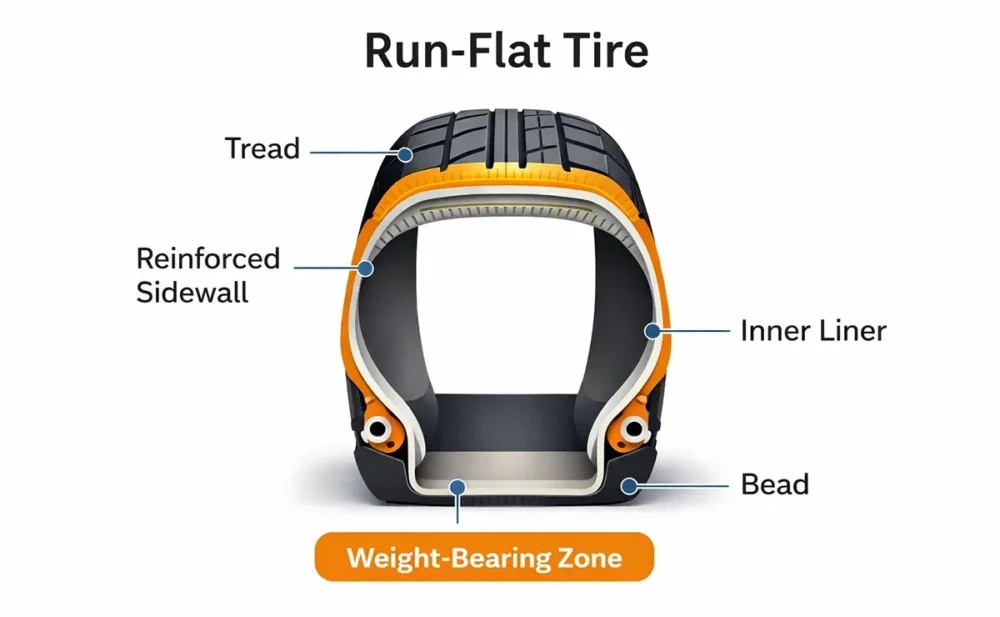
A technical diagram showing the cross-section of a run-flat tire with labeled parts: reinforced sidewall, tread, inner liner, bead, and weight-bearing zone highlighted.
How Do Run-Flat Tires Work?
The science is elegant, even if it comes with trade-offs.
A standard tire relies entirely on air pressure to support the vehicle’s load. When it loses that pressure — instantly or gradually — the sidewalls collapse under the weight of the car, and you’re riding on rim and rubber scraps within seconds.
Run-flat tires change the equation. The reinforced sidewall structure is stiff enough to support 1,500 to 2,000+ pounds of load per tire even at zero PSI. That rigidity is what gives you the ability to keep driving — typically at up to 50 mph for up to 50 miles — without damaging your wheel or losing vehicle control.
There’s an important catch though: your car must have a Tire Pressure Monitoring System (TPMS) for run-flats to be safe.
Because the reinforced sidewall masks the visible symptoms of a flat, you won’t necessarily feel or hear the difference between a pressurized tire and a completely flat one.
TPMS tells you when pressure drops so you know to start heading for a tire shop. All cars manufactured in the US after 2008 are required to have TPMS, so most drivers today are covered — but it’s something to verify if you drive an older vehicle.
The Pros of Run-Flat Tires
I’ll be straight with you: run-flats have real, meaningful advantages. Let me walk through each one honestly.
1. You Don’t Have to Change a Tire on the Side of the Road
This is the headline benefit, and it genuinely matters.
Changing a tire on the side of a busy US interstate is dangerous. According to AAA, roadside tire changes account for thousands of accidents and injuries each year. For drivers who travel alone frequently — especially at night — the ability to drive to safety after a puncture instead of stopping in a lane of traffic is a legitimate, potentially life-saving feature.
2. No Spare Tire Needed
Modern cars that come with run-flat tires from the factory typically don’t include a spare tire. That frees up space — especially in SUVs and sedans where trunk real estate is tight — and reduces the vehicle’s overall weight, which contributes marginally to fuel efficiency.
If your car came without a spare and you switch to standard tires, you’ll need to either buy a spare and mounting hardware, or carry a tire inflation kit (which doesn’t fix all types of damage).
3. Better Handling After a Puncture
A standard tire that goes flat becomes unpredictable — the vehicle lurches, pulls hard, and can become difficult to control, especially at highway speeds. Run-flat tires maintain their shape after pressure loss, which means you retain much more steering control and stability as you drive to safety.
This is especially important on front tires, where a blowout on a conventional tire can induce significant steering instability.
4. No More Emergency Roadside Calls for a Flat
If you’re a solo commuter or frequently on the road for work, run-flat tires can dramatically reduce your reliance on roadside assistance for this particular scenario. That’s real convenience and real time savings over the life of the tire.
5. Peace of Mind on Long Trips
There’s something to be said for the psychological benefit of knowing that a puncture won’t strand you in the middle of nowhere. On road trips through rural areas — places where the next tire shop might be 60 miles away — run-flat tires act as a built-in buffer.

The Cons of Run-Flat Tires
Now here’s where I’ll be equally honest with you. Run-flats have real drawbacks that many tire sales pages won’t tell you about. These are the reasons why a lot of drivers who weren’t originally fitted with run-flats choose not to adopt them.
1. Higher Purchase Price
Run-flat tires cost significantly more than comparable standard tires. Depending on the brand, size, and tire line, you’re typically looking at 30% to 50% more per tire. On a set of four, that’s a meaningful chunk of money.
For example, a standard all-season tire in a popular size like 225/50R17 might run $110–$140 per tire. A run-flat version of a comparable tire from the same brand in the same size often lands at $160–$220 or more. Multiply by four, and you’re spending an extra $200 to $400 on a single tire replacement.
2. Harsher Ride Quality
This is probably the most common complaint I hear from drivers who switch from standard tires to run-flats.
The reinforced sidewall that makes run-flats work is stiff — by necessity. That stiffness transmits more road vibration, bumps, and imperfections into the cabin. On smooth highways, you may barely notice it. On rough urban roads, potholed city streets, or rough chip-seal pavement (which is everywhere across rural America), the difference is noticeable.
Some manufacturers — Bridgestone’s DriveGuard line is a good example — have made meaningful strides in improving ride comfort on run-flats, but the physics are real: a stiffer sidewall means a firmer ride.
3. They Cannot Always Be Repaired
This is a big one that catches a lot of drivers off guard.
When a standard tire gets a nail in the tread, a tire shop can typically patch or plug it for $15–$30 and you’re back on the road. Many run-flat tires, especially those that have been driven on while flat, cannot be repaired.
Driving on a run-flat at zero pressure — even within the 50-mile limit — stresses the sidewall structure significantly. Most tire manufacturers and tire shops will not repair a run-flat that has been operated while deflated, citing safety concerns.
That means a minor puncture that would cost $25 to fix on a standard tire may cost you $150–$220 for a full run-flat replacement. Over the life of owning a vehicle, this adds up.
4. Shorter Tread Life
Because of the harder rubber compounds and stiffer construction used in run-flat tires, they tend to wear faster than equivalent standard tires.
You may get 30,000–40,000 miles out of a run-flat where a comparable standard all-season might last 50,000–60,000 miles. Combine that with the higher per-tire cost, and the total cost of ownership over a vehicle’s life is noticeably higher.
That said, tire technology has improved. Some newer run-flat designs are getting closer to standard tires in terms of tread longevity, so it’s worth checking independent tread-life testing for specific models you’re considering.
5. Not Compatible with All Vehicles
You can’t just slap run-flat tires on any car. The suspension systems of vehicles that come with run-flat tires from the factory are often tuned specifically to compensate for the stiffer sidewall — BMW is the classic example.
If you put run-flats on a car whose suspension wasn’t designed for them, the ride quality penalty is even worse.
Conversely, if your car came with run-flats from the factory and you switch to standard tires, you’ll need to add a spare and tire-changing equipment. Your suspension may also feel different in ways you didn’t anticipate.
Always consult your owner’s manual and ideally a trusted mechanic before making the switch in either direction.
6. Limited Selection in Some Sizes
While the run-flat market has grown considerably, certain sizes — particularly in the truck and off-road space — have fewer run-flat options available. If you have an unusual tire size or need a specialized performance tire, you may find the run-flat selection thin.

Run-Flat vs. Regular Tires: A Head-to-Head Comparison
| Feature | Run-Flat Tires | Standard Tires |
|---|---|---|
| Drive after puncture | Yes (up to 50 mph / 50 miles) | No |
| Spare tire required | No | Yes |
| Average cost per tire | $150–$250+ | $90–$160 |
| Ride comfort | Stiffer | Softer, more compliant |
| Tread life | Shorter (avg. 30K–45K mi) | Longer (avg. 45K–65K mi) |
| Repair after flat | Often not repairable | Usually repairable |
| TPMS required | Yes | Recommended |
| Weight | Heavier | Lighter |
| OEM fitment (BMW, Mini, etc.) | Standard | Optional |
What Do Run-Flat Tires Cost to Replace in the US?
Let me break down what you’ll realistically pay at a tire shop today, based on common tire sizes.
Economy / Entry-Level Run-Flats: $120–$160 per tire (brands like Bridgestone Turanza, Hankook Ventus)
Mid-Range Run-Flats: $160–$220 per tire (Michelin Primacy, Continental ContiProContact SSR, Pirelli Cinturato)
Premium / Performance Run-Flats: $220–$350+ per tire (Michelin Pilot Sport, Pirelli P Zero, Bridgestone Potenza)
Add installation fees ($15–$30 per tire), balancing ($10–$15 per tire), and TPMS sensor reset costs, and a full set of four mid-range run-flats will typically run you $800–$1,100 installed at a shop like Discount Tire, Costco Tire, or your local independent tire dealer.
Who Should Buy Run-Flat Tires?
After testing dozens of sets and talking to hundreds of drivers, here’s my honest take on who run-flat tires actually make sense for.
Run-flats are a strong choice if:
- Your vehicle came with run-flats from the factory (BMW, Mini, Cadillac ATS, some Mercedes models) — your suspension is tuned for them, and your car has no spare tire well
- You frequently drive alone at night or in low-traffic areas where a roadside stop would be unsafe
- You commute long distances on interstates and the convenience of not needing roadside assistance for a flat has real value to you
- Trunk space is a premium and eliminating the spare gives you meaningful cargo room
Run-flats are probably not the right choice if:
- You’re budget-conscious and the extra per-tire cost is a significant consideration
- Ride comfort is a priority for you, especially on rough urban roads
- You’re mechanically inclined and comfortable changing a tire yourself
- You drive a vehicle whose suspension was designed around standard tires
- You put high annual mileage on your vehicle and tread life and repair costs add up quickly

On the left, a person comfortably changing a standard tire with tools in a suburban driveway on a sunny day; on the right, a person in a car calmly driving past a highway at night with a TPMS light on.
Popular Run-Flat Tires Available in the US Market
Here are some of the most well-regarded run-flat tire lines you’ll find at US tire shops, covering different use cases:
Best All-Around Comfort: Bridgestone DriveGuard — this line was specifically redesigned to address the harsh ride complaint, and it shows. For everyday commuters, it’s one of the most comfortable run-flat options available in a wide range of sizes.
Best for BMW Owners: Continental ContiProContact SSR — the SSR (Self-Supporting Runflat) designation is Continental’s run-flat technology, and it’s been OEM-fitted on BMWs for years. Strong performance in wet and dry conditions.
Best Performance Run-Flat: Pirelli P Zero RFT — if you’re driving a performance sedan or sports car and want a run-flat that doesn’t sacrifice too much in handling dynamics, Pirelli’s P Zero in run-flat form is the standard against which others are judged.
Best Value Run-Flat: Hankook Ventus S1 Noble2 — Hankook has made huge strides in run-flat technology, and their pricing is typically 20–30% below the European premium brands for comparable performance.
Best Grand Touring Run-Flat: Michelin Primacy MXM4 ZP — Michelin’s “Zero Pressure” run-flat technology delivers a noticeably smoother ride than many competitors, and the Primacy MXM4 has excellent wet traction scores.
For a full ranked breakdown with test data and real-world reviews, check out my guide to the Best Run Flat Tires — it covers specific model recommendations by vehicle type, including SUVs, sedans, and performance cars.
Can You Mix Run-Flat and Regular Tires?
This is a question I get a lot, and the short answer is: technically yes, but practically no — and here’s why you shouldn’t.
Mixing run-flat and standard tires on the same vehicle creates a significant imbalance in handling characteristics. Run-flat tires have different stiffness, load behavior, and response to pressure loss than standard tires. In a panic stop or emergency maneuver, the front and rear tires behaving differently can make the car unpredictable.
Most tire manufacturers and the National Highway Traffic Safety Administration (NHTSA) advise against mixing run-flat and standard tires on the same axle, and ideally not on the same vehicle at all.
If one run-flat tire is damaged beyond repair, the correct approach is to replace it with another run-flat of the same model or a comparable equivalent — not to substitute a standard tire to save money in the short term.
Maintaining Run-Flat Tires: What’s Different?
If you’re running run-flats, a few maintenance habits are worth adjusting:
Check your TPMS regularly. Because a run-flat can feel normal even while losing pressure, your TPMS is your primary warning system. If that warning light comes on, take it seriously and get to a shop — don’t wait until your next oil change.
Rotate your tires on schedule. Run-flats tend to wear unevenly, particularly in front-wheel-drive vehicles. Sticking to a 5,000–6,000 mile rotation schedule helps extend tread life.
Inspect for sidewall damage after hard impacts. If you hit a pothole hard enough, even a run-flat can sustain internal sidewall damage that isn’t visible from the outside. After any significant impact, it’s worth having the tires inspected at a shop with mounting/balancing equipment.
Don’t exceed the post-puncture driving limits. The 50 mph / 50 mile guideline exists for a reason. Driving faster or farther after a puncture risks catastrophic sidewall failure and permanent wheel damage.
The Bottom Line: Are Run-Flat Tires Worth It?
After everything I’ve laid out, here’s where I land.
Run-flat tires are absolutely worth it in specific situations — and genuinely not worth the premium in others. The question isn’t whether run-flats are good or bad as an absolute. It’s whether they’re right for your vehicle, your driving patterns, and your budget.
If your car came with them from the factory, my advice is to stay with run-flats. Your car was engineered around them, you don’t have a spare, and the convenience and safety benefits are real. Buy quality replacements, keep your TPMS in working order, and rotate on schedule.
If you’re choosing whether to adopt run-flats on a car that didn’t come with them, think carefully about your situation. Do you drive alone at night often? Do you commute long distances? Is trunk space at a premium? If yes to multiple questions, the run-flat premium may genuinely be worth it for you.
If you’re primarily concerned about cost-per-mile and ride comfort, a quality set of standard all-season tires paired with a portable tire inflator and sealant kit — plus roadside assistance coverage through your insurance or AAA — is a practical and significantly cheaper alternative for many drivers.
There’s no universally correct answer. But I hope this breakdown gives you the information to make the right decision for your situation — not just the one the tire display at the shop makes look most appealing.
Frequently Asked Questions About Run-Flat Tires
Can run-flat tires be repaired after going flat?
Usually not if the tire has been driven on while deflated. Most manufacturers and shops will not repair a run-flat that’s been operated at zero pressure, citing sidewall stress and structural integrity concerns.
How long do run-flat tires last?
Typically 30,000–45,000 miles, though this varies by brand, driving style, and road conditions. Premium brands like Michelin and Bridgestone tend to perform better in tread-life testing.
Do run-flat tires require a special rim or wheel?
No special wheel is required. Run-flat tires mount on standard wheels, but your vehicle must have a functioning TPMS to operate them safely.
Are run-flat tires safe in snow and ice?
Performance in winter conditions varies by model. There are dedicated run-flat winter tires (Bridgestone Blizzak RFT, for example) designed for cold-weather traction. A standard all-season run-flat is not a substitute for a proper winter tire in severe snow climates.
Can I put regular tires on a BMW that came with run-flats?
Yes, but you’ll need to have a spare tire solution (a spare wheel and tire, or a temporary spare kit) since your car has no spare tire compartment. Some BMW owners prefer standard tires for improved ride comfort, and it’s a common modification — just make sure your shop accounts for the spare.
Have a question about run-flat tires or want to share your own experience with them? Drop a comment below — I read every one and respond to as many as I can.

I had a sidewall tear from a pothole on the NJ Turnpike. I never lost control of the car and could have driven further but opted to get towed. At 70 MPH I could clearly been injured and my car totaled. The tired paid for itself and I will always have run flats on my Mini