
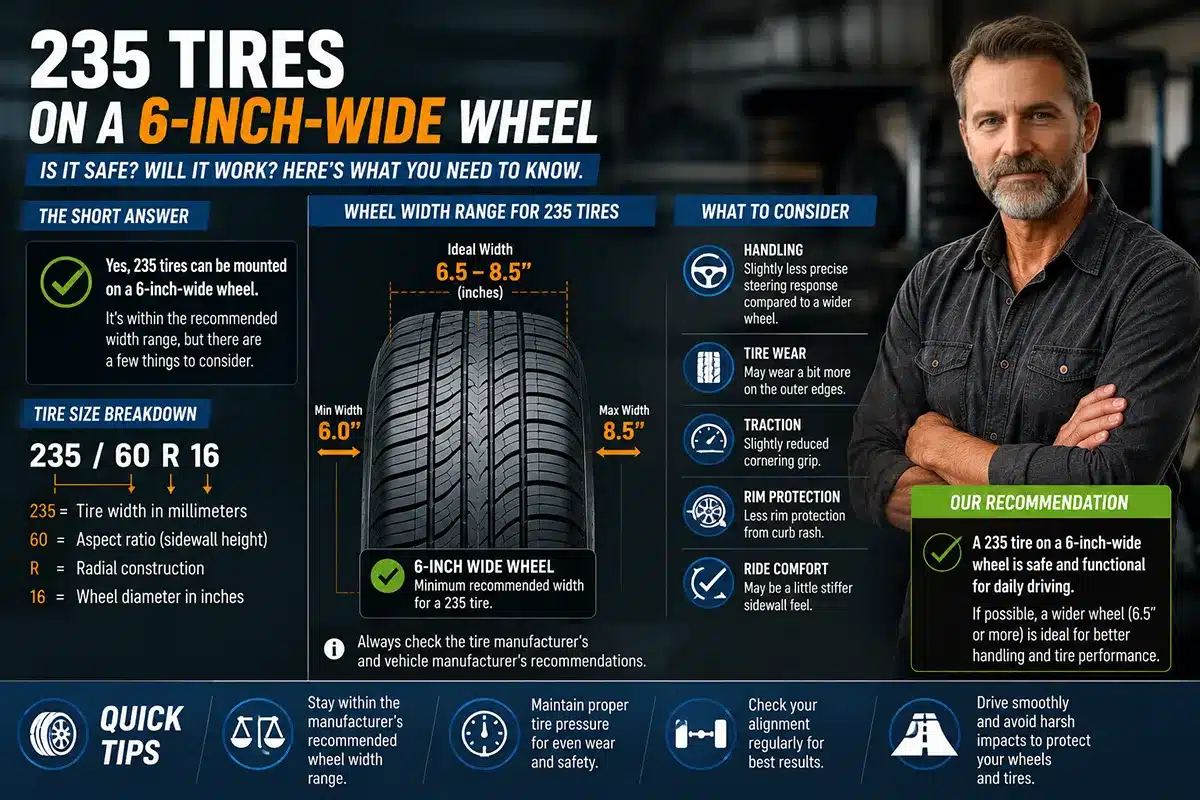
My neighbor rolled up one afternoon and asked me to look at his car. He’d just had 235/60R16 tires mounted on his factory 6-inch steel wheels — and something felt “off” when he drove home. One look at those tires told me everything. They weren’t sitting right, and I could see why.
TL;DR:
A 235 tire on a 6-inch rim is outside the Tire and Rim Association’s approved fitment range.
The tire will balloon outward, the contact patch narrows, handling becomes vague, and in emergency situations there is a real risk of the bead separating from the rim.
For everyday street driving at moderate speeds it might seem to “work,” but it is not safe, not optimal, and not something I’d put on any car I drive or recommend to a friend.
Stick to a minimum 6.5-inch rim — and ideally go 7 to 7.5 inches for a 235.
- Why People Try to Fit 235 Tires on 6-Inch Rims
- What the Tire and Rim Association Actually Says
- What Physically Happens When You Mount a 235 on a 6-Inch Rim
- Real-World Performance Differences I’ve Noticed
- When Does It Actually Matter?
- The Rim Width-to-Tire Width Rule of Thumb
- What Are Your Options If You’re Already In This Situation?
- What About Tire Aspect Ratio — Does It Change Things?
- Does Tire Brand Matter in This Scenario?
- A Quick Word on TPMS and This Fitment
- Summary: Should You Do It?
- Frequently Asked Questions
- Final Verdict
Why People Try to Fit 235 Tires on 6-Inch Rims
I get this question more than you might think, and it usually comes from one of three situations:
First, someone buys a used car and the previous owner already mounted over-wide tires on the factory narrow wheels.
They’re asking me whether they need to fix it. Second, someone is trying to run a budget winter tire setup using a set of narrow 16-inch steel wheels they found at a junkyard — and the only affordable tire in the right diameter happens to be a 235.
Third, a driver wants a beefier look for their compact car or small SUV without buying new wheels.
In all three cases, understanding what actually happens at the bead, sidewall, and contact patch is what determines whether this is a minor compromise or a genuine safety issue. Let me break it down from the inside out.
What the Tire and Rim Association Actually Says
The Tire and Rim Association (TRA) publishes engineering standards that define approved rim widths for every tire section width. These aren’t opinions — they are load-tested engineering specifications that tire manufacturers build their tires around.
For a 235mm section width tire, here’s the approved rim width range:
| Rim Width | Status |
|---|---|
| 6.0 inches | Below minimum — not approved |
| 6.5 inches | Minimum approved width |
| 7.0 inches | Approved |
| 7.5 inches | Approved — typical OEM fitment |
| 8.0 inches | Approved — performance fitment |
| 8.5 inches | Approved — maximum for most 235s |
| 9.0 inches | Above maximum — not approved |
A 6.0-inch rim sits below the minimum approved width for a 235-section tire. That’s not a gray area or a “well, it depends” situation.
The 6.5-inch minimum exists because below that threshold, the bead area cannot maintain proper contact with the rim flange at rated load and speed.
When I relay this information to customers and ask about the shop that mounted the tire, the answer is almost always the same: it was a budget shop that “just put them on” without checking fitment specs.
Shops that do this aren’t necessarily malicious — some simply don’t check, and the tires can go on. Technically mountable and technically safe are very different things.
What Physically Happens When You Mount a 235 on a 6-Inch Rim
I’ve had this happen on my own shop lift, and the visual difference is immediate and obvious. Here’s what changes:
The Sidewalls Bulge Outward
When the rim is too narrow to support the bead at the design width, the lower sidewall is forced to angle outward instead of transitioning cleanly from rim flange to tread shoulder.
The result looks exactly like a mildly underinflated tire — that rounded, bowing sidewall profile. Except in this case, adding more air doesn’t fix it. The geometry is wrong, not the pressure.
The Contact Patch Gets Narrower and Rounder
This surprised me the first time I studied it carefully. You’d think a wider tire would always give you a wider contact patch — but rim width dictates how flat the tread sits on the road surface. On a properly matched rim, a 235 tire presents a relatively flat, rectangular contact footprint.
On a 6-inch rim, the tread edges curl upward because the carcass is pinched inward at the bead, and the contact patch becomes narrower and more oval-shaped. You’re losing the exact grip advantage you thought you were gaining by going wider.
The Bead Seat Is Under Stress
The bead is designed to lock against a specific rim flange geometry. When the rim is too narrow, the bead is stretched over a smaller circumference and doesn’t seat the way it was engineered to.
Under hard cornering, braking load shifts laterally — and that’s when an improperly seated bead can unseat entirely. A tire that pops off a rim at highway speed is not a recoverable situation.
Section Height Changes Slightly
Because the tire’s circumference is fixed but the mounting width is narrower, the tire actually grows slightly taller. The section height increases by a small but measurable amount — typically 4–8mm depending on aspect ratio.
This affects your speedometer accuracy, suspension geometry, and ADAS (advanced driver assistance systems) calibration if your vehicle has them.
Real-World Performance Differences I’ve Noticed
When my neighbor brought his car by, I drove it around the block before we put it on the lift. The steering was noticeably vague in the center — that numb, disconnected feeling where you’re never quite sure how much grip you have.
The car tracked fine in a straight line, but any moderate corner felt like the tires were rolling onto their sidewalls.
Back at the shop, I pulled one wheel and compared the contact patch by doing a simple chalk test on a flat piece of paving — rolling the tire slowly and marking the contact width.
The 235 on the 6-inch rim showed a contact patch about 1.1 inches narrower than a same-spec tire I had on a correct 7.5-inch rim. That’s a meaningful difference in grip.
The ride quality was actually softer than expected — the extra sidewall flex acts as additional cushioning — but soft and compliant is not what you want from a tire. Predictable, responsive, and firmly seated is what keeps you safe.
When Does It Actually Matter?
I’ll be honest here: if you’re doing 35 mph on a quiet suburban street and never push the car hard, you probably won’t notice anything catastrophic in the short term.
Tires have been accidentally misfit and driven for months without incident. But there are specific conditions where the risk becomes very real:
Emergency braking: Under hard ABS activation, the tire flexes aggressively in all directions simultaneously. An improperly seated bead is most likely to release under combined braking and cornering load.
High-speed highway driving: At 70+ mph, centrifugal force is working on the tire. The bead load increases substantially, and small seating imperfections become more significant.
Wet roads: The narrowed, rounded contact patch loses hydroplaning resistance faster than a properly seated wide tire. The curved tread edges don’t evacuate water as efficiently.
Heavy loads or towing: If you’re near the tire’s max load rating, the sidewall deflects more under that extra weight. On a 6-inch rim, that sidewall is already compromised.
The Rim Width-to-Tire Width Rule of Thumb
I use this mental model with customers to make it simple:
The recommended rim width is roughly 70–75% of the tire’s section width in inches.
A 235mm tire converts to about 9.25 inches of section width.
- 70% of 9.25 inches = 6.5 inches (that’s the minimum — and it’s right at TRA spec)
- 75% of 9.25 inches = 6.9 inches (round up to 7.0 inches — solid everyday fitment)
- 80% of 9.25 inches = 7.4 inches (round to 7.5 inches — optimal for most performance and touring tires)
A 6.0-inch rim doesn’t even clear the 70% minimum threshold. It’s at 65% — and that’s where problems begin.
Here’s a quick reference table I hand to customers in my shop:
| Tire Width | Min Rim Width | Ideal Rim Width | Max Rim Width |
|---|---|---|---|
| 205mm | 5.5 in | 6.0–6.5 in | 7.5 in |
| 215mm | 6.0 in | 6.5–7.0 in | 8.0 in |
| 225mm | 6.0 in | 7.0–7.5 in | 8.0 in |
| 235mm | 6.5 in | 7.0–7.5 in | 8.5 in |
| 245mm | 7.0 in | 7.5–8.0 in | 9.0 in |
| 255mm | 7.0 in | 8.0–8.5 in | 9.5 in |
What Are Your Options If You’re Already In This Situation?
If you’re reading this because someone already mounted 235s on your 6-inch rims — or you’re considering it — here are the practical paths forward:
Option 1: Get the Right Rim Width
The cleanest solution is to source rims in the 7.0–7.5 inch width range. For most passenger cars that originally came with 6-inch rims, that means an aftermarket wheel.
The cost of a set of four aftermarket steel or alloy wheels in the 16–17 inch range, depending on your vehicle, typically runs $150–$400 for a decent set. That’s real money, but it’s the correct fix.
Option 2: Go Down in Tire Width
If you want to keep your existing 6-inch rims, go with a tire that fits. A 205 or 215 is properly supported on a 6-inch rim.
You lose a little footprint, but you gain correct geometry, predictable handling, and a properly seated bead. For most compact cars and small sedans that came with 6-inch rims from the factory, a 205 or 215 is likely what the tire placard calls for anyway.
Option 3: Accept It as a Temporary Measure at Reduced Speed
I won’t tell you this is a good idea, but if you’re in a situation where you have to drive on this setup briefly — you’re waiting on a parts order, you’re traveling and got stuck, whatever — limit your speed to surface streets, avoid highway driving, avoid hard cornering, and replace the setup as soon as possible. Do not treat this as a permanent solution.
Option 4: Have the Mounting Shop Remount Correctly
If the shop just put these on and you haven’t driven much, go back and insist they correct the fitment. A reputable shop will not mount a tire on an unapproved rim width, and if they did it without telling you, that’s on them to make right.
What About Tire Aspect Ratio — Does It Change Things?
This is a question I get from more detail-oriented customers, and it’s a fair one. Does running a higher-profile tire — say a 235/65R16 instead of a 235/45R18 — make the narrow rim fitment less problematic?
The honest answer is: slightly, but not enough to make it safe.
A higher aspect ratio means more sidewall height relative to section width. That extra sidewall does provide more flex capacity, which means the bead stress is distributed a little more gradually under cornering load.
But the fundamental problem — a bead seated on a rim that’s too narrow for the tire’s designed section width — remains unchanged regardless of aspect ratio.
The TRA rim width specifications apply to section width, and a 235mm tire is a 235mm tire regardless of the sidewall height.
Higher-profile tires also carry higher load ratings in most cases, which means the sidewall is engineered for more deformation — but “designed to flex more” and “safe on an undersized rim” are still two different things.
Does Tire Brand Matter in This Scenario?
I’ve mounted budget-tier and premium-tier tires in mismatched fitments, and the short answer is: premium tires handle the misfit slightly better but still should not be run this way.
Premium tires from brands like Michelin, Continental, or Bridgestone tend to have stiffer bead constructions and more precise carcass geometry.
This means the sidewall bulge may be slightly less pronounced, and the bead is marginally less likely to unseat under stress.
But those companies publish the same TRA-derived fitment specs as every other manufacturer, and none of them warrant their products when used outside approved rim widths.
I’ve seen a budget tire and a premium tire both fail bead integrity on undersized rims during my years in the shop.
The premium tire lasts longer under normal conditions — but “slightly more margin before failure” on an already unsafe fitment isn’t a recommendation.
A Quick Word on TPMS and This Fitment
If your vehicle has TPMS (Tire Pressure Monitoring System) — and any car sold in the U.S. after 2008 does — running the wrong fitment adds another wrinkle. TPMS sensors are calibrated to report a low-pressure warning when pressure drops a certain percentage below the vehicle’s target inflation pressure for the factory tire spec.
When you run a 235 on a 6-inch rim, the correct inflation pressure for the mismatched setup isn’t what the door placard says. The placard pressure is for the OEM tire size and rim combination.
Running higher pressure to compensate for the narrow rim may actually push the TPMS into a false “normal” reading while the bead stress situation remains unchanged. I’ve seen this confuse drivers who assume “TPMS didn’t light up, so I must be fine.”
Your TPMS light is not a fitment compatibility sensor. It only tells you about air pressure — not whether the tire is correctly seated on the right rim.
Summary: Should You Do It?
Let me be direct about where I stand after years of mounting tires and seeing what goes wrong when fitment is ignored:
No. A 235 tire should not be run on a 6-inch rim.
Not because it will instantly blow up — it probably won’t, at least not in the first few miles. But because the margin of safety that tire engineers build into a properly fitted tire disappears when you go outside the approved fitment window.
That margin exists for emergency situations — the deer that runs into the road, the sudden lane change, the blowout at 65 mph that you have to manage without losing control.
Those moments demand that every component in your tire-wheel system perform as designed.
If budget is the constraint, a used set of correct-width rims or stepping down to a 205 or 215 tire are both safer paths than running an undersized rim. I’ve helped dozens of customers find those solutions for less money than they expected.
The tires are the only part of your car that touches the road. That’s the one system where cutting corners isn’t worth it.
Frequently Asked Questions
Can you mount a 235 tire on a 6-inch rim?
Physically, yes — a tire shop can put it on. But a 6-inch rim is below the TRA minimum approved width for a 235 tire (the minimum is 6.5 inches). The bead won’t seat correctly, the sidewall will bulge, and the contact patch will be narrower than intended. Most reputable shops will refuse this fitment.
What is the minimum rim width for a 235 tire?
The Tire and Rim Association specifies 6.5 inches as the minimum approved rim width for a 235mm section width tire. The ideal rim width for a 235 is 7.0 to 7.5 inches for most applications.
What happens to a tire mounted on a rim that’s too narrow?
The sidewalls bow outward, the contact patch becomes narrower and more rounded, handling becomes imprecise, and the bead seat is placed under stress it wasn’t designed to handle. In extreme situations — hard cornering, emergency braking, or high-speed driving — the bead can unseat from the rim entirely.
Can I run 235 tires on 6-inch rims as winter tires?
No — winter tire setups on narrower rims are common, but the rim still needs to be within the approved fitment range for the tire. If your winter steel wheels are 6 inches, use a tire that’s approved for that width: typically 205 or 215 width for a 6-inch rim.
Will my TPMS work if I put 235 tires on 6-inch rims?
TPMS will still read tire pressure, but it cannot detect whether the bead is seated correctly or whether the fitment is safe. A TPMS that isn’t illuminated does not mean the fitment is correct.
What’s the widest tire I can safely run on a 6-inch rim?
Most 215mm tires are approved for a 6-inch rim, with 225mm being the widest many manufacturers allow on 6 inches (verify with your specific tire’s spec sheet). A 235 is generally not approved for a 6-inch rim.
How do I measure my rim width?
Measure the interior bead-to-bead distance — from the inside of one bead seat ledge to the inside of the opposite bead seat ledge. Do not measure the overall flange-to-flange width of the wheel. The bead seat measurement is typically 1 to 1.5 inches narrower than the outside width.
Final Verdict
A 235 tire on a 6-inch rim is an unapproved fitment that reduces safety margins, degrades handling, narrows the contact patch, and puts stress on the bead that can lead to failure in high-demand situations.
The fix is straightforward: source rims in the 7.0–7.5-inch range for your 235 tires, or step down to a 205 or 215 that fits your existing 6-inch wheels correctly.
If you’re shopping for replacement tires and wondering whether you can size up on your existing narrow wheels, the short answer is almost always: spend the extra money on the right rim, or right-size the tire instead.
I’ve seen the aftermath of bead failures in my shop. It’s not a situation you want to experience at speed on a highway.
Tires are not the place to compromise. Get the fitment right.
Have a tire fitment question? Drop it in the comments — I read every one.