
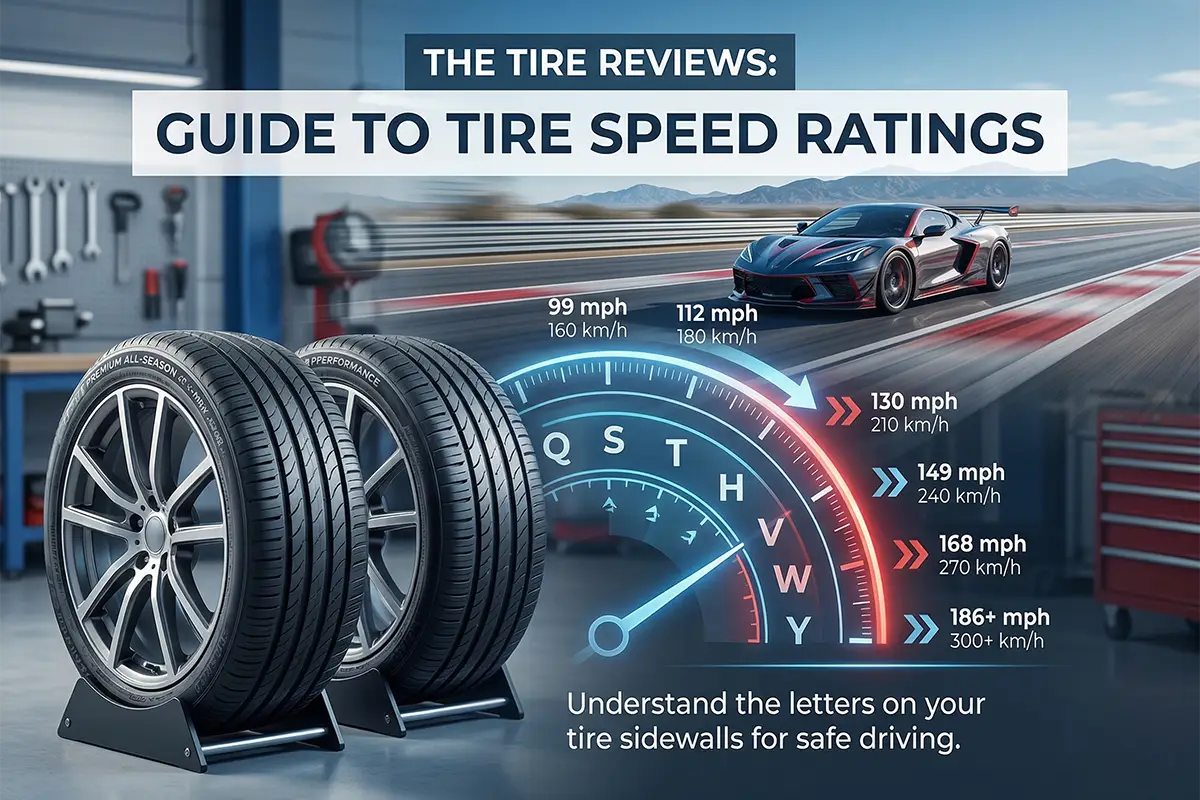
I’ve spent years testing and reviewing tires, and I can tell you that the single most confusing thing for most car owners isn’t the price, the brand, or even the tread pattern — it’s those cryptic letters and numbers on the sidewall.
If you’ve ever stared at something like 225/50R17 94V and had absolutely no idea what the “V” means, you’re not alone.
That little letter — the speed rating — is more important than most people realize, and getting it wrong can have real consequences for your safety.
Before we get into the full breakdown, if you’re also researching how to buy the right tires for your specific situation, I highly recommend checking out my tire buying and maintenance guide — it covers everything from reading tire specs to understanding warranties.
⚡ TL;DR — Tire Speed & Load Ratings at a Glance
- The speed rating is a letter code (e.g., T, H, V, W) showing the max sustained speed a tire is designed to handle.
- Never go BELOW the speed rating your vehicle manufacturer recommends.
- The load index (e.g., 94, 100) tells you the maximum weight each tire can carry.
- Common ratings for everyday drivers: S (112 mph), T (118 mph), H (130 mph), V (149 mph).
- Check your driver’s door jamb sticker or owner’s manual for the OEM-recommended speed rating and load index.
- Q Speed Rating (99 mph / 160 km/h)
- S Speed Rating (112 mph / 180 km/h)
- T Speed Rating — What Is T Speed Rating? (118 mph / 190 km/h)
- H Speed Rating — Speed Rating H Explained (130 mph / 210 km/h)
- V Speed Rating — Speed Rating V Explained (149 mph / 240 km/h)
- W Speed Rating — Speed Rating W Explained (168 mph / 270 km/h)
- Y Speed Rating (186 mph / 300 km/h) and (Y) Speed Rating (186+ mph)
- Why the Load Index Matters More Than You Think
- 1. Driver’s Door Jamb Sticker
- 2. Owner’s Manual
- 3. Existing Tires
- Going Higher Than Recommended: Generally OK
- Going Lower Than Recommended: Not Recommended
- What About Load Index — Can You Go Lower?
What Is Speed Rating on Tires?
When I first started reviewing tires, I assumed the speed rating was just a performance label — something that mattered only to track-day enthusiasts and sports car drivers. I was wrong.
The speed rating on tires is a standardized letter code assigned to a tire that indicates the maximum sustained speed the tire is designed to handle under its maximum load.
The key word here is sustained. It’s not a momentary spike to 150 mph — it’s the speed the tire can safely maintain over extended periods, assuming proper inflation and load.
Speed ratings are established and regulated by international standards (originally European, now adopted globally, including in the US). When you see an H, T, V, or W on your tire, it’s the result of laboratory and real-world testing.
Why it matters for you: Your vehicle manufacturer selected a specific speed rating for a reason. Going below that rating means your tires may not perform safely at highway speeds — they can overheat, deform, or even fail catastrophically. Going above the rating is generally fine (and often gives better handling), but you’ll usually pay more.
How to Read Your Tire Code
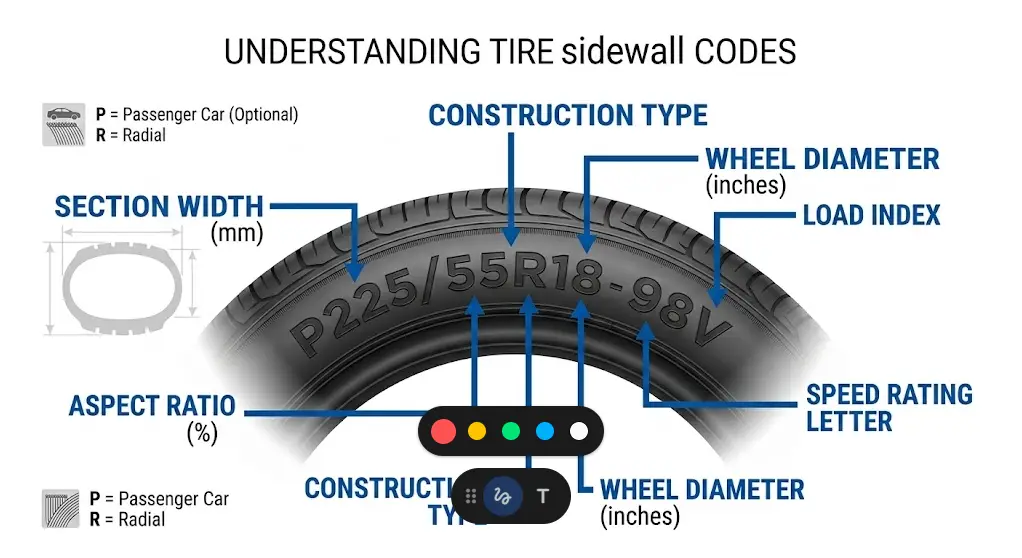
Here’s a quick example: 225/50R17 94H
- 225 = Section width in millimeters
- 50 = Aspect ratio (sidewall height as % of width)
- R = Radial construction
- 17 = Wheel diameter in inches
- 94 = Load index (max load per tire)
- H = Speed rating (max 130 mph / 210 km/h)
Tire Speed Rating Chart — Complete Guide
Here is the complete tire speed rating chart covering every speed symbol you’ll realistically encounter, from the slowest off-road ratings all the way to supercar-grade (Y) tires. I’ve included real-world context for each so you know exactly when each rating applies.
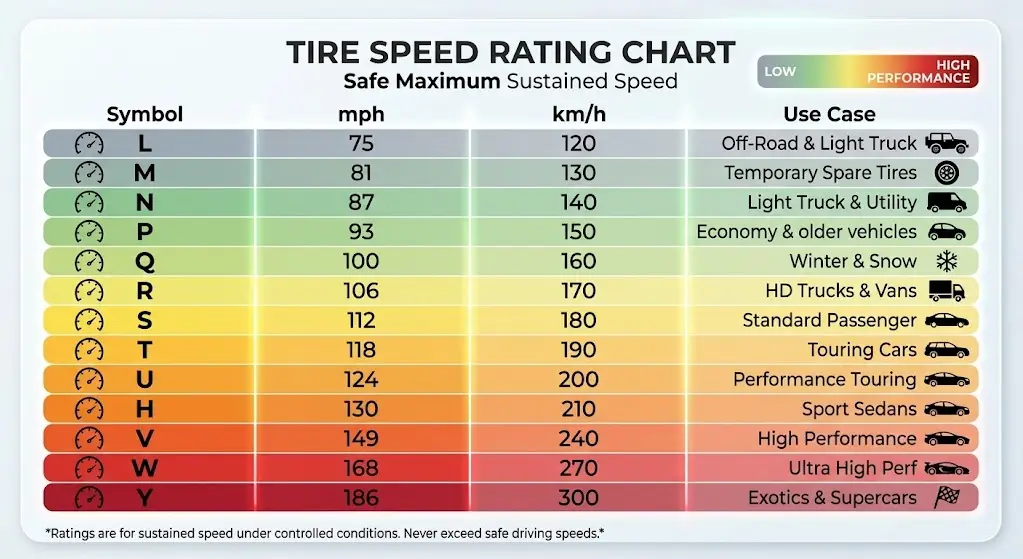
Infographic version of the tire speed rating chart
| Speed Symbol | Max Speed (mph) | Max Speed (km/h) | Typical Use Case |
| B | 31 mph | 50 km/h | Spare / off-road |
| C | 37 mph | 60 km/h | Heavy-duty / truck |
| D | 40 mph | 65 km/h | Farm / off-road equipment |
| E | 43 mph | 70 km/h | Farm / off-road |
| F | 50 mph | 80 km/h | Off-road, rare |
| G | 56 mph | 90 km/h | Off-road |
| J | 62 mph | 100 km/h | Off-road |
| K | 68 mph | 110 km/h | Off-road |
| L | 75 mph | 120 km/h | Off-road SUV / light truck |
| M | 81 mph | 130 km/h | Temporary spare |
| N | 87 mph | 140 km/h | Rare |
| P | 93 mph | 150 km/h | Rare |
| Q | 99 mph | 160 km/h | Winter / studded tires |
| R | 106 mph | 170 km/h | Heavy truck / bus |
| S | 112 mph | 180 km/h | Family sedans, light trucks |
| T | 118 mph | 190 km/h | Family cars, minivans |
| U | 124 mph | 200 km/h | Rare, passenger cars |
| H | 130 mph | 210 km/h | Sport sedans, coupes |
| V | 149 mph | 240 km/h | Sport cars, sports sedans |
| W | 168 mph | 270 km/h | High-performance sports cars |
| Y | 186 mph | 300 km/h | Ultra-high-performance |
| (Y) | 186+ mph | 300+ km/h | Exotic / supercar tires |
| Z | 149+ mph | 240+ km/h | High-performance (older designation) |
Note: The Z speed rating is an older designation that predates W and Y. Modern tires with a Z in the size code (e.g., 225/45ZR17) are typically also marked W or Y in the service description.
Tire Ratings Explained — Breaking Down the Most Common Speed Symbols
Let me walk you through the speed ratings you’ll actually encounter when shopping for tires in the USA. I’ve personally tested tires across most of these categories, so I’ll give you the real-world context, not just the textbook definition.
Q Speed Rating (99 mph / 160 km/h)
Q-rated tires are primarily designed for winter and studded tires. If you’ve ever shopped for dedicated snow tires, you’ve likely seen the Q rating.
The reduced speed ceiling isn’t because winter tires are cheap — it’s because the softer rubber compounds optimized for cold temperatures and ice grip can’t sustain high speeds safely.
If you live in a snowy region and drive under 99 mph on winter roads (which you absolutely should), a Q-rated winter tire is perfectly appropriate.
S Speed Rating (112 mph / 180 km/h)
S-rated tires appear on many family sedans, minivans, and light trucks. They’re perfectly adequate for US highway speeds, which top out at 85 mph in most states.
For the average commuter, an S-rated tire offers a good balance of durability and ride comfort without the premium price of higher-rated tires.
Check out my comparison of H vs S Speed Rating if you’re deciding between these two for a family vehicle.
T Speed Rating — What Is T Speed Rating? (118 mph / 190 km/h)
T speed rating is arguably the most common rating you’ll encounter in the US passenger car market. Minivans, family sedans, and everyday commuter cars frequently come with T-rated OEM tires.
The T rating provides a comfortable 18-mph cushion above US highway limits, which gives you peace of mind.
I’ve driven thousands of miles on T-rated tires — they’re perfectly safe, well-rounded, and often more affordable than H or V equivalents.
Wondering how T compares to its neighbors? See: H vs T Speed Rating, S vs T Speed Rating, V vs T Speed Rating, or Q vs S Speed Rating.
H Speed Rating — Speed Rating H Explained (130 mph / 210 km/h)
H speed rating sits right in the sweet spot for many enthusiast drivers and sport sedan owners.
A 130 mph ceiling is more than sufficient for spirited highway driving, and H-rated tires often feature stiffer sidewalls and improved cornering response compared to S or T tires.
Many sport-tuned sedans — think Honda Accord Sport, Toyota Camry XSE — come with H-rated rubber from the factory.
H is frequently compared against both T and V. Read my detailed writeup on V vs H Speed Rating to understand when upgrading to a V-rated tire makes sense.
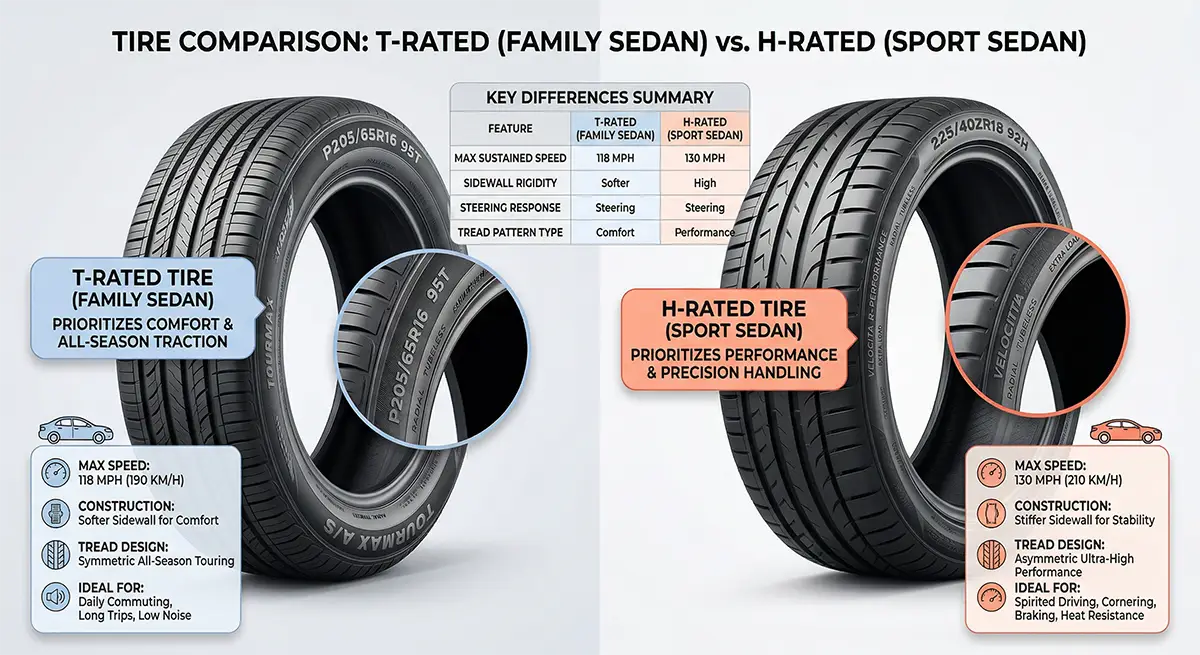
Side-by-side comparison visual of a T-rated family sedan tire vs an H-rated sport sedan tire.
V Speed Rating — Speed Rating V Explained (149 mph / 240 km/h)
V speed rating is where you start entering true performance territory. V-rated tires are common on sports sedans, hot hatches, and entry-level performance vehicles — think Ford Mustang, Audi A4, BMW 3 Series.
The stiffer construction required to achieve 149 mph capability also translates to sharper steering response and better dry-road handling. The trade-off is a slightly harsher ride and sometimes shorter tread life compared to H or T tires.
If you’re weighing your options, my V vs H Speed Rating guide is essential reading. And if you’re considering going all the way to W, see my V vs W Speed Rating comparison.
W Speed Rating — Speed Rating W Explained (168 mph / 270 km/h)
W speed rating is for serious performance machines. We’re talking Porsche 911, Corvette, BMW M3, and similar performance cars.
Getting a tire to safely sustain 168 mph requires advanced rubber compounds, reinforced internal structures, and precision manufacturing.
W-rated tires are engineered for exceptional heat dissipation and structural integrity at high speeds. For most US drivers, a W-rated tire is overkill — but if you occasionally track your car or drive high-powered sports cars, it’s worth the premium.
For a detailed breakdown, see my W vs Y Speed Rating comparison.
Y Speed Rating (186 mph / 300 km/h) and (Y) Speed Rating (186+ mph)
Y-rated tires are designed for exotic and ultra-high-performance vehicles — Ferrari, Lamborghini, Bentley, Aston Martin.
The (Y) designation (with parentheses) goes one step further, indicating the tire has been tested and approved for speeds above 186 mph. These tires are engineered masterpieces, but they’re completely unnecessary for 99% of US drivers.
What About the Z Speed Rating?
Z speed rating deserves a special mention because it causes a lot of confusion. Z was originally the highest rating, introduced before W and Y were established.
Today, Z in the tire size (e.g., 225/45ZR17) simply means the tire is rated for 149+ mph, and the actual capability — W or Y — is specified separately in the service description.
If you see a ZR in the tire size, look for the W or Y in the load/speed suffix to know the exact rating.
Tire Load Rating and Load Index — Everything You Need to Know
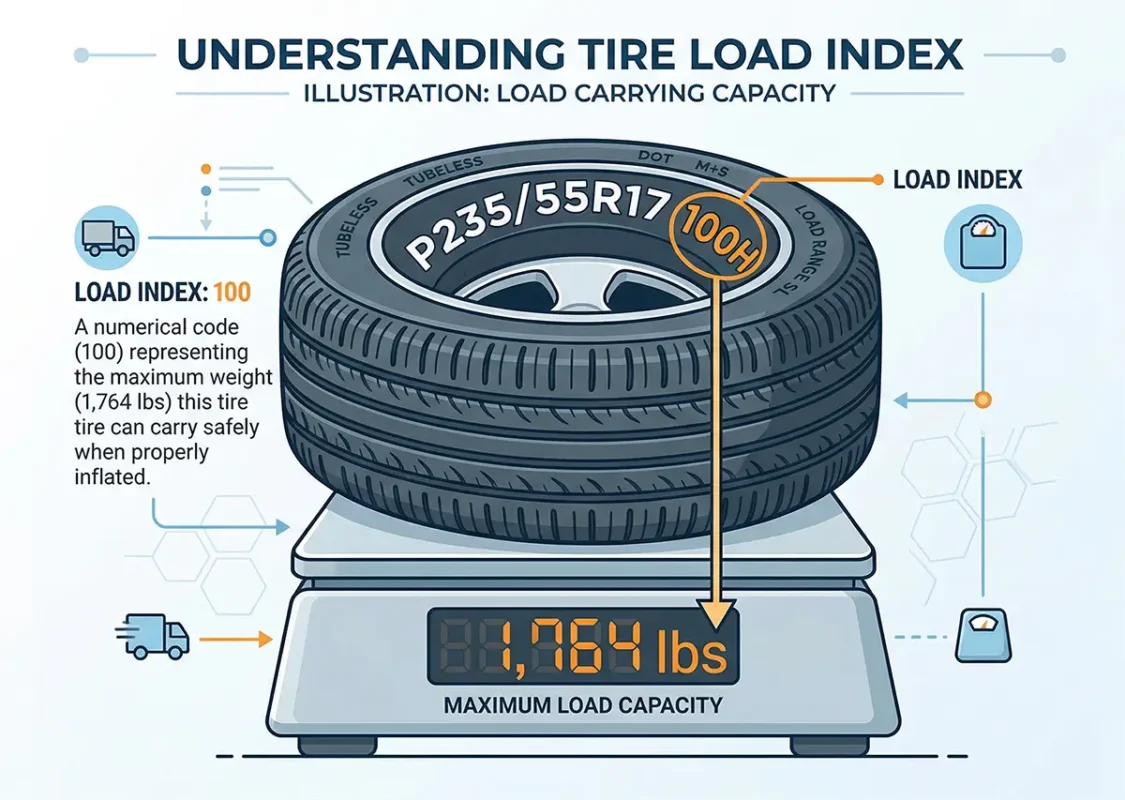
Infographic illustration showing the concept of load index
Now let’s talk about the other critical number: the load index. I see so many people focus entirely on the speed rating and completely ignore the load index — that’s a mistake.
The tire load index (also called tyre load index in British-English terminology) is a numerical code that indicates the maximum weight a single tire can support when properly inflated.
Higher number = more weight capacity. It’s not measured in pounds directly — it’s a standardized code that references a load chart.
For example, a load index of 94 means each tire can carry up to 1,477 lbs. Multiply by four tires and you get 5,908 lbs of total load capacity — covering the vehicle weight plus passengers and cargo.
Why the Load Index Matters More Than You Think
Here’s a situation I’ve seen go wrong: a driver buys a cheaper tire with a lower load index than the OEM spec, thinking it’s ‘close enough.’
Over time — especially with a full load of passengers, cargo, or when towing — the tire exceeds its load capacity. This causes sidewall flex, heat buildup, and in worst cases, a blowout. Always match or exceed your OEM load index.
Tire Load Rating Chart
Use this tire load rating chart to look up the weight capacity for your tires. The load index numbers you’ll see on most passenger cars in the US range from roughly 75 to 120.
| Load Index | Max Load (lbs) | Load Index | Max Load (lbs) | Load Index | Max Load (lbs) |
| 60 | 551 lbs | 80 | 992 lbs | 100 | 1764 lbs |
| 61 | 567 lbs | 81 | 1019 lbs | 101 | 1819 lbs |
| 62 | 584 lbs | 82 | 1047 lbs | 102 | 1874 lbs |
| 63 | 600 lbs | 83 | 1074 lbs | 103 | 1929 lbs |
| 64 | 617 lbs | 84 | 1102 lbs | 104 | 1984 lbs |
| 65 | 639 lbs | 85 | 1135 lbs | 105 | 2039 lbs |
| 66 | 661 lbs | 86 | 1168 lbs | 106 | 2094 lbs |
| 67 | 677 lbs | 87 | 1201 lbs | 107 | 2149 lbs |
| 68 | 694 lbs | 88 | 1235 lbs | 108 | 2205 lbs |
| 69 | 716 lbs | 89 | 1279 lbs | 109 | 2271 lbs |
| 70 | 739 lbs | 90 | 1323 lbs | 110 | 2337 lbs |
| 71 | 761 lbs | 91 | 1356 lbs | 111 | 2403 lbs |
| 72 | 783 lbs | 92 | 1389 lbs | 112 | 2469 lbs |
| 73 | 805 lbs | 93 | 1433 lbs | 113 | 2535 lbs |
| 74 | 827 lbs | 94 | 1477 lbs | 114 | 2601 lbs |
| 75 | 853 lbs | 95 | 1521 lbs | 115 | 2679 lbs |
| 76 | 882 lbs | 96 | 1565 lbs | 116 | 2756 lbs |
| 77 | 908 lbs | 97 | 1609 lbs | 117 | 2833 lbs |
| 78 | 937 lbs | 98 | 1653 lbs | 118 | 2910 lbs |
| 79 | 963 lbs | 99 | 1709 lbs | 119 | 2998 lbs |
All Tire Lineups — Speed Rating & Load Index by Vehicle Category
Here’s how typical speed and load ratings break down across different vehicle categories and popular tire product lines. Use this as a quick-reference guide when cross-shopping tires.
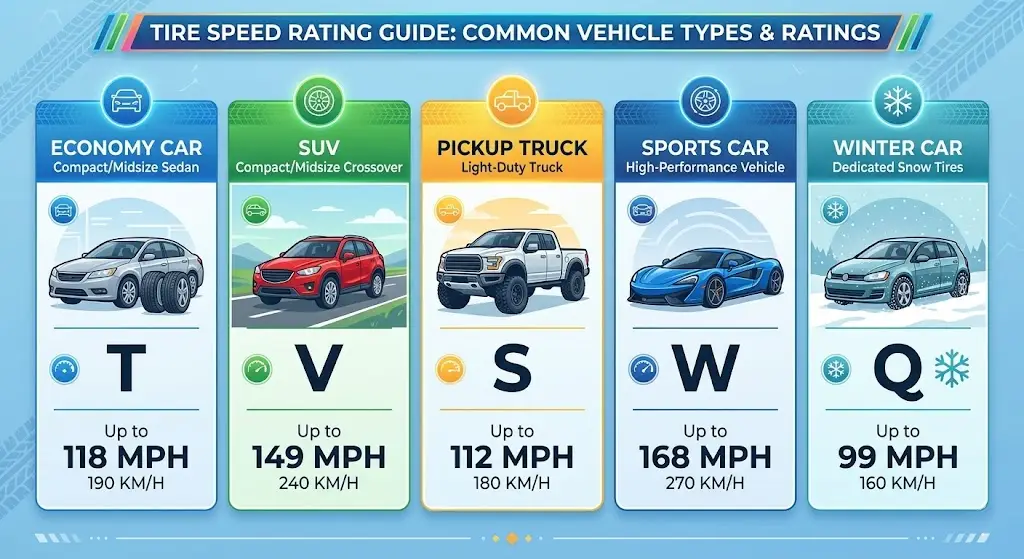
Different vehicle types (economy car, SUV, pickup truck, sports car, winter car)with their corresponding tire and speed rating
| Vehicle Category | Common Speed Rating | Common Load Index | Example Tire Lines |
| Economy / Compact Cars | S, T | 82–91 | Michelin Energy Saver, Bridgestone Ecopia |
| Family Sedans / Minivans | T, H | 88–96 | Michelin Defender, Continental TrueContact |
| SUVs / Crossovers | H, V | 100–112 | Goodyear Assurance, Pirelli Scorpion Verde |
| Light Trucks / Full-Size Pickups | R, S, T | 110–120 | Michelin LTX, BFGoodrich All-Terrain T/A |
| Sports Cars / Performance Sedans | V, W | 91–106 | Michelin Pilot Sport, Goodyear Eagle F1 |
| Ultra-High-Performance / Exotic | W, Y, (Y) | 95–112 | Pirelli P Zero, Continental SportContact 7 |
| Winter / Snow Tires | Q, S, T | 88–100 | Michelin X-Ice Snow, Bridgestone Blizzak WS90 |
| Temporary Spare (Donut) | M | 80–90 | OEM Compact Spares |
How to Find the Right Speed Rating and Load Index for Your Vehicle
One of the most common questions I get is: ‘How do I know what speed rating my car needs?’ Here are the three reliable ways to find out:
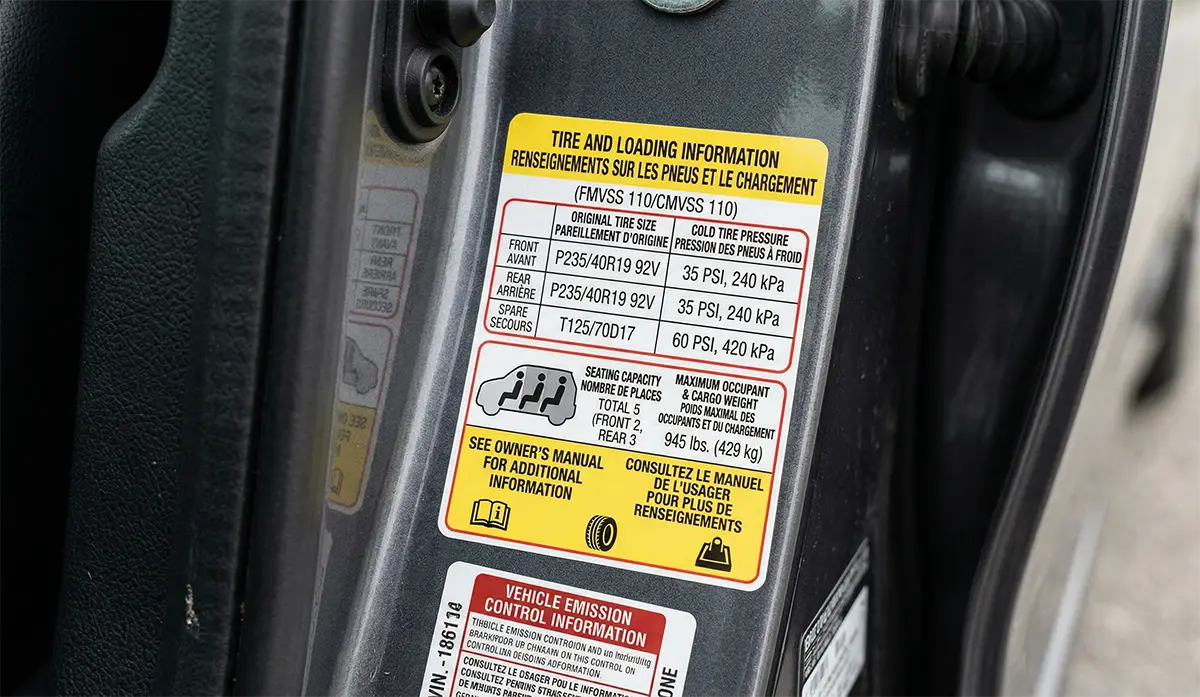
1. Driver’s Door Jamb Sticker
Open your driver’s door and look at the inner edge of the door frame. There’s a sticker (usually white or yellow) that lists the OEM-recommended tire size, including load index and speed rating. This is the most reliable source.
2. Owner’s Manual
Your vehicle’s owner’s manual will list the required tire specifications, including the minimum speed rating. Look in the ‘Tires and Wheels’ section.
3. Existing Tires
Look at your current tires’ sidewall markings. Unless a previous owner already changed the spec, your current tires should match the OEM recommendation. Find the letter at the very end of the code (e.g., the H in 225/55R17 97H).
Can You Use a Different Speed Rating Than Recommended?
Going Higher Than Recommended: Generally OK
If your car calls for H-rated tires and you want to put on V-rated tires, that’s generally fine. A higher speed rating means the tire is built to more demanding standards — it often has a stiffer sidewall, better heat resistance, and more responsive handling. The trade-off might be a slightly firmer ride and higher cost.
Going Lower Than Recommended: Not Recommended
This is where I have to be direct with you: putting lower-rated tires on a vehicle than the manufacturer specifies is a safety risk.
Even if you personally never intend to exceed the tire’s rated speed, your insurance company may deny a claim if they discover non-spec tires were involved in an accident.
More importantly, lower-rated tires have less robust construction that may not handle the dynamic loads of emergency maneuvers at highway speeds.
What About Load Index — Can You Go Lower?
No. Never use a lower load index than specified. A tire that’s underrated for your vehicle’s weight can fail — especially under full load, emergency braking, or hard cornering.
You can go higher on load index, which won’t hurt anything and sometimes gives you a harder-wearing tire.
Speed Rating on Tyres — A Note for International Readers
Whether you say tires (American English) or tyres (British English), the speed rating system is identical worldwide.
The tyre speed rating chart and tyre load rating chart I’ve presented above apply globally — the same letters, the same speeds, the same load index system.
The tyre load index numbers are standardized by international bodies (ISO and ETRTO), so a 94H in the US is the same as a 94H in the UK or Europe.
Speed Ratings and Seasonal Tires
One important nuance: when you fit dedicated winter tires, the speed rating will often be lower than your summer or all-season set.
This is expected and normal — the softer compounds that make winter tires grip in snow and ice at temperatures below 45°F cannot sustain the same high speeds as summer compounds.
If you switch to Q or S-rated winter tires from an H or V-rated summer setup, just be aware of the lower speed ceiling. Most drivers run well within Q or S limits during winter driving anyway, given road conditions.
FAQs About Tire Speed Ratings
What is the most common speed rating for US passenger cars?
T (118 mph) and H (130 mph) are the most common speed ratings on passenger cars sold in the USA. Family sedans and minivans frequently use T, while sport-oriented sedans and crossovers often use H.
Is a higher speed rating always better?
Not necessarily. Higher-rated tires are built with stiffer compounds that prioritize performance over comfort. If your car is rated for H, buying a V or W tire might give you sharper handling but a harsher ride and shorter tread life. Match the rating to your driving needs.
What happens if I exceed my tire’s speed rating?
Exceeding your tire’s rated speed generates heat that the tire’s structure wasn’t designed to handle. At mild exceedances, you risk accelerated wear. At sustained high over-speed, you risk catastrophic tire failure — delamination, blowout, or sudden loss of control.
Do I need to match all four tires to the same speed rating?
Yes, ideally. All four tires should have the same speed rating. If you must mix, always put the higher-rated tires on the rear axle to reduce the risk of oversteer in a tire failure situation. Check your vehicle manual for specific guidance.
What does the load index number mean on my tire?
The load index is a code that maps to a specific maximum weight capacity. For example, load index 94 = 1,477 lbs per tire. Multiply by four for total vehicle load capacity. Always match or exceed your OEM-specified load index when replacing tires.
Can I put winter tires with a lower speed rating on my car?
Yes, this is common and accepted practice. Winter tires frequently carry Q or S ratings even on vehicles that originally came with H or V-rated tires. Just drive within the winter tire’s speed limit during the winter season.
What is a Z speed rating vs W and Y?
Z is an older designation meaning 149+ mph. Modern tires have replaced it with W (168 mph) and Y (186 mph) for precision. If you see ZR in a tire size, look for the W or Y service description to know the exact limit.
Final Thoughts: Speed Ratings and Load Index Keep You Safe
After years of testing tires across all categories — from budget commuter rubber to exotic-grade ultra-high-performance tires — my advice is always the same: don’t shortchange yourself on the speed rating or load index.
These aren’t marketing numbers cooked up to upsell you on fancier tires. They’re engineering standards that represent the difference between a tire that performs as designed and one that fails when you need it most.
For everyday US driving, an H-rated tire is the sweet spot for most drivers — it gives you a meaningful safety margin above interstate speeds, responsive handling, and reasonable pricing.
If you drive a sports car or high-performance vehicle, match the V, W, or Y that your manufacturer specified. And if you’re a pickup truck owner or heavy-duty hauler, pay just as much attention to the load index as the speed rating.
When in doubt, reference your door jamb sticker and check out my tire buying and maintenance guide for a complete walkthrough of every spec you need to understand before buying your next set of tires.
Questions? Drop them in the comments — I answer every one. And if you’re comparing specific ratings head-to-head, check out: