
Load Range vs. Load Index: Two Different Things
People confuse these constantly, and I don’t blame them. Let me be direct about the difference.
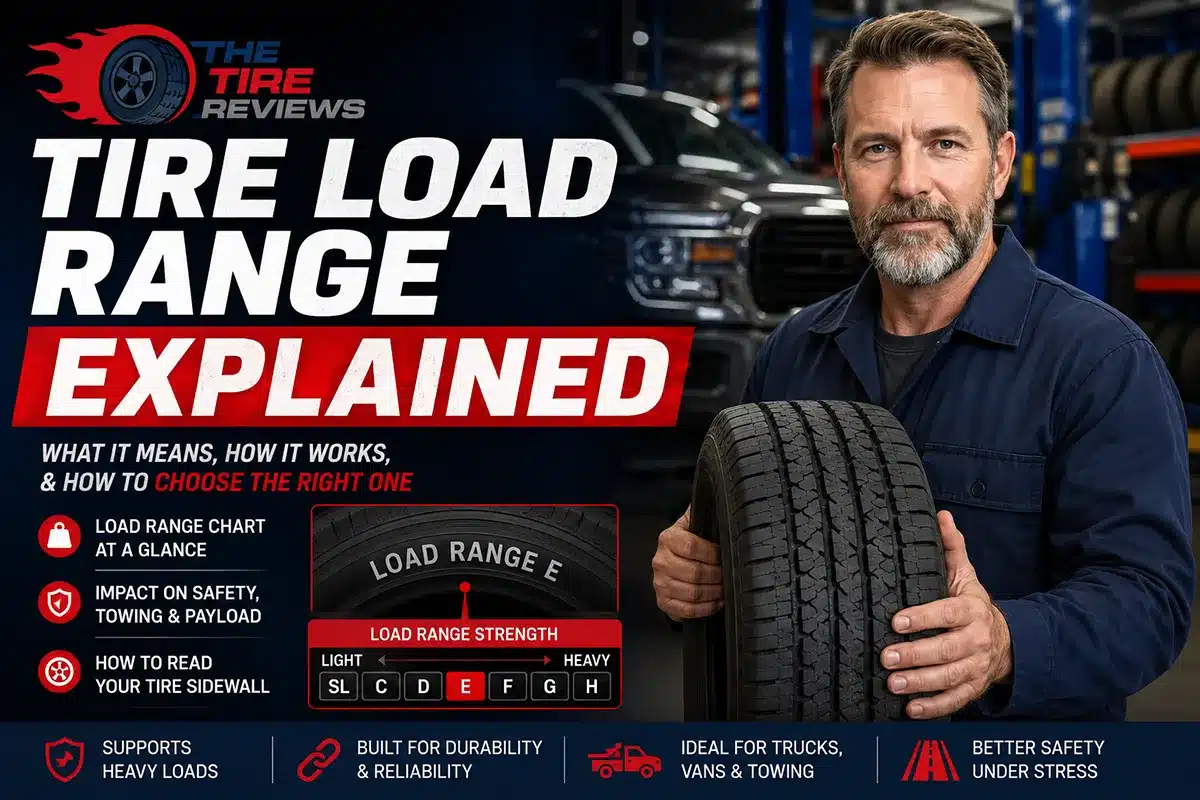
Load Range tells you the category of construction strength and maximum inflation pressure. It’s a letter (SL, XL, C, D, E, F).
Load Index is a number that tells you the specific maximum weight capacity for that individual tire at its rated pressure. A load index of 100 means the tire can carry 1,764 lbs. A load index of 121 means it can carry 3,197 lbs.
Here’s a condensed load index reference chart for the most common values you’ll encounter on passenger and light truck tires:
| Load Index | Max Load (lbs) |
|---|---|
| 85 | 1,135 |
| 90 | 1,323 |
| 95 | 1,521 |
| 100 | 1,764 |
| 105 | 2,039 |
| 110 | 2,337 |
| 115 | 2,679 |
| 121 | 3,197 |
| 126 | 3,748 |
You need both a compatible load range and a sufficient load index for your application. A tire can be Load Range E (great construction strength) but have a lower load index than your vehicle needs — it can happen on unusual size combinations. Always verify both numbers against your vehicle’s tire placard.
What Load Range Do You Actually Need? A Practical Guide
Let me skip the vague advice and give you something actionable.
Passenger Cars and Small Crossovers
You need: SL, or XL if your door placard specifies it.
Check the sticker on the inside of your driver’s door jamb. It will list the recommended tire size and, in many modern vehicles, will note if Extra Load (XL) is required. Most Camrys, Civics, Malibus, RAV4s in light configurations, and similar vehicles run SL tires from the factory. Stick with that unless you have a specific reason to change.
Mid-Size and Full-Size SUVs
You need: SL or XL depending on spec, occasionally C-range for heavier configurations.
A loaded Ford Explorer, Chevy Traverse, or Toyota Sequoia carrying seven passengers and cargo regularly will often spec XL tires. Vehicles like the Chevy Suburban or Ford Expedition in maximum tow configurations sometimes appear with LT C-range tires from the factory. Again — door placard is your bible here.
Half-Ton Pickup Trucks (F-150, RAM 1500, Silverado 1500)
You need: SL/XL for light use; C or D range for regular towing or hauling near max capacity.
This is where it gets nuanced. Modern half-ton trucks have gotten remarkably capable — the F-150 with Max Tow Package can pull over 14,000 lbs. At those loads, you want LT tires with at minimum Load Range C. For light duty commuting with occasional light hauling, the P-metric SL/XL tires that often come stock are fine.
Heavy-Duty Pickup Trucks (F-250/350, RAM 2500/3500, Silverado/Sierra 2500/3500)
You need: Load Range E minimum for towing and hauling. No exceptions. F-range only for severe commercial duty.
These trucks exist to work. Running anything below Load Range E on a 3/4-ton or 1-ton truck that sees any meaningful load is cutting corners on the most important safety component on the vehicle. Factory specs on these trucks almost universally call for LT tires with Load Range E.
Load Range F is worth considering only if you’re operating a 1-ton dualie in a genuine commercial or agricultural context — think daily farm use, heavy flatbed hauling, or fleet service where the truck is regularly running near its GVWR. For personal use, even demanding personal use, Load Range E is the correct answer.
Cargo Vans and Sprinter-Type Vehicles
You need: C or D range for work use; C minimum for passenger van configurations.
If you’re running a cargo van professionally — tools, equipment, products — Load Range C is the minimum I’d recommend and D is better for consistently heavy loads.
The Pressure Question: Can You Over-Inflate to Match a Higher Load Range?
Short answer: No. Tire pressure and load range are not interchangeable.
This is a dangerous misconception. If your vehicle calls for SL tires at 32 PSI, you cannot simply run an SL tire at 50 PSI and expect it to carry the load of a C-range tire. SL tires are not constructed to safely operate at 50 PSI. The internal structure — the carcass plies, the bead construction, the sidewall reinforcement — is fundamentally different between load ranges.
The flip side is equally true and more commonly misunderstood: running a Load Range E tire at SL tire pressures (say, 30–35 PSI) gives you an underinflated tire. The tire is designed to carry its rated load at 80 PSI. At 35 PSI, the sidewall is flexing more than it should, heat builds up, and you’ve created a blowout risk — even though the tire looks “fine” and has plenty of air.
If you’re swapping load ranges on a truck, recalibrate your tire pressure expectations entirely.
Load Range and Ride Quality: The Real Trade-Off
I’d be doing you a disservice if I only talked about safety and capacity without being honest about the daily-driving experience.
Stiffer tires carry more. That’s the engineering reality, and it comes at a price: Load Range C, D, E, and F tires ride noticeably firmer than SL/XL tires, especially when the vehicle isn’t loaded.
F-range in particular — at 95 PSI — is essentially a commercial spec, and anyone who’s ridden in a work truck on F-range tires over a rough road knows exactly what that feels like.
The higher ply rating means less sidewall flex, less compliance over bumps, and more road noise transmission into the cabin.
On my test drives comparing a RAM 1500 on LT Load Range E tires versus P-metric XL tires (both in comparable 265/70R17 sizes), the P-metric tires delivered a meaningfully more comfortable and quieter ride in everyday, unloaded driving around town.
The LT E-range tires felt planted and stable at highway speed with a full bed, but over the potholes of a Northern Virginia suburb they transmitted every crack and joint.
My honest take: match your load range to your actual use case, not your aspirational one. If you have an F-150 that you use exclusively for commuting and occasional Home Depot runs, and you never tow, the P-metric SL/XL tires that improve your ride and fuel economy are a completely legitimate choice.
If you regularly load that truck and tow a boat or camper on weekends, step up to a C-range LT tire without hesitation.
Frequently Asked Questions About Tire Load Range
Can I use a higher load range tire than my vehicle recommends?
In most cases, yes — using a higher load range is safe from a structural standpoint. The tire will carry more than your vehicle needs it to. The trade-offs are firmer ride quality, potentially higher cost, and the need to run the tire at higher pressures to achieve the rated load capacity. You should always consult your vehicle owner’s manual before changing load ranges, particularly on newer vehicles with advanced suspension tuning.
Is Load Range E better than Load Range C?
“Better” depends on your needs. For a work truck regularly hauling or towing heavy loads, yes — E range is the right choice. For a daily driver or lightly used pickup, the stiffness and cost of E-range tires is unnecessary and reduces ride comfort. There’s no universal answer here.
What does “10-ply rated” mean on a modern tire?
It means the tire’s load capacity is equivalent to what an old-school 10-ply physical construction would provide — but the actual tire almost certainly has fewer than 10 physical layers. Modern tire materials (high-tensile steel belts, aramid-reinforced sidewalls, advanced nylon) achieve the same or better strength with fewer plies.
Do XL tires last longer than SL tires?
Not inherently. Treadwear is primarily a function of the rubber compound (measured by UTQG treadwear rating), not load range. An XL tire with a 500 UTQG rating will not outlast an SL tire with a 700 UTQG rating. The XL designation is about load capacity, not longevity.
How do I know if my car needs XL tires?
Check your door jamb placard first. If it lists XL or “Extra Load,” that’s your answer. If you’ve lost the placard, check your owner’s manual or look up your vehicle’s OEM tire specs. Many tire retailer websites (Tire Rack, Discount Tire) will also flag XL requirement when you search by vehicle.
Can mixing load ranges on the same vehicle cause problems?
Yes. Mixing SL and XL tires — or any different load ranges — on the same vehicle can create imbalanced handling, particularly in cornering and emergency maneuvers. The tires will have different inflation pressures and different sidewall stiffness, which translates to uneven grip characteristics. Always run four matching load range tires.
Final Thoughts
Tire load range isn’t glamorous. It doesn’t give you bragging rights at the car meet or dominate YouTube tire review comments.
But it might be the single most safety-critical specification you choose when shopping for tires — especially if you drive a truck or SUV with any real-world utility use.
The homework is simple: look at your door jamb placard, understand your actual use case (not the use case you imagine in your head), and match your load range to both.
If you tow or haul regularly, step up. If you don’t, there’s no reason to punish your daily commute with truck-spec tires.
When in doubt, consult the tire fitment guides at major retailers or call your vehicle’s manufacturer helpline — both are free resources. The few minutes you spend getting this right are worth far more than the cost of a tire that fails on the highway.
Have a question about load range for your specific vehicle or use case? Drop it in the comments below — I read every one.

Load Range C, D, E, and F: When Do You Actually Need These?
This is where things get serious, and honestly, where I see the most dangerous mistakes.
Load Range C (6-Ply Rating)
Load Range C tires are light truck territory. You’ll find them on:
- 1/2-ton pickup trucks that see moderate hauling or towing
- Full-size cargo vans (think Ram ProMaster, Ford Transit)
- Trailers
- Some overlanding and off-road rigs where puncture resistance matters
At 50–60 PSI maximum inflation pressure, C-range tires can carry significantly more load than SL/XL tires in the same footprint. The trade-off is a firmer, less comfortable ride when running empty — a classic issue for truck owners who run high tire pressure all the time even without a load in the bed.
One thing I always tell people: if you have a 1/2-ton pickup and you’re towing near its maximum rated capacity, you probably need LT tires with at minimum a C load range. Check your vehicle’s towing documentation — it will often specify this.
- C vs. D: Load Range C vs. Load Range D Tires (6-Ply vs. 8-Ply)
- C vs. E: Load Range C vs. Load Range E Tires (6-Ply vs. 10-Ply)
Load Range D (8-Ply Rating)
D-range tires are less common in the consumer market but still relevant for:
- Some older 3/4-ton trucks
- Certain heavy-duty cargo vans
- Specialty and agricultural equipment
You’re unlikely to encounter D-range on a modern light truck tire from major manufacturers. Most have jumped from C directly to E.
Load Range E (10-Ply Rating)
This is the standard for serious truck work. If you drive a 3/4-ton (F-250, RAM 2500, Silverado 2500) or 1-ton truck and you’re doing any meaningful towing or hauling, Load Range E is almost certainly what your vehicle spec sheet calls for.
I helped a colleague spec out tires for his RAM 2500 Cummins diesel last fall. He regularly pulls a 12,000-lb fifth-wheel camper.
Running anything lighter than Load Range E on that rig would be reckless — the tire simply isn’t rated to handle the combined vehicle weight plus tongue load at highway speeds.
We landed on the BFGoodrich Commercial T/A All-Season 2 in LT265/70R17 Load Range E, and after 8,000 miles of mixed towing and daily driving, they’ve held up exactly as expected.
The hard truth about Load Range E: If your truck doesn’t actually need it, E-range tires can make your empty-truck ride feel punishing. Some full-size truck owners swap from the stock LT E-range tires to P-metric or XL tires for a more comfortable daily commute — but if you tow and haul regularly, that’s a trade-off with real safety implications. Know your use case.
- E vs. C: Load Range C vs. Load Range E Tires (6-Ply vs. 10-Ply)
- E vs. D: Load Range D vs. Load Range E Tires (8-Ply vs. 10-Ply)
- E vs. F: Load Range E vs. Load Range F Tires (10-Ply vs. 12-Ply)
- E vs. G: Load Range E vs. Load Range G Tires (10-Ply vs. 14-Ply)
Load Range F (12-Ply Rating)
Load Range F is where consumer tire shopping ends and commercial/fleet territory begins. These are rated for maximum 95 PSI and carry a 12-ply equivalent construction — you will almost never see them on a privately owned pickup truck used for personal transportation.
That said, there are legitimate reasons a private buyer ends up looking at F-range tires:
- Severe-duty 1-ton trucks in commercial or agricultural use — if you’re hauling grain, equipment, or livestock on rough rural roads every day, the additional sidewall strength of an F-range tire is a meaningful real-world benefit over E-range
- Heavy flatbed and gooseneck trailer applications — some operators running near the maximum GVWR of a 1-ton dualie will spec F-range tires for the additional safety margin
- Certain dually rear axle configurations — a few 1-ton dualie trucks, particularly when upfitted or modified for commercial use, may benefit from F-range on the rear axles
- Medium-duty commercial trucks (Classes 3–5) — box trucks, utility trucks, and vehicles in this range often roll on F-range tires from the factory
I’ve only personally evaluated F-range tires in the context of a commercial fleet inspection, not consumer tire shopping. The Goodyear G614 RST and Michelin XPS Rib are two examples you’ll see in the commercial space.
For most readers here, if you’re researching F-range, my first question would be: are you sure your use case isn’t fully addressed by a quality Load Range E tire? For the overwhelming majority of even serious truck work — including heavy towing and hauling on 1-ton pickups — Load Range E is the appropriate and sufficient choice.
One important caveat on F-range for consumer trucks: Running 95 PSI in tires on a pickup truck that wasn’t engineered for that inflation level can stress wheel components (hubs, bearings, rims) beyond their designed operating range. If you’re considering F-range for a non-commercial vehicle, talk to the vehicle manufacturer or a reputable commercial tire specialist before making the switch.
How to Read Load Range on Your Tire Sidewall
Let me walk you through a real tire sidewall example so you know exactly where to look.
Take a tire marked: LT265/70R17 121/118S Load Range E
Here’s how to decode it:
- LT — Light Truck designation (as opposed to “P” for Passenger)
- 265 — Tire width in millimeters (265mm across the tread)
- 70 — Aspect ratio (sidewall height is 70% of the width)
- R — Radial construction
- 17 — Wheel diameter in inches
- 121/118 — Load index for single and dual fitment (121 = approximately 3,197 lbs per tire in single application)
- S — Speed rating (up to 112 mph)
- Load Range E — Maximum 80 PSI, 10-ply rated
Sometimes the load range is spelled out (“LOAD RANGE E”). Other times you’ll see “MAX LOAD 80 PSI” and “10 PR” (ply rating) stamped separately, without the letter designation. Both convey the same information.
On passenger car tires, you’ll typically see it much more simply: 235/55R18 100H XL — with “XL” or “SL” (or simply nothing, which implies SL) near the end of the size string.
Load Range vs. Load Index: Two Different Things
People confuse these constantly, and I don’t blame them. Let me be direct about the difference.
Load Range tells you the category of construction strength and maximum inflation pressure. It’s a letter (SL, XL, C, D, E, F).
Load Index is a number that tells you the specific maximum weight capacity for that individual tire at its rated pressure. A load index of 100 means the tire can carry 1,764 lbs. A load index of 121 means it can carry 3,197 lbs.
Here’s a condensed load index reference chart for the most common values you’ll encounter on passenger and light truck tires:
| Load Index | Max Load (lbs) |
|---|---|
| 85 | 1,135 |
| 90 | 1,323 |
| 95 | 1,521 |
| 100 | 1,764 |
| 105 | 2,039 |
| 110 | 2,337 |
| 115 | 2,679 |
| 121 | 3,197 |
| 126 | 3,748 |
You need both a compatible load range and a sufficient load index for your application. A tire can be Load Range E (great construction strength) but have a lower load index than your vehicle needs — it can happen on unusual size combinations. Always verify both numbers against your vehicle’s tire placard.
What Load Range Do You Actually Need? A Practical Guide
Let me skip the vague advice and give you something actionable.
Passenger Cars and Small Crossovers
You need: SL, or XL if your door placard specifies it.
Check the sticker on the inside of your driver’s door jamb. It will list the recommended tire size and, in many modern vehicles, will note if Extra Load (XL) is required. Most Camrys, Civics, Malibus, RAV4s in light configurations, and similar vehicles run SL tires from the factory. Stick with that unless you have a specific reason to change.
Mid-Size and Full-Size SUVs
You need: SL or XL depending on spec, occasionally C-range for heavier configurations.
A loaded Ford Explorer, Chevy Traverse, or Toyota Sequoia carrying seven passengers and cargo regularly will often spec XL tires. Vehicles like the Chevy Suburban or Ford Expedition in maximum tow configurations sometimes appear with LT C-range tires from the factory. Again — door placard is your bible here.
Half-Ton Pickup Trucks (F-150, RAM 1500, Silverado 1500)
You need: SL/XL for light use; C or D range for regular towing or hauling near max capacity.
This is where it gets nuanced. Modern half-ton trucks have gotten remarkably capable — the F-150 with Max Tow Package can pull over 14,000 lbs. At those loads, you want LT tires with at minimum Load Range C. For light duty commuting with occasional light hauling, the P-metric SL/XL tires that often come stock are fine.
Heavy-Duty Pickup Trucks (F-250/350, RAM 2500/3500, Silverado/Sierra 2500/3500)
You need: Load Range E minimum for towing and hauling. No exceptions. F-range only for severe commercial duty.
These trucks exist to work. Running anything below Load Range E on a 3/4-ton or 1-ton truck that sees any meaningful load is cutting corners on the most important safety component on the vehicle. Factory specs on these trucks almost universally call for LT tires with Load Range E.
Load Range F is worth considering only if you’re operating a 1-ton dualie in a genuine commercial or agricultural context — think daily farm use, heavy flatbed hauling, or fleet service where the truck is regularly running near its GVWR. For personal use, even demanding personal use, Load Range E is the correct answer.
Cargo Vans and Sprinter-Type Vehicles
You need: C or D range for work use; C minimum for passenger van configurations.
If you’re running a cargo van professionally — tools, equipment, products — Load Range C is the minimum I’d recommend and D is better for consistently heavy loads.
The Pressure Question: Can You Over-Inflate to Match a Higher Load Range?
Short answer: No. Tire pressure and load range are not interchangeable.
This is a dangerous misconception. If your vehicle calls for SL tires at 32 PSI, you cannot simply run an SL tire at 50 PSI and expect it to carry the load of a C-range tire. SL tires are not constructed to safely operate at 50 PSI. The internal structure — the carcass plies, the bead construction, the sidewall reinforcement — is fundamentally different between load ranges.
The flip side is equally true and more commonly misunderstood: running a Load Range E tire at SL tire pressures (say, 30–35 PSI) gives you an underinflated tire. The tire is designed to carry its rated load at 80 PSI. At 35 PSI, the sidewall is flexing more than it should, heat builds up, and you’ve created a blowout risk — even though the tire looks “fine” and has plenty of air.
If you’re swapping load ranges on a truck, recalibrate your tire pressure expectations entirely.
Load Range and Ride Quality: The Real Trade-Off
I’d be doing you a disservice if I only talked about safety and capacity without being honest about the daily-driving experience.
Stiffer tires carry more. That’s the engineering reality, and it comes at a price: Load Range C, D, E, and F tires ride noticeably firmer than SL/XL tires, especially when the vehicle isn’t loaded.
F-range in particular — at 95 PSI — is essentially a commercial spec, and anyone who’s ridden in a work truck on F-range tires over a rough road knows exactly what that feels like.
The higher ply rating means less sidewall flex, less compliance over bumps, and more road noise transmission into the cabin.
On my test drives comparing a RAM 1500 on LT Load Range E tires versus P-metric XL tires (both in comparable 265/70R17 sizes), the P-metric tires delivered a meaningfully more comfortable and quieter ride in everyday, unloaded driving around town.
The LT E-range tires felt planted and stable at highway speed with a full bed, but over the potholes of a Northern Virginia suburb they transmitted every crack and joint.
My honest take: match your load range to your actual use case, not your aspirational one. If you have an F-150 that you use exclusively for commuting and occasional Home Depot runs, and you never tow, the P-metric SL/XL tires that improve your ride and fuel economy are a completely legitimate choice.
If you regularly load that truck and tow a boat or camper on weekends, step up to a C-range LT tire without hesitation.
Frequently Asked Questions About Tire Load Range
Can I use a higher load range tire than my vehicle recommends?
Is Load Range E better than Load Range C?
What does “10-ply rated” mean on a modern tire?
Do XL tires last longer than SL tires?
How do I know if my car needs XL tires?
Can mixing load ranges on the same vehicle cause problems?
Final Thoughts
Tire load range isn’t glamorous. It doesn’t give you bragging rights at the car meet or dominate YouTube tire review comments.
But it might be the single most safety-critical specification you choose when shopping for tires — especially if you drive a truck or SUV with any real-world utility use.
The homework is simple: look at your door jamb placard, understand your actual use case (not the use case you imagine in your head), and match your load range to both.
If you tow or haul regularly, step up. If you don’t, there’s no reason to punish your daily commute with truck-spec tires.
When in doubt, consult the tire fitment guides at major retailers or call your vehicle’s manufacturer helpline — both are free resources. The few minutes you spend getting this right are worth far more than the cost of a tire that fails on the highway.
Have a question about load range for your specific vehicle or use case? Drop it in the comments below — I read every one.
Most people stare at the sidewall of a tire and see a wall of numbers and letters that looks like a government code.
I used to be one of those people — until a loaded pickup truck on I-81 near Harrisonburg, VA, gave me a tire sidewall blowout lesson I’ll never forget.
That truck was running tires rated for a passenger car. The load range was completely wrong for what the owner was hauling. Don’t let that be you.
TL;DR: Tire load range tells you the maximum weight a tire can safely support at its rated inflation pressure. It’s expressed as a letter (SL, XL, C, D, E, F) or as a ply rating number. For most daily-driver passenger cars and crossovers, Standard Load (SL) or Extra Load (XL) is correct. If you tow, haul heavy cargo, or drive a truck or full-size van, you’ll likely need C, D, or E range tires. Getting this wrong doesn’t just cost you money — it’s genuinely dangerous.
- What Is Tire Load Range, Really?
- Tire Load Range Chart: All Load Range Types Explained
- Standard Load (SL) vs. Extra Load (XL): What’s the Difference?
- Load Range C, D, E, and F: When Do You Actually Need These?
- How to Read Load Range on Your Tire Sidewall
- Load Range vs. Load Index: Two Different Things
- What Load Range Do You Actually Need? A Practical Guide
- The Pressure Question: Can You Over-Inflate to Match a Higher Load Range?
- Load Range and Ride Quality: The Real Trade-Off
- Frequently Asked Questions About Tire Load Range
- Final Thoughts
What Is Tire Load Range, Really?
Before I get into charts and letters, I want to make sure you actually understand what load range is measuring — because the name trips people up.
Load range is not simply about how much weight the whole vehicle weighs divided by four tires. It’s a rating for the maximum load a single tire can carry at its maximum recommended inflation pressure. That distinction matters a lot.
When I was evaluating tires for my brother-in-law’s F-250 last spring, we weren’t just looking at whether the tires fit the rim.
We were asking whether the tires could carry the weight of a fully loaded truck bed and a trailer tongue weight simultaneously — at highway speeds, in summer heat, on long interstate runs. Load range is the answer to that question.
The load range system was developed by the Tire and Rim Association (TRA) and replaced the older numeric ply rating system that was common through the 1970s. Back then, a “6-ply tire” literally had six layers of rubber-coated fabric in the carcass.
Modern tires use fewer, stronger plies — so a tire rated as “Load Range C” might only have two physical plies of material, but it performs like the old 6-ply construction. The number in the modern “ply rating” is a legacy equivalent, not a literal count.
Tire Load Range Chart: All Load Range Types Explained
Here’s the complete reference chart. I’ll break down the important ones in detail below.
| Load Range | Ply Rating Equivalent | Typical Max PSI | Typical Use Case |
|---|---|---|---|
| SL (Standard Load) | 4-ply rating | 35–44 PSI | Passenger cars, light crossovers |
| XL (Extra Load) | 4-ply rating (reinforced) | 41–51 PSI | Heavier SUVs, performance cars, loaded passenger vehicles |
| C1 | 6-ply rating | 50 PSI | Light trucks, cargo vans, Class 2 towing |
| C2 | 6-ply rating | 60 PSI | Light trucks — higher pressure variant |
| D | 8-ply rating | 65 PSI | Medium-duty trucks, heavier hauling |
| E | 10-ply rating | 80 PSI | 3/4-ton and 1-ton trucks, heavy towing |
| F | 12-ply rating | 95 PSI | Commercial trucks, severe-duty applications |
| G | 14-ply rating | 110 PSI | Heavy commercial applications |
Quick note: You’ll sometimes see “LT” tires (Light Truck) marketed with a load range letter on the sidewall. “P” metric tires (Passenger) are almost always SL or XL. If a tire has “LT” before the size number — for example, LT265/70R17 — it is a light truck tire and will carry a C, D, or E rating.
Standard Load (SL) vs. Extra Load (XL): What’s the Difference?
This is by far the most common question I get from readers, and it’s a genuinely good one.
Standard Load (SL) tires are the baseline for passenger vehicles. They’re designed to operate at up to 35 PSI (sometimes 44 PSI depending on size) and carry a load index appropriate for a typical passenger car. The vast majority of sedans, coupes, hatchbacks, and smaller crossovers roll off the factory floor on SL tires.
Extra Load (XL) — sometimes stamped as “Reinforced” (RF) on European-spec tires — uses a stiffer sidewall construction and is rated for higher inflation pressures (up to 51 PSI depending on size). At max inflation, an XL tire can carry meaningfully more weight than the same-sized SL tire.
Here’s the part that surprises most people: XL tires are not automatically “better.” If your vehicle was engineered for SL tires, running XL tires at max pressure can actually give you a harsher, less compliant ride with no practical benefit. Where XL tires make real sense:
- Heavier SUVs and crossovers where the OEM spec calls for them (check your door placard — it will say if XL is required)
- Loaded passenger vehicles that frequently carry five adults plus luggage
- Some performance applications where sidewall stiffness aids handling precision
- European vehicles that commonly spec RF/XL as standard fitment
I’ve tested both XL and SL versions of the same tire model — most recently with the Michelin CrossClimate2 in a 235/55R18 size — and the ride quality difference is noticeable on rough pavement.
On my test route through the Shenandoah Valley, the SL version absorbed road texture better at the same vehicle-recommended tire pressure.
But on a heavier loaded crossover, the XL version handled a fully packed family road trip cargo load with better stability at highway speed.
Bottom line: Always match what your door jamb sticker specifies. If it says XL, run XL. If it says SL, there’s no benefit to upgrading unless your use case has genuinely changed.
Load Range C, D, E, and F: When Do You Actually Need These?
This is where things get serious, and honestly, where I see the most dangerous mistakes.
Load Range C (6-Ply Rating)
Load Range C tires are light truck territory. You’ll find them on:
- 1/2-ton pickup trucks that see moderate hauling or towing
- Full-size cargo vans (think Ram ProMaster, Ford Transit)
- Trailers
- Some overlanding and off-road rigs where puncture resistance matters
At 50–60 PSI maximum inflation pressure, C-range tires can carry significantly more load than SL/XL tires in the same footprint. The trade-off is a firmer, less comfortable ride when running empty — a classic issue for truck owners who run high tire pressure all the time even without a load in the bed.
One thing I always tell people: if you have a 1/2-ton pickup and you’re towing near its maximum rated capacity, you probably need LT tires with at minimum a C load range. Check your vehicle’s towing documentation — it will often specify this.
- C vs. D: Load Range C vs. Load Range D Tires (6-Ply vs. 8-Ply)
- C vs. E: Load Range C vs. Load Range E Tires (6-Ply vs. 10-Ply)
Load Range D (8-Ply Rating)
D-range tires are less common in the consumer market but still relevant for:
- Some older 3/4-ton trucks
- Certain heavy-duty cargo vans
- Specialty and agricultural equipment
You’re unlikely to encounter D-range on a modern light truck tire from major manufacturers. Most have jumped from C directly to E.
Load Range E (10-Ply Rating)
This is the standard for serious truck work. If you drive a 3/4-ton (F-250, RAM 2500, Silverado 2500) or 1-ton truck and you’re doing any meaningful towing or hauling, Load Range E is almost certainly what your vehicle spec sheet calls for.
I helped a colleague spec out tires for his RAM 2500 Cummins diesel last fall. He regularly pulls a 12,000-lb fifth-wheel camper.
Running anything lighter than Load Range E on that rig would be reckless — the tire simply isn’t rated to handle the combined vehicle weight plus tongue load at highway speeds.
We landed on the BFGoodrich Commercial T/A All-Season 2 in LT265/70R17 Load Range E, and after 8,000 miles of mixed towing and daily driving, they’ve held up exactly as expected.
The hard truth about Load Range E: If your truck doesn’t actually need it, E-range tires can make your empty-truck ride feel punishing. Some full-size truck owners swap from the stock LT E-range tires to P-metric or XL tires for a more comfortable daily commute — but if you tow and haul regularly, that’s a trade-off with real safety implications. Know your use case.
- E vs. C: Load Range C vs. Load Range E Tires (6-Ply vs. 10-Ply)
- E vs. D: Load Range D vs. Load Range E Tires (8-Ply vs. 10-Ply)
- E vs. F: Load Range E vs. Load Range F Tires (10-Ply vs. 12-Ply)
- E vs. G: Load Range E vs. Load Range G Tires (10-Ply vs. 14-Ply)
Load Range F (12-Ply Rating)
Load Range F is where consumer tire shopping ends and commercial/fleet territory begins. These are rated for maximum 95 PSI and carry a 12-ply equivalent construction — you will almost never see them on a privately owned pickup truck used for personal transportation.
That said, there are legitimate reasons a private buyer ends up looking at F-range tires:
- Severe-duty 1-ton trucks in commercial or agricultural use — if you’re hauling grain, equipment, or livestock on rough rural roads every day, the additional sidewall strength of an F-range tire is a meaningful real-world benefit over E-range
- Heavy flatbed and gooseneck trailer applications — some operators running near the maximum GVWR of a 1-ton dualie will spec F-range tires for the additional safety margin
- Certain dually rear axle configurations — a few 1-ton dualie trucks, particularly when upfitted or modified for commercial use, may benefit from F-range on the rear axles
- Medium-duty commercial trucks (Classes 3–5) — box trucks, utility trucks, and vehicles in this range often roll on F-range tires from the factory
I’ve only personally evaluated F-range tires in the context of a commercial fleet inspection, not consumer tire shopping. The Goodyear G614 RST and Michelin XPS Rib are two examples you’ll see in the commercial space.
For most readers here, if you’re researching F-range, my first question would be: are you sure your use case isn’t fully addressed by a quality Load Range E tire? For the overwhelming majority of even serious truck work — including heavy towing and hauling on 1-ton pickups — Load Range E is the appropriate and sufficient choice.
One important caveat on F-range for consumer trucks: Running 95 PSI in tires on a pickup truck that wasn’t engineered for that inflation level can stress wheel components (hubs, bearings, rims) beyond their designed operating range. If you’re considering F-range for a non-commercial vehicle, talk to the vehicle manufacturer or a reputable commercial tire specialist before making the switch.
How to Read Load Range on Your Tire Sidewall
Let me walk you through a real tire sidewall example so you know exactly where to look.
Take a tire marked: LT265/70R17 121/118S Load Range E
Here’s how to decode it:
- LT — Light Truck designation (as opposed to “P” for Passenger)
- 265 — Tire width in millimeters (265mm across the tread)
- 70 — Aspect ratio (sidewall height is 70% of the width)
- R — Radial construction
- 17 — Wheel diameter in inches
- 121/118 — Load index for single and dual fitment (121 = approximately 3,197 lbs per tire in single application)
- S — Speed rating (up to 112 mph)
- Load Range E — Maximum 80 PSI, 10-ply rated
Sometimes the load range is spelled out (“LOAD RANGE E”). Other times you’ll see “MAX LOAD 80 PSI” and “10 PR” (ply rating) stamped separately, without the letter designation. Both convey the same information.
On passenger car tires, you’ll typically see it much more simply: 235/55R18 100H XL — with “XL” or “SL” (or simply nothing, which implies SL) near the end of the size string.
Load Range vs. Load Index: Two Different Things
People confuse these constantly, and I don’t blame them. Let me be direct about the difference.
Load Range tells you the category of construction strength and maximum inflation pressure. It’s a letter (SL, XL, C, D, E, F).
Load Index is a number that tells you the specific maximum weight capacity for that individual tire at its rated pressure. A load index of 100 means the tire can carry 1,764 lbs. A load index of 121 means it can carry 3,197 lbs.
Here’s a condensed load index reference chart for the most common values you’ll encounter on passenger and light truck tires:
| Load Index | Max Load (lbs) |
|---|---|
| 85 | 1,135 |
| 90 | 1,323 |
| 95 | 1,521 |
| 100 | 1,764 |
| 105 | 2,039 |
| 110 | 2,337 |
| 115 | 2,679 |
| 121 | 3,197 |
| 126 | 3,748 |
You need both a compatible load range and a sufficient load index for your application. A tire can be Load Range E (great construction strength) but have a lower load index than your vehicle needs — it can happen on unusual size combinations. Always verify both numbers against your vehicle’s tire placard.
What Load Range Do You Actually Need? A Practical Guide
Let me skip the vague advice and give you something actionable.
Passenger Cars and Small Crossovers
You need: SL, or XL if your door placard specifies it.
Check the sticker on the inside of your driver’s door jamb. It will list the recommended tire size and, in many modern vehicles, will note if Extra Load (XL) is required. Most Camrys, Civics, Malibus, RAV4s in light configurations, and similar vehicles run SL tires from the factory. Stick with that unless you have a specific reason to change.
Mid-Size and Full-Size SUVs
You need: SL or XL depending on spec, occasionally C-range for heavier configurations.
A loaded Ford Explorer, Chevy Traverse, or Toyota Sequoia carrying seven passengers and cargo regularly will often spec XL tires. Vehicles like the Chevy Suburban or Ford Expedition in maximum tow configurations sometimes appear with LT C-range tires from the factory. Again — door placard is your bible here.
Half-Ton Pickup Trucks (F-150, RAM 1500, Silverado 1500)
You need: SL/XL for light use; C or D range for regular towing or hauling near max capacity.
This is where it gets nuanced. Modern half-ton trucks have gotten remarkably capable — the F-150 with Max Tow Package can pull over 14,000 lbs. At those loads, you want LT tires with at minimum Load Range C. For light duty commuting with occasional light hauling, the P-metric SL/XL tires that often come stock are fine.
Heavy-Duty Pickup Trucks (F-250/350, RAM 2500/3500, Silverado/Sierra 2500/3500)
You need: Load Range E minimum for towing and hauling. No exceptions. F-range only for severe commercial duty.
These trucks exist to work. Running anything below Load Range E on a 3/4-ton or 1-ton truck that sees any meaningful load is cutting corners on the most important safety component on the vehicle. Factory specs on these trucks almost universally call for LT tires with Load Range E.
Load Range F is worth considering only if you’re operating a 1-ton dualie in a genuine commercial or agricultural context — think daily farm use, heavy flatbed hauling, or fleet service where the truck is regularly running near its GVWR. For personal use, even demanding personal use, Load Range E is the correct answer.
Cargo Vans and Sprinter-Type Vehicles
You need: C or D range for work use; C minimum for passenger van configurations.
If you’re running a cargo van professionally — tools, equipment, products — Load Range C is the minimum I’d recommend and D is better for consistently heavy loads.
The Pressure Question: Can You Over-Inflate to Match a Higher Load Range?
Short answer: No. Tire pressure and load range are not interchangeable.
This is a dangerous misconception. If your vehicle calls for SL tires at 32 PSI, you cannot simply run an SL tire at 50 PSI and expect it to carry the load of a C-range tire. SL tires are not constructed to safely operate at 50 PSI. The internal structure — the carcass plies, the bead construction, the sidewall reinforcement — is fundamentally different between load ranges.
The flip side is equally true and more commonly misunderstood: running a Load Range E tire at SL tire pressures (say, 30–35 PSI) gives you an underinflated tire. The tire is designed to carry its rated load at 80 PSI. At 35 PSI, the sidewall is flexing more than it should, heat builds up, and you’ve created a blowout risk — even though the tire looks “fine” and has plenty of air.
If you’re swapping load ranges on a truck, recalibrate your tire pressure expectations entirely.
Load Range and Ride Quality: The Real Trade-Off
I’d be doing you a disservice if I only talked about safety and capacity without being honest about the daily-driving experience.
Stiffer tires carry more. That’s the engineering reality, and it comes at a price: Load Range C, D, E, and F tires ride noticeably firmer than SL/XL tires, especially when the vehicle isn’t loaded.
F-range in particular — at 95 PSI — is essentially a commercial spec, and anyone who’s ridden in a work truck on F-range tires over a rough road knows exactly what that feels like.
The higher ply rating means less sidewall flex, less compliance over bumps, and more road noise transmission into the cabin.
On my test drives comparing a RAM 1500 on LT Load Range E tires versus P-metric XL tires (both in comparable 265/70R17 sizes), the P-metric tires delivered a meaningfully more comfortable and quieter ride in everyday, unloaded driving around town.
The LT E-range tires felt planted and stable at highway speed with a full bed, but over the potholes of a Northern Virginia suburb they transmitted every crack and joint.
My honest take: match your load range to your actual use case, not your aspirational one. If you have an F-150 that you use exclusively for commuting and occasional Home Depot runs, and you never tow, the P-metric SL/XL tires that improve your ride and fuel economy are a completely legitimate choice.
If you regularly load that truck and tow a boat or camper on weekends, step up to a C-range LT tire without hesitation.
Frequently Asked Questions About Tire Load Range
Can I use a higher load range tire than my vehicle recommends?
Is Load Range E better than Load Range C?
What does “10-ply rated” mean on a modern tire?
Do XL tires last longer than SL tires?
How do I know if my car needs XL tires?
Can mixing load ranges on the same vehicle cause problems?
Final Thoughts
Tire load range isn’t glamorous. It doesn’t give you bragging rights at the car meet or dominate YouTube tire review comments.
But it might be the single most safety-critical specification you choose when shopping for tires — especially if you drive a truck or SUV with any real-world utility use.
The homework is simple: look at your door jamb placard, understand your actual use case (not the use case you imagine in your head), and match your load range to both.
If you tow or haul regularly, step up. If you don’t, there’s no reason to punish your daily commute with truck-spec tires.
When in doubt, consult the tire fitment guides at major retailers or call your vehicle’s manufacturer helpline — both are free resources. The few minutes you spend getting this right are worth far more than the cost of a tire that fails on the highway.
Have a question about load range for your specific vehicle or use case? Drop it in the comments below — I read every one.
Load Range C, D, E, and F: When Do You Actually Need These?
This is where things get serious, and honestly, where I see the most dangerous mistakes.
Load Range C (6-Ply Rating)
Load Range C tires are light truck territory. You’ll find them on:
- 1/2-ton pickup trucks that see moderate hauling or towing
- Full-size cargo vans (think Ram ProMaster, Ford Transit)
- Trailers
- Some overlanding and off-road rigs where puncture resistance matters
At 50–60 PSI maximum inflation pressure, C-range tires can carry significantly more load than SL/XL tires in the same footprint. The trade-off is a firmer, less comfortable ride when running empty — a classic issue for truck owners who run high tire pressure all the time even without a load in the bed.
One thing I always tell people: if you have a 1/2-ton pickup and you’re towing near its maximum rated capacity, you probably need LT tires with at minimum a C load range. Check your vehicle’s towing documentation — it will often specify this.
- C vs. D: Load Range C vs. Load Range D Tires (6-Ply vs. 8-Ply)
- C vs. E: Load Range C vs. Load Range E Tires (6-Ply vs. 10-Ply)
Load Range D (8-Ply Rating)
D-range tires are less common in the consumer market but still relevant for:
- Some older 3/4-ton trucks
- Certain heavy-duty cargo vans
- Specialty and agricultural equipment
You’re unlikely to encounter D-range on a modern light truck tire from major manufacturers. Most have jumped from C directly to E.
Load Range E (10-Ply Rating)
This is the standard for serious truck work. If you drive a 3/4-ton (F-250, RAM 2500, Silverado 2500) or 1-ton truck and you’re doing any meaningful towing or hauling, Load Range E is almost certainly what your vehicle spec sheet calls for.
I helped a colleague spec out tires for his RAM 2500 Cummins diesel last fall. He regularly pulls a 12,000-lb fifth-wheel camper.
Running anything lighter than Load Range E on that rig would be reckless — the tire simply isn’t rated to handle the combined vehicle weight plus tongue load at highway speeds.
We landed on the BFGoodrich Commercial T/A All-Season 2 in LT265/70R17 Load Range E, and after 8,000 miles of mixed towing and daily driving, they’ve held up exactly as expected.
The hard truth about Load Range E: If your truck doesn’t actually need it, E-range tires can make your empty-truck ride feel punishing. Some full-size truck owners swap from the stock LT E-range tires to P-metric or XL tires for a more comfortable daily commute — but if you tow and haul regularly, that’s a trade-off with real safety implications. Know your use case.
- E vs. C: Load Range C vs. Load Range E Tires (6-Ply vs. 10-Ply)
- E vs. D: Load Range D vs. Load Range E Tires (8-Ply vs. 10-Ply)
- E vs. F: Load Range E vs. Load Range F Tires (10-Ply vs. 12-Ply)
- E vs. G: Load Range E vs. Load Range G Tires (10-Ply vs. 14-Ply)
Load Range F (12-Ply Rating)
Load Range F is where consumer tire shopping ends and commercial/fleet territory begins. These are rated for maximum 95 PSI and carry a 12-ply equivalent construction — you will almost never see them on a privately owned pickup truck used for personal transportation.
That said, there are legitimate reasons a private buyer ends up looking at F-range tires:
- Severe-duty 1-ton trucks in commercial or agricultural use — if you’re hauling grain, equipment, or livestock on rough rural roads every day, the additional sidewall strength of an F-range tire is a meaningful real-world benefit over E-range
- Heavy flatbed and gooseneck trailer applications — some operators running near the maximum GVWR of a 1-ton dualie will spec F-range tires for the additional safety margin
- Certain dually rear axle configurations — a few 1-ton dualie trucks, particularly when upfitted or modified for commercial use, may benefit from F-range on the rear axles
- Medium-duty commercial trucks (Classes 3–5) — box trucks, utility trucks, and vehicles in this range often roll on F-range tires from the factory
I’ve only personally evaluated F-range tires in the context of a commercial fleet inspection, not consumer tire shopping. The Goodyear G614 RST and Michelin XPS Rib are two examples you’ll see in the commercial space.
For most readers here, if you’re researching F-range, my first question would be: are you sure your use case isn’t fully addressed by a quality Load Range E tire? For the overwhelming majority of even serious truck work — including heavy towing and hauling on 1-ton pickups — Load Range E is the appropriate and sufficient choice.
One important caveat on F-range for consumer trucks: Running 95 PSI in tires on a pickup truck that wasn’t engineered for that inflation level can stress wheel components (hubs, bearings, rims) beyond their designed operating range. If you’re considering F-range for a non-commercial vehicle, talk to the vehicle manufacturer or a reputable commercial tire specialist before making the switch.
How to Read Load Range on Your Tire Sidewall
Let me walk you through a real tire sidewall example so you know exactly where to look.
Take a tire marked: LT265/70R17 121/118S Load Range E
Here’s how to decode it:
- LT — Light Truck designation (as opposed to “P” for Passenger)
- 265 — Tire width in millimeters (265mm across the tread)
- 70 — Aspect ratio (sidewall height is 70% of the width)
- R — Radial construction
- 17 — Wheel diameter in inches
- 121/118 — Load index for single and dual fitment (121 = approximately 3,197 lbs per tire in single application)
- S — Speed rating (up to 112 mph)
- Load Range E — Maximum 80 PSI, 10-ply rated
Sometimes the load range is spelled out (“LOAD RANGE E”). Other times you’ll see “MAX LOAD 80 PSI” and “10 PR” (ply rating) stamped separately, without the letter designation. Both convey the same information.
On passenger car tires, you’ll typically see it much more simply: 235/55R18 100H XL — with “XL” or “SL” (or simply nothing, which implies SL) near the end of the size string.
Load Range vs. Load Index: Two Different Things
People confuse these constantly, and I don’t blame them. Let me be direct about the difference.
Load Range tells you the category of construction strength and maximum inflation pressure. It’s a letter (SL, XL, C, D, E, F).
Load Index is a number that tells you the specific maximum weight capacity for that individual tire at its rated pressure. A load index of 100 means the tire can carry 1,764 lbs. A load index of 121 means it can carry 3,197 lbs.
Here’s a condensed load index reference chart for the most common values you’ll encounter on passenger and light truck tires:
| Load Index | Max Load (lbs) |
|---|---|
| 85 | 1,135 |
| 90 | 1,323 |
| 95 | 1,521 |
| 100 | 1,764 |
| 105 | 2,039 |
| 110 | 2,337 |
| 115 | 2,679 |
| 121 | 3,197 |
| 126 | 3,748 |
You need both a compatible load range and a sufficient load index for your application. A tire can be Load Range E (great construction strength) but have a lower load index than your vehicle needs — it can happen on unusual size combinations. Always verify both numbers against your vehicle’s tire placard.
What Load Range Do You Actually Need? A Practical Guide
Let me skip the vague advice and give you something actionable.
Passenger Cars and Small Crossovers
You need: SL, or XL if your door placard specifies it.
Check the sticker on the inside of your driver’s door jamb. It will list the recommended tire size and, in many modern vehicles, will note if Extra Load (XL) is required. Most Camrys, Civics, Malibus, RAV4s in light configurations, and similar vehicles run SL tires from the factory. Stick with that unless you have a specific reason to change.
Mid-Size and Full-Size SUVs
You need: SL or XL depending on spec, occasionally C-range for heavier configurations.
A loaded Ford Explorer, Chevy Traverse, or Toyota Sequoia carrying seven passengers and cargo regularly will often spec XL tires. Vehicles like the Chevy Suburban or Ford Expedition in maximum tow configurations sometimes appear with LT C-range tires from the factory. Again — door placard is your bible here.
Half-Ton Pickup Trucks (F-150, RAM 1500, Silverado 1500)
You need: SL/XL for light use; C or D range for regular towing or hauling near max capacity.
This is where it gets nuanced. Modern half-ton trucks have gotten remarkably capable — the F-150 with Max Tow Package can pull over 14,000 lbs. At those loads, you want LT tires with at minimum Load Range C. For light duty commuting with occasional light hauling, the P-metric SL/XL tires that often come stock are fine.
Heavy-Duty Pickup Trucks (F-250/350, RAM 2500/3500, Silverado/Sierra 2500/3500)
You need: Load Range E minimum for towing and hauling. No exceptions. F-range only for severe commercial duty.
These trucks exist to work. Running anything below Load Range E on a 3/4-ton or 1-ton truck that sees any meaningful load is cutting corners on the most important safety component on the vehicle. Factory specs on these trucks almost universally call for LT tires with Load Range E.
Load Range F is worth considering only if you’re operating a 1-ton dualie in a genuine commercial or agricultural context — think daily farm use, heavy flatbed hauling, or fleet service where the truck is regularly running near its GVWR. For personal use, even demanding personal use, Load Range E is the correct answer.
Cargo Vans and Sprinter-Type Vehicles
You need: C or D range for work use; C minimum for passenger van configurations.
If you’re running a cargo van professionally — tools, equipment, products — Load Range C is the minimum I’d recommend and D is better for consistently heavy loads.
The Pressure Question: Can You Over-Inflate to Match a Higher Load Range?
Short answer: No. Tire pressure and load range are not interchangeable.
This is a dangerous misconception. If your vehicle calls for SL tires at 32 PSI, you cannot simply run an SL tire at 50 PSI and expect it to carry the load of a C-range tire. SL tires are not constructed to safely operate at 50 PSI. The internal structure — the carcass plies, the bead construction, the sidewall reinforcement — is fundamentally different between load ranges.
The flip side is equally true and more commonly misunderstood: running a Load Range E tire at SL tire pressures (say, 30–35 PSI) gives you an underinflated tire. The tire is designed to carry its rated load at 80 PSI. At 35 PSI, the sidewall is flexing more than it should, heat builds up, and you’ve created a blowout risk — even though the tire looks “fine” and has plenty of air.
If you’re swapping load ranges on a truck, recalibrate your tire pressure expectations entirely.
Load Range and Ride Quality: The Real Trade-Off
I’d be doing you a disservice if I only talked about safety and capacity without being honest about the daily-driving experience.
Stiffer tires carry more. That’s the engineering reality, and it comes at a price: Load Range C, D, E, and F tires ride noticeably firmer than SL/XL tires, especially when the vehicle isn’t loaded.
F-range in particular — at 95 PSI — is essentially a commercial spec, and anyone who’s ridden in a work truck on F-range tires over a rough road knows exactly what that feels like.
The higher ply rating means less sidewall flex, less compliance over bumps, and more road noise transmission into the cabin.
On my test drives comparing a RAM 1500 on LT Load Range E tires versus P-metric XL tires (both in comparable 265/70R17 sizes), the P-metric tires delivered a meaningfully more comfortable and quieter ride in everyday, unloaded driving around town.
The LT E-range tires felt planted and stable at highway speed with a full bed, but over the potholes of a Northern Virginia suburb they transmitted every crack and joint.
My honest take: match your load range to your actual use case, not your aspirational one. If you have an F-150 that you use exclusively for commuting and occasional Home Depot runs, and you never tow, the P-metric SL/XL tires that improve your ride and fuel economy are a completely legitimate choice.
If you regularly load that truck and tow a boat or camper on weekends, step up to a C-range LT tire without hesitation.
Frequently Asked Questions About Tire Load Range
Can I use a higher load range tire than my vehicle recommends?
Is Load Range E better than Load Range C?
What does “10-ply rated” mean on a modern tire?
Do XL tires last longer than SL tires?
How do I know if my car needs XL tires?
Can mixing load ranges on the same vehicle cause problems?
Final Thoughts
Tire load range isn’t glamorous. It doesn’t give you bragging rights at the car meet or dominate YouTube tire review comments.
But it might be the single most safety-critical specification you choose when shopping for tires — especially if you drive a truck or SUV with any real-world utility use.
The homework is simple: look at your door jamb placard, understand your actual use case (not the use case you imagine in your head), and match your load range to both.
If you tow or haul regularly, step up. If you don’t, there’s no reason to punish your daily commute with truck-spec tires.
When in doubt, consult the tire fitment guides at major retailers or call your vehicle’s manufacturer helpline — both are free resources. The few minutes you spend getting this right are worth far more than the cost of a tire that fails on the highway.
Have a question about load range for your specific vehicle or use case? Drop it in the comments below — I read every one.
Most people stare at the sidewall of a tire and see a wall of numbers and letters that looks like a government code.
I used to be one of those people — until a loaded pickup truck on I-81 near Harrisonburg, VA, gave me a tire sidewall blowout lesson I’ll never forget.
That truck was running tires rated for a passenger car. The load range was completely wrong for what the owner was hauling. Don’t let that be you.
TL;DR: Tire load range tells you the maximum weight a tire can safely support at its rated inflation pressure. It’s expressed as a letter (SL, XL, C, D, E, F) or as a ply rating number. For most daily-driver passenger cars and crossovers, Standard Load (SL) or Extra Load (XL) is correct. If you tow, haul heavy cargo, or drive a truck or full-size van, you’ll likely need C, D, or E range tires. Getting this wrong doesn’t just cost you money — it’s genuinely dangerous.
- What Is Tire Load Range, Really?
- Tire Load Range Chart: All Load Range Types Explained
- Standard Load (SL) vs. Extra Load (XL): What’s the Difference?
- Load Range C, D, E, and F: When Do You Actually Need These?
- How to Read Load Range on Your Tire Sidewall
- Load Range vs. Load Index: Two Different Things
- What Load Range Do You Actually Need? A Practical Guide
- The Pressure Question: Can You Over-Inflate to Match a Higher Load Range?
- Load Range and Ride Quality: The Real Trade-Off
- Frequently Asked Questions About Tire Load Range
- Final Thoughts
What Is Tire Load Range, Really?
Before I get into charts and letters, I want to make sure you actually understand what load range is measuring — because the name trips people up.
Load range is not simply about how much weight the whole vehicle weighs divided by four tires. It’s a rating for the maximum load a single tire can carry at its maximum recommended inflation pressure. That distinction matters a lot.
When I was evaluating tires for my brother-in-law’s F-250 last spring, we weren’t just looking at whether the tires fit the rim.
We were asking whether the tires could carry the weight of a fully loaded truck bed and a trailer tongue weight simultaneously — at highway speeds, in summer heat, on long interstate runs. Load range is the answer to that question.
The load range system was developed by the Tire and Rim Association (TRA) and replaced the older numeric ply rating system that was common through the 1970s. Back then, a “6-ply tire” literally had six layers of rubber-coated fabric in the carcass.
Modern tires use fewer, stronger plies — so a tire rated as “Load Range C” might only have two physical plies of material, but it performs like the old 6-ply construction. The number in the modern “ply rating” is a legacy equivalent, not a literal count.
Tire Load Range Chart: All Load Range Types Explained
Here’s the complete reference chart. I’ll break down the important ones in detail below.
| Load Range | Ply Rating Equivalent | Typical Max PSI | Typical Use Case |
|---|---|---|---|
| SL (Standard Load) | 4-ply rating | 35–44 PSI | Passenger cars, light crossovers |
| XL (Extra Load) | 4-ply rating (reinforced) | 41–51 PSI | Heavier SUVs, performance cars, loaded passenger vehicles |
| C1 | 6-ply rating | 50 PSI | Light trucks, cargo vans, Class 2 towing |
| C2 | 6-ply rating | 60 PSI | Light trucks — higher pressure variant |
| D | 8-ply rating | 65 PSI | Medium-duty trucks, heavier hauling |
| E | 10-ply rating | 80 PSI | 3/4-ton and 1-ton trucks, heavy towing |
| F | 12-ply rating | 95 PSI | Commercial trucks, severe-duty applications |
| G | 14-ply rating | 110 PSI | Heavy commercial applications |
Quick note: You’ll sometimes see “LT” tires (Light Truck) marketed with a load range letter on the sidewall. “P” metric tires (Passenger) are almost always SL or XL. If a tire has “LT” before the size number — for example, LT265/70R17 — it is a light truck tire and will carry a C, D, or E rating.
Standard Load (SL) vs. Extra Load (XL): What’s the Difference?
This is by far the most common question I get from readers, and it’s a genuinely good one.
Standard Load (SL) tires are the baseline for passenger vehicles. They’re designed to operate at up to 35 PSI (sometimes 44 PSI depending on size) and carry a load index appropriate for a typical passenger car. The vast majority of sedans, coupes, hatchbacks, and smaller crossovers roll off the factory floor on SL tires.
Extra Load (XL) — sometimes stamped as “Reinforced” (RF) on European-spec tires — uses a stiffer sidewall construction and is rated for higher inflation pressures (up to 51 PSI depending on size). At max inflation, an XL tire can carry meaningfully more weight than the same-sized SL tire.
Here’s the part that surprises most people: XL tires are not automatically “better.” If your vehicle was engineered for SL tires, running XL tires at max pressure can actually give you a harsher, less compliant ride with no practical benefit. Where XL tires make real sense:
- Heavier SUVs and crossovers where the OEM spec calls for them (check your door placard — it will say if XL is required)
- Loaded passenger vehicles that frequently carry five adults plus luggage
- Some performance applications where sidewall stiffness aids handling precision
- European vehicles that commonly spec RF/XL as standard fitment
I’ve tested both XL and SL versions of the same tire model — most recently with the Michelin CrossClimate2 in a 235/55R18 size — and the ride quality difference is noticeable on rough pavement.
On my test route through the Shenandoah Valley, the SL version absorbed road texture better at the same vehicle-recommended tire pressure.
But on a heavier loaded crossover, the XL version handled a fully packed family road trip cargo load with better stability at highway speed.
Bottom line: Always match what your door jamb sticker specifies. If it says XL, run XL. If it says SL, there’s no benefit to upgrading unless your use case has genuinely changed.
Load Range C, D, E, and F: When Do You Actually Need These?
This is where things get serious, and honestly, where I see the most dangerous mistakes.
Load Range C (6-Ply Rating)
Load Range C tires are light truck territory. You’ll find them on:
- 1/2-ton pickup trucks that see moderate hauling or towing
- Full-size cargo vans (think Ram ProMaster, Ford Transit)
- Trailers
- Some overlanding and off-road rigs where puncture resistance matters
At 50–60 PSI maximum inflation pressure, C-range tires can carry significantly more load than SL/XL tires in the same footprint. The trade-off is a firmer, less comfortable ride when running empty — a classic issue for truck owners who run high tire pressure all the time even without a load in the bed.
One thing I always tell people: if you have a 1/2-ton pickup and you’re towing near its maximum rated capacity, you probably need LT tires with at minimum a C load range. Check your vehicle’s towing documentation — it will often specify this.
- C vs. D: Load Range C vs. Load Range D Tires (6-Ply vs. 8-Ply)
- C vs. E: Load Range C vs. Load Range E Tires (6-Ply vs. 10-Ply)
Load Range D (8-Ply Rating)
D-range tires are less common in the consumer market but still relevant for:
- Some older 3/4-ton trucks
- Certain heavy-duty cargo vans
- Specialty and agricultural equipment
You’re unlikely to encounter D-range on a modern light truck tire from major manufacturers. Most have jumped from C directly to E.
Load Range E (10-Ply Rating)
This is the standard for serious truck work. If you drive a 3/4-ton (F-250, RAM 2500, Silverado 2500) or 1-ton truck and you’re doing any meaningful towing or hauling, Load Range E is almost certainly what your vehicle spec sheet calls for.
I helped a colleague spec out tires for his RAM 2500 Cummins diesel last fall. He regularly pulls a 12,000-lb fifth-wheel camper.
Running anything lighter than Load Range E on that rig would be reckless — the tire simply isn’t rated to handle the combined vehicle weight plus tongue load at highway speeds.
We landed on the BFGoodrich Commercial T/A All-Season 2 in LT265/70R17 Load Range E, and after 8,000 miles of mixed towing and daily driving, they’ve held up exactly as expected.
The hard truth about Load Range E: If your truck doesn’t actually need it, E-range tires can make your empty-truck ride feel punishing. Some full-size truck owners swap from the stock LT E-range tires to P-metric or XL tires for a more comfortable daily commute — but if you tow and haul regularly, that’s a trade-off with real safety implications. Know your use case.
- E vs. C: Load Range C vs. Load Range E Tires (6-Ply vs. 10-Ply)
- E vs. D: Load Range D vs. Load Range E Tires (8-Ply vs. 10-Ply)
- E vs. F: Load Range E vs. Load Range F Tires (10-Ply vs. 12-Ply)
- E vs. G: Load Range E vs. Load Range G Tires (10-Ply vs. 14-Ply)
Load Range F (12-Ply Rating)
Load Range F is where consumer tire shopping ends and commercial/fleet territory begins. These are rated for maximum 95 PSI and carry a 12-ply equivalent construction — you will almost never see them on a privately owned pickup truck used for personal transportation.
That said, there are legitimate reasons a private buyer ends up looking at F-range tires:
- Severe-duty 1-ton trucks in commercial or agricultural use — if you’re hauling grain, equipment, or livestock on rough rural roads every day, the additional sidewall strength of an F-range tire is a meaningful real-world benefit over E-range
- Heavy flatbed and gooseneck trailer applications — some operators running near the maximum GVWR of a 1-ton dualie will spec F-range tires for the additional safety margin
- Certain dually rear axle configurations — a few 1-ton dualie trucks, particularly when upfitted or modified for commercial use, may benefit from F-range on the rear axles
- Medium-duty commercial trucks (Classes 3–5) — box trucks, utility trucks, and vehicles in this range often roll on F-range tires from the factory
I’ve only personally evaluated F-range tires in the context of a commercial fleet inspection, not consumer tire shopping. The Goodyear G614 RST and Michelin XPS Rib are two examples you’ll see in the commercial space.
For most readers here, if you’re researching F-range, my first question would be: are you sure your use case isn’t fully addressed by a quality Load Range E tire? For the overwhelming majority of even serious truck work — including heavy towing and hauling on 1-ton pickups — Load Range E is the appropriate and sufficient choice.
One important caveat on F-range for consumer trucks: Running 95 PSI in tires on a pickup truck that wasn’t engineered for that inflation level can stress wheel components (hubs, bearings, rims) beyond their designed operating range. If you’re considering F-range for a non-commercial vehicle, talk to the vehicle manufacturer or a reputable commercial tire specialist before making the switch.
How to Read Load Range on Your Tire Sidewall
Let me walk you through a real tire sidewall example so you know exactly where to look.
Take a tire marked: LT265/70R17 121/118S Load Range E
Here’s how to decode it:
- LT — Light Truck designation (as opposed to “P” for Passenger)
- 265 — Tire width in millimeters (265mm across the tread)
- 70 — Aspect ratio (sidewall height is 70% of the width)
- R — Radial construction
- 17 — Wheel diameter in inches
- 121/118 — Load index for single and dual fitment (121 = approximately 3,197 lbs per tire in single application)
- S — Speed rating (up to 112 mph)
- Load Range E — Maximum 80 PSI, 10-ply rated
Sometimes the load range is spelled out (“LOAD RANGE E”). Other times you’ll see “MAX LOAD 80 PSI” and “10 PR” (ply rating) stamped separately, without the letter designation. Both convey the same information.
On passenger car tires, you’ll typically see it much more simply: 235/55R18 100H XL — with “XL” or “SL” (or simply nothing, which implies SL) near the end of the size string.
Load Range vs. Load Index: Two Different Things
People confuse these constantly, and I don’t blame them. Let me be direct about the difference.
Load Range tells you the category of construction strength and maximum inflation pressure. It’s a letter (SL, XL, C, D, E, F).
Load Index is a number that tells you the specific maximum weight capacity for that individual tire at its rated pressure. A load index of 100 means the tire can carry 1,764 lbs. A load index of 121 means it can carry 3,197 lbs.
Here’s a condensed load index reference chart for the most common values you’ll encounter on passenger and light truck tires:
| Load Index | Max Load (lbs) |
|---|---|
| 85 | 1,135 |
| 90 | 1,323 |
| 95 | 1,521 |
| 100 | 1,764 |
| 105 | 2,039 |
| 110 | 2,337 |
| 115 | 2,679 |
| 121 | 3,197 |
| 126 | 3,748 |
You need both a compatible load range and a sufficient load index for your application. A tire can be Load Range E (great construction strength) but have a lower load index than your vehicle needs — it can happen on unusual size combinations. Always verify both numbers against your vehicle’s tire placard.
What Load Range Do You Actually Need? A Practical Guide
Let me skip the vague advice and give you something actionable.
Passenger Cars and Small Crossovers
You need: SL, or XL if your door placard specifies it.
Check the sticker on the inside of your driver’s door jamb. It will list the recommended tire size and, in many modern vehicles, will note if Extra Load (XL) is required. Most Camrys, Civics, Malibus, RAV4s in light configurations, and similar vehicles run SL tires from the factory. Stick with that unless you have a specific reason to change.
Mid-Size and Full-Size SUVs
You need: SL or XL depending on spec, occasionally C-range for heavier configurations.
A loaded Ford Explorer, Chevy Traverse, or Toyota Sequoia carrying seven passengers and cargo regularly will often spec XL tires. Vehicles like the Chevy Suburban or Ford Expedition in maximum tow configurations sometimes appear with LT C-range tires from the factory. Again — door placard is your bible here.
Half-Ton Pickup Trucks (F-150, RAM 1500, Silverado 1500)
You need: SL/XL for light use; C or D range for regular towing or hauling near max capacity.
This is where it gets nuanced. Modern half-ton trucks have gotten remarkably capable — the F-150 with Max Tow Package can pull over 14,000 lbs. At those loads, you want LT tires with at minimum Load Range C. For light duty commuting with occasional light hauling, the P-metric SL/XL tires that often come stock are fine.
Heavy-Duty Pickup Trucks (F-250/350, RAM 2500/3500, Silverado/Sierra 2500/3500)
You need: Load Range E minimum for towing and hauling. No exceptions. F-range only for severe commercial duty.
These trucks exist to work. Running anything below Load Range E on a 3/4-ton or 1-ton truck that sees any meaningful load is cutting corners on the most important safety component on the vehicle. Factory specs on these trucks almost universally call for LT tires with Load Range E.
Load Range F is worth considering only if you’re operating a 1-ton dualie in a genuine commercial or agricultural context — think daily farm use, heavy flatbed hauling, or fleet service where the truck is regularly running near its GVWR. For personal use, even demanding personal use, Load Range E is the correct answer.
Cargo Vans and Sprinter-Type Vehicles
You need: C or D range for work use; C minimum for passenger van configurations.
If you’re running a cargo van professionally — tools, equipment, products — Load Range C is the minimum I’d recommend and D is better for consistently heavy loads.
The Pressure Question: Can You Over-Inflate to Match a Higher Load Range?
Short answer: No. Tire pressure and load range are not interchangeable.
This is a dangerous misconception. If your vehicle calls for SL tires at 32 PSI, you cannot simply run an SL tire at 50 PSI and expect it to carry the load of a C-range tire. SL tires are not constructed to safely operate at 50 PSI. The internal structure — the carcass plies, the bead construction, the sidewall reinforcement — is fundamentally different between load ranges.
The flip side is equally true and more commonly misunderstood: running a Load Range E tire at SL tire pressures (say, 30–35 PSI) gives you an underinflated tire. The tire is designed to carry its rated load at 80 PSI. At 35 PSI, the sidewall is flexing more than it should, heat builds up, and you’ve created a blowout risk — even though the tire looks “fine” and has plenty of air.
If you’re swapping load ranges on a truck, recalibrate your tire pressure expectations entirely.
Load Range and Ride Quality: The Real Trade-Off
I’d be doing you a disservice if I only talked about safety and capacity without being honest about the daily-driving experience.
Stiffer tires carry more. That’s the engineering reality, and it comes at a price: Load Range C, D, E, and F tires ride noticeably firmer than SL/XL tires, especially when the vehicle isn’t loaded.
F-range in particular — at 95 PSI — is essentially a commercial spec, and anyone who’s ridden in a work truck on F-range tires over a rough road knows exactly what that feels like.
The higher ply rating means less sidewall flex, less compliance over bumps, and more road noise transmission into the cabin.
On my test drives comparing a RAM 1500 on LT Load Range E tires versus P-metric XL tires (both in comparable 265/70R17 sizes), the P-metric tires delivered a meaningfully more comfortable and quieter ride in everyday, unloaded driving around town.
The LT E-range tires felt planted and stable at highway speed with a full bed, but over the potholes of a Northern Virginia suburb they transmitted every crack and joint.
My honest take: match your load range to your actual use case, not your aspirational one. If you have an F-150 that you use exclusively for commuting and occasional Home Depot runs, and you never tow, the P-metric SL/XL tires that improve your ride and fuel economy are a completely legitimate choice.
If you regularly load that truck and tow a boat or camper on weekends, step up to a C-range LT tire without hesitation.
Frequently Asked Questions About Tire Load Range
Can I use a higher load range tire than my vehicle recommends?
Is Load Range E better than Load Range C?
What does “10-ply rated” mean on a modern tire?
Do XL tires last longer than SL tires?
How do I know if my car needs XL tires?
Can mixing load ranges on the same vehicle cause problems?
Final Thoughts
Tire load range isn’t glamorous. It doesn’t give you bragging rights at the car meet or dominate YouTube tire review comments.
But it might be the single most safety-critical specification you choose when shopping for tires — especially if you drive a truck or SUV with any real-world utility use.
The homework is simple: look at your door jamb placard, understand your actual use case (not the use case you imagine in your head), and match your load range to both.
If you tow or haul regularly, step up. If you don’t, there’s no reason to punish your daily commute with truck-spec tires.
When in doubt, consult the tire fitment guides at major retailers or call your vehicle’s manufacturer helpline — both are free resources. The few minutes you spend getting this right are worth far more than the cost of a tire that fails on the highway.
Have a question about load range for your specific vehicle or use case? Drop it in the comments below — I read every one.

