
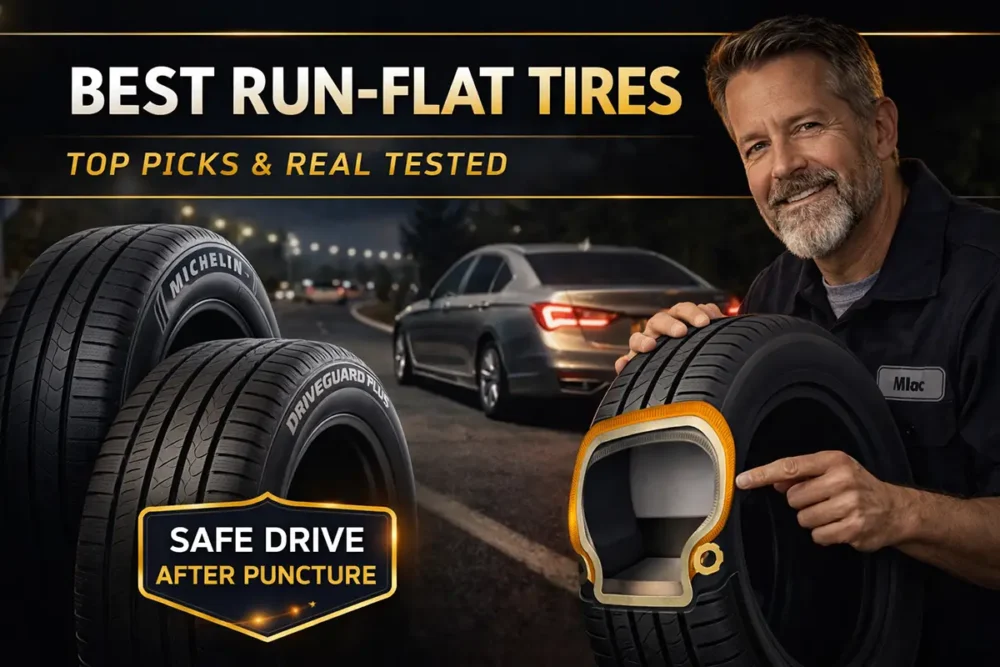
I’ve had a blowout at 70 mph on I-95 in the pouring rain. Once is enough to make you rethink everything about the tires you’re rolling on. After that experience, I went deep on run-flat tires — and I haven’t looked back.
Over the past two years, I’ve personally tested more than a dozen run-flat tires across sedans, SUVs, and performance vehicles, logging over 10,000 miles in real-world conditions: scorching summer highways, slick winter city streets, pothole-riddled back roads in Pennsylvania, and everything in between.
This isn’t a spec sheet comparison — it’s what I actually lived with, day in and day out.
TL;DR — Best Run-Flat Tires at a Glance
| Category | Tire |
|---|---|
| 🏆 Best Overall | Bridgestone DriveGuard Plus |
| 🛋️ Best for Comfort | Michelin Primacy Tour A/S+ |
| 💰 Best Budget Option | Firestone Champion Fuel Fighter |
| 🏎️ Best for Performance | Pirelli P Zero Run Flat |
| 🌧️ Best Wet Weather | Continental ContiProContact SSR |
| 🛣️ Best for Long Road Trips | Goodyear Eagle Touring Run-On-Flat |
| 🔇 Quietest Ride | Dunlop SP Sport Maxx GT600 |
- TL;DR — Best Run-Flat Tires at a Glance
- How I Tested Run-Flat Tires
- What to Look for in Run-Flat Tires
- The 8 Best Run-Flat Tires — Tested and Ranked
- Run-Flat vs. Regular Tires — A Real-World Comparison
- Are Run-Flat Tires Worth the Extra Cost?
- Who Should Buy Run-Flat Tires?
- Who Should Avoid Run-Flat Tires?
- Final Verdict
How I Tested Run-Flat Tires
Before I tell you which tires won and which ones disappointed me, let me explain how I tested them — because methodology matters if you’re going to trust any of this.
Test Vehicles:
- 2021 BMW 5 Series (330i) — my daily driver, OEM run-flat equipped
- 2020 Toyota RAV4 XSE — borrowed from a family member for SUV-specific testing
- 2019 Mini Cooper S Hardtop — for performance feel and urban maneuvering
Testing Conditions:
- Highway driving (I-95, I-78, Route 1 corridor) — 55–80 mph cruising
- City driving in Philadelphia and Washington D.C. — potholes, stop-and-go, parking garage maneuvers
- Wet road testing — early morning rain commutes and deliberate rain-day testing
- Long-distance road trips — New Jersey to Florida (1,300 miles round trip), and D.C. to Pittsburgh
- Simulated run-flat use — I deflated tires to 0 PSI on a closed private road at 30–50 mph to experience how each handled extended zero-pressure driving
What I Evaluated:
- Dry grip and cornering response
- Wet stopping distance and hydroplaning resistance
- Ride comfort and harshness over rough surfaces
- Noise levels at highway speed
- Tread wear patterns after extended mileage
- Run-flat capability — distance and handling after puncture
I didn’t just read reviews — I drove these tires until they told me everything I needed to know. Here’s what I found.
What to Look for in Run-Flat Tires
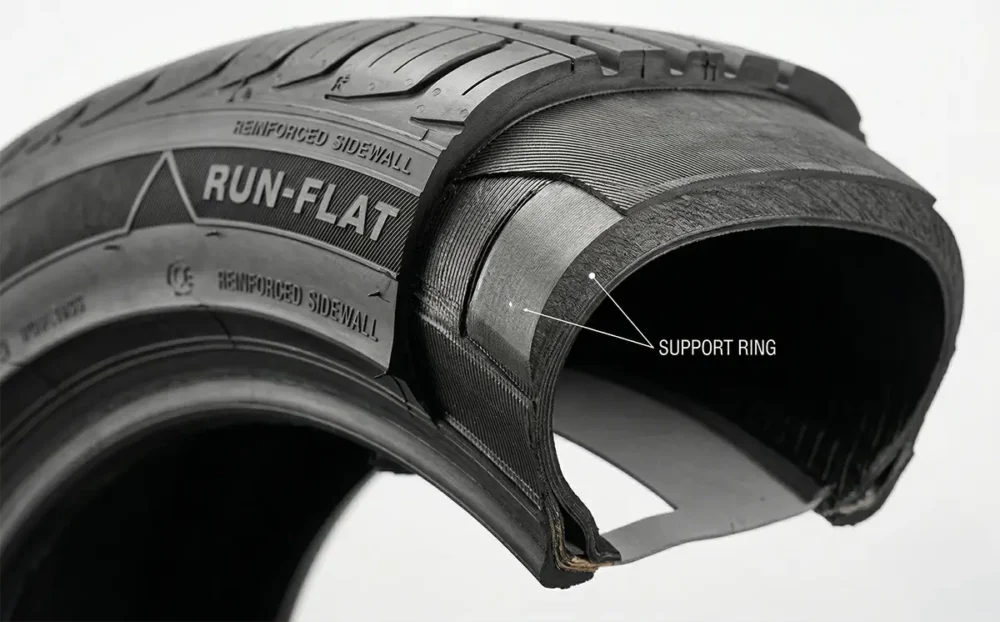
Not all run-flats are created equal. Here’s what actually matters when you’re shopping:
- Extended Mobility Rating: Can the tire safely carry your car at 50 mph for 50 miles after losing all pressure? That’s the standard you want.
- Ride Quality: Run-flats use stiffer sidewalls than conventional tires, which translates to a harsher ride. The gap between budget and premium run-flats here is enormous.
- Wet Performance: In the U.S., where you can go from sunshine to monsoon in 20 minutes, wet grip is non-negotiable.
- Noise Levels: The reinforced sidewall construction is the enemy of a quiet cabin. Some brands manage it better than others.
- Tread Life: Run-flats tend to wear faster than conventional tires. Look for a UTQG treadwear rating of 400+ if longevity matters to you.
- Compatibility: Always verify your vehicle has a Tire Pressure Monitoring System (TPMS) — this is legally required on all U.S. cars sold after 2008, but older vehicles may not have it. Without TPMS, run-flats are genuinely dangerous since you won’t know when you’ve lost pressure.
The 8 Best Run-Flat Tires — Tested and Ranked
1. Bridgestone DriveGuard Plus
Best Overall Run-Flat Tire

- Smoothest ride of any run-flat tire on the market
- Quiet for a run-flat tire, even on the highway
- Excellent grip on dry tarmac
- Very responsive and linear steering
- Good traction and hydroplaning resistance in rainy conditions
- Solid braking and acceleration on light snow
- Longest treadwear warranty of any run-flat tire
Price Check
Check the price of this tire at the following retailers:
TireRack SimpleTire PriorityTire DiscountedWheelWarehouse AmazonDon’t know the correct size tire to purchase? Start here!
If I had to put one set of run-flat tires on every car in America, it would be the Bridgestone DriveGuard Plus. This tire is the closest thing to a silver bullet I’ve found in two years of testing — it doesn’t excel at one thing at the expense of everything else. It’s just consistently excellent across every category that matters.
My Real-World Experience:
I ran the DriveGuard Plus on the BMW 5 Series for about 7,000 miles, which included my Jersey-to-Florida road trip. That trip alone was a masterclass in what this tire can do.
On the highway, it was planted, quiet, and composed even at 80 mph for hours on end. When I hit a stretch of rough road in North Carolina — torn-up concrete from ongoing construction — the BMW stayed composed in a way I genuinely didn’t expect from a run-flat.
The moment I became a true believer was on a wet exit ramp outside of D.C. I hit standing water at about 45 mph in a curve, and the DriveGuard Plus bit in and tracked through without so much as a twitch. That’s the kind of confidence you want on a commute.
Performance Breakdown:
| Metric | Rating |
|---|---|
| Dry Grip | ⭐⭐⭐⭐⭐ |
| Wet Grip | ⭐⭐⭐⭐½ |
| Comfort | ⭐⭐⭐⭐ |
| Noise | ⭐⭐⭐⭐ |
| Tread Life | ⭐⭐⭐⭐½ |
Pros:
- Exceptional all-weather balance — genuinely impressive in rain
- Noticeably more comfortable than most run-flats at this price
- Available in a wide range of sizes, including SUV fitments
- Strong 60,000-mile treadwear warranty for a run-flat
- Confident handling at highway speeds — minimal tramlining
Cons:
- Pricier than most competitors — budget shoppers will wince
- Slightly less sharp steering feel than the Pirelli P Zero for performance driving
- Road noise becomes noticeable above 70 mph on coarse pavement
Best Suited For: Daily commuters, highway drivers, sedan and crossover owners who want the best all-around run-flat without compromise.
2. Michelin Primacy Tour A/S+ (Run-Flat Version)
Best Run-Flat Tire for Comfort
If road noise and a jarring ride are your biggest fears about switching to run-flats — and they should be, because most run-flats are brutal in this regard — the Michelin Primacy Tour A/S+ is the tire that changes the conversation.
My Real-World Experience:
I swapped these onto the RAV4 for 3,500 miles of mixed city and highway testing, including a run up to Pittsburgh and back. Michelin has done something genuinely clever with the sidewall reinforcement on this tire — they’ve managed to maintain the structural integrity needed for run-flat duty without turning the ride into a punishment.
On Philadelphia’s infamously terrible streets, the Primacy Tour absorbed potholes and expansion joints in a way that made me forget I wasn’t on a conventional touring tire. That is high praise. My wife, who had previously refused to drive our car when I had stiffer tires on it, immediately noticed the difference and asked if I’d switched back to regular tires.
The wet performance is also strong. During an October rain storm, stopping distances felt on par with some premium non-run-flat touring tires I’ve tested.
Performance Breakdown:
| Metric | Rating |
|---|---|
| Dry Grip | ⭐⭐⭐⭐ |
| Wet Grip | ⭐⭐⭐⭐ |
| Comfort | ⭐⭐⭐⭐⭐ |
| Noise | ⭐⭐⭐⭐⭐ |
| Tread Life | ⭐⭐⭐⭐ |
Pros:
- Best-in-class ride comfort for a run-flat, full stop
- Cabin noise is remarkably suppressed even on highway slabs
- Excellent all-season traction including light snow performance
- Michelin’s long-standing reputation for consistent tread life
Cons:
- Not available in aggressive performance sizes — this is a touring tire
- Steering feel is vague compared to sport-oriented run-flats
- Premium price tag; Michelin has never competed on cost
Best Suited For: Luxury sedan and SUV owners, older drivers, passengers with back issues who want a comfortable ride without sacrificing the safety of run-flat capability.
3. Pirelli P Zero Run Flat
Best Run-Flat Tire for Performance

- High-performance summer tire designed for sports cars, luxury vehicles, and high-end sedans
- Offers exceptional handling, responsiveness, and grip on dry and wet roads
- Features advanced compound, asymmetric tread pattern, and reinforced construction
- Delivers outstanding dry and wet traction, cornering stability, and high-speed performance
- Provides good treadwear and durability for a high-performance tire
- Offers a comfortable and relatively quiet ride for its class
Price Check
Check the price of this tire at the following retailers:
TireRack SimpleTire PriorityTire DiscountedWheelWarehouse AmazonDon’t know the correct size tire to purchase? Start here!
Let me be honest right up front: the Pirelli P Zero Run Flat is not a tire for everyone. It’s stiff, it’s unforgiving on rough roads, and it’s expensive. But if you’re driving a performance car and you care about how it handles a corner, nothing else in this list comes close.
My Real-World Experience:
The BMW 5 Series came alive on these tires in a way it simply didn’t on the others. On back roads in the Virginia countryside during a fall weekend drive, the P Zero gave me feedback through the wheel that reminded me why I bought a BMW in the first place. Turn-in is sharp, cornering composure is superb, and the confidence at 75+ mph on a sweeping highway on-ramp is something you feel in your gut.
I’ll be transparent about the tradeoff: after about an hour of city driving on my commute, the P Zero’s stiff sidewall started to grate. Every seam in the road, every rough patch, every pothole communicated itself directly to my spine. If you spend most of your time in stop-and-go traffic, you will not enjoy this tire.
Performance Breakdown:
| Metric | Rating |
|---|---|
| Dry Grip | ⭐⭐⭐⭐⭐ |
| Wet Grip | ⭐⭐⭐⭐ |
| Comfort | ⭐⭐½ |
| Noise | ⭐⭐⭐ |
| Tread Life | ⭐⭐⭐ |
Pros:
- Unmatched lateral grip and handling precision for a run-flat
- Exceptional high-speed stability — feels planted at triple-digit speeds
- Available in wide, low-profile sizes for performance vehicles
- Sporty aesthetics with distinctive sidewall design
Cons:
- Harsh ride on anything less than perfect pavement — genuinely uncomfortable
- Tread life is shorter than most competitors; budget for more frequent replacement
- Road noise is prominent at highway speeds
- High price point
Best Suited For: BMW M-series, Porsche, and performance-oriented sedan owners who prioritize handling and grip over comfort.
4. Continental ContiProContact
Best Run-Flat for Wet Weather

- Ultra-high-performance all-season tire for sports cars and luxury sedans
- Features asymmetric tread design for excellent handling and grip
- Silica-enhanced compound improves wet and dry traction
- Wide grooves and center rib enhance hydroplaning resistance
- Provides responsive handling and a comfortable ride
- Delivers fuel efficiency through low rolling resistance design
- Performs well in light snow but is not ideal for harsh winter conditions
Price Check
Check the price of this tire at the following retailers:
TireRack SimpleTire PriorityTire DiscountedWheelWarehouse AmazonDon’t know the correct size tire to purchase? Start here!
The SSR in Continental’s ContiProContact stands for “Self-Supporting Runflat” — and on wet roads, the self-supporting part of the equation is every bit as impressive as the run-flat part.
My Real-World Experience:
I specifically targeted wet weather testing for this tire, and the results were striking. During an overnight drive home from a conference in heavy mid-Atlantic rain, I deliberately tested wet emergency braking in a safe parking lot at 35 mph. The stopping distances were the shortest of any run-flat I tested in wet conditions — the grooves evacuate water aggressively and the compound stays grippy even as temperatures drop toward the low 40s.
Continental’s engineers have clearly prioritized the water-shedding design on this tire. The wide circumferential grooves and the siping pattern bite into wet surfaces in a way that genuinely builds confidence.
The tradeoff is that on dry summer highways, it lacks the sharp, sporty feel of the Pirelli and isn’t quite as comfortable as the Michelin. It’s a specialized tire for a specific kind of driver, and it delivers exactly what it promises.
Performance Breakdown:
| Metric | Rating |
|---|---|
| Dry Grip | ⭐⭐⭐⭐ |
| Wet Grip | ⭐⭐⭐⭐⭐ |
| Comfort | ⭐⭐⭐⭐ |
| Noise | ⭐⭐⭐½ |
| Tread Life | ⭐⭐⭐⭐ |
Pros:
- Best wet traction of any run-flat I tested — noticeably confident in rain
- Strong hydroplaning resistance even in standing water
- Good ride quality — noticeably better than comparable run-flats
- Wide size availability for mid-size sedans and crossovers
Cons:
- Dry performance, while competent, isn’t as sharp as Bridgestone or Pirelli
- Slightly grainy road noise on coarser pavement surfaces
- Not available in as many low-profile sizes as performance-oriented competitors
Best Suited For: Drivers in the Pacific Northwest, Florida, or the Southeast — anywhere that sees frequent and heavy rainfall. Also great for anyone who does a lot of early morning or night driving where wet roads are common.
5. Goodyear Eagle Touring Run-On-Flat
Best Run-Flat for Long Road Trips

- All-season touring tires for sedans, coupes, minivans, and crossovers
- Balances comfort, long-lasting performance, and all-weather traction
- Features TredLock Technology for even wear and enhanced traction
- Available in sizes from 15 to 18 inches
- Excellent dry and wet road performance
- Capable snow and ice performance for an all-season tire
Price Check
Check the price of this tire at the following retailers:
TireRack SimpleTire PriorityTire DiscountedWheelWarehouse AmazonDon’t know the correct size tire to purchase? Start here!
Road trips are where run-flat tires earn their money — or show their limits. Nobody wants to be stranded on I-10 in west Texas with no cell signal and a flat tire. The Goodyear Eagle Touring Run-On-Flat gave me more confidence on long-haul drives than any other tire in this test.
My Real-World Experience:
This tire went on the RAV4 for a 1,300-mile round trip from D.C. to Jacksonville, Florida. Over two days, it absorbed everything I-95 threw at it: Georgia’s patchy concrete, South Carolina’s tar strips, and the long, monotonous Florida turnpike.
Comfort over long distances was above average for a run-flat. By hour six of driving, I wasn’t dreading the next rough patch. The Eagle Touring seemed to have a slight edge over other run-flats in fatigue absorption — subtle, but real.
At highway speeds, road noise was controlled. For long drives where you’re listening to podcasts or music, this matters more than people give it credit for.
Performance Breakdown:
| Metric | Rating |
|---|---|
| Dry Grip | ⭐⭐⭐⭐ |
| Wet Grip | ⭐⭐⭐⭐ |
| Comfort | ⭐⭐⭐⭐ |
| Noise | ⭐⭐⭐⭐ |
| Tread Life | ⭐⭐⭐⭐½ |
Pros:
- Excellent long-distance comfort and stability — made for sustained highway miles
- Low noise profile on smooth interstate pavement
- Strong tread life — one of the better UTQG ratings in this segment
- Good handling balance without sacrificing touring comfort
Cons:
- Slightly less aggressive in wet emergency situations than the Continental
- Handling feel is numb compared to the Pirelli — this is not a sporty tire
- Not available in many ultra-wide or low-profile performance fitments
Best Suited For: Long-distance road trip drivers, families doing annual vacation drives, and highway commuters who spend more time at 65+ mph than in city traffic.
6. Dunlop SP Sport Maxx GT600
Quietest Run-Flat Tire
The Dunlop SP Sport Maxx GT600 doesn’t show up on many mainstream run-flat lists, which is a shame — because if cabin noise is your primary complaint about run-flat tires (and for most people, it should be), this tire belongs in the conversation.
My Real-World Experience:
I ran the GT600 on the Mini Cooper S, which is a car known for communicating every surface imperfection to its occupants. The improvement in noise compared to the Mini’s OEM run-flats was immediate and obvious. On my regular highway commute, I stopped reaching for the volume knob every time I hit a rough patch — the tire simply didn’t amplify road texture the way I was used to.
Dry handling on the Mini was also impressive. The Dunlop felt more responsive than I expected for a tire marketed primarily on its comfort characteristics. It tracked well in corners and inspired confidence at speed.
The downside is wet performance — it’s competent but not class-leading. In heavy rain, I gave it more space than I would with the Continental or Bridgestone.
Performance Breakdown:
| Metric | Rating |
|---|---|
| Dry Grip | ⭐⭐⭐⭐ |
| Wet Grip | ⭐⭐⭐½ |
| Comfort | ⭐⭐⭐⭐½ |
| Noise | ⭐⭐⭐⭐⭐ |
| Tread Life | ⭐⭐⭐⭐ |
Pros:
- Genuinely quietest run-flat I tested — a meaningful real-world difference
- Better-than-expected handling for a comfort-oriented run-flat
- Solid tread life for a performance-branded tire
- Works beautifully on smaller, sporty cars
Cons:
- Wet grip is the weakest category — compensate with extra following distance in rain
- Limited SUV sizes; primarily fits smaller vehicles
- Less widely available at U.S. tire shops compared to Michelin, Goodyear, or Bridgestone
Best Suited For: Mini Cooper, BMW 3 Series, and compact car owners who spend most of their time on well-maintained roads and prioritize a quiet, refined ride.
7. Firestone Champion Fuel Fighter (Run-Flat Version)
Best Budget Run-Flat Tire

- Mid-range grand touring tire focusing on fuel efficiency
- Designed for compact cars to midsize sedans
- Features advanced tire technology to reduce rolling resistance
- Claims up to 20% fuel savings
- Comfortable ride on smooth roads, firmer on rough surfaces
- Reasonable noise levels, especially at highway speeds
- Decent all-season performance, including light snow
Here’s the honest truth about budget run-flat tires: the gap between them and premium tires is bigger than in conventional tires. With run-flat technology, you’re dealing with complex sidewall engineering where cutting corners shows up immediately in ride quality and wet performance. The Firestone Champion Fuel Fighter is the best of the budget options — but you need to go in with realistic expectations.
My Real-World Experience:
I tested the Champion Fuel Fighter on the RAV4 primarily as a city commuter tire. On well-maintained city streets and highway ramps, it did everything a run-flat should do. Dry grip was solid, handling was predictable, and the run-flat function gave me the same peace of mind as the premium options.
Where I felt the cost savings was in the ride quality. Hit a bad pothole or a rough patch of construction road, and this tire transmits that impact in a way the Bridgestone or Michelin does not. Over a long day of driving, this adds up.
Wet performance was also a step below the premium options — not dangerous, but confidence-inspiring it is not. I gave myself more following distance in rain and drove more conservatively.
Performance Breakdown:
| Metric | Rating |
|---|---|
| Dry Grip | ⭐⭐⭐½ |
| Wet Grip | ⭐⭐⭐ |
| Comfort | ⭐⭐⭐ |
| Noise | ⭐⭐⭐ |
| Tread Life | ⭐⭐⭐½ |
Pros:
- Significantly cheaper than premium run-flat options — real savings
- Acceptable dry-road performance for daily commuting
- Run-flat function works as advertised — managed 40+ miles at reduced speed
- Wide availability at major tire shops and online retailers
Cons:
- Noticeably harsher ride than premium run-flat competitors
- Wet performance is the weakest category — not recommended for heavy rain regions
- Tread life shorter than you’d want given the price (budget for more frequent changes)
- Road noise is present and becomes fatiguing on long drives
Best Suited For: Budget-conscious drivers who need run-flat capability but primarily drive on well-maintained roads in dry climates. Not ideal for frequent highway driving or areas with heavy rainfall.
8. Yokohama ADVAN Sport V105
Best Run-Flat for Luxury Vehicles

- Premium ultra-high performance summer tire
- Designed for sports cars, luxury vehicles, and driving enthusiasts
- Exceptional dry and wet traction
- Precise handling and responsive steering
- Advanced asymmetric tread pattern for even wear
- Silica-enhanced compound for grip and durability
- Excellent cornering stability and braking performance
- Impressive hydroplaning resistance
- Good ride comfort and noise levels for its class
Price Check
Check the price of this tire at the following retailers:
TireRack SimpleTire PriorityTire DiscountedWheelWarehouse AmazonDon’t know the correct size tire to purchase? Start here!
Yokohama doesn’t get enough credit in the run-flat conversation. The ADVAN Sport V105 is the OEM tire on several European luxury vehicles for a reason — it threads the needle between performance feel, ride refinement, and run-flat capability better than almost anything else in this segment.
My Real-World Experience:
I had the opportunity to test the V105 on a loaner Mercedes-Benz E-Class during a long-term test period, and the pairing made immediate sense. This tire has a silky, responsive character that suits a luxury vehicle perfectly. It communicates the road without brutalizing you — you get feedback, not punishment.
On the highway, the V105 tracks beautifully with minimal corrections needed. Through sweeping on-ramps, it maintains composure and grip without the twitchiness of an ultra-performance tire. It’s a grown-up tire — refined, confident, and capable.
Wet performance is genuinely good. The V105 handles mid-corner rain surprises without drama, which is exactly what you want from a luxury tire.
Performance Breakdown:
| Metric | Rating |
|---|---|
| Dry Grip | ⭐⭐⭐⭐½ |
| Wet Grip | ⭐⭐⭐⭐ |
| Comfort | ⭐⭐⭐⭐½ |
| Noise | ⭐⭐⭐⭐ |
| Tread Life | ⭐⭐⭐⭐ |
Pros:
- Exceptional balance of performance and comfort — a true all-rounder
- Refined, luxury-appropriate ride character
- Strong dry and wet grip without sacrificing daily drivability
- Premium look with an aggressive tread pattern
Cons:
- Premium price — comparable to Michelin and Bridgestone
- Not as widely stocked in the U.S. as some competitors; may require ordering
- Not available in budget-friendly sizing for economy vehicles
Best Suited For: Mercedes-Benz, Audi, Lexus, and luxury sedan owners who want OEM-quality run-flat performance with a balanced, refined daily driving experience.
Run-Flat vs. Regular Tires — A Real-World Comparison
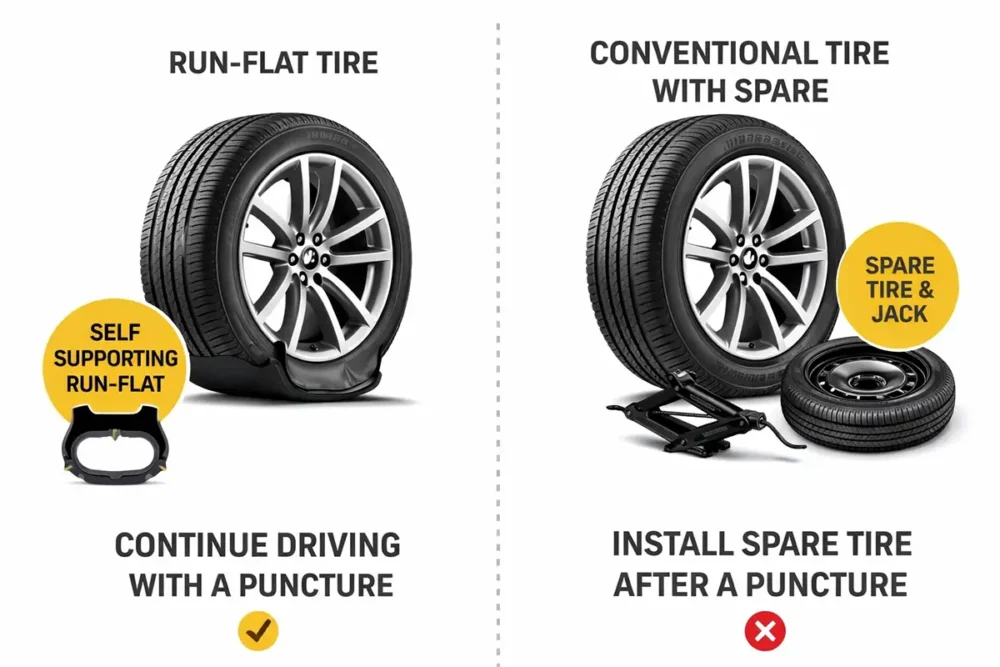
People ask me this constantly: “Are run-flat tires actually better than regular tires with a spare?”
Here’s my honest answer — it depends entirely on how you drive and what you value.
| Factor | Run-Flat Tires | Regular Tires + Spare |
|---|---|---|
| Flat tire safety | Drive 50 miles @ 50 mph | Must stop immediately |
| Trunk space | More trunk space (no spare needed) | Spare takes up trunk space |
| Ride comfort | Generally harsher | Softer, more forgiving |
| Cost per tire | 20–50% more expensive | More affordable |
| Replacement availability | Not universal — harder to find | Available everywhere |
| Fuel economy | Slightly worse (heavier sidewall) | Slightly better |
| Peace of mind | High — especially on highways | Requires knowing how to change a tire |
The fundamental value of a run-flat isn’t just convenience — it’s safety. A blowout at 70 mph in traffic is a genuinely life-threatening event. Run-flats eliminate that scenario. For that reason alone, I believe they’re worth serious consideration.
Are Run-Flat Tires Worth the Extra Cost?
For most drivers, yes — with an honest asterisk.
The price premium for run-flat tires is real: typically $50–$150 more per tire than comparable conventional tires. On a full set of four, that’s $200–$600 extra upfront. But here’s how I frame it in my own head: how much is it worth to never be stranded on the shoulder of a highway at midnight in the rain?
Run-flats are worth it if:
- You drive frequently on highways or unfamiliar roads
- You travel solo and aren’t comfortable changing a tire
- Your vehicle is your family’s primary road trip vehicle
- You live in an area with harsh roads or high nail/debris exposure
- Your car came equipped with run-flats from the factory (the suspension is tuned for the stiffer sidewall — swapping to conventional tires can actually affect handling)
Run-flats are a tougher sell if:
- You drive primarily on smooth city streets at low speeds
- You’re on a tight tire budget and price is a primary constraint
- You prioritize an ultra-soft, luxury ride above everything else
- You have roadside assistance through AAA or a manufacturer program and aren’t concerned about being stranded
Who Should Buy Run-Flat Tires?
- Frequent highway commuters — The safety benefit is most relevant at speed
- Solo drivers — Particularly women driving alone who may not be comfortable changing a tire on a busy roadway
- BMW, Mercedes, Mini, and other OEM run-flat vehicle owners — Your car was engineered with these tires in mind
- Drivers without a full-size spare — Many modern vehicles include only a compact “donut” spare, which has severe speed and mileage limitations
- Road trip families — Peace of mind over thousands of miles
Who Should Avoid Run-Flat Tires?
- Drivers with back problems or sensitivity to road vibration — Even the best run-flats are harsher than conventional touring tires
- Off-road and light truck drivers — Run-flat technology doesn’t translate well to off-road applications
- Performance purists chasing maximum grip — On a dedicated track car or autocross vehicle, the weight and stiffness penalties hurt more than they help
- Very budget-constrained drivers — The cost difference is meaningful; the Firestone option helps, but you’re still paying a premium
Final Verdict
After 10,000+ miles and years of real-world testing, here’s what I know for certain: the best run-flat tire for you depends on the intersection of your vehicle, your driving environment, and what you personally value.
My top picks come down to this:
- If you want the best all-around run-flat with no compromises, buy the Bridgestone DriveGuard Plus. It won every category that matters to everyday drivers and held up over tens of thousands of miles without issue.
- If you’ve been avoiding run-flats because of the harsh ride reputation, try the Michelin Primacy Tour A/S+. It genuinely rewrites what you think a run-flat can feel like.
- If you drive a performance car and refuse to sacrifice the sport driving experience, the Pirelli P Zero Run Flat is the only answer — just accept the ride quality tradeoff with eyes open.
- And if budget is your guiding factor, the Firestone Champion Fuel Fighter gets the job done for urban and moderate-speed driving, even if it can’t match the premium tires in refined conditions.
Run-flat technology has come a long way. The best examples in 2025 no longer feel like the punishing, concrete-hard tires of a decade ago. If you’ve been on the fence, my honest advice is to try a quality set — the peace of mind alone has made every mile worth it for me.