
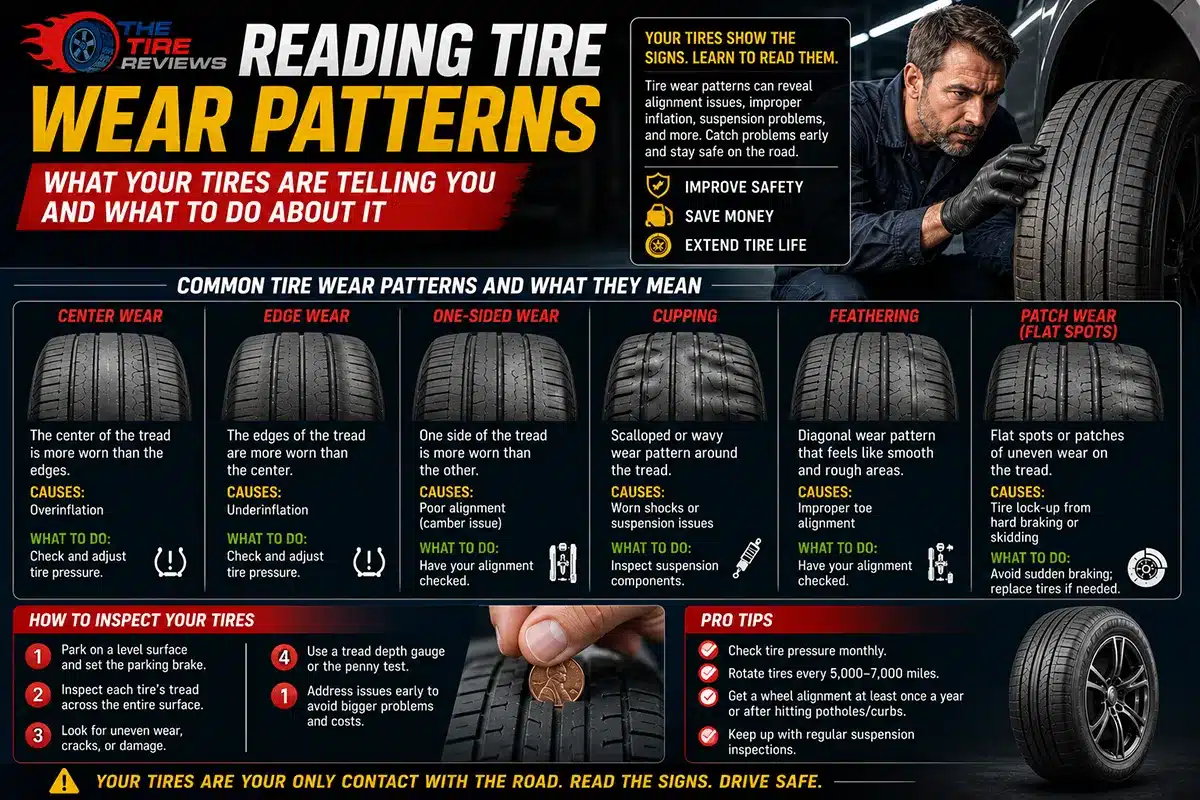
I’ve crouched next to more tire sidewalls than I can count — in driveways, on parking garage floors, even in the rain with a flashlight — and every single time, the rubber told me a story. The question is whether you know how to read it.
TL;DR:
Tire wear patterns are a direct diagnostic report from your suspension, alignment, and inflation systems. Center wear = overinflation. Edge wear = underinflation. One-sided wear = alignment problem. Cupping/scalloping = worn shocks or struts. Catching these patterns early can save you $400–$800 in premature tire replacement and prevent a dangerous blowout. Keep reading for the full visual guide, root causes, and exactly what to do next.
- Why Tire Wear Patterns Actually Matter
- The 6 Tire Wear Patterns You Need to Know
- Quick Reference: Tire Wear Pattern Diagnosis Table
- How to Inspect Your Own Tires in 10 Minutes
- When Wear Patterns Indicate Immediate Safety Concerns
- The Rotation Schedule That Actually Prevents Most Wear Problems
- Does Tire Brand or Model Affect Wear Pattern Susceptibility?
- FAQ: Tire Wear Patterns
- Final Thoughts: Your Tires Are Talking — Listen
Why Tire Wear Patterns Actually Matter
Most drivers only look at their tires when something goes obviously wrong — a flat, a bulge, or a warning light.
I used to be the same way, until a set of Continental CrossContact tires I put on my wife’s RAV4 wore down to the wear bars on the inside edges in under 18,000 miles.
The tires had 50,000-mile tread warranties. I was furious, then humbled when the alignment shop showed me the camber reading: -2.4 degrees. I had ignored a subtle pull to the left for months.
That experience taught me to check wear patterns the same way a doctor checks blood pressure — proactively, before symptoms escalate. Your tires are in contact with the road every single mile.
Over time, they record everything: your inflation habits, your suspension health, even how your car was aligned from the factory.
The good news is that tire wear patterns are readable by anyone willing to spend 10 minutes in their driveway. You don’t need a lift or alignment tools. You need your eyes, your hands, and this guide.
The 6 Tire Wear Patterns You Need to Know
1. Center Wear (Overinflation)
What it looks like: The center strip of the tread is worn down significantly more than the outer edges. Run your fingers across the tread — it feels noticeably lower in the middle.
What causes it: Overinflated tires balloon outward slightly, causing the center of the tread to bear the majority of the vehicle’s weight. The outer edges barely touch the road.
What I’ve seen in real life: On a 2019 Honda Accord I was evaluating with Michelin Defender2 tires, the owner had been inflating to the max PSI stamped on the tire sidewall — 51 PSI — instead of the vehicle manufacturer’s recommended 35 PSI. After just 22,000 miles, the center tread was nearly 2/32″ lower than the shoulders. Those tires had probably 15,000 miles of usable life left if inflation had been correct.
The fix: Check your door jamb sticker for the correct PSI. Set all four tires to that spec — not the number on the tire sidewall. Re-check monthly. If center wear is already significant, rotate immediately and monitor.
Safety consequence: Overinflated tires have a smaller contact patch, reduce wet-weather braking performance, and make the ride harsh. They’re also more vulnerable to impact damage from potholes.
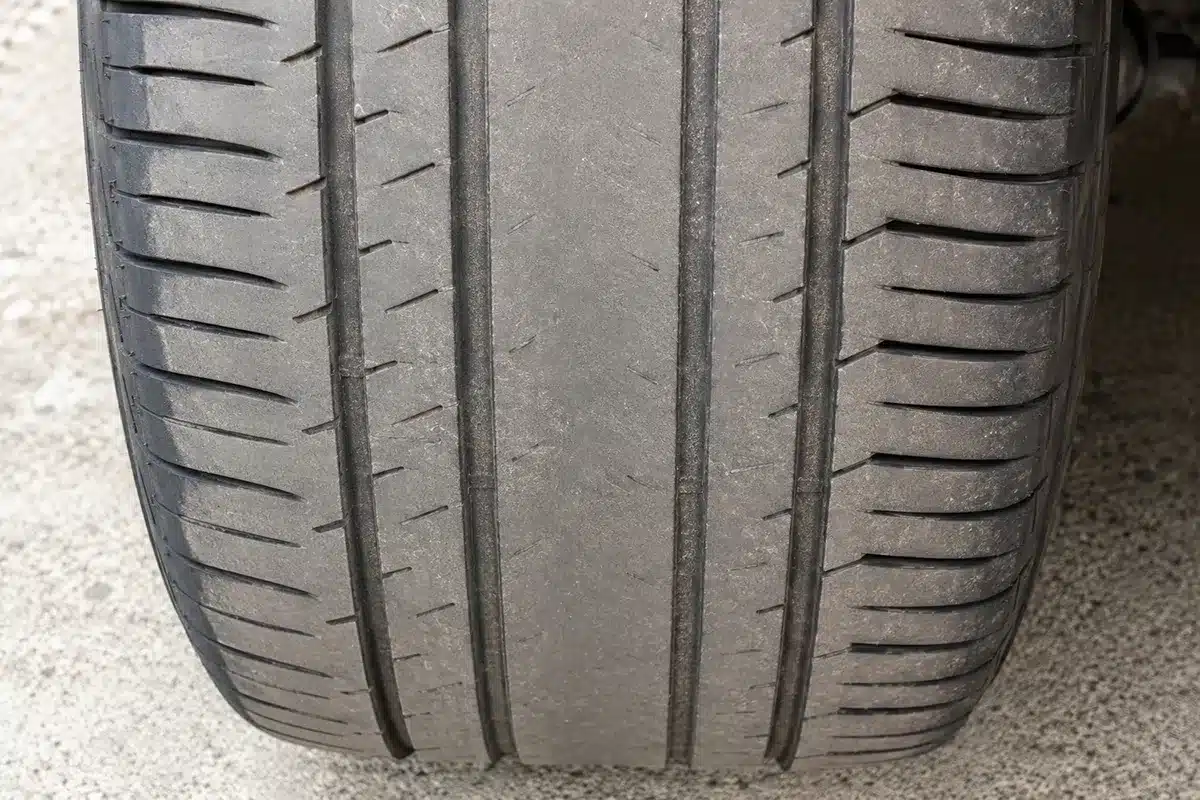
2. Edge Wear / Shoulder Wear (Underinflation)
What it looks like: Both outer edges of the tire are worn down faster than the center. Sometimes called “two-sided shoulder wear.” The center tread looks almost fine; the edges look chewed up.
What causes it: An underinflated tire flattens out under vehicle weight, causing the tread shoulders to do most of the work while the center sags away from the road surface.
Real-world note: This is the single most common wear pattern I encounter. Most drivers run their tires at least 5–8 PSI below spec — often without knowing it. Tires lose roughly 1 PSI per month naturally, and around 1 PSI per 10°F temperature drop in winter. A tire that was properly inflated in August can be 6–10 PSI low by February.
I inspected a 2021 Ford F-150 last fall that had been running at 27 PSI on all four tires. Door jamb spec was 35 PSI front and 60 PSI rear (it was a half-ton with LT tires). Both rear tires showed severe shoulder wear — and one had visible heat cracking along the inner shoulder. The owner had been driving like this for over a year.
The fix: Inflate to spec, rotate the tires immediately, and check whether the wear is uniform across both shoulders. If it is, inflation was the only issue. If one shoulder is worse than the other, you may have an alignment issue layered on top.
Safety consequence: Underinflation is the #1 cause of tire blowouts. An underinflated tire runs hotter, flexes more per revolution, and can delaminate at highway speeds. Do not ignore this.
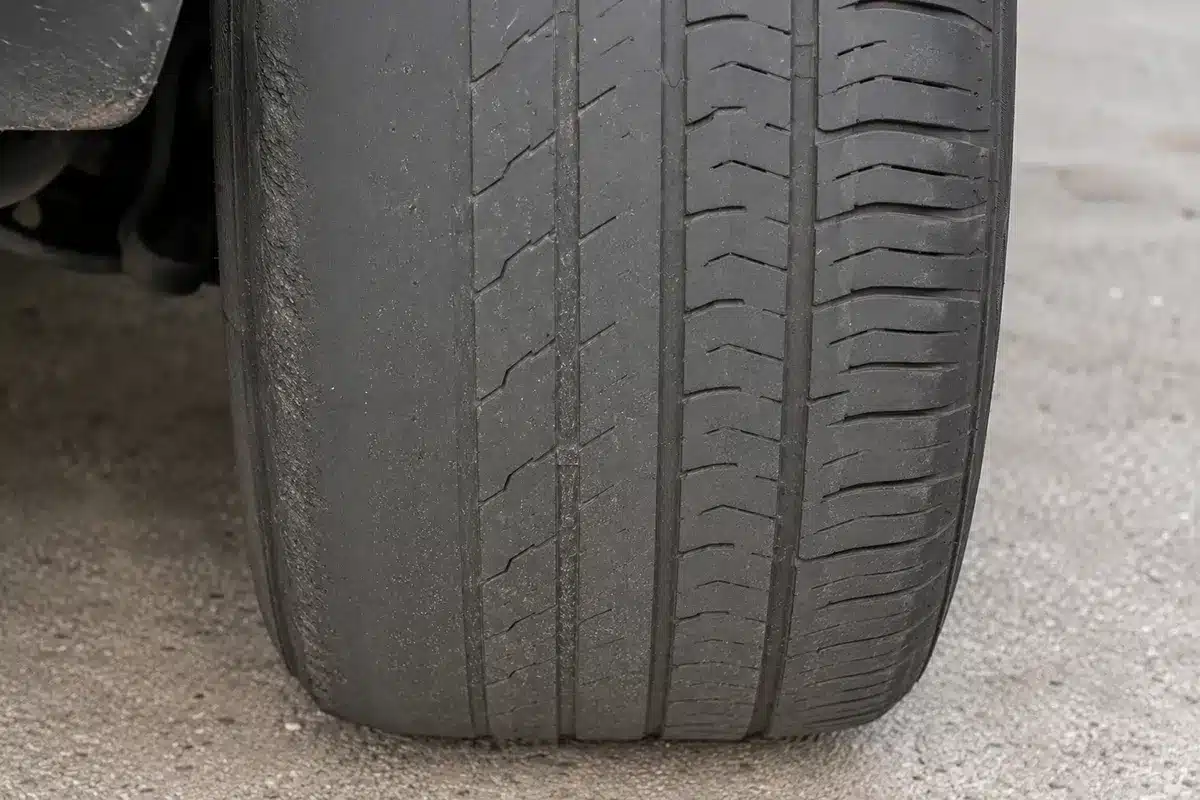
3. One-Sided or Camber Wear (Alignment Problem)
What it looks like: One edge of the tire — either the inner edge or the outer edge — is worn dramatically more than the other side. Sometimes the difference is so severe that the tread bars on one side are gone while the other side still looks new.
What causes it: Excessive positive or negative camber. Camber is the inward or outward tilt of the tire when viewed from the front of the vehicle. Modern vehicles are designed with a slight negative camber (tops of tires tilt inward) for handling stability — but if a ball joint, control arm bushing, or strut is worn, camber can go out of spec.
From my notes: I’ve seen this pattern appear in as little as 8,000 miles when a vehicle hits a significant curb impact that knocks the suspension geometry out. On the RAV4 I mentioned in the intro, the inner-edge wear was so pronounced that I could feel the tread depth difference by placing my palm flat across the tread. The inside blocks were almost flush with the wear indicators; the outside blocks still had 7/32″ remaining.
The fix: Get a four-wheel alignment immediately. Ask the shop to show you the before-and-after printout. If the camber is out of spec and alignment adjustment doesn’t fix it (some vehicles have limited camber adjustment), inspect the control arm bushings, ball joints, and strut mounts. For lifted or lowered vehicles, aftermarket camber correction plates may be needed.
Cost reality: An alignment is typically $80–$150. Replacing a prematurely destroyed tire set costs $400–$1,000+. The math is not complicated.
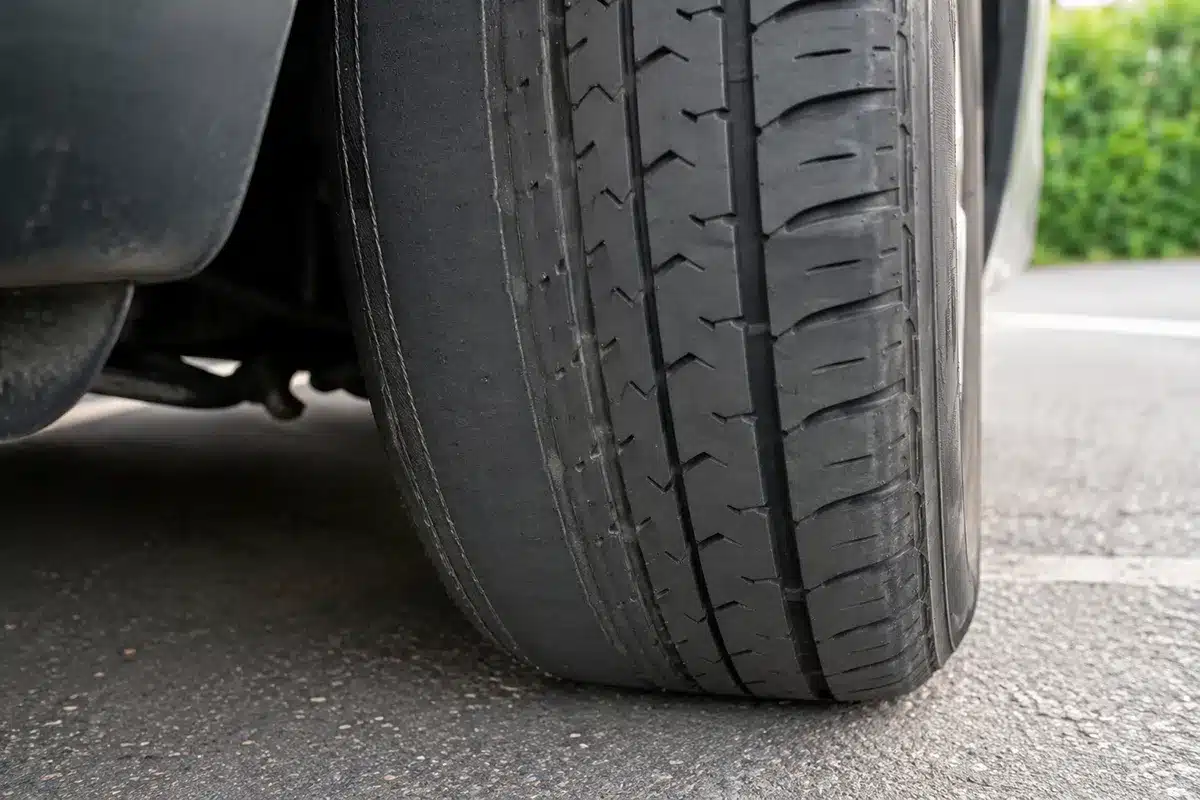
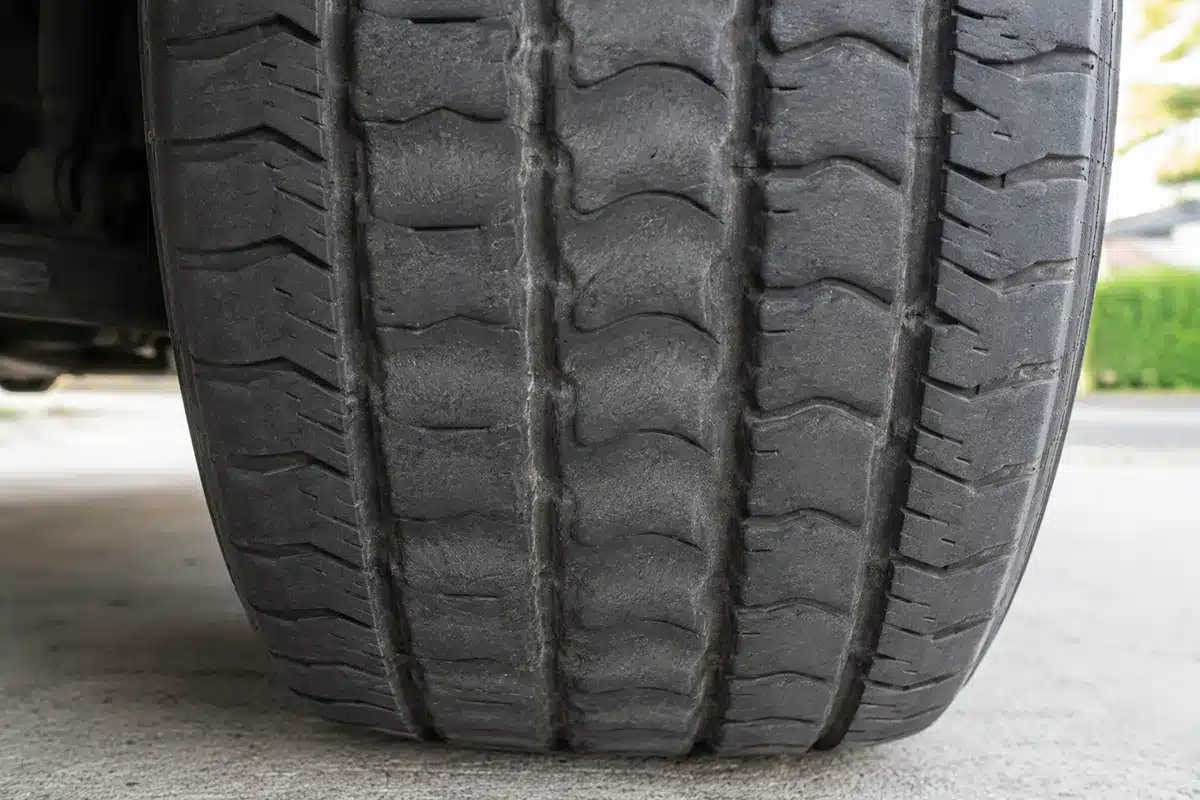
4. Cupping or Scalloping (Suspension Wear)
What it looks like: The tread surface has a series of high and low spots around the circumference — like someone scooped out uneven chunks of rubber at regular intervals. It can look random at first glance, but the pattern repeats every 8–16 inches around the tire. You can feel it with your hand more easily than you can see it.
What causes it: Worn or failing shock absorbers or struts. When shocks lose their damping ability, the tire bounces against the road rather than rolling smoothly. Each impact point wears a small divot. Over thousands of miles, these divots create the scalloped pattern.
A practical test: If you’re not sure whether you have cupping, run your open palm around the circumference of the tread slowly. Cupped tires feel wavy. Unaffected tires feel smooth and consistent.
What I’ve observed: I tested a set of Firestone Weathergrip all-season tires on a 2017 Toyota Camry with 78,000 miles and original shocks. The rear tires had moderate cupping visible at around 30,000 miles of tire use. When I had the rear struts inspected, they failed the standard bounce test — pressed down on the trunk, the car bounced three times before settling. Functional struts settle in one.
The fix: Replace the worn shocks or struts before putting new tires on. Putting new tires on a vehicle with bad shocks is money directly into the garbage. The new tires will develop the same wear pattern.
Noise clue: Cupped tires often produce a humming or droning noise that changes with speed and can sometimes be confused with a wheel bearing issue. If you hear that sound and your mechanic checks the bearings and finds nothing, ask them to check the tires next.
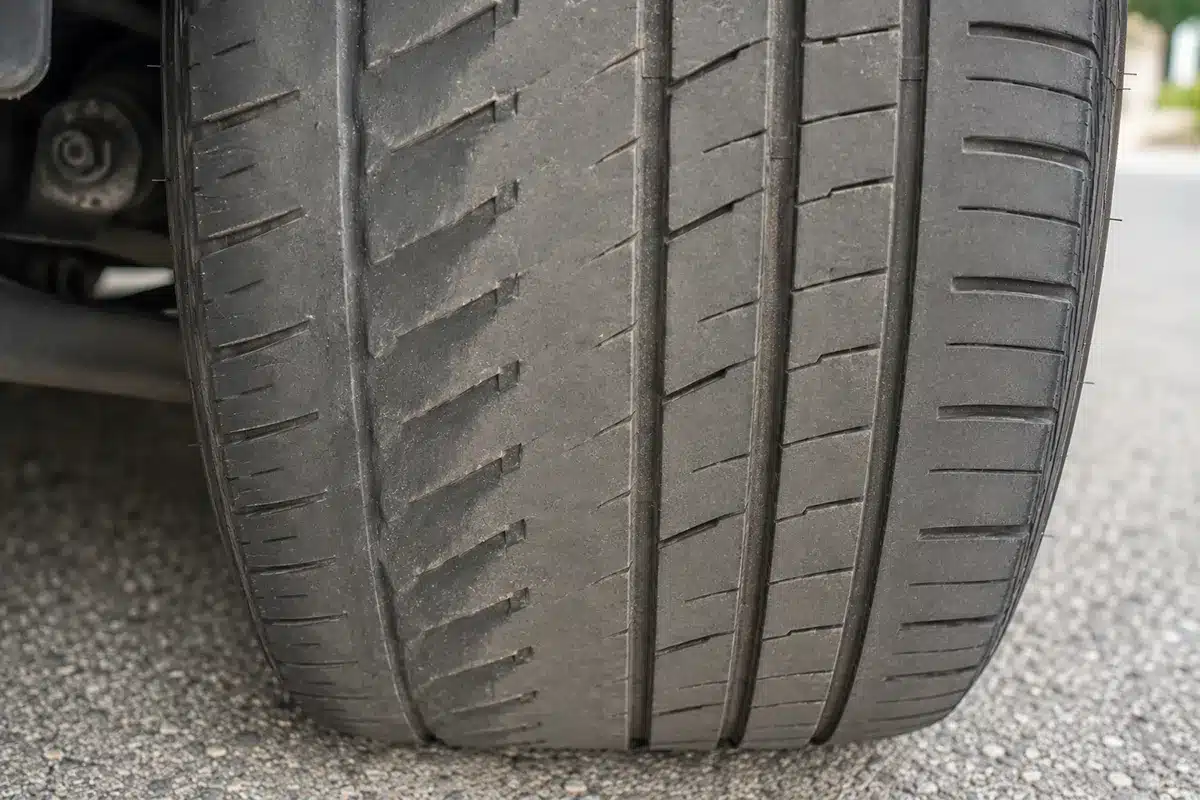
5. Feathering or Sawtooth Wear (Toe Misalignment)
What it looks like: The tread blocks or ribs are worn on one side of each block and rounded on the other side — like the edge of a saw blade. You’ll feel it more than see it. Run your hand across the tread perpendicular to the direction of travel. One direction feels sharp, the other feels smooth.
What causes it: Toe misalignment — where the tires point slightly inward (toe-in) or outward (toe-out) relative to the direction of travel. As the tire rolls forward, the tread scuffs sideways as well as forward, shaving material off one edge of each block.
Important distinction from camber wear: Feathering affects multiple ribs or rows uniformly across the width of the tread. Camber wear affects only one shoulder. If you’re not sure which you have, check whether the wear is on one side of the tire (camber) or on one side of every tread block across the full width (feathering/toe).
The fix: Four-wheel alignment, specifically a toe adjustment. This is usually the quickest alignment correction to make. Many alignment shops can fix a toe-only issue in under 30 minutes.
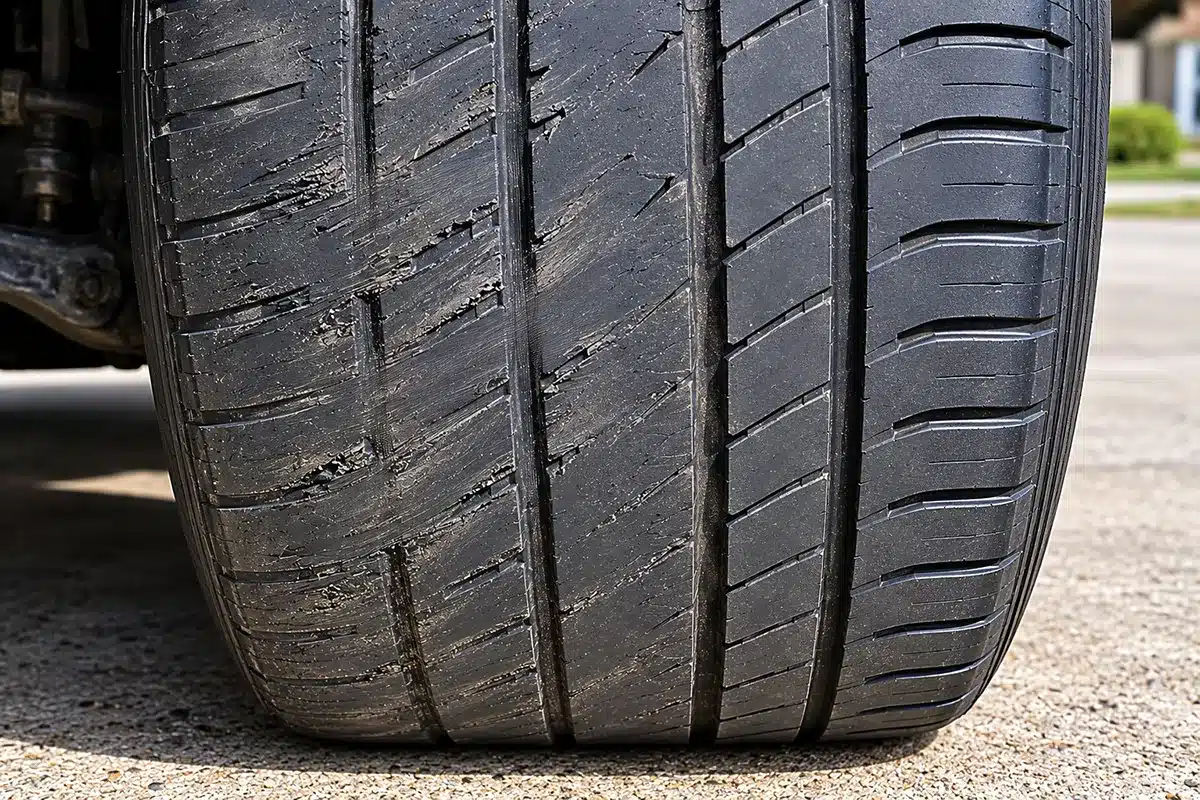
6. Diagonal Wear / Patchy Wear
What it looks like: Irregular diagonal stripes or patchy worn areas across the tire surface, not following the circumference cleanly. May look like diagonal heel-toe wear across multiple tread columns.
What causes it: This is usually a rotation neglect issue combined with a secondary factor — often slight misalignment or worn suspension. Tires that are never rotated develop their own wear characteristics based on their position (front tires wear faster under braking; drive axle tires wear under acceleration torque).
My rule of thumb: If wear looks like it doesn’t fit cleanly into one of the patterns above, it’s probably a combination issue — and the first step is always a rotation and alignment check, not just a rotation alone.
Quick Reference: Tire Wear Pattern Diagnosis Table
| Wear Pattern | Visual Clue | Root Cause | First Fix |
|---|---|---|---|
| Center wear | Middle worn, edges fine | Overinflation | Deflate to door jamb spec |
| Shoulder wear (both edges) | Edges worn, center fine | Underinflation | Inflate to door jamb spec |
| One-sided wear | Inner OR outer edge worn | Camber misalignment | Four-wheel alignment |
| Cupping / scalloping | Wavy/scooped around circumference | Worn shocks or struts | Replace shocks/struts first |
| Feathering / sawtooth | Sharp-rounded feel across tread | Toe misalignment | Four-wheel alignment |
| Patchy / diagonal | Irregular blotchy pattern | Rotation neglect + secondary factor | Rotate + alignment check |
How to Inspect Your Own Tires in 10 Minutes
You don’t need any tools for this inspection — just your eyes and hands.
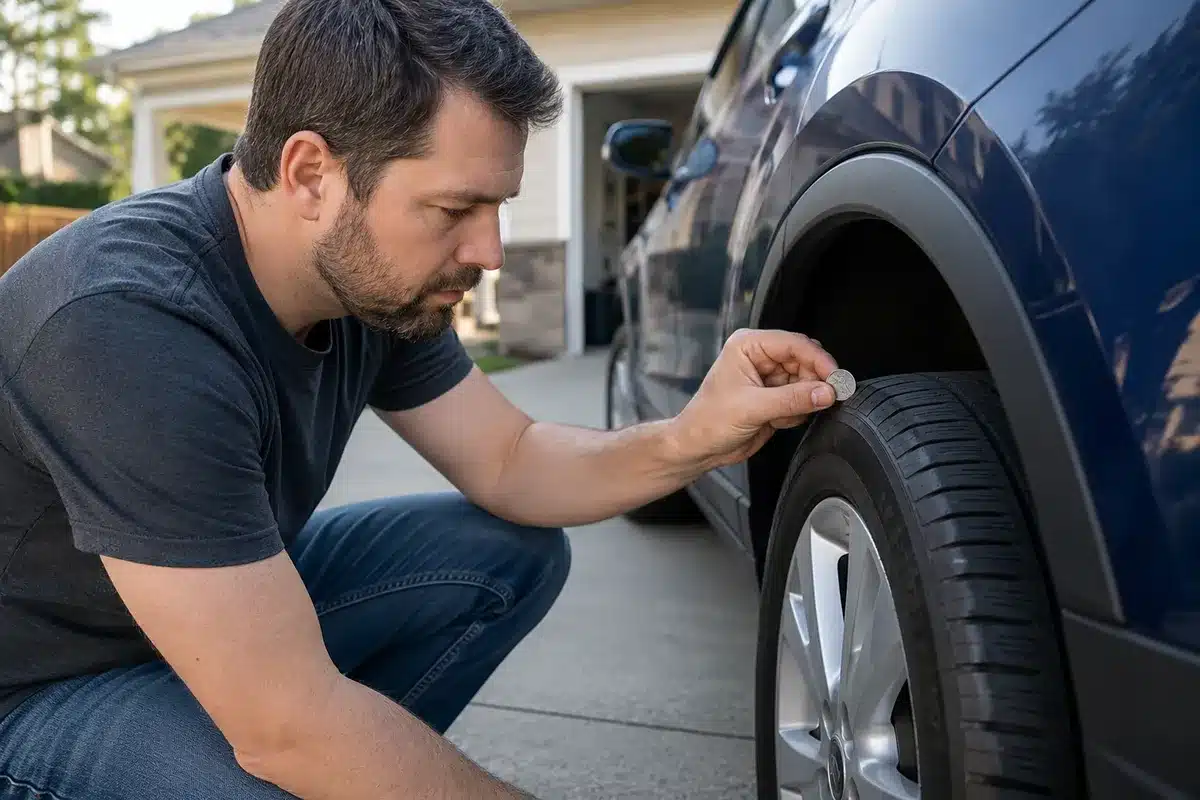
Step 1 — Check tread depth with the quarter test. Insert a U.S. quarter into the tread groove with Washington’s head pointing down. If you can see the top of Washington’s head, you’re at or below 4/32″ — time to start shopping for new tires. If you see the top of Lincoln’s head on a penny, you’re at or below 2/32″ and legally worn out in most states. I personally replace at 4/32″ or below — wet stopping distances increase significantly in that range.
Step 2 — Look at each tire from the front of the vehicle. Stand about 5 feet in front of the car and look at each front tire in turn. Does the tire look like it’s tilted at an unusual angle? Significant visible camber is an immediate alignment flag.
Step 3 — Run your hand around the circumference. With the vehicle on flat ground and the engine off, run your palm slowly around the outside of each tire. You’re feeling for waviness (cupping), sharp edges (feathering), or significantly lower areas (one-sided wear). Do this on both the outer shoulder and — if you can reach it without a lift — the inner shoulder.
Step 4 — Compare tread depth left-to-right across each tire. Use the quarter test on the inner shoulder, center rib, and outer shoulder of the same tire. If there’s more than 2/32″ variation across one tire, you have an uneven wear issue worth investigating.
Step 5 — Check tire pressure cold. “Cold” means the car has been parked for at least 3 hours or driven less than 1 mile. Inflate all four tires to the spec on the door jamb sticker — not the sidewall. Write down the date and readings. Repeat monthly.
Total time: about 10 minutes. Worth doing every time you wash your car.
When Wear Patterns Indicate Immediate Safety Concerns
Most tire wear is a gradual process — you have time to address it. But a few scenarios require immediate action:
Replace immediately if you see:
- Any tread depth at or below 2/32″ (bald tire)
- Exposed steel belts or cords (the tire carcass has been breached)
- Bulges or bubbles on the sidewall
- Cracking along the inner shoulder combined with low pressure
- Missing tread chunks or severe impact damage zones
Get to a shop within a week if you see:
- Tread depth below 4/32″ heading into fall/winter
- Visible one-sided camber wear that you can feel by hand
- Moderate cupping that’s causing road noise
Monitor and schedule service if you see:
- Minor feathering with no road noise or vibration
- Slight shoulder wear with otherwise good tread depth
- Early center wear that you’ve corrected with proper inflation
The Rotation Schedule That Actually Prevents Most Wear Problems
Most uneven wear problems I see in the field aren’t caused by catastrophic alignment failures — they’re caused by rotation neglect. Every 5,000 to 7,500 miles is the right cadence, regardless of what the tires look like.
Tires that are rotated on schedule wear so evenly that the pattern differences never become diagnostic problems.
For front-wheel-drive vehicles (which includes the majority of cars and crossovers on the road today), the front tires do the steering, braking, and driving — they wear roughly 40% faster than the rears.
Without rotation, you’ll be replacing two tires at a time rather than all four together, which creates a whole separate set of traction mismatches.
I pair my rotations with tire pressure checks. Every time I rotate, I also check the alignment readings. If I’ve driven a lot of rough roads, hit a major pothole, or notice any steering pull developing, I get an alignment check at that appointment. This has saved me from two instances of premature wear in the past three years.
Does Tire Brand or Model Affect Wear Pattern Susceptibility?
Somewhat, yes. Stiffer tread compounds tend to show wear patterns more clearly because the tread blocks don’t flex and self-correct as much. Softer performance compounds wear faster overall but sometimes mask minor misalignment.
Ultra-high-performance (UHP) summer tires are particularly sensitive to alignment — even 0.5 degrees of camber deviation will show up as measurable wear difference within 10,000 miles.
All-season touring tires from brands like Michelin, Continental, and Bridgestone are generally more forgiving of minor alignment variance — but that doesn’t mean ignoring alignment is safe. It just means the damage happens more slowly.
Budget tires sometimes show wear patterns at lower mileage, not because the patterns are more severe but because the tread depth was shallower to begin with. A tire starting with 9/32″ of tread has much less margin than one starting at 11/32″.
FAQ: Tire Wear Patterns
Can I still drive on a tire with uneven wear?
It depends on severity. Minor feathering or early shoulder wear is drivable while you schedule service. Significant camber wear, cupping down to 3/32″ or less, or any sidewall damage is not safe for extended highway driving.
Will rotating my tires fix uneven wear that’s already happened?
Rotation prevents further uneven wear but won’t undo existing damage. If one tire is significantly more worn than the others, rotation may balance out the remaining tread life — but it won’t regrow rubber. Address the root cause first.
How often should I check tire wear patterns?
Once a month, combined with a tire pressure check. Takes under 5 minutes once you know what to look for.
Is it possible to have two different wear patterns on the same tire?
Yes. I’ve seen tires with both one-sided wear (alignment problem) and feathering (toe issue) on the same tire. This usually means multiple out-of-spec alignment angles. A comprehensive four-wheel alignment printout will tell you what’s out.
Can wheel balancing affect wear patterns?
Wheel imbalance causes vibration and can contribute to cupping-like wear, but it’s usually less severe and more random than shock-related cupping. If you have road vibration at highway speeds and some tread irregularity, balance is the first thing to check — it’s cheap and often done during tire rotation.
What’s the difference between wear bars and tread depth gauges?
Wear bars are molded into the tread grooves at exactly 2/32″ — they appear as horizontal rubber bridges between tread blocks when you’re at the legal minimum. A tread depth gauge gives you an actual number at any depth. I prefer the gauge (they cost $5–$8 at any auto parts store) because I replace at 4/32″, not 2/32″, and wear bars don’t tell me when I’m there.
Final Thoughts: Your Tires Are Talking — Listen
The most expensive tire mistake I see consistently is not the decision to buy cheaper tires — it’s the decision to ignore what the tires are already telling you. A $100 alignment appointment can extend a $600 tire set by 20,000 miles. Five minutes of pressure checks per month can prevent a blowout at 75 mph.
Tire wear patterns are not a cosmetic issue. They’re your car’s diagnostic system, built into every square inch of tread rubber. Now that you know how to read them, check your tires this week. All four. Run your hand across the treads. Compare the shoulders. Check your door jamb PSI. You might be surprised what you find.
And if you’re in the market for new tires after finding worn-out rubber, check our guides on [best all-season tires], [best tires for wet roads], and [how to read tire size numbers] before you buy.
Inspected tires referenced in this article include vehicles from personal testing and real-world owner consultations. Mileage figures are approximate based on service records and wear measurements taken at the time of inspection.