
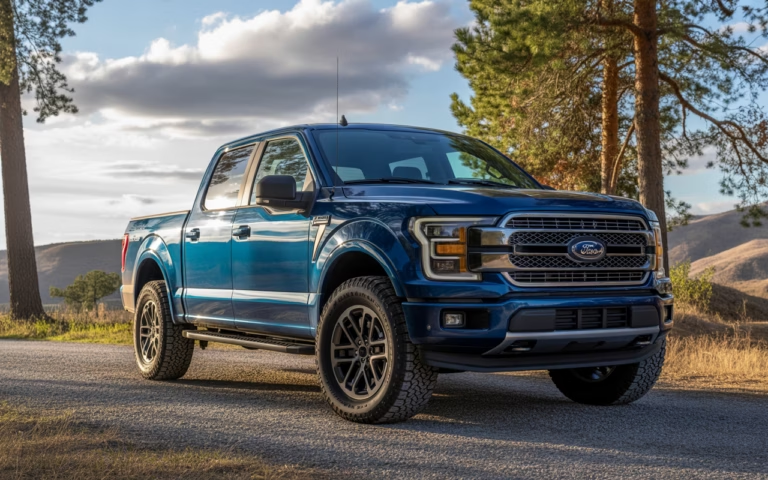
Are you getting the most out of your Ford F-150, or are your tires holding you back? Whether you’re navigating rush-hour traffic, hauling equipment to the job site, or conquering weekend trails, your truck’s performance hinges on one critical factor: the four patches of rubber connecting it to the road.
Yet with hundreds of tire options flooding the market—each promising superior performance, durability, and value—choosing the right set can feel overwhelming. Should you prioritize aggressive off-road traction or highway comfort? Is that premium tire really worth the extra cost, or will a budget option serve you just as well?
Here’s the challenge: the wrong tires can transform your capable F-150 into a noisy, inefficient, or unsafe vehicle that fails to meet your needs. They can compromise your truck’s towing capacity, reduce fuel economy, and even put you at risk during adverse weather conditions. The stakes are high, and the marketing hype doesn’t make the decision any easier.
In this comprehensive guide, we’ve done the heavy lifting for you. You’ll discover the 11 best tires for Ford F-150, complete with honest assessments of each option’s strengths and weaknesses. We’ll break down everything from all-terrain warriors and highway cruisers to specialized winter options and budget-friendly alternatives.
You’ll learn which tires excel in specific conditions, understand the key specifications that matter for your F-150, and gain practical insights on maintenance practices that extend tire life.
By the time you finish reading, you’ll have the knowledge and confidence to select the perfect tires that match your driving style, budget, and performance expectations—transforming your F-150 into the ultimate driving machine it was designed to be.
- 11 Best Tires for Ford F-150: Complete Guide for Every Driver
- Michelin Defender LTX M/S
- BFGoodrich All-Terrain T/A KO2
- Goodyear Wrangler DuraTrac
- Cooper Discoverer AT3 XLT
- Firestone Destination M/T2
- Continental TerrainContact H/T
- Bridgestone Blizzak DM-V2
- Falken Wildpeak A/T3W
- General Grabber APT
- Nitto Ridge Grappler
- Yokohama Geolandar A/T G015
- Bridgestone Dueler H/L Alenza Plus
- Continental TerrainContact A/T
- Toyo Open Country A/T III
- General Grabber ATX
- Understanding F-150 Tire Specifications: What You Need to Know
- Choosing the Best Tires for Your Ford F-150: Key Factors to Consider
- All-Terrain Tires for Your Ford F-150: The Perfect Balance
- Best Tires for Ford F-150: The Ultimate Guide for Truck Owners
- Off-Road Tires for the F-150: When the Adventure Calls
- Winter Tires for Your Ford F-150: Complete Cold Weather Guide
- Budget-Friendly Performance: Quality F-150 Tires Under $150
- Premium Tire Options for Your Ford F-150: Luxury Meets Performance
- Maximize Your F-150 Tire Lifespan: Essential Maintenance Tips
- Decoding the Tire Language: Understanding F-150 Tire Specifications
- Overcoming Common Tire Issues with Your Ford F-150
- When Should You Replace Your Ford F-150 Tires?
- Final Recommendations Based on Use Cases
- FAQs About Ford F-150 Tires
11 Best Tires for Ford F-150: Complete Guide for Every Driver
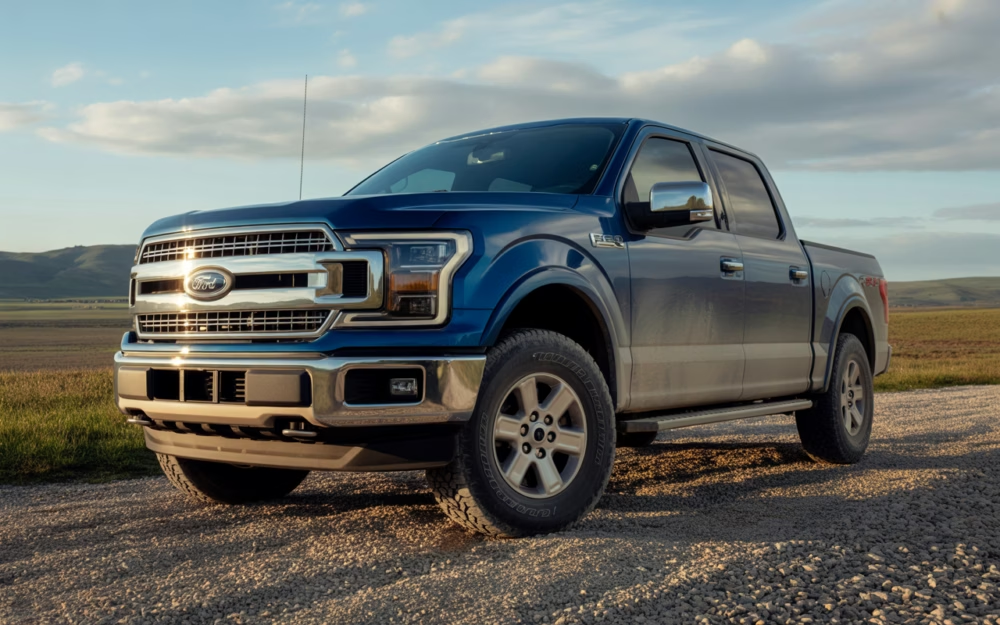
The Ford F-150 stands as America’s best-selling truck for good reason. Its versatility demands equally versatile tires that can handle everything from job sites to family road trips. Finding the perfect tire match for your F-150 depends on your driving habits, local climate, and budget considerations.
As a truck owner, you need tires that complement your vehicle’s capabilities rather than limit them. This comprehensive guide examines the 11 best tire options across various categories—all-terrain, highway, mud-terrain, all-season, and winter-specific models—to help you make an informed decision.
Each recommendation includes detailed pros and cons, performance characteristics, and price considerations. Whether you’re a contractor who needs maximum traction on rough terrain or a daily commuter seeking comfort and fuel efficiency, this guide will help you find the perfect tire match for your Ford F-150.
Michelin Defender LTX M/S
Best Overall Highway Tire
- It is best for a wet road
- It is super comfortable and quiet on the road
- It has an extended tread life
- Boasts of a good braking system
- Good tread pattern
- It is available in different sizes
- Ideal for all-season operation
- Very strong and durable
- Compatible with many car models
Price Check
Check the price of this tire at the following retailers:
TireRack SimpleTire PriorityTire DiscountedWheelWarehouse AmazonDon’t know the correct size tire to purchase? Start here!
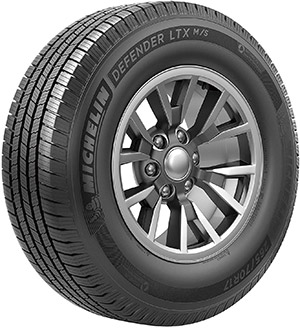
The Michelin Defender LTX M/S represents the gold standard for highway-focused F-150 owners. This premium tire delivers exceptional tread life with a 70,000-mile warranty that justifies its higher price point.
On the road, the Defender provides a quiet, comfortable ride with precise steering response that makes your truck feel more nimble than its size suggests. The tire’s EverTread compound maintains grip even as the tire ages, while its advanced siping patterns create excellent wet traction without sacrificing dry performance.
For F-150 owners who spend most of their time on paved roads but occasionally venture onto gravel driveways or construction sites, the Defender offers just enough off-road capability without compromising its primary highway strengths.
Pros:
- Outstanding tread life (70,000-mile warranty)
- Excellent wet and dry traction
- Reduced road noise compared to competitors
- Good fuel economy for a truck tire
Cons:
- Premium price point ($200-250 per tire)
- Limited capability in deep snow or mud
- Stiffer ride than some competitors
BFGoodrich All-Terrain T/A KO2
Best All-Terrain Tire
- Highly popular all-terrain tire known for its performance both on and off-road
- It has an aggressive tread pattern designed for traction in various conditions
- Off-road performance is exceptional, with high traction on loose surfaces like dirt, gravel, and mud
- On-road handling is impressive, offering responsive handling, strong grip on both dry and wet pavement, and minimal road noise
- Ride comfort is also good, with the tire providing a smooth and quiet ride on city streets and highways
Price Check
Check the price of this tire at the following retailers:
TireRack SimpleTire PriorityTire DiscountedWheelWarehouse AmazonDon’t know the correct size tire to purchase? Start here!
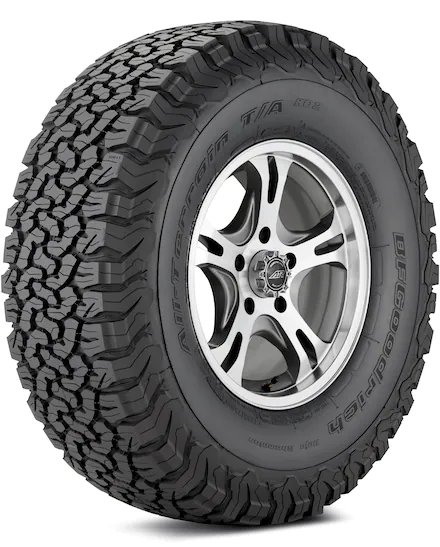
The BFGoodrich All-Terrain T/A KO2 has earned its reputation as the benchmark all-terrain tire for the F-150. These tires feature an aggressive tread pattern with interlocking tread blocks that provide excellent off-road traction while maintaining reasonable on-road manners.
What sets the KO2 apart is its CoreGard technology, which strengthens the sidewalls against punctures and splits—a common failure point in off-road situations. The tire’s serrated shoulder design helps it dig into soft surfaces like sand and mud, while the tread pattern is optimized to eject stones and prevent drilling.
F-150 owners report that these tires maintain their performance characteristics even after significant wear, unlike competitors that quickly lose their off-road capabilities as they age.
Pros:
- Excellent off-road traction in various conditions
- Reinforced sidewalls resist damage
- 50,000-mile warranty
- Three-peak mountain snowflake rating for winter performance
Cons:
- More road noise than highway tires
- Slight reduction in fuel economy
- Moderate price premium ($190-230 per tire)
Goodyear Wrangler DuraTrac

Best for Mixed Terrain
- All-terrain tire for trucks and SUVs, balancing off-road performance with on-road comfort
- Aggressive tread design for superior traction on loose surfaces
- Reinforced construction for enhanced durability and puncture resistance
- Excellent off-road capabilities in mud, rocks, and sand
- Surprisingly comfortable and quiet on-road performance
- Competes well against other popular all-terrain tires
Price Check
Check the price of this tire at the following retailers:
TireRack SimpleTire PriorityTire AmazonDon’t know the correct size tire to purchase? Start here!
The Goodyear Wrangler DuraTrac hits a sweet spot for F-150 owners who regularly transition between highway driving and moderate off-road use. These tires feature a self-cleaning tread design that prevents mud and snow buildup, maintaining traction in challenging conditions.
The DuraTrac’s TractiveGroove Technology provides additional traction in deep snow and mud, while the tire’s highly angled center tread blocks enhance stability during highway driving. The tire carries the Three-Peak Mountain Snowflake symbol, indicating it meets severe snow service requirements.
For contractors and outdoor enthusiasts, the DuraTrac offers a compelling balance of on-road comfort and off-road capability without the extreme compromises of dedicated mud-terrain tires.
Pros:
- Versatile performance across multiple surfaces
- Excellent winter traction
- Relatively quiet for an aggressive tire
- Durable construction with rim protector
Cons:
- Shorter tread life than premium highway tires (50,000-mile warranty)
- Can feel stiff on rough pavement
- Moderate price ($180-220 per tire)
Cooper Discoverer AT3 XLT
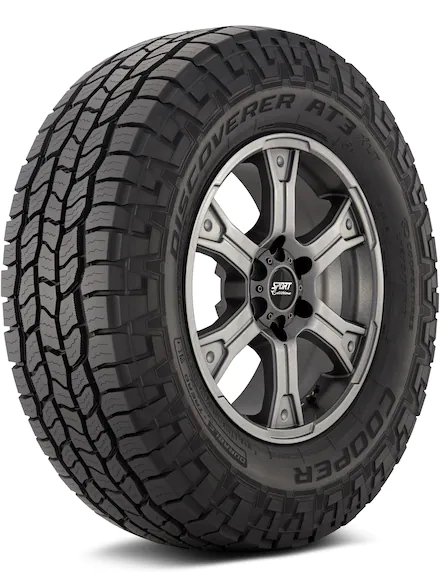
Best Value All-Terrain
- All-terrain tire for pickup trucks, SUVs, and light-duty vehicles
- Aggressive tread pattern for on-road and off-road performance
- Armor-Tek3 construction for enhanced durability and cut/chip resistance
- Stable-Trac technology for improved stability and handling
- Good on-road performance in dry and wet conditions
- Relatively quiet and comfortable for an all-terrain tire
- Excellent off-road capability in mud, rocks, and dirt
- Decent snow and ice performance, but not a dedicated winter tire
Price Check
Check the price of this tire at the following retailers:
TireRack PriorityTire SimpleTire AmazonDon’t know the correct size tire to purchase? Start here!
The Cooper Discoverer AT3 XLT delivers impressive all-terrain performance at a more accessible price point than premium competitors. Designed specifically for light trucks like the F-150, these tires feature Cooper’s Durable-Tread Technology that resists chipping and tearing on gravel roads.
The AT3 XLT includes Cooper’s Whisper Grooves that reduce road noise—a common complaint with all-terrain tires. The tire’s Stable-Trac technology increases footprint stability, improving traction and handling in both on and off-road situations.
F-150 owners particularly appreciate the tire’s stone ejector ledges that prevent rocks from lodging in the tread and causing damage over time.
Pros:
- Excellent value ($160-190 per tire)
- 60,000-mile treadwear warranty
- Quieter than most all-terrain options
- Good balance of on/off-road performance
Cons:
- Less aggressive in mud than specialized options
- Sidewalls not as puncture-resistant as premium alternatives
- Winter performance lags behind top competitors
Firestone Destination M/T2

Best Mud-Terrain Tire
- All-terrain, mud-terrain tire for trucks, SUVs, and off-road enthusiasts
- Aggressive tread pattern with deep, interlocking blocks for superior off-road traction
- Reinforced construction for durability and puncture resistance
- Relatively quiet and comfortable on-road performance
- Excellent for muddy trails, rocky paths, and loose gravel
- Balances off-road capability with daily driving performance
Price Check
Check the price of this tire at the following retailers:
TireRack SimpleTire PriorityTire DiscountedWheelWarehouse AmazonDon’t know the correct size tire to purchase? Start here!
For F-150 owners who regularly tackle serious off-road challenges, the Firestone Destination MT2 offers exceptional performance in mud, rocks, and loose terrain. These tires feature an aggressive tread pattern with 23-degree attack angles that provide forward bite in challenging conditions.
The MT2’s 3-ply sidewall construction offers superior resistance to punctures and cuts, while the stone and mud rejector design helps maintain traction by preventing buildup between lugs. The tire’s shoulder lugs extend down the sidewall, providing additional grip when aired down for extreme terrain.
While these tires make significant compromises in on-road comfort and noise, they deliver the off-road performance that serious adventurers demand.
Pros:
- Exceptional traction in mud, sand, and rocks
- Durable 3-ply sidewall construction
- Aggressive aesthetic complements lifted trucks
- Good value compared to premium mud tires
Cons:
- Significant road noise on highways
- Reduced fuel economy
- No mileage warranty
- Moderate price ($200-240 per tire)
Continental TerrainContact H/T

Best for Comfort
- Premium highway terrain tire for trucks and SUVs
- Advanced tread compound and unique pattern for versatile performance
- Excellent on-road handling in dry and wet conditions
- Good traction in light snow and mild off-road situations
- Quiet and comfortable ride on paved surfaces
- Reinforced construction for improved puncture resistance
- Suitable for daily driving with occasional light off-road use
- Offers a good balance of performance, comfort, and fuel efficiency
Price Check
Check the price of this tire at the following retailers:
TireRack SimpleTire PriorityTire DiscountedWheelWarehouse AmazonDon’t know the correct size tire to purchase? Start here!
The Continental TerrainContact H/T prioritizes on-road comfort and quiet performance while maintaining the durability F-150 owners expect. These highway-terrain tires feature Continental’s TractionPlus Technology that balances wet traction and tread life.
What distinguishes the TerrainContact is its exceptionally smooth and quiet ride. The tire’s computer-optimized tread pattern and sound-absorbing technology make it noticeably quieter than competitors. The tread design includes full-depth sipes that maintain wet traction even as the tire wears.
For F-150 owners who primarily use their trucks for family transportation and commuting, the TerrainContact delivers a near-luxury driving experience.
Pros:
- Exceptionally quiet and comfortable ride
- 70,000-mile treadwear warranty
- Excellent wet traction
- Good fuel economy
Cons:
- Limited off-road capability
- Premium price point ($190-230 per tire)
- Less aggressive styling than other truck tires
Bridgestone Blizzak DM-V2
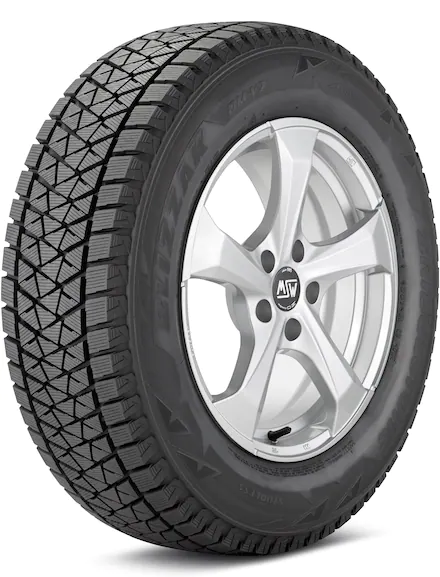
Best Winter Tire
- Dedicated winter tire for SUVs, crossovers, and light trucks
- Exceptional traction on snow, ice, and cold weather conditions
- Directional tread pattern for efficient snow/water evacuation
- Excellent grip and braking on slippery surfaces
- Good performance on dry and wet roads
- Relatively comfortable and quiet for a winter tire
- Suitable for a wide variety of SUVs and light trucks
Price Check
Check the price of this tire at the following retailers:
TireRack SimpleTire PriorityTire DiscountedWheelWarehouse AmazonDon’t know the correct size tire to purchase? Start here!
F-150 owners in severe winter climates need specialized winter tires, and the Bridgestone Blizzak DM-V2 sets the standard for cold-weather performance. These tires feature Bridgestone’s NanoPro Tech Multicell compound that includes microscopic bite particles and hydrophilic properties that improve grip on ice and snow.
The Blizzak’s directional tread pattern with 3D zigzag sipes creates thousands of edges for snow traction, while the tire’s wide circumferential grooves efficiently evacuate slush and water to prevent hydroplaning.
Unlike all-season or all-terrain options with winter ratings, the Blizzak is engineered specifically for cold temperatures, providing superior braking and cornering in winter conditions.
Pros:
- Exceptional snow and ice traction
- Superior cold-weather braking
- Stable handling in winter conditions
- Reasonable price for specialized performance ($170-200 per tire)
Cons:
- Must be removed during warm seasons
- No treadwear warranty
- Storage requirement when not in use
- Soft compound wears quickly on dry pavement
Falken Wildpeak A/T3W

Best All-Terrain for Snow
- All-terrain tire for trucks, SUVs, and off-road vehicles
- Balances on-road comfort with off-road capability
- Advanced tread compound resists cutting, chipping, and tearing
- Deep interlocking sipes and grooves for enhanced traction
- Reinforced construction with 3-ply sidewall for durability
- Excellent performance in mud, rock, sand, and dirt
- Good on-road handling and wet traction
- Quiet and comfortable ride for an all-terrain tire
Price Check
Check the price of this tire at the following retailers:
TireRack PriorityTire SimpleTire AmazonDon’t know the correct size tire to purchase? Start here!
The Falken Wildpeak AT3W has earned a reputation as an all-terrain tire that excels in winter conditions. Carrying the Three-Peak Mountain Snowflake rating, these tires feature an optimized tread design with 3D Canyon sipes that maintain stability even as the tread wears.
What distinguishes the Wildpeak is its heat diffuser technology in the lower sidewall that protects the internal tire components, particularly important when driving with heavy loads or towing. The tire’s silica-enriched compound maintains flexibility in cold temperatures, providing consistent winter performance.
For F-150 owners in variable climates who don’t want to switch between seasonal tires, the Wildpeak offers true year-round versatility.
Pros:
- Excellent snow performance for an all-terrain tire
- 55,000-mile warranty
- Aggressive appearance without excessive road noise
- Competitive pricing ($160-190 per tire)
Cons:
- Not quite as capable in deep mud as specialized options
- Slightly firmer ride than premium highway tires
- Less fuel-efficient than highway-focused alternatives
General Grabber APT

Best All-Purpose Tire
- Versatile all-terrain tires designed for balanced on-road comfort and off-road capability
- Offers good traction on various surfaces, including mud, gravel, and light snow
- Engineered for smooth on-road performance and reduced road noise
- Provides good handling and stability in both dry and wet conditions
- Decent performance in light snow, but not a dedicated winter tire
- Excels in off-road conditions like loose surfaces, rock crawling, and mud
- Balances fuel efficiency with off-road capability
Price Check
Check the price of this tire at the following retailers:
TireRack SimpleTire PriorityTire AmazonDon’t know the correct size tire to purchase? Start here!
The General Grabber APT (All-Purpose Terrain) strikes an effective balance between highway comfort and light off-road capability. These tires feature General’s DuraGen technology that enhances tread life and durability across multiple surfaces.
The Grabber APT’s Comfort Balance Technology uses an absorption layer beneath the tread to reduce vibration and road noise, creating a smoother ride than typical all-terrain tires. The tire’s StabiliTread Technology provides a wider, flatter footprint that improves treadwear and handling.
F-150 owners appreciate the Grabber’s year-round versatility and approachable price point, making it an excellent choice for those who need occasional off-road capability without sacrificing daily driving comfort.
Pros:
- Good balance of on and off-road performance
- 60,000-mile warranty
- Competitive price point ($140-170 per tire)
- Quieter than traditional all-terrain tires
Cons:
- Less aggressive in mud than dedicated all-terrain options
- Winter performance adequate but not exceptional
- Sidewall durability less robust than premium options
Nitto Ridge Grappler

Best Hybrid Terrain Tire
- Versatile all-terrain tire for light trucks, SUVs, and crossovers
- Performs well in various conditions: wet roads, muddy trails, snow, and ice
- Comfortable and quiet ride despite aggressive design
- Durable construction with reinforced sidewalls and cut-chip resistant compound
- Good balance of off-road capability and on-road manners
- Handles well in mud, rocks, sand, and snow
Price Check
Check the price of this tire at the following retailers:
TireRack SimpleTire PriorityTire DiscountedWheelWarehouse AmazonDon’t know the correct size tire to purchase? Start here!
The Nitto Ridge Grappler pioneered the “hybrid terrain” category, blending mud-terrain capability with all-terrain road manners. These tires feature alternating shoulder blocks that provide off-road traction while reducing on-road noise—a common complaint with aggressive tires.
The Ridge Grappler’s variable pitch tread pattern creates a unique sound signature that’s noticeably quieter than traditional mud-terrain tires. The tire’s reinforced block foundations increase rigidity for improved handling, while the staggered shoulder lugs provide additional off-road bite.
For F-150 owners seeking aggressive styling and capability without unbearable highway noise, the Ridge Grappler offers a compelling compromise.
Pros:
- Aggressive appearance with better road manners than mud tires
- Excellent traction in mud, sand, and rocks
- Quieter than traditional mud-terrain tires
- Reinforced sidewalls for off-road durability
Cons:
- No mileage warranty
- Premium pricing ($220-260 per tire)
- Still noisier than all-terrain alternatives
- Reduced fuel economy compared to highway tires
Yokohama Geolandar A/T G015
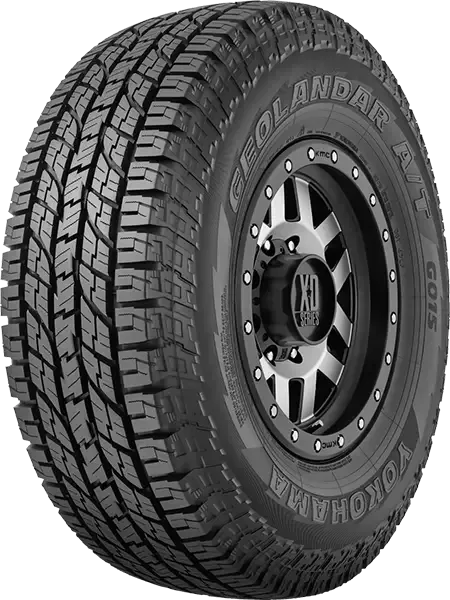
Best for Fuel Economy
- All-terrain tire for light trucks, SUVs, and crossovers
- Balances on-road comfort with off-road capability
- Aggressive tread design with deep grooves for enhanced traction
- Optimized for wet performance and hydroplaning resistance
- Durable construction with three-ply polyester casing
- Mountain Snowflake symbol for severe snow performance
- Good off-road performance on mud, rocks, and sand
- Smooth and quiet on-road ride
Price Check
Check the price of this tire at the following retailers:
TireRack SimpleTire PriorityTire DiscountedWheelWarehouse AmazonDon’t know the correct size tire to purchase? Start here!
The Yokohama Geolandar A/T G015 addresses a common concern among F-150 owners—fuel economy. These all-terrain tires feature Yokohama’s EnduroCore Construction and optimized tread pattern that reduces rolling resistance without sacrificing capability.
The Geolandar’s EdgeTech Grooves create additional biting edges for off-road traction, while the tire’s Triple 3D sipes maintain winter performance throughout the tire’s life. The tire carries a 60,000-mile treadwear warranty and the Three-Peak Mountain Snowflake symbol for winter certification.
Independent testing confirms that the Geolandar typically delivers 1-2 mpg better fuel economy than most aggressive all-terrain competitors, making it ideal for F-150 owners who cover significant highway miles.
Pros:
- Better fuel economy than most all-terrain tires
- 60,000-mile warranty
- Good snow traction with winter certification
- Reasonable price point ($160-190 per tire)
Cons:
- Less aggressive in mud than some competitors
- Sidewalls more vulnerable to punctures than premium options
- Slightly firmer ride on rough pavement
- Conservative styling compared to other all-terrain options
Bridgestone Dueler H/L Alenza Plus
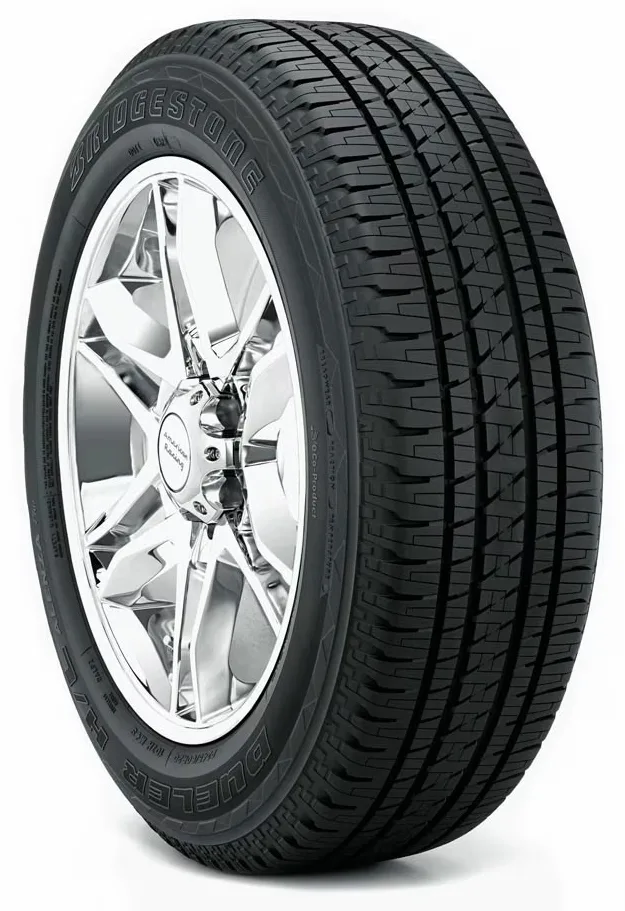
Best for Comfort and Quiet
- Premium all-season tire for SUVs and crossovers
- Advanced tread design for improved traction and handling
- Symmetric tread pattern with silica-enhanced compound
- Quiet and smooth ride with reliable dry/wet traction
- Good performance in all seasons, not for extreme winter
- Balanced performance, comfort, and durability
- Suitable for various popular SUV and truck models
- Emphasis on long-lasting tread life and even wear
Price Check
Check the price of this tire at the following retailers:
TireRack SimpleTire PriorityTire DiscountedWheelWarehouse AmazonDon’t know the correct size tire to purchase? Start here!
The Bridgestone Dueler H/L Alenza Plus prioritizes on-road comfort, making it ideal for F-150 owners who use their trucks primarily as daily drivers or for long highway trips.
Pros:
- Exceptionally quiet and smooth ride
- Excellent wet and dry traction on paved surfaces
- Superior tread life with 80,000-mile warranty
- Good fuel economy
- Responsive handling for a truck tire
Cons:
- Limited off-road capability
- Average performance in snow conditions
- Premium price point
The Alenza Plus uses Bridgestone’s NanoPro-Tech rubber compound that reduces rolling resistance while maintaining grip, contributing to better fuel economy. Its symmetric tread pattern with wide circumferential grooves provides excellent water evacuation, reducing hydroplaning risk during heavy rain.
Continental TerrainContact A/T

Best Fuel-Efficient All-Terrain
- It provides balanced performance for both on-road and off-road driving
- The tire features TractionPlus technology which ensures superior grip and control on various surfaces, including mud and gravel
- EcoPlus technology enhances fuel economy
- ComfortRide technology guarantees a comfortable and smooth ride
- It is equipped with full-depth sipes, enabling it to maintain its performance as the tread wears down over time
Price Check
Check the price of this tire at the following retailers:
TireRack SimpleTire PriorityTire DiscountedWheelWarehouse AmazonDon’t know the correct size tire to purchase? Start here!
The Continental TerrainContact A/T offers a unique combination of all-terrain capability and fuel efficiency, making it ideal for F-150 owners concerned about gas mileage.
Pros:
- Excellent fuel economy for an all-terrain tire
- Very comfortable and quiet on-road
- Good wet traction and hydroplaning resistance
- Capable in light off-road conditions
- 60,000-mile warranty
Cons:
- Less aggressive than competitors in deep mud or loose terrain
- Premium price point
- Not as rugged in appearance as more aggressive options
The TerrainContact uses Continental’s TractionPlus technology with an open tread pattern that provides off-road grip while maintaining on-road comfort. Its +Silane enhanced tread compound improves wet traction while reducing rolling resistance, helping to minimize the fuel economy penalty typically associated with all-terrain tires.
Toyo Open Country A/T III

Best for Balanced Performance
- Designed for trucks, SUVs, and crossovers, blending on-road comfort with off-road capability
- Features improvements in tread life, wet performance, comfort, and off-road traction
- Balances on-road manners and off-road performance with an all-season tread compound and pattern
- Delivers excellent traction in mud, snow, and rain thanks to an aggressive tread pattern and siping
- Offers a smooth, quiet ride with minimized road noise and vibrations
- Robust off-road performance in varied terrains including rocks, dirt, and sand
Price Check
Check the price of this tire at the following retailers:
TireRack SimpleTire PriorityTire DiscountedWheelWarehouse AmazonDon’t know the correct size tire to purchase? Start here!
The Toyo Open Country A/T III delivers well-rounded performance across various conditions, making it an excellent choice for F-150 owners who need versatility.
Pros:
- Excellent balance of on-road comfort and off-road capability
- Three-Peak Mountain Snowflake rating for winter performance
- Good tread life with 65,000-mile warranty
- Relatively quiet for an all-terrain tire
- Aggressive styling without extreme compromises
Cons:
- Not as specialized as some competitors in extreme conditions
- Slightly higher price than some comparable options
- Can feel stiff on smooth pavement
The Open Country A/T III features 3D multi-wave sipes that provide biting edges for snow traction while maintaining block stiffness for handling. Its staggered shoulder lugs provide off-road traction while the optimized tread pattern controls noise on highways, making it ideal for F-150 owners who want one tire that performs well across various conditions.
General Grabber ATX

Best Budget All-Terrain
- All-terrain tire designed for off-road capability and on-road comfort
- Aggressive tread pattern with deep grooves for various terrains
- Strong performance in mud, rocks, sand, and light snow
- Decent on-road handling and wet traction
- Good snow and ice performance for an all-terrain tire
- Surprisingly fuel-efficient for its category
- Balances off-road capability with on-road comfort and performance
Price Check
Check the price of this tire at the following retailers:
TireRack SimpleTire PriorityTire DiscountedWheelWarehouse AmazonDon’t know the correct size tire to purchase? Start here!
The General Grabber ATX offers impressive all-terrain performance at a more affordable price point, making it an excellent value option for F-150 owners.
Pros:
- Exceptional value for the performance
- Good off-road traction in various conditions
- Three-Peak Mountain Snowflake rating for winter use
- Durable construction with cut and chip resistance
- 60,000-mile warranty
Cons:
- Slightly more road noise than premium competitors
- Not as refined in on-road handling
- Less aggressive in deep mud than specialized options
The Grabber ATX features General’s DuraGen technology that enhances tread strength and durability, while its five-row tread pattern provides versatile traction across different surfaces. The tire includes stone bumpers that help eject rocks and prevent stone drilling, extending tread life during gravel road use.
Understanding F-150 Tire Specifications: What You Need to Know
When shopping for new tires for your Ford F-150, understanding the correct specifications is crucial for safety, performance, and longevity. The F-150 lineup offers various trims and configurations, each potentially requiring different tire specifications.
Stock Tire Sizes by F-150 Model/Trim
The Ford F-150 comes with different tire sizes depending on the trim level and model year:
- F-150 XL/XLT: Typically equipped with 245/70R17 or 265/70R17
- F-150 Lariat: Often comes with 275/65R18 or 275/55R20
- F-150 King Ranch/Platinum: Usually fitted with 275/55R20 or 285/45R22
- F-150 Raptor: Features larger 315/70R17 or 35-inch all-terrain tires
- F-150 Lightning (Electric): Equipped with 275/60R20 all-season tires
Always check your vehicle’s driver-side door jamb sticker or owner’s manual for the exact specifications recommended for your specific truck.
Load Rating Requirements
F-150 owners should pay close attention to load ratings when selecting tires:
- Light-Duty Use (Daily Driving): Look for tires with load index ratings of 109-116 (2,271-2,756 lbs per tire)
- Medium-Duty Use (Occasional Towing/Hauling): Consider tires with load index ratings of 117-121 (2,833-3,197 lbs per tire)
- Heavy-Duty Use (Frequent Towing/Maximum Payloads): Opt for tires with load index ratings of 122 or higher (3,307+ lbs per tire)
The F-150’s half-ton classification means your tires should be able to handle significant weight, especially if you regularly tow or haul heavy loads. LT (Light Truck) designated tires typically offer higher load capacities than P (Passenger) tires.
Speed Rating Considerations
Speed ratings indicate the maximum sustainable speed for a tire under ideal conditions:
- S-Rated (112 mph): Sufficient for most F-150 work trucks
- T-Rated (118 mph): Good for general-purpose trucks
- H-Rated (130 mph): Suitable for higher-performance F-150 models
- V-Rated (149 mph): Found on sport-oriented trucks like the F-150 Tremor
While most F-150 owners won’t approach these speeds, higher speed ratings often correlate with better handling characteristics and heat resistance, which can be beneficial for highway driving or when towing.
Seasonal Considerations for F-150 Owners
Your location and driving conditions should influence your tire selection:
- All-Season Tires: Ideal for F-150 owners in moderate climates with occasional light snow
- All-Terrain Tires: Best for those who split time between highways and off-road trails
- Mud-Terrain Tires: Recommended for serious off-roading but compromise on-road comfort and noise
- Winter/Snow Tires: Essential for F-150 owners in regions with heavy snowfall and freezing temperatures
For those in variable climates, consider having two sets of tires: all-terrain or highway tires for warmer months and dedicated winter tires for the cold season. This approach maximizes safety and performance year-round while extending the life of both tire sets.
Remember that proper tire maintenance, including regular rotation, alignment checks, and maintaining correct tire pressure, will extend the life of whichever tires you choose for your F-150.
Choosing the Best Tires for Your Ford F-150: Key Factors to Consider
When it comes to selecting the perfect tires for your Ford F-150, there’s no one-size-fits-all solution. Your ideal tire depends on several critical factors that reflect your specific driving needs and preferences. Before diving into our recommendations, let’s examine the key considerations that should guide your tire purchase decision.
Driving Conditions: Highway vs. Off-Road
The environments where you typically drive your F-150 should heavily influence your tire selection. If you’re primarily a highway driver, you’ll want tires that offer smooth, quiet performance with excellent fuel efficiency and long tread life. Highway tires typically feature more rigid construction and tread patterns designed for stability at higher speeds.
Conversely, if your F-150 regularly ventures off the beaten path, you’ll need tires with aggressive tread patterns, reinforced sidewalls, and enhanced grip capabilities. Off-road tires provide better traction on loose surfaces like mud, gravel, and sand, though this often comes at the expense of on-road comfort and noise levels.
Many F-150 owners find themselves somewhere in the middle, needing tires that perform well on pavement but can handle occasional off-road excursions. All-terrain tires offer this versatility, though they represent a compromise between specialized highway and off-road options.
Towing and Hauling Requirements
Your F-150’s workload should significantly impact your tire choice. If you regularly tow trailers or haul heavy loads, you’ll need tires with higher load ratings and enhanced stability features. Look for tires specifically designed with reinforced construction that can handle additional weight without excessive flexing or heat buildup.
For serious towing applications, consider tires with “LT” (Light Truck) designations rather than “P” (Passenger) tires, as they’re built with stronger materials and can safely handle heavier loads. Pay close attention to the load index number, which indicates how much weight each tire can support.
Weather and Seasonal Considerations
Your local climate plays a crucial role in determining the ideal tire for your F-150. If you live in an area with severe winters, dedicated winter tires with specialized rubber compounds that remain flexible in cold temperatures and tread patterns designed to grip snow and ice may be necessary.
For regions with mild winters but varied conditions, all-season tires provide year-round performance without the need to swap tires seasonally. Those in predominantly warm, dry climates might prefer summer tires that maximize grip and handling in hot conditions.
Wet weather performance is another important consideration – look for tires with effective water evacuation channels to prevent hydroplaning if you frequently drive in rainy conditions.
Budget Considerations
Tires represent a significant investment, with prices varying dramatically based on size, type, and brand. While premium tires often offer superior performance and longevity, there are excellent mid-range options that provide a better balance of quality and affordability.
When evaluating cost, consider the tire’s expected lifespan (typically measured in miles) rather than just the upfront price. A more expensive tire that lasts 20,000 miles longer than a budget option may actually provide better value over time. Additionally, factor in the potential fuel economy impacts – some tires are specifically designed to reduce rolling resistance and improve gas mileage.
Noise Level Preferences
Tire noise can significantly impact your driving experience, especially during highway travel. Generally, aggressive off-road tires generate more road noise due to their chunky tread patterns, while highway-focused tires offer quieter operation.
Many modern premium tires incorporate noise-reduction technologies like specialized tread patterns, sound-absorbing materials, and optimized pitch sequences. If you value a quiet cabin, prioritize tires marketed with noise-reduction features and read user reviews specifically addressing noise levels.
Remember that your ideal tire represents a balance of these factors based on your unique driving needs. With these considerations in mind, you’ll be better equipped to evaluate our upcoming tire recommendations for your Ford F-150.
All-Terrain Tires for Your Ford F-150: The Perfect Balance
All-terrain tires represent the sweet spot for many F-150 owners who need versatility without sacrificing too much in any one area. These tires are engineered to deliver reliable performance both on highways and when venturing off the beaten path.
The popularity of all-terrain tires among F-150 owners stems from their remarkable adaptability. With aggressive tread patterns that aren’t as extreme as mud tires but more capable than highway tires, they offer a balance that suits the diverse driving needs of most truck owners.
All-terrain tires typically feature reinforced sidewalls to resist punctures on rough terrain, interlocking tread elements for improved traction in loose conditions, and specialized compounds that resist chipping and tearing when driving over rocks and other sharp objects. Many modern all-terrain tires also incorporate technology to reduce road noise – historically a drawback of this tire type.
For F-150 owners who occasionally venture off-road but spend most driving time on paved surfaces, all-terrain tires make perfect sense. They provide significantly improved off-road capability compared to standard highway tires while maintaining reasonable fuel economy and acceptable road noise levels.
Popular brands in this category include BFGoodrich with their iconic KO2 tires, Goodyear’s Wrangler series, Cooper’s Discoverer AT3, and Falken’s Wildpeak AT3W. Each offers slightly different performance characteristics, with some prioritizing on-road comfort while others lean toward off-road capability.
The tread life of quality all-terrain tires typically ranges from 50,000-60,000 miles, representing a good value proposition for F-150 owners. While they generally cost more than standard highway tires, their versatility and durability often justify the additional investment, especially for those who use their trucks for both work and recreation.
When properly maintained and rotated regularly, all-terrain tires provide F-150 owners with confidence across a wide range of driving conditions – from daily commutes to weekend adventures – without requiring a dedicated set of specialized tires for different activities.
Best Tires for Ford F-150: The Ultimate Guide for Truck Owners
The Ford F-150 stands as America’s most popular pickup truck for good reason. Its versatility, power, and reliability make it a favorite for both work and play. However, even the best truck is only as good as the rubber it rides on. Selecting the right tires for your F-150 can dramatically improve its performance, fuel efficiency, and overall driving experience.
Whether you’re a daily commuter, weekend warrior, or serious off-roader, your tire needs will vary significantly. This comprehensive guide breaks down the 11 best tire options for Ford F-150 owners across various categories, helping you make an informed decision that matches your driving style, regional weather conditions, and budget considerations.
From all-terrain warriors to highway cruisers, we’ve evaluated the top contenders based on performance, durability, comfort, and value. Let’s dive into the world of F-150 tires to find your perfect match.
Off-Road Tires for the F-150: When the Adventure Calls
Ford F-150 owners who regularly venture beyond paved roads need tires that can handle the challenges of rough terrain while still providing reasonable on-road performance. Off-road tires are specifically designed with aggressive tread patterns, reinforced sidewalls, and specialized compounds to tackle mud, rocks, sand, and other difficult surfaces.
When selecting off-road tires for your F-150, it’s important to consider your specific needs. True off-road enthusiasts require maximum traction and durability, while weekend warriors might prefer a more balanced approach that doesn’t completely sacrifice highway comfort. Let’s explore the capabilities, drawbacks, and top choices for F-150 owners seeking serious off-road performance.
Off-road tires excel in challenging conditions thanks to their deep, widely-spaced tread blocks that bite into soft surfaces and self-clean by ejecting mud and debris. Their reinforced construction resists punctures from rocks and other hazards, while many feature special sidewall protection against cuts and abrasions. The best off-road tires also incorporate advanced rubber compounds that remain flexible in varying temperatures and provide superior grip on multiple surfaces.
However, these benefits come with tradeoffs. Off-road tires typically generate more road noise, reduce fuel economy, and may provide less precise handling on pavement. The aggressive tread patterns wear faster on highways, and the softer rubber compounds designed for off-road grip might not last as long as highway-focused alternatives.
For serious off-roaders, tires like the BFGoodrich All-Terrain T/A KO2 offer exceptional durability with reinforced sidewalls and chip-resistant compounds. The Goodyear Wrangler DuraTrac provides excellent traction in mud and snow while maintaining reasonable highway manners. The Falken Wildpeak AT3W features heat diffusion technology that protects internal components during extended off-road sessions.
Durability factors to consider include sidewall strength (look for 3-ply construction), cut and chip resistance in the tread compound, and stone ejectors that prevent rocks from drilling into the tire. The best off-road tires for your F-150 will match your specific adventure needs while providing acceptable performance during everyday driving.
Winter Tires for Your Ford F-150: Complete Cold Weather Guide
Winter brings unique challenges for F-150 owners. When temperatures consistently drop below 45°F (7°C), your all-season tires begin to lose their effectiveness as the rubber compounds harden. This is where winter tires prove invaluable.
Winter tires feature specialized rubber compounds that remain flexible in freezing temperatures, allowing them to maintain grip when all-season and summer tires become rigid and slippery. The deep, aggressive tread patterns with numerous sipes (small slits in the tread blocks) create thousands of biting edges that grip snow and ice.
For F-150 owners who experience regular snowfall, winter tires can reduce braking distances by up to 30-40% compared to all-season tires. The improved traction isn’t just for acceleration—it provides better cornering stability and more predictable handling in slippery conditions, which is particularly important for a truck with the F-150’s weight and dimensions.
Install your winter tires when temperatures consistently fall below 45°F, typically in late October or November in most northern regions. They should remain on until spring temperatures stabilize above this threshold, usually in March or April. The exact timing depends on your local climate patterns.
When storing winter tires during the off-season, clean them thoroughly first to remove road salt and grime. Store them in a cool, dry location away from direct sunlight, ozone sources (like electric motors or furnaces), and petroleum products. Consider using tire bags and stacking them horizontally or using wall-mounted racks to maintain their shape. If storing a complete tire-wheel assembly, reduce inflation pressure slightly and stack them or hang them properly to avoid deformation.
Remember that winter tires will wear more quickly in warm weather, so timely seasonal changeovers not only optimize performance but also extend the lifespan of both your winter and regular tire sets.
Budget-Friendly Performance: Quality F-150 Tires Under $150
Finding quality tires for your Ford F-150 doesn’t necessarily mean emptying your wallet. The market offers several budget-friendly options under $150 per tire that deliver impressive performance without compromising on essential features. These economical choices cater to F-150 owners who need reliable rubber but are mindful of expenses.
Value brands have significantly improved their manufacturing processes and materials in recent years, closing the gap with premium brands. Tires like the Falken Wildpeak A/T3W and Cooper Evolution H/T provide exceptional value, offering many features found in higher-priced alternatives at a fraction of the cost.
When shopping in this price range, focus on tires from established manufacturers with proven track records. These companies typically maintain decent quality control standards even for their budget lines. Brands like General Tire, Kumho, and Hankook consistently produce affordable options that perform admirably in various conditions.
Longevity is often a concern with budget tires, but several manufacturers have addressed this issue. Look for tires with higher treadwear ratings (above 500) and longer mileage warranties (50,000+ miles), which indicate the manufacturer’s confidence in their product’s durability. The Yokohama Geolandar A/T G015 and General Grabber HTS60, both typically available under $150, offer impressive treadlife while maintaining good performance characteristics.
To maximize the lifespan of budget-friendly tires, regular maintenance is crucial. Proper inflation, rotation every 5,000-7,000 miles, and alignment checks will help ensure even wear patterns and extended tire life. This maintenance routine becomes even more important with more affordable options, as it helps you extract maximum value from your investment.
Remember that while these budget options provide good value, they may make some compromises compared to premium alternatives. Typically, less expensive tires might produce more road noise, offer slightly reduced wet traction, or provide less refined ride quality. However, for many F-150 owners, these trade-offs are acceptable given the significant cost savings.
Premium Tire Options for Your Ford F-150: Luxury Meets Performance
When it comes to equipping your Ford F-150 with premium tires, you’re not just paying for a brand name—you’re investing in superior technology, enhanced durability, and a refined driving experience. High-end tires for your F-150 offer tangible benefits that justify their premium price tags.
Premium tires typically feature advanced rubber compounds that maintain flexibility in cold weather while resisting heat buildup during summer months. This translates to consistent performance year-round and extended tread life. Many luxury tire options incorporate silica-enhanced compounds that improve wet traction without sacrificing longevity.
The engineering behind premium tires also focuses on ride quality. Sophisticated tread patterns minimize road noise, creating a quieter cabin environment—something particularly noticeable on highway drives. The noise reduction technology in brands like Michelin and Bridgestone can transform your F-150’s ride quality, making long trips significantly more comfortable.
In terms of longevity, premium tires often outshine budget options by thousands of miles. Manufacturers like Goodyear and Continental offer models with projected lifespans of 70,000+ miles when properly maintained. While the initial investment is higher, the cost per mile often works out more favorable with these long-lasting options.
For F-150 owners who value performance alongside luxury, high-end tires deliver enhanced handling characteristics. The responsive steering and improved cornering stability can make your truck feel more planted and secure, especially during emergency maneuvers or challenging road conditions.
Brands like Michelin, Bridgestone, Pirelli, and Continental lead the premium segment, each offering specialized technologies that enhance different aspects of tire performance. These manufacturers invest heavily in research and development, often introducing innovations that eventually trickle down to more affordable tire lines.
The warranty coverage provided with premium tires adds another layer of value. Many high-end options come with mileage guarantees, road hazard protection, and satisfaction guarantees that budget tires simply don’t match. This comprehensive coverage provides peace of mind that complements the superior performance these tires deliver to your Ford F-150.
Maximize Your F-150 Tire Lifespan: Essential Maintenance Tips
Owning a Ford F-150 means investing in quality tires that can handle various terrains and conditions. However, even the best tires won’t perform optimally without proper maintenance. By following these essential maintenance practices, you can significantly extend your tire life, improve your truck’s performance, and save money in the long run.
Proper Inflation Practices
Maintaining correct tire pressure is perhaps the single most important maintenance habit for your F-150. Underinflated tires create excessive heat and stress, leading to premature wear and potential blowouts. Overinflated tires reduce traction and create uneven wear patterns.
For your F-150, always follow Ford’s recommended PSI levels, typically found in your owner’s manual or on the driver’s side door jamb. Remember that these recommendations may differ between front and rear tires. Check your tire pressure at least monthly and before long trips or when carrying heavy loads.
Pro tip: Always check pressure when tires are cold (before driving or at least three hours after driving). Temperature affects pressure readings—for every 10°F change in temperature, tire pressure changes by about 1 PSI.
Rotation Schedules
Regular tire rotation ensures even wear across all four tires. For F-150 trucks, which often carry uneven loads or drive on varied terrain, rotation is especially important.
Follow this schedule:
- Rotate your F-150’s tires every 5,000-8,000 miles
- Use the appropriate rotation pattern for your tire type (directional vs. non-directional)
- For 4WD F-150s, consider the cross-pattern rotation method
- Combine rotation with regular oil changes to establish a routine
During rotation, have a professional inspect your tires for any signs of damage or irregular wear that might indicate alignment issues.
Alignment Importance
Proper wheel alignment is crucial for your F-150, especially if you frequently drive off-road or haul heavy loads. Misalignment causes uneven and premature tire wear while reducing fuel efficiency and handling performance.
Signs your F-150 needs alignment include:
- Vehicle pulling to one side
- Uneven or rapid tire wear
- Steering wheel vibration
- Steering wheel not centered when driving straight
Have your alignment checked annually or whenever you notice these symptoms. Also schedule an alignment check after hitting significant potholes, curbs, or after installing new tires.
Tread Wear Monitoring
Regular tread inspection helps identify problems before they become serious. The legal minimum tread depth is 2/32″, but for optimal performance—especially in wet or snowy conditions—maintain at least 4/32″ of tread.
The penny test works well: insert a penny with Lincoln’s head upside down into your tire’s tread groove. If you can see the top of Lincoln’s head, your tread depth is less than 2/32″ and the tire needs replacement.
Also watch for these warning signs:
- Uneven wear patterns
- Shoulder wear (alignment issues)
- Center wear (overinflation)
- Edge wear (underinflation)
- Cupping or scalloping (suspension problems)
Extending Tire Life
Beyond the basics, these additional practices will help maximize your F-150’s tire lifespan:
- Mind your driving habits: Aggressive acceleration, hard braking, and high-speed cornering dramatically increase tire wear.
- Balance your load: Distribute weight evenly in your truck bed to prevent uneven tire stress.
- Seasonal tire changes: Consider dedicated winter tires for cold climates and switch back to all-season or summer tires when temperatures rise.
- Regular balancing: Have your tires balanced every 15,000 miles or when you notice vibrations.
- Keep them clean: Remove debris from treads and occasionally clean sidewalls with mild soap and water to prevent rubber deterioration.
- Mind the terrain: When possible, avoid rough roads, potholes, and debris that can cause premature wear or damage.
By implementing these maintenance practices, you’ll not only extend your F-150’s tire life but also improve safety, performance, and fuel economy. Remember that quality tires are an investment—proper care ensures you get the maximum return on that investment.
Decoding the Tire Language: Understanding F-150 Tire Specifications
When shopping for new tires for your Ford F-150, understanding tire specifications is crucial for making the right choice. The sidewall of your tire contains a wealth of information that can seem like a foreign language to the uninitiated.
A typical F-150 tire might have a marking like “P275/65R18 114T.” Let’s break this down:
- P indicates it’s a Passenger tire (LT would mean Light Truck)
- 275 is the width in millimeters
- 65 is the aspect ratio (sidewall height as a percentage of width)
- R means Radial construction
- 18 is the wheel diameter in inches
- 114 is the load index (higher numbers mean greater load capacity)
- T is the speed rating (T = up to 118 mph)
Beyond these basics, you’ll also find:
- Treadwear rating: Indicates expected tread life (higher numbers last longer)
- Traction rating: Graded AA, A, B, or C (AA being best)
- Temperature resistance: Rated A, B, or C (A being most resistant to heat)
- M+S or M/S: Indicates Mud and Snow capability
- Three-peak mountain snowflake symbol: Certified for severe winter conditions
For F-150 owners, the load index is particularly important. Most F-150 models require tires with load indexes between 109-116, depending on trim and configuration.
When considering compatible size alternatives, F-150 owners have several options. If your truck currently runs on 275/65R18 tires, you might also safely use 275/70R18 or 265/70R18, maintaining a similar overall diameter while changing width or aspect ratio slightly.
Upsizing can provide benefits like improved handling and a more aggressive stance, but comes with trade-offs. Going from a stock 275/65R18 to a 285/65R18 gives you a wider footprint for better grip, but might reduce fuel economy and potentially cause rubbing in tight turns.
Downsizing follows similar principles in reverse. A 265/65R18 will provide better fuel economy and potentially improved winter performance, but sacrifices some off-road capability and aesthetic appeal.
When comparing OEM versus aftermarket sizes, remember that Ford engineers selected the original equipment sizes for optimal balance of performance, comfort, and efficiency. Aftermarket alternatives offer more specialized performance characteristics but may compromise this balance.
For example, many F-150 Raptor owners switch from the OEM 315/70R17 tires to aftermarket 35″ or even 37″ options for more ground clearance and off-road capability, accepting the trade-offs in on-road performance and fuel economy.
Before making any significant changes to your tire size, consult your owner’s manual for the acceptable range of tire sizes for your specific F-150 model and consider consulting with a tire professional to ensure your new tires will work well with your truck’s systems.
Overcoming Common Tire Issues with Your Ford F-150
Ford F-150 owners often face several tire-related challenges that can impact both performance and safety. Understanding how to address these common issues will help extend the life of your tires and improve your driving experience.
Uneven tire wear is perhaps the most common problem F-150 owners encounter. This typically manifests as excessive wear on the outer edges of front tires, which results from the truck’s weight distribution and suspension geometry. To combat this issue, maintain a regular rotation schedule every 5,000-7,000 miles. This ensures all tires wear evenly and extends their overall lifespan. Additionally, checking your alignment twice yearly helps prevent the camber and toe angles from causing premature edge wear.
Vibration issues often plague F-150 drivers, particularly at highway speeds. These vibrations can stem from imbalanced tires, bent wheels, or suspension components that have worn out. If you’re experiencing steering wheel shimmy between 60-70 mph, have your tires dynamically balanced. For vibrations that persist after balancing, inspect your wheels for damage or consider having your driveshaft checked, as F-150s can develop driveline vibrations that feel similar to tire issues.
Noise complaints are another frequent concern. The aggressive tread patterns on many truck tires can generate significant road noise, especially with all-terrain or mud-terrain options. To reduce noise, consider tires specifically engineered for quieter performance, such as highway-terrain tires with continuous center ribs. Some F-150 owners also report success with sound-dampening products applied to wheel wells or upgrading to tires with noise-reducing technology built into their design.
Puncture prevention becomes particularly important for F-150 owners who frequently drive on construction sites or unpaved roads. Investing in tires with reinforced sidewalls and puncture-resistant technology can save considerable headache. Many premium truck tires now incorporate multi-ply sidewall construction and special puncture-sealing compounds. Some F-150 owners also opt to have tire sealant products installed preventatively, which can temporarily seal punctures until proper repairs can be made.
Seasonal challenges present another consideration for F-150 drivers. In winter conditions, even 4WD F-150s struggle with standard all-season tires. Dedicated winter tires with the three-peak mountain snowflake rating dramatically improve traction and braking performance. For those in milder climates, quality all-terrain tires with the M+S (Mud and Snow) rating provide a good compromise between all-season capability and specialized performance.
Finally, load capacity concerns affect many F-150 owners who use their trucks for towing or hauling. Always select tires with appropriate load ratings for your specific use case. The stock tire size and load rating serve as the minimum requirement, but those who regularly carry heavy loads should consider tires with higher load ratings, even if it means moving to a slightly different size or E-rated (10-ply) tires for maximum durability under load.
By addressing these common challenges proactively, F-150 owners can significantly improve their tire performance, safety, and longevity, ensuring their trucks remain ready for whatever tasks lie ahead.
When Should You Replace Your Ford F-150 Tires?
Your F-150’s tires are critical components that directly impact safety, performance, and fuel economy. Knowing when to replace them can save you from potential hazards and unnecessary expenses.
Signs of Wear Requiring Replacement
The most obvious indicator that your F-150 needs new tires is tread wear. Most tires come with built-in tread wear indicators—small raised bars that run perpendicular to the tread pattern. When these bars become flush with the surrounding rubber, it’s time for new tires. Alternatively, you can perform the penny test: insert a penny into the tread groove with Lincoln’s head upside down. If you can see all of Lincoln’s head, your tread depth is less than 2/32 inch, and replacement is necessary.
Beyond tread depth, watch for uneven wear patterns which might indicate alignment or suspension issues. Bulges, cracks, or blisters on the sidewall are serious red flags that warrant immediate replacement, as these weaknesses can lead to dangerous blowouts. If you notice your F-150 vibrating or pulling to one side during driving, tire damage could be the culprit.
Age Considerations Regardless of Tread
Even if your F-150’s tires appear to have adequate tread, age matters significantly. Rubber compounds deteriorate over time through a process called oxidation, which causes the material to become brittle and less effective. Most manufacturers and safety experts recommend replacing tires that are 6-10 years old, regardless of tread depth or appearance.
You can determine your tire’s age by checking the DOT code on the sidewall. The last four digits indicate the manufacturing date—the first two numbers represent the week, and the last two represent the year. For example, “2619” means the tire was manufactured in the 26th week of 2019.
Seasonal Replacement Timing
The changing seasons present an ideal opportunity to evaluate your F-150’s tire condition. Before winter arrives, ensure your tires have adequate tread depth to handle snow and ice—at least 5/32 inch is recommended for winter driving. Similarly, as spring approaches, check for winter damage such as potholes impacts that may have created internal damage not visible to the naked eye.
For F-150 owners who switch between all-season and dedicated winter tires, the transition periods in spring and fall are natural times to inspect tire condition. Many drivers find it economical to replace tires during these seasonal changes, often taking advantage of retailer promotions that coincide with these transition periods.
Safety Factors
The decision to replace your F-150’s tires should ultimately be guided by safety considerations. Tires are your only point of contact with the road, and their condition directly affects braking distance, handling, and traction. Studies show that tires with worn tread can increase stopping distances by over 40% in wet conditions compared to new tires.
For F-150 owners who frequently haul heavy loads or tow trailers, tire condition becomes even more critical. The additional stress placed on tires during these activities means you may need to replace tires earlier than the typical wear indicators suggest. Similarly, if you frequently drive off-road in your F-150, inspect your tires more regularly for punctures, cuts, or damage that might compromise their integrity.
Remember that all four tires should be replaced simultaneously to maintain balanced handling. If only two need replacement, the new tires should typically go on the rear axle to help prevent oversteer conditions in wet or slippery conditions.
Final Recommendations Based on Use Cases
For Daily Commuters: The Michelin Defender LTX M/S or Bridgestone Dueler H/L Alenza Plus offer the best combination of comfort, longevity, and fuel economy for primarily on-road use.
For Weekend Adventurers: The BFGoodrich All-Terrain T/A KO2 or Falken Wildpeak AT3W provide excellent all-around performance for those who split time between highways and trails.
For Serious Off-Roaders: The Firestone Destination M/T2 or Nitto Ridge Grappler deliver the traction needed for challenging terrain while offering different levels of on-road compromise.
For Snow Belt Residents: The Goodyear Wrangler DuraTrac or Falken Wildpeak AT3W with their Three-Peak Mountain Snowflake ratings provide the best year-round performance in regions with severe winters.
For Value-Conscious Shoppers: The General Grabber ATX or Cooper Discoverer AT3 XLT offer excellent performance-to-price ratios for budget-minded F-150 owners.
Remember that proper tire maintenance—including regular rotation, alignment checks, and maintaining correct inflation pressures—will maximize performance and longevity regardless of which tire you choose. Your driving habits and typical conditions should be the primary factors in selecting the perfect tires for your Ford F-150.
FAQs About Ford F-150 Tires
How often should I replace the tires on my Ford F-150?
The replacement schedule for your F-150 tires depends on several factors including driving habits, terrain, and maintenance practices. Most quality tires last between 50,000-70,000 miles with proper care, but you should replace them sooner if tread depth falls below 4/32 inch for optimal safety. Additionally, tires should be replaced after 6-10 years regardless of tread depth, as rubber compounds deteriorate over time through oxidation. Check the DOT code on your tire sidewall to determine manufacturing date—the last four digits indicate the week and year of production. If you frequently tow heavy loads, drive off-road, or notice uneven wear patterns, you may need to replace tires earlier than expected. Regular inspections for bulges, cracks, or sidewall damage are essential, as these issues require immediate replacement regardless of tread depth or tire age.
Can I mix different tire types on my F-150, such as all-terrain on front and highway tires on rear?
Mixing tire types on your F-150 is strongly discouraged and can compromise safety and performance. Different tire types have varying traction characteristics, tread patterns, and handling properties that can create unpredictable vehicle behavior, especially in emergency situations or adverse weather conditions. This mismatch can affect your truck’s stability during braking, cornering, and acceleration. If you must replace only two tires due to budget constraints, the new tires should always go on the rear axle to help prevent oversteer conditions in wet or slippery situations. However, the ideal approach is replacing all four tires simultaneously with the same make and model to maintain balanced handling and maximize safety. The only exception is if you’re running a dedicated spare tire for emergency use only, which is acceptable as long as you drive cautiously and replace it with a matching tire as soon as possible.
Do I really need winter tires for my F-150 if I have four-wheel drive?
While four-wheel drive helps with acceleration and traction in snowy conditions, it does nothing to improve braking or cornering grip—areas where winter tires make a dramatic difference. Four-wheel drive powers all four wheels, but if those wheels are fitted with all-season tires that have hardened in cold temperatures, you’ll still struggle with stopping and turning safely. Winter tires use specialized rubber compounds that remain flexible below 45°F, providing superior grip on cold, wet, icy, and snowy surfaces. Studies show that winter tires can reduce braking distances by 30-40% compared to all-season tires in winter conditions. If you live in an area with consistent temperatures below 45°F and regular snow or ice, dedicated winter tires are a worthwhile safety investment regardless of your F-150’s drivetrain. For those in milder climates with occasional winter weather, quality all-terrain tires with the Three-Peak Mountain Snowflake rating offer a good compromise.
What’s the difference between LT and P-rated tires, and which should I choose for my F-150?
The designation “LT” stands for Light Truck while “P” indicates Passenger tire, and the difference significantly impacts load capacity and durability. LT tires feature reinforced construction with stronger materials, additional plies, and higher load ratings designed to handle the demands of trucks used for towing and hauling. They typically have stiffer sidewalls and can safely carry heavier loads than P-rated tires of the same size. P-rated tires are designed primarily for passenger vehicles and offer a more comfortable ride with better fuel economy, but they have lower load capacities. For F-150 owners who regularly tow trailers, haul heavy loads in the bed, or use their trucks for work purposes, LT-rated tires are the better choice despite their higher cost and slightly firmer ride. If your F-150 serves primarily as a daily driver with minimal hauling or towing, P-rated tires may be adequate, but always verify that the load rating meets or exceeds your vehicle’s requirements as specified in your owner’s manual.
How much should I expect to spend on a quality set of tires for my Ford F-150?
The cost of quality F-150 tires varies significantly based on size, type, and brand, typically ranging from $140 to $260 per tire, or $560 to $1,040 for a complete set of four before installation. Budget-friendly options like the General Grabber ATX or Cooper Discoverer AT3 XLT typically cost $140-180 per tire and offer excellent value with good warranties and performance. Mid-range options including the Falken Wildpeak AT3W and Goodyear Wrangler DuraTrac fall in the $160-220 range and provide enhanced features and performance. Premium tires such as the Michelin Defender LTX M/S or Nitto Ridge Grappler command $200-260 per tire but often deliver superior longevity, refinement, and warranty coverage. When evaluating cost, consider the projected lifespan—a tire with a 70,000-mile warranty that costs $240 may provide better value than a $150 tire lasting only 50,000 miles. Additionally, factor in installation costs, which typically add $80-150 for mounting, balancing, disposal fees, and valve stems. Some retailers offer package deals that include free installation or road hazard warranties, which can improve overall value.
Will larger or more aggressive tires affect my F-150’s fuel economy?
Yes, upgrading to larger or more aggressive tires will almost certainly impact your F-150’s fuel economy, though the degree varies based on several factors. Larger diameter tires increase the rotational mass your engine must move, while wider tires create more rolling resistance against the road surface. Aggressive tread patterns found on all-terrain and mud-terrain tires also increase rolling resistance compared to smooth highway tires. Most F-150 owners report fuel economy decreases of 1-3 mpg when switching from highway tires to all-terrain options, with mud-terrain tires potentially causing even greater reductions. The weight difference matters too—heavier tires require more energy to accelerate and maintain speed. However, some modern tires incorporate fuel-saving technologies like the Continental TerrainContact A/T or Yokohama Geolandar A/T G015, which minimize these penalties through optimized tread patterns and low rolling resistance compounds. If fuel economy is a priority, look for tires specifically marketed with fuel-efficiency features and avoid unnecessarily large or aggressive options unless your driving needs truly require them.
How do I know if my F-150 needs a wheel alignment after installing new tires?
While new tire installation doesn’t automatically require an alignment, it’s an ideal time to have one performed since your wheels are already being serviced. Signs that your F-150 definitely needs alignment include the vehicle pulling to one side during straight-line driving, uneven or rapid tire wear patterns, steering wheel vibration, or the steering wheel sitting off-center when driving straight. Even without these obvious symptoms, alignment should be checked annually or after hitting significant potholes, curbs, or during off-road driving that might have impacted suspension components. Proper alignment is crucial for F-150s because misalignment causes premature and uneven tire wear, reduces fuel efficiency, and compromises handling safety. The cost of an alignment check typically ranges from $75-150, which is minimal compared to the expense of replacing tires prematurely due to uneven wear. Many tire retailers offer free alignment checks with tire purchases, and some include one or more alignments in their installation packages. Given that alignment issues can destroy new tires in as little as 10,000-15,000 miles, having this service performed when installing new rubber is a wise investment.
Are all-terrain tires worth the extra cost compared to standard highway tires for my F-150?
Whether all-terrain tires justify their additional cost depends entirely on your driving patterns and needs. If your F-150 regularly ventures onto unpaved roads, construction sites, gravel driveways, or recreational trails, all-terrain tires provide significantly better traction, durability, and confidence than highway tires. They feature reinforced sidewalls that resist punctures, deeper tread depths for longer life in mixed conditions, and aggressive patterns that grip loose surfaces effectively. However, if you drive primarily on paved roads with only occasional gravel exposure, highway tires offer better value through superior fuel economy, longer tread life on pavement, quieter operation, and lower purchase prices. The performance gap has narrowed considerably with modern tire technology—many all-terrain options now offer surprisingly good on-road manners with acceptable noise levels and fuel economy. For F-150 owners who genuinely use their trucks for diverse purposes, the versatility of quality all-terrain tires like the BFGoodrich KO2 or Falken Wildpeak AT3W often justifies the 15-25% price premium over highway alternatives. Consider your actual driving conditions honestly rather than aspirational off-road adventures when making this decision.