Are you staring at the faded sidewalls of your classic car’s tires, wondering if that set of “New Old Stock” beauties on eBay is a treasure or a time bomb? You’re not alone. Every vintage car enthusiast eventually faces the tire dilemma—a decision that’s far more consequential than choosing between chrome bumpers or paint colors.
Your tires represent the single most critical safety component on your classic vehicle, yet they’re also the most scrutinized element of period-correct restoration. Get it wrong, and you’re either risking your life on dangerously degraded rubber or sacrificing authenticity for modern performance.
This comprehensive vintage tire guide cuts through the confusion surrounding vintage tire selection, revealing the hidden dangers of aged rubber, decoding the arcane sizing systems that changed three times in automotive history, and introducing you to the ingenious “bias-look radials” that offer the best of both worlds.
Whether you’re preparing a museum-quality concours car or building a reliable weekend cruiser, you’ll discover exactly which tires belong on your classic—and which belong in a museum display case, never to touch pavement again.
The stakes are higher than you think: in 2023 alone, tire-related failures caused 646 fatalities, many involving rubber that looked perfectly fine to the untrained eye.
- The Critical Balance: Authenticity vs. Safety in Vintage Tires
- Understanding Vintage Tire Construction: Bias-Ply vs. Radial
- The Hidden Dangers of Aged Vintage Tires: What You Can’t See Can Hurt You
- How to Read Tire Date Codes: The Critical Safety Factor
- The Engineering Behind Modern Tires with Vintage Aesthetics
- Understanding Vintage Tire Sizing: A Translation Guide
- The Vintage Tire Marketplace: Key Players and Products
- Technical Compatibility and Installation Hardware: What You Need to Know
- Preventing Flat Spots in Vintage Tires: Storage Solutions and Maintenance Tips
- The Science of Vintage Tire Pressure: Finding the Perfect Balance
- Safety First: Critical Tire Inspection for Vintage Vehicles
- The Concours Conundrum: Vintage Tires in Show Competitions
- How Tire Choice Affects Vehicle Performance
- Insurance Considerations for Vintage Tires: What You Need to Know
- Balancing Authenticity with Safety: The Vintage Tire Dilemma
- FAQs About Vintage Tires
The Critical Balance: Authenticity vs. Safety in Vintage Tires
For classic car enthusiasts, tires represent far more than just rubber meeting the road—they’re the critical intersection of history, aesthetics, and safety. The vintage tire presents a unique challenge unlike any other component on a collector vehicle: it must simultaneously honor the past while performing safely in the present.
When restoring or maintaining a classic automobile, most components can be preserved in their original state without compromise. A chrome bumper from 1957 functions identically today as it did when new. However, tires are fundamentally different—they’re perishable chemical products with finite lifespans, regardless of mileage or appearance.
The vintage tire landscape offers three distinct paths for collectors. The purist might seek “New Old Stock” (NOS) tires—genuine period tires never mounted or driven—providing perfect visual authenticity but potentially catastrophic safety risks. The pragmatist might choose modern radials, sacrificing period-correct appearance for superior handling, braking, and longevity. The middle ground lies in specialized “bias-look radials,” engineered to combine modern internal construction with vintage aesthetic profiles.
This choice affects every aspect of the classic car experience. The correct tires define a vehicle’s stance—how it sits on the road—which dramatically impacts its visual presence. Period-correct tires complete the historical silhouette, with their tall sidewalls, distinctive tread patterns, and proper whitewalls or redlines. Yet simultaneously, tire selection fundamentally transforms how the car handles, stops, and responds to driver inputs.
For today’s collector, this decision requires balancing competing priorities: preserving automotive history versus ensuring roadworthiness; honoring original specifications versus adapting to modern road conditions and speeds. The ideal solution varies based on the vehicle’s intended use—whether it’s destined for static museum display, occasional Sunday drives, or regular touring events covering hundreds of miles.
Understanding Vintage Tire Construction: Bias-Ply vs. Radial
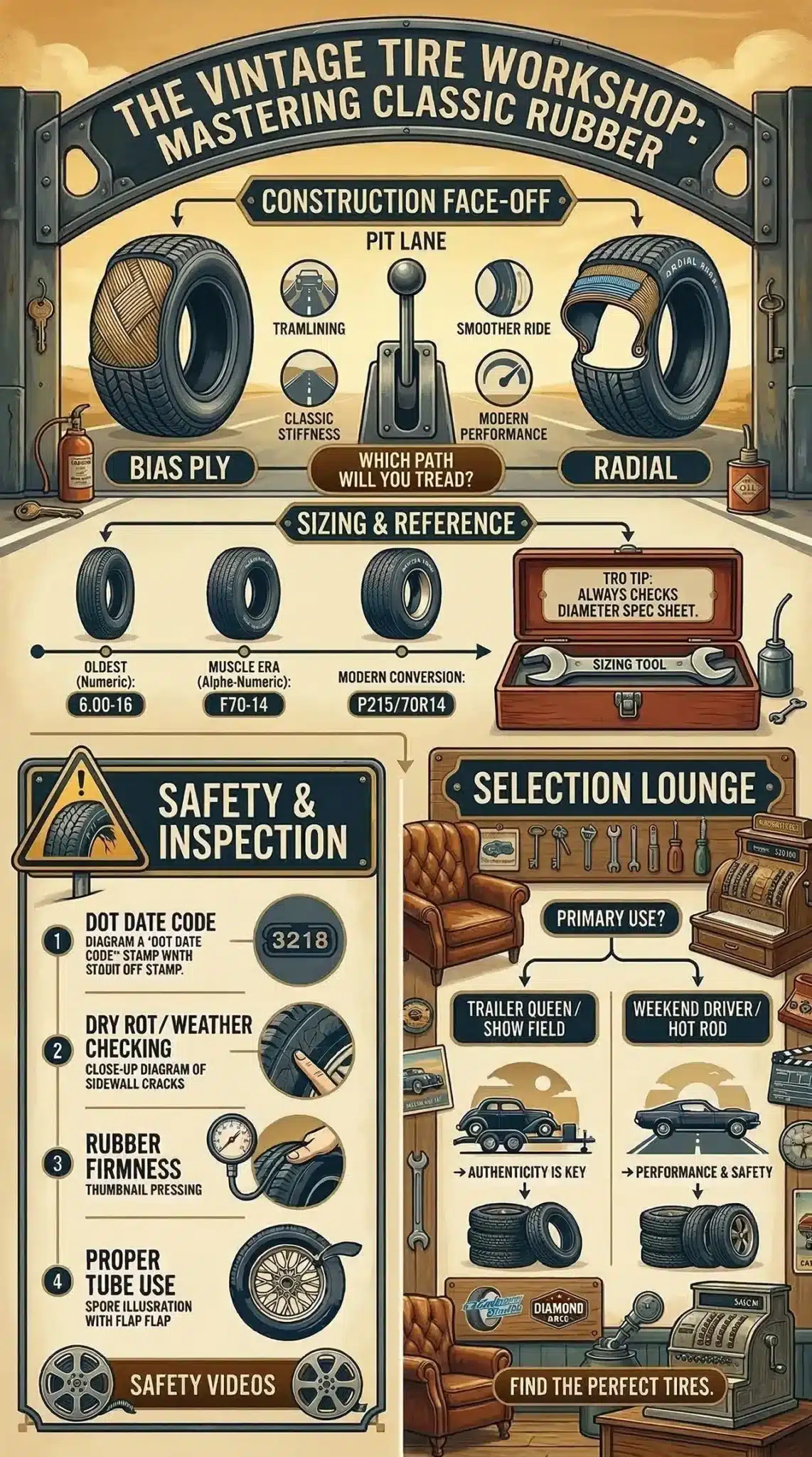
When restoring or maintaining a classic vehicle, tire selection becomes a crucial decision that affects not only authenticity but also safety and handling. The fundamental divide in vintage tire technology is between bias-ply and radial construction—two entirely different engineering approaches that create distinctly different driving experiences.
Bias-Ply Construction and Characteristics
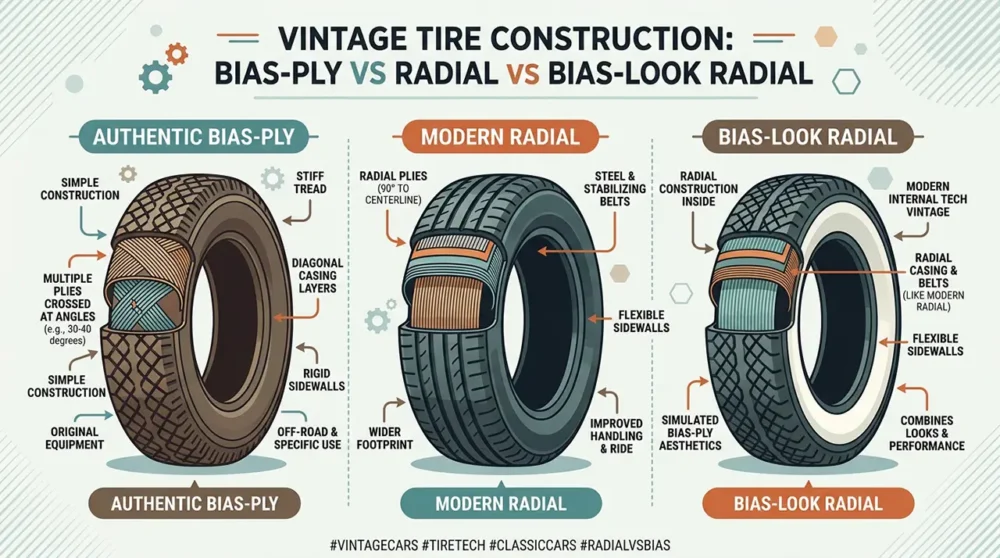
Bias-ply tires dominated the automotive landscape for the first 70 years of motoring. Their construction features diagonal fabric plies (typically nylon, rayon, or cotton) that run at 30-45 degree angles from bead to bead, crisscrossing to form a rigid lattice structure. This architecture creates a strong but inflexible tire where the sidewall and tread function as a single mechanical unit.
The defining characteristics of bias-ply tires include:
- Distinctive Appearance: Tall sidewalls with pronounced “bulge” and square shoulders that create the classic stance of vintage vehicles
- Road Feel: A lively, connected sensation where you feel every imperfection in the road
- Tramlining: The tendency to follow ruts and grooves in the road surface, requiring constant steering corrections
- Progressive Grip Loss: During cornering, the sidewall distortion lifts part of the tread off the road, reducing contact patch precisely when grip is needed most
- Heat Generation: The internal friction of the crisscrossing plies creates significant heat during sustained driving
Despite these limitations, bias-ply tires offer excellent protection against impacts and punctures due to their stiff sidewalls—a quality that explains why this technology persists in agricultural and off-road equipment today.
Radial Construction and Advantages
The radial tire, pioneered by Michelin and widely adopted in the 1970s, represents a fundamental reimagining of tire architecture. Radials feature cord plies that run at 90-degree angles from the centerline (radiating outward like spokes), reinforced by steel belts placed beneath the tread. This design mechanically separates the functions of the sidewall and tread.
Key advantages of radial tires include:
- Directional Stability: Radials track true and resist wandering, creating a relaxed, confident steering feel at highway speeds
- Superior Grip: The steel belts keep the tread flat against the road during cornering, maximizing contact patch and significantly improving handling and braking performance
- Reduced Heat: Less internal friction means cooler running temperatures and longer tread life—often 2-7 times the mileage of bias-ply equivalents
- Improved Ride Quality: The flexible sidewalls absorb road imperfections, reducing vibration and harshness transmitted to the chassis
Handling Differences: A Tale of Two Driving Experiences
The difference in driving feel between bias-ply and radial tires is dramatic and immediately noticeable:
Bias-ply tires create what enthusiasts call an “engaged” driving experience—the constant need for steering correction and the progressive loss of grip in corners makes for a busy, involved driving style. This can be charming on Sunday drives but potentially fatiguing on long highway journeys.
Radial tires deliver a more planted, predictable feel. The car tracks straight with minimal input, corners with greater confidence, and generally feels more settled. Many describe the upgrade to radials as making a vintage car feel “modern” in its road manners.
Original Equipment: Which Cars Were Designed for What
Understanding which tire technology your classic was designed around is crucial:
- Pre-1970 American Cars: Almost exclusively designed for bias-ply tires with soft suspension tuning to compensate for the harsh ride characteristics
- 1970s Transition Period: Many American manufacturers began offering radials as optional equipment, with European brands leading the adoption
- European Sports Cars: Many high-performance European vehicles (Jaguar, Porsche, Ferrari) adopted radials earlier, with suspension geometry specifically engineered for radial behavior
- Post-1975 Vehicles: Nearly all passenger cars worldwide came equipped with radials as standard equipment
This historical context explains why some purists insist that pre-1970 classics should run on bias-ply tires for historically correct handling characteristics, while others prefer the safety and practicality advantages of modern radials, even at the expense of perfect authenticity.
The Hidden Dangers of Aged Vintage Tires: What You Can’t See Can Hurt You
When it comes to vintage tires, what you can’t see is often more dangerous than what you can. While that set of New Old Stock (NOS) tires might look pristine on the outside with deep treads and unblemished sidewalls, beneath the surface lurks a chemical time bomb waiting to detonate.
Rubber, unlike metal or glass, undergoes continuous chemical degradation from the moment it’s manufactured. This isn’t just surface-level aging – it’s a fundamental molecular breakdown that compromises the tire’s structural integrity. Oxygen and ozone in the atmosphere attack the polymer chains in the rubber, causing them to break down and lose elasticity. This process turns the rubber hard and brittle, even when the tire appears visually perfect.
What makes this particularly treacherous is that the most critical degradation happens internally. The chemical bonds between the rubber tread and the underlying steel or fabric structure weaken over time, creating invisible failure points. To the naked eye, the tread may look deep and the sidewall unblemished, but the structural integrity is compromised. Under the heat and centrifugal force of highway driving, this can lead to catastrophic tread separation, where the entire tread strip delaminates from the casing, causing immediate loss of control.
The safety statistics are sobering. In 2023 alone, tire-related crashes resulted in 646 fatalities in the United States. A significant portion of these failures are attributed to aged tires that appeared serviceable but had deteriorated internally. This is why major tire manufacturers and safety organizations universally recommend replacing tires after 6-10 years, regardless of tread depth or visual condition.
Visual inspection simply isn’t enough when it comes to vintage rubber. That 20-year-old NOS tire might pass the eye test with flying colors, but chemically, it’s functioning more like hard plastic than flexible rubber. The compound has hardened, drastically reducing its coefficient of friction and increasing stopping distances. During panic braking or wet cornering, this can mean the difference between a near-miss and a serious collision.
For the vintage car enthusiast, the message is clear: those pristine-looking NOS tires belong in a museum display, not on the highway. They’re historical artifacts, not functional safety equipment for a vehicle that will carry you and your loved ones on public roads.
How to Read Tire Date Codes: The Critical Safety Factor
When it comes to vintage tires, appearance can be deceiving. A tire might look pristine with deep tread and shiny sidewalls, yet be dangerously degraded internally. This is why understanding how to decode the Department of Transportation (DOT) date code is an essential skill for any classic car enthusiast.
The DOT code is stamped on every tire sidewall and serves as the tire’s birth certificate. It’s the only reliable indicator of a tire’s true age, regardless of its visual condition or how many miles it has traveled.
Post-2000 Date Codes: The Four-Digit Standard
For tires manufactured after the year 2000, reading the date code is straightforward:
- Look for the DOT serial number on the sidewall
- The last four digits represent the manufacturing date
- The format is WWYY (Week-Year)
For example, “1023” means the tire was produced during the 10th week of 2023, while “4605” indicates the 46th week of 2005.
Pre-2000 Date Codes: The Three-Digit System
Tires made before 2000 used a more ambiguous three-digit system:
- The format is WWY (Week-Year)
- Only the last digit of the year is shown
- No indication of which decade the tire was made
For instance, a code of “128” indicates the tire was manufactured during the 12th week of a year ending in 8 – but this could be 1998, 1988, or even 1978. Some manufacturers added a small triangle symbol (◄) after the three-digit code to identify tires from the 1990s.
The Critical Safety Takeaway
Here’s the most important fact: Any tire with a three-digit date code is, by definition, more than 24 years old. Such tires have far exceeded their safe service life and should never be driven on public roads.
Maximum Age Guidelines
Industry standards are clear on tire age limits:
- Tires should be inspected annually after five years of age
- Regardless of appearance or tread depth, tires should be replaced after ten years
- For vintage vehicles driven regularly, many experts recommend a stricter six-year replacement interval
Remember that rubber compounds deteriorate chemically over time. This aging process affects the tire’s structural integrity and grip characteristics even if the tire looks new. The internal bonds between rubber layers weaken, potentially leading to sudden tread separation or blowout – a particularly dangerous scenario at highway speeds.
When investing in a classic car restoration, don’t compromise on tire safety. The date code is your most reliable indicator of whether a tire belongs on the road or in a museum display.
The Engineering Behind Modern Tires with Vintage Aesthetics
The vintage car enthusiast faces a challenging dilemma: maintain absolute historical accuracy with potentially unsafe original-style tires, or sacrifice authenticity for modern performance and safety. Fortunately, tire manufacturers have developed an ingenious solution—bias-look radials.
These hybrid tires represent the perfect marriage between old-world aesthetics and modern engineering. At their core, they utilize contemporary radial construction with steel belts and 90-degree plies, but the outer appearance is carefully designed to mimic the distinctive profile of vintage bias-ply tires.
The engineering is remarkably sophisticated. Manufacturers start with modern radial internals—polyester casing, steel belts, and advanced rubber compounds—but mold them to feature the tall aspect ratios (often 80 or 90 series), narrow tread widths, and distinctive “pie-crust” shoulders characteristic of tires from the 1940s-1960s. Many even include period-correct sidewall markings and precise whitewall widths to complete the illusion.
What makes these tires truly remarkable is how they deliver dramatically improved performance while maintaining visual authenticity. Compared to true bias-ply tires, bias-look radials offer:
- Superior Directional Stability: The steel belts prevent tread squirm that causes the wandering or “tramlining” common with original bias-ply tires, creating a relaxed, confident steering feel at highway speeds.
- Enhanced Grip and Cornering: The flexible sidewall absorbs lateral forces while the steel belts keep the tread planted flat on the road surface, maximizing the contact patch during cornering and significantly improving handling.
- Improved Longevity: While typical bias-ply tires might last 20,000-40,000 miles, bias-look radials can achieve 2-7 times that lifespan, often reaching 60,000+ miles with proper care.
- Reduced Flat-Spotting: The radial construction is far less prone to developing flat spots during storage, a common issue with traditional bias-ply tires, especially those with nylon construction.
Several manufacturers have emerged as leaders in this specialized market. Coker Tire dominates the American vintage tire landscape, producing tires under licensed historic brands like Firestone, BFGoodrich, and U.S. Royal. Their “American Classic” line specifically focuses on bias-look radials for 1950s cruisers requiring wide whitewalls with modern driveability.
For European sports cars, Michelin Classic offers the legendary XWX and X series tires that balance ride comfort with high-speed stability, though at premium prices. Vredestein’s Sprint Classic line provides 90% of Michelin’s performance at a significantly lower price point, making them popular for MG, Triumph, and Volvo owners.
For pre-war and early post-war vehicles with 16 to 21-inch rims, Coker’s Excelsior sub-brand offers options like the Stahl Sport Radial, which has revolutionized the handling of 1930s vehicles by hiding radial construction inside a very tall, narrow bias-style casing.
The visual difference between these bias-look radials and true vintage tires is minimal—only the most discerning judges at prestigious events like Pebble Beach might detect subtle differences in sidewall deflection. For 99% of classic car applications, these engineered hybrids provide the perfect solution: the authentic look of yesterday with the safety, performance, and longevity of today.
Understanding Vintage Tire Sizing: A Translation Guide
Navigating the complex world of vintage tire sizing can feel like deciphering an ancient language. If you’ve ever stared at a faded tire sidewall or flipped through a classic car manual wondering what those cryptic numbers mean, you’re not alone. The evolution of tire sizing conventions throughout automotive history has created a maze of nomenclature that can confuse even seasoned collectors.
Before the late 1960s, most American cars used numeric sizing—simple two-number combinations like 6.70-15 or 7.35-14. The first number represented the approximate width in inches, while the second indicated the wheel diameter. These tires were characteristically tall and narrow, with aspect ratios (height-to-width proportions) around 90%.
As muscle cars roared onto the scene in the mid-1960s, alpha-numeric sizing took over. Designations like F70-14 became standard, where the letter indicated the tire’s load capacity (A being smallest, L largest), the number specified the aspect ratio, and the final digits remained the wheel diameter. This system prevailed until the metric revolution of the late 1970s.
Today’s P-metric system (like P215/75R15) offers more precise information: the first number is the width in millimeters, the second is the aspect ratio percentage, R indicates radial construction, and the final number is the wheel diameter in inches.
When replacing vintage tires, maintaining the original overall diameter is crucial. A significant change in diameter affects your speedometer accuracy, gear ratios, and ultimately, how your classic car drives. A tire that’s 5% smaller in diameter will make your engine run approximately 5% faster at any given speed—potentially increasing wear and operating temperatures.
For practical application, here’s a quick conversion guide for common classic car wheel sizes:
For 14-inch wheels:
- 6.95-14 or C78-14 ≈ P185/75R14
- 7.35-14 or E78-14 ≈ P195/75R14
- 7.75-14 or F78-14 ≈ P205/75R14
- 8.25-14 or G78-14 ≈ P215/75R14
For 15-inch wheels (common on American classics):
- 6.40-15/6.70-15 or C78-15 ≈ P195/75R15 or P205/75R15
- 7.10-15/7.60-15 or F78-15 ≈ P215/75R15
- 8.00-15 or G78-15 ≈ P225/75R15
- 8.90-15 or L78-15 ≈ P235/75R15
When in doubt, opt for a tire with a taller profile (higher aspect ratio like 75 or 80 series) to maintain your classic’s original stance and driving dynamics. Remember, your vintage car was engineered with specific tire dimensions in mind—keeping close to those original specifications preserves the authentic driving experience and mechanical harmony of your prized automobile.
The Vintage Tire Marketplace: Key Players and Products
The vintage tire market is dominated by a handful of specialized manufacturers who have mastered the art of blending historical aesthetics with modern engineering. Understanding the key players in this niche industry can help collectors make informed decisions about their tire investments.
Coker Tire stands as the undisputed leader in the American vintage tire landscape. Based in Chattanooga, Tennessee, they’ve built their empire by acquiring licenses for historic brand names and refurbishing original molds. When you purchase a “Firestone Wide Oval” or “BF Goodrich Silvertown” today, you’re actually buying a Coker-manufactured tire produced under license, using contemporary rubber compounds in meticulously recreated molds.
Their “American Classic” line has become the go-to choice for 1950s cruisers requiring wide whitewalls with modern driveability. For pre-war and early post-war vehicles with 16 to 21-inch wheels, their Excelsior sub-brand offers specialized solutions. The Excelsior Stahl Sport Radial, in particular, has revolutionized the handling of 1930s vehicles by cleverly disguising radial construction inside tall, narrow bias-style casings.
For European sports car enthusiasts, Michelin Classic represents the gold standard. Their dedicated classic tire division continues to produce legendary models like the XWX and X series in small batches. The XWX was originally the only tire capable of handling the 180mph speeds of 1970s supercars like the Ferrari Daytona. Today, these tires command premium prices but deliver unmatched quality, balancing period-correct aesthetics with high-speed stability and ride comfort.
Vredestein offers an attractive alternative for European classics with their Sprint Classic line. These Dutch-manufactured tires have earned strong reputation in the restoration community for providing approximately 90% of Michelin’s performance at a significantly lower price point. They excel particularly in wet-weather conditions and feature authentic tread patterns, making them favorites for MG, Triumph, and Volvo restorations.
For those focused on competition and racing applications, Blockley has carved out a specialized niche. This UK-based manufacturer, founded by racing driver Julian Majzub, concentrates on pre-war and 1950s competition tires. Their bias-ply offerings are renowned for exceptional roundness and balance compared to mass-market reproductions, delivering a handling feel that many vintage racers prefer.
The pricing structure across these manufacturers reflects the specialized nature of the market:
- Standard modern tires typically cost $70-$80 per tire
- Reproduction vintage tires range from $250-$350 per tire
- Premium European classics like Michelin XWX can exceed $400 per tire
This price premium stems from low-volume production runs, licensing fees, and the specialized manufacturing processes required to create tires that meet both modern safety standards and vintage aesthetic requirements.
When selecting a manufacturer, consider not just price but the specific needs of your vehicle. European sports cars generally benefit from the handling characteristics of Michelin or Vredestein, while American classics often look most authentic with Coker’s wide range of whitewalls and period-correct tread patterns. For show vehicles that see minimal road use, appearance might be paramount, while frequently driven classics should prioritize the safety and performance aspects that these specialized manufacturers have engineered into their products.
Technical Compatibility and Installation Hardware: What You Need to Know
When mounting tires on vintage wheels, you’re not just dealing with a simple swap—you’re navigating a complex interface between old and new technologies. This critical junction demands careful attention to ensure both safety and performance.
Vintage wheels were designed for the tire technology of their era, creating several compatibility challenges when installing modern rubber. Many collectors overlook these crucial details, sometimes with dangerous consequences.
Rim Cracking: A Real Concern
One of the most debated topics in the vintage car community is whether mounting radial tires on wheels designed for bias-ply tires poses a safety risk. This concern has legitimate engineering foundations:
Bias-ply tires feature stiff sidewalls that distribute cornering loads relatively evenly across the wheel structure. In contrast, radial tires concentrate stress heavily at the rim flange due to their flexible sidewalls. This concentrated stress can potentially cause metal fatigue in vintage wheels over time.
Early stamped steel wheels (pre-1960s) and wire wheels are particularly vulnerable. The stress tends to manifest around rivet holes or the valve stem area, which are natural weak points in the wheel’s structure.
While catastrophic failures are relatively rare, regular inspection is essential. Before mounting radials on vintage wheels, thoroughly check for hairline cracks, especially at stress points. For vehicles driven frequently or at higher speeds, consider upgrading to modern reproduction wheels that maintain the vintage look while offering improved structural integrity.
Tube vs. Tubeless Applications
Modern tires are predominantly designed for tubeless applications, but many vintage wheels simply aren’t compatible with this technology:
Most vintage wheels (especially wire wheels and early steel rims) lack the crucial “safety hump” that keeps the bead sealed during cornering. Additionally, many aren’t airtight by design—wire wheels, for instance, allow air to escape through the spoke interfaces.
Even if your new tires are clearly marked “Tubeless,” you must use inner tubes if your vintage wheels require them. This isn’t optional—it’s mandatory for safety.
When using radial tires with tubes, you must select tubes specifically designed for radial applications. The constant flexing of radial sidewalls creates significant friction between the tire casing and tube. Standard tubes can overheat and fail under these conditions, while radial-specific tubes use heavier gauge rubber or special compounds to withstand this stress.
Installation Best Practices
Proper installation techniques are critical when mounting tires on vintage wheels:
- Use talcum powder when mounting tubes to lubricate the interface between tube and tire, preventing dangerous folds and friction points.
- Always install quality rim strips on wire wheels to protect the tube from spoke nipples that could otherwise puncture the tube.
- Balance carefully using stick-on weights for wheels without proper lips for clip-on weights.
- Torque wheel nuts properly using a calibrated torque wrench—over-tightening can distort vintage wheels.
- Break in new tires gradually, allowing the compounds to warm up and set properly before aggressive driving.
By respecting these technical compatibility issues, you’ll ensure your vintage tire and wheel combination delivers both the period-correct look you desire and the safety performance you need. Remember: the few square inches of rubber connecting your classic to the road represent the most critical safety system on your vehicle.
Preventing Flat Spots in Vintage Tires: Storage Solutions and Maintenance Tips
Vintage car owners face unique challenges when it comes to tire maintenance, particularly during periods when vehicles sit idle. One of the most common issues is flat spotting—a condition that can significantly impact your driving experience and potentially damage your vintage tires. Understanding why this happens and how to prevent it is essential for preserving your investment.
Why Vintage Tires Develop Flat Spots
Flat spotting occurs when the weight of a stationary vehicle compresses the tire’s contact patch against the ground for extended periods. This is particularly problematic with vintage tires, especially those with bias-ply construction using nylon cords. Unlike modern materials, nylon has a “memory” characteristic—it becomes flexible when heated during driving but sets in its compressed shape when cooled while parked.
The physics behind flat spotting is straightforward: the tire material under the vehicle’s weight deforms and, over time, can lose its ability to return to its original round shape. This is exacerbated in vintage tires because:
- Older rubber compounds are more susceptible to permanent deformation
- Bias-ply construction lacks the structural resilience of modern radials
- The tall sidewalls common in vintage tires create more potential for deformation
- Seasonal temperature changes accelerate the setting process
When you eventually drive the car after prolonged storage, these flat spots manifest as rhythmic thumping or vibrations. While minor flat spots in nylon bias-ply tires might disappear after 5-10 miles of driving as the tires heat up, more severe cases or flat spots in radial tires can become permanent, requiring tire replacement.
Methods to Prevent Damage During Storage
Preventing flat spots requires proactive measures, especially if your vintage vehicle will be stored for weeks or months. Here are effective strategies to minimize tire damage:
- Regular Movement: Ideally, drive your vintage car at least once every two weeks, even if just for a short distance. This prevents the tires from sitting in the same position for too long.
- Rotate Positioning: If driving isn’t possible, manually roll the car forward or backward every few weeks to change the tire contact points.
- Surface Consideration: Park on smooth, clean concrete rather than asphalt (which can get hot and accelerate flat spotting) or gravel (which creates uneven pressure points).
- Remove Weight Load: For long-term storage (3+ months), consider removing the weight load from the tires entirely using jack stands.
- Maintain Proper Inflation: Keep tires properly inflated—slightly overinflated for storage periods can reduce sidewall deflection and minimize flat spotting risk.
Tire Cradles and Other Storage Solutions
Specialized equipment can significantly reduce the risk of flat spots during storage:
Tire Cradles: These curved platforms distribute the vehicle’s weight over a wider arc of the tire rather than concentrating it on a single flat patch. The curved surface maintains a more natural tire shape during storage. Quality tire cradles typically feature:
- Curved design that matches tire radius
- Durable, non-abrasive materials
- Sufficient width to support the tire properly
- Non-slip surfaces to prevent movement
Pneumatic Tire Savers: These inflatable cushions sit under the tire and can be periodically adjusted to alter the contact point.
Jack Stands: The gold standard for long-term storage is placing the vehicle on jack stands, completely removing weight from the tires. This approach prevents both flat spots and suspension sag. When using jack stands:
- Ensure they’re rated for your vehicle’s weight
- Position them at manufacturer-recommended lifting points
- Use wheel chocks for added safety
- Consider adding a layer of protection between the jack stand and the vehicle’s frame
Tire Covers: While primarily for UV protection, quality tire covers also help maintain consistent temperature and humidity around the tire, reducing environmental stress.
Inflation Recommendations for Storage
Proper inflation is critical during storage periods, but vintage tire inflation requires special consideration:
- Optimal Storage Pressure: Increase tire pressure by 5-10 PSI above normal driving pressure (without exceeding the maximum pressure listed on the sidewall) to reduce the size of the contact patch.
- Monitor Regularly: Check pressure monthly during storage, as tires naturally lose pressure over time. Temperature fluctuations can also affect pressure readings.
- Pressure for Different Constructions: Bias-ply tires generally benefit from slightly higher storage pressure than radials due to their construction.
- Return to Normal: Before driving the vehicle again, remember to return tire pressure to the recommended driving PSI.
- Consider Tire Type: If you’ve upgraded to bias-look radials, follow modern inflation guidelines rather than vintage owner’s manual specifications, which were designed for original bias-ply tires.
By implementing these storage techniques and maintaining proper inflation, you’ll significantly extend the life of your vintage tires and preserve the authentic driving experience of your classic vehicle. Remember that proper tire care is not just about aesthetics—it’s a critical safety consideration that protects both your investment and everyone on the road.
The Science of Vintage Tire Pressure: Finding the Perfect Balance
Tire pressure might seem like a minor detail in classic car ownership, but it’s actually one of the most critical yet misunderstood aspects of vintage vehicle maintenance. Those faded pressure recommendations in your 1960s owner’s manual were written for a completely different tire technology and road environment than we have today.
Most vintage car manuals recommend surprisingly low pressures—often between 20-24 psi—which can be dangerously insufficient for modern driving conditions. These recommendations were calibrated for bias-ply tires traveling on rougher roads at lower average speeds than we experience today.
When switching between bias-ply and radial tires, pressure adjustments are essential. Bias-ply tires generally run at lower pressures because their stiff sidewall construction provides inherent structural support. Their crosshatched internal plies create a rigid casing that maintains shape even at lower pressures.
Radial tires, by contrast, typically require 4-8 psi more than the original bias-ply recommendation. Their flexible sidewalls need additional air pressure to maintain proper shape under load and prevent excessive heat buildup. Running a radial at the original bias-ply pressure recommendation can lead to premature wear, poor handling, and in extreme cases, tire failure.
Tire pressure dramatically affects how your classic car handles. Increasing front tire pressure by just 2-3 psi can noticeably reduce steering effort in cars without power steering—a welcome relief on long drives. Conversely, slightly lower pressure in the rear can improve traction on rear-wheel-drive classics, especially those with limited suspension sophistication.
For optimal handling balance, many enthusiasts use a pressure differential—running rear tires 1-2 psi lower than fronts to induce a slight understeer characteristic, which is generally safer and more predictable than oversteer. This technique is particularly valuable in vintage sports cars that might otherwise have twitchy handling characteristics.
Remember that tire pressure changes with temperature—approximately 1 psi for every 10°F change. A classic car stored in a 60°F garage and driven on a 90°F summer day will experience a natural pressure increase of about 3 psi. Always check pressures when tires are cold for consistent results, and consider seasonal adjustments for vehicles driven year-round.
Safety First: Critical Tire Inspection for Vintage Vehicles
When it comes to vintage tires, regular safety inspections are not just recommended—they’re essential. Unlike modern vehicles that might get daily use, classic cars often sit for extended periods, which can accelerate certain types of tire deterioration that aren’t immediately visible to the casual observer.
Identifying Sidewall Cracking
The sidewall is often the first area to show signs of aging. Look for what experts call “checking”—small, spider-web-like cracks that typically start near the bead (where the tire meets the rim) and the shoulder area. Even hairline cracks indicate that the rubber compounds are breaking down and losing elasticity. Any visible cracking means the tire’s structural integrity is compromised, regardless of how minor it may appear.
Pay special attention to the flex points where the sidewall meets the tread. These areas experience the most stress during driving and will often show deterioration first. Use your fingers to feel for irregularities that might not be visible—sometimes cracks can be felt before they’re large enough to see.
Checking for Belt Separation
Belt separation is one of the most dangerous tire failures and often occurs with no warning during driving. To inspect for potential separation:
- Run your hand slowly over the entire tread surface and sidewalls
- Look for any bulges, bubbles, or waviness in the tire’s profile
- Pay attention to any soft spots that feel different from the rest of the tire
- Check for any visible distortion when the tire is inflated but not under load
Any bulge, no matter how small, indicates that the internal structure of the tire has failed. This is non-negotiable—the tire must be replaced immediately, as belt separation can lead to catastrophic blowouts at speed.
When to Replace Regardless of Tread Depth
Many vintage car owners fall into the trap of judging tire condition solely by tread depth. While adequate tread is certainly important, age-related factors often necessitate replacement long before the tread is worn down:
- Age: Any tire over 6-10 years old should be replaced regardless of appearance or tread depth. The chemical compounds in rubber break down over time, even in perfect storage conditions.
- Storage damage: Tires that have been stored in sunlight, extreme temperatures, or high-ozone environments (near electric motors or generators) deteriorate faster.
- Infrequent use: Ironically, tires on rarely-driven vehicles can age worse than those in regular service, as the flexing of normal driving helps distribute protective compounds throughout the rubber.
- Manufacturing date: Always check the DOT code on the sidewall. The last four digits represent the week and year of manufacture (e.g., “1023” means the 10th week of 2023). Any tire with a three-digit code is pre-2000 and should be replaced immediately.
Remember that vintage tire failure isn’t just about inconvenience—it can lead to loss of vehicle control, damage to your prized classic, and personal injury. When in doubt, replace. No show trophy or period-correct appearance is worth the risk.
The Concours Conundrum: Vintage Tires in Show Competitions
For classic car enthusiasts who participate in prestigious Concours d’Elegance events, tire selection becomes a delicate balancing act between authenticity and practicality. Judges at top-tier events like Pebble Beach or Amelia Island scrutinize every detail, and inappropriate tire choices can cost valuable points.
Most judging standards at traditional concours events prioritize period-correctness above all else. This means bias-ply tires are strongly preferred for pre-1970s vehicles, as they provide the authentic stance and sidewall profile that the car would have had when new. Sharp-eyed judges look specifically for the distinctive “pie-crust” shoulders and tall sidewalls that characterized vintage rubber.
The most dedicated competitors have developed a strategic approach to this challenge: the two-set solution. They maintain one set of wheels with historically accurate (often reproduction) bias-ply tires exclusively for the show field, and a second set with safer radial tires for actual driving. This method allows them to trailer the vehicle to the event vicinity, swap to the show wheels for judging, then return to the safer driving set for the journey home.
For those who can’t justify the expense of two complete wheel sets, acceptable compromises do exist. High-quality bias-look radials from reputable manufacturers can sometimes pass casual inspection, particularly in less-stringent judging classes. The key is to choose tires with period-correct tread patterns, appropriate sidewall markings, and authentic whitewall or redline styling if applicable.
Some modern concours events have begun acknowledging the safety concerns of vintage tires by creating specific classes for “driven classics” that allow appropriate safety modifications including radial tires. These preservation classes focus more on the vehicle’s overall condition and historical significance rather than absolute factory-original specifications.
The wisest approach is to research the specific judging standards of your intended competition. Speaking with previous winners and judges can provide valuable insight into how strictly tire authenticity is enforced, allowing you to make an informed decision that balances show points with personal safety.
How Tire Choice Affects Vehicle Performance
The tires you choose for your vintage automobile dramatically influence every aspect of its performance. Far beyond mere aesthetics, your tire selection creates the foundation for how your classic car handles, stops, and feels on the road.
When selecting vintage tires, understanding performance implications helps you make choices aligned with your driving style. A concours show car that rarely exceeds parking lot speeds has vastly different requirements than a classic that regularly participates in touring events or spirited driving.
Braking Distance
Perhaps the most critical safety consideration is how quickly your car can stop. Modern radial tires significantly outperform vintage bias-ply designs in emergency braking scenarios:
- Bias-ply tires typically require 15-25% more distance to stop from highway speeds compared to radials
- NOS (New Old Stock) tires with hardened rubber compounds perform even worse, with braking distances potentially increasing by 30-50%
- Reproduction bias-ply tires with modern compounds perform better than originals but still can’t match radials
- Bias-look radials deliver nearly identical stopping performance to fully modern tires
For vehicles driven in modern traffic, this braking advantage alone makes a compelling case for radial technology, particularly if you frequently drive in congested areas where emergency stops might be necessary.
Cornering Grip
The architecture of your tires fundamentally changes how your car handles through corners:
- Bias-ply tires feature a rigid sidewall-to-tread connection that causes the contact patch to lift during cornering, reducing grip precisely when you need it most
- Radial tires maintain a larger, more consistent contact patch during cornering, delivering predictable grip that increases driver confidence
- Bias-look radials offer the handling benefits of radials while maintaining period-correct aesthetics
This difference becomes particularly noticeable in emergency avoidance maneuvers or on winding roads, where the superior grip of radials allows for more confident driving and a larger safety margin.
Ride Comfort
Your tire choice significantly impacts how your classic car feels on today’s roads:
- Bias-ply tires transmit more road vibration and harshness directly to the chassis
- Radial tires absorb road imperfections within their flexible sidewalls, isolating the vehicle from bumps
- Higher aspect ratios (taller sidewalls) generally provide better ride quality regardless of construction
For long-distance touring, the reduced fatigue from radial tires’ superior ride quality can make a significant difference in driving enjoyment.
High-Speed Stability
At highway speeds, tire design dramatically affects vehicle stability:
- Bias-ply tires are prone to “wandering” as they follow road imperfections, requiring constant steering corrections
- Radial tires track straight with minimal steering input, reducing driver fatigue
- Thermal efficiency is superior in radials, reducing heat buildup during sustained high-speed driving
For interstate travel or any driving above 55 mph, the directional stability of radials transforms the driving experience of vintage cars, making them more relaxed and confident at speeds they were never designed to maintain for hours at a stretch.
Matching Tire Type to Your Driving Habits
When selecting tires for your classic, honestly assess your typical driving patterns:
- Show car only: Period-correct bias-ply tires are appropriate if the vehicle is trailered to events
- Weekend cruiser: Bias-look radials offer an excellent compromise between authenticity and improved handling
- Regular driver: Modern radials with vintage sizing provide the safest option for daily use
- High-performance classic: Premium vintage-style radials from specialists like Michelin or Vredestein deliver the best handling for spirited driving
Remember that your tire choice isn’t permanent—many enthusiasts maintain two sets of wheels, using period-correct tires for shows and modern radials for driving enjoyment and safety.
Insurance Considerations for Vintage Tires: What You Need to Know
When it comes to vintage vehicles, tire selection impacts more than just driving performance—it can directly affect your insurance coverage. Many collectors overlook this critical intersection between tire choice and insurance protection.
Most specialty insurance providers like Hagerty and Chubb offer “Agreed Value” policies tailored to classic cars. These policies establish a predetermined value for your vehicle in case of total loss. However, these policies typically contain important clauses regarding vehicle maintenance and roadworthiness that directly relate to your tire choices.
The standard “Good Condition” clause found in most collector car policies requires that the vehicle be maintained in a roadworthy condition. This creates a potential issue if you’re running aged tires. Should you experience an accident caused by a blowout on a 20-year-old New Old Stock (NOS) tire, your insurer could potentially deny your claim based on negligence or failure to properly maintain the vehicle.
Insurance adjusters are increasingly aware of tire age and condition during claims investigations. If they determine your accident resulted from running unsafe, aged tires, you might face significant challenges getting your claim approved—even with comprehensive coverage.
Interestingly, upgrading to radial tires is almost universally accepted by classic car insurers and does not negatively impact the agreed value of your vehicle. In fact, many insurers prefer the safety profile of radials, recognizing the reduced risk they represent compared to original bias-ply tires or aged NOS options.
For maximum protection, consider these insurance best practices:
- Document your tire purchases and installation dates
- Keep records of tire inspections and rotations
- Photograph your tires as part of your regular vehicle documentation
- Consult with your insurance provider before making significant tire changes
- Consider disclosing your tire choice when establishing your agreed value policy
For serious concours competitors who maintain two sets of wheels (show tires and driving tires), be sure to document both sets with your insurer. This transparency ensures you’re covered regardless of which set is mounted during an incident.
Remember that insurance is fundamentally about risk management. By choosing modern, safety-focused tire options, you not only protect yourself and your passengers—you also strengthen your position with your insurance provider should you ever need to file a claim.
Balancing Authenticity with Safety: The Vintage Tire Dilemma
The world of vintage automobiles presents a unique challenge when it comes to tires. Unlike other restoration components where historical accuracy reigns supreme, tires represent the critical intersection between period-correct aesthetics and modern safety requirements. They are the only parts expected to perform in today’s driving conditions while maintaining the visual appeal of bygone eras.
For collectors and enthusiasts, this creates a fundamental dilemma: how to balance the pursuit of authenticity with the non-negotiable need for safety. The tire is, after all, your vehicle’s only point of contact with the road—a small patch of rubber responsible for acceleration, braking, and cornering forces that can mean the difference between a pleasant Sunday drive and a catastrophic accident.
The good news is that today’s market offers solutions for every type of enthusiast, whether you’re preparing for concours judging, enjoying weekend cruises, or embarking on cross-country touring adventures. The key is understanding your specific needs and the inherent trade-offs each option presents.
For show cars destined primarily for static display and concours events, period-correct bias-ply tires offer unmatched visual accuracy. The distinctive sidewall bulge, pie-crust shoulders, and authentic tread patterns satisfy even the most discerning judges. However, these should be modern reproductions rather than dangerous New Old Stock (NOS) tires, which may look pristine but have undergone invisible chemical degradation.
For weekend drivers who value both aesthetics and improved handling, bias-look radials represent the ideal compromise. These ingenious hybrids maintain the tall, narrow profile of vintage tires while incorporating modern radial construction internally. The result is a tire that looks 95% authentic to all but the most trained eye, yet offers significantly improved stability, grip, and longevity.
For serious tourers who put substantial miles on their classics, full modern radial tires provide the ultimate in safety and performance. While they may not satisfy concours judges, they transform the driving experience with superior wet-weather grip, reduced wandering on highway expansion joints, and dramatically improved high-speed stability.
The most dedicated enthusiasts often maintain multiple wheel sets—one with period-correct tires for shows and another with modern radials for driving. This approach ensures both authenticity when it matters and safety when it counts.
Remember that regardless of which path you choose, regular inspection and proper maintenance remain essential. Even the most advanced modern tire technology cannot overcome neglect or the inevitable aging process that affects all rubber compounds.
FAQs About Vintage Tires
Can I safely drive on New Old Stock (NOS) tires that look brand new?
No, even though NOS tires may appear pristine with deep tread and unblemished sidewalls, they are chemically degraded and potentially dangerous. Rubber undergoes continuous molecular breakdown from the moment of manufacture, regardless of whether the tire has been used. The polymer chains deteriorate due to oxygen and ozone exposure, causing the rubber to harden and become brittle. Most critically, the internal bonds between the tread and the underlying structure weaken invisibly over time, creating risk of catastrophic tread separation at highway speeds. Any tire over 10 years old should be replaced regardless of appearance, and most safety experts recommend a 6-year replacement interval for regularly driven vehicles. NOS tires belong in museum displays, not on vehicles driven on public roads.
What’s the difference between bias-ply and radial tires, and does it really matter for my classic car?
The difference is fundamental and dramatically affects how your classic car drives. Bias-ply tires feature diagonal fabric plies running at 30-45 degree angles that crisscross to form a rigid structure where the sidewall and tread work as one unit. This creates the “wandering” sensation where the car follows road imperfections and requires constant steering corrections. Radial tires have cords running at 90-degree angles reinforced by steel belts, mechanically separating the sidewall from the tread. This provides superior directional stability, significantly better grip during cornering and braking, cooler running temperatures, and 2-7 times longer tread life. The choice matters enormously because it affects safety, handling, comfort, and how fatiguing the car is to drive, especially at modern highway speeds.
How do I read the DOT date code to determine how old my tires are?
For tires manufactured after 2000, look for the last four digits of the DOT serial number stamped on the sidewall. The format is WWYY, where the first two digits indicate the week of manufacture and the last two indicate the year. For example, “1023” means the tire was made during the 10th week of 2023. For tires made before 2000, you’ll see only three digits in WWY format, showing the week and only the last digit of the year. A code like “128” could mean 1998, 1988, or 1978, creating ambiguity about the decade. Any tire with a three-digit code is by definition over 24 years old and has exceeded its safe service life. The date code is your only reliable indicator of tire age, as appearance can be deceiving.
What are bias-look radials, and are they a good compromise for my classic car?
Bias-look radials are hybrid tires that combine modern radial internal construction with vintage aesthetic profiles. They feature contemporary radial internals including steel belts, polyester casing, and 90-degree plies, but are molded to replicate the tall aspect ratios, narrow tread widths, and distinctive “pie-crust” shoulders characteristic of 1940s-1960s tires. They often include period-correct sidewall markings and precise whitewall widths. These tires deliver the safety and performance advantages of modern radials including superior directional stability, improved grip, better ride quality, and 2-7 times the tread life of authentic bias-ply tires, while maintaining 95-98% visual authenticity. For most collectors who actually drive their vehicles, bias-look radials represent the ideal solution, offering the best of both worlds except in the most stringent concours judging situations.
How do I convert my classic car’s vintage tire size to a modern equivalent?
Converting vintage tire sizes requires understanding three different naming systems used throughout automotive history. Pre-1967 numeric sizing like “6.70-15” indicates approximate width in inches and wheel diameter. The 1967-1979 alpha-numeric system like “F70-14” uses letters for load capacity and numbers for aspect ratio. Modern P-metric sizing like “P215/75R15” shows width in millimeters, aspect ratio as a percentage, construction type, and wheel diameter. The critical factor is maintaining the original overall diameter to preserve speedometer accuracy and gear ratios. For common 15-inch wheels, a 6.70-15 or C78-15 converts to approximately P195/75R15 or P205/75R15, while an 8.00-15 or G78-15 converts to approximately P225/75R15. When in doubt, choose the taller profile tire with a higher aspect ratio to maintain your classic’s original stance and driving dynamics.
Will mounting radial tires on my vintage wheels cause the rims to crack?
This is a legitimate concern with engineering foundations, though catastrophic failures are relatively rare. Bias-ply tires have stiff sidewalls that distribute cornering loads evenly across the wheel structure, while radial tires concentrate stress heavily at the rim flange due to their flexible sidewalls. This concentrated stress can potentially cause metal fatigue over time, particularly in early stamped steel wheels from before the 1960s or wire wheels. The stress typically manifests around rivet holes or valve stem areas, which are natural weak points. Before mounting radials on vintage wheels, thoroughly inspect for hairline cracks, especially at stress points. For vehicles driven frequently or at higher speeds, consider upgrading to modern reproduction wheels that maintain the vintage appearance while offering improved structural integrity. Regular inspection is essential regardless of your tire choice.
How can I prevent flat spots from forming on my vintage tires during storage?
Flat spotting occurs when the vehicle’s weight compresses the tire’s contact patch against the ground for extended periods, and it’s particularly problematic with nylon bias-ply tires that have “memory” characteristics. The most effective prevention method is to place the vehicle on jack stands for long-term storage exceeding three months, completely removing weight from the tires. If this isn’t feasible, use curved tire cradles that distribute weight over a wider arc rather than concentrating it on a single flat patch. Drive or manually roll the car every two weeks to change the contact points. Maintain proper inflation or slightly over-inflate during storage to reduce sidewall deflection. Park on smooth concrete rather than asphalt, which can get hot and accelerate flat spotting. Minor flat spots in nylon bias-ply tires often disappear after 5-10 miles of driving as the tires heat up, but severe cases or flat spots in radial tires can become permanent.
What tire pressure should I use for my classic car with modern radial tires?
Don’t rely on the pressure recommendations in your vintage owner’s manual, as those were calibrated for bias-ply tires on rougher roads at lower speeds. Most vintage manuals recommend surprisingly low pressures between 20-24 psi, which can be dangerously insufficient for modern driving conditions. Radial tires typically require 4-8 psi more than the original bias-ply recommendation because their flexible sidewalls need additional air pressure to maintain proper shape under load and prevent excessive heat buildup. A baseline of 28-32 psi is generally a safer starting point for radials on vintage cars, though you should consult the load and inflation tables provided by your specific tire manufacturer. Remember that tire pressure changes approximately 1 psi for every 10°F temperature change, so always check pressures when tires are cold and consider seasonal adjustments for year-round driving.
Which vintage tire manufacturers should I consider, and what are the price differences?
Coker Tire dominates the American vintage tire market, producing tires under licensed historic brands like Firestone, BFGoodrich, and U.S. Royal, with their “American Classic” line focusing on bias-look radials for 1950s cruisers. For European sports cars, Michelin Classic represents the gold standard with legendary models like the XWX series, offering unmatched quality that balances period-correct aesthetics with high-speed stability, though at premium prices often exceeding four hundred dollars per tire. Vredestein’s Sprint Classic line provides an attractive alternative, delivering approximately 90% of Michelin’s performance at significantly lower prices, making them popular for MG, Triumph, and Volvo restorations. Standard modern tires typically cost seventy to eighty dollars per tire, while reproduction vintage tires range from two hundred fifty to three hundred fifty dollars per tire. This price premium reflects low-volume production runs, licensing fees, and the specialized manufacturing processes required to meet both modern safety standards and vintage aesthetic requirements.
Will upgrading to radial tires affect my classic car insurance or show judging scores?
Upgrading to radial tires is almost universally accepted by specialty classic car insurers like Hagerty and Chubb, and does not negatively impact agreed value policies. In fact, many insurers prefer the safety profile of radials as they reduce risk. However, if you experience an accident caused by running aged or unsafe tires like old NOS stock, your insurer could potentially dispute the claim based on negligence or failure to maintain the vehicle in roadworthy condition as required by typical “good condition” clauses. For show competitions, the impact depends on the judging class. Strict Concours events often require bias-ply tires, and radials may result in point deductions if judges detect the radial identifier or differences in sidewall profile. Serious competitors often maintain two sets of wheels: authentic bias-ply tires for the show field and modern radials for driving. Some modern concours events have created “driven classics” classes that acknowledge safety concerns and allow appropriate modifications including radial tires, focusing more on overall condition than absolute factory-original specifications.