
I’ve been reviewing tires for years, and no tire category generates more “should I or shouldn’t I?” debates in my inbox than run-flat tires.
Before we get into the numbers and the real-world experience of owning them, I want to make sure you’re working from a solid foundation.
If you’re brand new to this topic, I recommend reading my full deep-dive on Run-Flat Tires first — it covers everything from how they work to which vehicles come equipped with them from the factory.
Now, for those of you who already know the basics and want the straight truth about cost and value: you’re in the right place.
TL;DR
- Run-flat tires cost $150–$550+ per tire, with a full set running $800–$2,200+ installed.
- They let you drive up to 50 miles at 50 mph after a puncture — no roadside tire change needed.
- Downsides: stiffer ride, shorter tread life, and most can’t be repaired — only replaced.
- They’re worth it if you drive a luxury/EV vehicle, commute solo through unsafe areas, or your car came with them from the factory.
- They’re NOT worth it if ride comfort, long-term cost savings, or wide tire availability matter most to you.
- TL;DR
- What Are Run-Flat Tires, and Why Does Everyone Have an Opinion About Them?
- How Much Do Run-Flat Tires Cost? (Real Price Breakdown)
- How Long Do Run-Flat Tires Last?
- Can Run-Flat Tires Be Repaired After a Puncture?
- The Real Pros of Run-Flat Tires (From Someone Who’s Used Them)
- The Real Cons of Run-Flat Tires (No Sugar-Coating)
- Who Should Buy Run-Flat Tires? (My Honest Recommendation)
- Best Run-Flat Tires Worth Buying
- Tips for Saving Money on Run-Flat Tires
- The Bottom Line: Are Run-Flat Tires Worth It?
- Frequently Asked Questions
What Are Run-Flat Tires, and Why Does Everyone Have an Opinion About Them?
I’ll be honest with you — the first time I swapped a BMW client’s run-flat tires for conventional ones, I expected them to come back upset.
Instead, they called me three days later raving about how much smoother and quieter the car suddenly felt. That’s run-flat tires in a nutshell: incredibly useful in the right situation, but not universally beloved.
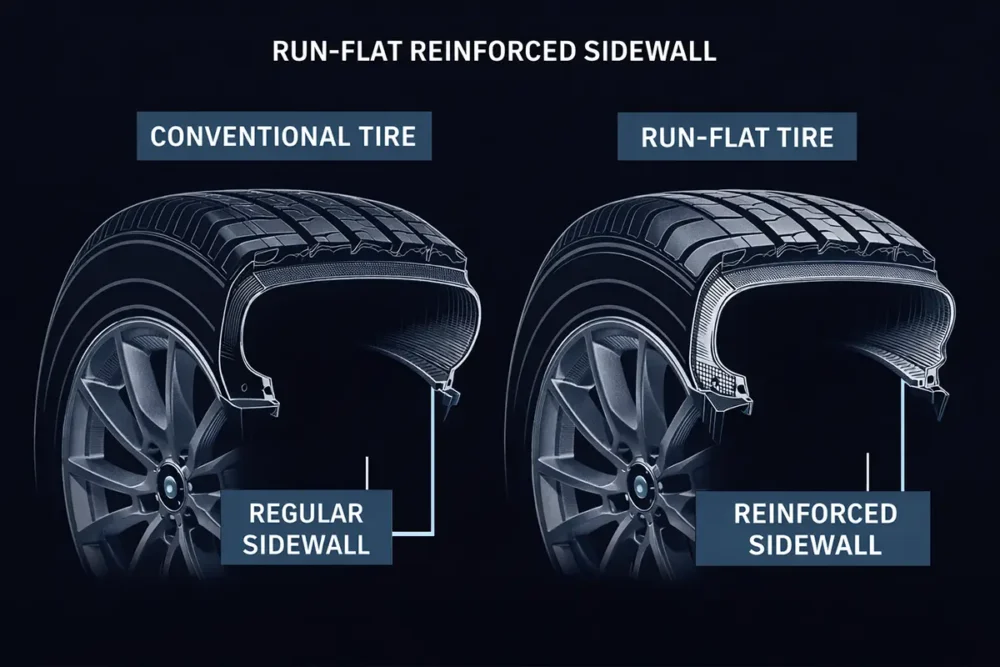
Run-flat tires are built with reinforced sidewalls — or in some cases, an internal support ring — that allow the tire to hold the vehicle’s weight even after losing all air pressure.
Where a conventional tire would collapse and destroy itself (and potentially your wheel) within seconds, a run-flat keeps its shape and lets you keep driving — typically up to 50 miles at speeds no higher than 50 mph — so you can reach a safe location or a tire shop.
They’re standard equipment on a wide range of vehicles today, from BMW and Mercedes-Benz sedans to Cadillac SUVs and even the Toyota Sienna minivan.
They’re also nearly universal on electric vehicles, which don’t have room for a spare tire because the battery takes up the underfloor space a spare would normally occupy.
So: smart technology, real benefits, genuine trade-offs. Let’s talk money first.
How Much Do Run-Flat Tires Cost? (Real Price Breakdown)
This is the question I get most often, so let’s not bury it. Run-flat tire prices vary based on brand, size, and performance tier — but here’s a realistic, current picture of what you’ll pay in the US market.
Price Per Tire
| Tier | Price Per Tire | Example Brands |
|---|---|---|
| Budget / Entry-Level | $150 – $230 | Goodyear Eagle LS-2, Dunlop |
| Mid-Range | $230 – $380 | Bridgestone DriveGuard, Continental SSR |
| Premium | $380 – $550+ | Michelin Pilot Sport ZP, Pirelli P Zero RFT |
A single run-flat tire will generally run you $150 to $550, depending on your vehicle’s tire size and the brand you choose. Budget-friendly options exist in the $150–$230 range, while premium performance run-flats from Michelin or Pirelli can easily exceed $500 per tire.
For context, a comparable conventional tire typically costs 25–50% less. That price gap is real and it compounds quickly when you’re buying four at a time.
Total Replacement Cost (Full Set of 4)
When you add installation, balancing, and TPMS initialization to the tire purchase price, here’s what a full set realistically costs:
- Tire cost (4 tires): $600 – $2,200
- Mounting & balancing: $15 – $100 per tire ($60 – $400 total)
- TPMS sensor service or replacement: $0 – $120 per sensor (if needed)
- Alignment check: $80 – $150
Realistic all-in total: $800 – $2,500+
For most everyday sedans and crossovers, you’re looking at somewhere in the $1,000–$1,400 range for a quality mid-tier set fully installed. For a performance vehicle or luxury car with large-diameter wheels, that number can push well past $1,800.
How Does That Compare to Regular Tires?
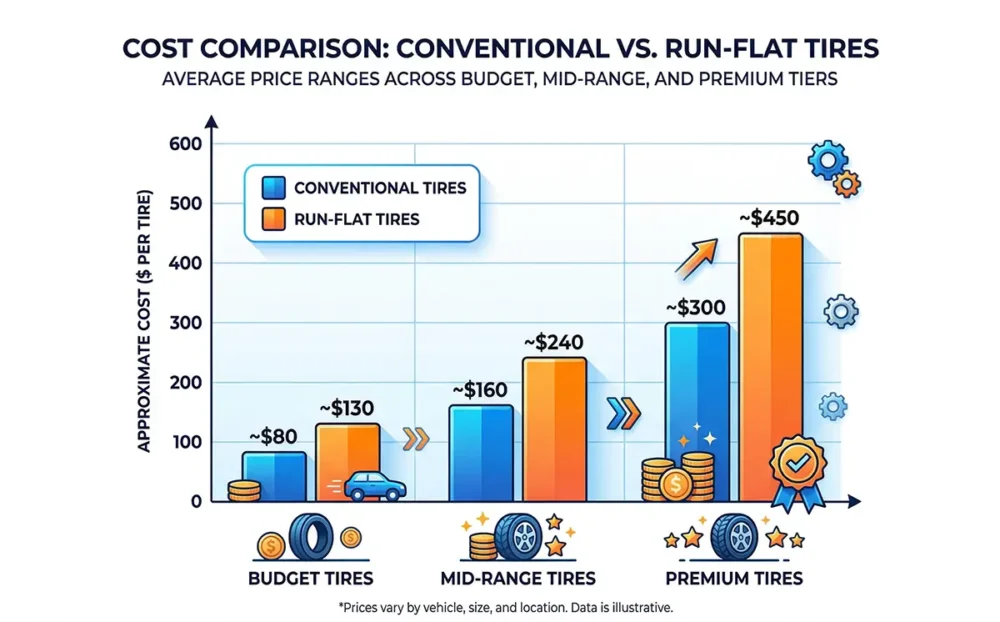
Let’s use a real-world example. A BMW 3 Series owner replacing a common size like 225/45R18 might pay around $180–$220 per tire for a conventional all-season tire from Michelin or Goodyear.
The run-flat equivalent from the same brand? Closer to $280–$350 per tire. That’s roughly $400–$500 extra for a full set — before installation.
Over the lifetime of the vehicle, that premium adds up. Especially since run-flat tires also tend to wear faster than conventional tires.
How Long Do Run-Flat Tires Last?
Shorter than you might hope. In independent studies, run-flat tires average around 42,000–45,000 miles of tread life, compared to 50,000–60,000 miles for comparable conventional tires.
That’s roughly a 6,000-mile gap on average according to J.D. Power research tracking tens of thousands of vehicle owners.
Why do they wear faster? The stiff sidewall construction that makes them so capable after a puncture also creates more friction and heat during normal driving — both enemies of tread life.
City driving with frequent stops, tight turns, and rough pavement accelerates this wear even more.
The practical takeaway: you’ll likely replace run-flat tires more frequently than conventional ones, which compounds the cost difference over time.
Owners who drive 15,000 miles per year might replace conventional tires every 3.5–4 years and run-flats every 3 years or less.
Can Run-Flat Tires Be Repaired After a Puncture?
Here’s where I need to be straight with you, because I think this is one of the most misunderstood parts of run-flat tire ownership: in most cases, no — they cannot be repaired.
Here’s the problem. When you drive on a flat conventional tire, you know it immediately because the car becomes almost undriveable.
With a run-flat, you keep rolling normally — which is the point. But that same rolling-while-deflated process stresses the internal sidewall structure in ways that are invisible to the naked eye.
Even if the puncture itself looks like a simple nail hole, the structural integrity of the sidewall may be compromised.
Because of this hidden damage risk, most tire manufacturers and shops won’t patch or plug a run-flat tire that’s been driven on while flat.
Yokohama, Pirelli, and Continental all recommend against repairing run-flats after air loss. Michelin allows a single repair under strict conditions, but only if the tire was driven correctly after losing pressure.
The financial impact of this is significant. A standard tire patch costs $20–$30. A run-flat tire replacement costs $200–$500. If you pick up a nail in your driveway, that single incident could cost you fifteen times more than it would with a conventional tire.
The Real Pros of Run-Flat Tires (From Someone Who’s Used Them)
I’ve tested and reviewed tires across dozens of vehicles, and I’ll give credit where it’s due. Run-flat tires offer genuine, tangible benefits for the right driver.
1. Safety After a Puncture
This is the big one. A conventional tire blowout at highway speed can send a vehicle into a dangerous swerve.
A run-flat deflating at the same speed maintains its shape, keeps the vehicle’s handling mostly intact, and allows you to safely reduce speed and pull off the road.
That’s not a marketing claim — it’s real-world physics. The reinforced sidewall prevents the catastrophic collapse that makes blowouts so dangerous.
2. No Roadside Tire Change
Getting a flat on a dark highway shoulder, in a bad neighborhood, or during a rainstorm is genuinely dangerous — especially if you’re alone.
Run-flat tires eliminate that scenario entirely. You drive to a safe place, park, and call a shop at your convenience.
For parents driving kids around, solo commuters, or anyone who regularly drives in unfamiliar areas, this peace of mind is worth real money.
3. No Spare Tire Needed (More Trunk Space)
A compact spare tire takes up meaningful cargo space and adds about 25 pounds to the vehicle. Over time, that weight costs you in fuel economy, and the space costs you in practicality.
Many SUVs and sedans with run-flats reclaim that entire wheel well for additional storage.
4. No Spare That Goes Unused for Years
Let’s be practical: most spare tires ride in the trunk for 8–10 years and get thrown out, never used. You’ve been hauling around an emergency kit that never deployed. With run-flats, that space and weight are simply gone.
5. Standard on EVs and Many Luxury Vehicles
If you drive a newer BMW, Mercedes-Benz, Cadillac, Lexus, Infiniti, or most electric vehicles, run-flat tires are likely what came on your car from the factory.
In many cases, the vehicle’s suspension was tuned specifically around the run-flat’s characteristics. Switching to conventional tires on these vehicles can affect handling in ways the manufacturer didn’t intend.
The Real Cons of Run-Flat Tires (No Sugar-Coating)
This is the section most manufacturer marketing materials skip. I won’t.
1. Harsher, Stiffer Ride Quality
The reinforced sidewall that makes run-flats structurally capable also makes them significantly stiffer than conventional tires.
That stiffness transfers road imperfections directly to the cabin with less absorption. Potholes hit harder. Expansion joints are more jarring. Road noise is often more pronounced.
Consumer surveys consistently list “harsher ride” as the number one complaint among run-flat tire owners.
Drivers who switch from run-flats to conventional tires almost universally report an immediate and noticeable improvement in ride quality and cabin noise.
Some luxury automakers — including Mercedes-Benz and Lexus — have begun offering conventional tire options on models that previously came exclusively with run-flats, specifically because of customer ride quality complaints.
2. Higher Purchase Price
I already covered the numbers, but it bears repeating in context: run-flat tires cost 25–50% more per tire than comparable conventional tires, and they wear out faster.
Over 100,000 miles of driving, you could easily spend $500–$1,000 more on tires alone by sticking with run-flats.
3. Most Punctures Require Full Replacement
As explained above, the inability to repair most punctured run-flat tires turns a $25 patch job into a $250–$500 tire replacement. This alone is a meaningful ongoing cost difference.
4. Shorter Tread Life
Faster wear means more frequent replacements, which multiplies all of the above cost disadvantages over time.
5. Limited Availability in Certain Sizes
Run-flat tires are available in far fewer sizes and configurations than conventional tires. If you’re driving through a small town and need an emergency replacement, there’s a real chance the local tire shop simply won’t have your size in stock. With a conventional tire, this is rarely an issue.
6. Not Truly Indestructible
Run-flats handle the most common puncture scenario beautifully. But a large pothole impact, a sidewall strike on a curb, or a particularly vicious piece of road debris can still damage a run-flat beyond the point of safe use — requiring immediate replacement just like a conventional tire blowout would.
Who Should Buy Run-Flat Tires? (My Honest Recommendation)
After years of testing and talking to real drivers, here’s my practical breakdown:
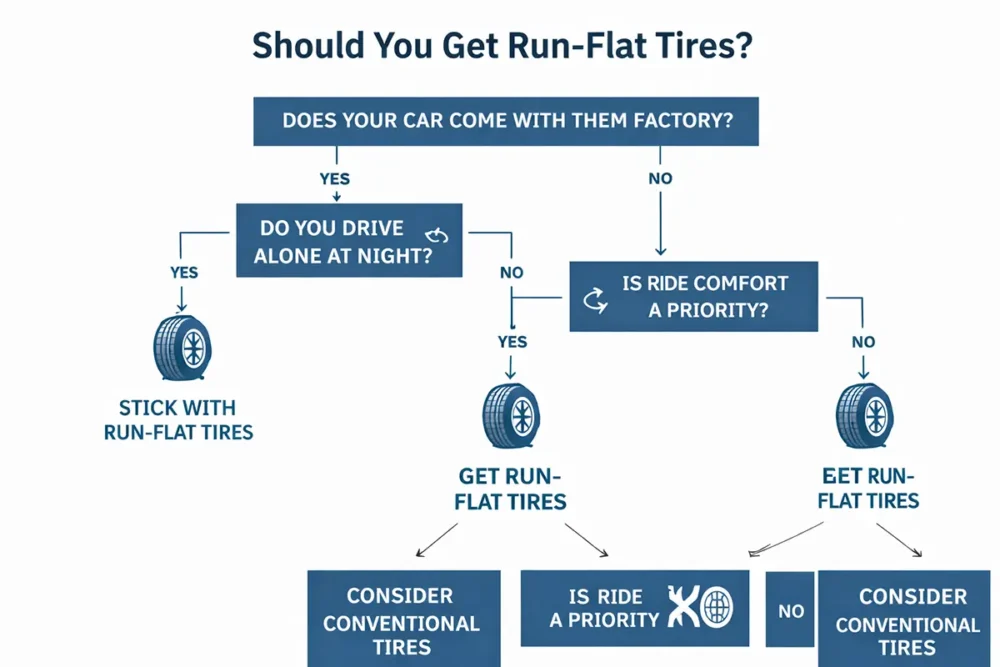
Run-flat tires make strong sense for you if:
- Your car came with them from the factory, especially if it’s a luxury vehicle with suspension tuned for run-flats, or an electric vehicle with no spare tire provision.
- You drive alone frequently, particularly at night, in high-crime areas, or in unfamiliar territory where a roadside tire change would feel unsafe.
- You have no mechanical ability or physical limitation that makes roadside tire changes difficult or impossible.
- You prioritize safety and convenience and are willing to pay a premium for both.
- You primarily drive in urban or suburban areas close to tire shops, which minimizes the “can’t find my size” problem.
Conventional tires are likely the better choice if:
- Ride comfort is a priority. If you care about a smooth, quiet drive, you’ll probably enjoy your vehicle more on conventional tires.
- You’re budget-conscious. The lower purchase price, lower cost per puncture repair, and longer tread life all favor conventional tires over the long run.
- You drive a high-mileage vehicle where the faster wear rate of run-flats will hit your wallet harder.
- You live in a rural area or travel frequently through remote regions where finding your specific run-flat size in an emergency could be genuinely difficult.
- You already carry roadside assistance through AAA, your insurance, or a manufacturer program. If a tow truck is just a phone call away, the emergency driving range of a run-flat becomes less critical.
Best Run-Flat Tires Worth Buying
If you’ve decided run-flats are right for you, here are the options I’d point you toward:
Bridgestone DriveGuard — My top pick for everyday drivers. Excellent ride comfort for a run-flat, strong all-season wet-weather grip, and available in a wide range of common sizes. One of the best compromises between run-flat capability and traditional tire comfort.
Michelin Pilot Sport A/S+ ZP — The performance driver’s run-flat. Exceptional handling, lower road noise than most run-flats, and Michelin’s reputation for tread longevity. The premium price is justified for those who drive spiritedly.
Continental ContiProContact SSR — A quiet, comfortable all-season run-flat that punches above its weight class for ride quality. Great choice for luxury sedan owners who want to stick with run-flats without sacrificing too much refinement.
Pirelli P Zero Run Flat — Built for sports cars and high-performance luxury vehicles. Exceptional grip and steering feel, but not the place to look if you prioritize quiet cruising.
Goodyear Eagle Sport All-Season ROF — A solid mid-range option that keeps costs manageable without sacrificing reliability. A good fit for drivers who want run-flat protection but don’t need the top-shelf performance of a Michelin or Pirelli.
Tips for Saving Money on Run-Flat Tires
Since cost is the most common reason people hesitate on run-flats, here are some practical ways I’ve seen drivers manage the expense:
Buy in sets of four — Many retailers offer significant discounts (sometimes $50–$100 back per set) when you purchase four tires at once. Goodyear, Discount Tire, and Costco Tire regularly run promotions specifically for this.
Check manufacturer rebates — Michelin, Bridgestone, and Continental frequently offer mail-in or online rebates ranging from $50 to $150 on qualifying tire purchases. Always check the manufacturer’s website before buying.
Don’t ignore Costco Tire — Costco often prices run-flat tires competitively and includes installation, rotation, and road hazard coverage in the purchase price. For Michelin run-flats in particular, Costco pricing can be surprisingly close to the cost of conventional alternatives elsewhere.
Compare online vs. in-store — Sites like SimpleTire, TireRack, and Discount Tire Direct often list run-flat tires below local shop prices. You can purchase online and have them shipped to a local installer.
Don’t mix run-flat and conventional tires on the same axle — I see this mistake regularly. Mixing tire types creates unpredictable handling. If you’re replacing two, replace two matching tires on the same axle.
The Bottom Line: Are Run-Flat Tires Worth It?
Here’s my honest answer after years of reviewing tires: it depends on who you are and how you drive.
If you commute solo, drive a luxury or electric vehicle, or genuinely want to eliminate the danger and inconvenience of a roadside flat, run-flat tires are absolutely worth the premium.
The safety benefit alone — keeping you moving after a puncture instead of stranding you on a highway shoulder — has real monetary and personal value that’s hard to dismiss.
But if ride comfort matters to you, if you’re trying to manage car ownership costs over the long haul, or if you regularly travel through areas where finding your specific run-flat size might be difficult, the math and the comfort trade-offs both point toward conventional tires plus a good roadside assistance plan.
The honest middle ground for most drivers? If your vehicle came with run-flat tires from the factory, keep them for at least one replacement cycle. The factory suspension tune assumes the run-flat’s characteristics.
Then, after a year or two living with them, you’ll know from your own experience whether the convenience justifies the cost for your situation.
Frequently Asked Questions
Can I replace run-flat tires with regular tires?
Generally yes, as long as your vehicle isn’t an EV or a model with no spare tire provision. However, some manufacturer warranties and suspension tuning notes advise against it. Always check your owner’s manual and consult your dealer.
Do run-flat tires affect gas mileage?
Yes, slightly. The heavier construction and stiffer sidewalls add rolling resistance, which costs a small amount of fuel efficiency. The impact is modest — typically 0.5–1 MPG — but it’s real.
How do I know if I have run-flat tires?
Look for markings on the tire sidewall. Common abbreviations include: RFT (Bridgestone), ROF or RunOnFlat (Goodyear), SSR (Continental), ZP or ZPS (Michelin), and EMT (Goodyear). Your owner’s manual will also specify.
What happens if I drive too far on a run-flat after it deflates?
You’ll destroy the tire’s internal structure, potentially damage your wheel, and render the tire unsafe. Most run-flats allow 50 miles at 50 mph after air loss — treat that as a hard limit, not a suggestion.
Can I use a regular spare tire if I have run-flats on my vehicle?
Yes, if your vehicle was equipped to carry one. Many vehicles with factory run-flats don’t include a spare at all, but if yours does, a conventional spare will work for getting you to a shop.
Have questions about whether run-flat tires are right for your specific vehicle? Drop them in the comments below — I read and respond to every one.