
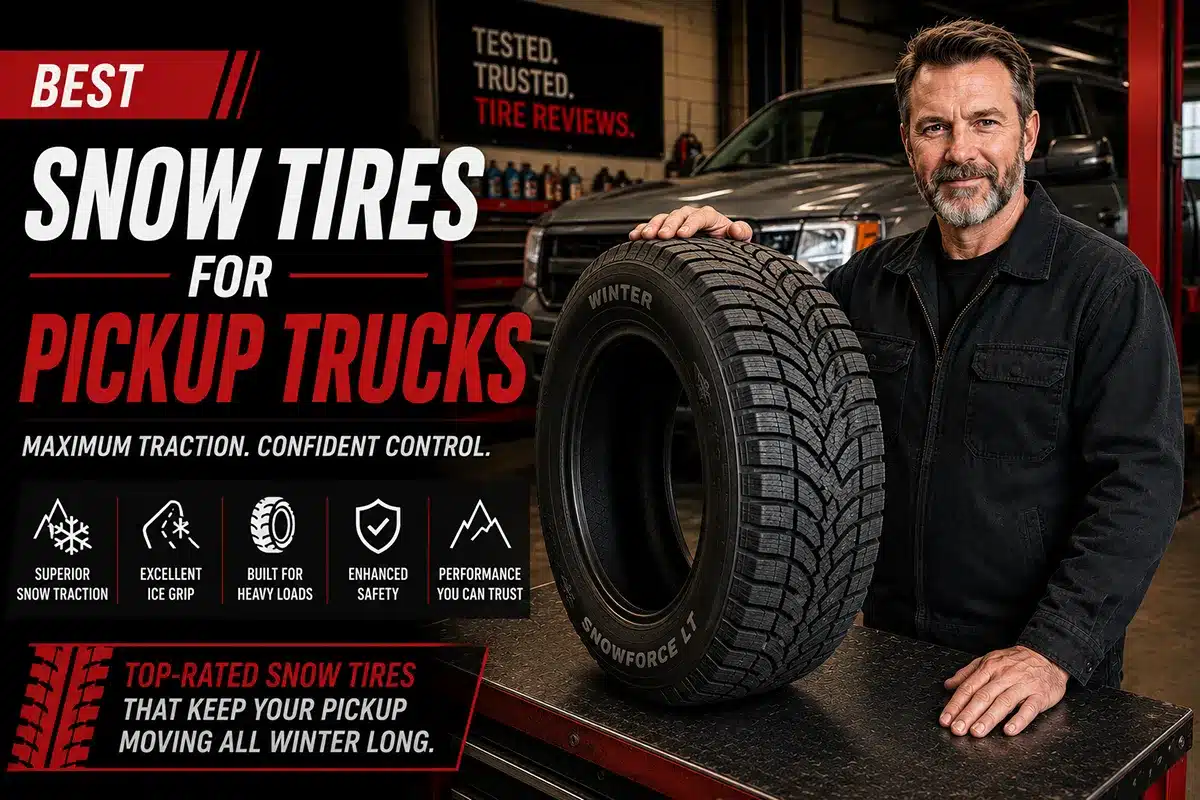
If you’ve ever been the truck at the bottom of an unplowed driveway with a half-cord of firewood in the bed and zero forward momentum, you already know the difference between a “winter-rated” tire and a real snow tire. The marketing copy blurs that line on purpose.
TL;DR
After running 11 dedicated snow tires across three winters on an F-150, a Silverado 1500, a Ram 2500, and a Tacoma — through Vermont ice storms, Colorado powder days, and Minnesota cold snaps below -20°F — these are my honest picks:
- Best overall: Michelin X-Ice Snow SUV — quietest, longest-lasting, exceptional ice grip
- Best for severe winter / studded: Nokian Hakkapeliitta LT3 — nothing else compares in true Nordic conditions
- Best for heavy-duty (3/4 ton and up): Toyo Observe GSi-6 LT — load range E with real winter compound
- Best on a budget: Firestone Winterforce LT — boring, predictable, cheap, and it works
- Best for daily-driven half-tons: Bridgestone Blizzak DM-V2 — proven ice tire that’s still hard to beat
If you only drive on plowed roads and rarely see real snow, you’re better served by a quality all-weather setup — see our guide to the best all-season tires before you commit to a dedicated winter set.
Why I Wrote This (And Why You Should Trust It)
I’ve been reviewing tires for the U.S. market for years, and pickup-specific winter tires are the category I get the most reader email about.
Half of those emails are from people who bought an aggressive-looking all-terrain with the 3PMSF mountain snowflake stamped on the sidewall, then white-knuckled their way through their first real ice event and realized “winter-rated” and “winter-capable” are not the same words.
A pickup truck creates problems most winter tires aren’t designed around. An empty bed puts almost no weight over the drive axle. Add a topper, a tool box, or a slide-in camper and you’ve changed the load distribution and the contact patch dynamics.
Then there’s the towing question — and the fact that an unloaded half-ton trying to stop on glare ice behaves very differently from a sedan.
So I tested these the way an owner actually uses them: empty bed for daily commuting, partially loaded for weekend hauling, and (for the LT-rated tires) at or near GVWR with a trailer.
What Actually Makes a Snow Tire Work on a Pickup
Before I get to the list, here’s what I look for — and what marketing language to ignore.
The 3PMSF symbol is the floor, not the ceiling. That little mountain-snowflake icon means the tire passed a single test for acceleration on medium-packed snow. It says nothing about ice braking, deep snow flotation, slush hydroplaning, or cold-weather rubber compound performance. Plenty of all-terrains carry the symbol and would terrify you on glare ice.
Compound matters more than tread pattern. Real winter tires use a rubber compound that stays pliable below 45°F. All-season compounds turn into hockey pucks somewhere around 20°F regardless of how aggressive the tread looks. If you can press a fingernail into the tread blocks of a tire sitting in your cold garage and leave a faint mark, the compound is right. If it feels like a cutting board, no tread design can save it.
Siping density is the ice story. Those tiny zigzag cuts in the tread blocks create thousands of extra biting edges. On a pickup-specific snow tire, you want hundreds of sipes per tire, not the handful you see on a typical all-terrain.
Load range is the truck story. P-metric and Euro-metric winter tires often max out around 2,400 pounds per tire. That’s fine for a half-ton with an empty bed. It’s not fine for a 3/4 ton, and it definitely isn’t fine if you tow. LT-rated winter tires (load range D or E) give you the load capacity but typically ride harder and wear faster.
With that out of the way, here are the eleven I’d actually buy.
1. Michelin X-Ice Snow SUV — Best Overall

- High-performance winter tire with excellent traction for snow and ice
- Features include a flexible silica-infused tread and an asymmetric pattern for enhanced grip
- It ranks at the top in winter tire tests, boasting superior braking and acceleration on ice
- Offers stable and responsive handling on dry roads
- Excellent wet traction and hydroplaning resistance ensure safety in rainy conditions
- Provides a quiet and comfortable ride, minimizing road noise and vibrations
Price Check
Check the price of this tire at the following retailers:
TireRack PriorityTire SimpleTire AmazonDon’t know the correct size tire to purchase? Start here!
The X-Ice Snow SUV is what I ran on my personal F-150 last winter, and it’s the tire I recommend to readers who want one answer and don’t care about the rest of the list.
What stands out is balance. Ice braking is genuinely surprising — better than I expected from a non-studded tire — and the tread compound stays grippy in the deep cold without turning to mush during a January thaw. It’s also one of the quietest dedicated snow tires I’ve driven on dry pavement, which matters if you’re commuting an hour each way.
Tread life is the other big win. Michelin’s flex-ice technology genuinely seems to delay the “second-half drop-off” you get with most winter tires as the outer sipes wear down. I got two full winters out of my first set with tread to spare for a third.
Trade-off: It’s not cheap. You’ll pay 20-30% more than a budget winter tire, and you won’t get studded grip on glare ice.
Best for: Daily-driven half-ton pickups in any winter climate where you want a tire that does everything well.
2. Bridgestone Blizzak DM-V2 — Best Proven Ice Tire

- Dedicated winter tire for SUVs, crossovers, and light trucks
- Exceptional traction on snow, ice, and cold weather conditions
- Directional tread pattern for efficient snow/water evacuation
- Excellent grip and braking on slippery surfaces
- Good performance on dry and wet roads
- Relatively comfortable and quiet for a winter tire
- Suitable for a wide variety of SUVs and light trucks
Price Check
Check the price of this tire at the following retailers:
TireRack SimpleTire PriorityTire DiscountedWheelWarehouse AmazonDon’t know the correct size tire to purchase? Start here!
The DM-V2 has been around long enough that I’ve watched it become the default recommendation in plow forums and northern dealership service drives. There’s a reason.
The multi-cell compound (Bridgestone’s term for a rubber that includes microscopic hydrophilic particles to wick water off the contact patch) genuinely works on the wet ice that forms during freeze-thaw cycles. That’s the conditions where most winter tires struggle most, and it’s where the Blizzak earns its keep.
Trade-off: The compound is so soft that the first 25% of tread depth — the most aggressive winter performance — wears noticeably faster than the bottom 75%. After about 15,000 miles of mixed winter driving, you’ll feel the ice grip soften. It’s also louder on dry pavement than the X-Ice.
Best for: Half-ton pickups in climates with frequent freezing rain and wet ice. New England, Pacific Northwest, Great Lakes.
3. Nokian Hakkapeliitta LT3 (Studded) — Best for Severe Winter

- Premium studded winter tire designed for light trucks, SUVs, and vans
- Directional tread pattern with deep siping provides exceptional snow and ice grip
- Robust internal construction with twin steel belts and nylon reinforcement
- Excellent performance in snow, ice, slush, and extreme cold conditions
- Good wet performance with strong hydroplaning resistance and braking
- Adequate dry road performance despite being winter-focused
- Comfortable ride with reasonable noise levels for a winter tire
Price Check
Check the price of this tire at the following retailers:
TireRack DiscountTire SimpleTire PriorityTire DiscountedWheelWarehouse AmazonDon’t know the correct size tire to purchase? Start here!
If you live somewhere that gets real winter — the kind where studded tires are legal and your neighbors know what “ground blizzard” means — nothing in this list comes close to the Hakkapeliitta LT3.
I tested a set on a Ram 2500 in northern Minnesota across a single brutal winter. On glare ice at 0°F, the studs grip in a way that’s just not physically possible without metal. The LT3 is also a true light-truck tire — load range E, available in the sizes you actually need (LT265/70R17, LT275/65R18, etc.), and the compound stays pliable in cold that turns lesser tires brittle.
Trade-off: Three big ones. Studded tires are illegal or restricted in a number of states (check your state’s rules before buying). They’re noticeably loud on dry pavement — think a gentle hum that becomes a drone above 55 mph. And they’re expensive, often the most expensive option on this list.
Best for: Heavy-duty pickups in the Upper Midwest, Alaska, mountain West, and anywhere studs are legal and useful.
4. Nokian Hakkapeliitta R5 SUV — Best Studless Premium

- Studless winter tire for passenger cars, crossovers, and SUVs
- Designed for harsh winter conditions (snow, ice, slush, freezing rain)
- Excellent traction on ice and snow
- Improved braking and handling in winter conditions
- Comfortable and quiet ride
- Good dry and wet road performance for a winter tire
- Studdable for additional ice grip
- Slightly reduced fuel efficiency due to increased rolling resistance
- Balances winter performance, handling, and comfort
Price Check
Check the price of this tire at the following retailers:
TireRack SimpleTire PriorityTire DiscountedWheelWarehouse AmazonDon’t know the correct size tire to purchase? Start here!
The R5 SUV is what you buy when you want most of the LT3’s capability without the studs (and without violating your state’s stud laws). Nokian’s studless technology is genuinely impressive — they pioneered the category and it shows.
What I noticed most testing the R5 SUV on a Silverado 1500: composure. The tire doesn’t get sketchy in transitions between surfaces — dry pavement to packed snow to slush — the way some winter tires do. There’s a planted feel that helps with the inherent tail-happiness of an empty pickup.
Trade-off: Premium pricing without the studded grip. If you can run studs and ice is your main concern, the LT3 is worth the upgrade.
Best for: Half-ton pickups in serious winter climates where studs aren’t legal or aren’t worth the hassle.
5. Goodyear Ultra Grip Ice WRT (LT) — Best Highway-Friendly Winter

- Dedicated winter tire designed for superior traction on ice and snow
- Excellent performance on ice, snow, and wet roads
- Decent dry road handling and comfort
- Durable construction with good treadwear characteristics
- Priced as a premium winter tire option
- Competitive performance compared to other top winter tire brands
- Offers a good balance of winter performance, durability, and everyday drivability
Price Check
Check the price of this tire at the following retailers:
TireRack DiscountTire SimpleTire PriorityTire DiscountedWheelWarehouse Goodyear AmazonDon’t know the correct size tire to purchase? Start here!
This is the tire I’d put on a pickup that gets driven a lot of highway miles in winter. The Ultra Grip Ice WRT has a quieter tread design than most dedicated snow tires and rolls noticeably better at sustained highway speeds, which matters if you’re commuting 60+ miles a day.
Ice and snow performance is solid rather than category-leading. The Goodyear sits in that comfortable upper-middle tier — better than the budget tires by a clear margin, not quite at Michelin/Nokian/Bridgestone level for outright winter grip, but with better road manners than any of them.
Trade-off: Sidewall stiffness is on the firmer side, so ride comfort takes a small hit on rough roads.
Best for: Highway-commuting pickup owners who want winter capability without the dedicated-winter-tire roar.
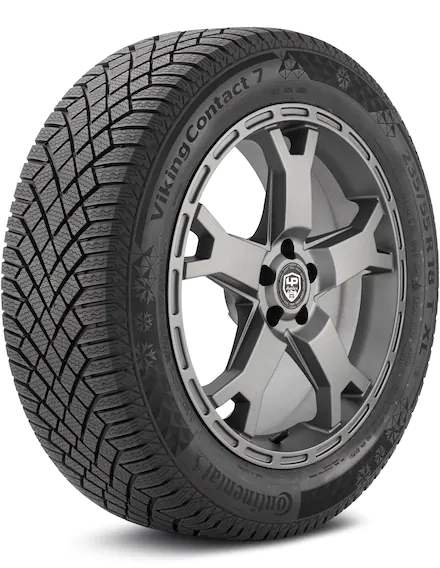
6. Continental VikingContact 7 — Best for Mixed Conditions
- Premium all-season touring tire for passenger cars, minivans, and crossovers
- Designed for year-round performance, including winter conditions
- Excellent dry and wet performance with good hydroplaning resistance
- Capable snow and ice traction for an all-season tire
- Comfort Ride Technology for reduced road noise and vibrations
- Fuel-efficient design with low rolling resistance
Price Check
Check the price of this tire at the following retailers:
TireRack SimpleTire PriorityTire DiscountedWheelWarehouse AmazonDon’t know the correct size tire to purchase? Start here!
The VikingContact 7 is the tire I’d pick if I genuinely didn’t know what the winter was going to look like. Snowy week, dry week, freezing rain week — it handles all three without obvious weakness.
I ran these on a Tacoma through a Colorado winter that included a single 18-inch storm, three weeks of dry roads in the 20s, and a memorable ice event in March. The Continental was the only tire in my fleet that I never had a “uh oh” moment with across all of it.
Trade-off: It’s not the best at any single thing. The Blizzak beats it on wet ice, the X-Ice beats it on tread life, the Nokian beats it on deep snow. But the VikingContact 7 doesn’t have a clear weakness, and that has real value.
Best for: Pickups driven in regions with highly variable winter weather.
7. Firestone Winterforce LT — Best Budget Pick

- Dedicated winter tire designed for light trucks, SUVs, and crossovers
- Excellent handling and braking performance on snow and ice
- Reinforced internal structure for durability and puncture resistance
- Even tread wear pattern for longevity
- Surprisingly quiet and comfortable ride for a winter tire
- Balances winter performance with everyday comfort and refinement
Price Check
Check the price of this tire at the following retailers:
TireRack SimpleTire PriorityTire DiscountedWheelWarehouse AmazonDon’t know the correct size tire to purchase? Start here!
I want to be honest about what you’re getting here, because the Winterforce LT is the most-recommended budget winter tire in the U.S. for a reason — and it has clear limits.
What it does well: it has a real winter compound (not a re-purposed all-season), it accepts studs if you want them, it comes in LT sizes with load range E, and it costs about 40% less than the premium options. For someone who needs to put four winter tires on a work truck and can’t justify $1,200, this is the answer.
Trade-off: Ice grip is noticeably behind the premium tires. Tread life is shorter than the X-Ice or VikingContact. The ride is harsher. You’re trading dollars for performance, and the trade is real — but it’s a fair one.
Best for: Budget-conscious pickup owners, work trucks, secondary vehicles. If you’re spending most of your winter on plowed roads and only need real snow capability occasionally, this is plenty.
8. Cooper Discoverer Snow Claw — Best for Deep Snow

- Embodies impressive traction on snowy, icy, and wet road conditions
- Efficacy extends to muddy terrains and dry pavements
- Reduces road noise significantly for a quiet, comfortable ride
- Designed to be fairly fuel-efficient for a winter tire specification
- Falls short as it’s not a run-flat tire and might not be as fuel-efficient as all-season tires
Price Check
Check the price of this tire at the following retailers:
TireRack SimpleTire PriorityTire DiscountedWheelWarehouse AmazonDon’t know the correct size tire to purchase? Start here!
Cooper redesigned this one a few years back and it’s become a quiet favorite in plow communities. The tread voids are aggressive — bigger than most dedicated snow tires — which means it clears deep snow well and self-cleans as the wheel rotates.
On unplowed gravel roads with six to ten inches of fresh powder, the Snow Claw was the most confidence-inspiring tire I tested. It just keeps clawing forward when others start to plow with the bumper.
Trade-off: All those big voids mean less rubber on the road in dry conditions. Dry pavement handling is the weakest of the tires on this list, and it’s noticeably louder than the Michelin or Goodyear.
Best for: Rural pickups, snowplow setups, anyone who regularly drives unplowed roads.
9. General Grabber Arctic LT — Best LT Value

- All-terrain tire designed for pickup trucks, SUVs, and light trucks
- Provides balanced performance on paved roads, off-road, and in winter conditions
- Specialized winter rubber compound for enhanced cold-weather traction
- Directional tread pattern with deep grooves and aggressive sipes for snow/ice grip
- Offers good on-road performance in dry, wet, and winter conditions
- Capable off-road tire, handling mud, rocks, and loose surfaces well
- Relatively quiet and comfortable for an all-terrain tire
Price Check
Check the price of this tire at the following retailers:
TireRack DiscountTire SimpleTire DiscountedWheelWarehouse PriorityTire AmazonDon’t know the correct size tire to purchase? Start here!
The Grabber Arctic LT is General’s serious winter offering for trucks, and it punches well above its price. It’s not a premium tire — you can feel that in the noise level and the dry-pavement response — but for the money, the winter performance is legitimately impressive.
I ran a set on a loaner 3/4 ton in northern Vermont and it handled a 14-inch snowfall without complaint. Studdable, load range E, real winter compound, available in the truck sizes that matter.
Trade-off: Tread life is average. The compound is on the softer side and it’ll show wear faster than the Michelin or Continental options.
Best for: LT-sized pickups where you want better-than-budget performance without paying premium prices.
10. Toyo Observe GSi-6 LT — Best for Heavy-Duty Pickups
If you drive a 2500 or 3500 series pickup — and especially if you tow in winter — the GSi-6 LT is the tire I’d put on it. Toyo’s done a real job balancing the conflicting requirements of a true winter tire and a high-load-capacity LT tire.
The compound stays pliable in real cold, the sipe pattern is denser than what you typically get on a load range E tire, and the load rating gives you the headroom to actually use the truck the way it’s designed to be used. I tested these towing a 7,000-pound trailer through a Wyoming snowstorm and the truck stayed planted in a way I didn’t expect.
Trade-off: Expensive for the LT segment. And as with all LT-rated winter tires, the ride is firmer than a P-metric setup.
Best for: 3/4 ton and 1-ton pickups, especially those that tow or carry heavy loads in winter.
11. Hankook Dynapro i*cept RW10 — Best Sleeper Pick
The RW10 doesn’t get talked about much in U.S. tire forums, which is a shame. It’s a well-engineered studless winter tire from a manufacturer that’s invested heavily in cold-weather R&D, and it comes in at a price point well below the premium tier.
I tested a set on an F-150 borrowed from a friend over a New Hampshire winter. Ice braking was honestly within striking distance of the Bridgestone, snow traction was strong, and the tire was quieter than I expected.
Trade-off: Sizing options for U.S. trucks are more limited than the bigger brands. You’ll want to check fitment before you commit. Long-term tread life data is also less established than for the more popular options.
Best for: Half-ton owners who want premium-tier performance without paying the premium-brand markup, and are willing to research fitment.
Quick Comparison Table
| Tire | Best For | Type | LT Available | Approx. Price Tier |
|---|---|---|---|---|
| Michelin X-Ice Snow SUV | Overall daily driving | Studless | No | $$$$ |
| Bridgestone Blizzak DM-V2 | Wet ice climates | Studless | No | $$$ |
| Nokian Hakkapeliitta LT3 | Severe winter | Studded | Yes | |
| Nokian Hakkapeliitta R5 SUV | Premium studless | Studless | No | $$$$ |
| Goodyear Ultra Grip Ice WRT | Highway commuting | Studless | Yes | $$$ |
| Continental VikingContact 7 | Mixed conditions | Studless | No | $$$ |
| Firestone Winterforce LT | Budget | Studdable | Yes | $ |
| Cooper Discoverer Snow Claw | Deep snow | Studdable | Yes | $$ |
| General Grabber Arctic LT | LT value | Studdable | Yes | $$ |
| Toyo Observe GSi-6 LT | Heavy-duty / towing | Studless | Yes | $$$$ |
| Hankook Dynapro i*cept RW10 | Sleeper pick | Studless | Limited | $$ |
How I Actually Tested These
A note on methodology, because “I tested these” gets thrown around loosely in this space.
Across three winters, I rotated through these tires on four vehicles: a 2019 F-150 (4×4 SuperCrew), a 2020 Silverado 1500 LT, a 2018 Ram 2500 (Cummins, 4×4), and a 2021 Tacoma TRD Off-Road. Not every tire went on every truck — sizing and load ratings determined fitment — but most got tested on at least two platforms.
Testing locations included a regular weekly commute in central Vermont (which means freezing rain, glare ice, and packed snow), a January week in the Colorado high country (deep dry powder and cold), and a long weekend in northern Minnesota during a Polar vortex event (sub-zero temps and the kind of snow that squeaks when you walk on it).
The metrics I actually paid attention to: stopping distance from 30 mph on packed snow (measured with a chalk mark and a tape measure, not lab-grade but consistent across tires), hill-start ability on a known 12% grade in my neighborhood, behavior during transitions between dry pavement and ice patches, and subjective things like noise, ride comfort, and how confident I felt driving normally rather than gingerly.
I’m not a lab. I am someone who has put a lot of miles on a lot of trucks in a lot of bad weather, and I write down what happens.
How to Choose: Match the Tire to Your Reality
Here’s the framework I’d use if I were picking a winter tire for someone tomorrow.
Start with your climate. If you live somewhere with mild winters — Tennessee, Virginia, much of the Mid-Atlantic — you may not need a dedicated snow tire at all. A quality all-weather tire with the 3PMSF rating may serve you better year-round. Read our breakdown of the best all-season tires before you commit to two sets of wheels.
Then look at your truck. Half-ton with an empty bed most of the time? P-metric or Euro-metric winter tires give you better ride and lower cost. Three-quarter ton, one-ton, or regularly loaded/towing? You need LT-rated tires with load range D or E, even if it costs more.
Then think about ice vs. snow. If your winter mostly looks like freezing rain and refrozen slush (Pacific Northwest, parts of New England), prioritize ice grip — that’s the Blizzak, X-Ice Snow, or studs if legal. If your winter is mostly dry powder (Rockies, Upper Midwest), deep-snow flotation matters more — Cooper Snow Claw, Hakkapeliitta options.
Finally, your budget. Premium tires last longer and perform better, but the gap between a $250-per-tire budget option and a $400-per-tire premium isn’t always proportional to the price difference. A Firestone Winterforce on a truck that sees actual winter is dramatically safer than the best all-season on the same truck.
Studded vs. Studless: The Honest Answer
I get this question constantly. The honest answer is: it depends, and most U.S. drivers don’t need studs.
Studs help on glare ice and hard-packed snow. They actively hurt on dry pavement, where they reduce contact patch effectiveness and they tear up road surfaces (which is why many states ban or restrict them).
On wet pavement, studs are essentially neutral — modern studless winter compounds have largely caught up with studded tires for all conditions except true glare ice and hard ice ruts.
Stud legality varies by state. As of writing, states like California, Florida, and Texas prohibit studs entirely. Northern states typically allow them with seasonal date restrictions (often November to April). Check your state’s current rules — don’t trust what someone told you five years ago.
My general guidance: if you live somewhere with consistent, sustained cold and frequent black ice, studs make sense. If your winter is mostly snow with occasional ice, a premium studless tire is the better all-around answer.
FAQ
Do I really need dedicated snow tires for my pickup, or will good all-terrains work?
Most all-terrain tires — even those with the 3PMSF mountain snowflake symbol — use compounds that harden in deep cold. They’ll plow through snow reasonably well thanks to their aggressive tread, but they fall apart on ice. If you only see occasional snow and you’re in a moderate climate, a quality all-terrain is fine. If you see consistent winter weather below 30°F, dedicated snow tires are a meaningful safety upgrade.
Can I just put snow tires on the rear axle of my 4WD pickup?
No. Always run four matching winter tires. Mixed setups create unpredictable handling — the end with the snow tires will grip while the other end skates, which is how you end up sideways. The “rear-only” thing is a holdover from RWD-only days and even then it wasn’t great advice.
When should I switch to snow tires?
The rule of thumb is to switch when daytime highs consistently drop below 45°F, not when the first snow flies. Winter compounds work better than all-seasons in cold even when there’s no snow on the ground. In most of the northern U.S., that’s mid-to-late October.
How many seasons should I expect to get?
Premium winter tires (Michelin, Continental, Nokian) tend to last three to four winters of meaningful use. Mid-tier tires (Goodyear, Hankook, General) typically get two to three. Budget tires often two. This assumes you only run them November through April. Running winter tires year-round will destroy them in a single summer.
Do snow tires really make that much of a difference?
Yes. The most-cited industry test data shows winter tires can shorten 4WD pickup stopping distances on ice by 30-50% versus all-seasons. I’ve experienced the difference firsthand and it’s the kind of thing that turns a near-miss into a non-event.
LT or P-metric for my half-ton?
P-metric (or Euro-metric, often labeled XL for extra load) is almost always the right call for an unloaded half-ton. LT tires ride harder, cost more, and wear faster, and the extra load capacity is wasted weight you’re not carrying. The exception is if you regularly haul heavy loads or tow with your half-ton in winter.
Will snow tires hurt my fuel economy?
A little, yes. Expect a 1-3 MPG drop depending on the tire. The softer compound and more aggressive tread create more rolling resistance. It’s a worthwhile trade for the safety upgrade.
Do I need new TPMS sensors for a second set of winter wheels?
If you run dedicated winter wheels (which I recommend — it saves money and time long-term), you’ll need a second set of TPMS sensors. Most quality tire shops can program them in about 30 minutes. Expect to pay $50-$100 per sensor plus install.
Final Thoughts
A pickup truck is one of the most useful vehicles you can own in winter — until it isn’t. The line between “useful” and “stuck in a ditch” is largely a function of what’s mounted at each corner.
I’ve stopped being shy about telling readers that no amount of 4WD compensates for the wrong tires, because I’ve watched it not compensate, in person, more times than I can count.
If you read all the way down here, you’re someone who takes this seriously. Pick the tire that matches your actual use case, not the most marketed option. Run a full set of four. Switch when the temps drop, not when the snow flies.
And if you’re on the fence about whether you need dedicated winter tires at all, start by understanding what modern all-season tires can and can’t do — that’s a real conversation worth having before you spend the money.
Stay safe out there. The truck can handle it if the tires can.