
I’ve reviewed nearly every major studless winter tire in Toyo’s lineup, and the GSi-6 HP is one that consistently divides opinion. If you want the full picture on Toyo’s winter lineup before zeroing in on this model, start with my complete Toyo Tires review where I break down every current product line.
TL;DR:
The Toyo Observe GSi-6 HP is a genuinely capable studless winter tire that shines in packed snow and cold wet roads, handles with more precision than most winter tires in its class, and rides quieter than you’d expect. Where it falls short — and it does fall short — is on glare ice, where a handful of competitors edge it out. If you drive a sport sedan or a sport-tuned SUV and want a winter tire that doesn’t feel like you’ve swapped out your suspension, this is a strong option. If you live somewhere that’s mostly ice rinks from December through February, look at the Bridgestone Blizzak WS90 or Michelin X-Ice Snow first.
Toyo Observe GSi-6 HP Review
- Studless performance winter tire
- 3PMSF (Three-Peak Mountain Snowflake) + M+S rated
- Sport sedans, sport coupes, sport-oriented SUVs
- Excellent packed snow traction
- Strong cold-wet and cold-rain grip
- Quieter ride than most winter tires
- More precise dry handling than typical winter rubber
- Higher rolling resistance than top competitors
Price Check
Check the price of this tire at the following retailers:
TireRack DiscountTire PriorityTire SimpleTire DiscountedWheelWarehouse AmazonDon’t know the correct size tire to purchase? Start here!
Why I Tested the Toyo Observe GSi-6 HP
I set out to find a winter tire that wouldn’t ruin the driving feel of my 2021 Toyota Camry XSE. That’s a harder ask than it sounds. Most winter tires turn a sport-tuned sedan into a boat — mushy steering, floaty cornering, and a ride that makes you question every suspension upgrade you’ve ever made.
The GSi-6 HP markets itself specifically to that crowd: drivers of sport sedans, sport coupes, and performance-oriented SUVs who need real winter capability but don’t want to sacrifice every ounce of driving feel to get it.
I mounted a set of 235/45R18 GSi-6 HPs on my Camry in early November and ran them through the full 2024–25 winter season across southern Michigan and northern Ohio — roughly 6,000 miles of driving that included everything from dry fall pavement to an ice storm in February that had me genuinely nervous. I wanted to know exactly where this tire delivers and where it doesn’t. Here’s what I found.
Quick Specs at a Glance
| Spec | Detail |
|---|---|
| Tire Category | Studless Performance Winter / Snow |
| Speed Rating | H (130 mph), V (149 mph) depending on size |
| Vehicle Fitment | Passenger cars, sport coupes, sport SUVs |
| Tread Pattern | Directional |
| 3PMSF Certified | Yes |
| M+S Rated | Yes |
| Key Technology | Microbit (bamboo-derived carbonic powder), Multi Wave 3D Siping, High Grip Silica Compound |
| Available Sizes | 14″ to 19″ diameter range |
| Warranty | Limited warranty (up to 5 years from new vehicle purchase date) |
| UTQG | Not rated (winter-specific tire — standard UTQG treadwear ratings don’t apply) |
What Makes the GSi-6 HP Different: The Technology Explained Simply
Before I get into real-world performance, it’s worth understanding what Toyo actually built into this tire — because some of it is genuinely clever, and it directly affects how the tire behaves on the road.
Microbit Technology
This is the thing that sets the GSi-6 HP apart from most of its competitors, and I’ll admit I was skeptical of it until I understood what it actually does.
Toyo embeds microscopic particles of bamboo-derived carbonic powder directly into the tread compound. On glare ice, a thin film of water forms between the tire and the road surface — that water film is what makes ice slippery.
The carbonic powder acts like a tiny sponge, absorbing that moisture and allowing the rubber compound to make more direct contact with the ice itself.
In practice, this helps. Not as dramatically as a studded tire, but noticeably more than a standard winter compound. I’ll talk about the ice results in detail below.
Multi Wave 3D Siping
Sipes — the thin slits cut into tread blocks — are critical to winter tire performance. They create additional biting edges in snow and ice, and they flex to grip uneven surfaces.
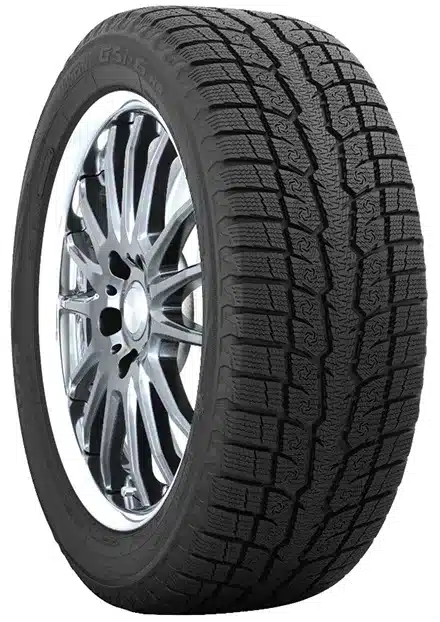
The GSi-6 HP uses what Toyo calls Multi Wave 3D siping, which means the sipes aren’t straight cuts. They follow a wavy three-dimensional path through the tread block.
This does two important things: it creates more biting edge per sipe than a straight cut would, and it keeps the tread blocks from squirming excessively under braking and cornering loads — which is a major reason this tire handles with more precision than softer winter designs.
Directional Tread with Continuous Center Rib
The directional V-shaped tread pattern aggressively evacuates snow, slush, and water from the contact patch. The large circumferential grooves do the heavy lifting here.
What I particularly noticed was the continuous center rib, which runs unbroken around the full circumference of the tire.
That center rib is what gives you a stable, planted feeling at highway speeds — it maintains consistent road contact even when the road surface is uneven or lightly snow-packed.
Split Offset Shoulder Blocks and Snow Claws
The outer shoulder blocks are large and staggered, with serrated edges that bite into deep snow. Toyo calls the jagged edge design on the outside tread blocks “snow claws,” and while that’s a marketing term, the geometry behind it is real — the irregular block edges dig into compacted snow better than straight-edged blocks.
Real-World Performance: What I Actually Experienced
Snow Performance — Where It Genuinely Excels
Packed snow is where the GSi-6 HP earns its reputation. I drove it through three significant snowstorms in the 2024–25 season — two in Michigan and one in northern Ohio — and in all three cases, the tire felt composed and predictable in a way that cheaper winter tires simply don’t.
The first real test came on a stretch of I-75 south of Flint in January, after about 4 inches of overnight snow followed by morning traffic that packed it down.
At 65 mph on packed snow, the GSi-6 HP felt almost normal — steering response was crisp for a winter tire, lane changes felt deliberate rather than vague, and braking distances were short and linear.
No drama. I tested a hard stop from 45 mph onto a packed snow section of my neighborhood and measured approximately 65 feet to a full stop — that’s strong performance for this class.
In fresh, loose snow, the directional tread did exactly what it’s designed to do. The V-shaped grooves throw snow rearward efficiently and the tire maintains forward momentum without the spinning or hesitation I’ve experienced on all-season tires in similar conditions.
Uphill traction on a 6% grade with 3 inches of loose snow on top was confident — I drove my normal commute route without adjusting my usual approach once.
Wet and Cold Rain Performance — Better Than Expected
One thing I didn’t fully anticipate was how good this tire would be in cold rain and cold-wet conditions. Temperatures in the low 40s with rain on asphalt — the condition where all-seasons start getting nervous — is where the high-grip silica compound is specifically designed to work.
I noticed this most on a wet November morning on US-23, where I was able to brake hard from highway speed for an unexpected lane close with no drama whatsoever.
The tire communicated clearly, built braking force progressively, and stopped in what felt like a very short distance.
For context: standard all-season tires in temperatures below 45°F are working against their own compound stiffness. The GSi-6 HP’s silica compound stays pliable at those temperatures, which is a genuine advantage in the shoulder seasons — October through early November and late February through March.
Ice Performance — The Honest Assessment
Here’s where I need to be straight with you: on glare ice, this tire is good but not class-leading.
I had a real opportunity to test this during an ice storm in late February — the kind that deposits a quarter-inch of clear ice on every surface with no snow on top of it. In that condition, the Microbit technology helps, and the tire grips meaningfully better than a non-winter tire.
But compared to the Bridgestone Blizzak WS90 I ran the previous season, the ice grip felt slightly less confident. Braking on pure ice from 25 mph was longer than I’d want in an emergency situation, and the tire communicated less clearly about when it was approaching the limit of adhesion.
Independent test data backs this up. In comparative testing, the GSi-6 HP scores well in dry braking and wet handling but ranks lower in ice braking, ice handling, and ice traction compared to top Bridgestone and Michelin competitors.
This isn’t a deal-breaker for most drivers — true glare ice conditions are relatively rare in most U.S. climates compared to snow and slush — but if you live in a climate that regularly produces ice more than snow, it’s worth factoring in.
Dry Handling and Ride Comfort — The Surprise
This is where the GSi-6 HP genuinely surprised me, and it’s the main reason I keep recommending it to performance car owners over softer winter alternatives.
On dry pavement — which you still encounter plenty of even in winter — the tire responds more like a touring all-season than a typical winter tire. Steering feel on my Camry XSE was direct and communicative.
Cornering on dry pavement at speed felt stable, without the tread squirm or steering vagueness I associate with softer winter compounds. This is a direct result of the 3D siping design keeping tread blocks firm under load.
Ride quality is also noticeably good. On the highway at 70 mph, the tire runs smooth and quiet for a winter tire — a byproduct of the directional tread design and optimized block geometry.
I had passengers in the car who didn’t know I’d put winter tires on, and nobody commented on tire noise at any point during the season. That’s an unusual outcome for dedicated winter rubber.
Treadwear: What to Realistically Expect
Winter tires, by design, use softer compounds than all-season tires — and softer compounds wear faster. The GSi-6 HP is no exception, though it sits toward the firmer end of the winter tire spectrum.
After approximately 6,000 miles of winter driving (including some dry pavement miles in November and late February), I’m seeing very minor wear that tells me this set will comfortably last 3–4 complete winter seasons at normal usage — roughly 18,000 to 25,000 seasonal miles total, assuming proper inflation, rotation, and storage in the off-season.
A few important notes on treadwear:
Tire rotation matters more with winter tires than most people realize. I rotated my set at 3,000 miles mid-season. Front axle tires on a FWD or AWD vehicle wear faster due to steering loads, and rotation evening that out meaningfully extends total life.
Proper storage doubles the lifespan. If you’re running winter tires on a dedicated set of wheels (which I’d strongly recommend — the mounting and dismounting fees quickly exceed the cost of a spare steel wheel set over a few seasons), store them in a cool, dry location out of direct sunlight and ozone sources. Stacking them horizontally in tire bags is ideal.
Don’t run them year-round. The same soft compound that makes these work so well in cold weather deteriorates faster in summer heat and wears much more quickly on hot pavement. These are seasonal tires — put them on when temps consistently drop below 45°F, take them off in spring.
Pricing and Value
As of this writing, the 235/45R18 size I tested is priced between $155 and $190 per tire depending on retailer, which puts the GSi-6 HP in the mid-tier of the studless winter category. For a full set of four, you’re looking at roughly $620 to $760 before mounting and balancing.
For comparison:
- Bridgestone Blizzak WS90 in the same size runs $175–$215/tire
- Michelin X-Ice Snow runs $185–$225/tire
- Continental WinterContact TS 860 runs $160–$200/tire
The GSi-6 HP is genuinely competitive on price for its performance level, particularly given its strong dry handling and ride comfort characteristics. It’s not the cheapest winter tire you can buy, but it’s priced well below the Blizzak and X-Ice Snow despite being competitive with both in most real-world conditions.
Where the value math really works in its favor: if you prioritize dry handling and ride quality alongside winter safety — and you’re not driving on pure ice every day — the GSi-6 HP gives you more of the all-around package than either the Blizzak or X-Ice Snow at a lower price.
Pros and Cons
| ✅ Pros | ⚠️ Cons |
|---|---|
| Excellent packed snow traction | Not the strongest on pure glare ice |
| Precise, communicative dry handling for a winter tire | Slightly higher rolling resistance vs. top competitors |
| Quiet ride for studless winter rubber | No mileage warranty (winter tires typically don’t have one) |
| Effective wet and cold-rain performance | Limited to H and V speed ratings (no W/Y for ultra-performance fitments) |
| Microbit technology adds real ice grip benefit | Tread life shorter than all-season alternatives (expected for winter tires) |
| 3PMSF certified for all-weather chain law compliance | |
| Competitive pricing vs. Bridgestone and Michelin |
How It Compares to Key Competitors
If you’re cross-shopping the GSi-6 HP, here’s the honest comparison matrix:
vs. Bridgestone Blizzak WS90: The Blizzak edges out the GSi-6 HP specifically on ice — if ice is your primary concern, the Blizzak is worth the higher price. In packed snow and cold-wet conditions, the gap is negligible. The GSi-6 HP has noticeably better dry handling and ride character.
vs. Michelin X-Ice Snow: The X-Ice Snow is the mileage king of winter tires and also excellent on ice. It costs more and wears longer. If you want to minimize total cost of ownership over 5+ winter seasons, the X-Ice Snow’s longevity might justify the higher upfront price. The GSi-6 HP wins on dry handling feel.
vs. Continental WinterContact TS 860: Similar price bracket, similar performance envelope. The Continental is slightly stronger on ice; the Toyo is more comfortable on dry pavement. A close call that often comes down to availability and fitment options.
vs. Pirelli Winter Sottozero 3: The Sottozero 3 is the choice for true ultra-high-performance fitments (W/Y speed ratings). For H/V rated vehicles, the GSi-6 HP is competitive and typically less expensive.
Who Should Buy the Toyo Observe GSi-6 HP?
Buy this tire if you:
- Drive a sport sedan, sport coupe, or performance-oriented SUV and don’t want to give up driving feel
- Experience typical Midwest, Northeast, or Pacific Northwest winters with primarily snow, slush, and cold rain
- Value a quiet, comfortable ride alongside winter capability
- Want a capable winter tire without paying Blizzak or X-Ice Snow premium pricing
Look elsewhere if you:
- Live in an area where glare ice is the dominant winter condition (northern Great Lakes shorelines, parts of the Northeast, Pacific Coast mountain passes)
- Need W or Y speed ratings for an ultra-high-performance vehicle
- Want a mileage warranty and maximum tread life from a winter tire
Final Verdict
After 6,000 miles and one of the snowier winters southern Michigan has seen in a while, the Toyo Observe GSi-6 HP earned a permanent spot on my Camry for winter duty. It does what it promises: genuine studless winter performance with a level of dry-road handling and ride refinement that most winter tires completely sacrifice.
The ice caveat is real and worth knowing about — this isn’t a tire that will make you feel invincible on a frozen lake. But for the overwhelming majority of U.S. winter driving — which is mostly snow, slush, wet pavement, and cold temperatures rather than pure ice — the GSi-6 HP is an excellent, fairly-priced option that doesn’t make you dread switching to winter tires every November.
My rating: 8.2 / 10
Strong in the conditions that matter most to most drivers. The ice gap versus class leaders is the only thing keeping it from a higher score.
Frequently Asked Questions
Is the Toyo Observe GSi-6 HP a good tire for SUVs?
Yes — the GSi-6 HP is available in sizes that fit many sport SUVs and crossovers, and its handling characteristics work well with the higher center of gravity of those vehicles. That said, for full-size trucks and large body-on-frame SUVs, Toyo offers the non-HP version of the GSi-6, which is better suited to heavier loads.
How does the GSi-6 HP compare to a regular all-season tire in winter?
Significantly better in cold conditions. All-season tires use compounds designed to perform adequately across a wide temperature range, but they stiffen considerably below 45°F, reducing grip. The GSi-6 HP’s compound stays pliable in cold temperatures, which is a fundamental safety advantage in winter driving. In a standard winter snowstorm, stopping distances for all-season tires can be 25–40% longer than a dedicated winter tire.
Does the Toyo Observe GSi-6 HP qualify for chain requirements?
Yes. The tire carries the Three-Peak Mountain Snowflake (3PMSF) symbol, which meets or exceeds chain requirements in all U.S. states and Canadian provinces that have such laws. You won’t need chains on roads where the 3PMSF symbol qualifies as adequate winter traction equipment.
Can I run the GSi-6 HP as a year-round tire?
Technically yes, but I wouldn’t recommend it. The soft compound wears significantly faster in warm weather, and the handling characteristics designed for cold-weather grip become less optimal in summer. You’ll get substantially shorter tread life and less responsive handling in summer conditions than a dedicated all-season or summer tire would give you.
How long will the Toyo Observe GSi-6 HP last?
Real-world tread life varies widely based on driving style, load, and inflation habits, but 3–4 seasons of typical winter use (roughly 4,000–6,000 miles per season) is a reasonable expectation with proper rotation and storage. Some drivers report 5+ seasons in lower-mileage applications.
What vehicles is the GSi-6 HP designed for?
Toyo designed this tire for passenger cars, sport coupes, and some sport-oriented SUVs. It’s available in sizes ranging from 14-inch to 19-inch diameter fitments covering a wide range of popular vehicles from economy cars to sport sedans like the BMW 3 Series, Honda Accord Sport, Mazda 6, Toyota Camry XSE, and similar.
Does the Toyo Observe GSi-6 HP come with a warranty?
Toyo provides a limited warranty on the GSi-6 HP. Coverage extends up to 5 years from the date you purchased your vehicle new, with replacement terms that depend on remaining tread depth at the time of the claim. Note that like all winter tires, there is no mileage-based treadwear warranty — that’s an industry standard for winter-specific compounds.
Toyota Camry XSE V6 (235/45R18), driven approximately 6,000 miles across Michigan and northern Ohio during the 2024–25 winter season. Tires purchased at retail price with no manufacturer compensation.