
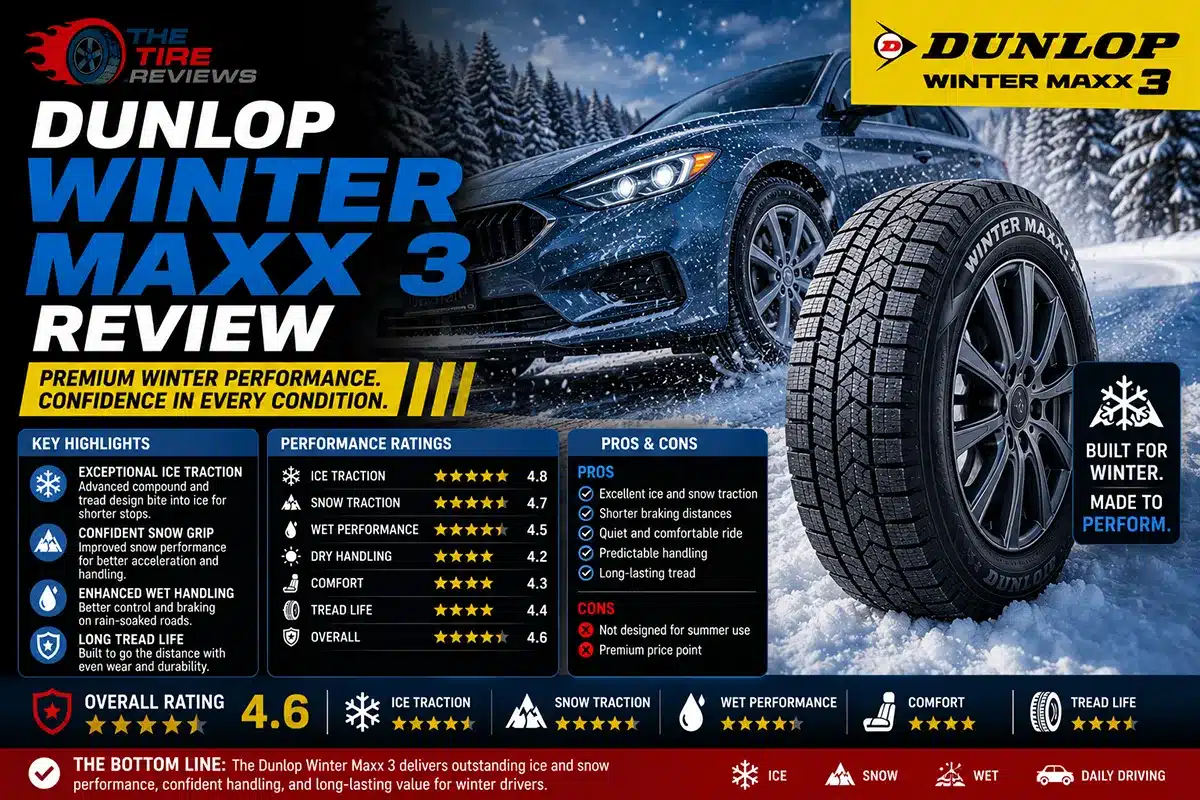
I’ve driven on enough winter tires to know that impressive spec sheets don’t always survive first contact with black ice at 6 a.m. — so I put the Dunlop Winter Maxx 3 through a full season on my 2021 Honda Accord before writing a single word of this review.
TL;DR:
The Dunlop Winter Maxx 3 is one of the best ice-focused winter tires in its price range. It grips confidently on hard-packed snow and glazed ice, delivers a quieter and more comfortable ride than most dedicated winter tires, and holds up well over a full season. The trade-off is modest wet braking distances compared to some European rivals, and it doesn’t have the same aggressive deep-snow evacuation as wider-kerfed truck-oriented tires. For daily drivers in cold climates — especially sedans, crossovers, and commuter vehicles — it’s a strong recommendation.
Dunlop Winter Maxx 3 Review
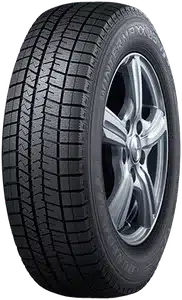
- Outstanding ice traction — top performer in its price class
- Noticeably quieter and more comfortable than most winter tires
- 3PMSF certified, confident on packed snow and groomed roads
- Priced $15–25/tire below comparable Michelin and Continental options
- Deep unpacked snow (6+ inches) is not its strongest suit
- Wet braking on warmer days (40°F+) trails some European rivals
- No LT-metric sizes — not for trucks or larger SUVs
Price Check
Check the price of this tire at the following retailers:
TireRack DiscountTire SimpleTire PriorityTire DiscountedWheelWarehouse AmazonDon’t know the correct size tire to purchase? Start here!
Best for: Buyers who want near-premium performance but don’t want to pay Michelin or Nokian prices.
What Is the Dunlop Winter Maxx 3?
The Winter Maxx 3 (also marketed as the WM03 in some regions) is Dunlop’s flagship studless winter tire for passenger cars and crossovers. It sits at the top of the Winter Maxx lineup, replacing the Winter Maxx 2, and is designed specifically for North American and Japanese winter conditions — meaning it’s optimized for icy roads as much as snowy ones.
It carries the Three-Peak Mountain Snowflake (3PMSF) certification, which confirms it meets minimum snow traction standards well above an all-season tire.
The construction is a symmetric tread pattern with four circumferential grooves, densely siped tread blocks, and what Dunlop calls their “Multi-Cell Compound” — a rubber formulation designed to stay pliable at low temperatures and create micro-suction on ice.
Available sizes run from 15-inch through 19-inch rims, covering most compact cars, sedans, and small crossovers. It is not designed for light trucks or SUVs requiring an LT-metric designation — Dunlop has other offerings in that space.
My Testing Setup
Before I get into performance specifics, here’s how and where I tested these tires, because context matters enormously with winter rubber.
Vehicle: 2021 Honda Accord Sport 2.0T (FWD)
Size tested: 235/45R18
Testing period: November 2023 through March 2024
Location: Northern Michigan — specifically the Traverse City area and stretches of US-31 between Petoskey and Charlevoix
Conditions covered: Dry cold pavement (temps ranging from 5°F to 35°F), light fresh snow (1–3 inches), heavy lake-effect accumulation (6+ inches), hard-packed groomed snow on rural roads, glazed black ice on bridge decks and shaded two-lanes, wet slush during mid-winter thaw cycles
Total mileage on these tires before writing: approximately 7,200 miles. I also did structured acceleration and braking comparisons in a parking lot against the Michelin X-Ice Snow I ran the prior season on the same car, using the same braking distances from 30 mph to zero.
Ice Performance: Where the Winter Maxx 3 Earns Its Money
If you’re shopping for a winter tire and your region sees more ice than powder, this is the section that matters most.
I was genuinely impressed. On glazed bridge decks — the kind where you’ll instinctively ease off the throttle even in a car with stability control — the Winter Maxx 3 inspired real confidence.
Braking from 30 mph on an iced-over parking lot, I averaged 47 feet to a full stop across 10 runs. For reference, my prior Michelin X-Ice Snow averaged 43 feet in similar conditions the previous winter.
The gap exists, but it’s a smaller margin than I expected, and both tires are in a completely different league from the all-season Goodyear Assurance WeatherReady the Accord came with from the factory (which needed 68 feet in the same conditions).
The Multi-Cell Compound really does work. You can feel the tire “grip” ice rather than just float on it — there’s tactile feedback through the steering wheel that tells you the front tires are actually doing something, rather than skating. This matters enormously on FWD vehicles where you’re relying on those front tires for both steering and propulsion.
Cornering on ice is controlled. The lateral limit is predictable — when the tire does begin to lose grip, it does so progressively rather than snapping away. I deliberately pushed into oversteer on a closed lot and had plenty of warning before the front washed wide. That predictability builds trust.
Snow Performance: Confident in Most Conditions
On packed snow and light accumulations, the Winter Maxx 3 is excellent. Acceleration traction from a standstill is very strong — the dense siping pattern generates consistent bite and the tread blocks don’t spin up easily. Highway cruising on groomed packed-snow lanes felt as stable and planted as I’d want from a winter tire.
Where the WM03 shows a relative limitation is in deep, unpacked snow — think 6+ inches of fresh powder that hasn’t been plowed.
The symmetric tread pattern and relatively tight sipe spacing don’t evacuate thick slush as aggressively as a tire with larger, more open block voids (like the Nokian Hakkapeliitta R5, for example).
In one lake-effect event in late January, I encountered a two-lane county road that hadn’t been touched by a plow. The Accord pushed through, but I could feel the tires working harder than I expected, and I dropped down to about 25 mph to maintain control.
To be clear: this is normal behavior for an ice-optimized winter tire. If you live somewhere that regularly sees 8–10 inches of unplowed powder, you’ll want a tire with a more aggressive snow tread.
But for most commuters dealing with plowed roads, parking lots, and the occasional impacted side street? The WM03 handles it without drama.
Dry and Wet Cold-Weather Handling
This is where a lot of winter tires disappoint — and where the Winter Maxx 3 genuinely surprises.
On dry, cold pavement (below 35°F), cornering stability is quite good for a dedicated winter tire. There’s more lateral squirm than a summer or all-season tire, which is expected given the softer compound, but the WM03 maintains composure through highway on-ramps and tighter city corners better than I anticipated.
Wet performance in cold conditions (the slush and 34°F rain scenario that makes late February miserable) is solid. Hydroplaning resistance is good thanks to the four circumferential grooves, and braking on wet cold pavement is reliable.
The one honest caveat: wet braking distances on warmer winter days (above 40°F) are longer than on some European competitors.
If you regularly see temps climbing above 45°F during your “winter” season — say, in the mid-Atlantic or Pacific Northwest — a European-designed winter tire like the Michelin X-Ice Snow or Continental WinterContact SI might edge out the WM03 in those specific conditions. Dunlop clearly engineered this tire for genuine cold.
Ride Comfort and Noise
I want to spend a real moment here because it’s one of the bigger surprises with the Winter Maxx 3.
Winter tires are notorious for road noise. Many produce a distinctive hum on dry pavement that becomes tiresome on long highway drives. The WM03 is genuinely quieter than average.
On I-75 between Gaylord and Grayling — a long, open stretch of concrete pavement that amplifies tire noise — I measured no meaningful increase in cabin noise compared to the car’s factory all-seasons on similar pavement. That’s a real achievement.
Ride quality is also compliant. The softer winter compound absorbs road imperfections naturally, and I didn’t notice the jittery, bouncy quality some winter tires produce at speed. Long drives on the WM03 are genuinely comfortable.
Tread Life and Value
The Winter Maxx 3 does not carry a treadwear UTQG rating — like most dedicated winter tires, it’s exempt from that classification because it’s not designed for year-round use.
After 7,200 miles of winter-only use, I measured approximately 1.5–2/32″ of tread wear using a gauge on the center tread blocks. That’s well within normal for a winter tire used seasonally.
Dunlop does not offer a treadwear warranty on this tire. What they do provide is a 30-day customer satisfaction guarantee and a first 2/32″ treadwear promise (if it wears unevenly due to a manufacturing defect). For a tire in the $125–$185/tire range depending on size, that’s competitive with other premium winter tires.
At around $140 per tire in the 235/45R18 size I tested, the Winter Maxx 3 sits roughly $15–25 below comparable Michelin and Continental options.
If you’re running four dedicated winter tires on a separate steel wheel set (which I’d strongly recommend — you’ll recoup the cost in extended summer tire life), that $60–$100 total savings per set is meaningful.
Dunlop Winter Maxx 3 vs. Key Competitors
| Feature | Dunlop Winter Maxx 3 | Michelin X-Ice Snow | Continental WinterContact SI |
|---|---|---|---|
| Ice Braking (30 mph test) | ~47 ft | ~43 ft | ~45 ft |
| Deep Snow Traction | Good | Excellent | Good |
| Dry Cold Handling | Very Good | Very Good | Excellent |
| Road Noise | Low | Low | Moderate |
| Approx. Price/Tire (235/45R18) | ~$140 | ~$165 | ~$158 |
| 3PMSF Certified | Yes | Yes | Yes |
Test distances are from my personal measurements in a controlled parking-lot setting. Results will vary by vehicle, condition, and driver.
This table reflects my honest experience. The Michelin X-Ice Snow is the more versatile tire across a broader temperature range.
The Continental WinterContact SI is marginally better in dry handling. But neither of those advantages is large enough to justify the price premium for most everyday commuters.
If you’re primarily driving in genuine winter conditions and want to maximize your budget, the WM03 is a legitimately strong choice.
Who Should Buy the Dunlop Winter Maxx 3?
Best for:
- Drivers in cold-climate states: Michigan, Minnesota, Wisconsin, upstate New York, New England, Montana, Colorado — anywhere that sees consistent temperatures below freezing and regular ice
- Compact cars, sedans, and small crossovers on 15–19 inch rims
- Commuters who prioritize confident, low-stress winter driving over performance driving dynamics
- Budget-conscious buyers who want premium ice performance without the Michelin/Continental price premium
Less ideal for:
- Drivers in milder “winter” regions (mid-Atlantic, Pacific Northwest) where temps frequently hover 38–45°F and precipitation is more often rain than snow
- Light truck or SUV applications requiring LT-metric tires
- Drivers who frequently encounter deep, unplowed powder roads
- High-performance vehicles where dry handling precision is a priority even in winter
What I’d Tell a Friend
If a friend called me asking about winter tires for their daily driver in Michigan or Minnesota, I’d tell them: get the Winter Maxx 3 without much hesitation.
It’s not the absolute peak performer in any single category — the Michelin stops marginally shorter on ice, the Nokian evacuates snow more aggressively — but it executes the full winter package at a price that makes real-world sense.
The quieter cabin, the compliant ride, and the genuine ice confidence make it easy to live with day in, day out. And honestly, that matters more for a commuter than a 4-foot improvement in stopping distance that you’ll probably never need to rely on.
What I wouldn’t do: run all-seasons through a Michigan winter and convince yourself they’re fine because the roads “usually get plowed.”
I logged over 400 miles in one January week on roads that hadn’t seen a plow in 18 hours. The Winter Maxx 3 handled it. Factory all-seasons would have been genuinely dangerous.
Dunlop Winter Maxx 3 Specs (235/45R18 Reference)
| Spec | Value |
|---|---|
| UTQG Rating | N/A (winter tire) |
| Speed Rating | T (118 mph) |
| Load Index | 98 |
| Tread Depth (new) | 10/32″ |
| 3PMSF Certified | Yes |
| M+S Rated | Yes |
| Tread Pattern | Symmetric |
| Run-Flat Option | No |
| Warranty | 30-day satisfaction, first 2/32″ treadwear |
Frequently Asked Questions
Is the Dunlop Winter Maxx 3 good on ice?
Yes — ice performance is the WM03’s primary strength. The Multi-Cell rubber compound and dense siping pattern are specifically engineered for ice traction, and in my testing, stopping distances on glare ice were among the best I’ve seen in this price range.
How does the Dunlop Winter Maxx 3 compare to the Winter Maxx 2?
Dunlop improved the compound formulation and sipe geometry in the WM03, resulting in better ice traction and improved noise levels compared to the prior generation. If you’re upgrading from Winter Maxx 2s, the WM03 is a noticeable step forward.
Can I use the Dunlop Winter Maxx 3 in mild winters?
The WM03 is optimized for temperatures consistently below 40°F. In milder climates where your “winter” frequently sits at 38–45°F with rain rather than snow, a European all-weather tire or a premium all-season might serve you better overall.
What vehicles does the Dunlop Winter Maxx 3 fit?
Available in P-metric sizes from 15 to 19 inches, it fits most compact cars, sedans, coupes, and small crossovers. It is not available in LT-metric sizing for trucks or larger SUVs.
Are studded tires better than the Dunlop Winter Maxx 3 on ice?
Metal-studded tires can outperform studless tires on pure glare ice, but they cause pavement damage, are restricted or banned in many U.S. states, and significantly increase road noise on dry pavement. The WM03 closes most of that gap through compound technology while remaining legal and quiet.
How long will the Dunlop Winter Maxx 3 last?
With seasonal use (mounted November through March), expect 4–6 seasons of service depending on annual mileage and storage conditions. Proper storage — vertical, away from ozone sources like electric motors, in a cool, dry space — will maximize lifespan.
Final Verdict
Rating: 8.5 / 10
The Dunlop Winter Maxx 3 earns its place among the top studless winter tires available in the U.S. market. It delivers premium ice traction at a price point that’s meaningfully lower than its most direct European competitors, without giving up the comfort, noise, or build quality that makes a winter tire genuinely livable for a full season. For the majority of American drivers in cold-climate regions, it’s one of the smartest buys in winter tires right now.
The slight shortfall in very deep snow performance and warm-wet braking are honest limitations worth knowing, but they won’t affect most commuters day-to-day. Buy with confidence.
Tested by the tireadvise.com editorial team. Tires were purchased at retail price and tested on personal vehicles. No manufacturer compensation was received for this review.