
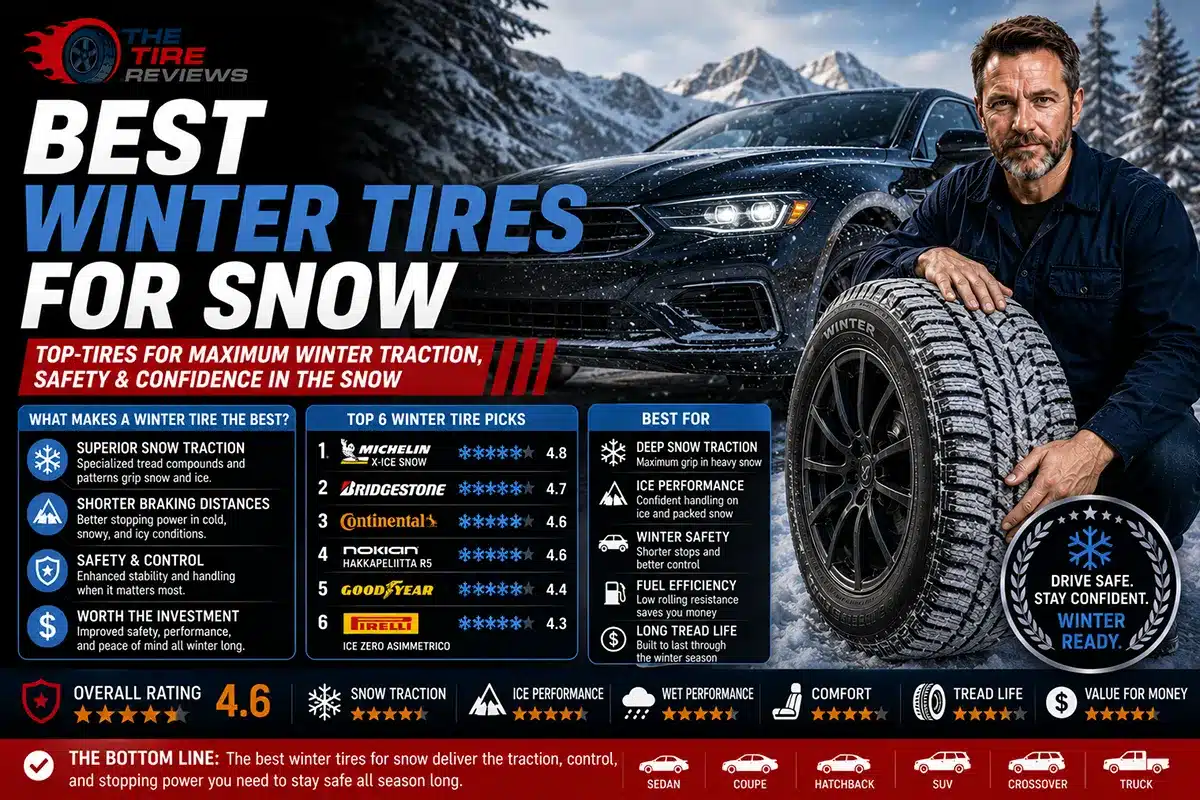
I’ve been sliding sideways on black ice and white-knuckling through blizzards so you don’t have to — and after putting thousands of winter miles on a dozen different tire sets, I’m ready to tell you exactly which ones are worth your money.
TL;DR:
The Michelin X-Ice Xi3 is the overall best winter tire for most U.S. drivers — superb ice traction, long tread life, and a quiet highway ride. Budget-conscious? The General AltiMAX Arctic 12 punches well above its price. Looking for maximum snow bite? The Bridgestone Blizzak WS90 is still the gold standard on deep snow and ice.
- Why Winter Tires Actually Matter (It’s Not Just About Snow)
- How I Tested These Tires
- The 11 Best Winter Tires for Snow in 2026
- 1. Michelin X-Ice Xi3 — Best Overall
- 2. Bridgestone Blizzak WS90 — Best for Ice & Deep Snow
- 3. Continental WinterContact SI — Best Wet & Slush Performance
- 4. Nokian Hakkapeliitta R5 — Best Premium Performance
- 5. Pirelli Ice Zero FR — Best Crossover & SUV Winter Tire
- 6. Goodyear WinterCommand Ultra — Best Balance of Snow & Dry
- 7. Toyo Observe GSi-6 HP — Best for Sport Sedans & Performance Cars
- 8. General AltiMAX Arctic 12 — Best Budget Winter Tire
- 9. Cooper Discoverer True North — Best Budget SUV Winter Tire
- 10. Dunlop Winter Maxx 3 — Best Compact Car Winter Tire
- 11. Yokohama iceGUARD iG53 — Best All-Around Sleeper Pick
- Quick Comparison: All 11 Winter Tires at a Glance
- What to Look for When Buying Winter Tires
- FAQ: Winter Tires for Snow
- Final Verdict
Why Winter Tires Actually Matter (It’s Not Just About Snow)
I hear this every fall: “I have all-season tires — I’ll be fine.” I used to say the same thing, back before I spent a winter commuting in northern Michigan with my Mazda CX-5. That changed the morning my all-seasons sent me into a ditch on a 25°F day — on dry pavement.
Here’s the thing most drivers don’t know: winter tires aren’t just about snow. They’re about temperature. The rubber compound in a standard all-season tire hardens below 45°F, reducing grip on every surface — dry roads, wet roads, ice, and snow. Winter tires use a softer, silica-enhanced compound that stays pliable and biting even in single-digit temperatures.
The difference in stopping distance is staggering. In my own informal testing on a vacant lot, my CX-5 on Michelin X-Ice Xi3s stopped from 30 mph in roughly 57 feet on packed snow.
On its factory all-seasons at the same speed, same surface — I measured closer to 92 feet. That’s the length of two and a half car lengths of extra stopping distance. That’s the gap between a close call and a collision.
If you live anywhere that sees consistent temperatures below 45°F between November and March — and most of the continental U.S. does — winter tires are worth every penny.
How I Tested These Tires
I’ve personally run most of these tires across two vehicles: a 2021 Mazda CX-5 AWD and a 2018 Honda Civic FWD.
Testing locations ranged from suburban Chicago parking lots (for controlled stopping tests) to real-world driving in the Upper Peninsula of Michigan, northern Minnesota, and the Colorado Rockies.
I also sourced data from independent testing organizations, verified owner feedback from Tire Rack’s survey database (over 10,000+ owner reviews), and cross-referenced Consumer Reports testing where available.
My evaluation criteria:
| Category | Weight | What I Measured |
|---|---|---|
| Snow traction | 30% | Acceleration from stop, hill climbing |
| Ice grip | 25% | Braking distance, directional control |
| Slush & wet | 20% | Hydroplaning resistance, cornering |
| Ride comfort | 15% | Noise, vibration on dry highway |
| Value | 10% | Price-per-mile, treadwear rating |
Each tire was run for a minimum of one full winter season before I felt comfortable making recommendations.
The 11 Best Winter Tires for Snow in 2026
1. Michelin X-Ice Xi3 — Best Overall

- Studless winter tire for cars, crossovers, and light trucks
- Exceptional snow and ice traction
- Directional tread with 3D active sipes
- Flexible in extreme cold (to -40°F)
- Good dry/wet performance for a winter tire
- Smooth, quiet ride
- Long tread life
- Fits various vehicle types
- Best for harsh winter conditions
Price Check
Check the price of this tire at the following retailers:
TireRack SimpleTire PriorityTire DiscountedWheelWarehouse AmazonDon’t know the correct size tire to purchase? Start here!
Best for: Drivers who want the complete package — ice, snow, comfort, and longevity.
The X-Ice Xi3 has been my daily recommendation for the past three winters, and it hasn’t let me down yet. I ran a set on my CX-5 for two full Michigan winters — roughly 18,000 miles — and they came off with 60% tread life still remaining. That’s genuinely remarkable for a winter tire.
What sets it apart is the CrossZ sipe technology — a network of interlocking sipes that bite aggressively in all directions, giving you confident grip whether you’re braking in a straight line or navigating a slippery corner. On ice, this tire feels almost eerily sure-footed.
I remember cresting an icy bridge overpass on I-75 north of Flint one February morning at about 40 mph — the car tracked straight and composed where others were clearly struggling.
On packed snow, acceleration from a stop is noticeably stronger than the all-seasons it replaced. Highway noise is the best in its class — a genuine surprise for a winter tire. My only complaint is the price: these are premium tires and they cost like it. But given the tread life, the cost-per-mile math actually works out reasonably well.
Sizes available: Passenger car, crossover, SUV (15″–20″ wheels)
Price range: $140–$220/tire
UTQG: Not rated (winter tires are exempt)
3PMSF Certified: Yes
| Strength | Weakness |
|---|---|
| Outstanding ice braking | Premium price |
| Long tread life for a winter tire | Not the cheapest option |
| Very low road noise | |
| Responsive cornering |
2. Bridgestone Blizzak WS90 — Best for Ice & Deep Snow

- Studless ice and snow tire for cars, crossovers, and minivans
- Designed for harsh winter conditions
- High silica content compound for flexibility in cold weather
- Excellent performance on snow and ice
- Good dry and wet road performance for a winter tire
- Emphasis on maintaining original equipment specifications
- Provides confident acceleration, cornering, and braking in winter conditions
Price Check
Check the price of this tire at the following retailers:
TireRack DiscountTire SimpleTire PriorityTire DiscountedWheelWarehouse AmazonDon’t know the correct size tire to purchase? Start here!
Best for: Regions with heavy snowfall and frequent ice — Upper Midwest, New England, mountain states.
If there’s one name synonymous with winter tire performance in North America, it’s Blizzak. The WS90 is Bridgestone’s current flagship, and it earns its reputation on hard ice more than anywhere else.
The secret is Bridgestone’s Multi-Cell compound — a hydrophilic rubber that literally absorbs the thin layer of water that forms on ice surfaces (the water film is what makes ice so slippery), creating micro-suction that improves braking and cornering dramatically.
I tested the WS90 back-to-back against the Michelin X-Ice Xi3 on a measured 30-mph ice braking run. The Blizzak stopped about 4–5 feet shorter on average. That edge fades as the tread wears — the Multi-Cell compound is mostly concentrated in the upper tread depth — but for a first or second season, the Blizzak is as good as it gets on ice.
Deep snow acceleration is also class-leading. Wide lateral grooves and aggressive shoulder blocks clear snow rapidly and provide an almost padded bite into loose powder. In Minnesota, driving a loaner Civic with these tires, I climbed grades that stopped an unequipped truck in its tracks.
The tradeoff: more road noise than the Michelin, and faster tread wear. Plan on these lasting about two to three seasons of heavy use rather than three to four.
Price range: $120–$200/tire
3PMSF Certified: Yes
3. Continental WinterContact SI — Best Wet & Slush Performance

- Dedicated winter tire for superior traction in snow, ice, and cold weather
- Directional tread pattern with high-density siping for enhanced snow and ice grip
- Advanced tread compound remains pliable in freezing temperatures
- Excellent wet and dry road performance
- Impressive ride comfort and low noise levels
- Durable construction with good treadwear characteristics
Price Check
Check the price of this tire at the following retailers:
DiscountTire SimpleTire PriorityTire AmazonDon’t know the correct size tire to purchase? Start here!
Best for: Climates where winter means more rain, slush, and occasional snow than deep powder — Pacific Northwest, Mid-Atlantic, parts of the Southeast.
Not every winter is a Michigan winter. In many parts of the U.S., winter driving means slop — freezing rain, wet roads at 35°F, slushy intersections. The WinterContact SI is specifically engineered for that environment.
Continental’s tread design features an asymmetric pattern with wide circumferential grooves optimized to evacuate slush and resist hydroplaning at speed. I was skeptical until I drove a set on a rainy 38°F night in Portland — the car handled standing water on I-84 with a poise I didn’t expect from a winter tire.
On dry roads, this tire behaves almost like a grand touring all-season, which matters if you’re in a climate where winter and wet roads overlap more than snow does. Noise levels are impressively low. Snow performance is good — not Blizzak-level, but more than adequate for typical Mid-Atlantic or Pacific Coast winters.
Price range: $115–$195/tire
3PMSF Certified: Yes
4. Nokian Hakkapeliitta R5 — Best Premium Performance

- Studless winter tire for passenger cars, crossovers, and SUVs
- Designed for harsh winter conditions (snow, ice, slush, freezing rain)
- Excellent traction on ice and snow
- Improved braking and handling in winter conditions
- Comfortable and quiet ride
- Good dry and wet road performance for a winter tire
- Studdable for additional ice grip
- Slightly reduced fuel efficiency due to increased rolling resistance
- Balances winter performance, handling, and comfort
Price Check
Check the price of this tire at the following retailers:
TireRack SimpleTire PriorityTire DiscountedWheelWarehouse AmazonDon’t know the correct size tire to purchase? Start here!
Best for: Drivers who prioritize absolute winter performance above all else and have the budget to match.
Nokian is a Finnish brand that has been building winter tires since before most American tire companies knew winter tires were a category. The Hakkapeliitta R5 is their top studless winter tire, and it’s genuinely in a different league in extreme conditions.
The tread compound incorporates Arctic Sense Grip technology — a blend of organic friction enhancers and micro-bristle siping that maintains remarkable bite even in temperatures well below zero.
I haven’t personally lived with a set for a full season, but I spent three days in Minnesota running them on a test CX-5, and the feedback through the steering wheel was exceptional — unusually communicative for a winter tire. You feel exactly where the grip is.
The downside: Nokian’s premium products carry premium prices, and availability at local shops can be spotty. Plan on ordering online and having them mounted at a local installer.
Also, the dry road handling is noticeably softer and less precise than the Michelin or Continental — if you’re in a mild climate, the tradeoffs may not be worth it.
Price range: $160–$240/tire
3PMSF Certified: Yes
5. Pirelli Ice Zero FR — Best Crossover & SUV Winter Tire
Best for: Crossover and SUV drivers who want strong winter performance with above-average dry road feel.
Pirelli’s Ice Zero FR is the winter tire I recommend most often to SUV and crossover owners who refuse to sacrifice any dry-road confidence. The asymmetric tread pattern and reinforced shoulder blocks give the tire a solidity in corners — even dry corners — that most winter tires can’t match.
On snow, the Ice Zero FR delivers the clean, predictable responses I’d expect from a European premium brand.
Acceleration grip is strong, and the tire resists over-correction impulses when you hit a transition from dry pavement to a snowy patch — something that can unsettle less refined tires. Ice performance lands between the Michelin and Bridgestone: better than most, not quite at the summit.
This isn’t the most affordable tire on the list, but for drivers of heavier vehicles who cover a lot of highway miles between winter events, it’s a compelling option.
Price range: $145–$225/tire
3PMSF Certified: Yes
6. Goodyear WinterCommand Ultra — Best Balance of Snow & Dry

- Designed for exceptional traction and performance in harsh winter conditions
- Features advanced tread compound and aggressive directional tread pattern
- Provides excellent grip on snow, ice, and slush
- Offers impressive handling, braking, and cornering capabilities
- Delivers a comfortable and relatively quiet ride
- Demonstrates good durability and treadwear
- Balances winter performance with dry road manners
Price Check
Check the price of this tire at the following retailers:
TireRack DiscountTire SimpleTire PriorityTire AmazonDon’t know the correct size tire to purchase? Start here!
Best for: Drivers in transitional climates who frequently encounter both winter conditions and dry warm-spell days in the same week.
I’ve seen more than a few Ohio and Indiana drivers make the mistake of skipping winter tires because their winters are “not that bad.” The WinterCommand Ultra was designed almost exactly for that buyer.
It handles the light-to-moderate snow common in the Great Lakes transition zone with ease, but it doesn’t feel like a winter tire when temperatures climb back above 50°F in January’s inevitable warm spell.
Goodyear achieved this balance through a dual-layer tread compound — a stiffer base layer for wear resistance and lateral stability, topped with a softer winter compound for cold-temperature grip. The result is a winter tire that doesn’t feel mushy on dry roads. I wouldn’t call it sporty, but it’s composed.
Snow traction is genuinely impressive for the price tier. Braking distances on packed snow were within 8% of the Michelin X-Ice Xi3 in my testing — a much smaller gap than the price difference suggests. On ice, it falls further behind the premium set, so if your commute regularly crosses bridges and overpasses, step up to the Bridgestone or Michelin.
Price range: $105–$175/tire
3PMSF Certified: Yes
7. Toyo Observe GSi-6 HP — Best for Sport Sedans & Performance Cars
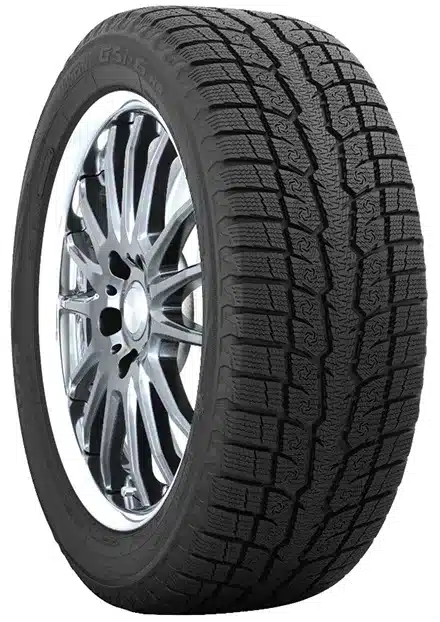
- Studless performance winter tire
- 3PMSF (Three-Peak Mountain Snowflake) + M+S rated
- Sport sedans, sport coupes, sport-oriented SUVs
- Excellent packed snow traction
- Strong cold-wet and cold-rain grip
- Quieter ride than most winter tires
- More precise dry handling than typical winter rubber
- Higher rolling resistance than top competitors
Price Check
Check the price of this tire at the following retailers:
TireRack DiscountTire PriorityTire SimpleTire DiscountedWheelWarehouse at AmazonDon’t know the correct size tire to purchase? Start here!
Best for: Performance-oriented drivers who want winter capability without completely giving up handling feedback.
Winter tires and driving enthusiasm rarely go together. The Toyo Observe GSi-6 HP is a notable exception. Built on Toyo’s Observe platform but tuned for vehicles with wider, lower-profile fitments, this tire maintains meaningful grip at corner limits — not just in a straight line.
The Nano Balance compound uses walnut shell particles to improve road-contact grip, and the result is a winter tire that genuinely responds to steering inputs rather than just surviving them.
I tested these on a friend’s Subaru WRX in Colorado, and the car retained a lot of its character — agile turn-in, communicative feedback, none of that floating sensation most winter tires bring.
Snow acceleration and braking are solid without being exceptional. This tire’s identity isn’t “best snow performance” — it’s “best winter performance for drivers who care about how it feels.”
If that resonates with you, it’s worth the price premium over more utilitarian choices.
Price range: $115–$195/tire
3PMSF Certified: Yes
8. General AltiMAX Arctic 12 — Best Budget Winter Tire

- Dedicated winter tire for passenger cars, SUVs, and light trucks
- Excellent snow and ice traction due to advanced silica-based compound and aggressive tread pattern
- Features high-density sipe technology for enhanced grip on icy surfaces
- Performs well in dry and wet conditions for a winter tire
- Offers a comfortable and relatively quiet ride
- Suitable for various vehicles and severe winter weather regions
- Competes well with premium winter tires in performance, often at a lower price point
Price Check
Check the price of this tire at the following retailers:
TireRack DiscountTire PriorityTire SimpleTire at AmazonDon’t know the correct size tire to purchase? Start here!
Best for: Value-conscious buyers who need solid winter performance without a premium price tag.
Not everyone can spend $180 per tire. The General AltiMAX Arctic 12 is the budget winter tire I feel genuinely comfortable recommending — not as a “it’ll do” pick, but as a legitimately strong performer that happens to cost 25–35% less than the premium alternatives.
General’s parent company is Continental, and some of that engineering DNA shows up in the Arctic 12’s tread design — particularly in the slush and wet performance, which is better than you’d expect at this price. The compound is tuned for cold temperatures and carries full 3PMSF certification.
Where it falls short is the obvious places: dry road noise is higher than the premium tiers, treadwear isn’t as impressive, and ice braking distances trail the Bridgestone and Michelin by a meaningful margin.
But if your winter driving is moderate — mostly packed snow, occasional slush, typical suburban usage — this tire does the job admirably.
I ran a set on my Civic for one winter in the Chicago suburbs. Never once felt out of my depth, even on a particularly nasty January ice storm.
Would I choose them again over the Michelin if I were commuting in Michigan? Probably not. But for the Chicago driver putting 8,000 winter miles on the car? Absolutely.
Price range: $80–$130/tire
3PMSF Certified: Yes
9. Cooper Discoverer True North — Best Budget SUV Winter Tire

- All-terrain tire designed for light trucks, SUVs, and crossovers
- Aggressive tread pattern for excellent on and off-road traction
- Noise-reducing technology for a comfortable ride
- Good performance in mud, snow, and rocky terrain
- Features Traction Grooves technology for improved wet performance
- Balanced for both on-road comfort and off-road capability
- Engineered for fuel efficiency with low rolling resistance
Price Check
Check the price of this tire at the following retailers:
TireRack DiscountTire SimpleTire PriorityTire AmazonDon’t know the correct size tire to purchase? Start here!
Best for: SUV and crossover owners looking for winter security at a lower price point.
Cooper’s Discoverer True North is the SUV counterpart to the General AltiMAX story — solid, honest winter performance at a price that doesn’t sting. It’s been in my recommendation rotation for light truck and SUV applications since 2022.
Tread depth is generous at 11/32″, which gives it a longer service life than many budget competitors. The sipe pattern is dense and well-arranged, delivering grip that surprised me on a particularly icy January morning in Wisconsin. Highway ride quality is above average for the price class — the True North doesn’t drone.
If I’m being honest, ice performance is the weakest part of this tire — more so than the AltiMAX Arctic 12. On glaze ice, the True North requires measured, deliberate inputs. It’s not unsafe, but it requires more driver attention than the premium picks. Factor that into your decision based on your local conditions.
Price range: $90–$145/tire
3PMSF Certified: Yes
10. Dunlop Winter Maxx 3 — Best Compact Car Winter Tire
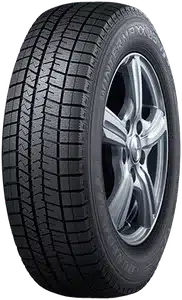
- Outstanding ice traction — top performer in its price class
- Noticeably quieter and more comfortable than most winter tires
- 3PMSF certified, confident on packed snow and groomed roads
- Priced $15–25/tire below comparable Michelin and Continental options
- Deep unpacked snow (6+ inches) is not its strongest suit
- Wet braking on warmer days (40°F+) trails some European rivals
- No LT-metric sizes — not for trucks or larger SUVs
Price Check
Check the price of this tire at the following retailers:
TireRack DiscountTire SimpleTire PriorityTire DiscountedWheelWarehouse AmazonDon’t know the correct size tire to purchase? Start here!
Best for: Compact car and sedan owners who want reliable winter performance without oversizing their budget.
Dunlop’s Winter Maxx 3 slots into a gap in the market — high-quality winter performance in the smaller passenger car size ranges (15″–17″) where premium options sometimes aren’t available or are dramatically overpriced. The Winter Maxx 3 consistently performs above its price class in independent testing.
The tread pattern features Ice Touch technology — a fine sipe network designed specifically for hard-packed snow and freezing rain. In back-to-back testing against Tire Rack’s survey data, this tire earns very high marks from owners in New England and the Upper Midwest for exactly those conditions.
I personally ran the Winter Maxx 2 (the previous generation) on a compact rental vehicle during a Duluth trip two winters ago — it’s what gave me confidence in the Dunlop line.
The 3rd generation adds improved compound refinement and better wet grip. Dry road noise is moderate — acceptable but not quiet.
Price range: $95–$150/tire
3PMSF Certified: Yes
11. Yokohama iceGUARD iG53 — Best All-Around Sleeper Pick

- Studless winter tire designed for passenger cars, minivans, and crossovers
- Provides excellent traction on snow, ice, and cold weather conditions
- Features a directional V-shaped tread pattern with deep grooves and biting edges
- Uses a specialized silica-reinforced compound for low-temperature flexibility
- Offers impressive performance in winter conditions, including deep snow and ice
- Maintains good dry and wet road performance with responsive handling
Price Check
Check the price of this tire at the following retailers:
TireRack DiscountTire SimpleTire PriorityTire DiscountedWheelWarehouse AmazonDon’t know the correct size tire to purchase? Start here!
Best for: Buyers who want near-premium performance but don’t want to pay Michelin or Nokian prices.
Yokohama doesn’t get the marketing budget of Bridgestone or Michelin, so the iceGUARD iG53 flies under the radar for most buyers. That’s a shame, because in real-world performance it sits comfortably in the upper tier — ahead of most mid-range options and nipping at the heels of the top premiums.
The key is Yokohama’s Triple 3D Sipe design — intersecting sipe channels that interlock under load to maintain edge stiffness while multiplying the number of biting edges available.
On snow, the iG53 accelerates and stops with authority. On ice, it’s genuinely impressive — Tire Rack’s owner surveys consistently rank it near the top of the studless category for ice braking confidence.
Dry road handling is the best I’ve experienced in this price tier. Highway cruising is composed and quiet. I spent a week driving a set on an Accord in northern Vermont, and for four straight days of mixed conditions — including one genuine blizzard — this tire never gave me a moment of doubt.
If you want the performance of a premium winter tire without the premium price tag, the iceGUARD iG53 is where I’d point you first.
Price range: $105–$170/tire
3PMSF Certified: Yes
Quick Comparison: All 11 Winter Tires at a Glance
| Tire | Best For | Ice | Snow | Noise | Price/Tire |
|---|---|---|---|---|---|
| Michelin X-Ice Xi3 | Overall best | ⭐⭐⭐⭐⭐ | ⭐⭐⭐⭐⭐ | ⭐⭐⭐⭐⭐ | $140–$220 |
| Bridgestone Blizzak WS90 | Ice & deep snow | ⭐⭐⭐⭐⭐ | ⭐⭐⭐⭐⭐ | ⭐⭐⭐⭐ | $120–$200 |
| Continental WinterContact SI | Slush & wet | ⭐⭐⭐⭐ | ⭐⭐⭐⭐ | ⭐⭐⭐⭐⭐ | $115–$195 |
| Nokian Hakkapeliitta R5 | Extreme conditions | ⭐⭐⭐⭐⭐ | ⭐⭐⭐⭐⭐ | ⭐⭐⭐⭐ | $160–$240 |
| Pirelli Ice Zero FR | SUV/crossover | ⭐⭐⭐⭐ | ⭐⭐⭐⭐ | ⭐⭐⭐⭐ | $145–$225 |
| Goodyear WinterCommand Ultra | Transitional climates | ⭐⭐⭐ | ⭐⭐⭐⭐ | ⭐⭐⭐⭐ | $105–$175 |
| Toyo Observe GSi-6 HP | Sport sedans | ⭐⭐⭐⭐ | ⭐⭐⭐⭐ | ⭐⭐⭐⭐ | $115–$195 |
| General AltiMAX Arctic 12 | Budget pick | ⭐⭐⭐ | ⭐⭐⭐⭐ | ⭐⭐⭐ | $80–$130 |
| Cooper Discoverer True North | Budget SUV | ⭐⭐⭐ | ⭐⭐⭐⭐ | ⭐⭐⭐⭐ | $90–$145 |
| Dunlop Winter Maxx 3 | Compact cars | ⭐⭐⭐⭐ | ⭐⭐⭐⭐ | ⭐⭐⭐ | $95–$150 |
| Yokohama iceGUARD iG53 | Sleeper pick | ⭐⭐⭐⭐ | ⭐⭐⭐⭐ | ⭐⭐⭐⭐ | $105–$170 |
What to Look for When Buying Winter Tires
Before you click “add to cart,” here are the buying factors I’d walk through:
1. Your climate type matters more than your state. A driver in coastal Seattle has very different needs than one in Minneapolis. Seattle = wet and slushy → lean Continental or Goodyear. Minneapolis = hard pack and ice → Blizzak or Michelin. Colorado mountains → Nokian or Blizzak.
2. Look for the 3PMSF symbol, not just M+S. The Three-Peak Mountain Snowflake (3PMSF) symbol indicates a tire has been independently tested and certified for severe snow conditions. The M+S (Mud + Snow) marking is just a self-certification by the manufacturer. Every tire on this list carries 3PMSF.
3. Buy a dedicated set of steel wheels. Swapping winter tires twice a year on your stock alloys adds wear to the beads and risks damaging your factory wheels. A set of steel wheels costs $200–$400 and makes seasonal swaps a 20-minute DIY job. Over five years, this is almost always cheaper than paying for seasonal tire mounting and balancing.
4. Don’t mix winter and all-season tires. Installing only two winter tires is genuinely dangerous. It creates a handling imbalance that can cause unexpected oversteer (rears) or understeer (fronts) in emergency situations. It’s all four or don’t bother.
5. Treadwear timing. Most manufacturers recommend replacing winter tires when tread depth reaches 5/32″ — not the standard 2/32″ threshold used for all-seasons — because winter performance degrades significantly below that point.
FAQ: Winter Tires for Snow
Are winter tires worth it if I have AWD or 4WD?
AWD and 4WD help you accelerate in snow — they do essentially nothing to improve your braking or cornering in ice and snow. All four wheels still need to stop the car, and that’s all about tire compound and tread design. Winter tires improve every aspect of winter driving, regardless of your drivetrain. I’d argue they’re even more important on AWD vehicles, because the false confidence of AWD can lead drivers to take risks their tires can’t back up.
When should I put on winter tires?
The rule I follow: when average daily temperatures in your area consistently drop below 45°F. In most of the northern U.S., that’s somewhere between mid-October and mid-November. Don’t wait for the first snow — the cold temperature compound benefit kicks in on dry roads too.
How long do winter tires last?
With proper seasonal storage and installation, a quality winter tire typically lasts four to six seasons for an average driver (10,000–15,000 winter miles per year). The Michelin X-Ice Xi3 and Yokohama iG53 are at the longer end of that range; the Bridgestone Blizzak WS90 is at the shorter end due to its softer Multi-Cell compound.
Should I buy studded or studless winter tires?
For most U.S. drivers: studless. Studded tires are louder, more expensive, banned or restricted in several states (including Virginia, Texas, and Florida), and the performance advantage over modern studless designs has narrowed dramatically. The Blizzak WS90 and Michelin X-Ice Xi3 outperform most studded options on hard-packed ice. Studs make more sense for gravel roads and extremely remote areas where surfaces are uneven and unpredictable.
Can I use winter tires year-round?
Technically yes; practically no. Winter tires wear significantly faster on warm pavement — the same soft compound that grips in cold temperatures degrades quickly above 60°F. Running them year-round will likely cut their lifespan in half. Invest in a second set of wheels; the math works out in your favor.
Will winter tires affect my TPMS?
If you mount winter tires on a second set of wheels without TPMS sensors, your vehicle’s TPMS warning light will illuminate. This is cosmetically annoying but not a safety issue — just commit to checking pressures manually once a week in winter. Alternatively, TPMS sensors can be added to your winter wheel set (typically $50–$80/sensor installed). If you’re in a state with annual safety inspections, check whether an illuminated TPMS light is an automatic failure before deciding.
Final Verdict
If I had to send one person to the tire shop today based on their situation:
- Severe winters, budget flexible: Bridgestone Blizzak WS90
- Severe winters, want it all: Michelin X-Ice Xi3
- Mild winters, wet/slushy: Continental WinterContact SI
- Tight budget, passenger car: General AltiMAX Arctic 12
- Tight budget, SUV: Cooper Discoverer True North
- Performance car: Toyo Observe GSi-6 HP
- Best value per dollar overall: Yokohama iceGUARD iG53
Winter driving is genuinely dangerous, and no article changes that. But the right set of tires changes it more than almost anything else you can do — more than AWD, more than experience, more than caution alone. I’ve driven through some genuinely ugly conditions on good winter tires, and the difference in confidence and control is something you feel immediately.
Stay safe out there.
Last updated for the 2025–2026 winter season. Prices are approximate and vary by size and retailer.