Most people buy a set of tires, glance at the warranty card, toss it in the glove box, and never think about it again — until something goes wrong.
I’ve been there. I bought a set of Michelin Defender tires a few years back, drove confidently knowing I had a “60,000-mile warranty,” and then watched a sidewall bubble develop at 28,000 miles.
What followed was a weeks-long back-and-forth with the retailer, a warranty claim that got partially denied, and a hard lesson in what tire warranties actually mean versus what most of us think they mean.
Here’s the truth: tire warranties are one of the most misunderstood parts of buying tires. Brands use them as selling points. Retailers gloss over the fine print. And buyers — most of us — assume the warranty is like an insurance policy that’ll make everything right if something goes wrong.
It’s not. Not even close.
If you want to get the full picture on how to buy tires smartly and take care of them properly, I’d recommend starting with this tire buying and maintenance guide before diving into the warranty specifics below.
TL;DR – Tire Warranty Quick Summary
What tire warranties typically cover:
- Manufacturing defects in materials and workmanship
- Premature treadwear (under specific, controlled conditions)
- Mileage shortfalls (pro-rated, not full replacements)
What they do NOT cover:
- Road hazard damage (unless you buy a separate road hazard plan)
- Damage from potholes, curbs, nails, or debris
- Improper inflation or overloading
- Mounting and installation errors
- Tires used in competition or off-road
Key takeaway: A tire warranty is a quality guarantee from the manufacturer — not a promise to replace your tire whenever something goes wrong. Read the fine print, keep your maintenance records, and don’t rely on a warranty to bail you out of road hazard damage.
- TL;DR – Tire Warranty Quick Summary
- What Is a Tire Warranty?
- Types of Tire Warranties Explained
- My Real-World Experience with Tire Warranties
- What Tire Warranties Typically Cover
- What Tire Warranties Do NOT Cover
- How Tire Warranty Claims Actually Work (Step-by-Step)
- Why Warranty Claims Get Rejected
- Pro-Rated Warranty Explained (With Real Examples)
- Real Cost vs. Claimed Value — The Honest Math
- Tips to Protect Your Tire Warranty
- Common Mistakes That Void Warranty
- Are Tire Warranties Worth It?
- When You Should Rely on Warranty (and When Not To)
- Final Verdict
What Is a Tire Warranty?
A tire warranty is a written commitment from the tire manufacturer (and sometimes the retailer) that their product meets certain quality and durability standards.
If the tire fails to meet those standards under normal use, the manufacturer agrees to repair, replace, or pro-rate a replacement.
The key phrase there is normal use. That’s where most warranty disputes begin and end.
Tire warranties are not the same as a store’s return policy. They’re not the same as car insurance. And they’re definitely not the same as a road hazard plan — which is a completely separate product that most retailers will try to upsell you on at checkout.
Understanding the difference between those categories before you buy your next set of tires will save you a significant amount of frustration and money.
Types of Tire Warranties Explained
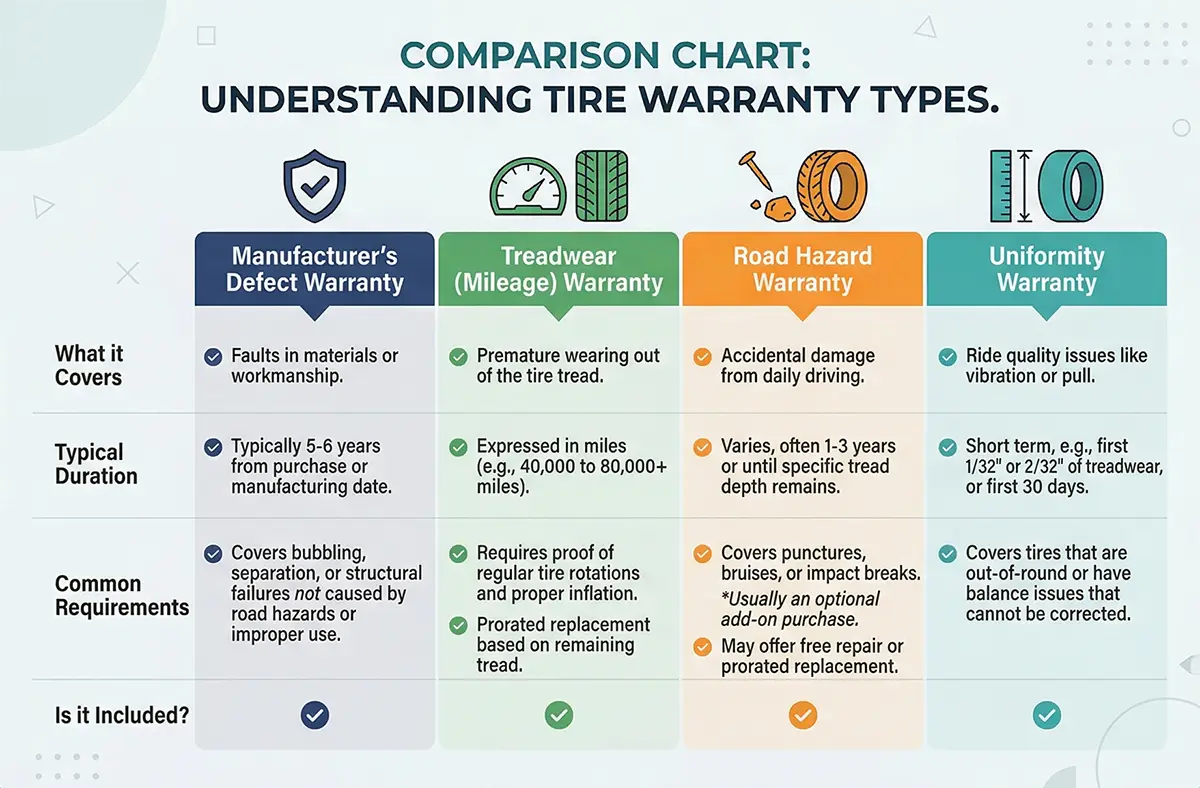
Comparison chart of tire warranty types
There are four main types of tire warranty coverage. Most people know about one or two of them. Here’s the full breakdown.
1. Treadwear Warranty
This is the warranty most tire brands advertise prominently. You’ve seen the numbers — 40,000 miles, 60,000 miles, 80,000 miles. These figures represent the manufacturer’s confidence in how long the tire tread should last under normal driving conditions.
What people don’t realize is that “normal driving conditions” is a tightly defined term. It typically means:
- Tires properly inflated according to the vehicle manufacturer’s specs
- Regular rotations (usually every 5,000–7,500 miles)
- No overloading
- Driving on paved roads in typical U.S. conditions
If you don’t rotate your tires on schedule and the front pair wears out at 35,000 miles on a 60,000-mile warranty, the claim will almost certainly be pro-rated based on the fact that you didn’t maintain them properly. More on pro-rating in a bit.
2. Road Hazard Warranty
Road hazard coverage is what most drivers actually need — and it’s almost never included in the standard tire warranty. Road hazard plans cover damage from things like:
- Potholes
- Nails and screws
- Glass and debris
- Curb strikes
You typically buy this separately, either through the tire retailer (Discount Tire, Costco, NTB, etc.) or through a third-party provider. Prices range from $10–$25 per tire. In my experience, it’s worth it on budget tires and in areas with rough road conditions.
Michelin, Goodyear, and Bridgestone do not include road hazard protection in their standard warranty. A few exceptions exist — notably Discount Tire’s “Certificate” program, which is their version of road hazard protection — but you need to ask specifically.
3. Workmanship & Materials Warranty
This is the core manufacturer’s warranty. Every tire brand offers some version of this. It covers defects that occurred during the tire’s manufacturing process — things like:
- Belt separations
- Sidewall failures caused by manufacturing flaws
- Tread separations not related to road damage
- Structural defects in the tire casing
In my experience, this warranty actually does get honored — IF you can clearly demonstrate the failure was a manufacturing defect. The challenge is that it’s often difficult to prove, and the manufacturer’s inspector (not an unbiased third party) makes the final call.
4. Mileage Warranty
The mileage warranty is technically a subset of the treadwear warranty, but it deserves its own spotlight because it’s the most heavily marketed and most misunderstood.
When a tire says it has a “70,000-mile warranty,” here’s what that actually means: if the tires wear out before 70,000 miles under the exact conditions outlined in the warranty terms, the manufacturer will credit you toward a new set — on a pro-rated basis.
That credit is almost never the full price of the tire. In fact, once you do the math, it’s often shockingly small. I’ll walk you through a real example in the Pro-Rated section later in this post.
My Real-World Experience with Tire Warranties
Let me tell you about three warranty situations I’ve personally dealt with — because they taught me more than any warranty document ever could.
Experience #1 — The Michelin Sidewall Bubble
At 28,000 miles on a 60,000-mile treadwear warranty, one of my Michelin Defender tires developed a noticeable sidewall bubble. I brought it in to the retailer where I bought them, expecting a straightforward replacement.
The retailer’s inspector looked at the tire for about four minutes and concluded the bubble was likely caused by an impact — a pothole or curb strike — rather than a manufacturing defect.
Claim denied under the workmanship warranty. I had purchased road hazard coverage, so I did ultimately get the tire replaced, but only after involving the retailer’s manager and pressing the point.
Lesson: Always buy road hazard coverage. Always.
Experience #2 — The Goodyear Pro-Rated Credit
A set of Goodyear Assurance ComfortDrive tires on my wife’s car wore down to the wear bars at around 42,000 miles on a 65,000-mile warranty. I filed a treadwear warranty claim expecting a meaningful credit.
The pro-rated math came out to a credit of roughly $28 per tire — because the tires had already used 65% of their rated mileage. After fees, it barely covered the cost difference. The process took three weeks and three separate visits to the retailer.
Lesson: Mileage warranty claims are rarely worth the effort unless the tire fails dramatically early.
Experience #3 — The Budget Tire That Just Failed
I once bought a set of budget tires from a lesser-known brand for a beater car. One tire developed a tread separation at 18,000 miles. The brand had a workmanship warranty.
When I contacted them, the warranty process involved mailing the tire to their facility at my cost, waiting 4–6 weeks, and receiving a decision via mail.
The claim was approved — I got a credit for one tire. But the process was cumbersome enough that I’ll never buy that brand again.
Lesson: Warranty quality varies dramatically by brand. Tier-one brands (Michelin, Bridgestone, Goodyear, Continental) have far smoother claims processes.
What Tire Warranties Typically Cover
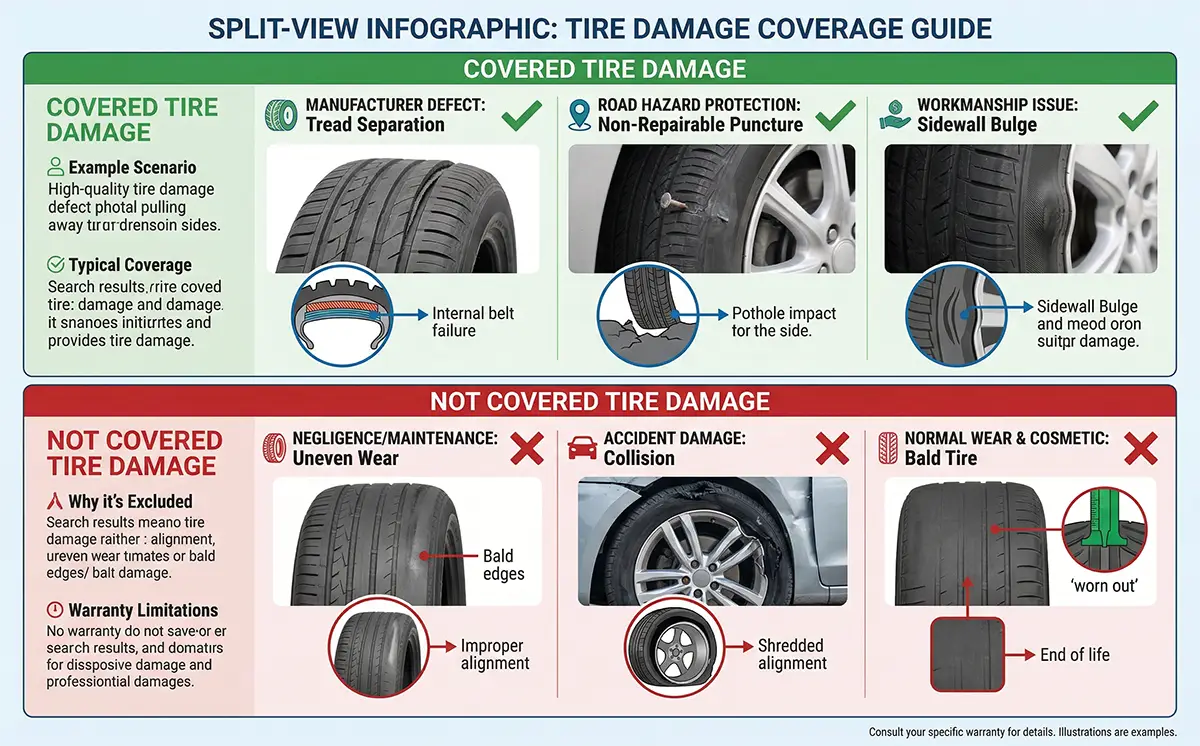
Infographic showing covered vs not covered tire damage
To keep this practical, here’s what you can generally count on being covered by a standard tire warranty:
- Manufacturing defects — Anything that went wrong in the factory: improper curing, air pockets in the compound, belt misalignment, casing irregularities.
- Premature treadwear — If the tread wears significantly faster than the rated mileage and you have maintenance records proving proper rotation and inflation.
- Structural failures unrelated to impact — Tread separations or sidewall failures that a manufacturer’s inspector determines weren’t caused by external road damage.
- Mileage shortfall credit — A pro-rated credit toward replacement tires if the tread wears out before the warranty mileage is reached.
The common thread across all of these is the phrase “under normal conditions.” Every single coverage category includes that qualifier, and manufacturers lean on it heavily when evaluating claims.
What Tire Warranties Do NOT Cover
This section is arguably the most important one in this entire article. Read it carefully, because this is where most people get blindsided.
Standard exclusions include:
- Road hazard damage — Flat tires, blowouts, or damage caused by potholes, nails, glass, debris, or curb strikes are universally excluded from the standard manufacturer warranty.
- Improper inflation — If you drove on an underinflated or overinflated tire, the claim will be denied. Manufacturers expect you to check tire pressure monthly.
- Incorrect mounting or installation errors — If the tire was improperly installed (wrong torque on lug nuts, improper bead seating), that’s on the installer, not the manufacturer.
- Overloading — Exceeding the tire’s load rating voids the warranty.
- Irregular wear from misalignment — If your vehicle’s wheels are out of alignment and it caused uneven wear, that’s not covered.
- Cosmetic damage — Surface cracking, weathering, or ozone cracking on older tires is typically excluded.
- Competition use — Any use in racing, off-road driving, or motorsports immediately voids most tire warranties.
- Tires sold as “used” — Warranties only apply to the original purchaser in most cases.
- Snow chains or cable damage — Damage caused by improper chain installation or use.
One thing I’ve noticed that catches people off guard: if your tires show uneven wear, most manufacturers will use that as evidence of poor maintenance — regardless of whether you actually rotated them or not. This is why I recommend keeping a simple maintenance log.
How Tire Warranty Claims Actually Work (Step-by-Step)
I’ve been through this process multiple times. Here’s how it actually goes:
Step 1 — Bring the tire to the retailer where you bought it. Most warranty claims must be initiated at the point of purchase or an authorized retailer for that brand. If you bought from an online retailer and had them installed elsewhere, this can get complicated.
Step 2 — The retailer’s technician inspects the tire. They’re looking for signs of external damage (impact, cuts, debris) versus signs of a manufacturing defect. This inspection is subjective, and results can vary by location and technician.
Step 3 — If approved at the retail level, the claim moves to the manufacturer. For significant claims (especially over $100 in value), the retailer typically contacts the manufacturer’s warranty department. Some brands (like Michelin and Bridgestone) have well-organized regional representatives who handle these claims efficiently.
Step 4 — The manufacturer makes a final determination. They may request photos, the physical tire, or additional documentation. This step can take anywhere from 48 hours to several weeks depending on the brand.
Step 5 — Credit or replacement is issued. If approved, you typically receive a credit toward a new tire of the same or comparable model. The amount depends on pro-rating and the specific warranty type.
Practical tip: Always bring your purchase receipt, any service records showing rotation/balancing, and photos of the damage on your phone. Going in prepared significantly improves your outcome.
Why Warranty Claims Get Rejected
In my experience — and from conversations with tire shop managers — the most common reasons warranty claims get denied are:
1. The damage looks like road hazard impact, not a manufacturing defect. This is the number one rejection reason. A sidewall bubble? Could be a manufacturing defect or could be a pothole hit. Inspectors often default to “impact damage” when there’s ambiguity.
2. No maintenance records. If you can’t prove you rotated the tires and maintained proper inflation, treadwear claims are almost always denied or heavily discounted.
3. The tire shows signs of improper inflation. An overinflated tire wears differently in the center. An underinflated tire wears on the outer edges. Both are dead giveaways to a trained inspector, and both void coverage.
4. The original purchase can’t be verified. Warranties are tied to the original buyer and purchase date. If you bought tires from a private seller or an unlicensed retailer, you may not have any warranty at all.
5. The tires were mounted or modified incorrectly. Any non-standard modification — including improper rim sizing, tire stretching, or incorrect mounting — immediately voids the warranty.
6. The claim is filed after the warranty period expires. Most warranties have both a mileage limit AND a time limit (usually 4–6 years from date of purchase). Whichever comes first applies.
Pro-Rated Warranty Explained (With Real Examples)
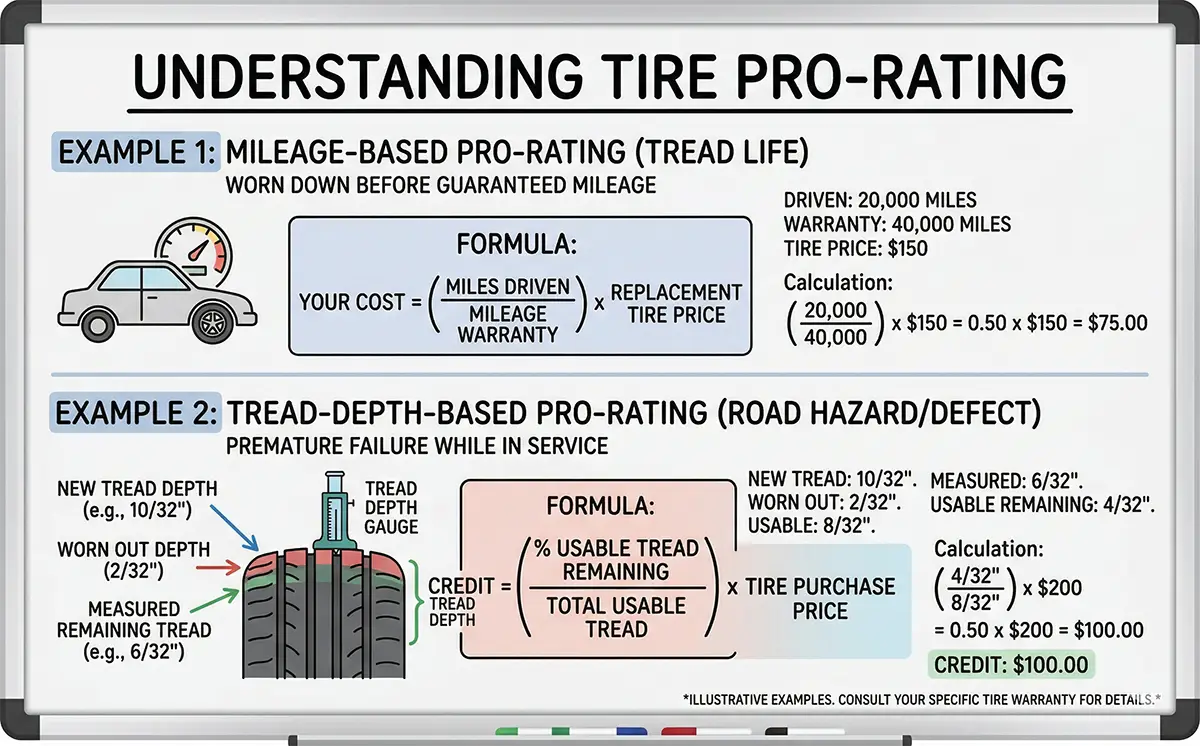
Simple math-style graphic showing tire pro-rating calculation
Pro-rating is the concept that trips people up most. Here’s how it actually works with a simple example:
Scenario:
- You buy a tire with a 60,000-mile treadwear warranty
- The tire cost $150
- The tire wears out at 45,000 miles
The math:
- You used 75% of the rated mileage (45,000 ÷ 60,000)
- The manufacturer credits you for the remaining 25% of the tire’s value
- 25% of $150 = $37.50 credit per tire
That’s before taxes, mounting fees, and disposal fees — which you typically pay out of pocket.
So in a real-world scenario, you’re walking out of the shop with a $37.50 credit on a tire that might now cost $160 (prices go up). You’re paying $122.50 out of pocket for the replacement, plus $20–$30 in labor.
That’s the reality of a pro-rated mileage warranty. It’s not worthless — but it’s a far cry from what most people imagine when they hear “60,000-mile warranty.”
The exception: if your tire fails at, say, 15,000 miles on a 60,000-mile warranty, the pro-rated credit would cover 75% of the replacement cost — which is actually meaningful. The earlier the failure, the more valuable the claim.
Real Cost vs. Claimed Value — The Honest Math
Let me be direct about something most tire reviews won’t say: the dollar value of most mileage warranty claims is marginal at best.
Here’s why:
- Tire prices increase over time, so the “credit” is based on the original price, not the current replacement cost
- Labor, disposal fees, and taxes are almost always excluded from coverage
- The pro-rating formula almost always favors the manufacturer
- Filing a claim takes time and multiple trips to the retailer
Where warranties genuinely deliver value:
- Early-stage manufacturing defects — If a tire fails in the first 20–25% of its rated life, the coverage is meaningful
- Workmanship claims — Tread separation or belt failure that’s clearly a factory defect, especially on a newer tire
- Road hazard plans (purchased separately) — These are the ones that pay off most consistently
Tips to Protect Your Tire Warranty
If you want to actually be able to use your warranty if something goes wrong, here’s what I do personally:
- Keep all receipts. Purchase receipt, installation invoice, the whole package. Store digital copies in your email or cloud storage.
- Log every tire rotation. A simple note in your phone or a glove box log card works. Date, mileage, and shop name.
- Check tire pressure monthly. Use a quality gauge. Don’t rely on the TPMS light — it only activates when pressure is dangerously low.
- Get an alignment check when you buy new tires. Misalignment is both a warranty voider and a tire killer.
- Photograph your tires. At purchase and every 10,000 miles. If a claim comes up, you’ll have visual documentation of the wear pattern over time.
- Buy from authorized retailers. Online tire purchases can complicate warranty claims significantly.
Common Mistakes That Void Warranty
The list of warranty-voiding behaviors is longer than most people expect:
- Mounting the wrong size tire for your vehicle (even by one size) — Manufacturers specify exact fitment in warranty terms
- Installing tires on mismatched rims — Incorrect rim width for the tire size voids coverage
- Running tires below the minimum inflation spec, even once
- Using tire dressing products that contain petroleum distillates — These can accelerate sidewall cracking and are cited in some rejection cases
- Buying used tires — The original purchaser clause means warranties don’t transfer
- Delaying too long after a visible defect appears — “Continued use of a known defective tire” is an exclusion in most warranty documents
Are Tire Warranties Worth It?
Honestly? It depends on the type of warranty.
Treadwear/Mileage warranties: Marginally useful. Don’t let a high mileage warranty number be a primary factor in your tire buying decision. Instead, focus on independent tread life test data, user reviews, and the tire’s actual performance ratings.
Workmanship & Materials warranties: Worth understanding. These protect you against real manufacturing failures, which — while rare with major brands — do happen. Tier-one brands honor these reasonably well.
Road hazard plans (retail add-ons): Genuinely worth it in most cases, especially if you drive in urban areas with rough roads, heavy construction zones, or high debris environments. At $15–$25 per tire, it often pays for itself with a single pothole incident.
When You Should Rely on Warranty (and When Not To)
Rely on it when:
- A tire shows structural failure well before the halfway point of its rated mileage
- You notice tread separation, belt shifting, or unusual bulging not related to any impact you know of
- You have complete documentation (receipts, rotation records, inflation history)
Don’t rely on it when:
- You’ve already driven 60–70% of the rated mileage — the pro-rated credit won’t justify the effort
- The damage is clearly from road impact — skip the manufacturer warranty and use your road hazard plan instead
- You don’t have maintenance records — the claim will likely be denied or significantly reduced
Final Verdict
After years of buying tires, filing claims, and learning the hard way, here’s my honest bottom line on tire warranties:
They’re a quality signal, not a safety net.
A 60,000-mile warranty tells you the manufacturer is confident in their tire’s durability. That confidence matters when you’re comparing brands. But it’s not a guarantee you’ll drive 60,000 miles without spending another dime.
The single most important thing you can do is buy road hazard protection at the point of purchase, keep your receipts and rotation records, and maintain proper tire pressure. Those three habits will serve you far better than any warranty marketing headline.
If you want to dig deeper into how to evaluate, buy, and maintain your tires so you’re never caught off guard, circle back to this tire buying and maintenance guide — it covers everything from reading tire specs to decoding those confusing sidewall numbers.
The more you know going in, the less you’ll be surprised when something goes wrong.
Have you ever filed a tire warranty claim? Share what happened in the comments — I’d genuinely like to hear how it went.