If you’ve ever stood in a tire shop staring at a sidewall code like P205/65R15 94T or LT235/75R15 104/101Q and thought, “What does any of this even mean?” — I’ve been there too.
Speed ratings are one of those pieces of tire information that look intimidating but are actually pretty straightforward once someone explains them in plain English.
Before I dive into the head-to-head comparison, I want to make sure you have the full picture on how all speed ratings work together.
I’ve put together a comprehensive tire speed ratings chart that covers every letter from L all the way to Y — it’s worth bookmarking before you go tire shopping.
Now, let’s talk specifically about Q vs T speed ratings — because if you’re shopping for tires for an SUV, a light truck, a winter set, or an everyday passenger car, there’s a real chance these two letters are going to show up in your search results, and they are not interchangeable.
TL;DR — Quick Answer
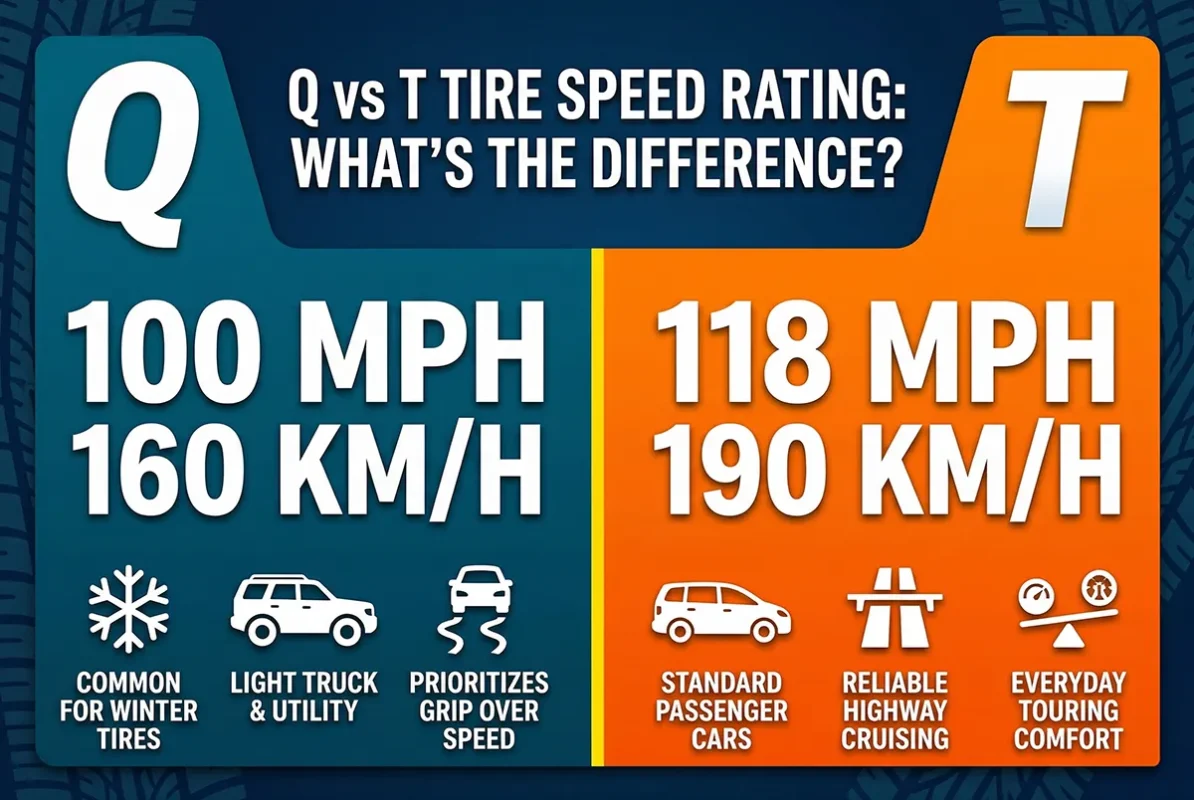
Q-rated tires are rated for a maximum speed of 99 mph (160 km/h). They’re most commonly found on light trucks, SUVs with heavy-duty needs, winter/snow tires, and spare tires. They prioritize load capacity and traction over speed capability.
T-rated tires are rated for a maximum speed of 118 mph (190 km/h). They’re the most common rating for passenger cars, minivans, and light SUVs — your typical everyday commuter vehicle.
Which one do you need? If your original tires came with a T rating, replace them with T-rated tires (or higher). If your truck, SUV, or dedicated winter tires are Q-rated, stick with Q or go up one level. Never go lower than your vehicle manufacturer’s recommendation.
Why I’m Writing This (And Why It Matters to You)
I run a tire review blog and I’ve personally helped friends and family navigate tire replacements for everything from a 2018 Honda CR-V to a Ford F-150 and a dedicated set of winter tires for a Subaru Outback.
The Q vs T question comes up constantly, and I get why — the letters feel arbitrary, the sidebars in owner’s manuals are hard to find, and most tire shop employees give you a 30-second answer when you deserve a 5-minute one.
So I wrote the guide I wish someone had handed me the first time I replaced tires on my own car. Let’s get into it.
What Is a Tire Speed Rating?
First, let me give you the foundation. A tire speed rating is a letter code that tells you the maximum sustained speed a tire is designed to handle under its rated load. It’s set by standardized testing — a tire is run at progressively higher speeds under load until it can handle a specific speed without failure.
Here’s what’s critical to understand: the speed rating is not a suggestion for how fast you should drive. It’s a safety ceiling based on engineering and materials. Exceed it consistently, and you risk heat buildup, structural breakdown, and a blowout.
The rating is always the last letter in the size code on your tire sidewall — for example:
P215/60R16 95T
That final “T” is your speed rating. Everything else — P215/60R16 95 — tells you the tire’s type, width, aspect ratio, construction, rim diameter, and load index.
Understanding the Full Speed Rating Alphabet
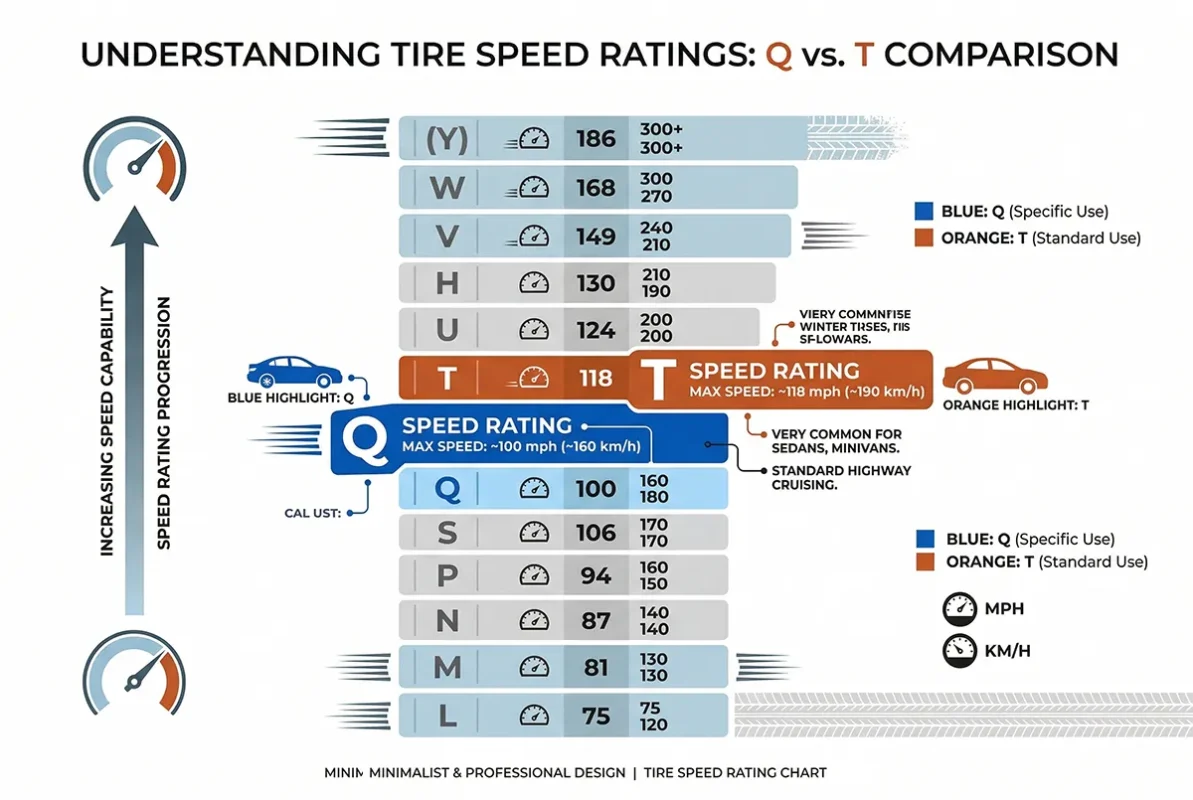
To understand where Q and T sit, you need to see the full picture. Here’s the complete speed rating chart:
| Speed Rating | Max Speed (mph) | Max Speed (km/h) | Typical Application |
|---|---|---|---|
| L | 75 mph | 120 km/h | Off-road, light truck |
| M | 81 mph | 130 km/h | Spare tires |
| N | 87 mph | 140 km/h | Spare tires |
| P | 93 mph | 150 km/h | Classic cars, vintage |
| Q | 99 mph | 160 km/h | Winter tires, light trucks, SUVs |
| R | 106 mph | 170 km/h | Heavy-duty light truck |
| S | 112 mph | 180 km/h | Family sedans, vans |
| T | 118 mph | 190 km/h | Passenger cars, light SUVs, minivans |
| U | 124 mph | 200 km/h | Sedans, coupes |
| H | 130 mph | 210 km/h | Sport sedans, coupes |
| V | 149 mph | 240 km/h | Sports cars, performance |
| W | 168 mph | 270 km/h | Exotic/performance vehicles |
| Y | 186 mph | 300 km/h | High-performance supercars |
| Z | 149+ mph | 240+ km/h | High-performance (older designation) |
So Q and T are neighbors in the alphabet but separated by two other ratings (R and S). In practice, they serve very different vehicle categories.
Q Speed Rating: What It Means and Who It’s For
The Basics
A Q-rated tire has a maximum speed rating of 99 mph (160 km/h). That number might seem low for a highway tire — and it is, intentionally.
Q-rated tires are built for applications where load capacity and traction are far more important than speed capability.
Think about it this way: if you’re driving a heavy-duty SUV through a Colorado snowstorm at 45 mph, raw speed is the last thing you need.
You need a tire with a serious tread compound that grips ice and packed snow, and that can carry the weight of your vehicle and all the gear you’ve packed for the ski trip. That’s exactly what Q-rated tires are engineered for.
Where You’ll See Q-Rated Tires
This is far and away the most common place you’ll find Q ratings. Many dedicated winter tires — the kind with the mountain/snowflake symbol on the sidewall — are Q-rated.
Brands like Bridgestone Blizzak, Michelin X-Ice, and Nokian Hakkapeliitta lines have Q-rated options specifically because the soft tread compound that makes them grip in cold temperatures also caps their safe operating speed. That’s an engineering tradeoff, not a flaw.
2. Light Trucks and Heavy-Duty SUVs
Some light truck (LT) tires, especially older or more load-oriented ones, carry Q ratings. If you’re hauling a loaded trailer or running with heavy payload, the manufacturer may have prioritized load rating over speed ceiling.
3. Spare Tires (Compact/Donut Spares)
Most donut spare tires you find in the trunk of a passenger car are rated at either M (81 mph) or T, but some full-size spare tires on trucks can be Q-rated.
That’s why the sticker on your spare tire compartment typically says to keep speeds below 50 mph — even if the technical rating is higher, manufacturers build in a conservative safety margin.
4. Older or More Budget-Oriented All-Season Truck Tires
Some value-tier all-season truck tires still carry Q ratings. You won’t see it on premium truck tire lines like Michelin LTX or Continental TerrainContact, but it shows up on more basic products.
Popular Q-Rated Tire Models
Here are some real-world Q-rated tires you’ll actually encounter while shopping:
- Bridgestone Blizzak WS90 (Q) — One of the best winter tires in the market, available in Q rating for passenger fitments
- Michelin X-Ice Xi3 (Q/T depending on size) — The Q-rated sizes are common in SUV fitments
- Nokian Hakkapeliitta R3 (Q) — Finnish-engineered, exceptional ice grip
- Goodyear Ultra Grip Ice WRT (Q) — Solid performer, widely available
- Cooper Discoverer M+S (Q) — Light truck winter/mud tire
- General Altimax Arctic 12 (Q) — Budget-friendly winter option
- Firestone Winterforce 2 (Q) — Older but dependable winter tire
- Continental VikingContact 7 (Q) — Available in Q for many SUV sizes
- Pirelli Ice Zero FR (Q) — Performance winter from a premium brand
- Falken Eurowinter HS02 (Q) — Good value winter tire
T Speed Rating: What It Means and Who It’s For
The Basics
A T-rated tire is rated for a maximum speed of 118 mph (190 km/h). It is, frankly, the most common speed rating you’ll find on passenger vehicles sold in the United States.
If you’re driving a Toyota Camry, Honda Accord, Chrysler Pacifica minivan, Ford Explorer (base trim), or most economy and mid-size sedans, there’s a very good chance your factory tires are T-rated.
The reason is practical: T is a sweet spot. It’s more than adequate for any legal highway speed in the United States (the maximum posted limit is 85 mph on a short stretch of Texas highway).
It allows tire manufacturers to use tread compounds that balance durability, fuel efficiency, ride comfort, and all-season traction without going overboard on the stiff, performance-oriented compounds you’d find in an H or V-rated tire.
Where You’ll See T-Rated Tires
1. Family Sedans
Probably the single largest category. Honda Civic, Toyota Corolla, Nissan Altima, Ford Fusion, Chevrolet Malibu — a huge percentage of America’s most popular sedans come OEM with T-rated tires.
2. Minivans
Almost every minivan on the road — Chrysler Pacifica, Toyota Sienna, Honda Odyssey, Kia Carnival — ships with T-rated tires. They’re people movers, not race cars, and T is perfectly matched to that mission.
3. Crossovers and Lighter SUVs
Smaller crossovers like the Honda CR-V, Toyota RAV4, Hyundai Tucson, and Subaru Forester often use T-rated tires. As you move up to larger, more performance-oriented SUVs, you’ll see the rating jump to H or V.
4. Pickup Trucks (Light-Duty Use)
Some light-duty truck configurations use T-rated tires when the priority is everyday commuting over heavy hauling.
Popular T-Rated Tire Models
T-rated tires are everywhere. Here are some of the most popular:
- Michelin Defender T+H (T and H) — One of the highest-rated all-season tires for sedans and CUVs
- Bridgestone Turanza QuietTrack (T) — Premium comfort-focused all-season
- Continental TrueContact Tour (T) — Long-wearing, fuel-efficient
- Goodyear Assurance WeatherReady (T/H) — Excellent all-weather performance
- Cooper CS5 Ultra Touring (T) — Great value all-season
- Pirelli Cinturato P7 All Season Plus (T/H) — Balanced performer
- Firestone All Season (T) — Entry-level but solid everyday tire
- General Altimax RT43 (T) — Budget pick with impressive treadwear warranty
- Kumho Solus TA31 (T) — Korean brand with strong value proposition
- Hankook Kinergy PT (T) — Another strong value all-season
- Nexen N Priz AH8 (T) — Budget tier, decent all-around
- Falken Sincera SN250 (T) — Good touring all-season
- Yokohama Avid Ascend GT (T) — Reliable mid-tier choice
Q vs T Speed Rating: Side-by-Side Comparison
Let me put it all in one place so you can reference it easily:
| Feature | Q Rating | T Rating |
|---|---|---|
| Max Speed | 99 mph (160 km/h) | 118 mph (190 km/h) |
| Speed Margin (US Highway) | ~14 mph above 85 mph limit | ~33 mph above 85 mph limit |
| Primary Use | Winter tires, light trucks, heavy SUVs | Passenger cars, minivans, light CUVs |
| Tread Compound | Often softer (winter), load-focused | Balanced all-season compound |
| Load Capacity | Often higher relative to speed | Standard load capacity |
| Typical Treadwear Rating | Lower (winter tires wear faster) | Higher (50,000–80,000+ miles) |
| Price Range | Varies; winter tires often cost more | Wide range, many budget options |
| Common OEM Fitment | Trucks, heavy SUVs, winter sets | Most US passenger vehicles |
| Year-Round Use? | Not recommended for dedicated winters | Yes (all-season versions) |
Can You Put Q-Rated Tires on a Car That Calls for T-Rated?
This is the real question most people are trying to answer, so let me be direct with you.
Technically, you can. Practically, you probably shouldn’t — at least not as a permanent solution.
Here’s the thing: if your vehicle came from the factory with T-rated tires, the engineers calculated that 118 mph was an appropriate speed ceiling for how the car is designed to perform, handle, and brake. If you drop to Q-rated tires, you now have tires with a lower speed threshold. Most of the time in everyday commuting at legal speeds, this doesn’t matter — 99 mph is still well above the 65–75 mph speeds most drivers cruise at.
However, there are a few real concerns:
- Heat buildup at sustained highway speeds: Speed ratings exist partly because tires generate heat as they roll. Q-rated tires may not dissipate heat as efficiently at sustained 75–80 mph highway driving as a T-rated tire would, especially on long summer road trips.
- Insurance and liability: In the unlikely event of an accident, your insurance company may ask about your tires. Running a lower speed rating than OEM-specified could create complications.
- Vehicle dynamics: Performance cars and sport-tuned suspensions are often paired with higher-rated tires for a reason. Dropping a rating affects the tire’s rigidity, which can affect handling predictability.
- The exception — winter tires: This is where it’s totally acceptable to go to Q from T. If your car uses T-rated all-seasons but you’re fitting dedicated Q-rated winter tires for 4–5 months of the year, that’s completely normal and recommended. Just don’t drive those winters in July.
Bottom line: For year-round all-season use, match or exceed your OEM speed rating. For a seasonal winter setup, a Q rating is perfectly acceptable even if your primary set is T.
Can You Put T-Rated Tires Where Q-Rated Were Specified?
Generally yes, and it’s actually a common upgrade move. Going up in speed rating is almost always acceptable. A T-rated tire meets or exceeds everything a Q-rated tire does from a speed capability standpoint.
The tradeoff might be in load capacity (some Q-rated LT tires carry higher load ratings than their T-rated counterparts), so double-check the load index, not just the speed rating.
If you’re replacing truck tires and the OEM spec was Q: Verify the load index carefully. Speed rating up is fine; don’t accidentally downgrade your load capacity.
What the Sidewall Code Actually Looks Like
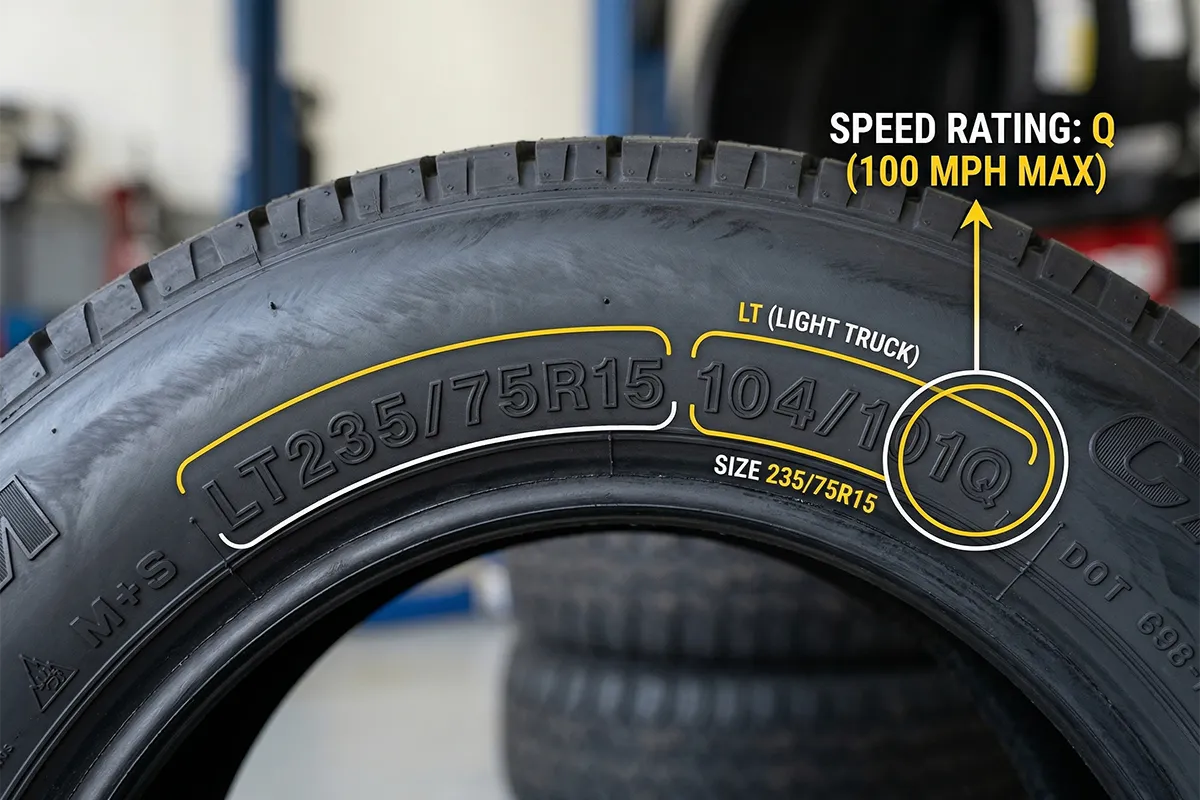
Let me decode a real example for you.
Q Rating Example:
LT235/75R15 104/101Q
- LT = Light Truck tire
- 235 = 235mm wide
- 75 = Aspect ratio (sidewall height is 75% of 235mm)
- R = Radial construction
- 15 = Fits a 15-inch rim
- 104/101 = Dual load index (single vs. dual rear configuration)
- Q = Max speed 99 mph
T Rating Example:
P215/60R16 95T
- P = Passenger tire
- 215 = 215mm wide
- 60 = Aspect ratio
- R = Radial
- 16 = 15-inch rim
- 95 = Load index (single number, single tire use)
- T = Max speed 118 mph
Does Speed Rating Affect Tire Warranty or Treadwear?
It can, indirectly. Speed rating affects the tire’s construction and compound, which in turn affects treadwear. Here’s how it plays out:
- Q-rated winter tires typically have lower treadwear ratings (200–400 range on the UTQG scale) because the soft compound needed for cold-weather grip wears faster in warm conditions. This is expected and by design — winter tires are not meant for year-round use.
- T-rated all-season tires typically have higher treadwear ratings (500–800 range), meaning they’re built to last. Many T-rated tires come with 60,000–80,000 mile tread warranties.
When you’re comparing tires, don’t just look at the speed rating — check the UTQG treadwear grade, the mileage warranty, and the traction and temperature grades too.
A tire with a T rating and an 800 treadwear grade is going to outlast a T-rated tire with a 400 treadwear grade by a wide margin.
Seasonal Use: The One Scenario Where Q and T Tires Coexist on the Same Car
Here’s a scenario I see all the time and want to address directly, because I think it causes the most confusion:
You drive a Toyota RAV4 that came with Bridgestone Dueler T-rated all-season tires from the factory. You live in Minnesota. Every October, you swap to a set of Bridgestone Blizzak WS90 winter tires, which are Q-rated.
Is that a problem? Absolutely not. This is the correct way to do it. You have two complete tire sets — one for each season — and they’re both appropriate for their intended use.
The Q-rated winters are perfect for cold, snowy driving. The T-rated all-seasons come back in April when the ice is gone.
The key is not mixing them. Don’t run three T-rated tires and one Q-rated tire. Always run a matched set (all four tires with the same speed rating) unless you’re in a rare emergency situation.
How Q and T Compare to Other Speed Ratings
Since I always think context helps, here’s how Q and T fit relative to other ratings you might be cross-shopping:
- S vs T Speed Rating — S (112 mph) and T (118 mph) are very close. S is slightly older and less common in new tires. If you’re choosing between S and T, T is almost always the better pick.
- H vs T Speed Rating — H (130 mph) is a meaningful step up from T. H-rated tires tend to have stiffer sidewalls and better hot-weather performance. Many drivers with sporty sedans or larger SUVs benefit from upgrading from T to H.
- Q vs S Speed Rating — Q (99 mph) vs S (112 mph). This comparison matters a lot for winter tire shoppers — some winter tires are S-rated rather than Q, giving you a bit more speed headroom.
- V vs H Speed Rating — Up in the performance category. V (149 mph) is common on sports cars and high-trim SUVs; H is a step below.
- V vs T Speed Rating — A big jump. V-rated tires are performance-oriented, with stiffer sidewalls and better high-speed handling. Not the right choice for an economy sedan that needs T-rated tires.
- H vs S Speed Rating — H vs S is a fairly common comparison for families upgrading from older family sedans to crossovers.
- V vs W Speed Rating — High-performance territory. W (168 mph) is for exotic vehicles and performance sports cars.
- W vs Y Speed Rating — The very top of the chart. Y (186 mph) is for track-oriented supercars.
- Z vs W Speed Rating — The Z designation is a legacy rating that overlaps with W and Y, still used in older sizing conventions.
How to Find the Right Speed Rating for Your Car
I’ll give you the fastest way to find this — three options, pick whichever is easiest:
Option 1: Check your driver’s door jamb sticker.
Open your driver’s door and look for a white or yellow sticker on the door frame. It will list the recommended tire size including speed rating.
Option 2: Check your owner’s manual.
The tire section will list the OEM specification including speed rating.
Option 3: Use a tire retailer’s fitment tool.
Sites like Tire Rack, Discount Tire, and SimpleTire let you enter your year/make/model and they’ll filter results to only show compatible tires. This is the most foolproof method and what I recommend to anyone who’s not confident reading the sidewall code.
Option 4: Look at your current tires.
If you just want to replace like-for-like, find the speed rating on your current tires and match it. The code is on the sidewall — it’s the last letter in the size string.
My Real-World Take: Q vs T in Everyday Life
After years of writing about tires and talking to real drivers, here’s what I’ve observed:
Most drivers never get close to either limit. If you’re commuting on US highways at 65–75 mph, both Q and T are way more than adequate from a pure speed standpoint. The rating isn’t something you need to be anxious about for everyday driving.
Where Q genuinely matters: Winter driving in cold climates. A Q-rated Blizzak on an icy January morning is worth every dollar. The compound that limits the speed ceiling also grips packed snow far better than any T-rated all-season.
Where T genuinely matters: Long summer road trips at highway speed, sustained driving in hot climates. A T-rated touring tire is built for efficiency and comfort at those sustained speeds. It’s the right tool for the daily driver.
The mistake I see most often: People buy the cheapest winter tire without checking if it has the mountain/snowflake symbol, or they assume a higher letter is always better. Sometimes a Q-rated Blizzak is worth more than a T-rated all-season for a driver in Buffalo, New York — speed ceiling and all.
Frequently Asked Questions
Is a Q speed rating safe for highway driving?
Yes. The US highway speed limit tops out at 85 mph on a small stretch of Texas highway, and most interstates run at 65–75 mph. Q-rated tires at 99 mph have a comfortable margin above any legal highway speed. The practical concern with Q-rated tires is sustained heat on long drives at consistent 75–80 mph in warm weather — not the speed rating itself failing.
Can I mix Q and T rated tires on the same vehicle?
No. You should always run four tires with the same speed rating. Mixing ratings creates uneven performance characteristics, especially during emergency braking and cornering. If you’re in a pinch with a spare, it’s okay temporarily, but replace it with the matching rating as soon as possible.
Are Q-rated tires always winter tires?
No, but winter tires are the most common place you’ll find Q ratings. Some light truck and older all-season tires carry Q ratings too. The rating is about speed capability and load focus, not season specifically — though Q and winter use correlate strongly in the market.
Do Q-rated tires wear out faster than T-rated?
It depends. Q-rated winter tires use soft compounds that wear faster in warm temperatures — which is why you’re supposed to take them off in spring. Q-rated non-winter truck tires can actually have excellent longevity. T-rated all-season tires typically have the highest treadwear ratings of the two in their respective all-season categories.
My car’s manual says T but the only tires I can find are Q-rated. What do I do?
This would be very unusual for a passenger car or light SUV, as T-rated tires are extremely common. If you’re in this situation, consult a professional tire dealer. For most vehicles, going up (T → H) is fine; going down (T → Q) for year-round all-season use is not recommended.
Will a Q-rated tire void my car’s warranty?
Running tires with a lower speed rating than OEM specified could potentially create issues with warranty claims related to suspension, handling, or safety systems. It’s unlikely to be a problem for drivetrain warranty, but I’d recommend sticking to OEM spec or higher to keep everything clean.
Final Verdict: Q vs T — Which Should You Choose?
Here’s my definitive take, based on years of following the tire industry and helping real people make these decisions:
Choose Q-rated tires if:
- You need dedicated winter/snow tires for a cold-climate region
- You drive a light truck or heavy-duty SUV and the OEM spec calls for Q
- You’re replacing a set of Q-rated tires with an identical or comparable fitment
- You’re shopping for winter tires and the best-rated options in your size are Q-rated (this is normal and not a downgrade)
Choose T-rated tires if:
- You drive a passenger car, minivan, or light crossover SUV
- You’re looking for year-round all-season tires for everyday commuting
- Your OEM tires are T-rated and you want a like-for-like replacement
- You’re looking for maximum treadwear life and mileage warranties
Consider going higher than T (to H or V) if:
- You have a performance sedan, sports car, or high-trim SUV
- Your OEM tires are already H-rated or higher
- You regularly drive at sustained high speeds (track days, spirited mountain roads)
- You want the stiffer sidewall feel for sharper steering response
At the end of the day, the most important thing is to never go below your OEM-specified speed rating for your primary, year-round tire set. Within that guideline, there’s plenty of room to choose based on your driving habits, budget, and priorities.
Have questions about your specific vehicle and tire size? Drop them in the comments below — I read and respond to every one. And if you found this guide helpful, share it with a friend who’s due for new tires. Helping people make confident, informed tire decisions is exactly why I write here.
Related Articles You Might Find Helpful:
- S vs T Speed Rating – Which Is Better for Your Car?
- H vs T Speed Rating – The Practical Guide
- Q vs S Speed Rating – What’s the Difference?
- V vs T Speed Rating – Do You Really Need Performance Tires?
- H vs S Speed Rating – A Side-by-Side Look
- V vs H Speed Rating – When Performance Matters
- V vs W Speed Rating – High Performance Explained
- W vs Y Speed Rating – The Supercar Tier
- Z vs W Speed Rating – Legacy Ratings Decoded
- Complete Tire Speed Ratings Chart
Disclaimer: Always consult your vehicle owner’s manual and a professional tire technician before replacing your tires. Speed rating recommendations from the manufacturer take precedence over general guidance.