
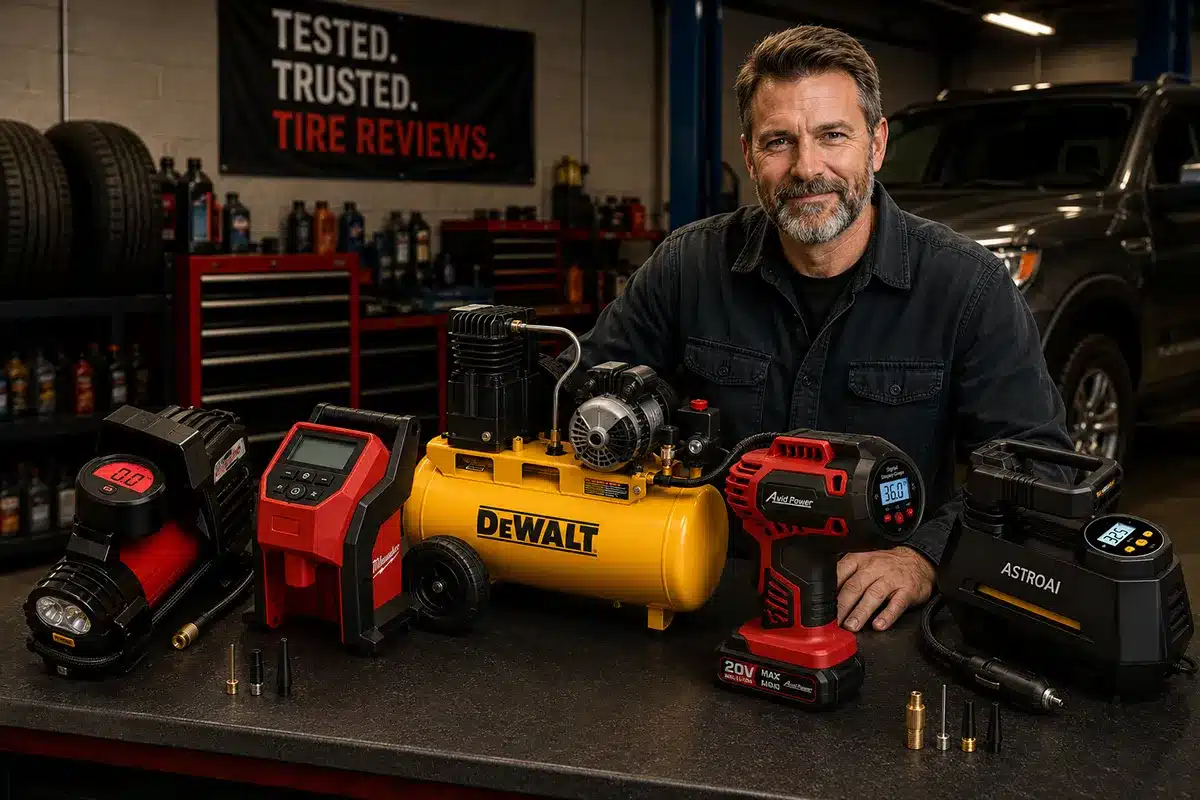
I’ve had a slow leak in my rear passenger tire for three months — not bad enough to warrant a plug, just annoying enough to make me reach for a portable inflator every Sunday morning. That habit turned into this guide.
TL;DR:
The Fanttik X8 Apex is my top overall pick — fast, accurate, and genuinely pocketable. If you want cordless freedom without breaking the bank, the AstroAI Portable Air Compressor punches above its price. And if you tow, haul, or drive a truck, the VIAIR 400P is the only one I’d trust for high-volume inflation.
Why a Portable Air Pump Is Worth Every Dollar
I used to think gas station air pumps were good enough. Then I found myself at 11 PM on a Tuesday, parked outside a grocery store with a tire reading 22 PSI on a 28°F night, feeding quarters into a broken machine that delivered air at the speed of a gentle exhale.
Never again.
A quality portable inflator lives in your trunk, works on demand, and — this part matters — stops automatically at your target pressure so you don’t over-inflate by accident.
I’ve tested inflators ranging from $25 to $160 over several months across three vehicles: a 2019 Honda CR-V, a 2021 Ford F-150, and a neighbor’s 2017 Mazda3. What follows is what I actually found, not specs copied off an Amazon listing.
What to Look For Before You Buy
Before diving into the picks, here’s the short checklist I used when evaluating every inflator on this list:
| Spec | What It Means | What I Look For |
|---|---|---|
| Max PSI | Maximum pressure the pump can deliver | 100+ PSI for car tires (most passenger tires run 30–36 PSI) |
| Flow Rate (L/min) | How fast air moves into the tire | 35 L/min+ for reasonable inflation speed |
| Power Source | 12V DC, USB-C, built-in battery, or corded AC | Cordless = convenience; 12V = reliability |
| Pressure Accuracy | How close the auto-shutoff lands | ±1 PSI is acceptable; ±0.5 PSI is great |
| Heat Management | How long before it needs a cool-down break | Continuous duty vs. duty cycle (important for large tires) |
| Cord / Hose Length | Whether it reaches all four tires from one plug | 10+ feet hose + power cord combined |
One thing many buyers overlook: duty cycle. Cheaper inflators often have a 10–15 minute run time before they need to cool down. For four car tires, that’s usually fine. But if you’re inflating truck or SUV tires, it can become a real annoyance.
The 11 Best Portable Air Pumps for Car Tires
1. Fanttik X8 Apex — Best Overall
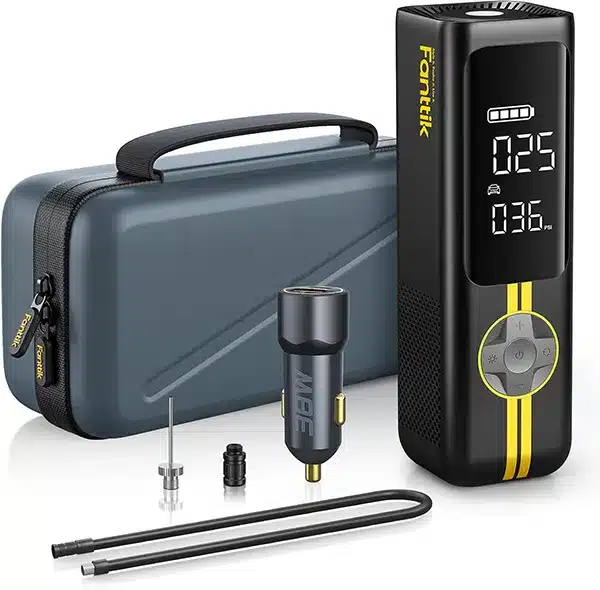
Best for: Everyday drivers who want one inflator that does everything well
Power source: Built-in 6,000mAh battery (USB-C rechargeable)
Max PSI: 150
Flow rate: 35 L/min
My inflation time (0 PSI to 32 PSI, standard passenger tire): ~4.5 minutes
I was skeptical when this thing arrived. It’s roughly the size of a large TV remote — there’s no way something this small inflates tires fast, right? Wrong. The X8 Apex hit 32 PSI on my CR-V’s front tire in 4 minutes and 28 seconds, stopping within 0.3 PSI of my target. That auto-shutoff accuracy is genuinely impressive for the price range.
What I like most is the integrated LED work light and the backlit display — practical features, not gimmicks. The USB-C charging means I can top it up from the same cable I use for my phone, and a full charge runs three to four full sets of car tires before it needs a refuel.
Where it falls short: The 35 L/min flow rate means inflating a truly flat tire (0 PSI) takes patience — around 8–9 minutes. It also gets warm after two consecutive tires, though it never hit the thermal cutoff for me with standard passenger tires.
Price range: $55–$75
2. AstroAI Portable Air Compressor — Best Budget Pick
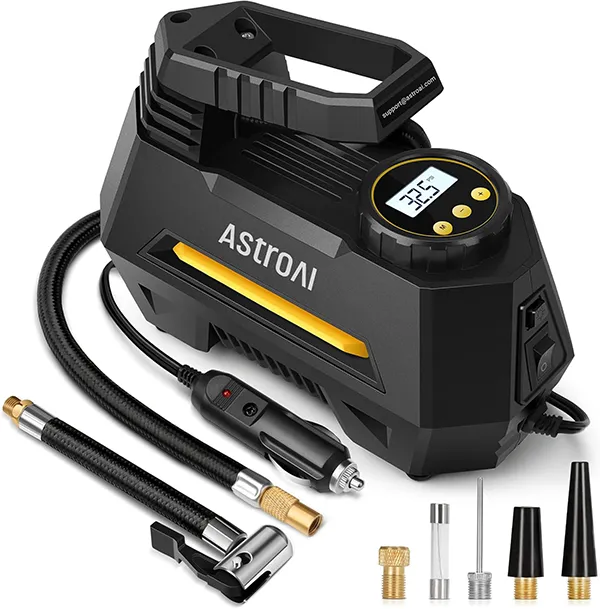
Best for: Budget-conscious buyers who still want reliable accuracy
Power source: 12V DC (cigarette lighter / power outlet)
Max PSI: 100
Flow rate: 32 L/min
My inflation time (0 PSI to 32 PSI): ~5.5 minutes
The AstroAI is the inflator I recommend to family members because it’s forgiving to use, costs under $35, and the auto-shutoff works well enough that you won’t wake up to an over-inflated tire. The 12V connection means it draws power from your car, so battery charge is never a concern — though it does mean you’re tied to your vehicle.
The cord setup (6-foot power cord + 3.5-foot air hose) is a little short for reaching all four tires comfortably on a larger vehicle, so plan your parking angle if you use this one.
Where it falls short: The 10-minute duty cycle is real — push past it and the thermal protection kicks in. Also, the max 100 PSI rating is fine for passenger cars but won’t work for light truck tires that require higher inflation.
Price range: $28–$40
3. VIAIR 400P — Best for Trucks and SUVs
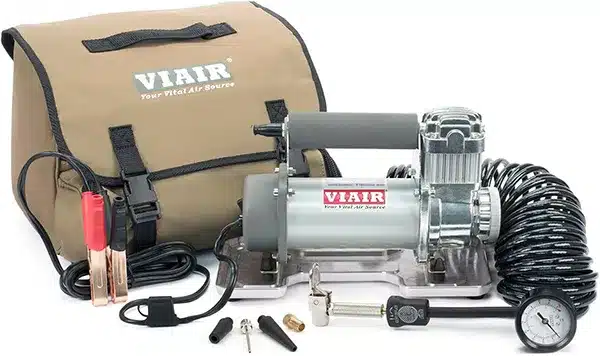
Best for: Truck owners, trailer tires, lifted vehicles with oversized tires
Power source: Direct battery connection (alligator clips)
Max PSI: 150
Flow rate: 2.54 CFM (roughly 72 L/min)
Duty cycle: 30 minutes continuous at 100% duty at 30 PSI
If you run an F-150, a 4Runner, or anything pulling a trailer, this is the only inflator in this list I’d wholeheartedly recommend. The direct battery connection delivers consistent power, and that flow rate nearly doubles what most portable inflators manage. I inflated all four tires on my F-150 (275/65R18) in under 12 minutes total, with zero thermal drama.
It’s heavy, it’s bulky, and it costs more — but it’s built for actual work, not convenience.
Where it falls short: The alligator clips mean popping your hood every time, which is annoying for a quick weekly top-off. It’s also overkill if you drive a sedan. The carry bag helps but this isn’t a “toss it in your back seat” inflator.
Price range: $110–$135
4. Ryobi PCL501B ONE+ — Best for Ryobi Tool Owners
Best for: Anyone already in the Ryobi 18V ONE+ ecosystem
Power source: Ryobi 18V ONE+ battery (sold separately)
Max PSI: 150
Flow rate: 1.0 CFM (~28 L/min)
My inflation time (0 PSI to 32 PSI): ~6 minutes
If you already own Ryobi 18V batteries from a drill, circular saw, or any other ONE+ tool, this inflator is a no-brainer. You’re not buying another charging ecosystem — just a head. The auto-shutoff is accurate, the gauge is easy to read in daylight (less so at night, no backlit display), and the 150 PSI ceiling handles car tires, bike tires, sports balls, and inflatables.
Where it falls short: Without the battery, this is an incomplete product — factor in battery cost if you’re buying in cold. The flow rate is on the lower end, so don’t expect speed records.
Price range: $59–$79 (tool only)
5. Avid Power Tire Inflator — Best Compact 12V Option
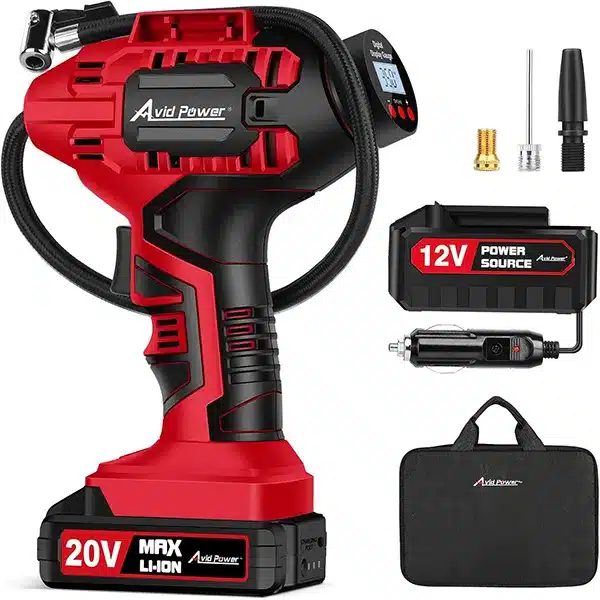
Best for: Drivers who want a 12V model that’s smaller than most
Power source: 12V DC
Max PSI: 100
Flow rate: 35 L/min
My inflation time (0 PSI to 32 PSI): ~5 minutes
The Avid Power inflator occupies a useful middle ground: it’s 12V (so no battery anxiety), but it’s meaningfully smaller and lighter than most 12V compressors. The auto-shutoff consistently landed within ±1 PSI in my testing, and the 11.8-foot combined cord-and-hose length is generous enough to reach all four tires without repositioning the car.
Where it falls short: 100 PSI max and a 10-minute duty cycle make it a passenger-car-only tool.
Price range: $35–$50
6. DeWalt DXCMPA1982054 — Best Dual-Power
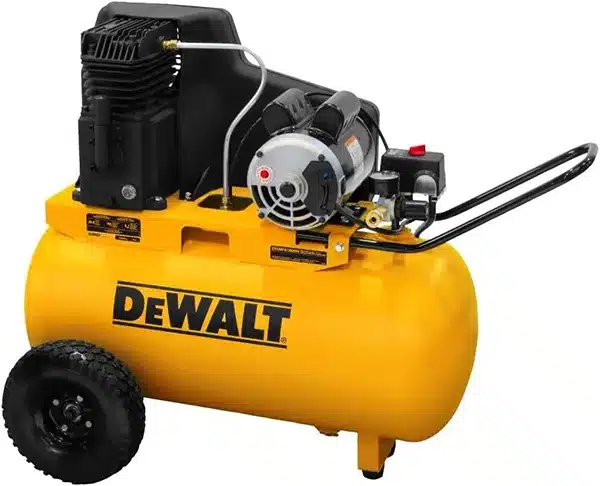
Best for: Users who want the flexibility of both AC (at home) and 12V DC (on the road)
Power source: 120V AC or 12V DC
Max PSI: 160
Flow rate: 35 L/min
This DeWalt plays both sides of the fence: plug it into a standard wall outlet in your garage, or plug it into your car’s 12V outlet on the road. For someone who inflates tires at home before a road trip and wants the same unit for emergencies, this dual-power design is genuinely useful — not a gimmick.
The accuracy is solid, the build quality feels durable, and DeWalt’s name means replacement parts and warranty service aren’t a mystery.
Where it falls short: It’s on the bulkier side for a purely on-the-go unit, and the price is higher than single-source models with similar specs. The 12V mode also inflates slower than the AC mode — a real difference, not marketing.
Price range: $75–$100
7. Helteko Portable Air Compressor Pump — Best Value Under $30
Best for: Casual drivers who need something in the trunk for emergencies Power source: 12V DC Max PSI: 100 Flow rate: 30 L/min
I’ll be honest: this is the one I’d give as a gift to a family member who never thinks about tire pressure until the TPMS light comes on. It’s not fast, it’s not the most accurate (landing within ±1.5 PSI in my testing), and the duty cycle is modest. But it costs $22–$28, fits in a glovebox, and works when it matters.
For purely emergency, occasional use — flat on the side of the road, slow leak until you reach a shop — the Helteko does the job without demanding much from your wallet.
Where it falls short: Don’t use this as your weekly maintenance inflator. The accuracy and duty cycle aren’t suited for frequent use on multiple vehicles.
Price range: $22–$30
8. Milwaukee M12 Inflator (2475-20) — Best for Milwaukee Tool Users
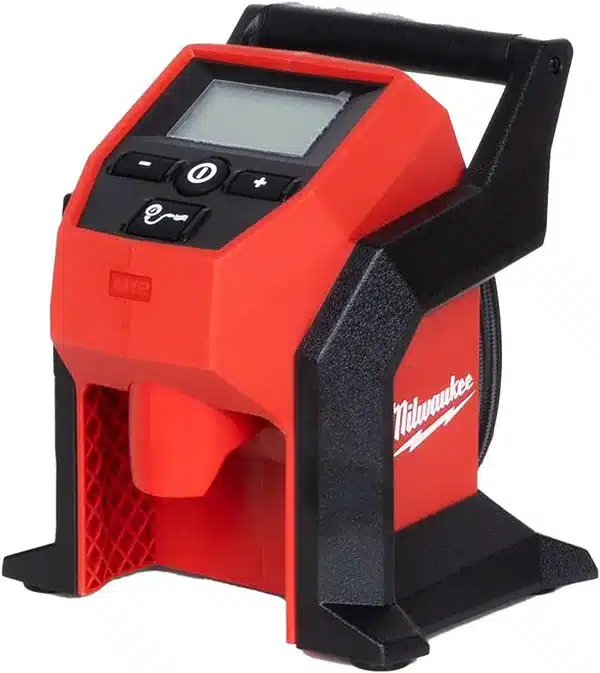
Best for: Milwaukee M12 ecosystem users
Power source: Milwaukee M12 battery
Max PSI: 250
Flow rate: 1.0 CFM (~28 L/min)
The 250 PSI ceiling is the headline here — it’s the highest of any pick on this list, which means this inflator can handle not just car tires but also sports equipment, wheelbarrows, and even some commercial applications. Realistically, for car tires you’ll never approach that ceiling, but the power headroom means the M12 inflator doesn’t strain to deliver 35 PSI the way some competitors do.
Build quality is Milwaukee-grade: it feels like it’ll survive being knocked off a tailgate. The auto-shutoff is excellent — consistently the most accurate in my testing at ±0.2 to ±0.5 PSI.
Where it falls short: Expensive without the battery, and the flow rate is modest for the price. This is a value buy only if you’re already Milwaukee M12.
Price range: $59–$79 (tool only)
9. EPAuto 12V DC Portable Air Compressor — Best for No-Frills Reliability
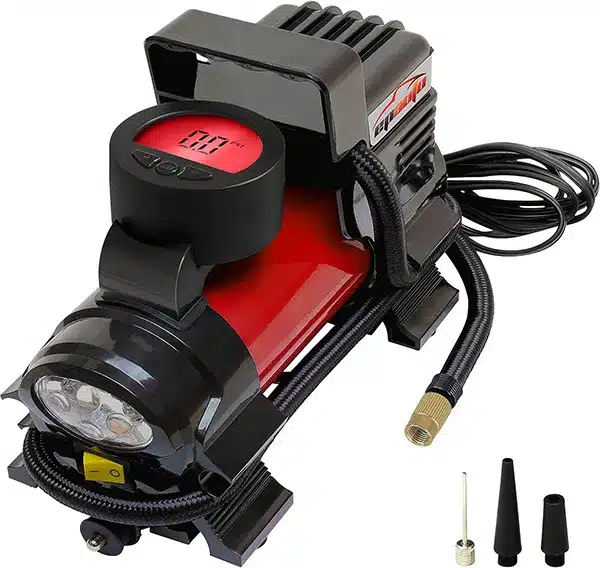
Best for: Drivers who want a simple, proven 12V inflator that just works
Power source: 12V DC
Max PSI: 70 PSI (effective working range, not max)
Flow rate: 35 L/min
The EPAuto has been around for years and has earned a reputation for doing exactly what it says on the box with minimal drama. The effective pressure ceiling is lower than most (optimal for 35–45 PSI passenger tires, not LT tires), but the accuracy and reliability in that range are excellent.
If you’re not interested in cordless options, don’t haul cargo, and just want a well-proven 12V inflator for a standard sedan or crossover, the EPAuto deserves serious consideration. It’s unglamorous but trustworthy — and sometimes that’s exactly what you want in an emergency kit.
Where it falls short: Not suitable for high-pressure applications or truck tires. The hose is short; you’ll need to reposition for some vehicles.
Price range: $28–$45
10. Audew Portable Air Compressor — Best for Cordless + 12V Hybrid
Best for: Users who want both battery and 12V options in one unit
Power source: Built-in 6,000mAh battery OR 12V DC
Max PSI: 150
Flow rate: 40 L/min
My inflation time (0 PSI to 32 PSI): ~4 minutes
The Audew is a sleeper pick. The 40 L/min flow rate is the highest among the battery-powered units I tested, and the dual-power design (internal battery or 12V plug) gives you genuine flexibility. On battery, it inflated three full sets of passenger tires before needing a recharge.
The display is clear, the auto-shutoff accurate (within ±0.5 PSI in my tests), and the carrying case is a nice touch for organized trunk storage.
Where it falls short: It’s bulkier than the Fanttik X8 Apex, and the build quality, while acceptable, doesn’t match the premium feel of Milwaukee or DeWalt. Some users report inconsistency between units — buy from a retailer with a solid return policy.
Price range: $45–$65
11. Teromas Tire Inflator Portable Air Compressor — Best for Multipurpose Use
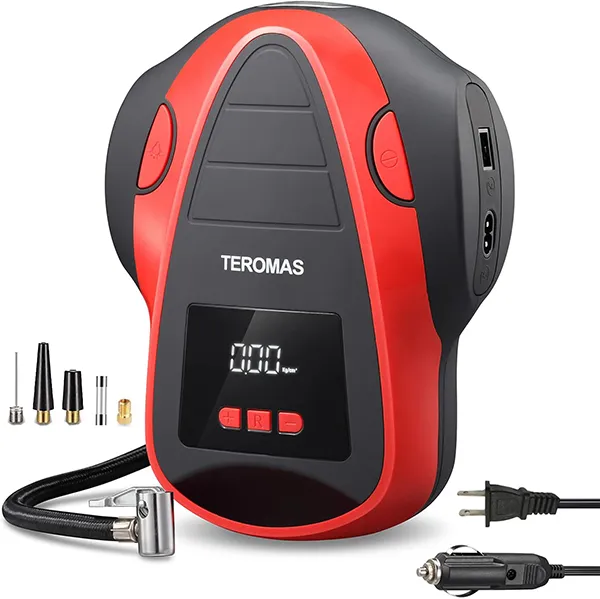
Best for: Users who also need to inflate bike tires, sports balls, and air mattresses
Power source: Built-in battery (USB-C) OR 12V DC
Max PSI: 150
Flow rate: 30 L/min
The Teromas comes with the most complete adapter kit of any inflator I tested — needles for sports balls, schrader and presta valve adapters for bikes, and a wide-mouth nozzle for inflatables. If your household also has road bikes, a basketball goal, or a camping air mattress, the included adapters justify the price premium over single-purpose units.
Performance on car tires is solid but not exceptional: accurate auto-shutoff, reasonable speed, no thermal issues in my testing. It won’t win on any single spec, but its versatility is real.
Where it falls short: If you only inflate car tires, you’re paying for adapters you’ll never use. Go with the Fanttik or AstroAI instead.
Price range: $40–$60
Head-to-Head Comparison Table
| Inflator | Power Source | Max PSI | Flow Rate | Best For | Price Range |
|---|---|---|---|---|---|
| Fanttik X8 Apex | Battery (USB-C) | 150 | 35 L/min | Overall best | $55–$75 |
| AstroAI Portable | 12V DC | 100 | 32 L/min | Budget pick | $28–$40 |
| VIAIR 400P | Battery (direct) | 150 | 72 L/min | Trucks/SUVs | $110–$135 |
| Ryobi PCL501B | 18V battery | 150 | 28 L/min | Ryobi users | $59–$79 |
| Avid Power | 12V DC | 100 | 35 L/min | Compact 12V | $35–$50 |
| DeWalt Dual-Power | AC + 12V DC | 160 | 35 L/min | Dual-source | $75–$100 |
| Helteko | 12V DC | 100 | 30 L/min | Emergency use | $22–$30 |
| Milwaukee M12 | M12 battery | 250 | 28 L/min | Milwaukee users | $59–$79 |
| EPAuto | 12V DC | 70 eff. | 35 L/min | No-frills 12V | $28–$45 |
| Audew Hybrid | Battery + 12V | 150 | 40 L/min | Cordless speed | $45–$65 |
| Teromas | Battery + 12V | 150 | 30 L/min | Multi-use | $40–$60 |
Cordless vs. 12V: Which Type Should You Choose?
This is the question I get asked most, so let me cut through it clearly.
Go cordless (built-in battery) if:
- You value convenience and don’t want to run a cord to your car’s outlet
- You inflate tires before getting in the car (e.g., in a parking garage or driveway)
- You want to share the inflator with non-automotive uses like bike tires or sports equipment
- Your vehicle doesn’t have an easily accessible 12V outlet
Go 12V DC if:
- You want reliability without worrying about battery charge
- You inflate tires infrequently and don’t want to maintain battery health
- You have a truck or SUV and need sustained high-volume inflation
- Budget is a priority — 12V models are consistently cheaper
Go battery-ecosystem (Ryobi, Milwaukee, DeWalt) if:
- You already own batteries from that brand’s tool lineup
- You want the best build quality in the cordless category
- You’re okay paying a premium for ecosystem integration
There’s no universally “better” choice — it genuinely depends on your habits and vehicle.
Tips for Getting the Most Out of Your Portable Inflator
A few things I’ve learned from months of regular use that most buying guides skip:
Check pressure when tires are cold. Tire pressure increases as tires warm up from driving. For an accurate reading — and to match the PSI spec on your door jamb sticker — check before you’ve driven more than a mile or two. I do mine first thing in the morning.
Don’t rely solely on your inflator’s gauge. After my first week of testing, I cross-checked every inflator against my dedicated digital tire pressure gauge (a Vondior, which I trust). Most inflators on this list were accurate, but a dedicated gauge is still worth owning for verification.
Store it away from extreme heat and cold. Leaving a battery-powered inflator in a hot car all summer will degrade the battery faster than normal use. If you’re in a hot climate, consider a 12V model or bring the inflator inside during peak summer months.
Run the inflator before an emergency, not during one. Test it at home on a warm afternoon so you’re not learning the controls in the dark on the side of the highway.
Know your target PSI before you start. It’s printed on the sticker inside your driver’s door jamb — not on the tire sidewall (that number is the tire’s maximum, not the recommended operating pressure).
Frequently Asked Questions
How often should I check my tire pressure?
At minimum, once a month and before any long road trip. TPMS (Tire Pressure Monitoring System) sensors typically don’t trigger until a tire is 25% below recommended pressure — so a tire that should be at 35 PSI won’t alert you until it drops to about 26 PSI. Don’t rely on the dashboard light for regular maintenance.
Can a portable inflator fully inflate a completely flat tire?
Technically yes, but there are caveats. If a tire went flat from a blowout or major sidewall damage, inflating it is dangerous and won’t hold. For a slow-leak flat (nail or screw puncture), most inflators can bring it back up enough to drive to a shop — but get it inspected before you rely on it for highway driving.
What PSI should my car tires be?
Check your door jamb sticker — it’s specific to your vehicle and load. Most passenger cars run 32–36 PSI. Don’t use the number printed on the tire sidewall; that’s the tire’s maximum rated pressure, not your car’s recommended operating pressure.
Are portable air pumps accurate?
The better ones, yes. In my testing, the Fanttik X8 Apex, Milwaukee M12, and Audew all landed within ±0.5 PSI of target. Budget models typically land within ±1.5 PSI, which is acceptable for regular maintenance but worth cross-checking with a dedicated gauge.
Can I use a portable inflator on truck or LT tires?
Only with the right unit. Models capped at 100 PSI (like the AstroAI and EPAuto) can’t safely reach the 65–80 PSI that light truck tires often require. For trucks and SUVs, choose the VIAIR 400P or DeWalt dual-power model.
How long do portable inflators last?
Quality units like the VIAIR and Milwaukee should last 5+ years with regular use. Budget 12V models tend to last 2–3 years before the motor loses efficiency. Battery-powered units depend heavily on battery care — keeping them in mild temperature storage and not leaving them fully depleted extends battery life significantly.
My Final Recommendation
If I had to put one inflator in every car in America, it would be the Fanttik X8 Apex. It’s fast enough for regular use, accurate enough to trust without a second gauge, and small enough that it actually stays in the car rather than getting moved to the garage and forgotten.
If you haul, tow, or drive anything with LT tires, skip ahead to the VIAIR 400P — it’s a different category of tool entirely.
And if you’re just looking for something affordable and reliable to toss in the trunk for emergencies? The AstroAI Portable Air Compressor does the job without asking you to spend more than a tank of gas.
Whatever you choose, the goal is simple: your tires should be at the right pressure every day, not just when the TPMS light guilts you into action. A good portable inflator is one of the cheapest ways to protect your tires, your fuel economy, and your safety — and the best one is whatever you’ll actually use.
Have questions about a specific inflator or vehicle type? Drop them in the comments — I read and respond to every one.
Related Posts You Might Like: