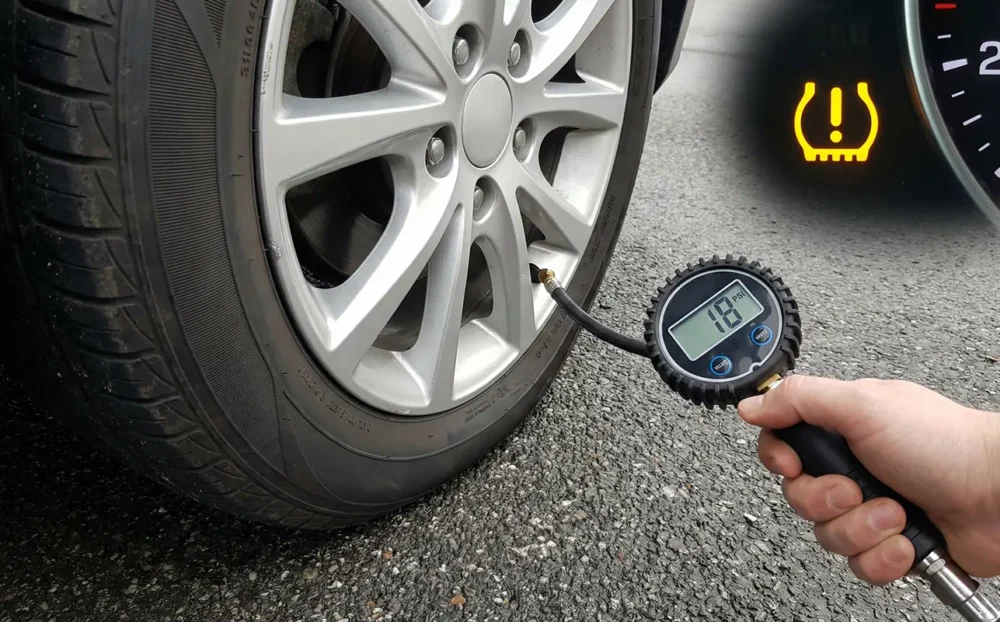
It starts with a subtle sluggishness in the steering. Maybe the ride feels a little softer than usual. Or perhaps, more alarmingly, that horseshoe-shaped orange light with the exclamation point pops up on your dashboard.
Low tire pressure.
It is the single most common maintenance issue we see at The Tire Reviews. In fact, checking your pressure is the very first step we recommend in our tire buying and maintenance guide, yet unfortunately, it is also the most ignored. Many drivers believe that as long as the tire isn’t completely flat (riding on the rim), it’s “good enough.”
But here is the hard truth: Under-inflation is the silent killer of tires, fuel economy, and safety.
Driving on a tire that is just 5 or 6 PSI (pounds per square inch) too low might not look dangerous to the naked eye, but inside the tire, a catastrophic chain reaction is taking place.
In this comprehensive guide, we are going to break down the physics of under-inflation, the financial costs to your wallet, and the critical safety risks you take when you ignore that pressure gauge.
- The Physics of Failure: Why Low Pressure is Dangerous
- The Financial Impact: How Under-Inflation Steals Your Money
- Safety Risks: Handling and Braking
- Why Is My Light On? (Understanding TPMS)
- The Seasonal Factor: Winter vs. Summer
- Finding the “Perfect” Pressure
- How to Stay Safe: A Maintenance Routine
- Conclusion: Don’t Ignore the Air
- Frequently Asked Questions (FAQ)
The Physics of Failure: Why Low Pressure is Dangerous
To understand why low pressure is bad, you have to understand what a tire actually does. Your car doesn’t ride on the rubber; it rides on the air inside the rubber. The tire is just the container.
When that container isn’t full, the structural integrity of the tire changes.
1. The Heat Build-Up (The Blowout Factor)
The absolute worst enemy of a tire is heat. When a tire rolls, the sidewall flexes and stretches. This flexing generates internal heat—a process called hysteresis.
When a tire is properly inflated, the internal air pressure supports the sidewall, keeping flexing to a minimum. The heat generated is manageable and dissipates through the tread.
What happens when pressure is low? Without enough air support, the sidewalls collapse and bulge outward. As you drive, that bulging sidewall has to bend, straighten, and bend again hundreds of times per minute. This excessive flexing generates massive amounts of friction heat—far more than the tire was designed to handle.
If the internal temperature of the rubber gets too high, the chemical bonds holding the tire components together begin to break down. The tread can separate from the casing, or the sidewall can disintegrate from the inside out. This is the primary cause of a high-speed blowout.
2. The Contact Patch Distortion
The “contact patch” is the footprint of the tire that actually touches the road. On a properly inflated tire, this patch is rectangular and flat, ensuring even grip.
When pressure drops, the center of the tire lifts off the road, and the vehicle’s weight shifts entirely to the outer edges (the shoulders) of the tire. Imagine stepping on a marshmallow—the center squishes down, and the sides bulge out. This distortion ruins your traction and destroys your tread life.
The Financial Impact: How Under-Inflation Steals Your Money
Before a low tire causes an accident, it will hurt you in a place you visit every week: the gas station.
Rolling Resistance and Fuel Economy
Think about riding a bicycle. When the tires are rock hard, you can coast for a long time. When the tires are soft, you have to pedal much harder to keep moving.
The same applies to your car. A soft, under-inflated tire creates more rolling resistance. The engine has to work harder to push the car down the road.
- The Cost: The Department of Energy estimates that for every 1 PSI drop in pressure of all four tires, your gas mileage can lower by 0.2%. That might sound small, but if you are driving around 8 PSI low (which is common), you are essentially paying a “stupidity tax” every time you fill up.
Premature Tire Wear
Tires are expensive. You want them to last 50,000 or 60,000 miles. Under-inflation is the fastest way to cut that lifespan in half.
Because the contact patch is distorted, the shoulders of the tire take all the abuse. You will notice the outer edges of the tread wearing down smooth, while the center of the tire still has plenty of tread depth left. This is called shoulder wear. Once those shoulders are bald, the tire is illegal and unsafe, forcing you to replace it prematurely.
Safety Risks: Handling and Braking
Beyond the risk of a blowout, low tire pressure fundamentally changes how your car behaves in an emergency.
Sluggish Handling
Air pressure gives the tire its spring rate and stiffness. When pressure is low, the sidewall becomes “mushy.” If you have to swerve to avoid a deer or a pothole, the tire will roll over on its sidewall. This causes a delay in steering response and can make the rear of the car feel unstable or “loose.”
Hydroplaning Risks
In wet conditions, your tire treads are designed to channel water away like a pump. If the tire is under-inflated, the tread grooves collapse and squeeze together. This reduces their ability to evacuate water. If you are wondering how tire pressure behaves in different conditions, the rule of thumb is that low pressure drastically lowers the speed at which you will hydroplane. A tire that might hold the road at 60 MPH when properly inflated could lose contact with the road at just 45 MPH if it is under-inflated.
Why Is My Light On? (Understanding TPMS)
Since 2008, all passenger cars in the US have been required to have a Tire Pressure Monitoring System (TPMS). This is that annoying yellow light on your dash.
The system is designed to trigger when a tire is 25% below the manufacturer’s recommended pressure.
- The Problem: 25% is a lot. If your recommended pressure is 35 PSI, the light won’t come on until you hit 26 PSI. By that point, you are already suffering from poor fuel economy, safety risks, and accelerated wear. Do not wait for the light to check your tires.
Dealing with TPMS Issues
Sometimes, the light comes on, but the pressure is fine. TPMS sensors are battery-powered and live inside the tire, meaning they are prone to damage and corrosion. If you have a faulty sensor, you might be wondering about the expense. How much does it cost to replace a tire pressure sensor? Generally, you are looking at $50 to $150 per wheel depending on the vehicle and labor.
Because of this cost, some drivers ask: Can tire pressure sensors be disabled? While it is technically possible on some vehicles, it is illegal for a shop to do it, and we highly advise against it. That light is your last line of defense against a catastrophic failure.
The Seasonal Factor: Winter vs. Summer
“But I filled them up in July! Why are they low in December?”
This is simple physics. Air is a gas, and gases expand when heated and contract when cooled.
Winter Pressure Drop
For every 10°F drop in ambient temperature, your tire pressure drops by about 1 PSI. If you last checked your tires in late summer (80°F) and now it is a freezing morning (20°F), you have lost 6 PSI just from the weather change. This is why it is critical to know what tire pressure should be in the winter. You often need to add air as the season changes to compensate for the contraction.
Summer Expansion
Conversely, heat causes pressure to rise. Driving generates heat, and hot asphalt adds even more. If you over-inflate your tires in the winter, they might become dangerously high in the summer. Understanding what tire pressure should be in the summer ensures you don’t cross the line from under-inflation to over-inflation, which causes a harsh ride and center-tread wear.
Finding the “Perfect” Pressure
If low pressure is bad, what is the right number?
The Placard vs. The Sidewall
This is the most common mistake drivers make.
- DO NOT use the “Max Press” number stamped on the sidewall of the tire. That is the maximum amount of air the tire can hold before it explodes. It is not the driving pressure.
- DO use the yellow and white placard located in your driver’s side door jamb (or owner’s manual).
That placard tells you what is the best tire pressure for my tires specifically for your vehicle’s weight and handling characteristics.
Is There a “Sweet Spot”?
Many enthusiasts and mechanics ignore the placard slightly in favor of a universal standard. You will often hear people debating why 40 PSI is the sweet spot for modern fuel efficiency. While 40 PSI can offer better MPG and sharper steering, it creates a stiffer ride. Generally, sticking to the manufacturer’s recommendation (usually 32-35 PSI) is the safest bet for the average driver, but experimenting within a safe range (never exceeding the sidewall max) can help you find what is the perfect tire pressure for your driving style.
How to Stay Safe: A Maintenance Routine
Knowing the dangers is half the battle. The other half is building a habit.
1. Check Them Regularily
Tires are not hermetically sealed. Rubber is permeable, meaning air molecules can slowly migrate through the tire wall over time. So, why do tires lose pressure? aside from punctures?
- Permeation: Natural loss of 1-3 PSI per month.
- Valve Stems: Old valves can leak slowly.
- Rim Corrosion: Rust on the wheel bead can cause slow leaks.
Because of this natural loss, you cannot just “set it and forget it.” We recommend reading our guide on how often you should check tire pressure. (Spoiler: Once a month is the minimum requirement).
2. What If I Don’t Have a Gauge?
You are at a gas station, the air pump is broken, and you suspect a tire is low. While a digital gauge is always best, there are visual and tactile cues you can use in an emergency. You can learn how to check tire pressure without a gauge by looking at the sidewall bulge or comparing the “squish” of the tires with your hand. It’s not precise, but it can save you from driving on a dangerously flat tire.
Conclusion: Don’t Ignore the Air
Air is free (at most gas stations, anyway). It is the cheapest performance upgrade, safety feature, and fuel-saver you have. Driving on low tire pressure is a gamble.
You are betting the structural integrity of your tires against the heat of the road. You might win that bet for a few months, but eventually, the physics will catch up with you.
Take five minutes today. Walk around your car. Check your pressures. If you find one that is low, fill it up. Your wallet, your car, and your passengers will thank you.
Frequently Asked Questions (FAQ)
Can I drive on a tire with 20 PSI?
No. While the rim might not be touching the ground, 20 PSI is dangerously low for most passenger vehicles. At highway speeds, this will generate excessive heat and could lead to a blowout.
Does low tire pressure affect the transmission?
Surprisingly, yes. If one tire is significantly lower than the others, it has a smaller circumference. This means it spins faster than the other tires. On modern All-Wheel Drive (AWD) systems (like Subarus or Audis), this difference in wheel speed can confuse the differential and cause overheating or mechanical damage.
Will adding air clear the TPMS light immediately?
Not always. After filling the tires to the correct pressure, you usually need to drive the car for a few miles at speeds over 20 MPH for the sensors to reset and turn off the light.
Is nitrogen better than air for preventing pressure loss?
Nitrogen molecules are larger than oxygen molecules, so they permeate through the rubber slower. However, for the average driver, regular air (which is already 78% nitrogen) is perfectly fine. The most important thing is maintaining the pressure, regardless of what gas you use.