The tires on your vehicle are more than just round pieces of rubber that connect you to the road. They are sophisticated engineering marvels, critical for your safety, your vehicle’s performance, and your overall driving experience
Among the myriad of codes and markings on a tire’s sidewall, the speed rating is one of the most vital, yet often the most misunderstood.
It’s a code that unlocks crucial information about a tire’s capabilities, its intended use, and its limits. Understanding tire speed ratings isn’t just for performance enthusiasts; it’s essential knowledge for every driver who values safety and wants to get the most out of their vehicle.
This comprehensive guide will demystify the world of tire speed ratings. We will explore what they are, why they are fundamentally important, and how to decode them on your own tires.
We will delve into the engineering behind these ratings, their direct impact on your vehicle’s handling and safety, and provide clear guidance on how to choose the correct speed rating for your specific needs.
By the end of this article, you will possess the knowledge to make informed decisions about your tires, ensuring optimal performance and, most importantly, paramount safety on every journey.
- Key Takeaways
- What Are Tire Speed Ratings and Why Do They Matter?
- Beyond the Speed Limit: A Glimpse into Tire Engineering and Your Drive
- Decoding Your Tire’s Sidewall: Finding the Speed Rating Symbol
- Locating the Tire Code: Where Speed Ratings Live
- Understanding the Alphanumeric Code: Your Tire’s Full Story
- Speed Rating Tire Chart: What Each Letter Means for Your Drive
- Different Tire Speed Ratings
- The Elusive “Z” and “ZR” Designations: Beyond the Top
- Beyond the Number: How Speed Ratings Impact Overall Vehicle Performance
- The Engineering Behind High-Performance Tires: The Science of Speed and Safety
- Choosing the Right Speed Rating for Your Vehicle and Driving Style
- Critical Safety Implications and Common Misconceptions
- The Interplay: Speed Rating, Load Index, and Tire Pressure
- Conclusion: Making Informed Choices for Optimal Performance and Safety
Key Takeaways
To summarize, here are the essential points to remember about tire speed ratings:
- Definition: A tire speed rating indicates the maximum speed at which a tire can safely sustain its rated load under specific conditions.
- Location: The speed rating is represented by a letter (speed symbol) found at the end of the tire’s alphanumeric code on the sidewall (e.g., ‘H’ in P225/60R17 98H).
- Importance: Speed ratings are crucial for ensuring tire structural integrity, predictable handling, effective braking, and overall vehicle control.
- Impact on Performance: Higher speed ratings generally correlate with enhanced handling, better braking, and improved stability, though they can sometimes lead to a firmer ride and reduced tread life.
- Engineering: These ratings are backed by advanced tire construction, specialized rubber compounds, and rigorous testing by tire manufacturers.
- Selection: Always adhere to your vehicle manufacturer’s recommended speed rating, found in the owner’s manual or on the driver’s side doorjamb sticker.
- Dangers of Exceeding: Driving beyond a tire’s speed rating can lead to overheating, structural compromise, and potentially catastrophic tire failure (blowout).
- Mixing Tires: Avoid mixing tires with different speed ratings on the same vehicle, as it can lead to imbalanced handling and compromised safety systems.
- Interdependence: Speed ratings work in conjunction with load index and proper tire pressure. All three must be correctly matched and maintained for optimal safety.
- Special Cases: Light truck (LT) tires and winter tires often have lower speed ratings due to their specialized design priorities.
What Are Tire Speed Ratings and Why Do They Matter?
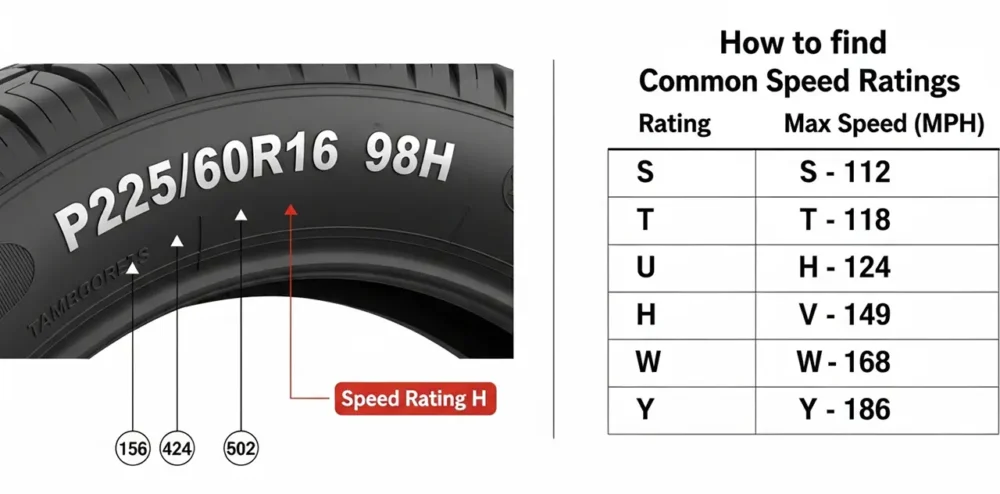
The last letter in your tire’s size code is the speed rating, which corresponds to a specific maximum safe speed.
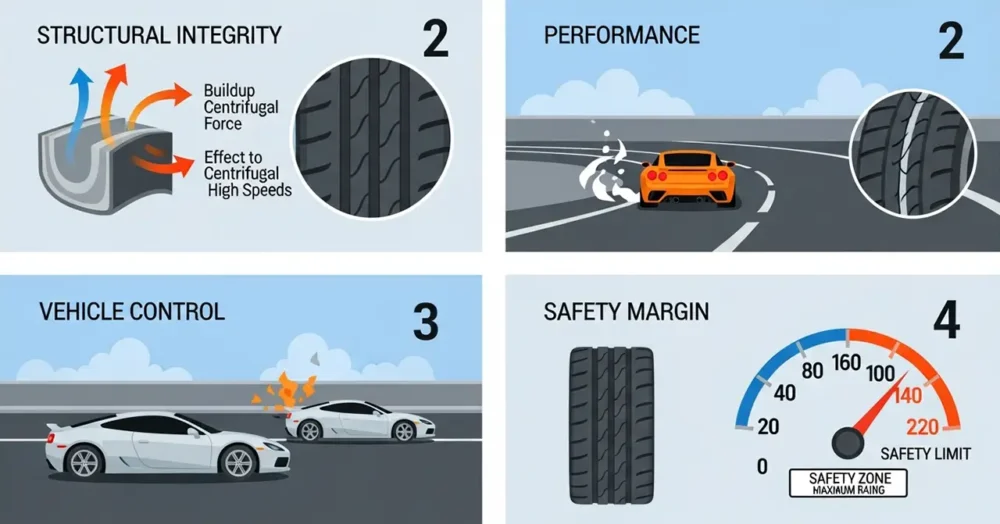
A tire’s speed rating impacts its structural integrity, performance characteristics, your vehicle’s control, and provides a crucial safety margin.
At its core, a tire speed rating is a standardized designation that indicates the maximum speed at which a tire can safely carry a normal load under specified conditions.
These ratings are not arbitrary; they are the result of extensive engineering and rigorous testing by tire manufacturers to ensure that their products meet specific performance and safety benchmarks.
Why do these ratings matter so profoundly? They are directly linked to several critical aspects of your driving experience and vehicle safety:
- Structural Integrity: Tires designed for higher speeds incorporate specific construction methods and materials to withstand the increased centrifugal forces and heat generated. Exceeding a tire’s speed rating can lead to catastrophic failure, such as a blowout.
- Performance Characteristics: A tire’s speed rating is often indicative of its performance capabilities. Higher speed-rated tires typically offer enhanced grip, superior handling, and more responsive braking due to stiffer sidewalls and specialized tread compounds.
- Vehicle Control: The ability of your tires to maintain their shape and grip under stress directly influences your vehicle’s overall control. Whether navigating high-speed highways or performing emergency maneuvers, the speed rating ensures the tire can perform as expected.
- Safety Margin: Speed ratings provide a crucial safety margin. Even if you don’t drive at extreme speeds, the tire is engineered to perform reliably under demanding conditions that can occur at legal speeds, such as sudden braking or evasive steering.
In essence, the tire speed rating is a critical piece of information that directly influences how your vehicle interacts with the road at speed, affecting everything from your comfort to your ability to avoid accidents.
It’s a testament to the advanced engineering that goes into every tire, ensuring that your connection to the road remains secure and predictable.
Beyond the Speed Limit: A Glimpse into Tire Engineering and Your Drive
The concept of a speed rating might initially seem straightforward – a maximum speed. However, it represents a complex interplay of engineering, material science, and design that underpins the tire’s ability to perform under stress.
Tires are far from simple commodities; they are intricate components designed to manage immense forces and temperatures.
The engineering behind a tire’s speed rating involves several key areas. The rubber compounds used are formulated not only for grip and wear but also to resist the heat generated at high speeds.
The internal structure, including the plies and belts, is designed for strength and stability. Sidewall stiffness is a crucial factor, influencing how the tire deforms under load and cornering forces at speed.
This sophisticated engineering directly translates into your driving experience. A higher speed rating often signifies a tire built for responsiveness and precision.
This means that when you turn the steering wheel, the vehicle reacts more decisively. During braking, the tire’s ability to maintain its shape and grip ensures consistent and effective stopping power.
Even the tread pattern is optimized to manage heat dissipation and provide stable contact with the road surface.
Understanding that your tire’s speed rating is a product of advanced design sheds light on why it is so crucial for maintaining the intended performance and safety characteristics of your vehicle.
Decoding Your Tire’s Sidewall: Finding the Speed Rating Symbol
The most crucial information about your tire, including its speed rating, is printed directly onto its sidewall. This is where the tire manufacturer clearly communicates the tire’s specifications, dimensions, and intended capabilities.
For the average driver, the sidewall can appear to be a dense array of letters and numbers, but understanding its layout is straightforward once you know what to look for.
The tire’s sidewall contains a wealth of data, including the manufacturer’s name, the tire model, its size designation, tread wear indicators, maximum load capacity, and, importantly, the speed rating.
This information is standardized to ensure consistency across different brands and is essential for proper tire selection and maintenance.
By learning to read these markings, you empower yourself to make informed decisions about your vehicle’s tires, ensuring you maintain optimal performance and safety.
Locating the Tire Code: Where Speed Ratings Live
The alphanumeric code on your tire’s sidewall is a comprehensive description of its characteristics. This code typically appears as a sequence of numbers and letters, such as P225/60R17 98H. To find the speed rating, you need to look at the very end of this primary service description.
This alphanumeric sequence provides a detailed breakdown of the tire. For instance, ‘P’ often indicates a passenger tire. The first set of numbers (‘225’) denotes the tire’s width in millimeters.
The next number (’60’) is the aspect ratio, representing the tire’s sidewall height as a percentage of its width. The letter ‘R’ signifies radial construction, a virtually universal standard for modern tires.
The number following ‘R’ (’17’) indicates the wheel diameter in inches. Following these specifications, you will often find a number, such as ’98’, which is the load index, indicating the maximum load the tire can carry.
Finally, the last letter in this sequence, like ‘H’ in our example, is the speed symbol, which represents the tire’s speed rating.
Understanding the Alphanumeric Code: Your Tire’s Full Story
To truly understand the speed rating, it’s beneficial to briefly contextualize it within the broader tire code. Let’s break down the example P225/60R17 98H:
- P: This prefix indicates the tire is designed for passenger vehicles. Other prefixes like LT (Light Truck) denote different vehicle types with distinct engineering priorities.
- 225: This is the tire’s width in millimeters, measured from sidewall to sidewall.
- 60: This is the aspect ratio, expressed as a percentage. It means the tire’s sidewall height is 60% of its width (225 mm). A lower aspect ratio generally indicates a stiffer sidewall and a sportier feel.
- R: This denotes the tire’s construction. ‘R’ stands for radial, meaning the internal fabric plies run radially across the tire from bead to bead. This is the standard for almost all modern tires.
- 17: This is the diameter of the wheel that the tire is designed to fit, measured in inches.
- 98: This is the load index. It’s a numerical code that corresponds to the maximum weight each tire can safely support when properly inflated. You would then cross-reference this number with a load index chart provided by tire manufacturers or regulatory bodies to find the actual weight capacity.
- H: This is the speed symbol, or speed rating. It is the final character in this sequence and is the key to understanding the tire’s maximum speed capability.
While the load index and speed rating are often grouped together at the end of the tire code, they represent distinct safety parameters.
Both are critical, and they work in conjunction with proper tire pressure to ensure the tire performs safely under its intended operating conditions.
Speed Rating Tire Chart: What Each Letter Means for Your Drive
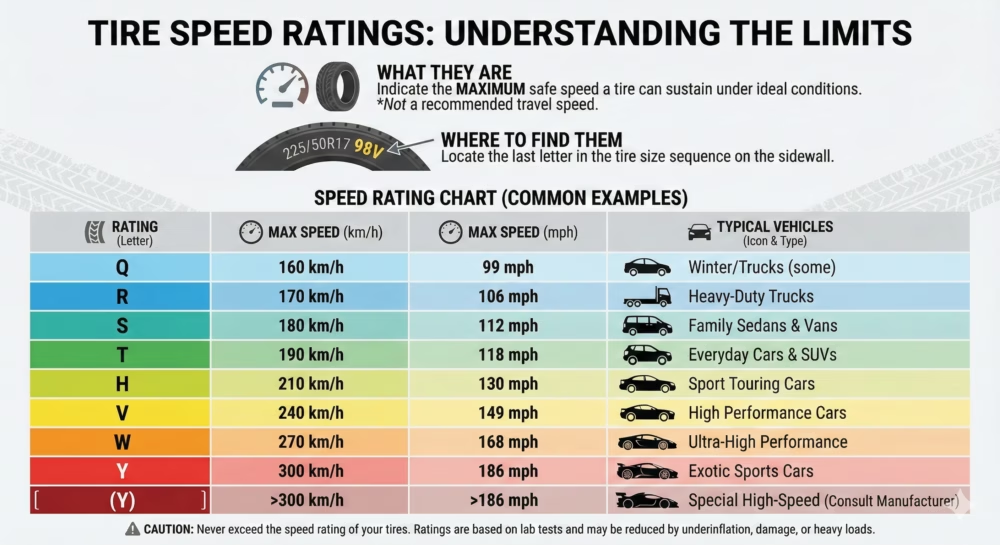
The alphabet of tire speed ratings is a precise system that translates a letter into a specific maximum speed capability. This chart, often referred to as the speed symbol chart, is the key to understanding what each letter signifies.
It’s important to note that the ratings do not follow a strict alphabetical order in terms of speed; some letters are grouped together, and higher performance ratings are not always simply the next letter in the alphabet.
Here is a breakdown of common tire speed ratings and their corresponding maximum speeds:
| Speed Symbol | Maximum Speed (MPH) | Maximum Speed (KPH) | Notes |
|---|---|---|---|
| L | 75 | 120 | Older rating, typically for temporary spare tires. |
| M | 81 | 130 | Older rating, for some light trucks and trailers. |
| N | 87 | 140 | Older rating, for some light trucks and trailers. |
| P | 94 | 150 | Older rating, for some light trucks. |
| Q | 100 | 160 | Common for light trucks and some all-season tires. |
| R | 106 | 170 | Common for light trucks and some all-season tires. |
| S | 112 | 180 | Standard for many passenger cars, minivans. Offers a good balance of ride comfort and durability. |
| T | 118 | 190 | Common for family cars and minivans. Slightly higher performance than S. |
| U | 124 | 200 | Less common, typically for certain performance-oriented vehicles. |
| H | 130 | 210 | Historically considered “high performance.” Common on sporty sedans and cars where spirited driving is expected. |
| V | 149 | 240 | Found on many sports sedans and performance-oriented cars. Offers significant handling and stability at higher speeds. |
| W | 168 | 270 | Reserved for high-performance sports cars and exotics. Engineered for extreme speeds and dynamic handling. |
| Y | 186 | 300 | The highest standard speed rating. Used on the most extreme performance vehicles. |
| (ZR) | >149 (>240) | >149 (>240) | An older designation, often appearing as part of the tire size (e.g., 225/50ZR16). Implies a speed capability above V. |
Note: The “ZR” designation is a bit of a special case. Historically, it indicated a radial tire with a speed rating above 149 mph. In modern tire coding, the ‘W’ and ‘Y’ ratings have largely superseded the need for ‘ZR’ as a standalone speed indicator, though it may still appear in older tire size formats.
Check Out Our Speed Rating Comparison
- V vs H Speed Rating
- Q vs S Speed Rating
- V vs W Speed Rating
- H vs T Speed Rating
- S vs T Speed Rating
- V vs T Speed Rating
- W vs Y Speed Rating
- H vs S Speed Rating
- V vs H Speed Rating
- UTQG Rating Guide
- Tire Temperature Rating Guide
Different Tire Speed Ratings
Common Passenger Car Speed Ratings (S, T, H, V)
For the vast majority of passenger vehicles on the road today, you’ll encounter speed ratings ranging from ‘S’ to ‘V’. These ratings are designed to match the performance capabilities and intended use of everyday cars, family sedans, and sporty coupes.
S (112 mph / 180 km/h)
This is a standard speed rating found on a wide array of passenger cars, minivans, and some SUVs. Tires with an ‘S’ rating offer a good balance of ride comfort, tread wear, and durability for typical driving conditions.
They are engineered to handle the demands of daily commuting, highway cruising, and moderate spirited driving without issue, as long as you stay within the rated speed.
T (118 mph / 190 km/h)
A step up from the ‘S’ rating, the ‘T’ rating is also common for many family cars and minivans.
It indicates a slightly higher speed capability and often suggests a tire that is well-suited for longer highway journeys or drivers who appreciate a bit more responsiveness.
While the difference might seem small on paper, it reflects subtle engineering choices in the tire’s construction and compound.
H (130 mph / 210 km/h)
Historically, the ‘H’ rating was considered a premium performance indicator. Today, it’s commonly found on vehicles that offer a more engaging driving experience, such as sport sedans, performance coupes, and some luxury vehicles.
Tires with an ‘H’ rating often feature a stiffer construction and a tread compound designed to provide better grip and handling response, especially during cornering and at higher speeds.
V (149 mph / 240 km/h)
The ‘V’ rating signifies a significant step into the high-performance category. These tires are standard on many sports cars, high-performance sedans, and luxury vehicles designed for significant speed and dynamic capability.
Tires with a ‘V’ rating are engineered with advanced construction techniques and specialized rubber compounds to offer exceptional handling, steering precision, and braking performance at high velocities.
They are built to maintain their shape and integrity under extreme centrifugal forces.
High-Performance & Ultra-High Performance Speed Ratings (W, Y)
Moving beyond the common passenger car ratings, we enter the realm of high-performance and ultra-high performance tires, designated by ‘W’ and ‘Y’ speed symbols. These ratings are reserved for vehicles built for extreme speed and dynamic driving.
W (168 mph / 270 km/h)
The ‘W’ rating is a hallmark of true high-performance vehicles, including many sports cars, supercars, and performance variants of luxury cars.
Tires bearing this rating are constructed with advanced materials and engineering to ensure they can safely sustain speeds up to 168 mph.
This includes robust internal structures to prevent deformation and a specialized tread compound that maintains grip and stability under immense stress. Their design prioritizes razor-sharp handling, rapid acceleration, and potent braking capabilities.
Y (186 mph / 300 km/h)
The ‘Y’ rating represents the pinnacle of commonly available tire speed ratings. It is found on exotic supercars and the most extreme performance vehicles capable of exceeding 186 mph.
Tires with a ‘Y’ rating undergo the most rigorous testing and feature the most advanced tire technology available.
They are engineered to provide ultimate grip, precise control, and reliable performance even at speeds approaching 200 mph, demanding the highest standards in material science, construction, and heat management.
The Elusive “Z” and “ZR” Designations: Beyond the Top
The “Z” and “ZR” designations in tire coding are often a source of confusion due to their historical context and their place in the evolution of speed ratings.
Historically, a “Z” rating indicated a tire with a speed capability exceeding 149 mph (240 km/h). At the time, this was the highest designation available.
When speed ratings evolved and the ‘W’ and ‘Y’ classifications were introduced, “Z” became somewhat redundant as a standalone highest rating. However, you might still encounter “Z” or “ZR” in older tire size formats, such as 225/50ZR16.
The “ZR” designation specifically means a radial tire with a speed capability exceeding 149 mph. In contemporary tire codes, when a “Z” appears as the last character in the size designation (e.g., 225/50Z R16), it generally implies a speed rating of ‘V’ or higher, and the manufacturer’s documentation or tire sidewall secondary markings should clarify the specific speed rating.
The presence of “ZR” or a “Z” in the size often indicates a performance-oriented tire designed for higher speeds, and it’s crucial to check the specific speed rating if available or consult with a tire professional.
Beyond the Number: How Speed Ratings Impact Overall Vehicle Performance
The speed rating of a tire is not merely an abstract number; it profoundly influences how your vehicle performs in a variety of driving scenarios, often even at legal speeds.
Understanding these impacts helps drivers appreciate why selecting the correct speed rating is critical beyond just adhering to vehicle manufacturer recommendations.
Enhanced Handling Characteristics and Cornering Ability
Tires with higher speed ratings generally feature stiffer sidewalls and more aggressive tread patterns. The stiffer sidewall resists deformation more effectively under cornering loads.
This translates directly into a more responsive steering feel and the ability to maintain a tighter, more controlled line through turns.
For sports cars and performance vehicles, this enhanced handling is paramount for agility and driver engagement.
Even on a standard vehicle, a tire matched to the manufacturer’s recommended higher speed rating can provide a more stable and predictable feel when making lane changes or navigating winding roads.
Improved Braking and Stopping Power
The ability of a tire to provide consistent and powerful braking is directly linked to its speed rating.
Tires designed for higher speeds are engineered to maintain their structural integrity and tread contact patch under extreme deceleration forces.
This means they can dissipate heat more effectively, preventing brake fade and ensuring reliable stopping distances.
The stiffer sidewalls also contribute to better stability during hard braking, reducing the likelihood of the vehicle ‘squatting’ or losing composure.
Therefore, a tire with an appropriate speed rating can significantly enhance your safety margin in emergency situations.
Ride Comfort Versus Performance: Finding Your Balance
There is often a trade-off between ride comfort and performance when it comes to tire speed ratings.
Tires with higher speed ratings (like V, W, Y) typically have stiffer sidewalls and firmer tread compounds designed for responsiveness and heat resistance.
This rigidity, while beneficial for handling and braking, can lead to a firmer, less forgiving ride. You may feel road imperfections more acutely, and the tire may transmit more noise and vibration into the cabin.
Conversely, tires with lower speed ratings (like S and T) often prioritize ride comfort. They tend to have more flexible sidewalls that absorb road shock better, providing a smoother and quieter ride.
Choosing the right speed rating involves balancing these factors based on your vehicle and your personal preferences.
The Engineering Behind High-Performance Tires: The Science of Speed and Safety
The ability of a tire to safely achieve and sustain high speeds is a testament to advanced engineering and material science.
Tire manufacturers invest heavily in research and development to create tires that can withstand the immense forces and heat generated at extreme velocities.
Understanding this engineering sheds light on why these tires are so effective and why adhering to their ratings is crucial.
Advanced Tire Construction and Materials
High-performance tires utilize specialized construction techniques and compounds. This includes:
- High-Tensile Steel Belts: Multiple layers of steel belts under the tread enhance stability, durability, and heat resistance.
- Reinforced Sidewalls: Sidewalls are often made with stiffer compounds and may incorporate additional reinforcing materials. This prevents excessive flexing at high speeds, maintaining the tire’s intended shape and enhancing steering response.
- Specialized Rubber Compounds: Advanced tread compounds, often incorporating silica and other polymers, are designed to offer a superior balance of grip in dry and wet conditions, heat resistance, and wear characteristics. These compounds are formulated to remain stable and provide consistent traction across a wide temperature range.
- Optimized Tread Patterns: Tread designs are carefully sculpted to provide optimal contact with the road surface for grip and handling, while also facilitating the efficient dissipation of heat generated by friction and internal flexing.
Managing Heat Buildup: A Critical Safety Factor
Heat is the primary enemy of any tire, but its effects are dramatically amplified at high speeds.
The friction between the tire and the road, along with the internal flexing of the tire’s components, generates significant heat.
If this heat cannot be managed effectively, it can degrade the rubber compounds, weaken the tire’s internal structure, and lead to premature wear or, in the worst-case scenario, a catastrophic tire failure (blowout).
High-speed rated tires are specifically engineered with internal cooling channels or materials that promote heat dissipation, ensuring the tire remains within safe operating temperatures even under sustained high-speed conditions.
Rigorous Testing and Standards: Ensuring Reliability
Before a tire is approved for a particular speed rating, it undergoes extensive testing protocols.
These tests, often conducted under international standards like those set by the ISO (International Organization for Standardization) or ECE (Economic Commission for Europe), subject the tires to simulated high-speed driving conditions.
They are evaluated for their ability to maintain speed, handle loads, and resist heat buildup over extended periods.
Some tests may involve driving the tire at its rated speed continuously for extended durations, or even at speeds slightly above the rated maximum, to confirm its safety margin.
This rigorous validation process is what gives consumers confidence in the performance and safety of tires with specific speed ratings.
Choosing the Right Speed Rating for Your Vehicle and Driving Style
Selecting the appropriate tire speed rating is a crucial step in ensuring your vehicle’s safety and performance.
It’s not simply a matter of picking the highest rating you can find; it’s about matching the tire’s capabilities to your vehicle’s design and your personal driving habits.
Consulting Your Vehicle Manufacturer’s Recommendations
This is the single most important guideline. Your vehicle’s manufacturer has specifically engineered your car or truck to perform optimally with tires that meet certain specifications, including the speed rating. This information is readily available in several places:
- Owner’s Manual: The definitive source for all vehicle specifications.
- Driver’s Side Doorjamb Sticker: A placard typically located on the doorframe contains tire size, load index, and speed rating recommendations.
- Fuel Filler Door: Some manufacturers also provide this information inside the fuel filler door. Sticking to the manufacturer’s recommended speed rating ensures that your tires will perform as intended by the vehicle’s engineers, providing the designed safety margin, handling characteristics, and stability.
Matching Your Driving Needs and Environment
While the manufacturer’s recommendation is paramount, considering your driving habits can further refine your choice.
- Daily Commuter: If your driving primarily consists of city traffic and moderate highway speeds, tires with standard speed ratings (S, T, H) that match your vehicle’s recommendations will likely suffice.
- Long-Distance Highway Driver: For those who frequently cover long distances at higher highway speeds, a tire with a slightly higher speed rating than the minimum recommended can offer greater confidence and stability, provided it’s within the vehicle’s design parameters.
- Spirited Driver / Performance Enthusiast: If you enjoy spirited driving, track days, or frequently push your vehicle’s performance envelope (within legal and safe limits), opting for tires with a speed rating at the higher end of your vehicle’s recommended range, or even one step higher if suitable, can enhance handling, grip, and responsiveness.
- Climate Considerations: In regions with extremely high ambient temperatures, tires operating closer to their maximum speed rating might generate more heat. If you frequently drive in such conditions, opting for a tire with a slightly higher speed rating can provide an additional layer of safety.
Special Considerations: Light Trucks and Winter Tires
Light Truck (LT) Tires
Tires designed for light trucks, often designated with an “LT” prefix in their size (e.g., LT265/70R17), are engineered with durability and load-carrying capacity as primary concerns. Consequently, they often have lower speed ratings (typically Q, S, or T).
This is because their construction is heavier and designed for off-road capability and hauling, not high-speed performance. It is critical to match the LT tire speed rating to the vehicle’s requirements, which are often lower than those for passenger cars.
Winter Tires
Winter tires are specifically designed for optimal grip and performance in cold temperatures, snow, and ice. This often involves softer rubber compounds that remain flexible in the cold and aggressive tread patterns.
These characteristics, while excellent for winter traction, typically mean winter tires have lower speed ratings than their all-season or summer counterparts.
For example, a vehicle that uses H-rated all-season tires might only be equipped with Q or T-rated winter tires. It is essential to adhere to the speed rating limitations of winter tires to maintain safety.
Critical Safety Implications and Common Misconceptions
Understanding tire speed ratings is paramount for safety. Misinterpreting or ignoring these ratings can lead to dangerous situations. Several misconceptions about speed ratings persist among drivers, potentially compromising their safety.
The Dangers of Exceeding Your Tire’s Speed Rating:
Driving a vehicle at speeds consistently exceeding the manufacturer’s recommended tire speed rating is a significant safety risk.
The primary danger lies in heat buildup. As a tire spins at high speeds, internal friction and flexing generate heat.
If this heat exceeds the tire’s design capacity, the rubber compounds can degrade, the internal structure can weaken, and the tire’s integrity can be compromised.
This can lead to reduced traction, unpredictable handling, and, in the most severe cases, a sudden and catastrophic tire failure known as a blowout.
A blowout at high speed can result in a complete loss of vehicle control, potentially leading to severe accidents.
Why Mixing Speed Ratings is Not Recommended
It is strongly advised against mixing tires with different speed ratings on the same vehicle, particularly on the same axle.
Handling Imbalance: Different speed ratings imply different performance characteristics, such as sidewall stiffness and grip levels. Mixing them can create an imbalance in handling, where one axle responds differently to steering inputs or braking than the other. This unpredictability can be dangerous, especially during emergency maneuvers.
Uneven Wear: Tires with different speed ratings will likely wear at different rates. A higher-rated tire may be more durable under stress, while a lower-rated tire might wear out faster or deform differently, leading to uneven wear patterns across the vehicle.
Compromising Safety Systems: Modern vehicles are equipped with sophisticated safety systems like Anti-lock Braking Systems (ABS) and Electronic Stability Control (ESC). These systems rely on consistent tire performance. Mismatched tires can interfere with the calibration and effectiveness of these systems, reducing their ability to help you maintain control.
Common Misconceptions
“My car can’t go that fast, so the speed rating doesn’t matter.”
This is a dangerous misconception. While you may not intentionally drive at 150 mph, the speed rating reflects the tire’s ability to handle stresses encountered even at legal speeds, especially under demanding conditions like sudden braking, evasive maneuvers, or driving in very hot weather. A tire rated for a lower speed might not have the structural integrity or heat resistance to cope with these stresses.
“The speed rating is the tire’s absolute limit; I should stay well below it.”
While it’s wise to have a buffer, the speed rating is a sustained speed capability under specified load conditions. It is not a momentary peak limit. Tires are designed with a margin of safety above their rated speed, but consistently exceeding it voids that margin. The goal is to use tires rated appropriately for your vehicle’s capabilities.
The Interplay: Speed Rating, Load Index, and Tire Pressure
A tire’s speed rating is not an isolated specification; it works in tandem with other critical tire codes and maintenance factors to ensure overall safety and performance. Understanding this interplay is vital for a comprehensive approach to tire management.
Load Index
As mentioned, the load index is a numerical code that specifies the maximum weight a single tire can carry when inflated to its recommended pressure.
A higher load index is necessary for heavier vehicles or applications that demand greater load-carrying capacity. Importantly, the load index is directly related to the speed rating.
A tire’s ability to handle a certain speed is contingent upon it not being overloaded. If a tire is operating near its maximum load capacity, its speed capability may be reduced, and its susceptibility to heat buildup increases.
Therefore, always ensure both the load index and speed rating meet or exceed your vehicle manufacturer’s requirements.
Tire Pressure
Proper tire inflation is arguably the most critical factor in maintaining a tire’s performance and safety, especially concerning its speed rating.
Maintaining Shape: Correct tire pressure ensures the tire maintains its intended shape under load. Under-inflation can cause excessive flexing of the sidewalls, leading to overheating and premature wear. Over-inflation can reduce the tire’s contact patch, leading to reduced grip and a harsher ride.
Heat Dissipation: Properly inflated tires distribute heat more effectively. Under-inflated tires generate more heat due to increased flexing, directly impacting their ability to perform at their rated speed. Over-inflated tires can also contribute to heat buildup by deforming differently.
Load Capacity: Tire pressure is directly linked to the tire’s load-carrying capacity. The load index specified by the manufacturer is valid only at a specific, recommended inflation pressure. Deviating from this pressure will alter the tire’s ability to carry its rated load, which in turn affects its speed capability.
How They Interact
The speed rating, load index, and tire pressure are interdependent. You cannot have one without the others. A tire with a high speed rating and load index will not perform safely if it is improperly inflated.
Similarly, using a tire with an inadequate load index or speed rating, even if perfectly inflated, will compromise safety.
Always refer to your vehicle manufacturer’s recommendations for tire size, load index, speed rating, and recommended inflation pressures.
Regularly checking your tire pressure and ensuring your tires meet or exceed these specifications is a fundamental aspect of safe driving.
Conclusion: Making Informed Choices for Optimal Performance and Safety
The speed rating on your tire is far more than a technical detail; it is a critical indicator of a tire’s engineered capabilities and a fundamental component of your vehicle’s overall safety and performance equation.
By understanding what these ratings represent, how to find them on your tire’s sidewall, and what they mean for your driving experience, you empower yourself to make informed decisions.
Always prioritize your vehicle manufacturer’s recommendations for tire size, load index, and speed rating. These specifications are not arbitrary; they are the result of extensive engineering designed to ensure your vehicle performs as intended, providing a predictable and safe driving experience.
Choosing tires that meet or exceed these requirements is a direct investment in your safety and the optimal performance of your vehicle.
Empowering Drivers: Your Role in Tire Safety and Performance
Understanding tire speed ratings is a significant step towards becoming a more informed and responsible driver. It’s about recognizing that your tires are active safety components, not passive accessories. Beyond selecting the correct speed rating, however, lies the ongoing responsibility of tire maintenance.
Regularly checking your tire pressure, inspecting your tires for signs of wear or damage (cuts, bulges, punctures), and ensuring proper wheel alignment are all integral to maximizing tire performance and safety. These practices not only help your tires achieve their rated capabilities but also contribute to better fuel economy, a smoother ride, and extended tire life.
By taking the time to understand the codes on your tires and proactively managing their condition, you play a vital role in ensuring your safety and the optimal performance of your vehicle. Drive with knowledge, drive with confidence, and always prioritize the integrity of the tires that connect you to the road.