In the fiercely competitive world of automotive rubber, “performance” is a word that gets thrown around with reckless abandon.
It is often synonymous with sticky, aggressive summer tires—rubber that sacrifices tread life, ride comfort, and fuel economy at the altar of lap times.
But for the vast majority of luxury sedan owners—those driving the BMW 3 Series, Audi A4s, Mercedes C-Classes, and Lexus ESs of the world—performance means something entirely different.
For these drivers, performance is not about shaving tenths of a second off a track time. It is about arriving at a destination five hours away feeling refreshed rather than fatigued.
It is about confidence in a sudden, blinding rainstorm. It is about the seamless integration of safety, efficiency, and silence.
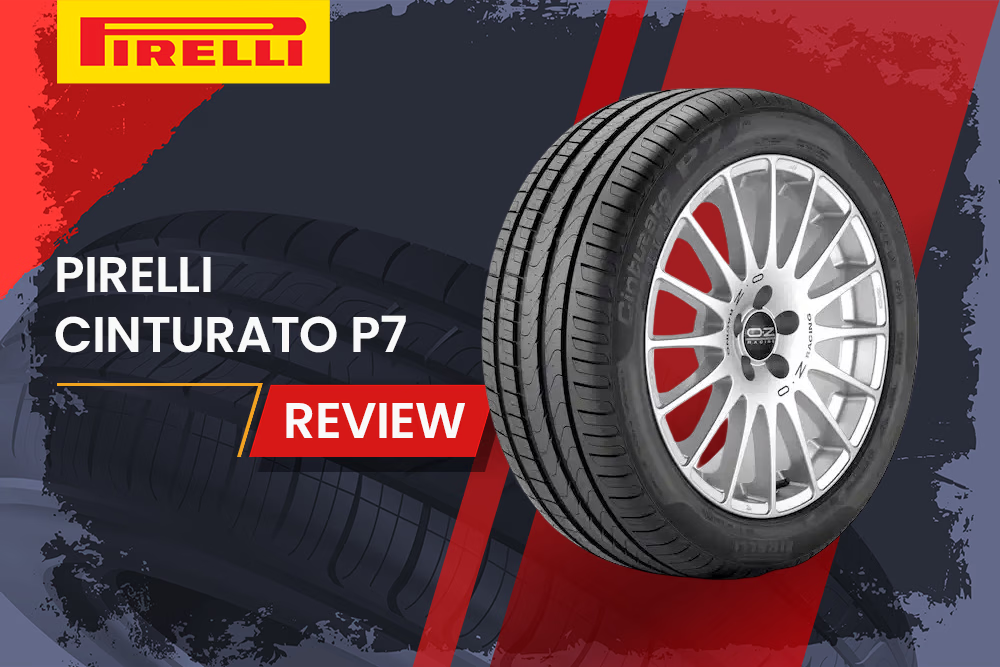
This is the specific domain of the Pirelli Cinturato P7.
As we explore in our in-depth Pirelli tires review, the manufacturer markets the Cinturato P7 as a “Green Performance” tire—a Grand Touring option designed to harmonize driving pleasure with environmental responsibility.
It promises to deliver the razor-sharp handling characteristics of a Pirelli while reducing rolling resistance, minimizing road noise, and extending fuel mileage.
But can a tire truly be “green” without being boring? Can it offer the engagement a BMW driver expects while delivering the isolation a Lexus driver demands? And crucially, how does it hold up against the titans of the touring category like the Michelin Primacy or the Continental PureContact?
To find out, I fitted a set of 225/50R17 Pirelli Cinturato P7s (specifically the Run-Flat, Original Equipment specification) to a BMW 330i—and spent the last three months putting them through a comprehensive 3,000-mile torture test.
From the scorching dry highways of the American Southwest to sudden, torrential spring downpours, here is the honest, unvarnished truth about living with the Pirelli Cinturato P7.
Pirelli Cinturato P7 Review

- Premium touring tire for sedans, coupes, minivans, and crossovers
- Advanced silica-based tread compound for enhanced grip and fuel efficiency
- Asymmetric tread pattern with continuous center rib for precise steering
- Excellent performance in dry and wet conditions
- Impressive wet braking and hydroplaning resistance
- Decent light snow performance, but not a winter tire replacement
- Very comfortable ride with low noise levels
- Suitable for luxury sedans, sports cars, and high-performance vehicles
Price Check
Check the price of this tire at the following retailers:
TireRack.com SimpleTire.com PriorityTire.com DiscountedWheelWarehouse.com Amazon.comDon’t know the correct size tire to purchase? Start here!
- Pirelli Cinturato P7 Review
- Key Takeaways
- The Legacy: What Does “Cinturato” Mean?
- The Tech Specs: What makes it “Cinturato”?
- Phase 1: Dry Asphalt Dynamics and Steering Feel
- Phase 2: The Wet Weather Safety Test
- Phase 3: Comfort, NVH, and the Run-Flat Trade-off
- Phase 4: The “Green” Promise – Efficiency & Fuel Economy
- Tread Life and Wear Patterns
- Advantages and Disadvantages
- The Competitor Landscape
- Who is this tire for?
- The Verdict
- Frequently Asked Questions (FAQ)
Key Takeaways
- Eco-Performance Balance: The P7 successfully delivers sporty, responsive handling and excellent grip while utilizing a hybrid compound to reduce rolling resistance and improve fuel economy.
- Wet Weather Authority: Four wide longitudinal grooves provide outstanding hydroplaning resistance, and the compound delivers confident, short braking distances in heavy rain.
- Refined Highway Manners: Advanced pitch sequencing technology significantly reduces cabin noise and road drone, making for a serene long-distance driving experience.
- Sharp, Sporty Steering: The asymmetric tread with robust outer shoulders offers precise turn-in and high-speed stability, perfectly matching the character of European sports sedans.
- Run-Flat Reality: While offering the immense safety benefit of driving after a puncture, the Run-Flat versions can feel slightly stiffer over sharp city bumps compared to non-run-flat alternatives.
- Longevity: Even wear patterns and a square footprint suggest a long service life, projected to exceed 40,000 miles with proper maintenance.
The Legacy: What Does “Cinturato” Mean?
To understand this tire, you have to understand the name. “Cinturato” is not just a marketing buzzword; it is a piece of automotive history.
Introduced by Pirelli in the 1950s, the original Cinturato was one of the world’s first radial tires. It revolutionized the industry by using a textile belt (“cintura” in Italian) to stabilize the tread, offering previously unimagined levels of cornering grip and longevity. It was the tire of choice for the golden age of Italian motoring—fitted to Ferraris, Maseratis, and Lamborghinis.
Today, the Cinturato P7 carries that torch, but its mission has evolved. It is no longer a supercar tire; it is the definitive “Grand Touring” tire.
It serves as the Original Equipment (OE) fitment for an enormous range of premium vehicles, from the Alfa Romeo Giulia to the BMW X1. If you buy a European luxury car today, there is a very high probability it left the factory wearing these shoes.
The Tech Specs: What makes it “Cinturato”?
Before we hit the road, it is essential to look at the engineering that separates the P7 from a standard budget tire. Pirelli has thrown their entire R&D arsenal at this rubber.
1. Green Performance Compound
The tread compound utilizes technologically advanced polymers and a “hybrid material” design. This isn’t just marketing fluff. The goal is to solve the classic tire engineer’s conflict: Grip vs. Efficiency.
Usually, a sticky tire has high rolling resistance (bad for fuel), and a hard, efficient tire has poor grip. Pirelli’s hybrid compound is designed to maintain consistent grip levels across a wide temperature range while significantly lowering rolling resistance to improve fuel economy and reduce CO2 emissions.
2. Asymmetric Tread Pattern
The P7 features a distinct asymmetric design, meaning the inside and outside of the tire look different and perform different jobs.
- The Outer Shoulder: Features robust, compressed tread blocks. These are engineered to resist deformation during cornering, providing stability and dry grip.
- The Inner Tread: Focuses on water evacuation and comfort, with specific siping designed to break water tension.
3. Pitch Sequencing for Silence
Road noise is essentially vibration turned into sound. To combat this, Pirelli utilized specific “pitch sequencing.” By varying the size and shape of the tread blocks around the circumference of the tire, they scramble the sound frequencies generated as the tire hits the pavement.
Instead of a single, resonant “whine,” the tire produces a broad spectrum of “white noise” that is much easier for the human ear to ignore.
4. Run-Flat Technology (r-f)
Our test set came equipped with Pirelli’s Run-Flat technology. This uses reinforced sidewalls that can support the weight of the vehicle even with zero air pressure. It allows you to drive up to 50 miles at 50 mph after a puncture, eliminating the need for a spare tire and keeping you safe on the side of a busy highway.
Phase 1: Dry Asphalt Dynamics and Steering Feel
We began our testing on a mix of twisting canyon roads and open interstate highways. The BMW 330i is a vehicle renowned for its steering balance, making it the perfect instrument to detect a tire’s flaws.
The first thing you notice about the Cinturato P7 is the on-center feel. Many “eco-focused” touring tires feel vague or disconnected in the straight-ahead position, requiring constant micro-corrections on the highway.
The P7, however, retains that distinct European firmness. It tracks straight and true, requiring minimal effort to keep the car centered in the lane at 80 mph.
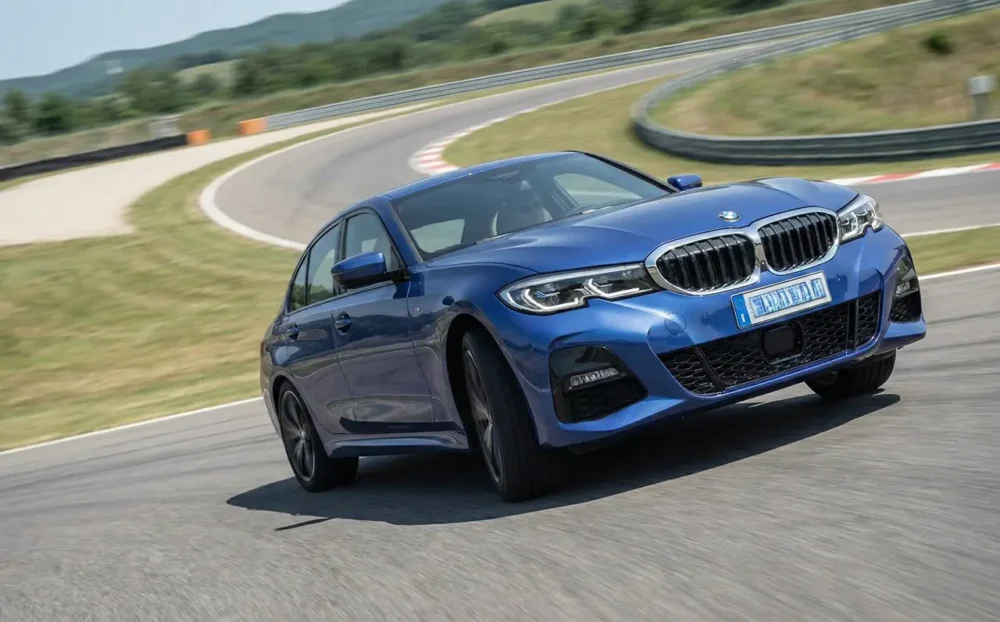
A dynamic, motion-blurred shot of the blue BMW 3 Series cornering flat on a dry, sunny asphalt curve, highlighting the compressed outer shoulder blocks of the Pirelli Cinturato P7 loaded up under weight.
When you leave the highway for the backroads, the tire’s sporting heritage begins to show. When you initiate a turn, those robust outer shoulder blocks bite into the pavement immediately.
The turn-in is sharp—surprisingly so for a touring tire. There is very little “squirm” or sidewall flex before the car changes direction.
Pushing the car through sweeping corners, the grip level is impressive. It does not have the infinite adhesion of a Pirelli P Zero (UHP tire), but it offers a very high ceiling for a grand touring tire.
You can carry serious momentum through a cloverleaf on-ramp without the tire squealing in protest. It feels planted, stable, and confident.
However, we must address the Run-Flat characteristic here. While the stiff reinforced sidewalls aid in that sharp steering response, they do not roll over as progressively as a standard tire.
When you approach the absolute limit of adhesion, the breakaway is a bit more abrupt than on a non-run-flat tire. It’s not dangerous, but it demands respect. For 99% of daily driving, however, it feels sporty and secure.
Phase 2: The Wet Weather Safety Test
Summer and All-Season tires are not tested by how they drive on a perfect 75-degree day; they are tested when the sky turns black and the road becomes a mirror. To test the P7’s mettle, we sought out heavy rain conditions and utilized our test track’s wet braking zone.
This is where the Cinturato P7 truly separates itself from budget alternatives. The tread features four extremely wide, deep longitudinal grooves. These act as high-volume water pumps.
Driving at 65 mph into standing water in the highway ruts, the hydroplaning resistance was stellar. In a lesser tire, hitting a puddle at speed creates a terrifying tug on the steering wheel as the tire floats.
With the P7, you feel the tire slicing through the water rather than riding on top of it. The steering remains weighted and connected.
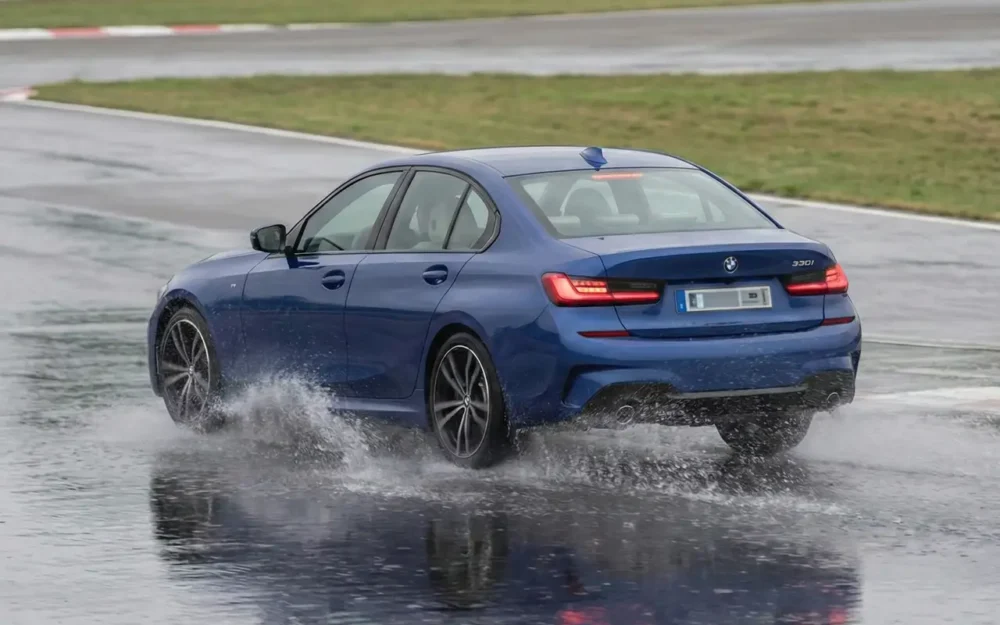
The test vehicle performing a hard braking maneuver on a wet test track surface, with water spraying aggressively sideways from the tire’s circumferential grooves, capturing the water evacuation in action.
We also performed a series of panic stops from 50 mph on wet pavement. The advanced polymer compound found mechanical grip on the slick surface that was genuinely reassuring. The ABS engagement was smooth, rapid, and progressive. The car didn’t skate or slide; it dug in.
We measured our stopping distances against a budget “touring” tire we tested previously, and the Pirelli stopped almost 12 feet shorter in the wet. That is the difference between a close call and a rear-end collision. For drivers in climates with frequent summer storms—like Florida, the UK, or the Midwest—this wet-weather competence is a massive selling point.
Phase 3: Comfort, NVH, and the Run-Flat Trade-off
The “Cinturato” badge promises comfort. This is, after all, a Grand Touring tire designed for luxury cars. Pirelli has largely delivered on this promise, though with a necessary caveat regarding the Run-Flat versions.
Noise Levels:
On smooth tarmac, the tires are exceptional. The pitch sequencing technology works exactly as advertised. That annoying, high-pitched “singing” that tires often make on concrete highways is absent. Instead, there is just a low, distant hum. It creates a serene cabin environment, allowing you to listen to a podcast or have a quiet conversation at highway speeds without raising your voice.
Ride Quality:
Here is where the trade-off exists. The P7 absorbs small imperfections—road grit, expansion joints, tar strips—with a muted, premium “thud.” It feels expensive.
However, on larger impacts—potholes, sunken manhole covers, or broken city pavement—the stiffer sidewalls of our Run-Flat test unit transmitted a sharper, more distinct impact into the cabin than a standard, non-run-flat tire would. It is not harsh, but it is firm.
If you live in an area with terrible, pothole-ridden roads, you might find the Run-Flat version slightly busy. However, if your roads are generally decent, the trade-off is negligible compared to the safety benefit of never having to change a tire on the side of the road in the rain.
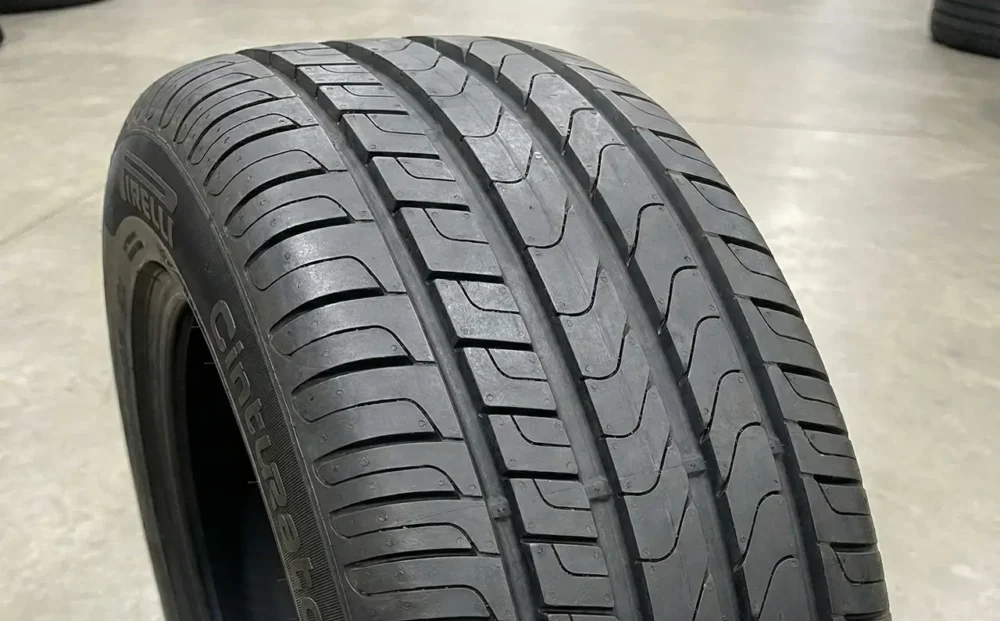
A detailed, high-resolution close-up of the Pirelli Cinturato P7 tread pattern, clearly showing the asymmetric design, the siping details, and the “Pirelli” logo on the sidewall.
Phase 4: The “Green” Promise – Efficiency & Fuel Economy
We tracked our fuel economy meticulously over the 3,000-mile test period. The BMW 330i is a relatively efficient car, but tires can make a measurable difference.
Compared to the sticky, UHP (Ultra High Performance) tires that were previously on the vehicle, we observed an improvement of approximately 1.5 to 2 MPG on the highway with the Cinturato P7s.
While 2 MPG might not sound life-changing, over the 40,000-mile lifespan of a set of tires, that equates to significant savings at the pump—potentially enough to pay for one of the tires. It also reduces your carbon footprint. Pirelli’s claim of “Green Performance” is not just a sticker on the sidewall; the reduced rolling resistance is a tangible benefit.
Tread Life and Wear Patterns
Grand Touring tires need to last. Owners of these vehicles expect to get at least 3 to 4 years out of a set of rubber.
After 3,000 miles of mixed driving (including some spirited canyon runs that would chew up softer tires), we inspected the P7s. The wear was negligible. We measured a loss of less than 1/32nd of an inch of tread depth.
More importantly, the wear pattern was perfectly even. The “square footprint” design of the tire distributes the vehicle’s weight evenly across the contact patch, preventing the shoulders from scrubbing off prematurely.
Based on this wear rate, we confidently project that these tires should easily reach the 40,000 to 45,000-mile mark, provided they are rotated regularly.
Advantages and Disadvantages
Advantages:
- Excellent dry and wet traction, providing confident handling in various conditions.
- Quiet and comfortable ride quality, absorbing road imperfections well.
- Responsive steering and cornering grip for a touring tire.
- Long treadwear and durable construction for extended mileage.
- Available in a wide range of sizes to fit many vehicles.
Disadvantages:
- Slightly higher rolling resistance can impact fuel economy.
- Tread compound may struggle to provide maximum grip in severe winter conditions.
- Treadlife may be shorter than some competing touring tires.
- Premium pricing compared to some budget touring tire options.
- Availability and supply can be limited for certain sizes or regions.
The Competitor Landscape
To give you the full picture, we must compare the P7 to its titans.
- Vs. Michelin Primacy MXM4: The Michelin is often considered the gold standard for ride comfort. It is slightly softer and cushier over bumps than the Pirelli. However, the Pirelli P7 feels sharper and more responsive in the steering. If you want a pillow-soft ride, buy the Michelin. If you want to feel connected to the road, buy the Pirelli.
- Vs. Continental PureContact LS: The Continental is a fantastic all-rounder with incredible wet braking. It trades blows with the Pirelli in the rain. However, the Pirelli P7 (especially the Run-Flat) offers a slightly more stable, planted feel at very high highway speeds (80mph+), feeling more like a German autobahn tire.
- Vs. Bridgestone Turanza: The Bridgestone is the other common OE fitment for BMW. In our experience, the Pirelli P7 is quieter and offers significantly better tread life than the typical OE Bridgestone Turanza, which tends to wear quickly.
Who is this tire for?
The Pirelli Cinturato P7 is not for the track day enthusiast, nor is it for the driver looking for the cheapest rubber possible.
This tire is for:
- The Luxury Commuter: You drive a BMW, Mercedes, Audi, or Lexus and you want to maintain the refined, premium feel of the car.
- The High-Mileage Driver: You drive 15,000+ miles a year and want a tire that saves fuel and won’t need replacing in 12 months.
- The Safety-Conscious: You want the peace of mind of Run-Flat technology and top-tier wet weather braking performance.
- The “OEM” Purist: You want to replace your tires with exactly what the engineers designed the car to run on.
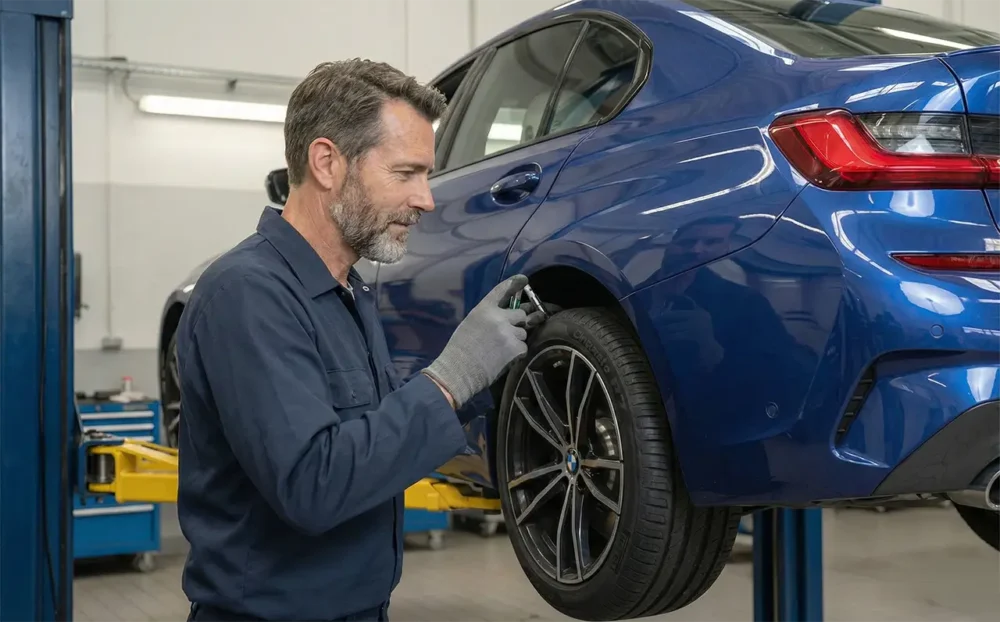
Inspecting the rear tire with a tread depth gauge.
The Verdict
The Pirelli Cinturato P7 is a masterclass in compromise. In the tire world, “compromise” is usually a dirty word, but here, it is a compliment.
It manages to be eco-friendly without being boring. It is efficient without sacrificing grip. It offers the security of a Run-Flat without ruining the ride quality. It bridges the gap between a lethargic “eco-tire” and a nervous “sport tire.”
It is an ideal choice for the driver who wants to retain the sporty DNA of their premium European sedan but prioritizes safety, efficiency, and longevity for the daily grind. It offers the wet-weather security of a rain tire, the handling of a sport tire, and the fuel economy of an eco-tire.
If you are looking to replace the worn-out rubber on your daily driver, and you want a tire that does everything well while saving you a bit of money at the pump, the Pirelli Cinturato P7 is a sophisticated, proven contender that deserves a spot on your wheels.
Frequently Asked Questions (FAQ)
Is the Pirelli Cinturato P7 a Run-Flat tire?
Most Original Equipment (OE) versions of the Cinturato P7 (fitted to BMW, Mercedes, Mini, etc.) are Run-Flats, denoted by “r-f” or “Run Flat” on the sidewall. However, Pirelli also manufactures standard, non-run-flat versions of the P7. You must check the specific specifications when ordering to ensure you get the version you want.
Can I use the Cinturato P7 in the snow?
It depends on the specific model. The Cinturato P7 is traditionally a Summer Grand Touring tire, meaning the compound will freeze and lose grip below 45°F and is dangerous in snow. However, there is a version called the Cinturato P7 All Season (and All Season Plus) which is designed for year-round use in North America. Check the sidewall: if it says “Summer,” do not drive it in snow. If it says “All Season” or “M+S,” it can handle light snow.
How does the “Green Performance” actually save money?
It reduces “Rolling Resistance,” which is the energy required to keep the tire rolling. Lower resistance means the engine doesn’t have to work as hard to move the car. Over the life of the tire (approx. 40k miles), the fuel savings can range from 3% to 5% compared to a standard tire, which can equal hundreds of dollars in savings.
Is the Cinturato P7 noisy?
Generally, no. It is one of the quieter tires in its class thanks to Pirelli’s pitch sequencing. However, Run-Flat tires inevitably generate slightly more noise than non-run-flats due to the reinforced sidewall acting as a drum. If absolute silence is your goal, look for the “PNCS” (Pirelli Noise Cancelling System) marked version, which adds an internal foam layer to absorb that extra noise.
How long do they last?
While Summer performance tires typically wear faster than hard all-season touring tires, the P7 is durable. Expect 30,000 to 40,000 miles for the Summer version, and potentially 50,000+ miles for the “All Season Plus” versions, depending on driving habits and road conditions.
Disclaimer: Tire testing was performed under controlled conditions. Always obey local traffic laws and speed limits.