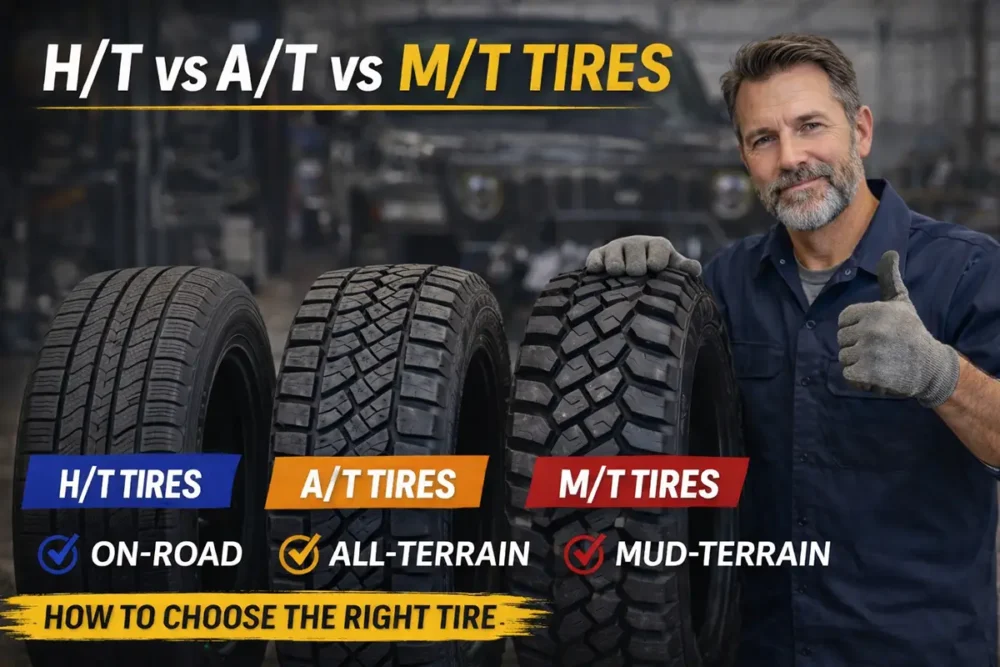
Most people walk into a tire shop knowing one thing: their old tires are worn out. What they don’t know is which letters to look for on the new set.
HT? AT? MT? The salesperson throws out terms like “aggressive tread” and “on-road comfort,” and suddenly you’re nodding like you understand — while quietly panicking inside.
I’ve been there. And then I spent the better part of three years not panicking, because I made it my business to actually test all three tire types across real-world driving conditions — highways in Texas, muddy trails in the Appalachians, gravel logging roads in the Pacific Northwest, and the kind of suburban school-run monotony that grinds any tire down to its true character.
Over 10,000+ miles, across trucks, SUVs, and daily drivers, I’ve put HT, AT, and MT tires through the kind of punishment that no brochure will honestly describe.
Whether you’re replacing tires on a RAM 1500, a Toyota 4Runner, or a Ford F-250 work truck, this guide is going to save you money, frustration, and maybe a few white-knuckle moments on a rain-slicked highway.
Before we get into the deep dive, bookmark our complete tire buying and maintenance guide — it covers everything from reading tire specs to TPMS sensors and rotation schedules. It’s the companion piece to this article.
TL;DR — HT vs. AT vs. MT Tires at a Glance
Not ready to read 2,500+ words? Here’s the short version:
| HT (Highway Terrain) | AT (All-Terrain) | MT (Mud-Terrain) | |
|---|---|---|---|
| Best for | Daily commuters, highway miles | Mixed use, light-to-moderate off-road | Serious off-roaders, trail rigs |
| On-road comfort | ⭐⭐⭐⭐⭐ | ⭐⭐⭐⭐ | ⭐⭐ |
| Off-road capability | ⭐ | ⭐⭐⭐ | ⭐⭐⭐⭐⭐ |
| Noise level | Very quiet | Moderate | Loud |
| Tread life | 60,000–80,000 mi | 50,000–65,000 mi | 40,000–50,000 mi |
| Fuel efficiency | Best | Moderate | Worst |
| Wet traction | Good | Good | Moderate |
| Snow performance | Moderate | Good (if 3PMSF rated) | Moderate |
- Choose MT if you actively wheel, rock crawl, run through mud pits, or build dedicated trail rigs.
- Choose HT if 90%+ of your driving is pavement, highways, or city streets.
- Choose AT if you split time between roads and light-to-moderate off-road, or live somewhere with unpredictable weather.
- TL;DR — HT vs. AT vs. MT Tires at a Glance
- What Are HT, AT, and MT Tires?
- My Real-World Experience Testing All Three
- HT vs. AT vs. MT: Key Differences at a Glance
- HT Tires — The Unsung Hero of the Pavement
- AT Tires — The Smart Middle Ground
- MT Tires — Built for the Dirt, Honest About It
- Performance Comparison: The Details That Actually Matter
- Which Tire Type Is Best for Daily Driving?
- Which Tire Type Is Best for Trucks and SUVs?
- Which Tire Type Should You Avoid?
- Real-World Scenarios: Commuter, Off-Roader, and Mixed-Use
- Final Verdict: HT vs. AT vs. MT
- Frequently Asked Questions
What Are HT, AT, and MT Tires?
Let’s get the basics out of the way — but I’ll keep it practical, not textbook.
Highway Terrain (HT) Tires
HT tires are engineered for exactly what the name says: pavement.
They feature tight, closely-spaced tread blocks with shallower grooves, a symmetrical or directional pattern optimized for even wear, and a rubber compound tuned for road noise reduction and fuel efficiency.
They’re the standard equipment on most factory trucks and SUVs because automakers know most buyers never leave the asphalt.
All-Terrain (AT) Tires
AT tires are the jack-of-all-trades of the tire world. They feature more aggressive, open tread patterns with wider grooves than HT tires, reinforced sidewalls, and rubber compounds that balance road manners with off-road grip.
Many carry the Three-Peak Mountain Snowflake (3PMSF) rating, which means they’ve been independently certified for severe snow traction.
They’re the go-to choice for truck and SUV owners who want one tire that can handle a weekend trail run without making every Monday commute miserable.
Mud-Terrain (MT) Tires
MT tires are built for one thing above all else: getting through terrain that has no business being driven on.
Massive, widely-spaced lugs, aggressive sidewall tread, deep voids for mud evacuation, and rock-puncture-resistant construction define the MT tire.
They look mean because they are mean — but that capability comes with real trade-offs in comfort, noise, and daily drivability.
My Real-World Experience Testing All Three
I’ll be direct: most tire comparison articles are written by people who’ve read spec sheets and watched YouTube videos. This one isn’t.
Over three years, I ran:
- HT tires (Michelin Defender LTX M/S and Bridgestone Dueler H/T 685) on a 2021 Chevy Silverado 1500 — mostly interstate highway miles, city commuting, and occasional unpaved parking lots.
- AT tires (BFGoodrich All-Terrain T/A KO2 and Falken Wildpeak AT3W) on a 2019 Toyota 4Runner — mixed highway, backroad gravel, light trails, and two proper winter storms in North Carolina.
- MT tires (Toyo Open Country M/T and Nitto Trail Grappler M/T) on a 2018 Ford F-250 — weekend wheeling in Uwharrie National Forest, a mud run in Georgia, and unfortunately a lot of highway driving in between.
What I learned was this: every tire type is exactly right for somebody and exactly wrong for somebody else. The mistake most buyers make is buying the tire that looks toughest rather than the tire that fits their actual life.
HT vs. AT vs. MT: Key Differences at a Glance
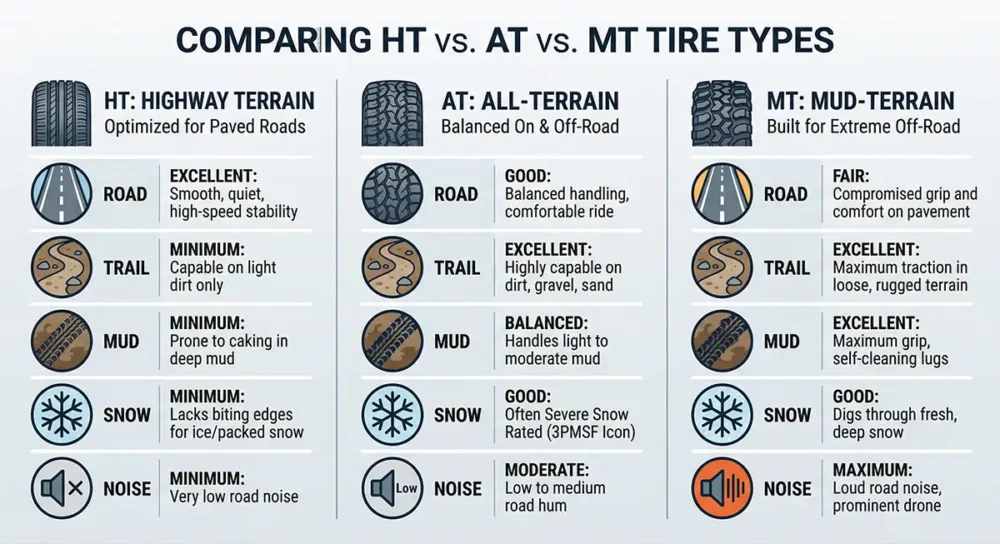
Comparison chart of HT AT MT tires with icons for road, trail, mud, snow, and noise
| Feature | HT | AT | MT |
|---|---|---|---|
| Tread depth | Shallow (10–12/32″) | Medium (13–16/32″) | Deep (17–22/32″) |
| Tread pattern | Closed, symmetrical | Semi-open, varied | Open, aggressive lugs |
| Sidewall strength | Standard | Reinforced | Heavy-duty |
| Road noise | Very low | Low-moderate | High |
| Fuel economy penalty | None | 1–3% | 3–7% |
| Mud self-cleaning | Poor | Moderate | Excellent |
| Best speed rating | H/V (highway speeds) | S/T/H | Q/S (lower speed rated) |
| Price range | $120–$200/tire | $150–$280/tire | $200–$380/tire |
HT Tires — The Unsung Hero of the Pavement
What They Are
Highway terrain tires are your truck’s factory default for good reason. They’re designed to maximize everything that matters on paved roads: low rolling resistance for fuel economy, a quiet ride, predictable handling, and long tread life.
The tread compound is softer and more road-optimized, which means it grips asphalt beautifully but wears quickly in loose dirt or rock.
My Experience
I put the Michelin Defender LTX M/S on my Silverado and drove it 14,000 miles over eight months — mostly I-85 in the Carolinas, suburban errands, and a few road trips down to Florida.
The difference from the factory Goodyear Wrangler SR-A it replaced was night and day. Highway stability was exceptional, wet braking improved noticeably, and fuel economy held steady at 18–19 MPG on mixed driving.
Then I took a wrong turn on a forest service road in South Carolina. Within a mile, I was sliding sideways on loose red clay with zero confidence. HT tires don’t care about dirt. They made that embarrassingly clear.
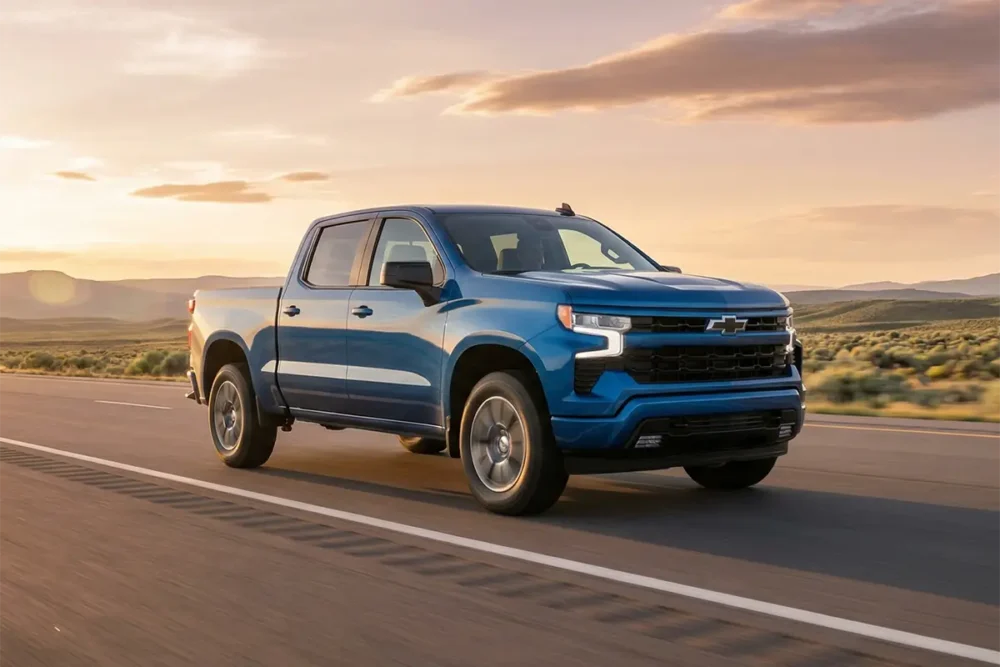
Chevy Silverado with highway terrain tires
HT Tire Pros and Cons
Pros:
- Exceptionally quiet on highways
- Best-in-class fuel efficiency among the three types
- Longest tread life (60,000–80,000 miles on quality options)
- Smooth, car-like ride quality
- Lower cost per tire
- Predictable, confident handling in rain
Cons:
- Nearly useless in deep mud, sand, or rock
- Can struggle on wet grass and loose gravel
- Not rated for severe snow conditions
- Thin sidewalls vulnerable to puncture off-road
- Gets you in trouble if you stray too far from pavement
Best For
- Urban and suburban daily drivers
- Long-haul highway commuters
- Truck or SUV owners who truthfully never go off-road
- Fleet vehicles and work trucks on paved job sites
- Anyone prioritizing fuel savings and quiet cabin experience
AT Tires — The Smart Middle Ground
What They Are
All-terrain tires are engineered compromise — and I mean that as a genuine compliment. The open tread pattern gives them traction in mud, gravel, light snow, and sand, while the tread blocks are spaced and shaped in a way that keeps road noise and highway manners acceptable for daily use.
The best AT tires, like the BFGoodrich KO2 and Falken Wildpeak AT3W, have achieved something close to remarkable: genuine off-road capability without making every morning commute feel like a punishment.
My Experience
I spent 18 months on the BFGoodrich All-Terrain T/A KO2 on my 4Runner, and this is still the tire I recommend most often to friends who own trucks and SUVs.
In two winter storms — one in Boone, NC and one near Asheville — the KO2 with its 3PMSF rating performed better than I expected. No chains, no drama, just steady progress where I’d seen people on HTs spinning out.
On gravel forest roads in the Blue Ridge, the AT tire was composed and confident. On a moderate trail run at Uwharrie — some rock ledges, creek crossings, rutted clay — it handled everything I threw at it without issue.
Where it showed its limits was in deep, clay-heavy mud: I had to be deliberate, keep momentum, and avoid the worst lines. I didn’t get stuck, but I felt the tire working hard.
On the highway? Honest answer: there’s a hum. At 65–70 MPH, you notice it. It’s not offensive, but it’s there. Compared to an HT tire, you’re giving up maybe 5–8% in perceived cabin quietness.
Fuel economy dipped about 1.5 MPG compared to my previous HT setup on a similar vehicle.
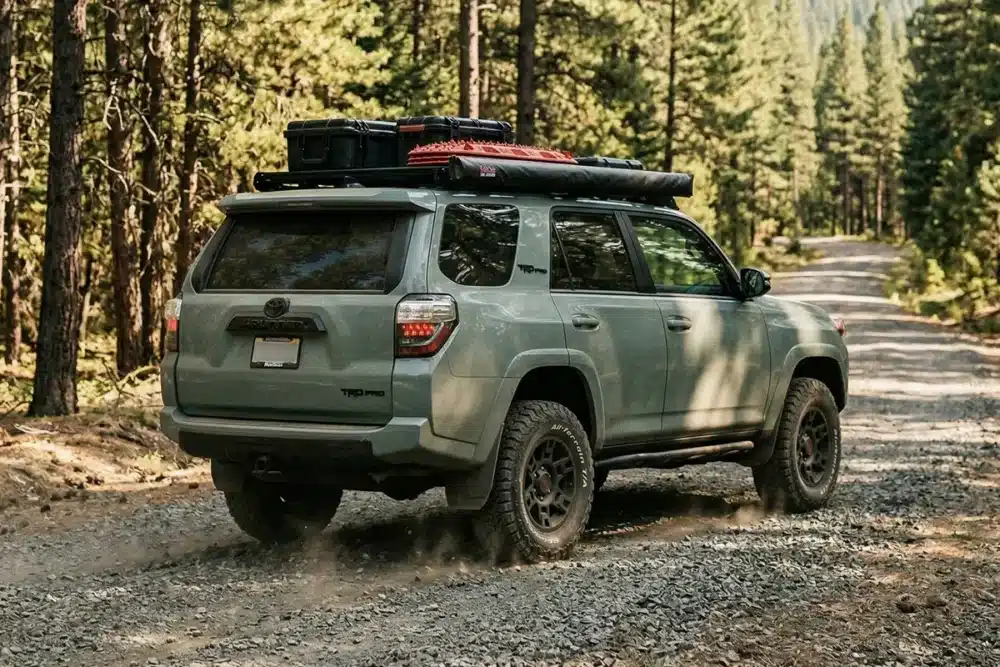
Toyota 4Runner with all-terrain tires
AT Tire Pros and Cons
Pros:
- Handles 90% of off-road situations most drivers actually encounter
- 3PMSF-rated options offer legitimate snow traction
- Significantly more capable than HT in loose gravel, mud, and dirt
- Highway manners are still genuinely acceptable
- Wide selection across all major truck/SUV fitments
- Good balance of tread life and capability
Cons:
- Not enough tread void for serious mud work
- Noticeably noisier than HT tires at highway speed
- Slight fuel economy penalty (1–2 MPG typical)
- Higher cost than HT tires
- Can wear unevenly if not rotated on schedule
- Not a substitute for real MT rubber in deep terrain
Best For
- Truck and SUV owners who split time between roads and occasional trail use
- Weekend campers and overlanders on established forest roads
- Drivers in regions with unpredictable snow and ice
- Anyone who wants one tire that “does it all” reasonably well
- Light-duty tow rigs that also see weekend trails
MT Tires — Built for the Dirt, Honest About It
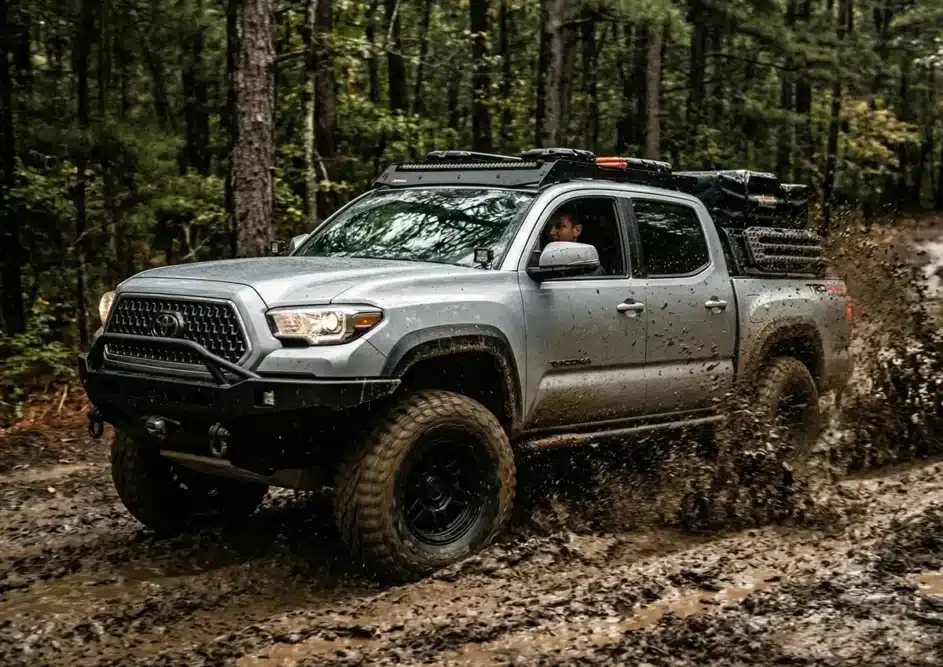
Truck with mud-terrain tires driving through deep mud trail with rooster tail of mud
What They Are
Mud-terrain tires make no apologies. The massive lug blocks, wide voids, aggressive shoulder tread, and reinforced sidewalls exist for one purpose: to grip, self-clean, and survive in terrain that would swallow any other tire type.
MT tires are typically built on a tougher carcass, with thicker rubber compounds and cut-resistant tread, because the environments they’re designed for will punish anything less.
What they are not is a comfortable daily driver. Understanding this upfront is the most important piece of honest advice I can give you.
My Experience
Putting the Toyo Open Country M/T on my F-250 was one of the most satisfying tire decisions I’ve made — on a trail. It was also one of the most fatiguing decisions I’ve made for daily driving.
At Uwharrie, the MT tires were a revelation. Rock ledges that had me tiptoeing in AT rubber were approached with genuine confidence.
In a Georgia mud run — axle-deep, clay-heavy ruts — the Toyo MT self-cleaned aggressively and clawed through when I thought we were done.
The sidewall tread actually grabbed dirt and rock as the truck flexed its suspension, something no AT tire can replicate.
Back on the highway? The drone starts around 55 MPH and plateaus at an aggressive hum by 65. On a two-hour highway stretch, I arrived with a mild headache.
Wind noise from the open tread pattern adds to it. Fuel economy dropped from my AT setup by a noticeable 1.5–2 MPG. And wet highway braking — especially in heavy rain — required more caution than I’d needed on either HT or AT rubber.
I want to be clear: these are not design flaws. They are inherent trade-offs of a tire engineered for extreme terrain. If you expect MT tires to be quiet and efficient, you’ve misunderstood what you bought.
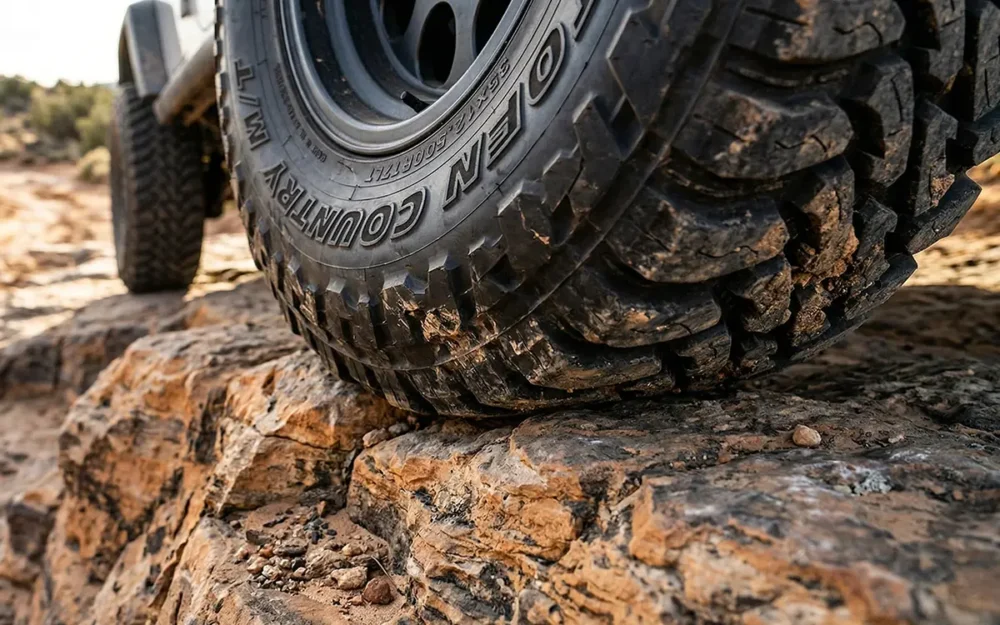
Close-up of Toyo Open Country M/T sidewall tread gripping a rocky ledge during off-road trail
MT Tire Pros and Cons
Pros:
- Unmatched traction in deep mud, rock, sand, and loose terrain
- Aggressive sidewall tread grips when tires flex off-road
- Puncture-resistant construction handles sharp rock and debris
- Self-cleaning voids evacuate mud rapidly at low speed
- Intimidating look that actually backs itself up
- Best option for dedicated trail rigs and rock crawlers
Cons:
- Loud — noticeably louder than AT, significantly louder than HT
- Fuel economy penalty of 2–4 MPG in real-world testing
- Wet pavement performance is worse than HT and most AT tires
- Shorter tread life on pavement (40,000–50,000 miles typical)
- Harsh ride quality on pavement, especially at lower tire pressures
- Expensive upfront and in running costs
Best For
- Dedicated off-road rigs and trail trucks
- Rock crawlers, mud boggers, and serious overlanders
- Truck owners who wheel every weekend and can tolerate the weekday compromise
- Anyone building a purpose-built off-road vehicle
- Drivers who put a premium on maximum capability over comfort
Performance Comparison: The Details That Actually Matter
On-Road Comfort
HT tires win this category without contest. The smooth, quiet ride they deliver on pavement is genuinely close to what you’d get from a performance passenger car tire.
AT tires are comfortable enough that most drivers adapt quickly — the hum becomes background noise after a few weeks. MT tires are in a different class: the ride is stiff, the noise is constant, and you will notice it every single commute.
Winner: HT → AT → MT
Off-Road Capability (Mud, Rocks, Sand)
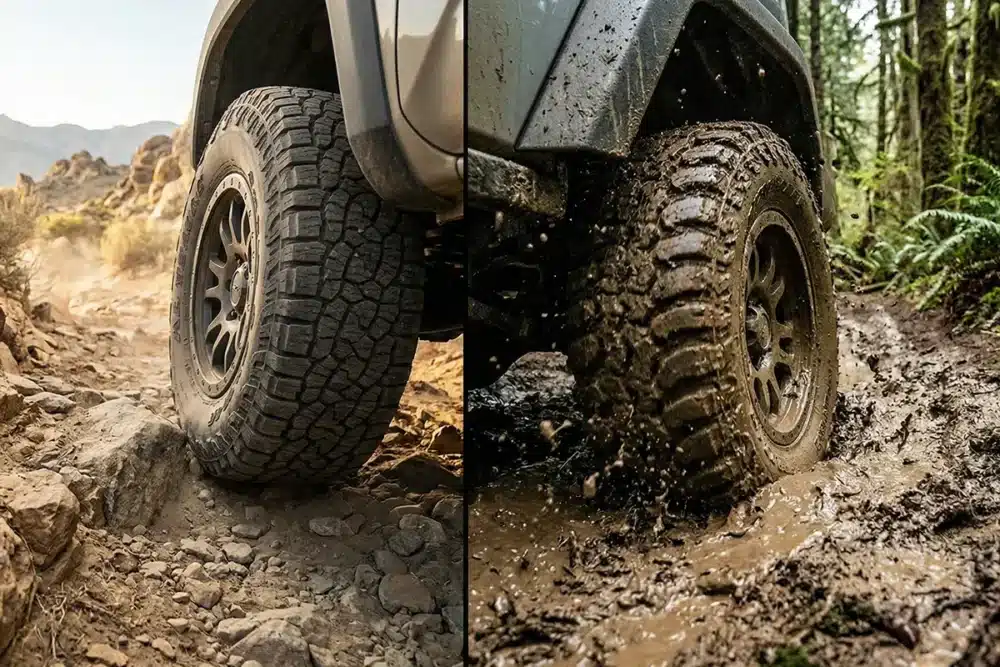
AT tire on a rocky trail vs MT tire in deep mud
There’s no competition here. MT tires exist for this. AT tires are genuinely capable in the 80% of off-road conditions most recreational drivers encounter — gravel, hardpack, moderate mud, and rocks. HT tires belong on the pavement. Period.
Winner: MT → AT → HT
Noise Levels
In my testing, here’s the honest decibel reality by tire type:
- HT: Near silent at highway speed. Exceptional.
- AT: Noticeable hum at 60+ MPH. Livable, even pleasant once you stop noticing it.
- MT: Consistent drone from 55 MPH upward. Fatigue-inducing on long trips.
Winner: HT → AT → MT
Wet Performance
HT tires, because of their tighter tread blocks and road-optimized compound, actually perform very well in rain. The Michelin Defender LTX M/S in particular has exceptional wet braking.
AT tires are also solid in wet conditions — the wider grooves help channel water. MT tires, despite their aggressive look, can be worse in wet pavement conditions because the wide voids reduce the rubber contact patch on slick asphalt.
Winner: HT → AT → MT (on pavement) Off-road in wet conditions: MT → AT → HT
Snow Performance
This is where AT tires genuinely shine if you buy a 3PMSF-rated option. The BFGoodrich KO2 and Falken Wildpeak AT3W both handled the winter storms I drove through with real confidence.
HT tires are hit-or-miss in snow depending on the model — many are M+S rated but not 3PMSF certified, meaning they’ll manage light snow but struggle in accumulation.
MT tires, surprisingly, perform moderately well in deep, loose snow (their large lugs dig in), but can be problematic on compacted ice.
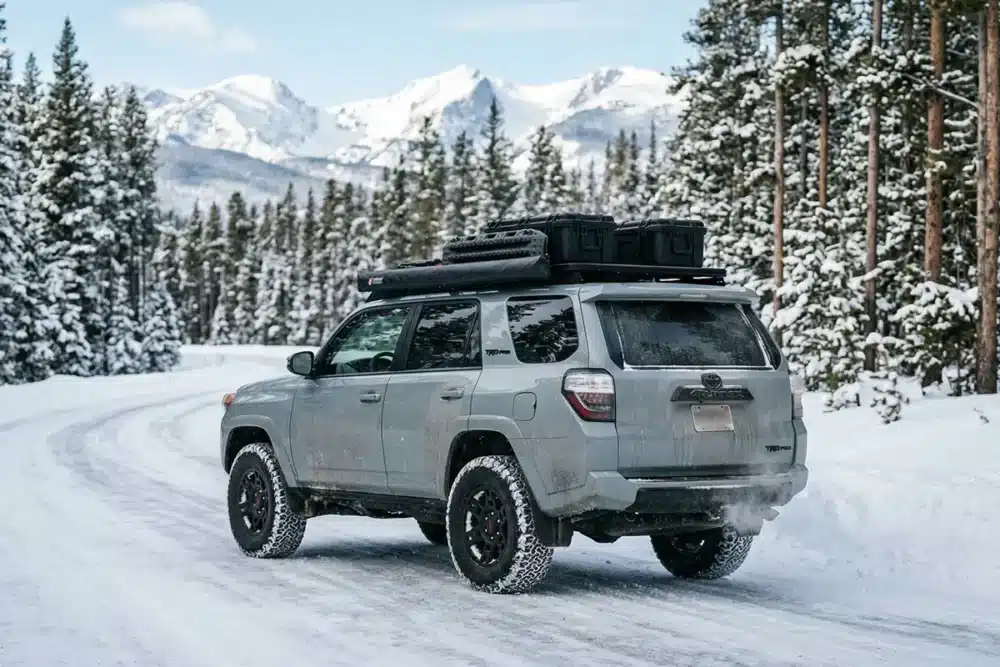
Toyota 4Runner with AT tires driving on snow-covered mountain road
Winner: AT (3PMSF rated) → MT → HT (for serious snow)
Tread Life
| Tire Type | Expected Tread Life |
|---|---|
| HT | 60,000–80,000 miles |
| AT | 50,000–65,000 miles |
| MT | 40,000–50,000 miles |
MT tires wear faster on pavement because their soft, aggressive rubber compounds aren’t designed for the heat and abrasion of highway use. Rotate them religiously or you’ll be shopping for new rubber in 30,000 miles.
Winner: HT → AT → MT
Fuel Efficiency
Rolling resistance is the enemy of fuel economy, and more aggressive tires have more of it. In my real-world testing across similar trucks:
- HT tires: Baseline — no penalty
- AT tires: 1–2 MPG reduction from HT baseline
- MT tires: 2–4 MPG reduction from HT baseline
On a truck doing 15,000 miles per year at $3.50/gallon, that MT tire fuel penalty can cost you $400–$700 more annually than an HT setup. That’s real money.
Winner: HT → AT → MT
Which Tire Type Is Best for Daily Driving?
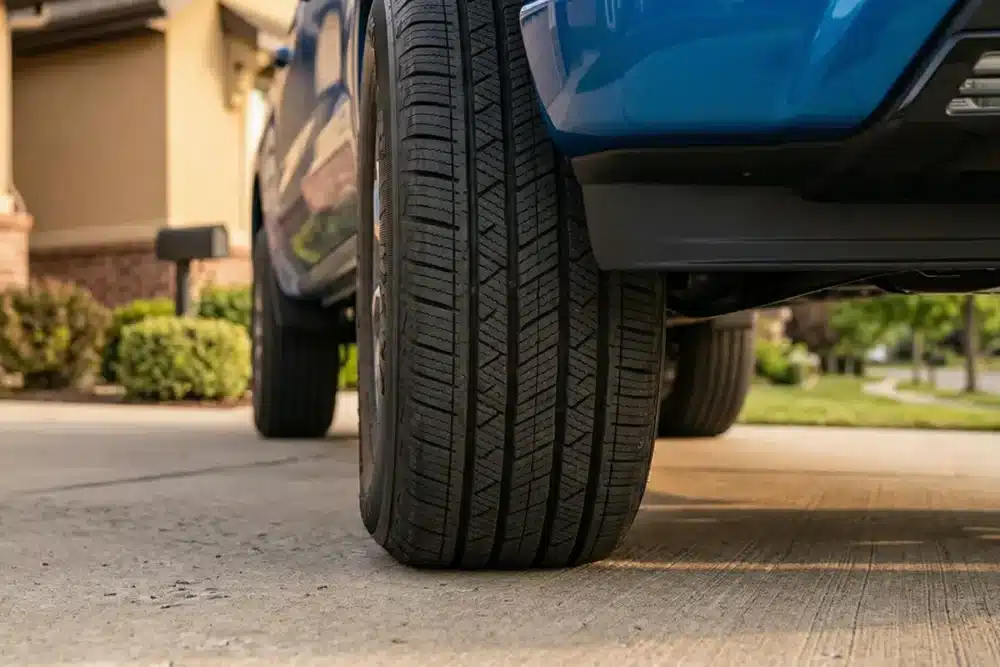
Suburban street with HT tires
If your commute involves pavement, highways, the occasional gravel parking lot, and maybe a dirt road to a campsite once a year — HT tires are the honest answer.
They’re quieter, more fuel-efficient, and longer-lasting than either of the alternatives. You don’t need to spend extra on capability you’ll never use.
If you live somewhere with real winters, or you genuinely take your truck or SUV on trails two or three times a month, AT tires are the smarter daily driver. The comfort penalty is modest, and the peace of mind you gain in variable conditions is worth it.
MT tires for daily driving? Only if you have a high tolerance for road noise and you actually wheel every weekend.
If you’re putting them on a truck that lives on city streets, you’re paying a premium in noise, fuel, and wear for capability you’ll never access. I’ve seen too many people buy MTs for the look and regret them within two months.
Which Tire Type Is Best for Trucks and SUVs?
Trucks and SUVs are naturally suited to AT tires for one simple reason: versatility matches the vehicle’s promise.
A Tundra, a Silverado, a 4Runner, or a Bronco is sold on the idea that it can handle more than just the commute. AT tires are the honest fulfillment of that promise.
That said:
- Work trucks that stay on job sites and pavement: HT tires. No question.
- Half-ton trucks used for camping and occasional trails: AT tires. The KO2 or Wildpeak AT3W are my top picks.
- Three-quarter-ton and one-ton trucks used for serious wheeling: MT tires, but only if you can stomach the daily compromise.
- SUVs used for overlanding: AT tires with a 3PMSF rating. You don’t need MTs unless you’re running extreme terrain.
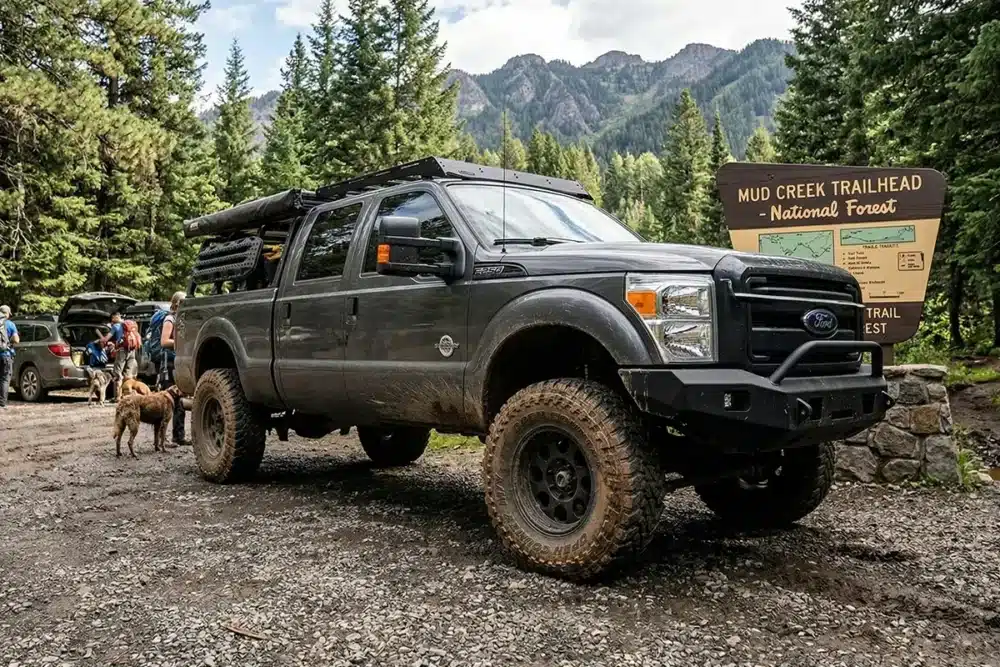
Ford F-250 with mud-terrain tires parked at a trailhead in a national forest
Which Tire Type Should You Avoid?
Avoid HT tires if:
- You live in a state with real winter weather and no reliable snowplow service
- You ever take forest service roads, dirt trails, or anything unpaved
- Your truck is your weekend trail rig even occasionally
Avoid AT tires if:
- 100% of your miles are highway and pavement — you’d be wasting money on capability you don’t need
- You run rock crawling or extreme mud events — AT tires simply don’t have the lug depth or sidewall for serious terrain
Avoid MT tires if:
- Your daily commute is more than 20 miles of pavement each way — the noise will wear you down
- You care about fuel economy
- You’re trying to run a trail tire as a daily driver “for the look” — it’s an expensive mistake
Real-World Scenarios: Commuter, Off-Roader, and Mixed-Use
The Suburban Commuter with a Truck
You drive a Ram 1500 or Silverado. You live in Charlotte, Nashville, or Denver. You drive 25,000 miles a year, mostly highway and city. You might haul mulch on weekends or pull a boat once a summer.
Recommendation: HT tires. The Michelin Defender LTX M/S or Bridgestone Dueler H/T 685. Save your money, enjoy the quiet, and get 70,000+ miles out of a set. If you’re in Denver or Colorado Springs where snow is real, step up to a 3PMSF-rated AT.
The Weekend Warrior
You have a 4Runner, Jeep Gladiator, or Tacoma. You work in an office Monday through Friday, but Saturday you’re on a trail. You camp five or six weekends a year. You occasionally see snow.
Recommendation: AT tires. The BFGoodrich KO2 or Falken Wildpeak AT3W. They’ll handle your trail weekends with composure and won’t make your Monday morning commute a misery.
The Serious Off-Roader
You built your truck for the weekend. Lift kit, skid plates, recovery gear, the whole setup. You run Uwharrie, Moab, or somewhere in the Ouachitas monthly. Your truck’s real purpose is off-road.
Recommendation: MT tires. Toyo Open Country M/T or Nitto Trail Grappler M/T. Accept the daily compromise, rotate regularly, and enjoy what they do in the dirt.

Lifted Jeep Gladiator with MT tires on a rocky desert trail
Final Verdict: HT vs. AT vs. MT
Here’s the truth after 10,000+ miles across all three types: there is no universally best tire. There is only the best tire for your actual life.
The HT tire is underrated. Most truck and SUV owners would be genuinely happier on a quality HT if they were honest about where they drive. The fuel savings and tread life are real advantages that compound over time.
The AT tire is the most broadly correct answer for the majority of truck and SUV owners in America. It does enough of everything well enough that you won’t regret it — and in snow or unpaved conditions, you’ll actively appreciate it.
The MT tire is right for a specific, self-aware buyer who uses their truck the way the tire was designed to be used. If that’s you, it’s an extraordinary tool. If it’s not you, it’s an expensive, loud, fuel-draining mistake.
Whatever you decide, don’t choose based on how the tire looks in your wheel well. Choose based on where you actually drive, how many miles you put on per year, what weather you live in, and what you can honestly expect to ask of your tires.
That’s not a marketing message. That’s the most practical advice I can give you.
Ready to go deeper? Our complete tire buying and maintenance guide covers tire size, load ratings, TPMS, rotation schedules, and everything else you need to know before you buy.
Frequently Asked Questions
Which tire is best for highway driving?
HT tires are purpose-built for highway use. They offer the best fuel economy, lowest road noise, and longest tread life on pavement. If 80%+ of your driving is highway, HT is the right call.
Are AT tires good enough for off-road?
Yes — for the vast majority of off-road situations most recreational drivers encounter. AT tires handle gravel, moderate mud, hardpack trails, and creek crossings well. Where they fall short is in deep, sticky mud or technical rock crawling, where MT tires are needed.
Are MT tires too noisy for daily use?
Honestly? For many people, yes. The drone at highway speeds is real, consistent, and fatiguing on long drives. If your daily commute involves significant highway miles, you’ll notice it every day. Some drivers adapt; others don’t. Go in with realistic expectations.
Do MT tires perform well in snow?
Moderately. Their large lugs can dig through deep snow, but on packed ice they’re actually less predictable than a 3PMSF-rated AT tire. For snow-specific performance, a quality AT tire with the Three-Peak Mountain Snowflake rating is the better choice.
How much do MT tires hurt fuel economy?
In my real-world testing, between 2–4 MPG compared to HT tires on the same truck. Compared to AT tires, expect roughly 1.5–2 MPG less. Over 15,000 miles a year, that’s a meaningful cost difference.