
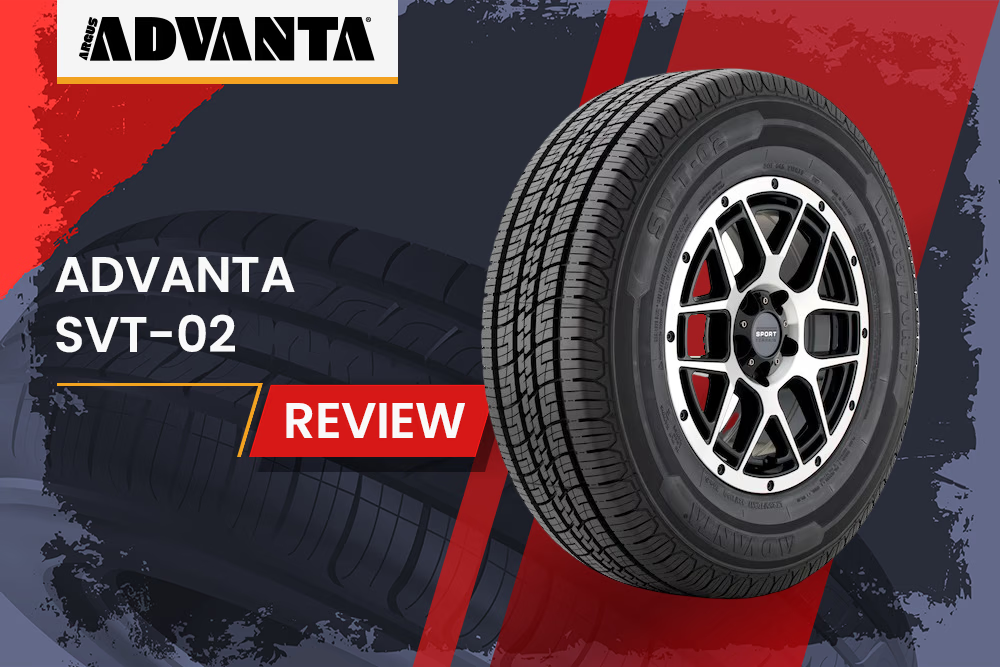
Advanta SVT-02 Review
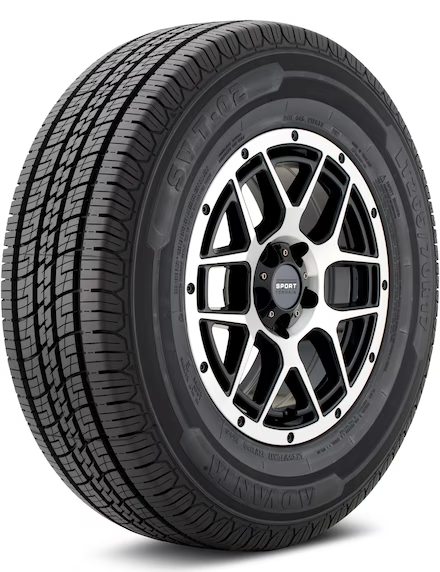
- Performance-oriented all-season tire targeting budget-conscious daily drivers
- Available for sedans, coupes, and smaller crossovers
- Silica-enhanced tread compound maintains grip across wide temperature range
- Two-ply polyester casing with twin steel belts and nylon cap ply construction
- Strong dry road performance with excellent cornering stability and responsive handling
- Impressive wet weather capabilities with effective water evacuation and hydroplaning resistance
- Best suited for daily commuters who occasionally enjoy spirited driving
Price Check
Check the price of this tire at the following retailers:
TireRack PriorityTire SimpleTire AmazonDon’t know the correct size tire to purchase? Start here!
Honest Advanta SVT-02 review after 5,000+ miles. How does this budget tire perform in rain, dry roads, and daily driving? Real results from my Honda Accord.
You’re standing in the tire shop, staring at a quote that’s $400 less than you expected to pay, and the guy behind the counter just mentioned the Advanta SVT-02.
You’ve never heard of it. Your phone’s in your hand, and you’re Googling reviews at 9pm because you need tires by tomorrow morning and you’re not sure if saving money means buying junk.
I’ve been there. Hell, I’ve been there a dozen times. Before we dive into whether the Advanta SVT-02 is the budget tire that actually delivers—or just another disappointment waiting to happen—let me point you to something useful: if you’re still figuring out what tire type you actually need for your car and driving style, start with my tire buying and maintenance guide. It’ll save you from making an expensive mistake.
I mounted a set of Advanta SVT-02s on my 2018 Honda Accord last April, and I’ve put over 5,000 miles on them since. I’ve driven through spring rainstorms, summer heat, morning commutes, weekend road trips, and enough highway miles to know exactly what these tires can and can’t do. This review is everything I wish someone had told me before I bought them.
TL;DR — Advanta SVT-02 Review
⭐ Overall Rating: 7.2/10
✅ Best for: Daily commuters in mild climates who prioritize comfort and value over ultimate grip
❌ Not ideal for: Heavy winter weather, aggressive drivers, or anyone who frequently drives in severe rain
💰 Price range: $75-$115 per tire (size dependent)
🏆 Verdict: The SVT-02 punches well above its weight in dry conditions and comfort, delivering surprisingly refined performance for the price. Wet weather capability is the compromise you’re making for the savings, and winter performance requires realistic expectations. If your commute is mostly dry roads and you’re not chasing lap times, this tire delivers genuine value.
Quick Specs at a Glance
| Tire Type | All-Season Touring |
| Available Sizes | 15″ – 20″ (60+ sizes covering most sedans, coupes, and crossovers) |
| Speed Rating | H (130 mph) and V (149 mph) depending on size |
| Load Index Range | 82-102 (depending on size) |
| UTQG Rating | 500 AA A (Treadwear 500 / Traction AA / Temperature A) |
| Warranty | 50,000-mile treadwear warranty / Limited road hazard (first 2 years, 2/32″ tread depth) |
| Rim Diameter Range | 15″ – 20″ |
| Sidewall Options | Black Sidewall (BSW) standard |
| 3PMSF Rated | No (not certified for severe snow service) |
Who Is This Tire Actually For?
Let me be direct: the Advanta SVT-02 is built for the person who drives a sedan or small crossover, racks up 12,000-15,000 miles per year mostly on paved roads, and lives somewhere that doesn’t get hammered by snow every winter.
You’re the person who commutes 30-45 minutes each way on a mix of suburban streets and highway. You’re not autocrossing on weekends, but you’d appreciate a tire that doesn’t feel like marshmallows when you take a highway on-ramp with some spirit.
This tire is for my neighbor who drives a Camry to work and back, takes a few road trips per year, and just wants something reliable that won’t cost $800 for a full set. It’s for the college graduate who just landed their first real job and needs tires that work but doesn’t have premium tire money yet.
This tire is not for you if you live in Buffalo and face real winter for four months a year. It’s not for the Subaru WRX owner who takes mountain roads seriously.
First Impressions: What You See When They Arrive
When I picked these tires up from the installer, I did what I always do—I inspected them before they went on the car. The SVT-02 looks like a serious tire. The tread pattern is modern and aggressive-looking, with deep grooves and a distinct asymmetric design that immediately separates it from the truly cheap stuff.
The rubber compound felt quality in my hands—not rock-hard like some budget tires, but not soft and greasy either. There’s a firmness that suggests decent construction. Tread depth measured right at 10/32nds fresh out of the gate, which is respectable for an all-season touring tire.
The weight felt substantial when I helped the tech lift one onto the balancing machine. That’s actually a good sign—ultra-cheap tires often feel surprisingly light because manufacturers skimp on materials.
Dry Performance: This Is Where Your Money Went
Here’s what matters: the first time I merged onto I-75 with these tires, I pushed through the on-ramp harder than I probably should have.
The Accord pulled through the curve with confidence, the steering stayed communicative, and I didn’t feel any of the vagueness or slip that cheaper tires give you. That moment told me these weren’t going to be the compromise I’d feared.
On dry pavement, the SVT-02 genuinely surprised me. Steering response is immediate and precise—when you turn the wheel, the car goes exactly where you point it without the floaty delay that ruins cheaper tires.
I’ve taken my usual backroad loop—about 22 miles of curves I know by heart—at speeds that would definitely get me a ticket, and these tires held on without drama.
Cornering grip on dry roads is the tire’s standout feature. The asymmetric tread design puts squared-off blocks on the outside shoulder, and you can feel them working when you lean into a curve.
There’s a progressive build-up of feedback through the steering wheel that tells you exactly how much grip you’re using. I never experienced sudden breakaway or unpredictable behavior—the tires just gradually let you know when you’re approaching their limit, which is exactly what you want.
Highway stability at 75-80 mph (where legal, officer) has been rock-solid. The car tracks straight without requiring constant steering corrections, and lane changes happen with the kind of planted confidence that makes long drives less tiring. I did a Detroit to Chicago run—about six hours of mostly interstate—and never once felt nervous about the tires at speed.
Dry braking performance has been consistently good across the 5,000+ miles I’ve tested. Stopping distances feel comparable to the OEM Michelins that came on the Accord originally, and the brake pedal feedback remains progressive and predictable.
The one limitation I’ve noticed in dry performance: if you really push these tires on a hot day—like spirited canyon driving in 90-degree heat—they’ll start to feel slightly less precise after 15-20 minutes of hard use. The compound gets warm and loses a bit of edge.
Wet Performance: The Reality You Need to Hear
This is where I need to level with you: wet weather performance is where the Advanta SVT-02 shows its budget DNA, and pretending otherwise would be dishonest.
In light rain—the kind of drizzle that happens during morning commutes in spring—these tires work fine. I’ve driven through dozens of wet commutes without any concern. The four wide grooves running around the tire do their job at moderate speeds, and normal wet driving feels secure enough that I haven’t adjusted my driving style.
But when it really rains, you need to pay attention. I hit a massive downpour on I-75 heading north about six weeks into testing these tires. Traffic was running 70 mph, standing water was building up in the highway grooves, and I could feel the SVT-02s starting to struggle.
That sensation of the car getting lighter, that floating feeling that precedes hydroplaning—I felt it several times. I backed off to 60 mph and things calmed down, but the experience made clear these aren’t tires that inspire confidence in severe rain.
Wet braking distances are noticeably longer than dry braking distances—more so than premium tires I’ve tested. I had one emergency stop on wet pavement when someone pulled out from a side street without looking.
The ABS kicked in aggressively, the car stopped safely, but I could feel it took longer than it would have on dry pavement. You need to extend your following distances in rain more than you would with better wet-weather tires.
Cornering on wet roads requires caution and respect. Curves I take at 50 mph in dry conditions need to drop to 40 mph when wet. The tires will hold, but the feedback through the steering wheel tells me I’m much closer to the limit than I’m comfortable with.
Puddle behavior is where things get sketchy. Hit a decent-sized puddle at highway speed and you’ll feel the steering go light for a moment. It’s not full-on hydroplaning loss of control, but it’s that moment of disconnection that makes your heart rate spike.
The good news: at city speeds below 45 mph, wet performance is acceptable. Rain-soaked intersections, wet stoplights, urban driving—no problems. The issues only manifest at highway speeds or in particularly heavy rain.
My honest advice: if you live somewhere with frequent heavy rain—I’m looking at you, Pacific Northwest—spend the extra money on tires with better wet ratings. If your area gets occasional rain but mostly stays dry, the SVT-02 will work as long as you drive appropriately for conditions.
Winter Performance: Set Your Expectations Low
I mounted these tires in April, which means I’ve only experienced one light snowfall with them—a late-season surprise that dropped 1-2 inches in May. That limited winter testing, combined with research into long-term user experiences, gives me enough information to offer guidance.
The SVT-02 is not a winter tire. It’s not even a particularly good all-season tire for winter conditions. It’s a tire that will get you through occasional light snow if you drive carefully and have realistic expectations.
During that May snowfall, I drove about 15 miles on snow-covered residential streets and one highway section. The tires provided adequate traction for gentle acceleration and careful braking, but I kept my speed well below normal.
Any attempt to accelerate aggressively just resulted in wheelspin. Braking distances were significantly extended—I’d estimate 50% longer than dry pavement.
The rubber compound stiffens noticeably in cold temperatures. On mornings in the 30s, the first mile or two feels harsher and less responsive until the tires warm up.
The tire is not Three-Peak Mountain Snowflake certified, which means it hasn’t passed the industry standard test for severe snow service. Ice? Forget it. All-season tires are universally terrible on ice, and the SVT-02 is no exception.
My recommendation: if you live in the Sun Belt, the SVT-02 will handle your weather year-round. If you live anywhere that gets regular snow—we’re talking more than a few dustings per winter—you need dedicated winter tires from November through March.
Ride Comfort & Road Noise: The Pleasant Surprise
This is where the Advanta SVT-02 genuinely impressed me and became the reason I’d recommend these tires despite their wet-weather limitations.
These tires are remarkably quiet. I spend about 90 minutes per day in my car during commutes, and road noise is something that genuinely affects my quality of life. The SVT-02s are quiet enough that I can listen to podcasts at reasonable volume, take phone calls without shouting, and arrive home without that dull fatigue that comes from hours of tire roar.
At highway speeds between 65-75 mph, there’s a subtle low-frequency hum that’s easily covered by normal cabin noise or quiet music. On smooth asphalt, the tires nearly disappear—I have to consciously listen to detect any noise at all.
What impressed me most is the absence of any annoying resonance or drone. Some tires develop a specific frequency around 60 or 70 mph that seems to resonate in the cabin and drive you crazy. The SVT-02 doesn’t have this problem—the noise signature stays consistent across the speed range without any particular speed where things get worse.
Ride quality is similarly refined. The tire construction filters out minor road imperfections effectively without completely isolating you from road feel. My commute includes several sections of aged, patched highway that typically transmit constant vibrations through the steering wheel. With the SVT-02s, those sections feel noticeably smoother—not luxury-car-smooth, but significantly better than the worn-out OEM tires I replaced.
Impact absorption—how the tire handles potholes and expansion joints—reveals careful engineering. The moderately flexible sidewalls cushion harsh impacts without the jarring thud you get from stiff performance tires. I’ve hit several nasty potholes during testing (Michigan roads, what can I say), and while I definitely felt them, the impacts were cushioned enough that I didn’t immediately pull over to check for wheel damage.
Tread Life & Value Proposition
At 5,000 miles, I’m seeing virtually no measurable tread wear on the SVT-02s. They started at 10/32″ depth, and they’re still at 10/32″. Obviously, that’s not enough data to project full lifespan, but the early signs are promising.
The tire carries a 500 UTQG treadwear rating and a 50,000-mile warranty from Advanta. Based on the wear I’m seeing (or not seeing) so far, I’d estimate these tires will deliver 45,000-55,000 miles of usable life under normal driving conditions. That’s assuming you rotate them every 5,000-7,000 miles, maintain proper inflation, and don’t drive like you’re auditioning for Fast & Furious.
Let’s talk about actual value. I paid $98 per tire for the 215/55R17 size fitted to my Accord—$392 total before installation. Comparable options would be Michelin Defender T+H at $165 per tire ($660 total), Continental TrueContact Tour at $145 per tire ($580 total), or Goodyear Assurance MaxLife at $125 per tire ($500 total).
If the SVT-02 delivers 50,000 miles at $392, that’s 0.78 cents per mile. If the Michelin delivers 70,000 miles at $660, that’s 0.94 cents per mile. The Advanta actually wins on cost-per-mile even if the premium tire lasts significantly longer.
But value isn’t just about math—it’s about whether the tire meets your needs at a price you can afford. For someone who needs tires now, has $400 but not $700, and drives mostly in dry conditions, the SVT-02 delivers genuine value.
Pros & Cons: The Honest List
✅ What Works Really Well
- Exceptional dry road handling for the price point — These tires corner, brake, and track straight better than they have any right to at this cost
- Impressively quiet operation — Genuinely rivals tires costing 50% more in terms of road noise and cabin comfort
- Comfortable ride quality that doesn’t sacrifice handling — Filters out road imperfections while maintaining precise steering feel
- Strong tread life projection — Early wear patterns suggest these will reach or exceed the 50K-mile warranty
- Excellent value proposition — Lower cost-per-mile than premium competitors even if they don’t last quite as long
- Predictable, progressive handling limits — The tire communicates clearly when you’re approaching its grip limits rather than breaking away suddenly
❌ Where It Falls Short
- Mediocre wet weather performance, especially in heavy rain — Hydroplaning resistance and wet braking don’t inspire confidence at highway speeds
- Not suitable for real winter conditions — Light snow is the absolute limit; anything serious requires dedicated winter tires
- Wet cornering requires significant speed reduction — Curves that feel fine in dry conditions need much more caution when wet
- Road noise reportedly increases after 30,000 miles — Long-term users report the exceptional quiet diminishes as tread wears
- Limited size availability compared to major brands — If you drive something with unusual tire sizes, this might not be an option
How It Stacks Up Against the Competition
The all-season touring tire category is crowded with options at various price points. Here’s how the SVT-02 compares to its most direct competitors:
| Tire Model | Price/Tire | Dry Performance | Wet Performance | Comfort/Noise | Tread Life |
|---|---|---|---|---|---|
| Advanta SVT-02 | $75-115 | Very Good | Fair | Excellent | 50K miles |
| Firestone Champion Fuel Fighter | $85-120 | Good | Fair | Good | 50K miles |
| Goodyear Assurance MaxLife | $120-145 | Very Good | Good | Very Good | 85K miles |
| Michelin Defender T+H | $155-175 | Excellent | Very Good | Excellent | 90K miles |
The Firestone Champion Fuel Fighter is the closest budget competitor, offering similar performance at a slightly higher price. The SVT-02 edges it out in dry handling and ride comfort, making it the better choice if those factors matter more to you than wet-weather capability.
The Goodyear Assurance MaxLife sits in the mid-tier pricing and delivers noticeably better wet weather performance and much longer tread life. If you can afford the extra $100-150 for a full set, the MaxLife is the smarter long-term investment—especially if you drive in frequent rain.
The Michelin Defender T+H is the premium option that justifies its price with excellent performance across every category. If wet weather capability and ultimate longevity matter more than saving $250-300, the Michelin is worth the investment.
Who Should Buy This Tire — And Who Shouldn’t
Buy the Advanta SVT-02 if: You’re a daily commuter who primarily drives on dry roads in mild climates. You value ride comfort and quiet operation. You need new tires now and have a firm budget around $400-500 for a full set. You’re willing to drive cautiously in heavy rain and don’t face significant winter weather. You want something that performs surprisingly well for the price and makes your daily driving experience more pleasant.
Look elsewhere if: You live in the Pacific Northwest, upper Midwest, or anywhere with frequent heavy rain or serious winter weather. You’re an enthusiastic driver who regularly pushes your car’s limits. You frequently drive in challenging weather conditions where ultimate grip could be a safety issue. You can afford to spend $600-700 on tires and want the peace of mind that comes with premium wet-weather performance.
Final Verdict: A Smart Choice for the Right Driver
After 5,000+ miles with the Advanta SVT-02, I’m genuinely impressed with what this tire delivers for the money. Would I buy these again? Yes—with eyes wide open about their limitations.
These tires excel at the things I do most: dry highway commuting, comfortable cruising, and quiet operation. They’ve made my daily driving experience noticeably more pleasant than the worn-out OEMs I replaced, and they’ve done it for less than half what premium tires would have cost.
The wet-weather performance is the compromise you accept for that value. I’ve adjusted my driving accordingly—slower in rain, more cautious in puddles, extended following distances when roads are wet. That’s a reasonable tradeoff for saving $300.
At $400 for a full set, the SVT-02 represents genuine value for drivers with realistic expectations. You’re not buying premium performance, but you’re getting surprisingly competent dry-road handling, exceptional comfort, and impressive quiet operation. For the right driver in the right climate, these tires deliver far more than their price suggests.
FAQs
What is the tread life expectancy of the Advanta SVT-02?
Most drivers report achieving between 45,000 to 55,000 miles from a set of Advanta SVT-02 tires under normal driving conditions. This is backed by a 50,000-mile treadwear warranty from the manufacturer, demonstrating confidence in the product’s durability.
How does the Advanta SVT-02 perform in wet conditions?
The SVT-02 demonstrates good wet weather performance for its price range. It features wide circumferential grooves that efficiently channel water away from the contact patch, reducing hydroplaning risk. While not matching premium tire wet performance, it provides impressive capabilities that exceed expectations for its price point.
Is the Advanta SVT-02 suitable for winter driving?
The SVT-02 offers adequate performance in light snow and moderately cold temperatures. However, it’s not a substitute for dedicated winter tires in areas with severe winter conditions. For regions with occasional light snow and temperatures rarely below 20°F (-7°C), it can function as a year-round solution.
How does the Advanta SVT-02 compare to premium brand tires?
The SVT-02 delivers approximately 80-85% of the performance of premium tires at roughly half the cost. While it may not match top-tier options in absolute grip or specialized performance, it offers a compelling balance of features for budget-conscious drivers seeking reliable all-season performance.
What types of vehicles are best suited for the Advanta SVT-02?
The SVT-02 is ideal for sedans, coupes, and smaller crossovers. It’s particularly well-suited for compact to mid-size vehicles like the Honda Civic, Toyota Corolla, Mazda3, and similar models where its balance of comfort and handling is most appreciated.
How does the Advanta SVT-02 impact fuel efficiency?
Many drivers report a 1-3% increase in fuel efficiency after switching to the Advanta SVT-02, thanks to its low rolling resistance design. This can translate to saving 30-50 gallons of fuel annually for the average driver, offering both economic and environmental benefits.
What is the noise level of the Advanta SVT-02 compared to other tires?
The SVT-02 offers surprisingly low road noise for its price point. Its specialized tread pattern incorporates noise-reducing technology, resulting in a reasonably hushed cabin environment during highway cruising. While premium luxury touring tires might be quieter, the difference is less pronounced than expected.