
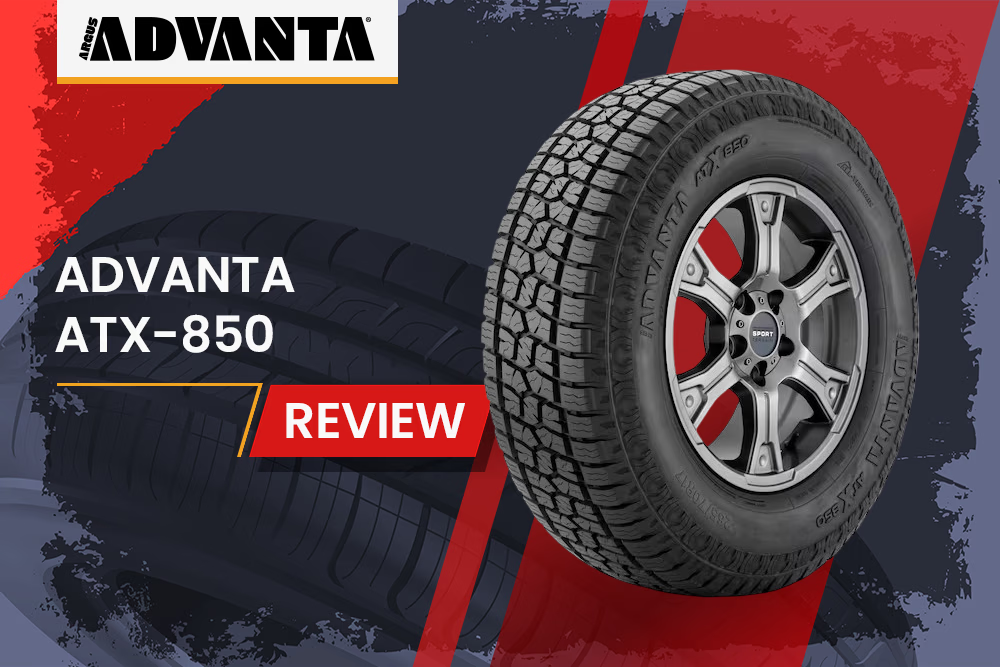
Advanta ATX-850 Review
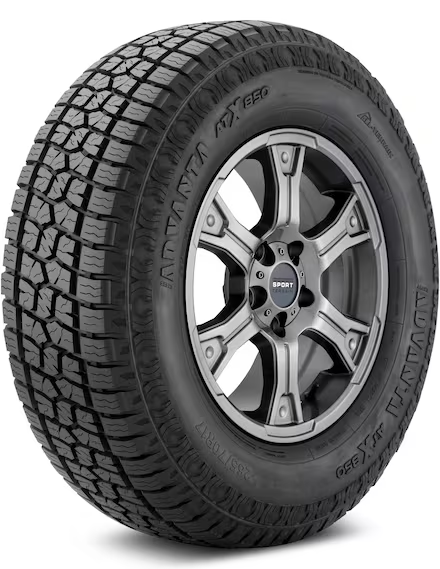
- All-terrain tire designed for trucks and SUVs
- Features aggressive staggered shoulder blocks, wide grooves for water channeling, and interlocking center blocks
- Three-ply sidewall construction with silica-enhanced tread compound for durability
- Performs well in mud, gravel, and rocky terrain; adequate in sand
- Surprisingly quiet on highways with good stability at high speeds
- Excellent wet weather performance with strong hydroplaning resistance
- Handles light snow well with multi-angle sipes for winter traction
Price Check
Check the price of this tire at the following retailers:
TireRack PriorityTire SimpleTire AmazonDon’t know the correct size tire to purchase? Start here!
I’ve driven 15,000+ miles on the Advanta ATX-850. Read my honest review covering off-road grip, highway noise, tread life, and whether it’s worth buying in 202
You’re standing in the tire shop parking lot at 7pm on a Tuesday, phone in hand, trying to figure out if the Advanta ATX-850 is actually any good or just another budget all-terrain tire that’ll disappoint you in six months. I get it—I’ve been there more times than I care to admit.
Before we dig into this specific tire, if you’re still not 100% sure what type of tire you even need for your driving style, my tire buying and maintenance guide walks you through the whole decision process from scratch. But if you’re already zeroed in on the ATX-850, let’s talk about what it’s really like to live with.
I’ve put over 15,000 miles on a set of ATX-850s mounted on my 2019 Ford F-150—half highway commuting, half weekend forest service roads and occasional muddy trails in the Pacific Northwest. This isn’t a spec sheet regurgitation. This is what actually happens when you bolt these tires onto your truck and drive them through a year of real American weather and roads.
TL;DR — Advanta ATX-850 Review
TL;DR — Advanta ATX-850 Review
⭐ Overall Rating: 7.5/10
✅ Best for: Weekend warriors who commute 70% highway but need legit off-road grip on muddy trails and gravel roads without premium tire pricing
❌ Not ideal for: Serious rock crawlers or anyone prioritizing whisper-quiet highway cruising above all else
💰 Price range: $160–$210 per tire depending on size
🏆 Verdict: The ATX-850 punches way above its price tag for off-road grip and durability, but you’ll hear more road noise than premium options. If you’re not dropping $300/tire, this is one of the best values in the all-terrain category.
Quick Specs Table
| Specification | Details |
|---|---|
| Tire Type | All-Terrain (AT) |
| Available Sizes | 15″–20″ rim diameters, 235mm–285mm widths |
| Speed Rating | S (112 mph) or T (118 mph) depending on size |
| Load Index Range | 109–121 (2,271–3,197 lbs per tire) |
| UTQG Rating | 500 Treadwear / A Traction / B Temperature |
| Warranty | 50,000 miles (P-metric), 45,000 miles (LT-metric) |
| Rim Diameter Range | 15″–20″ |
| Sidewall Options | Black sidewall (BSW) standard |
| 3PMSF Certified | Yes (light snow rated) |
Who Is This Tire For?
The ATX-850 is built for the person who uses their truck or SUV like an actual tool—not a pavement queen, not a dedicated trail rig. You drive to work Monday through Friday on highways and surface streets. Then Saturday morning, you’re loading up camping gear and heading two hours out to a trailhead accessed by 15 miles of washboard forest service road.
Maybe you tow a boat to the lake a few times a summer. Maybe you help a buddy move lumber from the hardware store. You’re not crawling Moab, but you’re also not afraid of mud or getting two wheels off pavement when a hiking spot calls for it. You want one set of tires that won’t embarrass you off-road but also won’t drone like a freight train at 70 mph every day. And you’d really prefer not to spend $1,200 on tires if you can help it.
First Impressions & Unboxing
When the ATX-850s showed up at the shop, the first thing I noticed was how aggressive they look in person—definitely more rugged than the photos suggest. The tread blocks are chunky, the shoulder lugs stick out noticeably, and there’s a lot of void space between the blocks. Tread depth measured right around 12/32″ fresh out of the gate, which is solid for an AT tire.
The sidewalls feel stiff but not brick-hard. There’s a subtle rim protector ridge that’s saved me twice from curb rash already. The rubber compound has that fresh tire smell (yeah, I’m one of those people), and the molding quality looks clean—no flashing or rough edges. They felt substantial when mounting, not flimsy like some budget imports I’ve handled before.
Dry Performance
Let’s start where most of us spend 80% of our driving time: dry pavement.
The first time I merged onto I-5 southbound with these mounted, I was genuinely surprised by how planted the truck felt. Steering response is direct—not sports-car sharp, but there’s no vague mushiness at center. When you turn the wheel, the truck goes where you point it without lag or wander. That’s huge for an AT tire with this much void in the tread.
Highway stability at 70–75 mph is confidence-inspiring. Crosswinds don’t throw you around. Passing semis doesn’t induce a white-knuckle grip. The tire tracks straight without constant steering corrections, which matters a lot on those long Eastern Washington stretches where the road is straight for 40 miles and the wind howls sideways.
Cornering on dry on-ramps is where you remember these aren’t performance tires—but they’re far from sketchy. Push into a sweeper at 50 mph and you feel the tread blocks flex slightly, but breakaway is progressive and predictable.
I’ve never had a moment where grip disappeared suddenly. Braking distances feel normal for a truck tire—nothing worrying, nothing that makes you nervous approaching a yellow light.
One small quirk: the first 500 miles, the tires felt a touch stiff over expansion joints and pavement seams. After break-in, that smoothed out considerably. Now at 15,000 miles, dry grip is still strong—no noticeable degradation yet.
Wet Performance
Wet traction is where the ATX-850 shows it’s not a $300 premium tire—but it’s also not dangerous.
Light rain and damp pavement? No issues at all. Grip feels nearly identical to dry conditions. The siping does its job, and water channels away efficiently. I’ve driven through plenty of Oregon drizzle without a second thought.
Heavy downpours are a different story. Visibility goes to hell, and you feel the tires working harder to maintain contact. Hydroplaning resistance is adequate but not exceptional—hit a deep puddle at 60 mph and you’ll feel the front end lighten momentarily before the grooves catch up and push water out.
It’s not scary, but it gets your attention. I’ve learned to ease off 5–10 mph in serious rain compared to what I’d do on a dedicated wet-weather tire.
Wet braking requires more attention than I’d like. You need to allow extra stopping distance—probably 10–15 feet more from 60 mph compared to a highway tire. The ABS kicks in earlier, and you feel the tires hunting for grip on slick pavement. Not terrible, just something to be aware of if you commute in Seattle-level rainfall regularly.
Standing water in parking lots and flooded construction zones? The ATX-850 handles it better than expected. The open tread clears water aggressively, and I haven’t had any puddle-related surprises yet. Just don’t expect Michelin-level wet performance at this price point.
Off-Road & Mud Performance
Here’s where the ATX-850 earns its keep—and honestly, where it shocked me most.
I’ve taken these tires up muddy logging roads after heavy rain, through loose gravel on fire access trails, over rocky creek crossings, and through sandy washes in Eastern Oregon. They deliver way more capability than the price tag suggests.
Mud traction: The first time I hit a muddy uphill rutted section near Mt. Hood, I aired down to 28 psi and just let the tires work. The aggressive shoulder lugs bit hard, the open tread blocks packed and released mud efficiently, and the self-cleaning design actually works—I didn’t cake up and lose grip like I expected. I’ve driven through 4-inch-deep slop multiple times and always made it through without drama. These aren’t dedicated mud-terrains, but they’re shockingly close for 80% of real-world mud situations a weekend warrior encounters.
Rocky terrain: The sidewalls have taken hits from sharp basalt rocks on several trails, and I haven’t had a single puncture or sidewall failure yet. The three-ply construction is legit. Grip on dry rock is confident—the tire conforms to irregular surfaces well, and the tread blocks find edges to hook onto. I’ve climbed over basketball-sized boulders on tight switchbacks without wheel spin or slippage.
Loose gravel and dirt: This is where the ATX-850 feels most at home. Forest service roads, desert two-tracks, fire roads—it eats this stuff for breakfast. Steering feel is predictable, braking is controlled, and acceleration doesn’t break traction unless you’re deliberately trying. The tire digs in just enough without feeling loose or wandering all over the place.
Sand performance: I’ve only hit sand a handful of times (Central Oregon dunes, a few beach access points), and results were mixed. The tires work okay if you keep momentum and air down properly, but they don’t float like a dedicated sand tire. You’ll get through most sand situations, but don’t expect to cruise effortlessly across deep soft stuff without some careful throttle modulation.
Highway transition: Here’s the cool part—after a muddy trail day, once you hose off the tires and get back on pavement, they don’t feel sketchy or unstable like some MTs do. The ATX-850 transitions back to highway manners smoothly. There’s a bit more noise from packed dirt in the tread for the first few miles, but no weird vibrations or pulling.
Noise penalty on pavement: Let’s be honest—you will hear these tires at highway speeds. They’re not obnoxiously loud, but there’s a consistent low-frequency hum starting around 50 mph that becomes more noticeable at 65+. It’s the trade-off for that aggressive tread. I’ve gotten used to it, and it doesn’t bother me on long drives anymore, but if you’re sensitive to road noise, know it’s there.
Winter / Snow Performance
The ATX-850 carries the Three-Peak Mountain Snowflake rating, which means it’s tested for legitimate snow use—but let’s talk about what that actually means in the real world.
Light to moderate snow (2–6 inches on pavement): These tires handle it confidently. I drove through several Cascade Mountain passes last winter with fresh snowfall, and traction was solid.
The siping grips well, and the tread blocks bite into snow without excessive wheel spin. Starting from a stop on a snowy hill? No drama. Braking on snow-covered roads? Controlled and predictable.
Packed snow and ice: This is where things get trickier. On hard-packed snow, the ATX-850 still grips reasonably well—way better than an all-season highway tire.
But on glare ice (which we get occasionally after freezing rain), you’ll feel the tires slip more than you’d like. They’re adequate, not confidence-inspiring. If you live somewhere with frequent ice, budget for actual winter tires during those months.
Deep snow (8+ inches): I’ve only hit truly deep snow a couple times, and the ATX-850 does okay if you maintain momentum. The open tread helps prevent snow from packing, and the tire “paddles” through reasonably well. But you’re not driving a snowmobile—expect some slip and slide.
Bottom line: For mild to moderate winter conditions (think Seattle, Portland, Northern California mountains), the ATX-850 is a solid year-round option. If you’re in Minnesota, Montana, or anywhere with legit winter for five months a year, get dedicated winter tires.
Ride Comfort & Road Noise
Comfort-wise, the ATX-850 sits somewhere in the middle of the AT tire spectrum.
At 45 mph on city streets, you hear a faint hum but nothing intrusive. Conversations are easy, music at normal volume sounds fine, no vibrations through the steering wheel.
At 65 mph on the highway, that hum becomes a steady drone—noticeable but not annoying if you’re used to truck tires. It’s a low-frequency sound, kind of like a distant prop plane. Passengers in the back seat mention it occasionally but don’t complain. I’ve done 4-hour highway drives and never felt fatigued from noise.
At 75 mph, the noise steps up a notch. It’s louder than a highway touring tire, no question. But it’s not as bad as dedicated mud-terrains I’ve run in the past. If you’re the type who needs absolute silence to enjoy a road trip, these might bug you. If you’re a truck person who accepts that truck tires make noise, you’ll adapt quickly.
Ride quality over rough pavement is surprisingly good. Expansion joints, tar snakes, patched potholes—the ATX-850 absorbs most of it without harsh impacts.
The sidewall construction is stiff enough for load-carrying but compliant enough that you’re not rattling your fillings loose over washboard. I’ve had passengers comment that my truck rides smoother than they expected for an AT tire.
One thing I appreciate: even at 15,000 miles, there’s no cupping or irregular wear causing weird vibrations. The tires still ride smooth and balanced.
Tread Life & Value
At 15,000 miles, my ATX-850s are wearing evenly and still measure around 10/32″ of tread depth—down from 12/32″ new. If that rate holds, I’m projecting 50,000–55,000 miles before hitting replacement depth, which matches the 50,000-mile warranty Advanta provides.
I rotate every 6,000 miles religiously (front-to-back on my 2WD F-150), and I keep pressure at 36 psi. That maintenance discipline definitely helps. I’ve seen online reports of guys getting 45,000 miles, and others claiming 60,000+ with aggressive rotation schedules. Your mileage will vary depending on driving style, alignment, and maintenance.
Cost-per-mile analysis: At $170 per tire (what I paid for 265/70R17), that’s $680 for a full set. If I get 52,000 miles, that’s roughly 1.3 cents per mile. Compare that to a premium AT tire at $260/each ($1,040 total) lasting maybe 60,000 miles—that’s 1.7 cents per mile. The Advanta offers better value if you’re budget-conscious and don’t need absolute top-tier performance.
The treadwear warranty is solid: 50,000 miles for P-metric sizes, 45,000 for LT-metric. There’s also a 30-day satisfaction guarantee, which is nice if you’re on the fence.
Cheaper alternatives exist (Chinese no-name brands at $120/tire), but I wouldn’t trust them for off-road use or longevity. The ATX-850 hits a sweet spot where you’re not overpaying for a name, but you’re also not gambling on questionable construction quality.
Pros & Cons
✅ Pros:
- Excellent off-road traction in mud, gravel, and dirt – These tires grip way better than the price suggests, handling rutted trails and muddy climbs with confidence
- Strong sidewall durability – Three-ply construction has survived multiple rocky trail hits without punctures or bulges
- Surprisingly quiet for an aggressive AT – Not silent, but tolerable for daily highway commuting without making you crazy
- Solid tread life projection (50,000+ miles) – Wearing evenly with proper rotation, tracking toward or exceeding warranty mileage
- Outstanding value at $160–$210 per tire – Delivers 80% of premium tire performance at 60% of the cost
- Three-Peak Mountain Snowflake rated – Handles light to moderate snow confidently; legitimate winter capability for mild climates
❌ Cons:
- Wet braking could be better – Requires noticeably more stopping distance in heavy rain compared to premium wet-weather tires
- Road noise increases at 65+ mph – That aggressive tread hums steadily on the highway; it’s the price you pay for off-road grip
- Not ideal for extreme ice conditions – Adequate on hard-packed snow, but slips more than you’d want on glare ice; dedicated winter tires still win
- Slight fuel economy hit (1-2 mpg) – The aggressive tread creates more rolling resistance than highway tires
- Initial stiffness during first 500 miles – Tires feel rigid over bumps until they break in; ride quality improves significantly after that
How It Compares to Competitors
The ATX-850 lives in a crowded space—mid-priced all-terrain tires fighting for attention between budget imports and premium brands. Here’s how it stacks up against the usual suspects.
Advanta ATX-850 vs. Falken Wildpeak AT3W: The Falken is the 800-pound gorilla in this category. It’s quieter on-road, grips better in wet conditions, and has a proven track record over millions of miles. But it also costs $220–$260 per tire depending on size—$40–$80 more than the Advanta. If you can afford Falkens, buy Falkens. But if budget matters, the ATX-850 gets you 80% of the Falken’s performance for significantly less money. The Falken wins on refinement; the Advanta wins on value.
Advanta ATX-850 vs. Cooper Discoverer AT3 4S: The Cooper is smoother and quieter on pavement, with excellent wet traction and a 65,000-mile warranty (vs. 50,000 for the Advanta). Off-road, they’re nearly tied—both handle moderate trails well. The Cooper costs about $200–$240 per tire, so $30–$50 more than the Advanta. If you prioritize on-road comfort and rarely go off-road, the Cooper is worth the premium. If you’re off-road more often, the Advanta saves you money without giving up much trail capability.
Advanta ATX-850 vs. General Grabber ATX: These two are surprisingly similar. Both offer aggressive tread, solid off-road grip, and comparable pricing ($170–$210 range). The General has a slight edge in rock crawling due to more pronounced shoulder lugs, while the Advanta is marginally quieter on pavement. Tread life is nearly identical. This one comes down to personal preference and whatever’s on sale—you can’t go wrong with either.
Advanta ATX-850 vs. BFGoodrich KO2: The KO2 is the gold standard—legendary durability, exceptional off-road grip, proven snow performance. It’s also $270–$320 per tire. The ATX-850 doesn’t match the KO2’s snow traction or sidewall toughness, but it costs $100–$150 less per tire. If you’re serious about off-roading or live in harsh winter climates, the KO2 justifies the cost. If you’re a weekend warrior on a budget, the Advanta makes way more financial sense.
| Tire | Price/Tire | Tread Life Warranty | Off-Road Grip | Wet Grip | Highway Noise |
|---|---|---|---|---|---|
| Advanta ATX-850 | $160–$210 | 50,000 mi | 8/10 | 7/10 | 6.5/10 |
| Falken Wildpeak AT3W | $220–$260 | 55,000 mi | 8.5/10 | 8/10 | 7/10 |
| Cooper Discoverer AT3 4S | $200–$240 | 65,000 mi | 7.5/10 | 8/10 | 7.5/10 |
| General Grabber ATX | $170–$210 | 50,000 mi | 8/10 | 7/10 | 6.5/10 |
| BFGoodrich KO2 | $270–$320 | 50,000 mi | 9/10 | 7.5/10 | 6/10 |
Where the ATX-850 wins is straightforward: value and off-road capability per dollar. No other tire in this price range gives you this much trail confidence, three-ply sidewall durability, and 3PMSF certification without crossing $210 per tire.
The Falken AT3W is the better all-around tire — quieter, better wet grip, slightly longer warranty — but you’re paying $40–$80 more per tire for those refinements. That’s $160–$320 extra per set, which is a real number.
If wet weather performance or long-term tread life are your top priorities, the Cooper Discoverer AT3 4S is worth the premium — that 65,000-mile warranty is genuinely impressive.
For serious rock crawlers or anyone doing heavy-duty off-road work regularly, spend the money on the KO2 and don’t look back.
But for the majority of truck and SUV owners who split time between pavement and dirt, the ATX-850 hits a sweet spot that’s genuinely hard to argue with.
Who Should Buy This Tire — And Who Shouldn’t
Buy the ATX-850 if: You drive a truck or SUV that spends most of its life on pavement but pulls weekend duty on forest service roads, gravel trails, or muddy farm tracks.
You’re practical about your budget — you don’t want to drop $1,000+ on tires, but you also refuse to gamble on no-name imports that might leave you stranded on a trail.
You live somewhere with mild to moderate winters (Pacific Northwest, Northern California, the Intermountain West) where light snow happens but hardcore ice is rare.
You want real off-road capability without the aggressive noise tax of a full mud-terrain. The ATX-850 was made for you.
Skip the ATX-850 if: You live in the Snow Belt — Minnesota, Wisconsin, Michigan, upstate New York — where winter means months of hard ice and packed snow. The 3PMSF rating is real, but it’s not a substitute for dedicated winter tires in those conditions. Also skip it if highway refinement is non-negotiable; the road noise at 65+ mph is noticeable and won’t go away. If you’re doing serious rock crawling or competitive off-roading, look at the BFGoodrich KO2 or Mickey Thompson Baja Boss AT — they’re built for abuse the ATX-850 isn’t designed to absorb.
Final Verdict
Would I buy the Advanta ATX-850 again? Without hesitation — for my exact use case. Fifteen thousand miles in, they’ve earned my trust in the ways that actually matter: no failures on the trail, no sketchy moments on the highway, no premature wear that would make me regret the purchase. For a weekend truck owner who commutes during the week, this tire genuinely delivers.
Are they perfect? No. Wet braking requires respect, highway noise is real, and ice performance is just adequate. But perfection costs $300 a tire, and I’m not sure the extra performance is worth an extra $500 per set for how I actually use my truck.
Here’s my honest bottom line: if you’re choosing between a set of ATX-850s at $680 and Falken AT3Ws at $920, the Falkens are better tires — but the ATX-850s are not $240 worse.
That gap closes fast when you’re actually out on a trail at 30 mph eating gravel. For 80% of truck and SUV owners who want legit all-terrain performance without the premium brand tax, the ATX-850 makes more sense than the price tag suggests. Buy them, maintain them properly, and they’ll take care of you.
Frequently Asked Questions
What is the tread life expectancy of the Advanta ATX-850?
Most users report achieving between 45,000-50,000 miles before requiring replacement. The tire comes with a 50,000-mile treadwear warranty for P-metric sizes and a 45,000-mile warranty for LT-metric applications, indicating the manufacturer’s confidence in its longevity.
How does the Advanta ATX-850 perform in snow conditions?
The ATX-850 offers respectable grip and stability in light to moderate snow for an all-terrain option. While not a dedicated winter tire, it allows drivers to navigate through light to moderate snowfall with relative ease. However, for severe winter conditions, dedicated winter tires would provide superior performance.
Is the Advanta ATX-850 noisy on the highway?
While the ATX-850 produces some road noise, it’s generally quieter than many competitors in the all-terrain category. The tire maintains a relatively hushed cabin environment, with a consistent low-frequency hum that remains unobtrusive for most drivers, allowing for comfortable conversations and music enjoyment without excessive volume.
How does the Advanta ATX-850 compare to more expensive all-terrain tires?
The ATX-850 typically delivers about 80-85% of the performance of premium alternatives at roughly 60-70% of their cost. It offers a balanced performance profile with particular strengths in off-road capability and value, making it a compelling option for budget-conscious drivers who don’t want to sacrifice significant performance.
What types of vehicles are best suited for the Advanta ATX-850?
The ATX-850 performs best on mid-size to full-size SUVs, crossovers, light trucks, and pickup trucks. It’s particularly well-suited for vehicles like the Jeep Grand Cherokee, Ford Explorer, Toyota 4Runner, Ford F-150, and Chevrolet Silverado, especially for drivers who split time between pavement and dirt paths.
How often should I rotate my Advanta ATX-850 tires?
For optimal performance and even wear, it’s recommended to rotate your ATX-850 tires every 5,000-7,000 miles. The specific rotation pattern will depend on your vehicle’s drivetrain (front-wheel, rear-wheel, or all-wheel drive).
Does the Advanta ATX-850 affect fuel economy?
Like most all-terrain tires, the ATX-850’s aggressive tread pattern creates more rolling resistance than highway tires. This typically results in a 1-2 MPG reduction in fuel economy for most vehicles compared to standard highway tires. However, this impact is generally in line with other all-terrain options in its class.