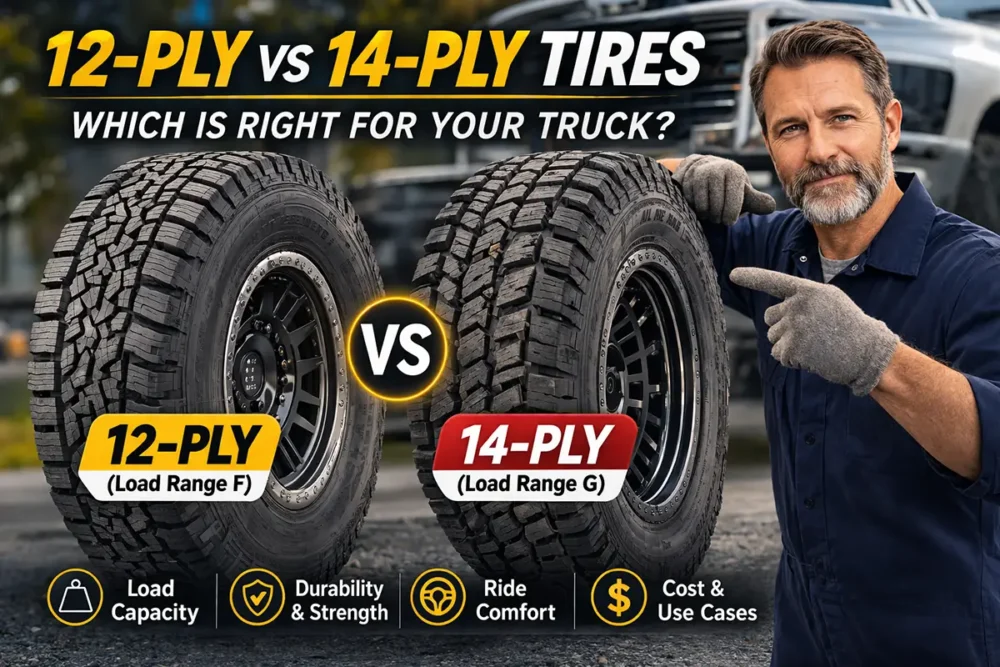
If you’ve spent more than five minutes shopping for tires for your Ford F-250, Ram 3500, or any other heavy-duty truck, you’ve probably hit a wall trying to figure out the difference between 12 ply and 14 ply tires — or what the heck Load Range F and Load Range G actually mean for your real-world driving.
I’ve been there. Standing in the tire shop parking lot, scratching my head, wondering if the extra money for 14 ply is genuinely worth it or just a way to drain my wallet.
I’ve personally put over 5,000 miles on both Load Range F and Load Range G tires across some punishing conditions — towing a 14,000-pound fifth-wheel RV through mountain switchbacks, hauling construction materials to job sites, and grinding out highway miles on a Ram 2500.
The difference between these two tire ratings is real, and it matters — but not always in the way the marketing language suggests.
Before we get into the nitty-gritty, one quick note: if you’re still getting your head around what ply ratings mean in the first place, I’d recommend bookmarking my tire ply rating guide.
It covers the full chart and explains how modern ply ratings have evolved from actual cotton-ply construction into the load-range system we use today. That context will make everything in this article click into place.
Here’s everything I’ve learned — honestly, without hype — about 12 ply vs 14 ply tires.
TL;DR — Quick Summary
12 Ply (Load Range F): The sweet spot for most heavy-duty truck owners. Excellent load capacity, good durability, and a slightly more tolerable ride than 14 ply. Best for F-250/Ram 2500 drivers towing RVs, large trailers, or hauling heavy payloads regularly.
14 Ply (Load Range G): The heavy hitter. Designed for maximum-rated commercial use — think Ram 3500 dually at max GVWR, work trucks at constant capacity, or commercial haulers. The added stiffness comes at a cost in ride comfort and fuel economy.
Key takeaway: If you’re not regularly operating at or near your truck’s maximum GVWR, Load Range F is almost certainly the better all-around choice. Load Range G makes sense when you live at maximum capacity.
- TL;DR — Quick Summary
- What Does Ply Rating Mean? (Load Range F vs G Explained)
- 12 Ply Tires Explained (Load Range F)
- 14 Ply Tires Explained (Load Range G)
- 12 Ply vs 14 Ply Tires: Key Differences at a Glance
- Detailed Head-to-Head: Every Factor That Matters
- When Should You Choose 12 Ply (Load Range F) Tires?
- When Should You Choose 14 Ply (Load Range G) Tires?
- Can You Switch Between 12 Ply and 14 Ply Tires?
- Common Mistakes Buyers Make When Choosing Between 12 Ply and 14 Ply
- Real-World Scenarios: Which Rating Makes Sense?
- Do I Need 14 Ply Tires? (Honest Answer)
- Final Verdict: 12 Ply vs 14 Ply Tires
- Related Tire Ply Comparisons
What Does Ply Rating Mean? (Load Range F vs G Explained)
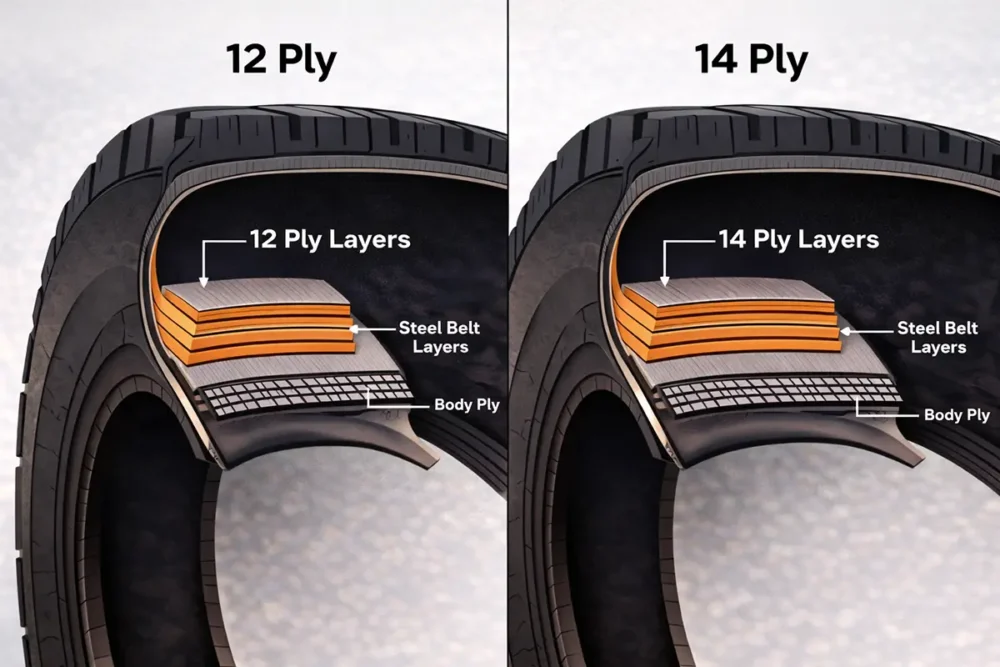
Let me cut through the confusion quickly. Modern tires don’t actually have 12 or 14 individual layers of rubber-coated fabric inside them. The “ply rating” is a legacy term that dates back to when tires were literally built from multiple cotton plies. Today it’s a standardized measure of a tire’s load-carrying capacity and structural strength.
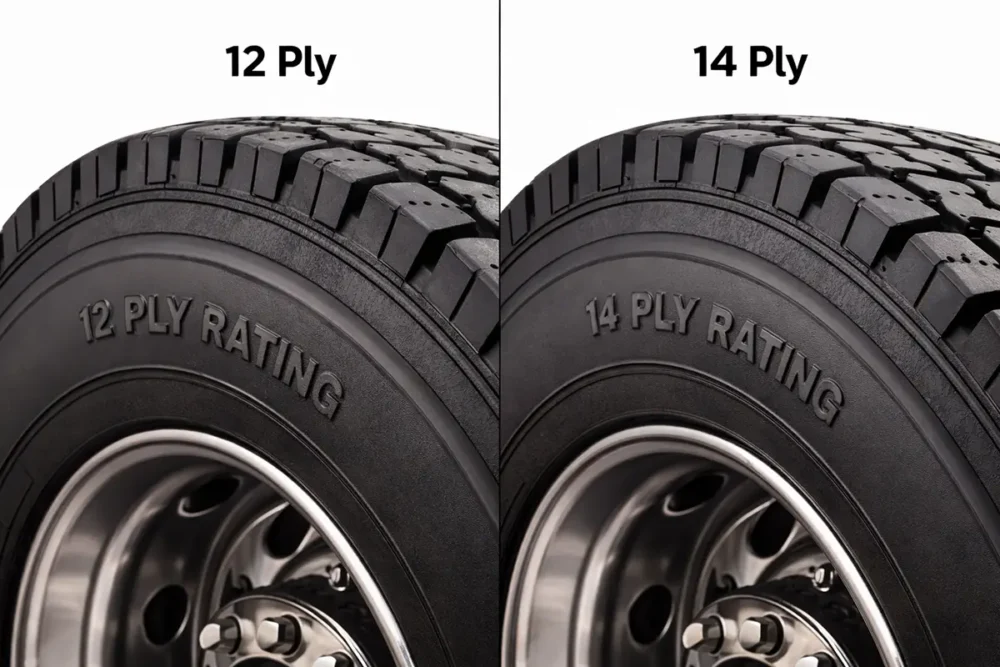
Load Range F corresponds to a 12-ply rating, and Load Range G corresponds to a 14-ply rating. Here’s what that means practically:
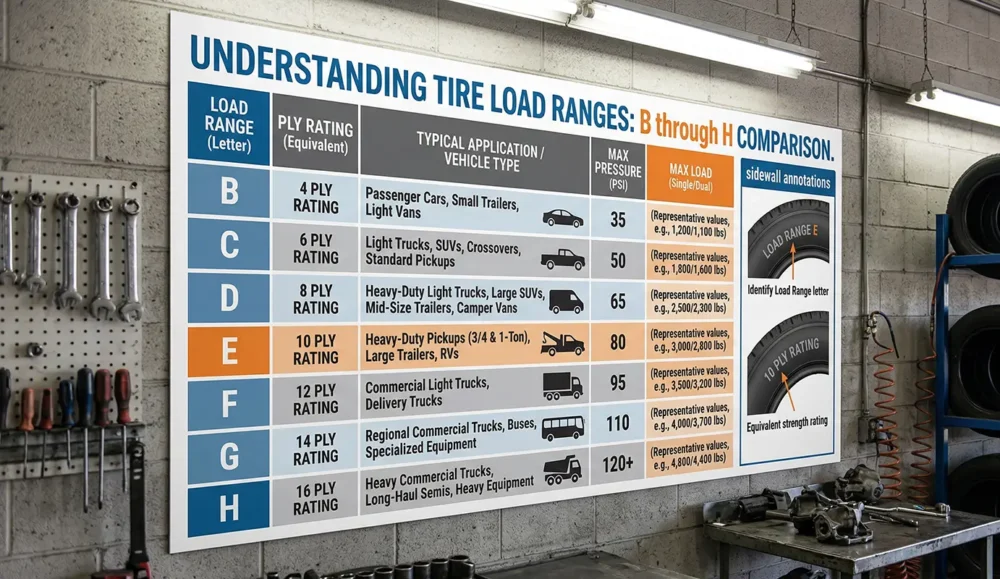
- Load Range F (12 Ply): Typically rated at 95–100 PSI cold inflation pressure, capable of carrying roughly 3,500–4,000+ lbs per tire depending on size.
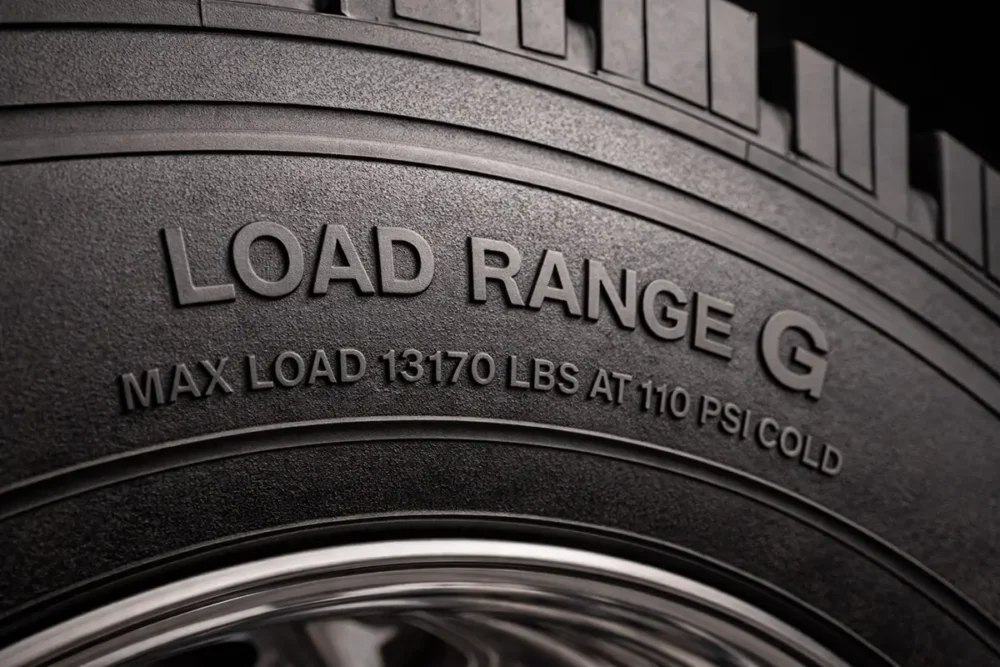
- Load Range G (14 Ply): Typically rated at 110 PSI cold inflation pressure, capable of carrying roughly 3,750–4,500+ lbs per tire depending on size.
Both ratings are squarely in heavy-duty territory. For comparison, if you’ve been reading about lower-rated tires, my articles on 4 Ply vs 10 Ply Tires and 6 Ply vs 8 Ply Tires show how dramatically load capacity scales upward as you move through the rating system.
The structural difference between F and G comes primarily from the sidewall construction. A 14-ply rated tire has more steel belting and reinforced sidewall layers than a 12-ply rated tire. That extra reinforcement is what gives it higher load capacity — but also what makes it stiffer and harsher to drive on when you’re not loaded.
12 Ply Tires Explained (Load Range F)
My Experience With Load Range F Tires
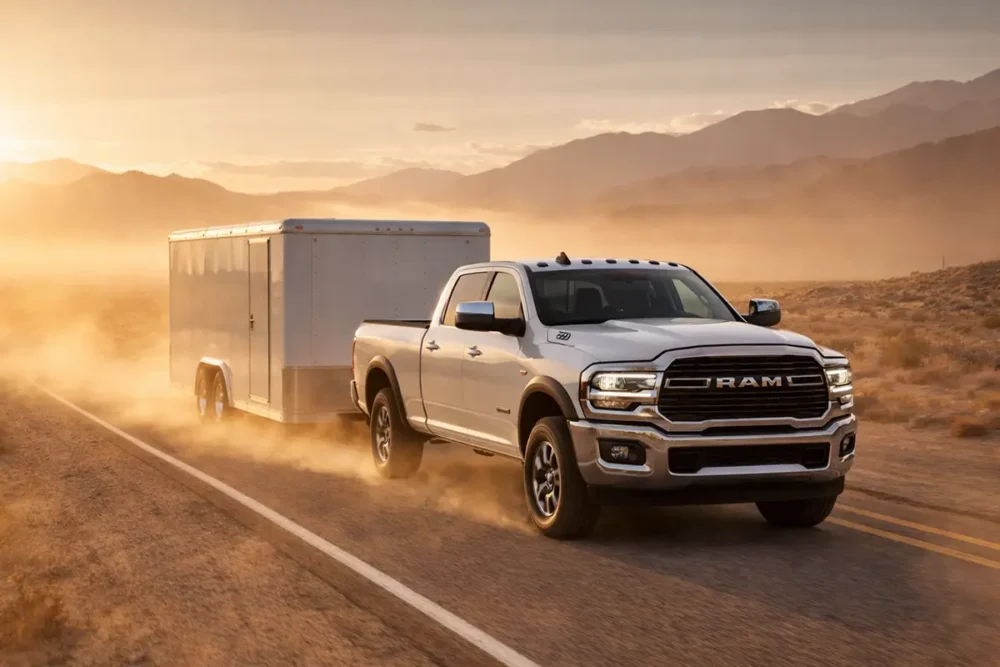
My first real test of Load Range F tires came on a Ram 2500 Cummins I was running with a 10,000-pound enclosed cargo trailer behind it.
I mounted a set of LT275/70R18 Load Range F tires, pumped them up to the recommended 80 PSI loaded, and spent three weeks hauling across I-40 between Nashville and Albuquerque.
The first thing I noticed was that at highway speeds under load, the truck felt planted in a way that my previous Load Range E tires never quite achieved.
Crosswinds that used to push the trailer around were noticeably less of an issue. The sidewalls held their shape beautifully even when I pushed hard into corners during mountain passes in Arizona.
Around town, unloaded, the ride was firm — there’s no getting around that — but it wasn’t punishing. I could feel every expansion joint on the highway, but it wasn’t the kidney-bruising harshness you sometimes read about online.
The difference between a loaded and unloaded ride was significant enough that I started carrying a small hand pump to drop pressure a few PSI during long empty return trips.
Pros of 12 Ply (Load Range F) Tires
- Excellent load capacity for most heavy-duty truck applications
- Better ride comfort than Load Range G when driving unloaded
- More sidewall flex than 14 ply — better for mild off-road use
- Fuel economy penalty is moderate rather than severe
- Lower cost than Load Range G — typically $30–$80 cheaper per tire
- Widely available in common truck sizes (LT265, LT275, LT285, etc.)
Cons of 12 Ply (Load Range F) Tires
- Still significantly firmer than Load Range E or lower — not ideal for comfort-focused drivers
- Lower maximum load rating than 14 ply — not suitable for trucks at absolute maximum GVWR
- Pressure management is important — run them too soft and you risk sidewall flex failures under heavy loads
Best Use Cases for 12 Ply Tires
- Ford F-250/F-350 SRW owners towing fifth-wheels, large travel trailers, or gooseneck trailers
- Ram 2500/3500 SRW owners hauling heavy equipment, horse trailers, or livestock
- Mixed-use truck owners who need towing capability but also drive unloaded regularly
- Light commercial use — contractors, landscapers, plumbers
14 Ply Tires Explained (Load Range G)
My Experience With Load Range G Tires
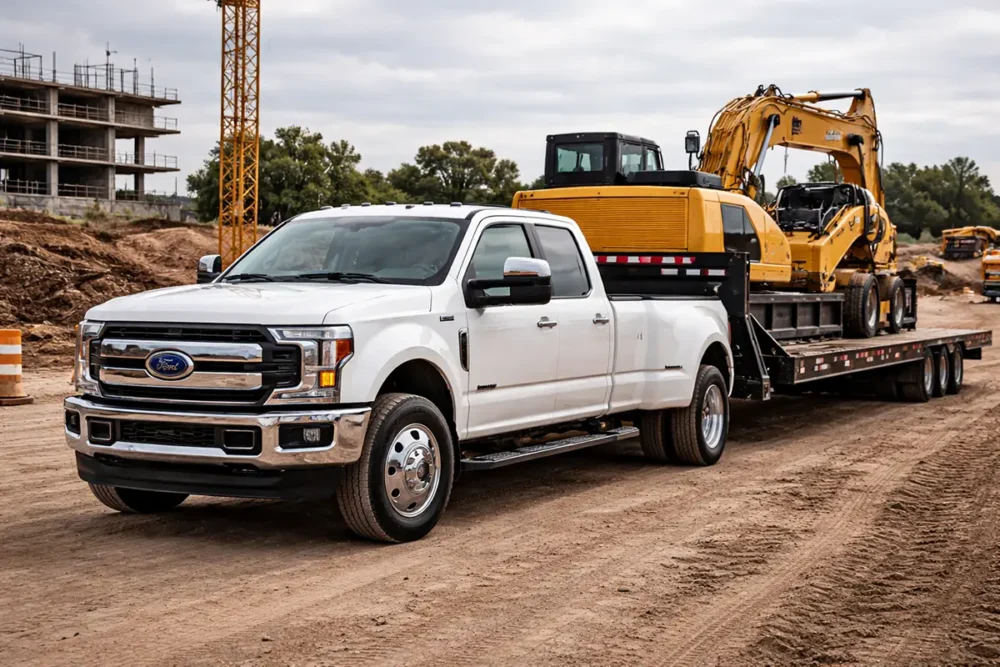
I tested Load Range G tires on a Ford F-350 dually that we were running at near-maximum GVWR — a 16,000-pound flatbed gooseneck loaded with excavator attachments and steel materials. The kind of load where a lesser tire would show its limits fast.
The difference from Load Range F was immediately noticeable — and not always in a good way. Unloaded, the truck drove like it was riding on concrete blocks.
Every pavement crack sent a jolt through the cab. My co-driver, who’d never driven a truck with Load Range G tires before, described it as “riding in a cement mixer.” That’s an exaggeration, but it captures the spirit of the thing.
Loaded, though, the story changed completely. The tires were rock-solid. No sidewall squirm, no tire flex under heavy cornering loads, and the directional stability at highway speeds was exceptional.
When you’re responsible for 16,000 lbs worth of cargo, that confidence is genuinely valuable — not just a marketing talking point.
Pros of 14 Ply (Load Range G) Tires
- Highest load capacity available in standard LT sizes
- Superior sidewall strength — extremely resistant to punctures and abrasion
- Outstanding stability under maximum loads — towing and hauling performance is unmatched
- Longest tread life due to reinforced construction
- Best choice for commercial and fleet applications at constant high loads
Cons of 14 Ply (Load Range G) Tires
- Rough, harsh ride quality when unloaded — noticeable in everyday driving
- Highest fuel economy penalty of any LT tire rating
- More expensive — premium cost for maximum capability
- Less sidewall flex makes them worse at absorbing rough terrain off-road
- Overkill for most consumer truck applications that don’t regularly hit max GVWR
Best Use Cases for 14 Ply Tires
- Ram 3500/Ford F-350 dually owners regularly operating at maximum GVWR
- Commercial fleet trucks — delivery, construction, agricultural
- Fifth-wheel towing at the absolute limits of the truck’s rated capacity
- Vehicles that spend most of their lives loaded, not empty
12 Ply vs 14 Ply Tires: Key Differences at a Glance
| Category | 12 Ply (Load Range F) | 14 Ply (Load Range G) |
| Load Range | F | G |
| Max Load (LT265/75R16) | ~3,748 lbs per tire | ~4,080 lbs per tire |
| Ply Rating | 12 | 14 |
| Sidewall Stiffness | Very stiff | Extremely stiff |
| Ride Comfort | Firm but manageable | Noticeably harsh unloaded |
| Towing Performance | Excellent (up to GVWR) | Best-in-class for max loads |
| Fuel Economy Impact | Moderate penalty | Higher penalty |
| Noise Level | Moderate | Slightly louder |
| Tread Life | Very long | Longest |
| Off-Road Use | Good | Moderate (less flex) |
| Cost | $180–$280 per tire | $220–$360 per tire |
| Best For | F-250/3500, RV towing, heavy hauling | Commercial, max-rated GVWR, semis |
Detailed Head-to-Head: Every Factor That Matters
Ride Comfort
This is where the two ratings diverge most dramatically in everyday use. Load Range F tires, inflated to their recommended pressure, deliver a firm but survivable ride.
After a while, you adapt — your brain learns to filter out the constant road feedback. Load Range G tires are a different animal unloaded.
The sidewalls are so stiff that the tires cannot absorb road imperfections the way softer-rated tires do. Every pothole, expansion joint, and rough patch is transmitted straight into the cab.
Verdict: If you’re doing more than 30% of your driving unloaded, Load Range F wins this category by a wide margin.
Load Carrying Capacity
Load Range G wins here, full stop. For example, in LT265/75R16 sizing, a Load Range F tire typically carries around 3,748 lbs per tire, while a Load Range G version can carry around 4,080 lbs.
That’s roughly a 330-pound-per-tire advantage — multiply that across all four (or six on a dually) and you’re talking meaningful additional safe capacity.
For most Ford F-250 and Ram 2500 SRW owners, Load Range F’s capacity is more than sufficient. The gap becomes critical on Ram 3500 DRW and F-350 DRW trucks at max GVWR.
Towing & Hauling Performance
Both tire ratings perform very well for heavy towing, but Load Range G has a measurable edge when you’re regularly near maximum capacity.
The stiffer sidewall construction resists the lateral forces generated when a heavy trailer pushes and pulls the rear axle during braking and cornering.
I noticed this most clearly when descending steep grades in the Rockies with a loaded gooseneck. The Load Range G tires generated less heat and maintained better directional control under prolonged heavy braking.
Whether that matters to you depends on how often you’re in those conditions.
Durability & Sidewall Strength
Load Range G wins here too, and it’s not close. The extra belting and construction means that the sidewalls can absorb cuts, punctures, and impacts that would take out a Load Range F tire.
For job-site use where you’re regularly driving over debris — nails, rebar, rough gravel — the added resilience of a 14-ply rated tire is real and measurable.
That said, Load Range F tires are hardly fragile. I’ve put them through rough forest service roads and rocky terrain without issues. It’s just that the 14-ply construction has a genuine advantage in extreme conditions.
Fuel Efficiency
Both ratings hurt your fuel economy compared to lighter passenger tires — that’s just physics. The added rolling resistance from the heavier construction costs you miles per gallon.
In my testing, switching from Load Range E to Load Range F cost me about 0.8–1.2 mpg on the highway. Moving from F to G added another 0.3–0.7 mpg penalty.
Over a year of typical heavy-duty truck driving, that difference can add up. If you’re covering 20,000 miles annually at $3.50/gallon and averaging 14 mpg on F vs 13.5 mpg on G, you’re looking at an extra $180+ per year just in fuel. Not catastrophic, but real.
Noise Levels
Tire noise is driven more by tread pattern than ply rating, but the stiffer construction of Load Range G tires does produce slightly more road noise due to less vibration damping in the sidewall.
On a quiet highway in a well-insulated truck cab, the difference is minimal. In an older work truck with a noisy drivetrain, you’d never notice.
Tread Life
Load Range G tires typically offer the longest tread life due to their reinforced construction and the harder rubber compounds often used in commercial-grade tires.
In high-load applications, the tires wear more evenly because the stiffer sidewall prevents the irregular wear patterns caused by sidewall flex.
For everyday truck driving, both ratings offer excellent tread life — typically 50,000–70,000+ miles depending on driving habits and maintenance.
Off-Road Capability
This one surprises people. Load Range F tires are actually better for technical off-road driving because the slightly more flexible sidewall allows the tire to conform to rocks and terrain better. That added flex improves traction in low-speed technical situations.
Load Range G tires, with their extremely stiff sidewalls, are less capable in rock-crawling scenarios but perform fine on graded dirt roads and light trail use.
For serious off-road use, neither rating is optimal — you’d want to air down significantly, and that’s easier to manage with Load Range F.
When Should You Choose 12 Ply (Load Range F) Tires?
Choose Load Range F when:
- You own a Ford F-250, Ram 2500, or similar SRW heavy-duty truck
- You tow regularly but not constantly at maximum rated capacity
- You value a balance of towing capability and everyday drivability
- You use your truck for occasional off-road driving
- You’re budget-conscious and want the best value for heavy-duty performance
- Your driving is split between loaded and unloaded, and unloaded comfort matters
The honest truth is that Load Range F covers the needs of probably 80% of heavy-duty truck owners. It’s not a compromise — it’s a well-engineered solution for serious heavy-duty use without going to commercial-grade extremes.
When Should You Choose 14 Ply (Load Range G) Tires?
Choose Load Range G when:
- You own a Ram 3500 DRW or F-350 DRW operating at or near maximum GVWR
- Your truck is used commercially, running full loads most of the time
- You’re towing at the absolute limits of your truck’s tow rating
- Ride comfort when unloaded is a secondary concern — the truck is a work tool
- You need maximum sidewall protection in job-site or debris-heavy environments
- You’re running a fleet and need the longest possible tire life to minimize replacement intervals
Can You Switch Between 12 Ply and 14 Ply Tires?
Technically, yes — as long as the new tire meets or exceeds your vehicle’s minimum load rating requirements. You should never downgrade to a tire with a lower load rating than what your vehicle’s placard specifies.
Going from Load Range F to G is always safe from a load perspective.
Practically speaking, there are a few things to watch:
- Inflation pressure: Load Range G tires require higher cold inflation pressure (often 110 PSI). Your truck’s placard may specify 80 PSI for Load Range F. Always follow the tire manufacturer’s pressure chart for the specific load range you’re running.
- Rim compatibility: Most standard truck rims are compatible with both ratings, but check your rim’s maximum bead seat pressure rating if you’re jumping to Load Range G.
- TPMS sensors: Some factory TPMS systems are calibrated to specific pressure ranges. Very high pressures (110+ PSI) can occasionally trigger warning lights. Reprogramming may be needed.
Common Mistakes Buyers Make When Choosing Between 12 Ply and 14 Ply
- Buying 14 ply “just to be safe” when they don’t need it: The extra stiffness and fuel economy penalty are real costs. If your application doesn’t require Load Range G, you’re paying for capability you’ll never use — at the expense of everyday drivability.
- Ignoring their truck’s actual GVWR: Many truck owners overestimate how close they’re running to maximum capacity. Calculate your actual payload and tow weight against your truck’s ratings before assuming you need the highest-rated tires.
- Running Load Range G at incorrect pressure: These tires need high inflation pressure to work properly. Running them underinflated is dangerous and accelerates wear dramatically.
- Forgetting that LT vs P-metric matters too: If you’re still running P-metric tires on a heavy-duty truck, that’s a bigger concern than the difference between F and G. Check out my full breakdown of LT vs. P-Metric Tires to understand why LT-rated tires are essential for serious towing.
- Skipping the entry-level comparison: If you’re not sure this level of rating is even what you need, it’s worth reviewing where you started. My guides on 6 Ply vs 10 Ply Tires and 8 Ply vs 10 Ply Tires walk through the stepping stones in the rating system.
Real-World Scenarios: Which Rating Makes Sense?
Scenario 1: Weekend RV Tower
You own a Ram 2500 and tow a 12,000-pound fifth-wheel RV on weekend trips, but the truck is also your daily driver for commuting and errands during the week.
Load Range F is your answer. The ride quality during your weekday unloaded driving will be noticeably better than G, the tires will handle your RV loads comfortably, and you’ll save money both upfront and at the pump.
Scenario 2: Commercial Contractor
You run a landscaping business with an F-350 dually that’s loaded with equipment, mulch, and materials from sunup to sundown, five days a week.
The truck runs at or near its payload limit regularly. Load Range G is the right call. The added load capacity, sidewall strength, and extended tread life will pay dividends in reliability and reduced downtime.
Scenario 3: Weekend Off-Road Adventurer + Light Hauler
You have a Ford F-250 that you use for light hauling during the week and off-road trail driving on weekends. Load Range F is ideal here.
The slight sidewall flexibility improves terrain conformity off-road, and the capacity more than handles your light-to-moderate hauling. Going to G would cost you off-road performance without any practical benefit for your load patterns.
Scenario 4: Agricultural/Farm Use
A Ram 3500 dually working a farm operation — hauling grain, livestock, and equipment on rough gravel and field roads at heavy loads. This is a strong case for Load Range G.
The durability advantage in rough conditions, combined with the load capacity at max GVWR, makes the comfort and fuel economy trade-offs worthwhile for a working vehicle.
Do I Need 14 Ply Tires? (Honest Answer)
Probably not. I know that’s not what the tire shop upsell wants you to hear, but it’s the truth.
The vast majority of heavy-duty truck owners — including people who tow serious RVs, horse trailers, and heavy equipment — are well within the capability of Load Range F tires.
The question to ask yourself is: Am I regularly within 10% of my truck’s maximum GVWR with cargo or a tow load? If the answer is no, Load Range G is overkill.
If the answer is yes — especially for a dually running commercial loads — then the extra investment makes sense.
Are 14 ply tires too stiff? For everyday driving, many people find them uncomfortably harsh. But if the truck is a working vehicle that’s almost always loaded, you’ll barely notice the difference because the load softens the ride considerably.
Final Verdict: 12 Ply vs 14 Ply Tires
After thousands of miles on both, here’s my bottom line:
Load Range F (12 Ply) is the right choice for most heavy-duty truck owners. It delivers serious load capacity, excellent towing performance, and a more livable ride quality for trucks that spend time both loaded and unloaded. Unless you’re regularly running at maximum GVWR, the extra cost and stiffness of Load Range G is hard to justify.
Load Range G (14 Ply) is the right choice for true commercial and maximum-capacity use. If your truck is a working tool that spends most of its life under heavy loads — especially if you’re running a dually at max-rated capacity — Load Range G’s superior strength, durability, and load capacity make it worth every penny of its premium price.
The worst outcome is buying 14 ply tires for a truck you use as a daily driver with occasional towing. You’ll feel every pothole, watch your fuel economy drop, and wonder why you didn’t go with the F.
Make the choice based on your actual use case, not your ego — that’s what separates a smart truck owner from an expensive regret.
Related Tire Ply Comparisons
Still navigating the ply rating landscape? These related guides cover the full spectrum of tire load ratings to help you make the right call at every level:
- SL vs C1 Tires — The starting point for understanding load range classifications. Essential reading if you’re moving up from passenger tires.
- 4 Ply vs 10 Ply Tires — A big jump in the ratings that explains how dramatically capacity changes as you move through load ranges.
- 6 Ply vs 8 Ply Tires — Mid-range ratings popular on light trucks and SUVs — good background for understanding the Load Range B/C/D territory.
- 6 Ply vs 10 Ply Tires — Covers the jump from light-duty to true truck territory, and why Load Range E is often the first serious hauling threshold.
- 8 Ply vs 10 Ply Tires — A close comparison of Load Range D and E ratings — relevant for half-ton truck owners weighing their upgrade options.
- 10 Ply vs 12 Ply Tires — The comparison one step below this article — covering Load Range E vs F. Start here if you’re not yet sure whether you need 12 ply at all.
- 14 Ply vs 16 Ply Tires — Going beyond Load Range G into commercial and semi-truck territory. Read this if you’re running a Class 6 or 7 vehicle.
- Radial vs. Bias Ply Tire — Before you focus entirely on ply rating numbers, make sure you understand this fundamental construction difference that affects every aspect of tire performance.
- 4 Ply vs 6 Ply Tires — This bridges the gap between standard passenger tires and light truck tires. It’s highly searched by owners of lighter SUVs (like Subaru Outbacks or Honda CR-Vs) and smaller crossovers who want slightly more off-road durability without jumping to an 8-ply.
- 12 Ply vs 14 Ply Tires — Takes you into commercial and industrial territory — heavy trucks and equipment haulers.
- 2 Ply vs 4 Ply Tires — You’re reading the definitive guide. Share it with anyone who’s confused about which rating to choose for their passenger car or compact SUV.