You are driving down the highway at 65 mph. Suddenly, your steering wheel starts to shimmy and shake in your hands. Or perhaps you let go of the wheel for a split second, and your car immediately dives to the right, as if it’s chasing a squirrel into the ditch.
These are the two most common complaints drivers have, and they point to two very different problems: Balance and Alignment.
While these terms are often used interchangeably in casual conversation (or by service advisors trying to upsell you), they refer to completely distinct mechanical procedures. One is about weight, and the other is about angles.
In this guide, which is a critical chapter of our complete Tire Buying and Maintenance Guide, we will break down the physics, the symptoms, and the solutions for both, so you never pay for a service you don’t need again.
- Part 1: What is Tire Balancing? (The Physics of Weight)
- Part 2: What is Wheel Alignment? (The Geometry of Angles)
- Part 3: Balancing vs. Alignment – The Key Differences
- Part 4: Advanced Technology – Road Force Balancing
- Part 5: Cost Breakdown & Maintenance Intervals
- Part 6: How to Check Alignment at Home (The DIY Guide)
- Part 7: Conclusion – The Final Verdict
- Frequently Asked Questions (FAQ)
Part 1: What is Tire Balancing? (The Physics of Weight)
Tires and wheels look perfectly round to the naked eye, but they are imperfect.
- The Tire: During manufacturing, the rubber might be slightly thicker on one side, or the steel belts might overlap, creating a “heavy spot.”
- The Wheel: The metal rim might have a slightly denser casting on one side or a valve stem that adds weight.
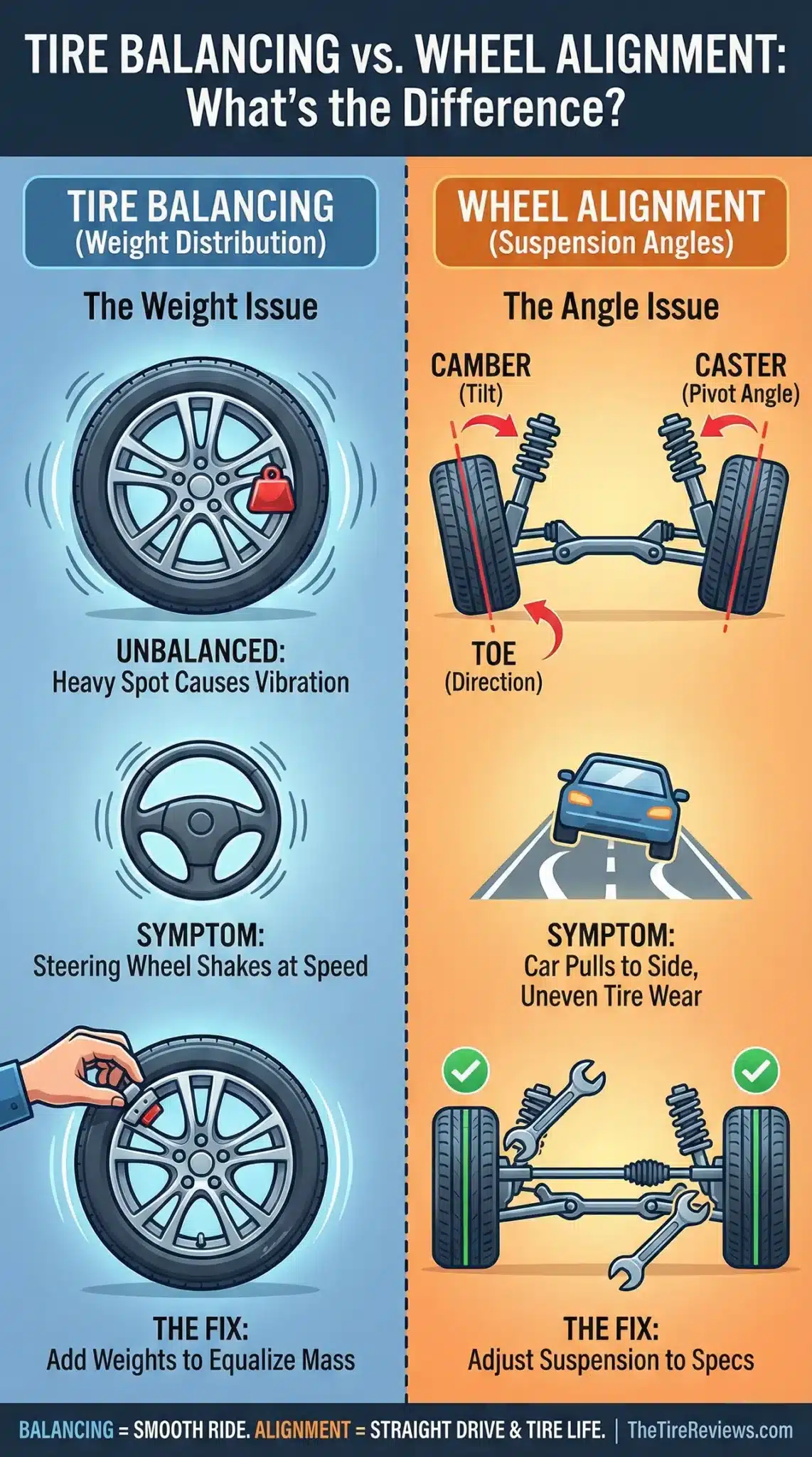
Tire Balancing is the process of equalizing the weight of the combined tire and wheel assembly so that it spins smoothly at high speeds.
Imagine a washing machine. If you throw a heavy wet blanket on just one side of the drum, the machine will bang and shake violently during the spin cycle. This is exactly what happens to your car when a tire is out of balance—but instead of 800 RPM, your tire is spinning at highway speeds.
How It’s Done: The Process
To balance a tire, a technician mounts the wheel on a Dynamic Balancing Machine. This machine spins the wheel to simulate driving speeds and uses sensors to measure exactly where the “heavy spots” are.
- The Fix: The machine tells the technician exactly how much weight to add and where. The tech then attaches small lead, zinc, or steel weights to the rim opposite the heavy spot to cancel it out.
There are two types of weights:
- Clip-On: Hammered onto the lip of steel wheels or older alloy wheels.
- Adhesive (Stick-On): Taped inside the barrel of the wheel. These are used on modern high-end alloy wheels to avoid damaging the face or visible finish.
Symptoms of Unbalanced Tires
- Speed-Specific Vibration: This is the dead giveaway. You feel a vibration that starts at a specific speed (e.g., 60 mph) and might smooth out if you go faster (e.g., 75 mph).
- Steering Wheel Shake: If the front tires are out of balance, the steering wheel will shimmy left and right.
- Seat/Floor Vibration: If the rear tires are out of balance, you will feel the vibration in your seat or through the floorboards.
- Cupped Tire Wear: Over time, the bouncing tire will create “scalloped” dips in the tread. If you spot this specific type of tire wear pattern, it is almost certainly a balance issue.
Part 2: What is Wheel Alignment? (The Geometry of Angles)
While balancing is about the tire and wheel spinning without wobbling, Wheel Alignment is about the suspension system. It has nothing to do with the tire or wheel itself.
Alignment adjusts the angles of the tires—how they sit relative to the road and to each other. Over time, hitting potholes, curbs, or even just regular wear and tear on suspension bushings can knock these angles out of spec.
When a technician performs an alignment, they are adjusting the tie rods, control arms, and struts to bring the wheels back to the manufacturer’s precise geometric specifications.

The “Big Three” Alignment Angles
To understand alignment, you need to understand the three distinct angles that are being measured.
1. Camber (The Lean)
Stand at the front of your car and look at the tires. Camber is the inward or outward tilt of the tire.
- Negative Camber: The top of the tire leans in towards the engine. (Common on race cars for cornering grip).
- Positive Camber: The top of the tire leans out away from the car.
- The Symptom: If your camber is off, you will see smooth, excessive wear on just one edge of the tire (inside or outside shoulder).
2. Toe (The Direction)
Imagine looking at your feet. If you point your toes in, that’s Toe-In. If you point them out like a duck, that’s Toe-Out.
- Toe-In: The fronts of the tires are closer together than the rears.
- Toe-Out: The fronts of the tires are further apart.
- The Symptom: This is the #1 killer of tires. If your toe is off by just 1/8th of an inch, your tires are literally being dragged sideways down the road for every mile you drive. This creates rapid, feathered wear across the tread. It will destroy a set of tires in less than 5,000 miles.
3. Caster (The Stability)
This is the hardest one to visualize. Caster is the angle of your steering axis (the pivot point) when viewed from the side of the car. Think of the front forks on a chopper motorcycle—that extreme angle is “Positive Caster.”
- Positive Caster: The steering axis tilts back toward the driver. This provides straight-line stability and helps the steering wheel return to center after a turn.
- The Symptom: If caster is off, your car will wander on the highway, or the steering will feel “light” and twitchy. It rarely causes tire wear but drastically affects safety and handling.
Symptoms of Bad Alignment
- Vehicle Pulling: You have to constantly fight the steering wheel to keep the car going straight. If you let go, it drifts to the left or right.
- Crooked Steering Wheel: You are driving straight down a flat road, but the logo on your steering wheel is rotated to the 2 o’clock position.
- Squealing Tires: You hear a screeching noise when turning at low speeds (like in a parking garage).
- Uneven Wear: As mentioned, smooth wear on one side or “feathering” across the tread.
Part 3: Balancing vs. Alignment – The Key Differences
The confusion between balancing and alignment often stems from overlapping symptoms. Both can cause a “shaking” steering wheel, but the type of shake is different.
Here is a simple breakdown to help you diagnose your car:
| Feature | Tire Balancing | Wheel Alignment |
| What It Fixes | Weight Distribution (Heavy spots) | Suspension Angles (Camber, Caster, Toe) |
| Primary Symptom | Vibration at specific speeds (e.g., 60-70 mph). | Car pulls to one side; steering wheel is crooked. |
| Secondary Symptom | Cupped (scalloped) tire wear. | Smooth wear on one edge; feathering. |
| When to Do It | Every 5,000-6,000 miles (with rotation). | Every 6-12 months (or after hitting a pothole). |
| The Fix | Adding small metal weights to the rim. | Adjusting tie rods, control arms, and struts. |
| Cost | Low ($15 – $20 per tire). | High ($80 – $150 for 4 wheels). |
The “Speed Test” Trick
If you are unsure which problem you have, take your car on the highway.
- Does the steering wheel shake at 45 mph but smooth out at 65 mph? That is almost certainly a balance issue.
- Does the steering wheel fight you constantly, regardless of speed? That is an alignment issue.
- Does the car drift to the right when you let go of the wheel on a flat road? That is definitely alignment.
Part 4: Advanced Technology – Road Force Balancing
Standard balancing spins the wheel in the air. This is fine for most cars, but it misses one critical factor: The Road.
A tire might be perfectly balanced in terms of weight but still have a “stiff spot” in the sidewall or be slightly out of round. When you put the weight of a 4,000-lb vehicle on it, that stiff spot acts like a speed bump every time it hits the pavement.
Road Force Balancing solves this.
- The Machine: A Road Force Balancer (like the Hunter GSP9700) uses a massive roller that presses against the tire with up to 1,200 lbs of force while it spins.
- The Diagnosis: It measures the “radial force variation” (stiffness) and runout (roundness) of the tire under load.
- The Fix: The machine can tell the technician to rotate the tire on the rim to match the high spot of the tire with the low spot of the wheel (force matching). This cancels out the vibration without adding massive amounts of weight.
Is it worth the extra cost?
Yes, if you have:
- Low-profile tires (e.g., 40-series or lower).
- Large wheels (19-inch+).
- A sensitive luxury car or sports car.
- A persistent vibration that standard balancing hasn’t fixed.
Part 5: Cost Breakdown & Maintenance Intervals
How Much Does It Cost? (2025 Estimates)
- Standard Balancing: $15 – $25 per tire. Most shops include this when you buy new tires. If you are just coming in for a rotate and balance, expect to pay around $60 – $80 for all four.
- Road Force Balancing: $25 – $40 per tire. It takes longer and requires more expensive equipment.
- Wheel Alignment:
- 2-Wheel (Front End): $60 – $90. Suitable for older trucks or cars with solid rear axles.
- 4-Wheel (Thrust Angle): $90 – $150. Required for most modern cars, SUVs, and all-wheel-drive vehicles.
- Lifetime Alignment: $180 – $220. Some chains (like Firestone) offer a “lifetime” deal where you pay once and get free alignments for as long as you own the car. If you plan to keep your car for more than 2 years, this pays for itself quickly.
When Should You Get It Done?
Tire Balancing:
- Every 5,000-6,000 miles: We recommend combining balancing with your regular tire rotation. Doing these together saves time and ensures the tire wears evenly at its new position on the car.
- When you buy new tires: Always.
- If you lose a weight: You might see a clean spot on your dirty rim where a weight used to be.
Wheel Alignment:
- Every 6-12 months: Roads change, suspension settles, and parts wear.
- After new tires: Don’t ruin your $800 investment in 5,000 miles. Get an alignment to ensure they wear evenly.
- After suspension work: If you replace struts, shocks, tie rods, or ball joints, you must get an alignment. The geometry has changed.
- After a hard impact: Hitting a curb, a deep pothole, or a parking block can bend a tie rod instantly.
Part 6: How to Check Alignment at Home (The DIY Guide)
While you cannot perform a precise computerized alignment in your driveway without thousands of dollars of equipment, you can check if your alignment is grossly out of spec using basic tools. This is known as a “rough alignment check” and can save you a trip to the shop if everything looks good.
The String Method (Checking Toe)
This old-school racer’s trick is surprisingly accurate for diagnosing toe issues.
What You Need:
- 4 Jack stands (or sturdy boxes)
- String or fishing line
- Tape measure
- A helper
Steps:
- Set Up the Box: Park on level ground with the steering wheel perfectly straight. Place a jack stand at each corner of the car, a few feet away from the bumpers.
- Run the String: Tie the string to the rear jack stand, pull it tight past the tires to the front stand. Do this on both sides. The string should be parallel to the car and at the height of the wheel center.
- Measure the Distance: Measure from the string to the center of the wheel hub on the front and rear wheels. Adjust the stands until the string is perfectly parallel to the car body (equal distance from the hubs).
- Check the Rim: Now, measure the distance from the string to the front edge of the rim and the rear edge of the rim on the front wheel.
- Equal Distance: Zero Toe (Perfect).
- Front is Smaller: Toe-In (Good for stability).
- Rear is Smaller: Toe-Out (Bad for tire wear).
- Difference > 1/8th Inch: Your alignment is significantly off. Get it checked professionally.
The Penny Test (Checking Camber Wear)
Use a penny to check tread depth across the tire. Insert Abe Lincoln’s head into the tread groove.
- Check the Inside Edge: If you can see all of Lincoln’s head, your tread is worn down.
- Check the Outside Edge: If Lincoln is buried up to his nose, your tread is deep.
- The Diagnosis: A significant difference in tread depth between the inside and outside edge indicates a Camber issue.
The Vibration Isolation Test (Checking Balance)
You can often tell which tire is unbalanced by where you feel the vibration.
- Steering Wheel Shake: The imbalance is in the Front Tires. The vibration travels up the steering column directly to your hands.
- Seat/Floor Shake: The imbalance is in the Rear Tires. The vibration travels through the chassis and body of the car.
- Brake Pedal Pulse: This is not balance or alignment. This is a warped brake rotor.
Part 7: Conclusion – The Final Verdict
So, which one do you need?
- If your steering wheel shakes at highway speeds: Get a Balance.
- If your car pulls to the side or your tires are wearing unevenly: Get an Alignment.
- If you just bought new tires: Get Both.
Think of it this way: Tire Balancing protects your comfort (smooth ride), while Wheel Alignment protects your wallet (tire life).
Ignoring either one is a false economy. Skipping a $80 alignment might save you money today, but it will cost you $800 in ruined tires six months from now. A shaking steering wheel might seem like a minor annoyance, but it is hammering your suspension components—ball joints, tie rods, and wheel bearings—with thousands of damaging impacts per mile.
Don’t wait for the symptoms to get severe. Make balancing and alignment part of your regular maintenance routine, just like oil changes. Your car will drive better, your tires will last longer, and you will be safer on the road.
Frequently Asked Questions (FAQ)
Do I really need an alignment every time I get new tires?
Yes. Think of it as insurance for your new purchase. Even if your old tires wore evenly, the process of mounting new tires and the varying tread depths can highlight minor alignment issues. Spending $80 to protect an $800 investment is smart money.
Can bad alignment cause vibration?
Rarely. Bad alignment usually causes pulling or uneven wear. However, extremely severe misalignment (like a bent tie rod) can cause a “death wobble” or shimmy. But 99% of vibrations are due to balance or bent wheels.
How long does an alignment take?
A standard 4-wheel alignment takes about 60 minutes. If suspension parts are rusted or seized (common in the Rust Belt), it can take longer.
My car pulls to the right. Is it alignment?
Most likely, yes. However, you should check your tire pressure first! A low tire on the right side will cause the car to pull to the right significantly. Also, some roads are “crowned” (higher in the middle) for drainage, which can cause a slight drift. Test on a flat parking lot to be sure.
What causes alignment to go bad?
Three things:
Impacts: Potholes, curbs, accidents.
Wear: Worn ball joints, tie rods, or bushings allow the wheels to wobble.
Modifications: Lowering or lifting a car changes the suspension geometry drastically.
Is “Lifetime Alignment” worth it?
If you plan to keep the vehicle for more than 2-3 years, absolutely. An alignment costs roughly $100. A lifetime package is usually $180-$220. If you get it checked twice a year (as recommended), it pays for itself in the first year.
Can I drive with bad alignment?
You can, but you shouldn’t. It’s not immediately dangerous like bad brakes, but it makes the car unpredictable in an emergency maneuver (like swerving to avoid a deer). It also increases stopping distances and destroys your tires.