
When you mention “performance tires,” the mind immediately drifts to low-slung Italian supercars or nimble German sports coupes.
But what happens when you need high-speed precision, tenacious grip, and aggressive styling for a vehicle that weighs 5,000 pounds and has eight inches of ground clearance?
Welcome back to The Tire Reviews. I’m Mark Harrison, and today we are looking at a tire that helped define an entire automotive segment: the classic Pirelli Scorpion Zero.
The concept of the “Sport Truck” or “Performance SUV” has exploded over the last two decades. We now live in a world where a Porsche Cayenne or a Range Rover Sport can out-accelerate a classic Ferrari.
However, getting a massive, heavy, high-riding vehicle to handle like a sports sedan requires a very specific type of rubber.
Standard passenger-car tires buckle under the immense weight during cornering, and traditional chunky truck tires are far too squishy and noisy for high-speed highway cruising.
As we’ve noted in our comprehensive Pirelli tires review, the brand solved this problem years ago by leveraging their legendary “P Zero” motorsport DNA and injecting it into a robust, truck-capable carcass.
The result was the Scorpion Zero—a Street/Sport Truck All-Season tire designed to provide year-round traction, razor-sharp handling, and undeniable style.
But in a modern market flooded with newer iterations like the Scorpion Zero Asimmetrico and the Scorpion Zero All Season Plus 3, does the original “Z-tread” Scorpion Zero still hold its own?
To find out, I ordered a fresh set from Tire Rack, mounted them on our long-term Range Rover Sport test vehicle, and spent the last few months pushing them to the absolute limit.
From blistering interstate runs to the winding, unpredictable, and often unpaved mountain roads of Montana, we put the Scorpion Zero through a grueling 5,000-mile real-world torture test.
Here is the unvarnished truth about living with the Pirelli Scorpion Zero.
Pirelli Scorpion Zero Review
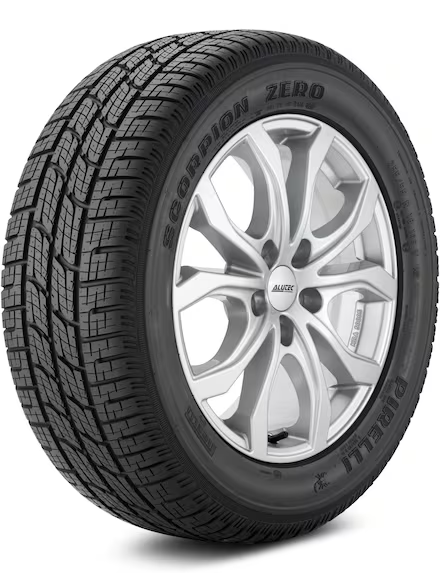
- Razor-sharp steering response and immense dry cornering grip.
- Rock-solid high-speed highway stability.
- Excellent hydroplaning resistance in heavy rain.
- Surprisingly capable traction on gravel and dirt roads.
- Virtually silent operation on smooth asphalt.
- Taut, connected ride quality with well-damped impacts.
- Uniform tread wear thanks to rigid interlocking tread blocks.
- Bold, aggressive “Sport Truck” aesthetic.
Price Check
Check the price of this tire at the following retailers:
TireRack SimpleTire PriorityTire DiscountedWheelWarehouse AmazonDon’t know the correct size tire to purchase? Start here!
- Pirelli Scorpion Zero Review
- Key Takeaways
- The Engineering: What Makes the “Zero” Tick?
- Phase 1: Dry Tarmac and Highway Dynamics
- Phase 2: The Wet Weather Torture Test
- Phase 3: The Light Trail and Gravel Test
- Phase 4: The Winter Reality Check
- NVH (Noise, Vibration, and Harshness) and Comfort
- Treadwear and Value
- The Competitor Landscape
- The Final Verdict
Key Takeaways
- Iconic Sport Truck Handling: The unique interlocking “Z” tread pattern provides immense block rigidity, delivering razor-sharp steering response and stability for heavy SUVs and trucks.
- Confident Wet Performance: Wide circumferential and lateral grooves act as high-speed water pumps, significantly reducing the risk of hydroplaning in heavy rain.
- Light Off-Road Capability: Unlike pure street-only performance tires, the aggressive tread blocks offer surprisingly good traction on loose gravel, dirt roads, and light mud.
- Not for Severe Winter: While M+S rated, the large tread blocks lack the micro-siping needed for deep snow or ice; it should be treated as a three-season tire in northern climates.
- Aggressive Aesthetics: The distinctive tread design provides a muscular, custom look that enhances the visual appeal of performance crossovers and sport trucks.
- Treadwear Expectations: As a grip-focused performance tire, it lacks a mileage warranty; expect robust but ultimately shorter tread life compared to modern eco-touring tires.
The Engineering: What Makes the “Zero” Tick?
Before we dive into the driving dynamics, we need to talk about the physical engineering of this tire, because it is visually and structurally distinct from almost everything else on the road today.
The Iconic “Z” Tread Pattern Depending on the specific width and size you order, the Scorpion Zero features either a single “Z” or a “Double Z” tread block pattern running straight down the intermediate ribs of the tire. This is not just a cosmetic choice to make the tire look aggressive—though it certainly achieves that.
These interlocking Z-shaped blocks serve a critical mechanical purpose. When you turn the steering wheel of a heavy SUV, the lateral forces try to tear the tread blocks apart or fold them over.
The Z-shape allows the blocks to interlock and support each other under heavy cornering loads. This provides immense tread rigidity, which translates directly into the steering wheel as crisp, immediate response rather than the vague, “mushy” feeling you get from standard SUV tires.
The Tread Compound The Scorpion Zero uses a high-performance all-season compound. It is formulated to offer progressive grip—meaning it breaks away predictably at the limit rather than snapping into a sudden slide. While it lacks the advanced silica-rich, extreme-cold-weather polymers of the newest “Plus 3” generation, it is highly durable against the sheer scrubbing forces generated by heavy sport trucks on dry pavement.
Water Evacuation Flanking those aggressive Z-blocks are wide, deep circumferential grooves, coupled with sweeping lateral grooves. Because a wide 20-inch or 22-inch tire acts like a pontoon ski on wet roads, these grooves are absolutely essential for pumping standing water out from under the contact patch, resisting hydroplaning at highway speeds.
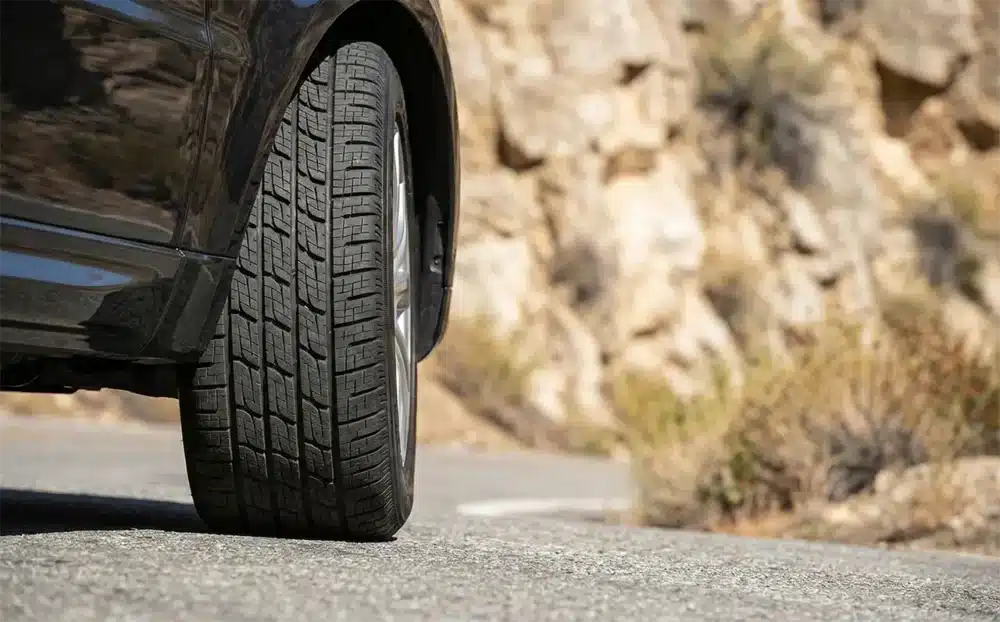
A close-up, highly detailed shot of the Pirelli Scorpion Zero tire, clearly showcasing the unique, aggressive “Double Z” interlocking tread block pattern down the center.
Phase 1: Dry Tarmac and Highway Dynamics
Our testing commenced during a stretch of beautiful, dry weather. For a tire that carries the “Zero” badge, dry handling is the most critical metric.
The immediate sensation when pulling onto the highway is a feeling of immense structural solidity. High-performance SUVs are incredibly sensitive to tire sidewall stiffness.
If you put a standard touring tire on a Range Rover or a BMW X5, the vehicle feels nervous and disconnected at speed. The Pirelli Scorpion Zero, however, features an internal structure bolstered by twin steel belts and spirally wrapped nylon.
Cruising at 80 mph on the interstate, the vehicle tracks as straight as an arrow. It requires virtually no micro-corrections at the steering wheel to stay centered in the lane. The vehicle feels planted, heavy, and secure.
Taking the Range Rover off the highway and onto a ribbon of twisting two-lane blacktop allowed the Z-tread blocks to truly shine. When you initiate a turn, the steering response is startlingly direct for a vehicle of this size.
As weight transfers to the outside wheels in a sweeping corner, those interlocking blocks brace against each other. You can feel a firm, unyielding shelf of grip.
Pushing the vehicle harder reveals the progressive nature of the compound. The Scorpion Zero communicates its limits beautifully.
It doesn’t suddenly let go; instead, it offers a mild, audible tire squeal, letting you know that you are approaching the absolute limit of adhesion. It inspires massive confidence, allowing you to carry speeds through corners that would be terrifying on standard truck rubber.
Phase 2: The Wet Weather Torture Test
An ultra-high-performance tire is a joy in the dry, but the “All-Season” designation means it has to keep you out of the ditch when the skies open up.
During our second month of testing, we drove straight into a torrential downpour that left deep, stagnant pools of water in the highway ruts. Hydroplaning is a terrifying experience in a lightweight sports car; in a 5,000-pound SUV, it is a catastrophic loss of kinetic control.
This is where the Scorpion Zero’s wide circumferential grooves earn their keep. Driving at 65 mph through heavy rain, the hydroplaning resistance proved to be excellent.
Hitting standing water resulted in a momentary, firm tug at the steering wheel, but the tire rapidly sliced through the puddle, pumping massive rooster tails of spray out the rear and instantly regaining its mechanical grip on the tarmac.
Wet braking performance—arguably the most vital safety metric for a daily-driven SUV—is solid. In simulated panic stops from 50 mph on a wet surface, the tire dug in effectively.
While it may not match the absolute wet-stopping distances of Pirelli’s newest, silica-heavy Scorpion Zero All Season Plus 3, it still hauls a heavy vehicle down to zero with reassuring stability and smooth ABS engagement.
If you live in a notoriously rainy climate like the Pacific Northwest or the Gulf Coast, the Scorpion Zero offers more than enough wet-weather security for daily driving.
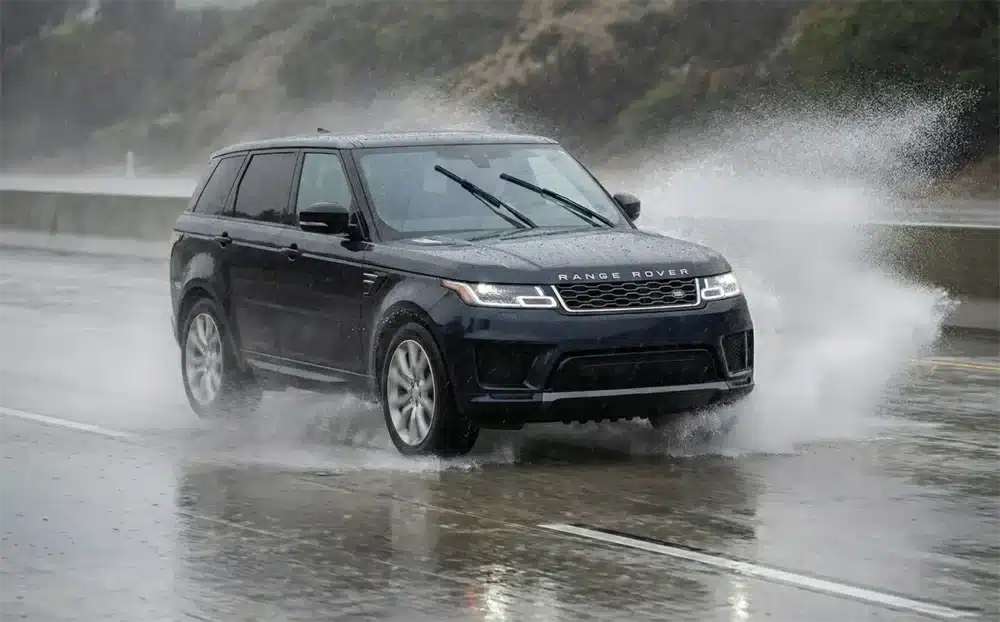
A image of the test vehicle driving at highway speeds through a severe rainstorm, with the Pirelli Scorpion Zero tires displacing large amounts of water from the road surface.
Phase 3: The Light Trail and Gravel Test
Here is where the Scorpion Zero separates itself from pure passenger-car performance tires. Pirelli officially states that the Scorpion Zero is designed to offer “good grip and traction on gravel and grass/mud.”
Living and testing vehicles out here in Montana means our tires have to deal with more than just pristine asphalt. Our daily routes frequently transition from highways to miles of unpaved, washboard gravel roads, dirt trails, and occasionally muddy ranch paths.
Taking an Ultra-High Performance tire onto gravel is usually a recipe for chipped tread blocks and zero traction. However, the Scorpion Zero handled our off-pavement excursions surprisingly well.
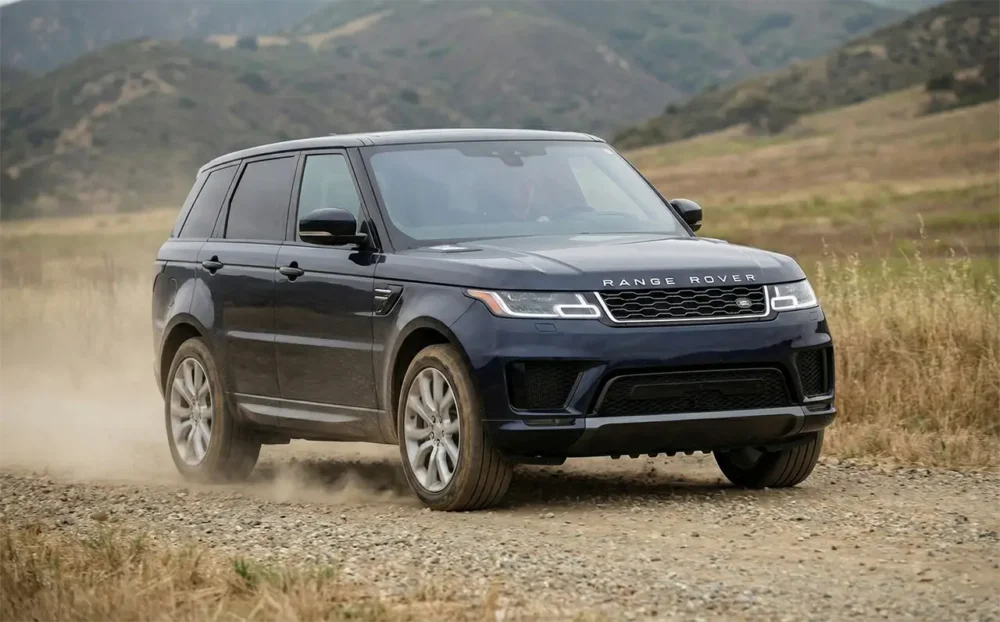
On loose, high-speed gravel roads, the deep Z-blocks acted like miniature paddles. The tire was able to bite into the loose top layer, providing confident steering and preventing the rear end of the SUV from constantly trying to step out and oversteer.
We also ventured down a two-track dirt trail after a brief rainstorm. In light, slick mud and wet grass, the tire managed to find forward momentum. The wide grooves allowed the tire to self-clean moderately well, ejecting the mud rather than turning into a smooth, featureless slick.
To be absolutely clear: The Scorpion Zero is not an All-Terrain tire. If you are planning on rock crawling in Moab or tackling deep, hub-deep mud bogs, you need something like the Pirelli Scorpion All Terrain Plus.
But for the sport-truck owner who needs to confidently navigate a long gravel driveway, a wet grassy field at a car show, or a well-maintained dirt fire road, the Scorpion Zero is remarkably capable.
Phase 4: The Winter Reality Check
The “All-Season” badge in the North American tire market is notoriously vague. It implies year-round capability, but physics always has the final say.
The Pirelli Scorpion Zero carries the M+S (Mud and Snow) rating, indicating that it meets the rubber industry’s geometric requirements for snow traction. However, it does not carry the severe snow service 3PMSF (Three-Peak Mountain Snowflake) symbol.
Our testing window allowed us to experience an early-season cold snap that dropped an inch of light, powdery snow across the valley, followed by a hard freeze.
In a light dusting of fresh powder, the Scorpion Zero relies entirely on the biting edges of its Z-blocks. Because the tread blocks are so large and relatively devoid of dense, microscopic siping (unlike a dedicated winter tire), its snow traction is strictly limited.
Coupled with the Range Rover’s advanced all-wheel-drive system, we were able to accelerate from a stop without excessive wheel spin.
However, when it came to braking and cornering on that same snow, the limits of the Street/Sport Truck compound became glaringly obvious.
The rubber stiffens significantly as temperatures drop below 40 degrees Fahrenheit, reducing its ability to conform to the road.
Braking distances extended dramatically, requiring extremely cautious, early pedal application. Cornering grip was minimal, and the front end of the SUV would readily push wide (understeer) if we carried too much speed into a snowy bend.
On solid, packed ice, the tire offers very little mechanical grip.
The Winter Verdict: If you live in a mild climate where it snows perhaps once a year, and the roads are plowed immediately, the Scorpion Zero will suffice if driven with extreme caution.
However, if you live in the Snowbelt, the Rockies, or Canada, you must treat the Scorpion Zero as a three-season performance tire. Do not attempt to use this tire as a substitute for a dedicated winter setup like the Pirelli Scorpion Winter.
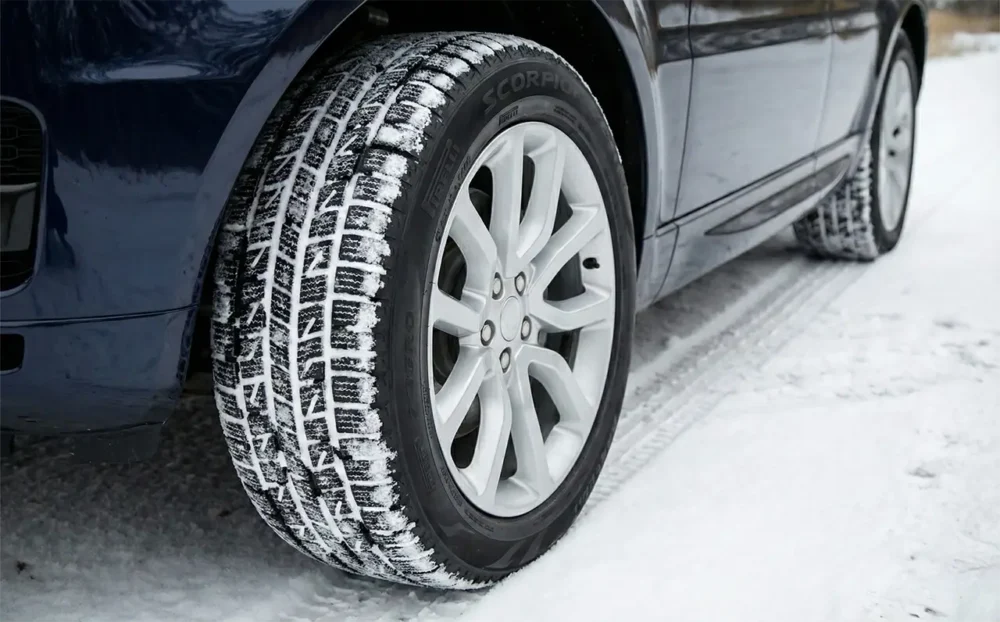
A image of the test vehicle parked on a lightly snow-covered road, showing the Pirelli Scorpion Zero tire tread interacting with the winter surface.
NVH (Noise, Vibration, and Harshness) and Comfort
A common flaw with aggressive, blocky tread patterns is road noise. As large tread blocks slap against the pavement at 70 mph, they trap and compress air, creating a low-frequency drone or a high-pitched whine that can completely ruin the luxurious cabin of a premium SUV.
Pirelli engineered the Scorpion Zero to combine high-speed precision with low noise levels. They achieved this by slightly varying the exact size and pitch of the Z-blocks around the circumference of the tire. This “variable pitch sequencing” scrambles the sound waves, preventing them from amplifying into a noticeable drone.
During our 5,000 miles of testing, the acoustic performance was highly impressive. On fresh blacktop, the tire is virtually silent. On older, grooved concrete highways, you can hear a faint hum, but it is easily masked by the vehicle’s radio at a low volume.
Ride comfort is firmly on the “sport” side of the spectrum. Because the sidewalls are reinforced for heavy cornering, the tire transmits more road texture into the cabin than a standard, squishy touring tire.
When you hit a sharp expansion joint or a pothole, you will feel a distinct, solid “thud.”
However, the impacts are well-damped and never feel harsh or spine-jarring. It provides exactly the type of taut, connected ride quality that driving enthusiasts prefer.
Treadwear and Value
When discussing the original Pirelli Scorpion Zero, it is important to understand its position in the market. As an older, ultra-high-performance design that prioritizes absolute grip and structural rigidity, it does not come with a manufacturer’s treadwear mileage warranty. (Pirelli only offers a Uniformity Warranty for the first year or 2/32″ of wear, and a Workmanship/Materials warranty).
This lack of a mileage warranty is completely standard for tires in the maximum performance and original equipment (OE) categories.
After 5,000 hard miles of testing, we put our test vehicle on a lift and used a tread depth gauge across all four tires. We measured an average wear of just over 1.5/32″ of an inch.
Crucially, the wear was perfectly uniform across the face of the tire, indicating that the interlocking Z-blocks effectively prevent the shoulders from scrubbing away prematurely during aggressive cornering.
Based on our testing and historical data from other drivers, if you rotate these tires religiously every 5,000 miles and ensure your heavy SUV remains in perfect alignment, you can reasonably expect between 25,000 and 35,000 miles of usable life.
While this may seem low compared to a modern 70,000-mile touring tire, it is the necessary trade-off for the massive levels of dry grip and heavy-duty steering response the Scorpion Zero provides.
The Competitor Landscape
To fully evaluate the classic Scorpion Zero, we have to look at how it stacks up against its siblings and competitors.
- Vs. Pirelli Scorpion Zero Asimmetrico: The Asimmetrico was the evolutionary follow-up to the standard Zero. Instead of the symmetrical Z-blocks, it uses an asymmetrical design to further tune handling and noise. The Asimmetrico generally offers slightly sharper steering turn-in on dry roads, while the original Scorpion Zero often feels just a bit more rugged on dirt and gravel due to the deeper, continuous center blocks.
- Vs. Pirelli Scorpion Zero All Season Plus 3: This is Pirelli’s newest, most technologically advanced aftermarket replacement tire for SUVs. If your priority is maximum tread life (it offers a 50k+ mileage warranty), ultra-quiet operation, and better light-snow traction, the Plus 3 is the superior, modern choice. However, the original Scorpion Zero still holds a slight edge in pure, raw steering weight and aggressive, classic “Sport Truck” aesthetics.
- Vs. Michelin Pilot Sport 4 SUV: The Michelin is the undisputed modern king of the performance SUV segment, offering ungodly levels of wet and dry grip. However, the Michelin is strictly a summer tire that cannot be driven in freezing temperatures, and it generally carries a significantly higher price tag than the older Scorpion Zero design.
The Final Verdict
After 5,000 miles of putting the Pirelli Scorpion Zero through its paces, it is easy to see why this tire became a legend in the sport truck community.
It is an unapologetic, purpose-built performance tool. It takes heavy, high-riding vehicles and forces them to obey the laws of physics, delivering steering response, cornering stability, and high-speed confidence that standard SUV tires simply cannot replicate.
Furthermore, its unique Z-tread pattern provides a bold, aggressive aesthetic that perfectly complements the muscular stance of modern sport trucks, while still offering enough versatility to conquer a gravel road or a sudden summer downpour.
It is not a modern, high-mileage eco-tire, and it is certainly not a winter tire. But if you own a performance SUV or a tuned pickup truck, and you want a tire that delivers classic, heavy-duty handling precision with undeniable Italian motorsport flair, the original Pirelli Scorpion Zero remains a highly capable and exciting choice.