
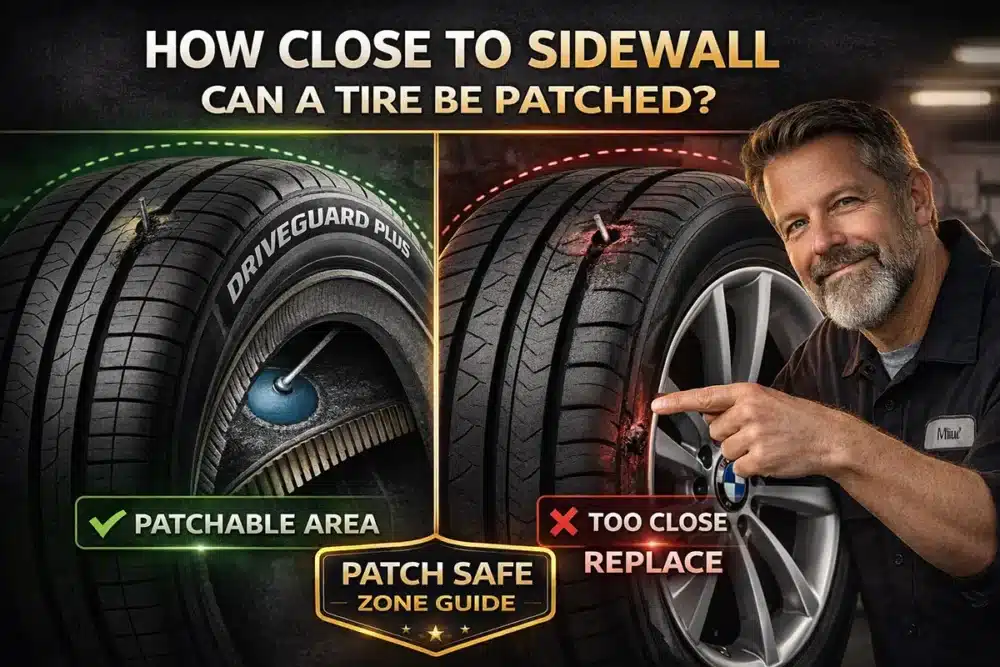
A few years ago, I pulled into my driveway after a long day and noticed my front-left tire looking a little low. I grabbed my pressure gauge, topped it off, and went to bed. The next morning it was flat again.
I pulled the tire off and found the culprit — a roofing nail sitting barely a half-inch from the sidewall edge. That little nail almost cost me $180 for a brand-new tire. Almost.
That experience sent me down a rabbit hole of tire repair standards, manufacturer specs, and long conversations with shop technicians — and what I learned genuinely surprised me.
Most drivers have no idea where the safe repair zone on their tire actually is, or why shops sometimes say a tire “can’t be patched” when it looks totally fine from the outside.
If you’re still navigating the basics of owning and maintaining your vehicle’s rubber, I’d strongly recommend bookmarking this tire buying and maintenance guide alongside this post — it covers everything from choosing the right tire to when to replace it.
In this post, I’m going to walk you through 10 specific rules that determine whether a tire can be patched near the sidewall — rules that tire shops, safety standards, and the Rubber Manufacturers Association (RMA) actually follow. No filler, just the straight answers you need before you hand over your keys.
TL;DR — Quick Answer
- A tire puncture must be at least ½ inch (12mm) from the edge of the tread to be safely patched — many shops require 1 inch.
- The sidewall and shoulder zones can never be patched — ever. Replace the tire.
- The hole must be no larger than ¼ inch (6mm) in diameter.
- Only a proper patch-plug combo from the inside is a permanent, safe repair.
- Plugs alone, sidewall patches, and bead-area repairs are all unsafe and temporary at best.
- When in doubt, ask the tech to show you exactly where the damage sits on the tire before agreeing to a repair.
- Rule 01: The ½-Inch Rule: The Absolute Minimum Distance from the Sidewall
- Rule 02: Understand the Three Zones of a Tire — Only One Can Be Patched
- Rule 03: The Sidewall Can Never Be Patched — Here’s Exactly Why
- Rule 04: The Size of the Puncture Matters Just as Much as the Location
- Rule 05: Not All Punctures Are Eligible — The Type of Damage Determines Everything
- Rule 06: A Plug Alone Is Not a Permanent or Safe Repair
- Rule 07: Driving on a Flat Before Repair Can Make a Patchable Tire Unrepairable
- Rule 08: Run-Flat Tires Follow Different (Stricter) Rules
- Rule 09: How to Assess Your Puncture Location Before You Get to the Shop
- Rule 10: When a Tire Must Be Replaced — No Exceptions
- FAQs: Questions I Get From Readers
- My Final Word on Sidewall Patches
Rule 01: The ½-Inch Rule: The Absolute Minimum Distance from the Sidewall
Let’s start with the number you probably came here for: according to the Rubber Manufacturers Association (RMA) and most major tire manufacturers, a puncture must be located at least ½ inch (12mm) from the inner edge of the tread to qualify for a permanent repair.
Many reputable shops and brands like Michelin actually push that number to 1 full inch to give an extra buffer of safety.
I want to be clear about what “distance from the sidewall” actually means here. We’re talking about the distance from the edge of the usable tread, measured across the tread face — not from the outside rubber wall you can see standing next to your car.
The shoulder area (where the tread begins to curve toward the sidewall) is part of this no-repair zone too. I’ve seen shops misrepresent this to customers, so always ask for clarification.
RMA minimum distance
½ in
12mm from tread edge
Recommended safe buffer
1 in
25mm — most pro shops
Max repairable puncture size
¼ in
6mm diameter
My tip
When I’m at the shop, I always ask the technician to lay the tire flat and point to exactly where the hole sits. A good shop will do this without hesitation. If they can’t or won’t, that’s a red flag.
Rule 02: Understand the Three Zones of a Tire — Only One Can Be Patched
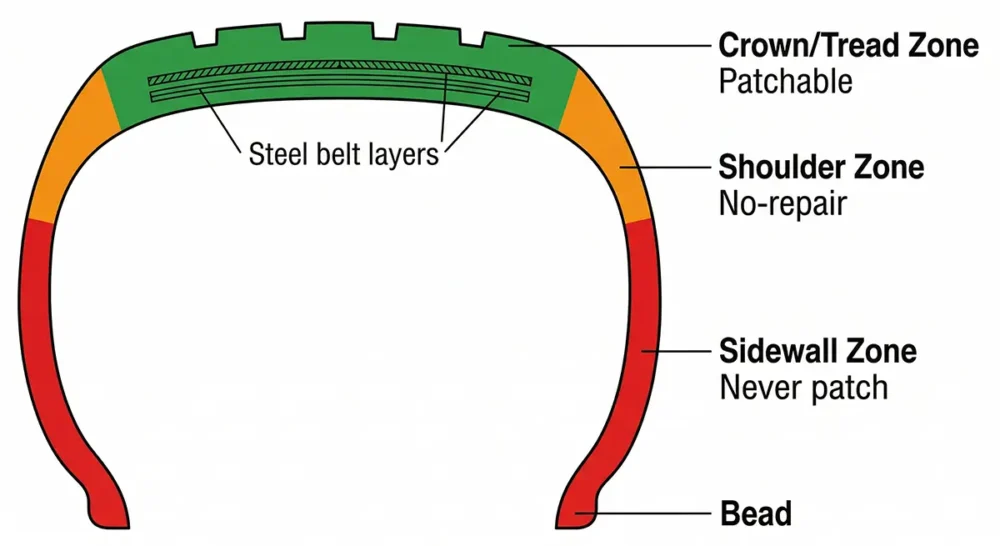
Cross-section of a typical passenger tire showing the three zones. Only damage within the crown/tread area can be permanently repaired.
One of the most useful things I ever did was actually learn the anatomy of a tire. Once you understand the three distinct zones, the patching rules start to make intuitive sense. Here’s how they break down:
| Zone | Location | Can it be patched? | Why |
|---|---|---|---|
| Crown / Tread Area | The flat, road-contact surface in the middle of the tread | Yes — if within limits | Reinforced with steel belts; patch stays supported under load |
| Shoulder Area | Where the tread starts to curve toward the side | No | High-flex zone; patch won’t hold; structural risk |
| Sidewall | The vertical side of the tire | Never | Constantly flexes; no steel belt support; catastrophic failure risk |
The crown area — the portion directly contacting the road — is reinforced with steel belts. Those belts give a patch something rigid to hold against.
The moment you move toward the shoulder or sidewall, you’re in an area that flexes dramatically with every rotation. A patch in that zone will either fail immediately or, worse, hold long enough to give you false confidence before letting go on a highway.
Rule 03: The Sidewall Can Never Be Patched — Here’s Exactly Why
I cannot stress this enough: there is no such thing as a safe sidewall patch. I’ve seen “sidewall repair” kits sold at auto parts stores, and they are, frankly, dangerous products. Let me explain the physics of why this is true.
A tire sidewall flexes thousands of times per mile. As the tire rotates, the sidewall compresses and expands constantly under the weight of your vehicle.
This flexing is by design — it’s what gives your tire its ride comfort and handling characteristics. But it also means that any patch or plug applied to the sidewall is subject to relentless mechanical stress that will work it loose — usually faster than you’d expect.
On top of that, the sidewall has no steel belt reinforcement. In the tread area, the steel belts hold the interior cords in tension and give a patch a solid, stable surface to bond to.
In the sidewall, you’re bonding to a layer of rubber-covered nylon or polyester cords with nothing behind them. The patch has no structural backing, and it will eventually peel away.
Safety warning
If a tire shop offers to patch your sidewall damage, walk away. This is not a legitimate repair — it’s a liability. A sidewall blowout at highway speed is one of the most dangerous tire failures you can experience. When the sidewall is compromised, the only safe answer is a new tire.
Rule 04: The Size of the Puncture Matters Just as Much as the Location
Even if a puncture is perfectly centered in the tread zone, it may still be irreparable depending on size. The industry standard maximum puncture diameter that can be permanently repaired is ¼ inch (6mm).
Anything larger than that — even in an ideal location — compromises too much of the tire’s structural integrity for a patch to restore it safely.
In practice, most nail and screw punctures fall well under this limit. The typical roofing nail or drywall screw creates a hole of about 3–4mm — well within the repairable range.
The trouble starts with larger bolts, jagged metal debris, or potholes that cause impact damage. When I’ve seen holes from larger hardware or road debris, they’re almost always over the ¼-inch limit, and at that point, you’re buying a new tire.
One thing I’ve learned: never try to estimate puncture size from the outside of the tire. The rubber closes around a nail and can make a ¼-inch hole look like a tiny pinhole. The technician needs to remove the object and measure from the inside, after dismounting the tire.
Rule 05: Not All Punctures Are Eligible — The Type of Damage Determines Everything
Location and size are only two sides of the triangle. The third is the type of damage. Here’s how different damage types stack up when it comes to repairability:
| Damage type | Repairable? | Notes |
|---|---|---|
| Nail / screw puncture (tread center) | Yes | Most common repairable scenario; patch-plug required |
| Nail / screw puncture (near shoulder) | No | Within ½–1 inch of tread edge; replace tire |
| Sidewall puncture (any) | Never | No exceptions; replace tire |
| Sidewall bulge or bubble | Never | Internal belt separation; blowout risk; replace immediately |
| Run-flat damage | No | Most manufacturers say unrepairable after run-flat event |
| Impact break (pothole) | No | Causes internal cord damage not visible externally |
| Multiple punctures, tread zone | Maybe | Allowed only if patches don’t overlap; max 2 per tire |
A sidewall bulge deserves special mention because I’ve had readers ask me whether that can be “deflated” and patched. The short answer: absolutely not.
A bulge is caused by internal cord separation — the steel or fabric cords inside the tire have broken, and air is pushing the outer rubber layer outward. That’s a structural failure, not a puncture. That tire needs to come off the car immediately.
Rule 06: A Plug Alone Is Not a Permanent or Safe Repair
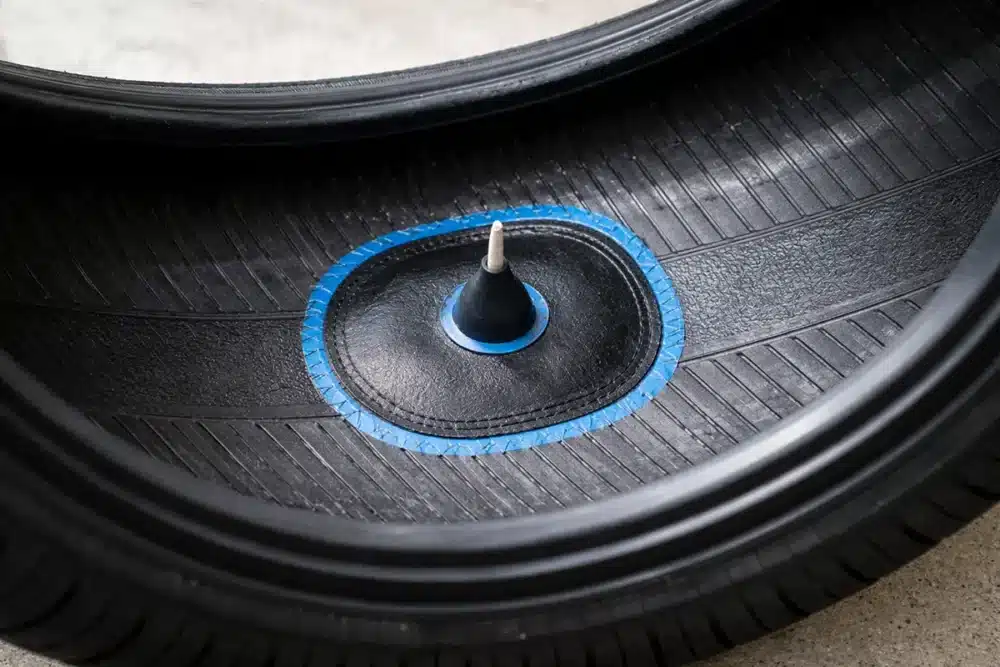
A proper combination plug-patch repair as seen from inside a dismounted tire. The mushroom-shaped unit fills the puncture channel and seals the inner liner simultaneously.
If you’ve ever had a quick tire repair at a gas station or budget shop where the technician stuck a rubber rope into the hole from the outside without removing the tire — that’s a plug-only repair, and it’s not a permanent fix. I want to be direct about this because the topic comes up all the time.
The RMA, Tire Industry Association (TIA), and virtually every major tire manufacturer agree: the only acceptable permanent tire repair is a combination plug-patch applied from the inside, after the tire has been removed from the wheel and inspected internally. Here’s the difference between the three common approaches:
Plug only (external)
Temporary
No internal inspection; may mask damage
Patch only (internal)
Better, but
Seals liner but doesn’t fill the void in casing
Plug-patch combo (internal)
Permanent
Fills hole + seals liner; industry standard
I’ve driven on external plug repairs and honestly, for short-term emergencies they’re fine for getting you to a proper shop. But I’d never rely on one for longer than a day or so. The plug can work loose, doesn’t address potential internal damage, and doesn’t seal the inner liner properly.
What to ask at the shop
Ask specifically: “Are you going to remove the tire from the rim and repair it from the inside with a combination patch?” If the answer is no, ask why — or find a shop that will do it right.
Rule 07: Driving on a Flat Before Repair Can Make a Patchable Tire Unrepairable
Here’s a rule that has nothing to do with where the nail is — and everything to do with what you did after you noticed the nail.
If you drove more than a short distance on a significantly underinflated or flat tire, you may have caused internal damage that disqualifies an otherwise perfectly positioned puncture from being repaired.
When a tire runs flat or severely underinflated, the sidewalls flex far beyond their designed limits. This generates tremendous heat and can cause the rubber compounds to delaminate, the cords to crack or separate, and the inner liner to break down. None of this is visible from the outside of the tire.
The technician will inspect the inside of the tire for signs of heat damage — a brownish or burnt appearance on the inner liner is the telltale sign. I’ve seen perfectly centered nail punctures that were unrepairable because the car had been driven even a quarter-mile on a completely flat tire.
What to do instead
The moment you notice a flat or suspect a slow leak, pull over safely and immediately. Use a can of temporary inflator (like Fix-a-Flat) only as a last resort to get you off the highway — be aware this can make the tire harder to repair and may void some warranties. Better yet, swap to your spare right then and there.
Rule 08: Run-Flat Tires Follow Different (Stricter) Rules
If you’re driving a vehicle equipped with run-flat tires — common on BMWs, Mini Coopers, and many newer Cadillacs and Chevrolets — the rules change significantly.
Most run-flat tire manufacturers, including Bridgestone (DriveGuard), Michelin (Zero Pressure), and Continental (SSR), state that run-flat tires should not be repaired after a run-flat event.
The reinforced sidewall that makes run-flat tires capable of running at zero pressure for up to 50 miles at 50 mph is also what makes them impossible to fully inspect after such an event.
The extended flex creates internal stresses that can’t be observed from the outside, even with a proper internal inspection.
This is admittedly frustrating from a cost perspective — run-flat tires are significantly more expensive than standard tires, often running $200–$350 per tire for popular sizes.
But driving on a compromised run-flat is a genuine safety risk, and I can’t recommend it. Some newer run-flat designs are coming to market that allow limited repairs under specific conditions, but these are not yet widespread.
Always check your specific tire manufacturer’s published repair guidelines.
Rule 09: How to Assess Your Puncture Location Before You Get to the Shop
You don’t need to be a tire technician to make a rough preliminary assessment of whether your tire is likely repairable. Here’s what I do whenever I find a nail or suspect a puncture:
First, I look at where the nail is sitting relative to the tire’s tread width. If the nail is centered — or even within the outer third of the tread on either side — I’m cautiously optimistic.
If it’s sitting in the curving part of the tire where the tread starts to slope toward the sidewall, my expectation shifts toward replacement.
I also look at the shape of the object. A roofing nail or drywall screw punching straight into the tread at roughly a 90-degree angle is the most favorable scenario.
A nail that entered at a sharp diagonal angle creates a much larger channel through the tire’s body, and may cross the repairable zone even if the entry point looks acceptable.
Here’s the visual test I use: I place my thumb at the edge where the tread meets the sidewall and fan my finger inward about an inch.
If the puncture falls within that inch, I already know the shop is likely to recommend replacement. If it’s clearly in the center tread region, I drive to the shop with confidence.
Quick field assessment checklist
- Is the puncture in the center of the tread, not near the curve? Good sign.
- Is the object (nail/screw) perpendicular to the tread surface? Good sign.
- Does the nail look small — under ¼ inch across? Good sign.
- Is the tire still holding most of its air (slow leak, not flat)? Good sign.
- Did you drive far on a flat tire? May be irreparable regardless of location.
- Is there any visible sidewall damage, bubbling, or cracking? Replace immediately.
Rule 10: When a Tire Must Be Replaced — No Exceptions
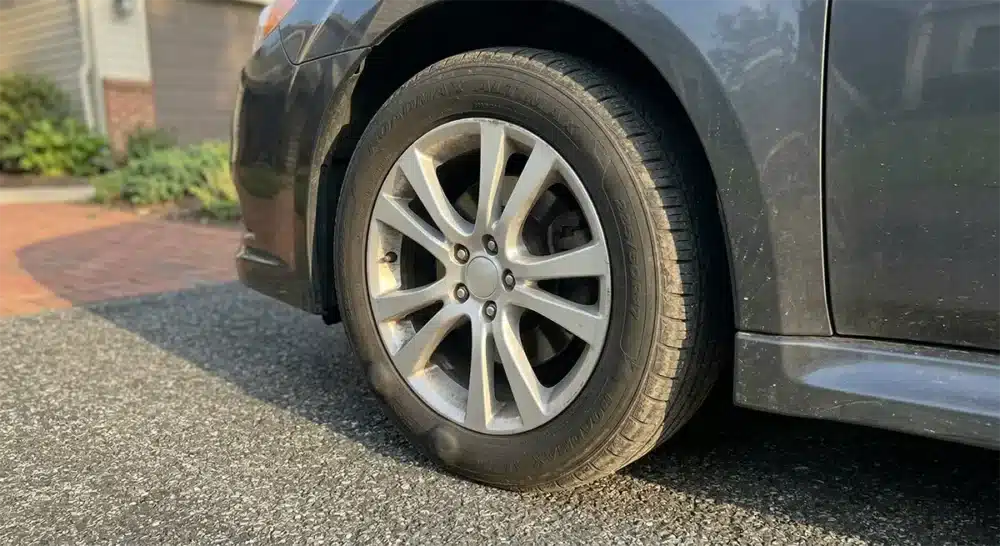
A sidewall bulge like this — no matter how small — is a non-negotiable replacement situation. This indicates internal belt separation and is a blowout waiting to happen.
All the rules above converge into a simple decision matrix: is this tire repairable, or does it need to go? I want to leave you with a clear summary of the situations where replacement is not optional, no matter what a budget shop might tell you:
| Scenario | Decision |
|---|---|
| Puncture within ½ inch of tread edge | Replace |
| Any sidewall puncture | Replace |
| Sidewall bulge or bubble | Replace immediately |
| Puncture larger than ¼ inch (6mm) | Replace |
| Run-flat driven after pressure loss event | Replace |
| Driven far on flat (severe heat damage) | Replace |
| More than 2 previous patches on same tire | Replace |
| Tread worn below 2/32 inch | Replace |
| Puncture center of tread, under ¼ inch, proper PSI maintained | Repair eligible |
I know replacement feels like the shop is trying to upsell you. Sometimes that’s true — I won’t pretend otherwise. But when I’ve looked at the scenarios above, the safety case for replacement is legitimate.
A tire failure at highway speed is a $180 problem that can turn into a catastrophic one. The math isn’t hard.
FAQs: Questions I Get From Readers
Can a tire be patched on the inner sidewall edge?
No. The inner sidewall follows the same rules as the outer sidewall. Any sidewall surface — interior or exterior — is a no-repair zone. The ½-inch minimum applies from the tread edge inward, regardless of which wall the edge is nearest to.
My shop said the puncture is in the “grey area” — what does that mean?
This typically means the puncture is in the shoulder zone or within about ½–¾ inch of the tread edge — technically outside the safe repair zone but close enough that some shops will make the call on a case-by-case basis. I’d recommend erring on the side of caution and replacing the tire. Ask a second shop for their opinion if you’re uncertain.
How long does a proper tire patch last?
A correctly installed combination plug-patch in the safe tread zone is designed to last the remaining life of the tire. You should never need to re-repair that puncture. If you’re having recurring air loss after a professional repair, the seal has failed and the tire should be replaced.
What’s the cost difference between a patch repair and replacing the tire?
A professional patch repair typically runs $15–$40 at most shops. A new tire for a standard passenger vehicle ranges from $80 to $250+ depending on size and brand. That cost difference is real, but it shouldn’t be the deciding factor — safety requirements should be.
Can I patch a tire that has two punctures?
Yes, under specific conditions. Both punctures must be in the safe tread zone, both must be under ¼ inch, and the patches must not overlap each other. Most standards limit a tire to a maximum of two repairs total over its lifetime. Three or more prior repairs, or any repairs that would cause overlapping patches, means it’s time for a new tire.
My Final Word on Sidewall Patches
After years of reviewing tires and talking to technicians across the country, my honest takeaway is this: tire repair rules exist because tire failures are genuinely dangerous — not because shops want to sell you new tires (though some do). The ½-inch rule, the sidewall no-repair rule, and the plug-patch standard all come from hard data on how tires fail and what causes blowouts.
The most empowering thing I can tell you is to learn your tires. Know what the tread zone looks like, understand where the shoulder begins, and don’t let anyone talk you into a sidewall patch or a sloppy plug-only repair. If a shop is pushing back on these basics, find a better shop.
And if you’re ever staring down a repair bill that feels unjustified, remember: a tire is the only thing between 3,000 pounds of vehicle and the road. It’s not the place to cut corners.
About this article: This post reflects industry standards from the Rubber Manufacturers Association (RMA) and Tire Industry Association (TIA) guidelines, as well as repair specifications published by Michelin, Bridgestone, and Continental. Individual tire manufacturers may have specific repair restrictions for certain tire models — always consult your tire’s documentation or manufacturer website for model-specific guidance. Nothing in this post constitutes professional mechanical advice; when in doubt, consult a certified tire technician.

Money grab by retail tire sellers and manufacturers. If a simple nail or screw hole with no significant structural damage to the tire, previously repaired these for 30 years and never experienced an issue. Ridiculous rule …