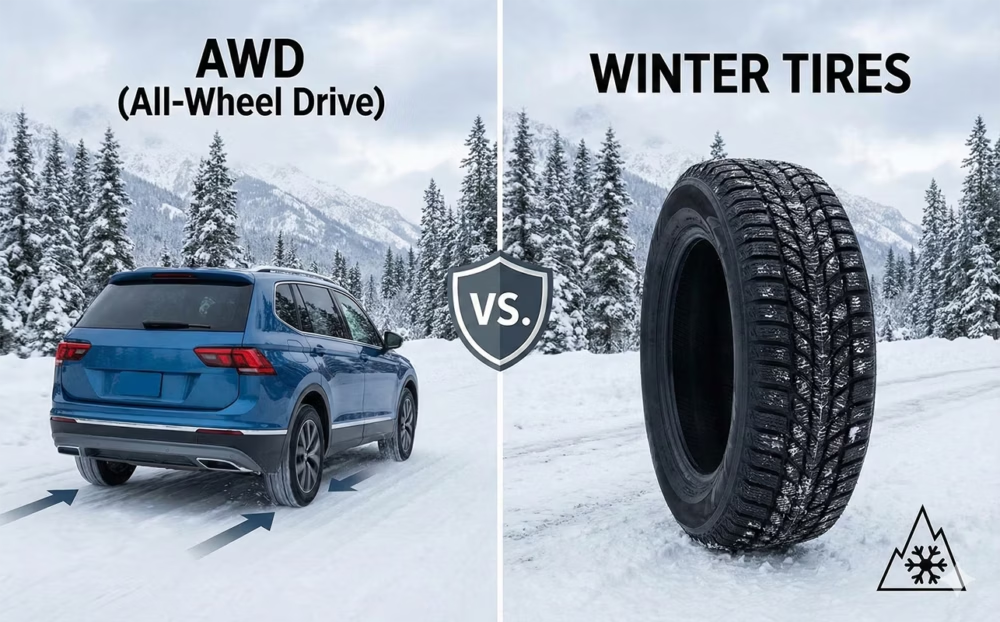
The crisp air, the falling snowflakes, the picturesque white landscapes – winter driving can be beautiful, but it’s also fraught with peril. As temperatures drop and precipitation increases, the roads transform into a treacherous ballet of slick surfaces. In this challenging environment, many drivers rely on the perceived invincibility of their all-wheel-drive (AWD) vehicles, believing it’s the ultimate security solution against winter’s wrath.
However, this widespread belief is a dangerous misconception, a form of malformed data in a driver’s risk assessment. Much like a site owner might overlook critical vulnerabilities, assuming their basic defenses are sufficient against online attacks, many drivers place undue faith in AWD alone, leaving them unprepared for the true demands of winter.
The reality is far more nuanced: AWD is a powerful tool, but it’s not a complete security service. This article aims to dissect the myth, illuminate the science, and provide a clear path toward genuine winter driving safety, ensuring you can navigate the snow and ice with confidence, not just a false sense of security.
- The Allure of All-Wheel Drive in Winter
- The Core Misconception: Why AWD Alone Isn’t Enough
- Article Thesis: AWD Helps You Go, Winter Tires Help You Go, Turn, and Stop Safely
- Understanding All-Wheel Drive (AWD): Capabilities and Core Limitations
- The Science of Winter Tires: Engineered for Cold, Snow, and Ice
- Specialized Rubber Compounds: Maintaining Flexibility in Freezing Temperatures
- Aggressive Tread Design: Biting into Snow and Evacuating Slush
- The Role of Sipes: Enhanced Grip on Snow-Packed Ice
- Why All-Season Tires Fail in Winter: Hardening Compounds and Compromised Tread
- The Three-Peak Mountain Snowflake (3PMSF) Symbol: What it Means for Winter Safety
- The Critical Comparison: Real-World Scenarios and Performance Differences
- Beyond Equipment: The Paramount Role of Driver Actions and Comprehensive Preparation
- Defensive Driving in Winter Weather: Reducing Speed and Increasing Following Distance
- Gentle Inputs: Smooth Steering, Braking, and Acceleration to Maintain Traction
- Understanding Vehicle Dynamics: How Anti-Lock Brakes and Stability Control Interact with Tire Grip
- Essential Winter Vehicle Maintenance:
- Planning and Awareness: Knowing When to Stay Home or Drive with Extreme Caution
- Preparing for the Unexpected: Emergency Kits for Snowstorms and Remote Travel
- The Investment in Safety: Cost-Benefit Analysis of Winter Tires
- Conclusion: Dispelling the Myth, Embracing the Truth for Safer Winter Driving
- FAQs
The Allure of All-Wheel Drive in Winter
All-wheel drive (AWD) has become increasingly popular, particularly in regions that experience winter weather. The automotive all-wheel drive market size in 2026 is estimated at $40.14 billion, growing from 2025 value of $37.44 billion with 2031 projections showing USD 56.82 billion, growing at 7.20% CAGR over 2026-2031 [Mordor Intelligence, 2025].
This growth underscores the appeal of AWD for consumers seeking enhanced capability in challenging conditions. The primary draw is the system’s ability to send power to all four wheels simultaneously, providing superior traction compared to two-wheel-drive (2WD) systems when accelerating or climbing inclines on slippery surfaces.
This advantage is particularly noticeable when starting from a standstill on ice or packed snow, or when ascending steep, snowy hills. The feeling of being firmly planted, of having an extra layer of grip, instills a sense of confidence. For many, the investment in an AWD vehicle is seen as a proactive security solution against the unpredictability of winter roads, a way to preemptively address the risks associated with snow and ice.
The Core Misconception: Why AWD Alone Isn’t Enough
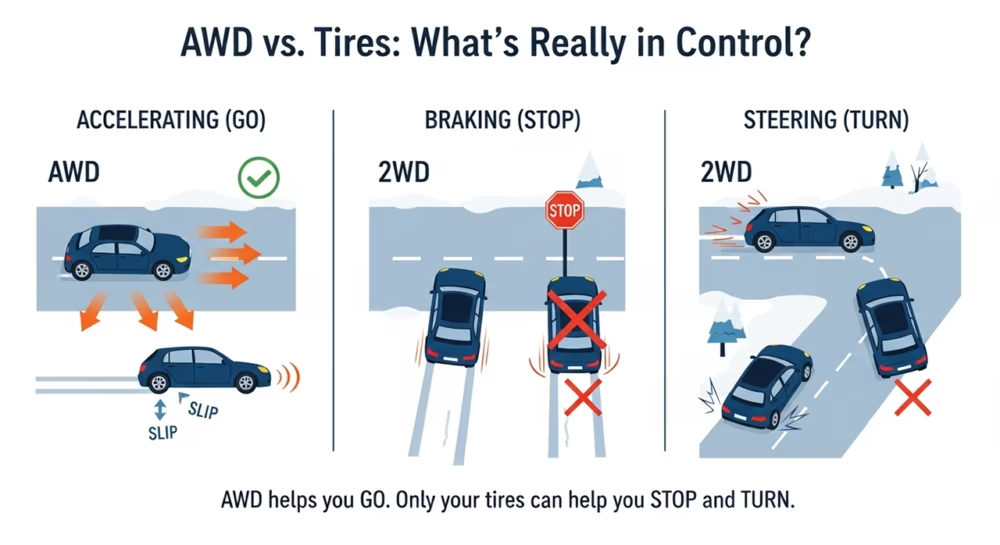
While AWD provides a clear advantage for acceleration on slick surfaces, it offers no benefit for braking or steering, which are entirely dependent on tire grip.
The fundamental flaw in the “AWD is invincible” myth lies in what it actually enhances: forward momentum. AWD systems are primarily designed to improve acceleration and initial grip on slippery surfaces. They excel at getting vehicles moving from a stop or maintaining forward progress on low-traction surfaces.
However, they do very little to improve the vehicle’s ability to steer or stop. This is where the critical danger lies. While your AWD vehicle might feel eager to get going, its tires are still the sole contact points with the road.
If those tires are not designed for cold temperatures and snow, they will perform poorly when it’s time to slow down or change direction. The allure of AWD can create a dangerous illusion, much like a site owner believing a firewall alone is a complete security service against all online attacks. The reality is that AWD only addresses part of the winter driving equation.
Article Thesis: AWD Helps You Go, Winter Tires Help You Go, Turn, and Stop Safely
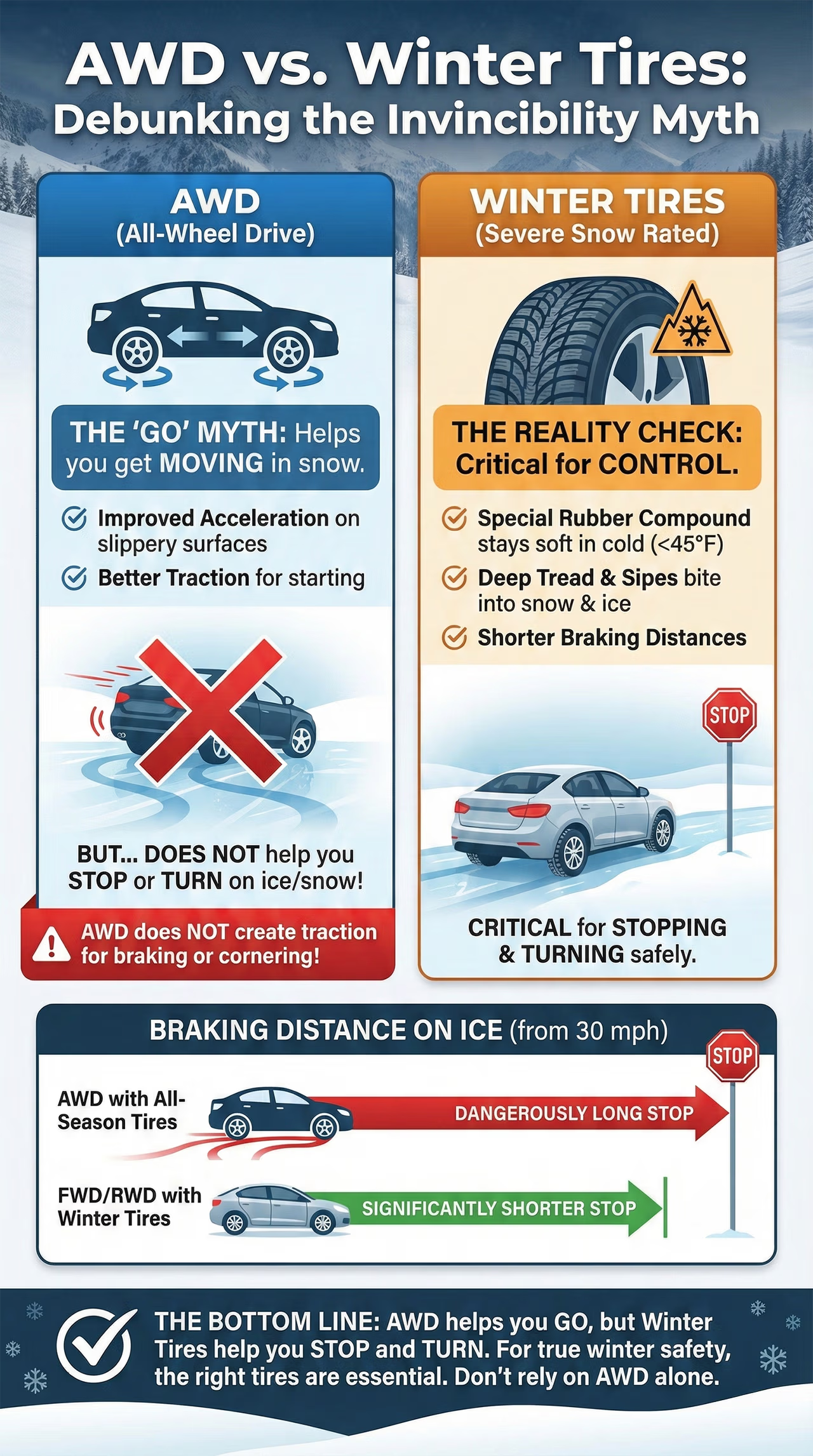
The essential truth of winter driving can be distilled into a simple, yet vital, thesis: AWD systems help you go; winter tires help you go, turn, and stop safely. AWD enhances your ability to apply power to the ground, improving acceleration on slick surfaces. It’s a significant advantage for forward motion.
However, it does not magically improve the grip of your tires when you need to brake or maneuver. This is where winter tires become indispensable.
Engineered with specific compounds and tread designs, winter tires are the only security solution that directly addresses the challenges of cold, snow, and ice for all critical aspects of driving: acceleration, braking, and cornering. Without appropriate tires, even the most sophisticated AWD system operates with a fundamental vulnerability, leaving drivers susceptible to loss of control.
Understanding All-Wheel Drive (AWD): Capabilities and Core Limitations
All-wheel drive is a drivetrain that distributes power to all four wheels of a vehicle. This can be a permanent system, where all wheels are always driven, or an on-demand system, where power is sent to the rear or front wheels only when slippage is detected. The goal is to maximize traction by ensuring that if one or more wheels lose grip, power can be rerouted to the wheels that still have it. This is why AWD excels in situations requiring forward propulsion on slippery surfaces.
How AWD Systems Work: Distributing Power for Traction
Modern AWD systems are sophisticated, often utilizing electronic sensors to monitor wheel speed, throttle position, and steering angle. When slip is detected at a wheel, the system can instantaneously adjust power distribution. For instance, if the front wheels start to spin on ice, the system can send more power to the rear wheels, which may have better grip. This dynamic power allocation helps maintain forward momentum, making it easier to get moving and climb hills in snow or slush. This is an undeniable benefit for drivers facing difficult terrain.
The “Going” Advantage: Improved Acceleration on Slippery Surfaces
The most significant benefit of AWD in winter is its ability to improve acceleration. On a slick surface, a 2WD vehicle might spin its drive wheels, losing precious momentum. An AWD system, by distributing power to all four wheels, can significantly reduce wheel spin and allow the vehicle to accelerate more effectively. This can be crucial when merging into traffic, navigating intersections, or climbing steep, snow-covered inclines. It feels like a powerful security solution against getting stuck.
Where AWD Falls Short: Braking, Turning, and Lateral Grip
Here lies the critical limitation: AWD systems do not influence the vehicle’s ability to brake or turn. The forces of deceleration and lateral movement (cornering) are entirely dependent on the vehicle’s tires and the driver’s input. While AWD might help you get moving on ice, it does nothing to shorten the distance required to stop once you apply the brakes. Similarly, during a corner, the tires are responsible for providing the lateral grip to keep the vehicle on its intended path. If the tires lack adequate traction, the AWD system cannot compensate, and the vehicle can easily lose control. This is analogous to a cybersecurity system that can detect an intruder (AWD detecting slip) but cannot physically stop them from accessing sensitive data (the vehicle itself) once they’re inside.
The Psychological Trap: Overconfidence and Increased Risk for Drivers
One of the most insidious dangers associated with AWD is the psychological effect it has on drivers. The enhanced sense of grip and control, particularly during acceleration, can lead to overconfidence. This overconfidence can manifest as driving faster than conditions warrant, following other vehicles too closely, or attempting maneuvers that would be considered reckless in a 2WD vehicle. Less than 15 percent of AWD or 4WD vehicle drivers equipped their vehicles with winter tires [Consumer Reports, 2023]. This statistic highlights a concerning reality: many AWD owners underestimate their vehicle’s limitations. This false sense of security, akin to a site owner believing their basic defenses are a foolproof security solution against sophisticated online attacks, can lead to higher-risk driving behaviors, ultimately increasing the likelihood of an accident. This is where the malformed data in perception becomes hazardous, transforming a helpful feature into a potential trap.
The Science of Winter Tires: Engineered for Cold, Snow, and Ice
While AWD tackles the challenge of power delivery, winter tires are engineered to master the fundamental interaction between the vehicle and the road surface in freezing temperatures. They are not merely tires with a different tread pattern; they are sophisticated pieces of safety equipment designed from the ground up for winter conditions.
Specialized Rubber Compounds: Maintaining Flexibility in Freezing Temperatures
The most crucial difference between winter tires and their all-season counterparts lies in their rubber compound. All-season tires are designed to perform adequately across a wider temperature range but harden significantly in cold weather. This hardening reduces their flexibility and, consequently, their ability to conform to the road surface, drastically diminishing traction. Winter tires, on the other hand, are made with a high-silica compound that remains flexible and pliable even in sub-freezing temperatures. This flexibility allows the tire to maintain optimal contact with the road, whether it’s cold asphalt, ice, or snow, ensuring consistent grip and predictable handling.
Aggressive Tread Design: Biting into Snow and Evacuating Slush
Winter tire tread patterns are distinctively aggressive. They feature deeper grooves and larger tread blocks than all-season tires. These deep grooves are designed to effectively channel away snow and slush, preventing hydroplaning and maintaining contact with the road surface. The larger tread blocks are shaped to “bite” into the snow, creating microscopic sipes that act like cleats, providing enhanced grip. This biting action is essential for both acceleration and braking on packed snow and icy surfaces.
The Role of Sipes: Enhanced Grip on Snow-Packed Ice
A defining characteristic of winter tires is the presence of thousands of tiny slits or channels called sipes. These sipes are meticulously designed into the tread blocks. On icy or packed snow surfaces, these sipes create thousands of biting edges, acting like miniature claws that grip the road. During braking and acceleration, they help to evacuate water and slush from the contact patch, further enhancing traction. Without these sipes, the tire would simply skim over the ice, rendering any AWD system ineffective.
Why All-Season Tires Fail in Winter: Hardening Compounds and Compromised Tread
All-season tires are a compromise. Their rubber compounds harden significantly below 7°C (45°F), losing their elasticity and grip. Their tread designs are optimized for a balance of wet, dry, and light snow conditions, but they lack the deep grooves and biting edges necessary for serious winter performance. As a result, all-season tires offer very limited traction in true winter conditions. Driving.ca [Source 5] aptly states that all-seasons offer “rare traction in winter.” When encountering significant snow or ice, the performance of an all-season tire on an AWD vehicle is dramatically compromised, negating much of the AWD’s benefit, particularly for critical functions like braking.
The Three-Peak Mountain Snowflake (3PMSF) Symbol: What it Means for Winter Safety
When selecting winter tires, look for the Three-Peak Mountain Snowflake (3PMSF) symbol. This symbol, often depicted as a snowflake within a mountain silhouette, is a certification indicating that the tire has met specific performance requirements in snow testing. Tires with the 3PMSF symbol are designed to provide superior traction, handling, and braking capabilities in severe winter conditions, including deep snow and ice. While tires marked “M+S” (Mud and Snow) may offer some improvement over all-season tires, the 3PMSF symbol is the definitive indicator of true winter performance and a crucial aspect of any effective security solution for drivers.
The Critical Comparison: Real-World Scenarios and Performance Differences
Understanding the theoretical advantages and disadvantages is one thing; seeing them play out in real-world scenarios is another. The combination of AWD and tires significantly dictates a vehicle’s performance in winter.
AWD with All-Season Tires: The Illusion of Security
Many drivers mistakenly believe their AWD vehicle equipped with all-season tires is fully prepared for winter. In reality, this combination offers an illusion of security. While the AWD may help you accelerate from a stop on a moderately snowy road, its limitations become starkly apparent during braking or sharp turns. On an icy patch, attempting to brake could result in a prolonged stopping distance, as the tires struggle to find grip. A sudden steering input might lead to understeer or oversteer, as the tires lack the necessary lateral traction to guide the vehicle. This scenario is akin to a security service that can detect a threat but is incapable of neutralizing it, leaving the site owner vulnerable to significant damage.
2WD (FWD/RWD) with Winter Tires: Surprising Safety Advantages
A rear-wheel-drive (RWD) or front-wheel-drive (FWD) vehicle equipped with proper winter tires can, in many situations, offer superior safety and control compared to an AWD vehicle running on all-season tires. Winter tires provide the essential grip for braking and turning, which are often the most critical factors in avoiding accidents. While a 2WD vehicle might struggle more with initial acceleration on steep, icy inclines, its ability to stop and steer predictably on slippery surfaces provides a more reliable security solution for overall safety. Studies consistently show that tires are the single most important factor for winter driving safety.
AWD with Winter Tires: The Optimal Winter Driving Solution
The ultimate security solution for winter driving is the combination of AWD and dedicated winter tires. This setup provides the best of both worlds: the enhanced acceleration and forward momentum of AWD, coupled with the superior braking, steering, and traction provided by winter tires. With this configuration, drivers benefit from improved grip in all critical aspects of driving, significantly reducing the risk of losing control in snow and ice. It represents a holistic approach to vehicle safety in challenging conditions.
Empirical Evidence: What Tests and Studies Show
Numerous independent tests and studies consistently validate the importance of winter tires, even on AWD vehicles. Organizations like AAA and various automotive publications regularly conduct rigorous testing. These tests often demonstrate that AWD systems with all-season tires can have significantly longer braking distances on snow and ice compared to 2WD vehicles fitted with winter tires. For instance, winter tires can help you stop about 6-7 feet sooner when braking compared to all-season tires on average [The Safe Driver, 2023]. Driving on snowy roads can increase the distance it takes a car to stop completely by 10 times [The Zebra, 2026]. These figures highlight that the tire’s performance is paramount. They reinforce that while AWD can help you go, it’s the tires that ultimately allow you to safely stop and avoid collisions.
Beyond Equipment: The Paramount Role of Driver Actions and Comprehensive Preparation
While the right equipment – specifically winter tires – is foundational to safe winter driving, it is not the sole determinant of safety. Driver actions and comprehensive preparation play an equally critical role, acting as the most crucial security service a driver can implement. No matter how advanced your AWD system or how capable your winter tires, reckless or inattentive driving will always increase risk.
Defensive Driving in Winter Weather: Reducing Speed and Increasing Following Distance
The most effective security solution for any driver in winter is to adopt a defensive driving mindset. This means significantly reducing speed, far below the posted limits, to account for reduced traction and longer stopping distances. It also involves increasing following distance—aiming for at least an eight-second gap between your vehicle and the one ahead. This buffer provides adequate space and time to react to unexpected stops or hazards.
Gentle Inputs: Smooth Steering, Braking, and Acceleration to Maintain Traction
Abrupt inputs are the enemy of traction on slippery surfaces. Smooth, gentle steering, braking, and acceleration are essential. Avoid sudden turns or hard braking. If you need to slow down, apply the brakes gradually. If you need to steer, do so smoothly. When accelerating, apply the throttle gently to prevent wheel spin. These nuanced actions allow the tires to maintain their grip on the road surface, preventing skids and maintaining control.
Understanding Vehicle Dynamics: How Anti-Lock Brakes and Stability Control Interact with Tire Grip
Modern vehicles are equipped with advanced safety systems like Anti-lock Braking Systems (ABS) and Electronic Stability Control (ESC). ABS prevents the wheels from locking up during braking, allowing the driver to maintain steering control. ESC helps to prevent skids by selectively applying brakes to individual wheels and reducing engine power when it detects a loss of steering control. However, the effectiveness of these systems is directly tied to the vehicle’s tires. They are designed to work in conjunction with good tire grip, not to compensate for severely compromised traction. On tires lacking adequate winter traction, ABS and ESC may struggle to perform optimally, highlighting again that the tire is the primary security solution.
Essential Winter Vehicle Maintenance:
Beyond tires, proper vehicle maintenance is a critical layer of security. Cold weather can affect various vehicle systems. Ensure your tires are properly inflated, as cold temperatures can reduce tire pressure, impacting performance and fuel efficiency. Check your coolant levels to ensure your antifreeze is adequate for freezing temperatures. Make sure your battery is in good condition, as cold weather significantly reduces battery power. Top up your windshield washer fluid with a de-icing solution. These basic maintenance actions ensure your vehicle is mechanically sound and ready for the stresses of winter.
Planning and Awareness: Knowing When to Stay Home or Drive with Extreme Caution
One of the most important driver actions is proactive planning and awareness. Check weather forecasts before you travel and be aware of road conditions. If severe winter weather is predicted—heavy snow, ice, or whiteout conditions—the safest security solution is often to postpone your trip. If travel is unavoidable, plan your route carefully, avoiding potentially hazardous roads if possible. Being aware of your surroundings and the behavior of other drivers is crucial. This proactive approach is a vital part of a comprehensive security solution against the unpredictable nature of winter.
Preparing for the Unexpected: Emergency Kits for Snowstorms and Remote Travel
Even with the best preparation, winter driving can lead to unexpected situations. As a crucial security solution, always carry a well-stocked winter emergency kit in your vehicle. This should include items such as blankets, warm clothing, non-perishable food, water, a first-aid kit, a flashlight with extra batteries, a portable phone charger, a shovel, sand or kitty litter for traction, and jumper cables. For remote travel, consider adding a satellite communication device. This kit provides a vital safety net in case of breakdowns or getting stranded, ensuring you have the resources to stay safe until help arrives.
The Investment in Safety: Cost-Benefit Analysis of Winter Tires
The idea of purchasing a second set of tires might seem like an unnecessary expense, especially for those with AWD vehicles. However, a closer look reveals that winter tires are not just an expense, but a critical investment in safety and a cost-effective security solution in the long run.
Initial Outlay: Understanding the Cost of a Dedicated Set of Winter Tires
The word on the street often focuses on the initial cost of winter tires. A set of four winter tires can range from several hundred to over a thousand dollars, depending on the vehicle, tire size, and brand. This initial outlay can seem substantial. However, this cost must be weighed against the potential consequences of not having them. The winter tires market is projected to reach $42.39 billion by 2031, growing at a CAGR of 5.80% from 2024 to 2031 [Verified Market Research, 2023], indicating a significant and growing recognition of their value.
The expense of an accident—repairs, medical bills, insurance deductibles, and potential legal costs—can far exceed the cost of winter tires. Furthermore, winter tires are designed for longevity in cold conditions. When used seasonally, they experience less wear and tear than all-season tires used year-round in varying temperatures, potentially extending the lifespan of both sets of tires. The tangible cost of a block of repairs can be immense, whereas winter tires provide a proactive security solution that mitigates these risks.
Conclusion: Dispelling the Myth, Embracing the Truth for Safer Winter Driving
The pervasive myth that all-wheel drive alone makes a vehicle invincible in winter is a dangerous deception. While AWD offers a distinct advantage in getting vehicles moving on slippery surfaces, it is fundamentally incapable of enhancing a tire’s ability to brake or steer effectively.
This core misconception creates a false sense of security, leading drivers to adopt riskier actions and underestimate the true demands of winter driving. The real security solution lies in a comprehensive approach that prioritizes the right equipment and responsible behavior.
Winter tires, with their specialized rubber compounds, aggressive tread designs, and sipes, are engineered to provide critical traction on snow and ice. They are not an optional upgrade but an essential component for safe winter operation.
When combined with AWD, they form the optimal security solution, providing unparalleled grip for acceleration, braking, and turning. However, even the most advanced AWD system and the best winter tires cannot replace prudent driving actions. Reducing speed, increasing following distance, and making smooth inputs are paramount security services that every driver must employ.
Ultimately, the truth behind the “invincible myth” is that true safety on winter roads comes from understanding your vehicle’s capabilities, equipping it with the appropriate tires, and driving with awareness and caution. Don’t let the perceived invincibility of AWD leave you vulnerable to the online attacks of slick roads.
Invest in winter tires, practice defensive driving actions, and embrace the knowledge that will provide genuine peace of mind. The word on the street might be about AWD, but the word of physics and engineering clearly points to winter tires as the indispensable partner for conquering snow and ice safely.
FAQs
What is an all-wheel drive (AWD) system and how does it work?
An all-wheel drive (AWD) system is a drivetrain that distributes power to all four wheels of a vehicle, rather than just the front or rear two. This can function as a permanent system where all wheels are always driven, or an on-demand system where power is rerouted to specific wheels when sensors detect slippage. The primary function of AWD is to maximize traction for forward propulsion; if one wheel loses grip on a slick surface, the system transfers power to the wheels that still have traction, helping the vehicle maintain momentum and climb hills.
What are winter tires and how do they differ from all-season tires?
Winter tires are engineered with specific rubber compounds and tread designs that distinguish them from all-season tires. They are designed to remain soft and pliable in cold temperatures, whereas all-season tire compounds can harden and lose grip. Winter tires feature specialized tread patterns that bite into snow and ice, providing the necessary friction for safe driving. The article describes them as the only “security solution” that directly addresses the challenges of cold, snow, and ice for all aspects of driving, including acceleration, braking, and cornering.
Why are winter tires recommended for cold weather driving?
Winter tires are recommended because they are the only equipment that improves vehicle performance in all three critical areas: acceleration, braking, and cornering. While AWD helps you move forward, it cannot increase the friction between the tire and the road. Winter tires provide that essential grip, significantly reducing stopping distances and ensuring the vehicle can hold a line during a turn. Tests cited in the article show that winter tires can reduce stopping distances by 6-7 feet compared to all-season tires, which is often the difference between a safe stop and a collision.
Does AWD eliminate the need for winter tires in snowy or icy conditions?
No, AWD does not eliminate the need for winter tires. The article states that relying on AWD without winter tires is a “fundamental vulnerability.” While AWD excels at helping a vehicle accelerate and get moving on slippery surfaces, it does nothing to improve the vehicle’s ability to stop or turn. The forces required for braking and cornering depend entirely on the tires’ grip on the road surface, which AWD cannot influence.
What are the limitations of AWD systems without winter tires on snowy or icy roads?
The primary limitation of AWD without winter tires is its inability to assist with deceleration and lateral movement. If a driver attempts to brake on an icy patch with all-season tires, the AWD system cannot shorten the stopping distance, potentially leading to an accident. Similarly, during a turn, if the tires lack lateral traction, the vehicle will slide regardless of which wheels are powered. The article compares this to a security system that detects an intruder but cannot stop them; AWD detects slip but cannot physically force the vehicle to stop or steer if the tires have no grip.
Can AWD vehicles benefit from using winter tires in harsh winter conditions?
Yes, AWD vehicles benefit significantly from using winter tires. In fact, the article identifies the combination of AWD and dedicated winter tires as the “optimal winter driving solution.” This setup provides the best of both worlds: the superior acceleration and hill-climbing ability of the AWD system, combined with the unmatched braking and cornering grip of winter tires. This holistic approach ensures the driver has maximum control in all driving scenarios, not just when accelerating.
Which is more effective for winter driving: AWD or winter tires?
For overall safety, winter tires are more effective than AWD. The article clarifies that AWD helps you “go,” while winter tires help you “go, turn, and stop safely.” A two-wheel-drive (FWD or RWD) vehicle equipped with winter tires will often outperform an AWD vehicle on all-season tires in braking and cornering tests. Since stopping and steering are arguably more critical for avoiding accidents than accelerating is, winter tires are considered the superior single safety upgrade for winter conditions.
What is the best practice for combining AWD and winter tires during the winter season?
The best practice is to equip your AWD vehicle with a set of four dedicated winter tires. This eliminates the “illusion of security” that many AWD owners have when driving on all-season tires. By doing so, you capitalize on the AWD’s ability to reduce wheel spin during acceleration while relying on the winter tires to provide the necessary grip for emergency braking and sharp turns. Additionally, the article advises adopting a defensive driving mindset—reducing speed and increasing following distance—as even the best equipment cannot overcome reckless driving on ice.