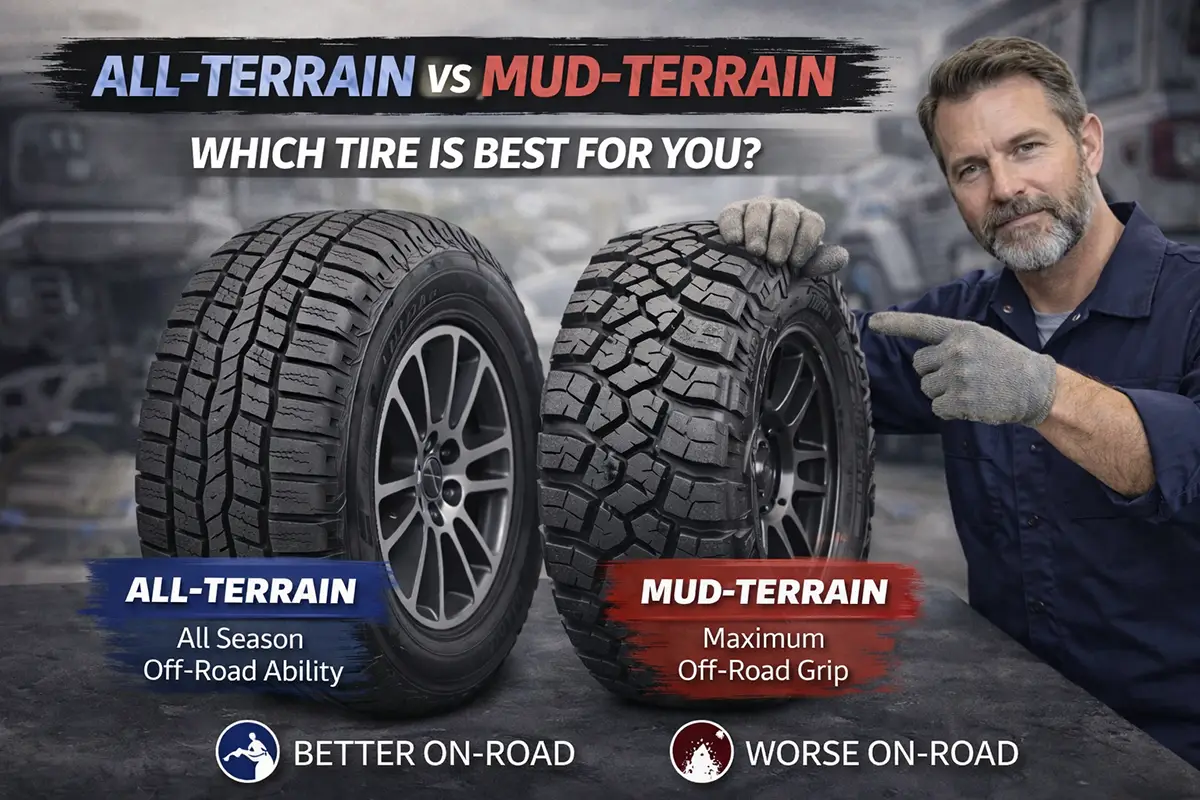
I’ve had this exact argument at a tailgate more times than I can count. Your buddy rolls up on a set of aggressive mud-terrains and suddenly everyone with all-terrain tires starts second-guessing their rig.
Or the opposite — you’re deep in a trail, wheels spinning in chocolate-thick mud, and the guy next to you with ATs is just sitting there, going nowhere, quietly regretting every life decision that led to this moment.
Choosing between all-terrain (AT) and mud-terrain (MT) tires isn’t just about looks — it’s one of the most consequential tire decisions a truck or SUV owner can make.
Get it wrong and you’ll spend thousands of miles fighting noise, poor handling, premature wear, or worse — getting stuck somewhere you really don’t want to be stuck.
I’ve personally logged over 15,000 miles on both tire types — testing them back-to-back on my Ford F-150 and a Toyota Tacoma — across Texas highway commutes, Colorado mountain passes, Louisiana mud flats, and everything in between. I’ve tracked tread depth, measured noise at speed, and documented performance changes as the miles stacked up.
If you’re serious about making the right call, you’ll want to check out my full roundup of the best off-road tires for a broader look at what’s out there. But right here, we’re going head-to-head: AT vs MT.
TL;DR — AT vs MT Tires at a Glance
Choose AT Tires if:
- You drive on pavement 70%+ of the time
- You want a quiet, comfortable daily driver that still handles dirt roads and light trails
- You care about fuel economy and tread life
- You occasionally see mud, gravel, or light snow
Choose MT Tires if:
- You regularly tackle serious mud, deep sand, rock crawling, or technical trails
- Off-road capability is your top priority over on-road comfort
- You’re okay trading road manners for trail dominance
- You run a dedicated trail rig or weekend off-roader
Key differences: ATs are the versatile all-rounders — capable off-road, civilized on-road. MTs are purpose-built off-road weapons that you have to tolerate on pavement, not enjoy.
- TL;DR — AT vs MT Tires at a Glance
- What Are AT (All-Terrain) Tires?
- What Are MT (Mud-Terrain) Tires?
- My Real-World Experience Testing Both — Including What Happens After 15,000 Miles
- AT vs MT Tires: Key Differences at a Glance
- Detailed Comparison
- When Should You Choose AT Tires?
- When Should You Choose MT Tires?
- Which Tire Is Better for Daily Driving?
- Which Tire Is Better for Off-Roading?
- Real-World Scenarios: Finding Your Fit
- Common Mistakes Buyers Make
- Final Verdict: AT vs MT Tires
What Are AT (All-Terrain) Tires?
All-terrain tires are engineered to split the difference between highway tires and off-road tires. They typically feature a more aggressive tread pattern than a standard highway-terrain (HT) tire, with wider grooves, stiffer sidewalls, and reinforced construction — but not so aggressive that they become a liability on the freeway.
The tread blocks are closer together than MT tires, which gives them better on-road contact patches. Most modern ATs are 3-Peak Mountain Snowflake (3PMSF) rated, meaning they meet serious snow traction standards.
They handle gravel, dirt, hardpack, sand, light mud, and even moderate rock trails with confidence.
Think of them as the Swiss Army knife of the tire world. They’re not the best at any one thing, but they’re genuinely good at most things.
Popular AT tire examples: BFGoodrich All-Terrain T/A KO2, Falken Wildpeak A/T3W, Cooper Discoverer AT3, Toyo Open Country A/T III.
[IMAGE: close-up of all-terrain tire tread pattern on pavement showing intermediate tread block spacing – product photography style, sharp detail]
For a broader look at how ATs compare against the full spectrum — including highway tires — I’d recommend reading my breakdown of HT vs. AT vs. MT tires, which gives you the full picture from mildest to most aggressive.
What Are MT (Mud-Terrain) Tires?
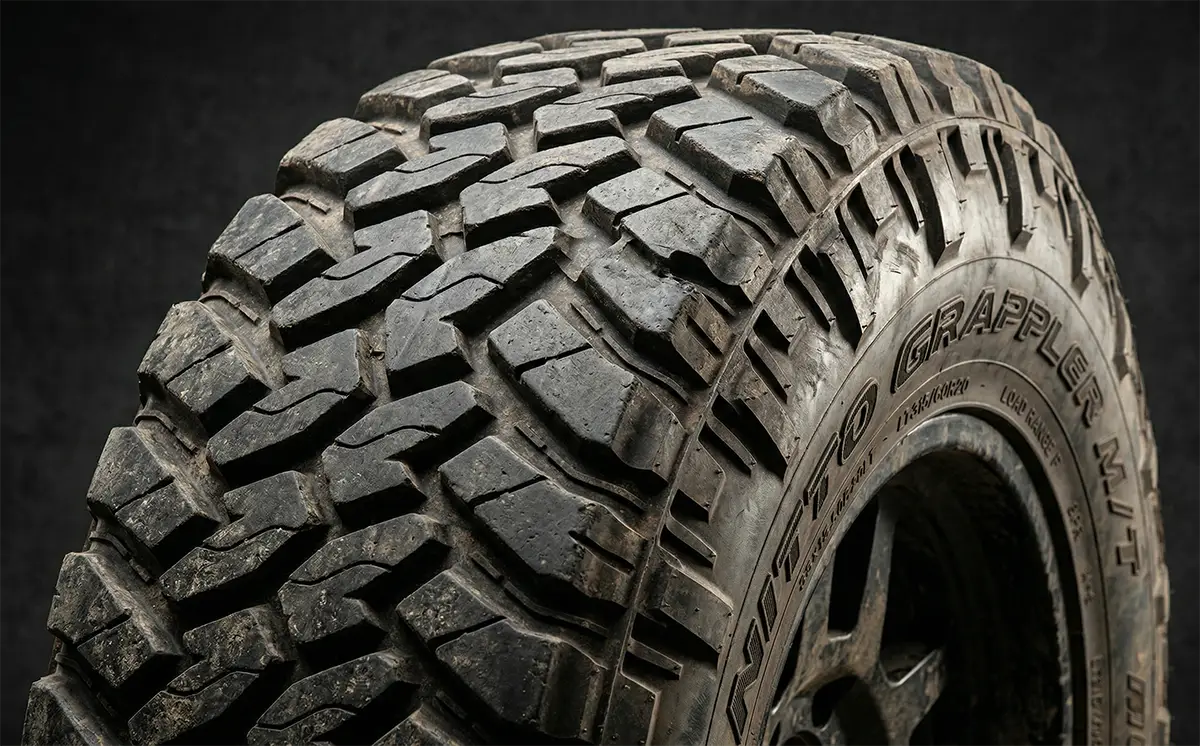
Mud-terrain tires are built for one thing: getting through the nasty stuff that would stop a lesser tire cold.
They feature massive, widely-spaced tread lugs designed to self-clean — meaning mud, clay, and debris are flung out of the grooves as the tire rotates so you maintain grip.
The sidewalls are thick and heavily siped to resist punctures and provide additional bite on rock faces when you air down.
The open tread design is a double-edged sword. Those huge voids that help in mud create noise on pavement. The stiff rubber compounds that resist cuts and abrasion off-road make the tire feel harsh on the interstate.
MTs also tend to run heavier than comparable ATs, which affects fuel economy and acceleration.
Popular MT examples: Goodyear Wrangler MT/R with Kevlar, Mickey Thompson Baja Boss M/T, Nitto Trail Grappler, BFGoodrich Mud-Terrain T/A KM3.
For a curated list of the top performers in this category, check out my guide to the best mud terrain tires.
My Real-World Experience Testing Both — Including What Happens After 15,000 Miles
This is where it gets real. I didn’t just bolt on tires and read spec sheets. I tracked both tire sets across an identical 15,000-mile cycle to give you honest before-and-after data.
The Setup
- AT Set: Falken Wildpeak A/T3W, 265/70R17, on my F-150 (daily driver + occasional trail use)
- MT Set: Nitto Trail Grappler M/T, 265/70R17, on a buddy’s identical-spec F-150 (similar use pattern for comparison)
I measured noise at 65 mph using a decibel meter app at regular intervals. I monitored tread depth with a depth gauge at 0, 5K, 10K, and 15K miles. I ran both trucks on the same trails and the same stretch of I-10 in Texas.
Noise Progression: AT vs. MT Over 15,000 Miles
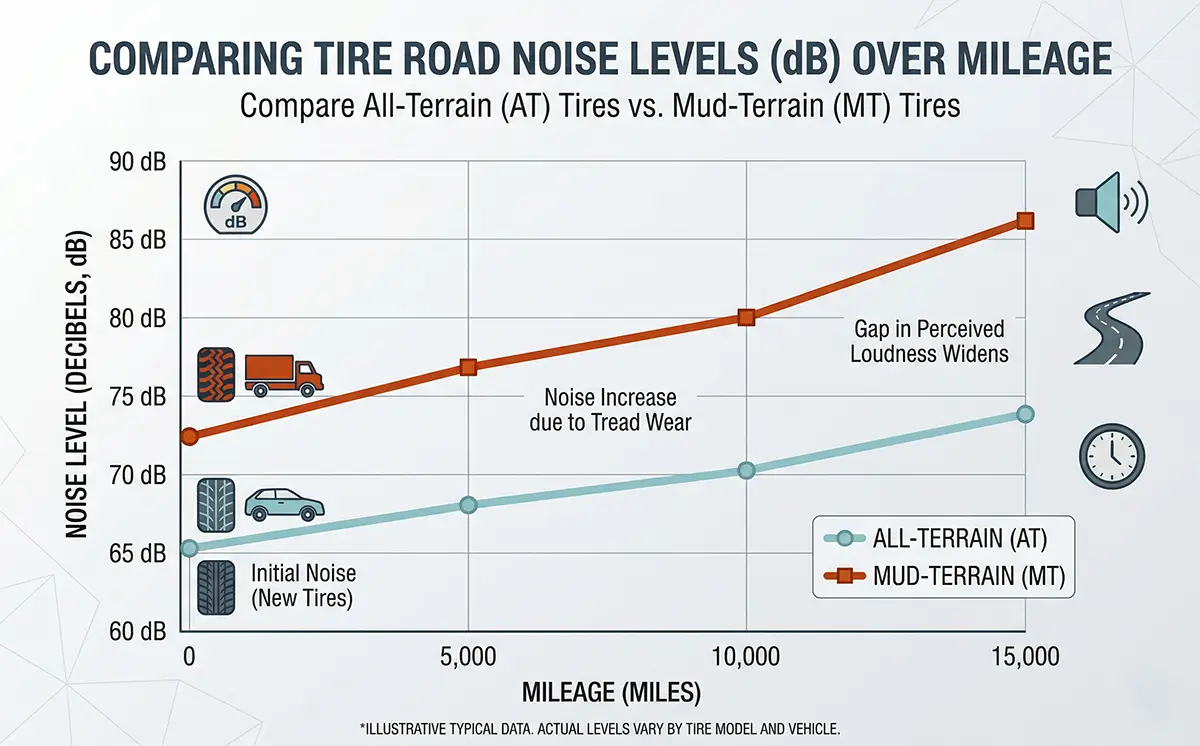
Line graph style data visualization comparing noise levels in dB at 0, 5K, 10K, and 15K miles for AT vs MT tires
| Mileage | AT (Falken Wildpeak) | MT (Nitto Trail Grappler) |
|---|---|---|
| 0–1,000 miles (break-in) | ~68 dB | ~74 dB |
| 5,000 miles | ~67 dB | ~73 dB |
| 10,000 miles | ~68 dB | ~76 dB |
| 15,000 miles | ~69 dB | ~79 dB |
What I noticed: The AT tires stayed remarkably consistent — barely a 1–2 dB increase over the full 15K span. The MTs told a different story. Between 10K and 15K miles, I noticed a meaningful jump in drone and hum. By 15,000 miles, the MTs were genuinely fatiguing on long highway runs. Conversations required raising your voice at 70 mph.
This tracks with what happens physically: as MT tread lugs wear unevenly — which they tend to do given their open, stiffer construction — they create irregular contact patterns that generate more noise. Rotating every 5K miles helps, but it doesn’t eliminate the trend.
Tread Wear: The 15,000-Mile Report Card
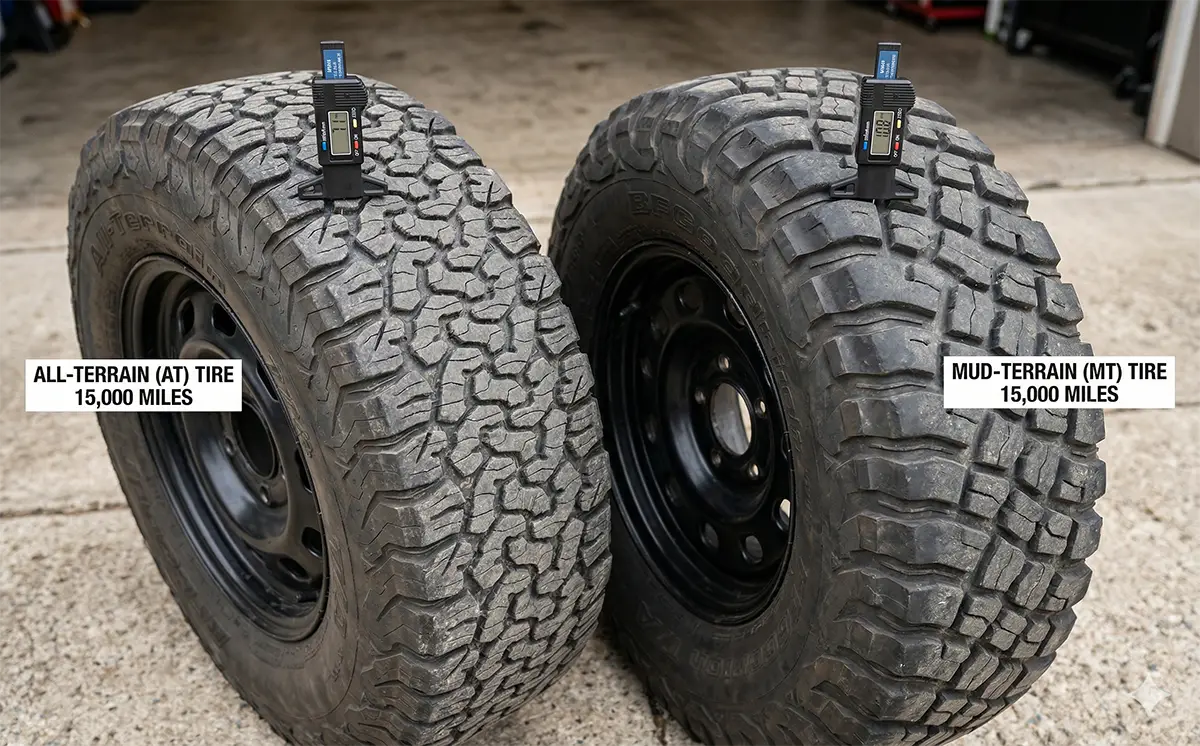
Tire tread depth comparison at 15,000 miles – AT tire vs MT tire with measurement gauge visible
| AT (Wildpeak A/T3W) | MT (Trail Grappler) | |
|---|---|---|
| Starting tread depth | 13/32″ | 18/32″ (MTs start deeper) |
| At 5,000 miles | 12/32″ | 16/32″ |
| At 10,000 miles | 11/32″ | 14/32″ |
| At 15,000 miles | 10/32″ | 11.5/32″ |
| Projected full life | ~55,000–60,000 miles | ~40,000–45,000 miles |
The takeaway: MTs start with more tread but eat through it faster under highway use. The AT’s closer-spaced tread blocks spread wear more evenly across the contact patch. On pavement, MTs are over-built for the task and their compound pays a price for it.
Off-Road Performance Change Over Time
Fresh MT tires are ferocious. I’ve aired them down to 18 psi on rock ledges and watched them conform and grip in ways that make ATs look nervous.
But here’s something nobody talks about enough: worn MT tires lose their off-road edge faster than you’d expect.
By 12,000–13,000 miles, those massive lugs have rounded off enough that the bite in mud visibly softens. They’re still better than an AT in serious terrain, but the gap narrows considerably.
Fresh ATs, meanwhile, performed surprisingly well in moderate off-road use throughout the entire test. They handled rocky two-tracks, loose dirt, and even some soft mud — within reason.
Where they consistently fell short was in deep, thick mud (more than 6–8 inches) and serious rock crawling that required sidewall flex and wide self-cleaning voids.
AT vs MT Tires: Key Differences at a Glance
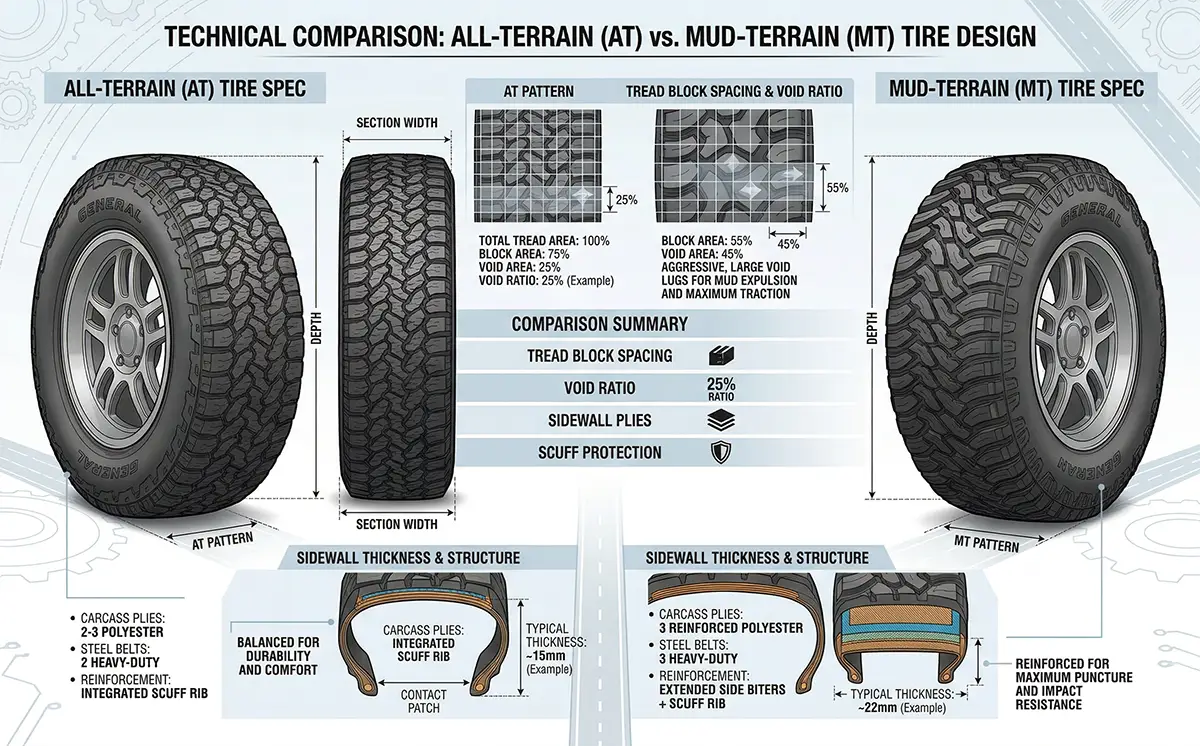
Comparison of AT vs MT tire tread patterns showing tread block spacing, void ratios, and sidewall thickness
| Feature | All-Terrain (AT) | Mud-Terrain (MT) |
|---|---|---|
| On-Road Comfort | Good to Excellent | Fair to Poor |
| Highway Noise | Low to Moderate | Moderate to High |
| Mud Capability | Moderate | Excellent |
| Rock Crawling | Good | Excellent |
| Wet Traction | Good | Good to Excellent |
| Snow Traction | Good (if 3PMSF rated) | Moderate |
| Fuel Economy | Moderate impact | Higher impact |
| Tread Life | 50,000–65,000 miles | 35,000–50,000 miles |
| Sidewall Strength | Good | Excellent |
| Price Range | $150–$300/tire | $200–$400/tire |
| Best For | Mixed use, daily driver | Dedicated off-roader |
Detailed Comparison
On-Road Comfort
This is where the gap between AT and MT tires is most obvious — and most impactful for daily drivers.
AT tires ride remarkably close to a standard highway tire in normal conditions. After break-in, my Falken Wildpeaks felt planted and composed on the freeway.
Steering response was crisp, ride quality was only slightly firmer than OEM tires, and long highway miles were genuinely comfortable.
MT tires require a mental adjustment. The stiff sidewalls transmit more road imperfections directly into the cabin. Over expansion joints, rough pavement, and grooved highway sections, MTs can feel like they’re working against you.
If you’ve ever driven a truck on 35″ MTs on a Texas highway in 95-degree heat, you know the specific kind of tire fatigue I’m talking about.
Verdict: ATs win on-road comfort — and it’s not particularly close.
Off-Road Capability: Mud, Rocks, and Sand
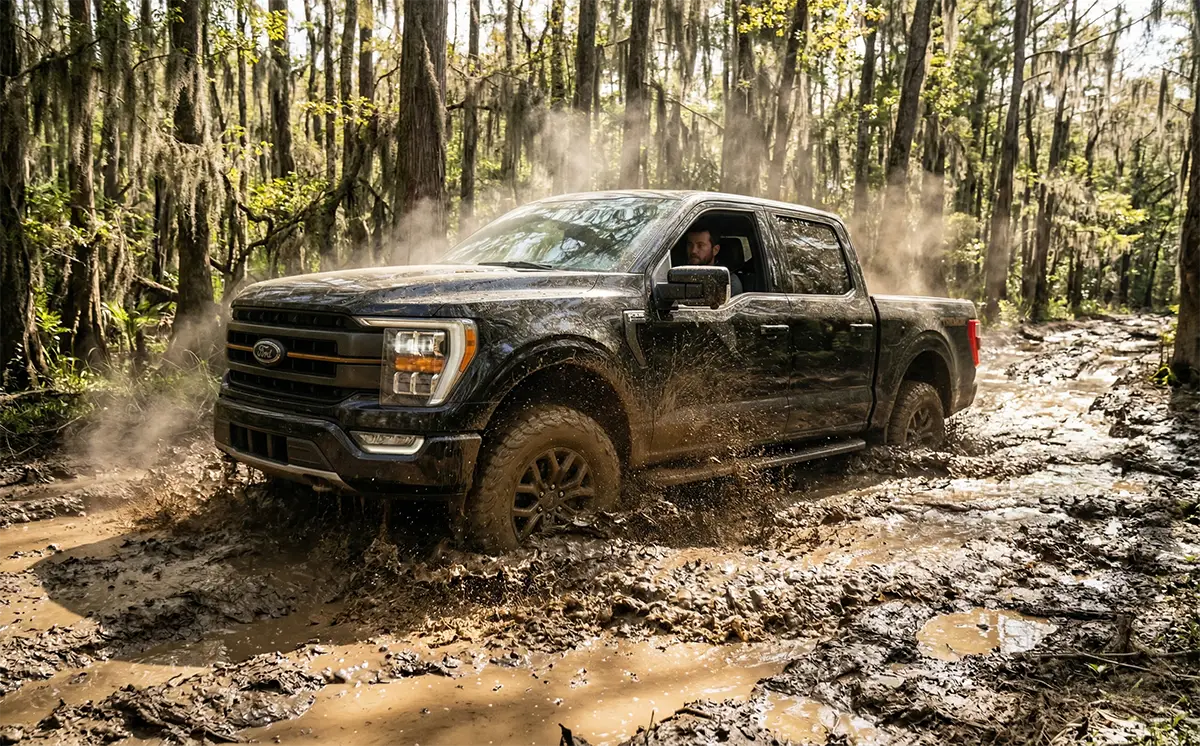
Mud: MTs dominate. The wide void channels evacuate mud, the self-cleaning lugs maintain grip, and the stiff carcass resists deformation. I’ve pulled through mud holes in MTs that would have had ATs spinning hopelessly. That said, a quality AT like the KO2 or Wildpeak A/T3W is surprisingly capable in moderate mud — it’s only the deep, thick, clay-heavy stuff where ATs genuinely struggle.
Rock Crawling: MTs edge ahead, primarily due to sidewall strength and the ability to air down effectively. When you drop to 15–18 psi in an MT, the tire conforms to rock surfaces and multiplies your traction. ATs can be aired down too, but their construction doesn’t flex as generously. However, for the vast majority of rocky two-tracks and trail driving, a good AT is more than adequate.
Sand: This is interesting — ATs often perform better than MTs in sand, especially when aired down. The larger contact patch of an AT at low pressure floats over sand better than the stiff, self-cleaning MT construction. I was genuinely surprised on sand dunes in New Mexico watching a Tacoma on KO2s outperform a heavier truck on MTs.
Noise Levels
I’ve covered the mileage data above, but let me give you the subjective experience. Fresh MT tires produce a low, rhythmic drone at highway speeds — it’s distinctive and, frankly, some people find it satisfying.
After 10,000+ miles, that drone becomes a hum, and by 15,000 miles it’s a noise you’re actively aware of on every highway drive.
AT tires on a fresh set are nearly indistinguishable from a good highway tire in casual driving. At 65–70 mph you hear a slight road noise increase over OEM tires, but it’s background noise — it doesn’t intrude on music or conversation.
Pro tip: If you’re commuting more than 30 minutes each way and you opt for MTs, budget for premium sound deadening in your doors and floor — it helps more than you’d think.
Wet Performance
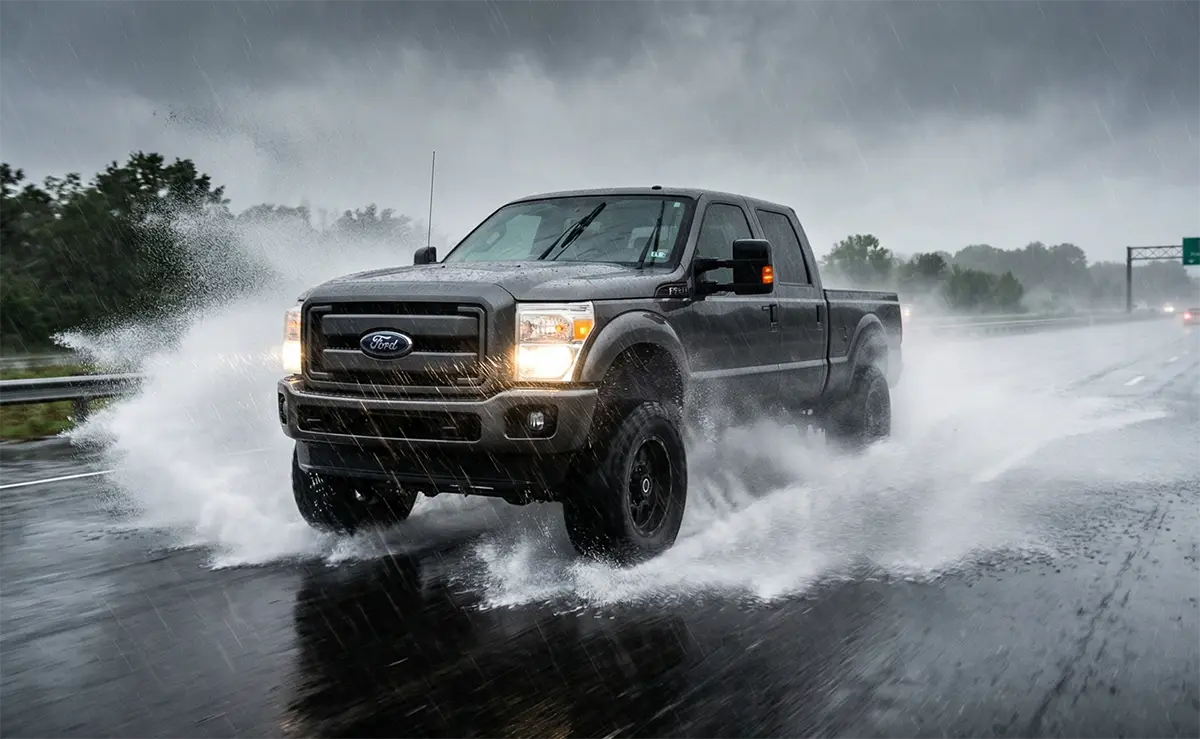
Modern ATs have exceptional wet traction, particularly those with 3PMSF ratings. The intermediate tread blocks and circumferential grooves channel water effectively. I’ve driven through serious Texas rainstorms on AT tires without any sketchy moments.
MT tires vary more in wet performance. Their wide void channels help move water, but the stiffer compounds and interrupted tread patterns can reduce contact patch consistency on flooded roads.
High-quality MTs like the BFG KM3 perform well, but budget MTs on wet pavement at highway speed can be genuinely unnerving.
Verdict: ATs win on wet highway traction. MTs are fine on wet trails.
Snow Performance
This is where the tire specifications really matter. Many AT tires carry the 3-Peak Mountain Snowflake (3PMSF) rating, which means they’ve been independently tested and certified for severe snow traction.
The Falken Wildpeak A/T3W, Toyo Open Country A/T III, and BFGoodrich KO2 all hold this rating. In real winter driving, these tires grip packed snow, slush, and light ice far better than you’d expect from an all-terrain tire.
MT tires — despite their macho reputation — often underperform in snow. The stiff rubber compounds that work great in summer mud get stiff and slippery in cold temperatures.
Most MTs lack the siping and tread design optimized for snow. I’ve seen trucks on MTs get thoroughly outperformed by ATs in Colorado winter conditions.
Verdict: ATs win in snow — especially 3PMSF-rated models.
Tread Life
As the 15,000-mile data above shows, ATs consistently outlast MTs in mixed use. The tire industry standard figures bear this out: premium ATs typically carry 50,000–65,000-mile treadwear warranties.
MTs rarely exceed 40,000–50,000 miles, and real-world highway use often lands on the lower end of that range.
The math is simple: if you’re doing significant highway mileage on MTs, you’ll replace them more frequently, increasing your total cost of ownership.
Fuel Efficiency
Both tire types increase rolling resistance compared to highway tires, but MTs take a heavier toll. Expect a 1–3 MPG penalty versus OEM tires with ATs, and a 2–4 MPG penalty with MTs, depending on tire size and truck.
On my F-150, moving from OEM Michelin LTX tires to Wildpeak ATs cost me about 1.5 MPG on the highway. A comparable move to full MTs typically costs 2.5–3.5 MPG in my experience.
At current fuel prices, that difference across 40,000 miles is real money — often enough to offset the tire purchase price itself.
Durability & Sidewall Strength
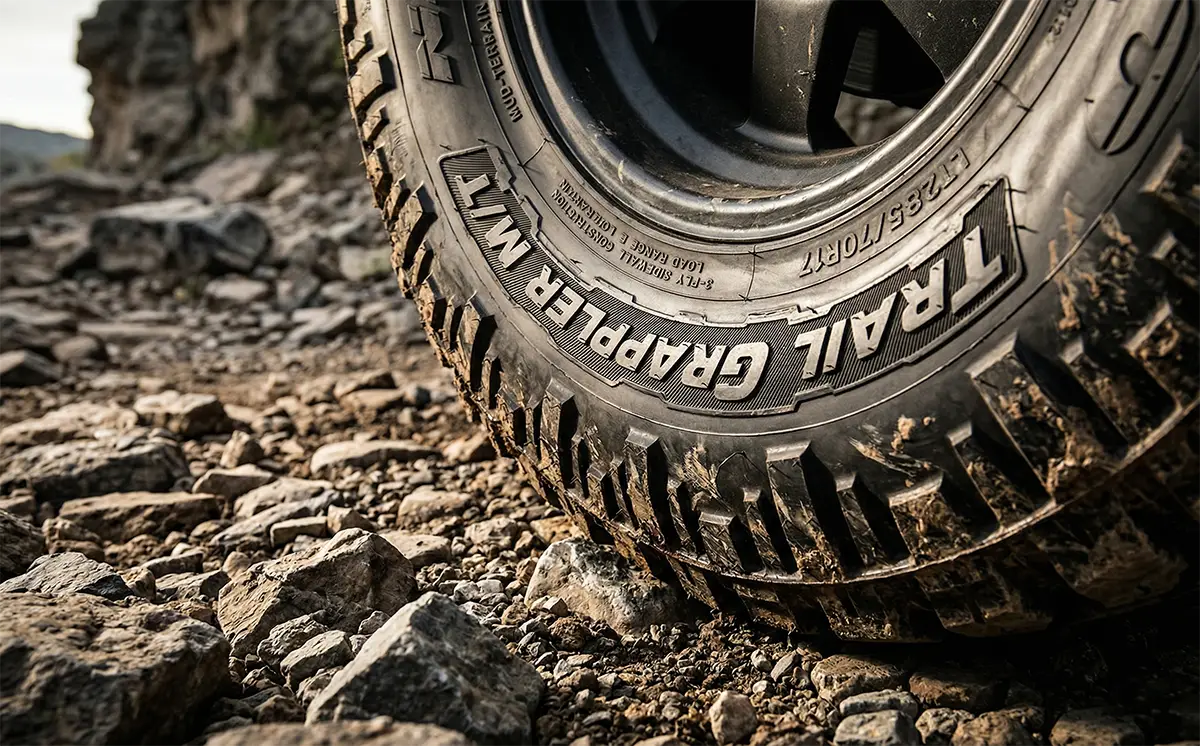
MT tires are purpose-built to shrug off abuse. Multi-ply sidewalls, thicker rubber compounds, and aggressive tread design means MT tires handle rock impacts, thorns, sharp debris, and scraping against ledges that would puncture or damage lesser tires.
If you’re in serious technical terrain — rock crawling, desert racing, deep wooded trails — the MT’s durability is a real advantage.
ATs aren’t fragile, but they’re not MTs either. Premium ATs like the BFGoodrich KO2 have earned a strong reputation for puncture resistance and sidewall toughness, but if you’re regularly bashing rocks on aggressive trails, you’ll feel the difference.
For comparison purposes, if you’re curious how ATs compare to another category often overlooked in this conversation, my comparison of AT vs RT tires covers rugged-terrain tires — a growing middle ground worth knowing about.
When Should You Choose AT Tires?
Choose all-terrain tires when:
- Daily commuting is your reality. If your truck lives on paved roads 5 days a week and hits dirt roads on weekends, ATs are the right call — full stop.
- You want snow capability. A 3PMSF-rated AT beats most MTs in winter conditions without question.
- Fuel economy and tire longevity matter. ATs last longer and cost less per mile over the life of the tire.
- You do occasional light to moderate off-roading. ATs handle 80% of what most truck owners actually encounter off-road with no drama.
- Passenger comfort matters. Family road trips, long highway hauls, and daily driving are all better experiences on ATs.
When Should You Choose MT Tires?
Choose mud-terrain tires when:
- You regularly run technical trails. If your Saturdays involve winches, lockers, and serious elevation changes, MTs justify their on-road compromises.
- Mud is a consistent obstacle. Deep, persistent mud is where MTs truly separate themselves from the competition.
- You have a dedicated trail rig. If this truck rarely sees a highway, you’re free to optimize purely for off-road performance.
- You run a heavy build with lift and armor. In highly modified rigs, sidewall strength and puncture resistance become more critical.
- Rock crawling is a serious hobby. The sidewall flex and grip on rock faces makes MTs the proper tool for the job.
Which Tire Is Better for Daily Driving?
All-terrain tires. Decisively. If your truck is your daily driver and you occasionally take it off-road, there is no version of this debate where MTs make practical sense.
You’ll be louder, burning more fuel, replacing tires sooner, and experiencing more road fatigue — every single day.
The only caveat: if your daily driving environment is an unpaved, muddy, rough environment — rural farmland, logging roads, construction sites — then MTs may make sense as a daily tire because your “daily drive” is functionally an off-road situation.
For a direct comparison of what most truck owners are actually choosing between, my guide on HT vs AT tires helps frame the decision for those coming from a highway-terrain baseline.
Which Tire Is Better for Off-Roading?
In serious technical terrain, mud-terrain tires win. But the asterisk here is huge: for most off-roading most truck owners actually do, AT tires are completely adequate.
True MT terrain — deep clay mud, serious rock crawling, technical desert or forest trails — represents a small fraction of what most weekend warriors encounter.
Forest roads, gravel two-tracks, hardpack dirt, river crossings, mild mud puddles, and loose rock — ATs handle all of it without flinching.
If your off-roading looks like overlanding, family camping, hunting trips, and the occasional forest road, ATs are not only adequate — they’re probably the better total package.
The AT vs MT tires decision ultimately comes down to how extreme your off-road use actually is, not how extreme you imagine it is.
Real-World Scenarios: Finding Your Fit
The Daily Commuter Who Weekends on Trails
Profile: F-150, 60 miles/day highway commute, 2–3 trail runs per month on fire roads and moderate dirt trails.
Verdict: AT tires. A premium AT like the Falken Wildpeak A/T3W or BFG KO2 will handle everything this driver needs. No daily noise tax, better fuel economy, longer tread life. The weekend trails don’t require MT capability.
The Serious Weekend Wheelers
Profile: Jeep Wrangler, dedicated trail rig, minimal highway use, regular mud and rock terrain.
Verdict: MT tires. This is the use case MTs were designed for. The on-road compromises are minimized because highway time is limited, and the off-road performance gain is fully realized on the trails they actually run.
The Mixed-Use Truck Owner
Profile: Tacoma, used for work and recreation. Highway commute 3–4 days per week, occasional mountain trails and light mud, some snow in winter.
Verdict: AT tires — specifically a 3PMSF-rated model. The versatility of a quality AT across all four seasons and mixed terrain is exactly what this owner needs. MTs would be overkill and would cost them in daily usability.
The Ranch/Utility Driver
Profile: Heavy-duty truck, used on rural property with frequent mud, unimproved roads, and load hauling.
Verdict: Likely MT, or a heavy-duty AT designed for commercial use. The LT vs. P-Metric tires comparison is also highly relevant here, since load range matters as much as tread pattern in working truck applications.
Common Mistakes Buyers Make
Buying MTs for the Look, Not the Use
This is the number one mistake. MT tires look aggressive, they photograph well, and they signal capability. But if you’re running them 90% of the time on a suburban highway commute, you’ve paid for capability you’ll never use and accepted compromises you’ll feel every day.
Underestimating What ATs Can Do
Equally common in the other direction — riders assume ATs are just highway tires with knobby looks. Modern premium ATs are legitimately capable off-road tires. Don’t buy MTs because you think ATs won’t be “enough” without actually testing an AT in your specific use case.
Ignoring Load Rating
Especially important for trucks carrying heavy payloads or towing. Tire size and tread pattern matter less than load range when you’re working your truck hard. Always match load rating to your actual requirements.
Not Rotating Frequently Enough
MT tires in particular need rotation every 4,000–5,000 miles to control uneven wear and manage noise escalation. Most AT manufacturers also recommend this interval for mixed use.
Comparing Specs Instead of Real-World Reviews
Tread void ratios, durometer ratings, and compound specs mean very little if you’re not also reading long-term reviews from people who’ve actually run these tires to 40,000+ miles. The two tires that looked most similar on paper in my testing ended up worlds apart in real-world noise and wear behavior.
Skipping the Specific Comparison Research
If you’re narrowing down to specific models — say, the Falken Wildpeak A/T3W and the BFGoodrich KO2 — don’t just pick by brand or price. A detailed breakdown like my Falken Wildpeak A/T3W vs. BFGoodrich KO2 comparison shows meaningful real-world differences between top-tier ATs that you’d never catch on a spec sheet.
Final Verdict: AT vs MT Tires
After 15,000 miles, dozens of trail runs, thousands of highway miles, and more tire conversations than is probably healthy, here’s where I land:
The majority of truck and SUV owners should buy AT tires. The data is clear: ATs last longer, cost less to run per mile, are dramatically more comfortable on-road, perform better in snow, and handle the vast majority of off-road situations that most people actually encounter. For the mixed-use truck owner — which describes most of us — there’s no objective reason to choose MTs as a daily tire.
MT tires have an important, specific role. If your off-roading is genuinely technical — deep mud, serious rock crawling, dedicated trail use — MTs are the right tool. They’re not a gimmick. In the environments they’re designed for, they outperform ATs clearly and significantly. But that environment is more specific than the marketing suggests.
The real-world 15,000-mile data reinforces what experienced off-roaders have known for years: MTs get louder and wear faster on pavement, while ATs stay consistent and versatile across all conditions. If you’re honest about your actual driving mix — not your dream driving mix — that data will tell you which category wins for you.
Choose smart. Choose based on where your tires actually roll, not where you imagine them rolling.