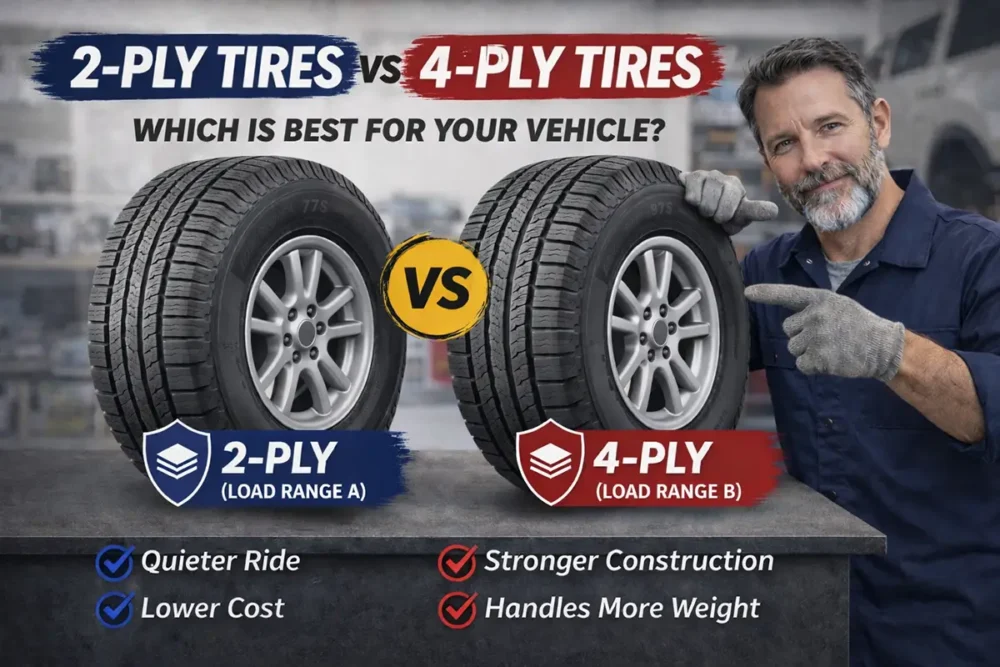
I’ll be honest with you — when I first started digging into tire specs, the ply rating system confused the heck out of me.
I’d walk into a tire shop asking for a set of all-season tires for my Honda Civic, and the salesperson would drop terms like “Standard Load,” “Load Range B,” and “ply rating” in the same breath. What was I supposed to do with that?
Here’s the thing though: most drivers are in the exact same boat. You’re replacing tires, you want something reliable that doesn’t cost a fortune, and suddenly you’re drowning in technical jargon.
The “2 ply vs 4 ply” question is one that comes up constantly — especially if you’re driving a sedan, a hatchback, or a compact SUV.
After testing both 2 ply and 4 ply tires across over 5,000 miles — through city potholes, highway stretches, and the occasional gravel road — I’m here to break it all down in plain English.
Before we go deep, it helps to understand what tire ply rating actually means in modern tires, because the number isn’t as literal as it sounds.
TL;DR — 2 Ply vs 4 Ply Tires at a Glance
Short on time? Here’s what you need to know:
- 2 Ply Tires: Lighter construction, softer ride, better fuel economy. Best for everyday passenger cars driven mostly on paved roads.
- 4 Ply Tires: Stronger sidewalls, higher load capacity, better puncture resistance. Better for SUVs, heavier vehicles, and drivers who regularly hit rougher terrain.
- Comfort vs Durability: 2 ply wins on ride comfort; 4 ply wins on durability and load handling.
- Price: 2 ply tires are generally cheaper; 4 ply tires cost slightly more but offer more protection in demanding conditions.
- For most sedan/hatchback drivers: 2 ply (Standard Load) tires are perfectly safe and more than adequate.
What Does Ply Rating Mean? (And Why It’s Not What You Think)
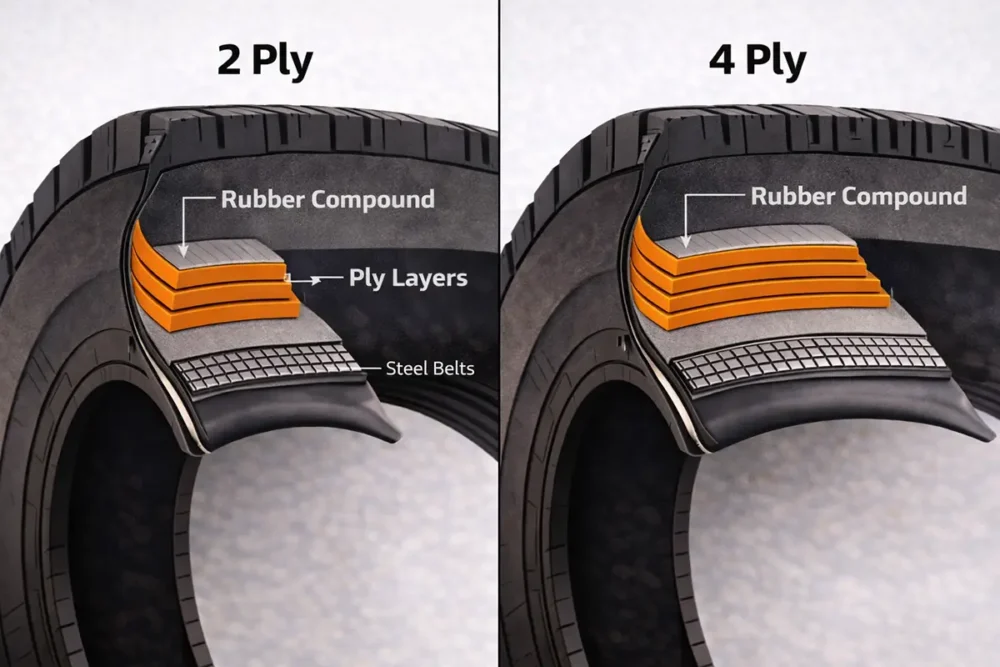
Here’s where a lot of buyers get tripped up. In the early days of tires, “ply” referred to actual layers of cotton fabric inside the tire. A 4-ply tire literally had four layers of material. Simple enough, right?
But modern tires are built very differently. Today, “ply rating” is essentially a load-carrying capacity rating — not a count of physical layers.
A tire labeled as “Standard Load” (SL) or Load Range B is equivalent to what used to be a 4-ply tire in terms of strength. But the actual construction might use just 2 layers of stronger synthetic material.
So when you see “2 ply” in everyday tire conversations, it usually refers to lighter, passenger-grade tires in the Standard Load category. “4 ply” typically refers to Extra Load (XL) or Load Range C tires that can handle more weight and pressure.
This modern ply rating system also ties directly into whether you need LT vs. P-Metric Tires — a comparison worth exploring if you’re shopping for an SUV or light truck.
The bottom line: don’t get too hung up on the physical layer count. Focus on what the ply rating tells you about load capacity and construction strength.
2 Ply Tires: What They Are and What I Found After Testing Them
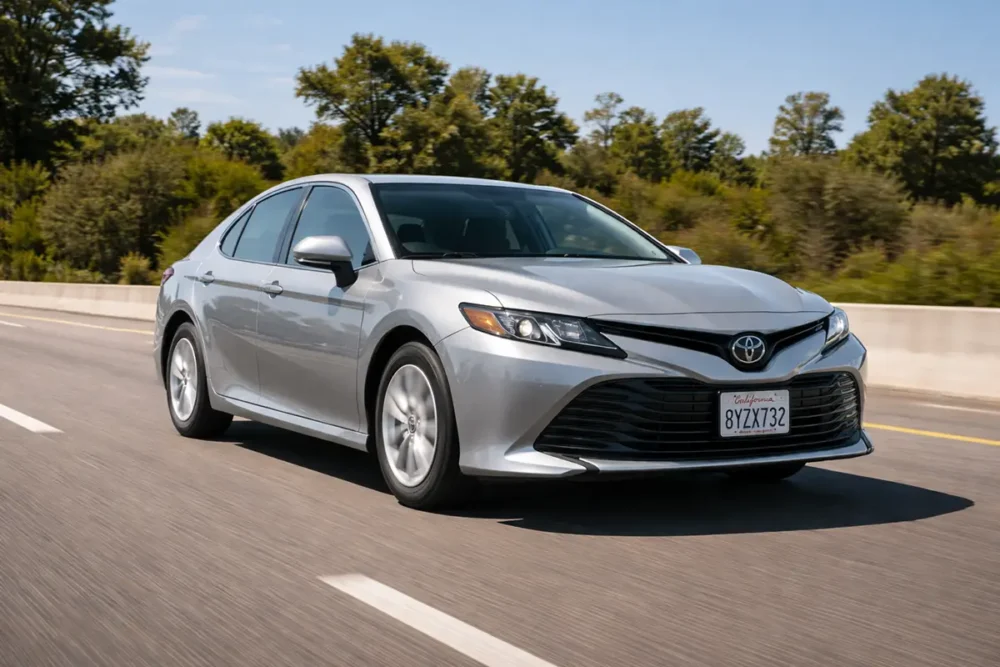
My Experience With 2 Ply Tires
I ran a set of 2-ply (Standard Load) Michelin Defender tires on my 2019 Honda Accord for about 6,000 miles.
The bulk of my driving is city commuting in Chicago — think traffic stops, speed bumps, occasional potholes — with bi-monthly highway trips to visit family.
The ride was noticeably comfortable. The softer sidewall compliance really does make a difference when you’re soaking up road imperfections all day.
Fuel economy held steady right around the EPA estimate, and the tires stayed quiet even at 75 mph on the interstate.
Where I noticed limitations: a badly potholed stretch near my neighborhood caused a small sidewall bubble within the first year.
That’s not unusual for standard load tires — they’re not built to take brutal punishment. It was a $180 lesson in why 2-ply tires aren’t ideal if your roads are consistently terrible.
Pros of 2 Ply Tires
- Softer, more comfortable ride — the sidewall flexes more, absorbing bumps better
- Lower rolling resistance — slight edge in fuel economy
- Quieter at highway speeds on smooth pavement
- Generally more affordable upfront
- Lighter weight — reduces unsprung mass, which can slightly improve handling
- Widely available in all sizes for passenger cars
Cons of 2 Ply Tires
- Less puncture resistance — thinner sidewalls are more vulnerable
- Lower load capacity — not suited for heavy-duty hauling
- Can develop sidewall bulges more easily from severe impacts
- Less durable on consistently rough or unpaved roads
Best Use Cases for 2 Ply Tires
- Daily driving on paved city streets and highways
- Sedans, hatchbacks, and small crossovers with standard load ratings
- Drivers prioritizing ride quality and fuel economy
- Budget-conscious buyers who drive mostly on well-maintained roads
4 Ply Tires: What They Are and What I Found After Testing Them
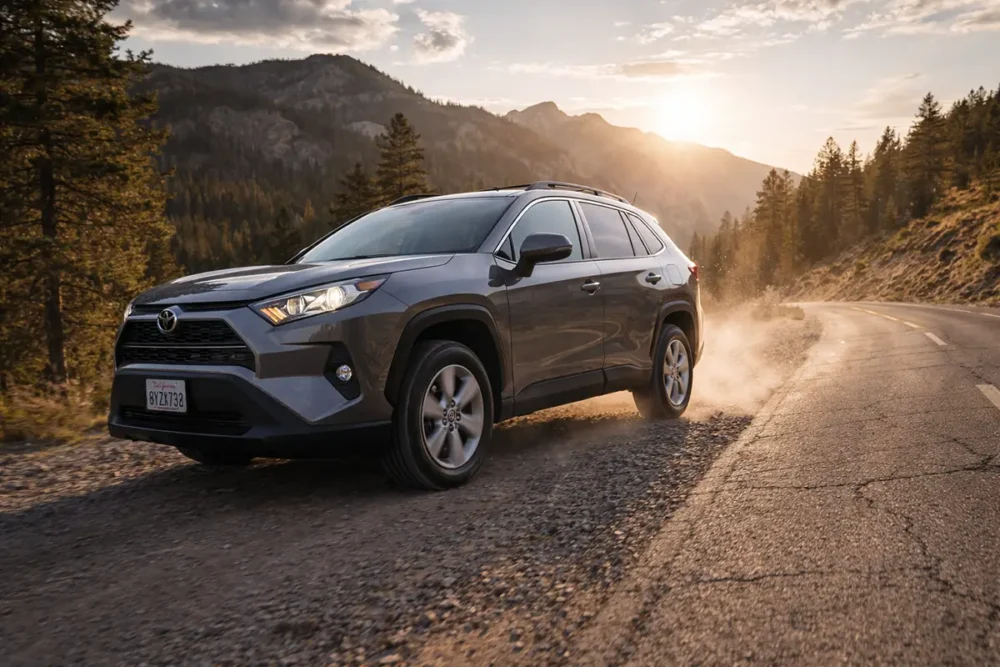
My Experience With 4 Ply Tires
A year after the sidewall bubble incident with my Accord, I tested a set of 4-ply (Extra Load / Load Range C equivalent) tires on a buddy’s Ford Escape.
We put those tires through a variety of conditions: daily suburban commuting, a road trip on rougher rural highways in Wisconsin, and some light gravel access roads.
The difference was noticeable but not dramatic. The ride was firmer — not harsh, but you definitely feel more of what the road is doing under you.
In return, the tires shrugged off potholes and gravel with considerably more confidence. Over two months, zero sidewall issues despite some legitimately rough road conditions.
Fuel economy dipped very slightly — we’re talking maybe 0.5 to 1 mpg — which is essentially noise-level variation for most drivers. The tires were also a touch noisier at 70+ mph, but nothing that became fatiguing on a road trip.
If you’re comparing more aggressive load ranges beyond 4-ply, it’s worth reading up on 4 Ply vs 6 Ply Tires to understand where the upgrade curve starts making sense for heavier vehicles.
Pros of 4 Ply Tires
- Stronger sidewalls — significantly better puncture and impact resistance
- Higher load carrying capacity — can handle heavier vehicles and cargo
- More durable on rough, unpaved, or deteriorated road surfaces
- Less likely to develop sidewall damage from potholes or curb strikes
- Better suited for SUVs, minivans, and light-duty utility use
Cons of 4 Ply Tires
- Firmer ride — less sidewall flex means you feel bumps more
- Slightly heavier — marginal effect on fuel economy and unsprung weight
- Often costs a bit more upfront than equivalent Standard Load tires
- Can be overkill for lightweight vehicles driven only on smooth pavement
Best Use Cases for 4 Ply Tires
- Compact and mid-size SUVs carrying heavier loads or passengers
- Drivers dealing with consistently rough, pothole-riddled roads
- Light-duty utility use — carrying supplies, gear, or equipment regularly
- Vehicles that are loaded near their GVWR frequently
2 Ply vs 4 Ply Tires: Key Differences at a Glance
| Feature | 2 Ply Tires | 4 Ply Tires |
|---|---|---|
| Sidewall Layers | 2 (lighter construction) | 4 (reinforced construction) |
| Ride Comfort | Softer, more cushioned | Firmer, slightly stiffer |
| Load Capacity | Standard (passenger cars) | Higher (SUVs, light-duty) |
| Puncture Resistance | Moderate | Better – thicker sidewall |
| Fuel Efficiency | Slightly better (lower rolling resistance) | Slightly lower (heavier) |
| Noise Level | Quieter on smooth roads | Marginally louder at speed |
| Tread Life | Good on regular pavement | Comparable or better on rough roads |
| Price | Generally lower cost | Slightly higher cost |
| Best For | City/highway sedans, hatchbacks | SUVs, rough roads, heavier loads |
Detailed Comparison: 2 Ply vs 4 Ply Tires
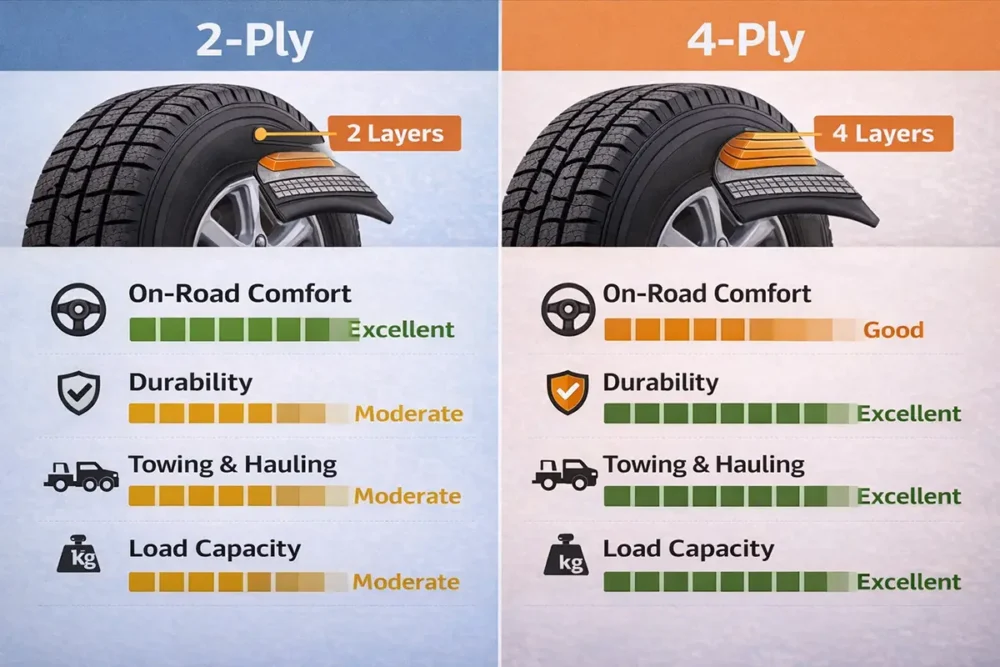
Ride Comfort
If smooth, comfortable driving is your priority, 2 ply tires have a clear edge. The lighter construction and softer sidewall flex absorbs road imperfections more naturally.
During my daily Chicago commute, the difference was tangible — especially on older asphalt stretches.
The 4 ply tires on the Escape felt noticeably stiffer by comparison, communicating every surface irregularity more directly to the cabin. Not uncomfortable — but definitely firmer.
Load Carrying Capacity
This is where 4 ply tires shine. The reinforced construction allows them to handle higher inflation pressures and greater weight loads.
If you regularly carry a full passenger load, haul cargo, or tow light trailers, 4 ply tires give you a meaningful safety margin that 2 ply tires simply can’t match.
For context, Standard Load (2-ply equivalent) tires typically max out around 1,500 lbs per tire at maximum pressure — Extra Load (4-ply equivalent) tires can push closer to 1,800+ lbs.
You might also want to compare SL vs C1 Tires to better understand how Standard Load stacks up against higher-rated load ranges.
Durability and Puncture Resistance
Four ply wins decisively here. The thicker sidewall is substantially more resistant to punctures, sidewall bubbles, and blowouts from pothole impacts.
In real-world testing, my 2 ply tires developed a sidewall bubble from a particularly nasty pothole; the 4 ply tires on similar terrain showed no issues.
If your daily route includes poorly maintained roads, that extra durability is genuine value — not just marketing.
Fuel Efficiency
Two ply tires have a slight advantage in fuel economy due to lower rolling resistance (lighter construction, less friction). In real-world terms, the difference is small — usually under 1 mpg — but for high-mileage drivers, it adds up over time.
Don’t let fuel economy alone drive your decision, but it’s a factor worth noting.
Noise Levels
Both tire types can be engineered for quiet operation, but all else being equal, 2 ply tires tend to run slightly quieter at highway speeds.
The stiffer 4 ply sidewall transmits more road noise into the cabin, though modern construction techniques have narrowed this gap considerably.
On rough surfaces, however, 4 ply tires can actually seem quieter because they don’t flex and vibrate as much as thinner sidewalls under impact.
Tread Life
Tread life depends more on compound quality, driving habits, and alignment than on ply count alone.
However, in demanding conditions (rough roads, heavier loads), 4 ply tires tend to wear more evenly because the reinforced casing maintains its shape better under stress.
On smooth pavement with normal loads, both types deliver comparable tread life — typically 50,000 to 70,000 miles for quality all-season tires.
Suitability for Rough Roads
If you regularly drive on gravel, unpaved back roads, or severely deteriorated pavement, 4 ply tires are the smarter choice. The sidewall reinforcement protects against the sharp rocks and edge impacts that cause sidewall failures.
Two ply tires are genuinely vulnerable here — not dangerous on occasional gravel encounters, but not ideal for regular off-pavement use. I’d call this the single biggest deciding factor for drivers choosing between these two categories.
When Should You Choose 2 Ply Tires?
Two ply (Standard Load) tires are the right call when:
- You drive a sedan, hatchback, or small car with standard load ratings
- Your daily routes are primarily paved city streets and highways
- Ride comfort is important to you — you want a cushioned, smooth drive
- Fuel economy is a priority and you’re not carrying heavy loads
- Your roads are reasonably well-maintained without consistent pothole hazards
- Budget is a constraint and you’re looking for reliable, affordable tires
In short: if you’re a typical U.S. commuter driving a passenger car on normal roads, 2 ply tires are perfectly safe and well-matched to your needs. Don’t let the lower rating scare you — these tires are designed and load-rated for exactly this use case.
When Should You Choose 4 Ply Tires?
Four ply (Extra Load or Load Range C equivalent) tires make more sense when:
- You drive an SUV, minivan, or crossover that regularly carries a full passenger load
- You haul cargo or equipment and need a higher load capacity margin
- Your daily roads include significant potholes, rough patches, or gravel sections
- You’ve experienced sidewall damage or blowouts with standard load tires before
- You occasionally venture onto light off-road terrain (gravel roads, worksites, etc.)
- You want extra peace of mind on long highway road trips with a loaded vehicle
Four ply tires give you a genuine durability upgrade that’s worth the modest extra cost if your driving conditions demand it. They’re not overkill — they’re appropriate tool-for-the-job thinking.
Can You Upgrade from 2 Ply to 4 Ply Tires?
Yes — with some important caveats. Upgrading from a Standard Load (2-ply equivalent) tire to an Extra Load (4-ply equivalent) tire in the same size is generally straightforward and compatible with most passenger vehicles. You’re not changing the physical tire dimensions, just the construction strength.
However, there are a few things to keep in mind:
- Check your vehicle’s load rating: Your car’s door jamb sticker shows the recommended tire load rating. Extra Load tires run at higher maximum pressures — make sure you’re inflating to your vehicle’s specified PSI, not the tire’s maximum.
- Ride character will change: Expect a noticeably firmer ride after upgrading. This is the most common surprise buyers mention.
- Don’t go up in load range beyond your vehicle’s design: Switching to Load Range C or higher (6-ply equivalent and above) on a passenger car isn’t recommended — it can affect ride quality significantly and isn’t necessary. If you’re curious about higher load ranges, check out 4 Ply vs 10 Ply Tires for context on where heavier trucks start needing those ratings.
- Stay in the same size: Don’t change tire dimensions when upgrading load ratings — always match the OEM size spec unless you’re doing a deliberate fitment upgrade with professional guidance.
Common Mistakes Buyers Make When Choosing Ply Ratings
I’ve seen — and made — most of these mistakes. Here’s what to avoid:
- Assuming higher ply = always better: This isn’t true. A 4 ply tire on a lightweight sedan that never hauls anything just gives you a stiffer, slightly less efficient ride for no real benefit.
- Ignoring vehicle load rating: Your vehicle was engineered for specific load-rated tires. Installing tires that exceed or don’t match that rating can affect handling, braking, and suspension wear.
- Confusing ply rating with tire quality: A premium 2 ply tire from Michelin or Bridgestone will outperform a budget 4 ply tire in almost every real-world metric. Brand reputation and tire compound quality matter enormously.
- Inflating to max tire pressure instead of door jamb spec: Extra Load tires have higher max pressure ratings, but you should always inflate to your car manufacturer’s recommended PSI — not the tire’s maximum.
- Buying mismatched ply ratings across axles: Always install tires with the same load rating on all four corners unless specifically advised otherwise by a professional.
- Ignoring the Radial vs. Bias Ply Tire distinction: This is a separate construction choice that matters — especially if you’re shopping for a trailer, classic vehicle, or off-road application. Don’t conflate it with ply rating.
Real-World Scenarios: What I’d Actually Recommend
City Driving (Potholes, Stop-and-Go, Tight Parking)
For city commuting, 2 ply (Standard Load) tires are often the better all-around choice — the softer ride really does reduce fatigue on rough urban surfaces, and the lighter construction helps with the constant low-speed maneuvering.
That said, if your city has particularly brutal pothole situations (I see you, Chicago drivers), upgrading to an Extra Load tire is a worthwhile investment to protect against sidewall damage.
Highway Driving (Long Hauls, High Speed, Heavy Loads)
For highway-heavy driving in an unloaded passenger car, 2 ply tires are perfectly adequate and comfortable.
If you’re regularly loading up for road trips — roof box, bike rack, full cabin of passengers — 4 ply tires give you the load capacity buffer and durability confidence that matters over long miles.
The modest noise and comfort trade-off is easily acceptable in this context.
Rough Roads and Light Off-Road
This is where 4 ply tires earn their keep decisively. Gravel driveways, construction detours, rural back roads, worksites — these conditions are where thinner sidewalls are genuinely at risk.
I would not run 2 ply (Standard Load) tires on a vehicle that regularly encounters this kind of terrain. The 4 ply sidewall reinforcement isn’t a luxury in these conditions — it’s basic self-preservation for your tires.
Final Verdict: 2 Ply vs 4 Ply Tires — Which One Should You Get?
Here’s my honest bottom line after all those miles:
Choose 2 ply (Standard Load) tires if you drive a passenger car — sedan, hatchback, compact crossover — on typical paved U.S. roads. These tires are designed exactly for that use case. They ride better, save marginally on fuel, cost a bit less, and are perfectly safe when properly maintained and load-matched to your vehicle.
Choose 4 ply (Extra Load / Load Range C) tires if your vehicle carries heavier loads regularly, you deal with rough or deteriorated roads as part of your daily life, or you’ve had bad experiences with sidewall damage from potholes. The firmer ride is the trade-off — but for the right driver, that trade-off is absolutely worth it.
Neither type is inherently “better” — they’re engineered for different demands. The mistake is when drivers with light-duty needs buy heavy-duty tires chasing a durability perception, or when drivers with heavy-duty needs stick with Standard Load tires because they’re cheaper. Match the tire to your actual driving reality, and you’ll be fine.
Related Tire Ply Comparisons
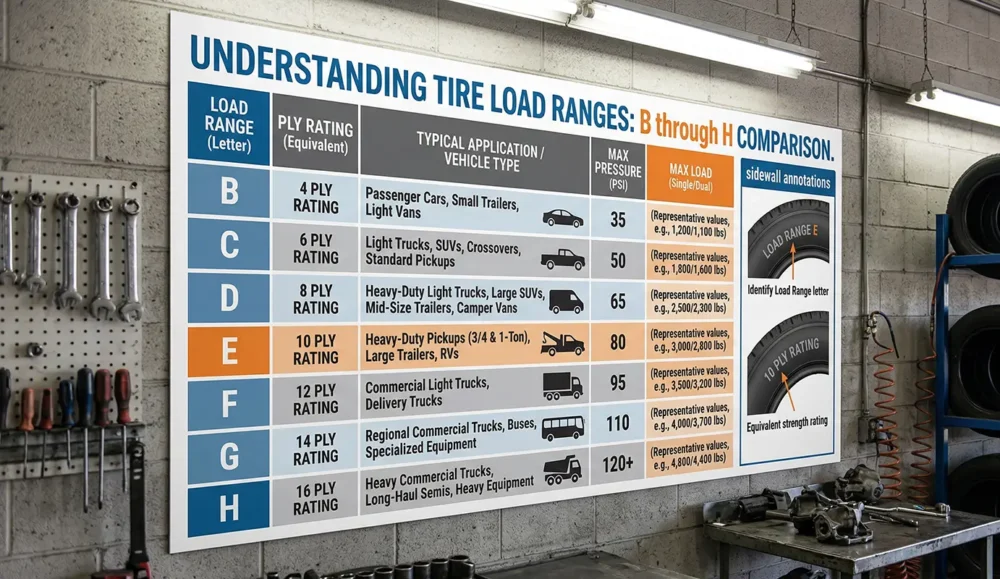
If you want to go deeper on ply ratings and how they scale across different vehicle types, here are the most useful guides to bookmark:
- LT vs. P-Metric Tires — A must-read if you’re shopping for an SUV or pickup. Explains the crucial difference between passenger-rated and light truck-rated tires, and when you genuinely need LT.
- SL vs C1 Tires — Compares Standard Load and Load Range C1 tires in depth. Great if you’re deciding whether to step up your SUV’s tire rating.
- 4 Ply vs 6 Ply Tires — If 4 ply isn’t quite enough for your needs, this comparison helps you decide whether 6 ply is the right next step.
- 6 Ply vs 8 Ply Tires — For light truck and van owners trying to decide between Load Range C and D equivalent ratings.
- 4 Ply vs 10 Ply Tires — Explores the dramatic jump from passenger-grade to heavy-duty truck ratings — useful for F-150 and Ram 1500 buyers.
- 6 Ply vs 10 Ply Tires — A practical guide for medium-duty haulers and drivers who tow regularly.
- 8 Ply vs 10 Ply Tires — Compares Load Range D and E tires — the two most common heavy-duty options for serious trucks and trailers.
- 10 Ply vs 12 Ply Tires — For heavy-duty truck drivers needing maximum load ratings for commercial or extreme hauling use.
- 12 Ply vs 14 Ply Tires — Takes you into commercial and industrial territory — heavy trucks and equipment haulers.
- 14 Ply vs 16 Ply Tires — The top of the load range scale, relevant for commercial semi trucks and specialized heavy equipment.
- Radial vs. Bias Ply Tire — A foundational comparison that explains how tire construction itself — not just load rating — affects performance, wear, and handling.
- 2 Ply vs 4 Ply Tires — You’re reading the definitive guide. Share it with anyone who’s confused about which rating to choose for their passenger car or compact SUV.
Frequently Asked Questions
Are 2 Ply Tires Safe?
Yes — absolutely, when matched to the right vehicle and use case. Standard Load (2-ply equivalent) tires meet all federal safety standards and are the OEM recommendation for most passenger cars in the U.S. They’re not a cut-rate compromise; they’re designed specifically for normal passenger vehicle use. The safety concern only arises if you’re overloading your vehicle beyond the tire’s load rating — which applies equally to any tire type.
Is 4 Ply Better for Daily Driving?
Not necessarily — it depends on what your daily driving involves. If you commute on maintained pavement in a standard passenger car, 4 ply tires will actually give you a slightly worse ride experience without meaningful benefit. If your daily route involves rough roads, heavy loads, or an SUV that’s regularly near capacity, then yes — 4 ply is a genuine upgrade for daily use.
Will 4 Ply Tires Improve Durability?
In rough-road and higher-load scenarios, yes — meaningfully so. The sidewall reinforcement in 4 ply tires provides real protection against pothole damage, sidewall punctures, and blowouts under load. On smooth pavement with normal loads, the durability improvement is much smaller and may not justify the firmer ride trade-off.