If you’ve ever stared at a tire sidewall and seen a letter — V or Y — buried inside a string of numbers and wondered what it actually means for your daily drive, you’re in the right place.
I’ve been reviewing and testing tires for years, and speed ratings are one of the most misunderstood specs I get asked about.
Before we dive deep, if you want a full side-by-side overview of every speed rating letter, check out my tire speed ratings chart — it’ll give you the complete picture.
In this post, I’m focusing specifically on the V vs Y matchup, because these two ratings are where most performance-oriented buyers get tripped up.
TL;DR
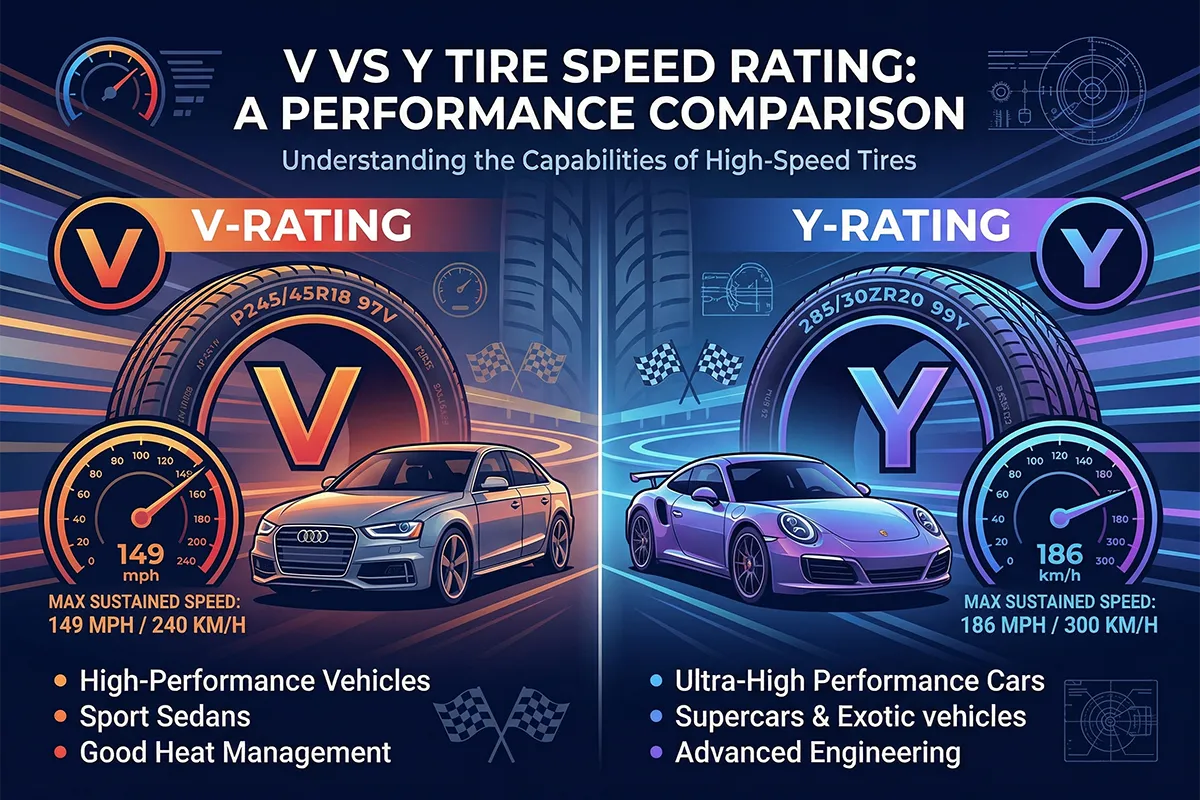
V-rated tires are built for speeds up to 149 mph and work great on everyday sedans, SUVs, and crossovers that want performance without the premium price. Y-rated tires handle up to 186 mph and are designed for exotic sports cars and ultra-high-performance vehicles. For 99% of American drivers, a V-rated tire is more than enough — and it’ll cost less and last longer. Only go Y if your car specifically requires it or if you regularly push the limits of a performance vehicle.
What Is a Tire Speed Rating, and Why Does It Matter?
Speed ratings exist for a very practical reason: as tires spin faster, they generate more heat. A tire that can’t handle the heat at high speeds starts to degrade structurally — and that’s a dangerous situation.
The speed rating letter on your tire is the manufacturer’s guarantee that the tire can safely sustain the listed top speed under optimal conditions for an extended period.
That said, speed ratings are not just about how fast you drive. They also signal the tire’s overall construction quality, its heat dissipation design, and often — though not always — its handling characteristics.
A higher-rated tire generally has a stiffer construction, a stickier compound, and a more performance-biased tread pattern.
Here’s the key point I want you to hold onto through this whole article: a speed rating is a minimum standard, not a maximum aspiration. Your tire needs to meet or exceed your vehicle’s OEM (factory) rating.
Going higher is usually fine — going lower can void your warranty and, more importantly, compromise safety.
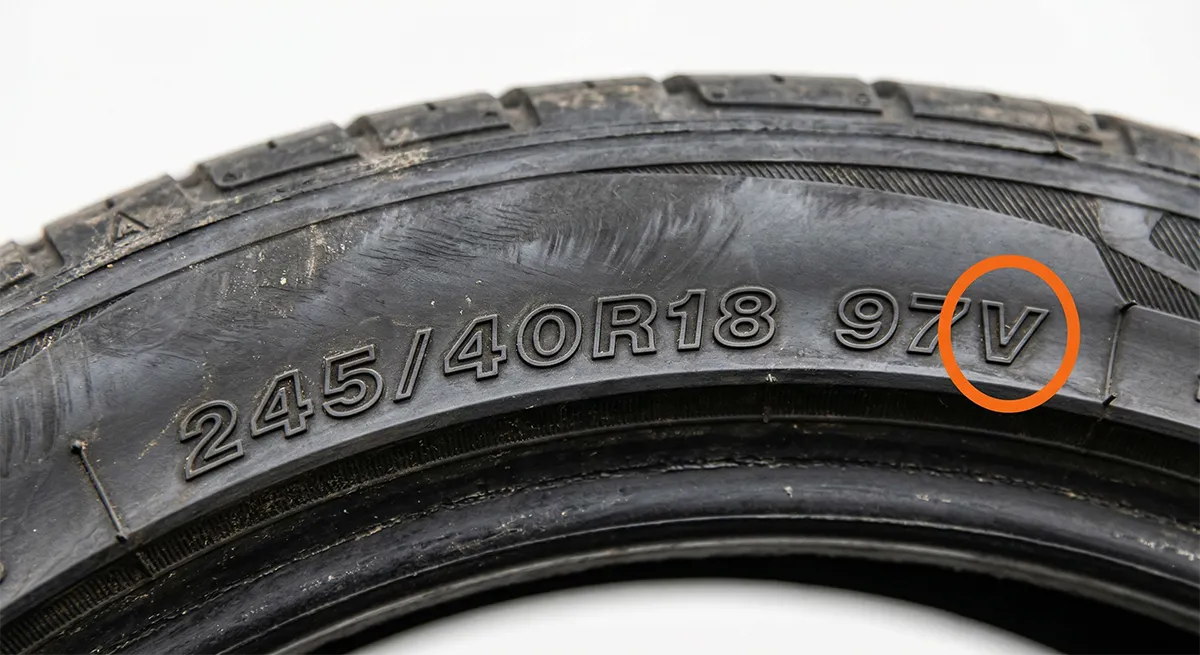
Speed rating explained on tire sidewall
V Speed Rating: What You Need to Know
Speed Capability
A V-rated tire is certified to sustain speeds up to 149 mph (240 km/h). Let’s be honest — that’s faster than any American highway speed limit and faster than most of us will ever drive outside of a track day.
For a daily driver, V is a strong upper limit with plenty of real-world headroom.
Construction and Feel
V-rated tires sit in what I think of as the “sweet spot” of the performance tire spectrum.
They’re constructed with reinforced belts and a firmer sidewall compared to H-rated or lower tires, but they’re not as stiff as the Y-rated ultra-high-performance tires.
That means you get noticeably sharper steering and better cornering grip than a standard touring tire, without sacrificing the comfortable ride quality that makes everyday commuting enjoyable.
In my experience testing these tires, the V-rated category tends to produce the best balance between performance and everyday usability.
They respond well in both dry and wet conditions, and most V-rated tires from top brands offer respectable all-season capability.
Who Should Buy V-Rated Tires?
V-rated tires are the right choice for the vast majority of performance-minded buyers. Here’s a practical list of vehicle types where V makes the most sense:
- Sport sedans: Honda Accord Sport, Mazda6, Toyota Camry TRD
- Crossovers and SUVs: Mazda CX-5, Toyota RAV4 Adventure, Honda CR-V Sport
- Entry-level performance cars: Honda Civic Si, Subaru WRX, Volkswagen GTI
- Luxury sedans: Acura TLX, Genesis G70, Cadillac CT4
V-Rated Tire Pros
- Excellent balance of performance and comfort
- Generally longer tread life than Y-rated tires
- More affordable — often 25–40% less than comparable Y-rated options
- Good fuel economy characteristics
- Wide selection from all major brands
V-Rated Tire Cons
- Not appropriate for true exotic sports cars or vehicles with Y requirements
- Can feel slightly vague compared to Y-rated tires in aggressive cornering
- Speed limit of 149 mph means less headroom on the Autobahn (matters if you travel)
Y Speed Rating: What You Need to Know
Speed Capability
A Y-rated tire is certified to sustain speeds up to 186 mph (300 km/h). That is an extraordinary threshold.
The only vehicles in the US market that genuinely require Y-rated tires are exotic sports cars, hypercars, and a select group of performance-tuned vehicles — think Ferrari, Lamborghini, Porsche 911 Turbo, Chevrolet Corvette Z06, and BMW M5 Competition.
Construction and Feel
Y-rated tires are engineered at a completely different performance tier.
They use advanced rubber compounds with a high silica content for better grip at elevated temperatures, reinforced internal belt structures to prevent deformation at speed, and tread patterns optimized for lateral acceleration and high-speed stability rather than passenger comfort.
The trade-off is real: Y-rated tires are typically stiffer, noisier on highway surfaces, and wear faster than V-rated alternatives. That’s the price of performance at this level, and most buyers in this category understand and accept that trade-off.
Who Should Buy Y-Rated Tires?
- Exotic and supercar owners: Ferrari, Lamborghini, Bugatti, McLaren
- High-performance sports cars: Porsche 911 Turbo S, Chevrolet Corvette Z06/ZR1, BMW M3/M4
- Track-day enthusiasts: Anyone who regularly drives at or near the edge on a closed circuit
- Buyers who want the best available grip: Even on lower-powered cars, some enthusiasts choose Y for the compound quality
Y-Rated Tire Pros
- Best-in-class grip at high speeds and in hard cornering
- Exceptional dry and wet performance at the limits
- Required and optimized for exotic car performance systems
- Confidence-inspiring feel at track day pace
Y-Rated Tire Cons
- Significantly more expensive — premium Y-rated tires can run $300–$600+ per tire
- Shorter tread life — some high-performance Y tires wear in 20,000–30,000 miles
- Stiffer ride quality on everyday roads
- Overkill for the vast majority of daily drivers
V vs Y Speed Rating: Head-to-Head Comparison
Here’s a quick-glance breakdown of how V and Y speed ratings compare across the factors that matter most when you’re shopping for replacement tires:
| Feature | V Speed Rating | Y Speed Rating | Winner For Most Drivers |
|---|---|---|---|
| Max Speed | 149 mph (240 km/h) | 186 mph (300 km/h) | Depends on vehicle |
| Everyday Comfort | Excellent | Good–Excellent | V (slightly) |
| Tread Life | 50,000–60,000 mi avg | 30,000–45,000 mi avg | V |
| Fuel Economy | Slightly better | Moderate | V |
| Price | $$ | $$$–$$$$ | V |
| Best For | Sedans, crossovers, daily drivers | Sports cars, luxury performance | V for daily, Y for performance |
| High-Speed Handling | Very good | Exceptional | Y |
| Wet Traction | Very good | Excellent | Y (marginal) |
Real-World Driving: Does the Speed Rating Actually Change Anything?
This is the question I get asked most often — and it deserves a straight answer. For 99% of driving in the United States, you will never legally approach the speed where V vs Y makes a meaningful safety difference.
The highest legal speed limit in the US is 85 mph in parts of Texas, and even aggressive highway merging in most cities tops out around 80 mph.
What you will notice day-to-day, however, is the difference in compound characteristics. Y-rated tires use a stickier rubber formula that improves handling and wet grip at normal speeds too, not just at 180+ mph.
So if you have a car that benefits from that extra grip — say a Porsche 718 Cayman or a BMW M4 — upgrading to Y-rated rubber can genuinely sharpen the driving experience even on your regular commute.
If you’re driving a Toyota Camry, a Mazda CX-5, or a Honda Accord, I’d tell you directly: don’t spend the extra money on Y-rated tires.
You won’t feel a meaningful improvement in daily driving, and you’ll pay significantly more at purchase and replacement.
Best V-Rated Tires in 2025: My Top Picks
Over the years, I’ve driven on — or thoroughly researched — every major V-rated tire on the US market. Here are the tires that consistently stand out in their class:
| Tire Name | Best For | Notable Trait |
|---|---|---|
| Michelin Pilot Sport 4 | Daily driver performance | Exceptional wet + dry balance |
| Continental ExtremeContact Sport 02 | Sport sedans & crossovers | Precise steering feel |
| Bridgestone Potenza Sport | Performance all-season use | Long tread life for V-rated |
| Goodyear Eagle F1 Asymmetric 6 | Luxury & sport sedans | Quiet, comfortable ride |
| Pirelli P Zero PZ4 | European luxury sport cars | Low road noise, superb grip |
| Yokohama ADVAN Sport V107 | Premium sport sedans | Excellent cornering stability |
| Hankook Ventus S1 evo3 | Sport coupes | Budget-friendly performance |
| Falken Azenis FK520 | Budget-conscious sport drivers | Solid all-around performer |
| Toyo Proxes Sport A/S | All-season performance | Surprisingly grippy in rain |
| Cooper Zeon RS3-G1 | Affordable sport daily driver | Good tread wear rating |
My top personal recommendation in the V-rated category is the Michelin Pilot Sport 4. It’s the tire I’d put on my own daily driver performance car without a second thought.
The Goodyear Eagle F1 Asymmetric 6 is a fantastic choice if road noise is your top concern. And if you’re on a budget, the Hankook Ventus S1 evo3 offers genuinely impressive performance at a fraction of the Michelin price.
Best Y-Rated Tires in 2025: My Top Picks
If your vehicle genuinely needs Y-rated rubber — or you’re a serious performance driver who wants the best grip available — here are the tires worth considering:
| Tire Name | Best For | Notable Trait |
| Michelin Pilot Sport 4S | Exotic and sports cars | Best in class wet & dry grip |
| Michelin Pilot Sport Cup 2 | Track use & supercars | Near race-level performance |
| Continental SportContact 7 | Ultra-high performance sports | Exceptional lateral grip |
| Pirelli P Zero Corsa | Ferrari, Lamborghini OE fitments | OEM-grade track capability |
| Goodyear Eagle F1 SuperSport | Porsche, BMW M-series | Supercar-level performance |
| Bridgestone Potenza RE-71RS | Track days & AutoX | Extremely high grip compound |
| Yokohama ADVAN Neova AD09 | Lightweight sports cars | Razor-sharp steering response |
| Dunlop Sport Maxx Race 2 | Racing-derived road tire | Very high lateral Gs |
| Pirelli Trofeo R | Semi-slick track use | Extreme grip, short life |
| Toyo Proxes R888R | AutoX / time attack | DOT-legal race compound |
For road-use Y-rated tires, the Michelin Pilot Sport 4S is the undisputed benchmark. I’ve seen it tested against virtually everything in its class and it consistently delivers the best combination of wet grip, dry performance, and real-world usability.
If you’re more track-focused, the Bridgestone Potenza RE-71RS and Toyo Proxes R888R are the performance monsters of the lineup — but know that they’ll wear quickly on the street.
Can You Replace a Y-Rated Tire with a V-Rated Tire?
Technically, yes. Practically, I’d caution against it — especially if your vehicle originally came with Y-rated tires from the factory.
Here’s why: manufacturers engineer high-performance vehicles with specific tires as part of the overall chassis tune.
The suspension calibration, the ABS thresholds, the ESC intervention points — all of these systems are developed with Y-rated tire behavior in mind.
Swapping in V-rated tires can subtly alter how those systems interact with the road, which may reduce their effectiveness in an emergency.
For exotic cars and track machines, I always recommend staying at or above the OEM speed rating.
For a Porsche 911 Turbo that came with Y-rated tires, don’t downgrade to V. The potential performance and safety implications simply aren’t worth the cost savings.
On the other hand, if your everyday sedan or crossover came with V-rated tires and you’re looking to replace them, you’re perfectly fine staying in the V category — or even stepping up to W or Y if you want the compound benefits. You should never go lower than the OEM rating.
V vs Y Speed Rating: Price Difference Breakdown
Let’s talk money, because this is where the rubber meets the road (pun intended) for most buyers. Y-rated tires command a significant price premium over V-rated options, and it’s not just a slight markup:
- Entry-level V-rated (e.g. Falken Azenis FK520, 245/45R18): ~$110–$140 per tire
- Mid-range V-rated (e.g. Continental ExtremeContact Sport 02): ~$160–$220 per tire
- Premium V-rated (e.g. Michelin Pilot Sport 4): ~$200–$280 per tire
- Entry Y-rated (e.g. Yokohama ADVAN Neova AD09): ~$230–$290 per tire
- Mid-range Y-rated (e.g. Goodyear Eagle F1 SuperSport): ~$280–$380 per tire
- Premium Y-rated (e.g. Michelin Pilot Sport 4S): ~$320–$500 per tire
On a full set of four tires, the difference between a solid V-rated option and a comparable Y-rated option can easily be $400–$800 or more. Factor in the shorter tread life of Y-rated tires, and the cost-of-ownership gap widens further.
Unless you genuinely need or want what a Y-rated tire delivers, that’s real money better kept in your pocket.
Exploring Other Speed Rating Comparisons
Speed ratings don’t exist in a vacuum — understanding where V and Y sit on the full spectrum helps put this comparison in context. Here are some other comparisons you might find useful:
- V vs H Speed Rating — Great if you’re deciding between a performance and a touring-class tire
- V vs W Speed Rating — The step between V and Y, W offers a compelling middle ground
- W vs Y Speed Rating — Which ultra-high-performance option is right for your sports car?
- H vs T Speed Rating — For buyers of everyday family sedans and touring vehicles
- S vs T Speed Rating — The two most common economy and standard touring ratings explained
- H vs S Speed Rating — Stepping up from a standard to a performance-adjacent tire
- V vs T Speed Rating — A big jump in performance tier, worth understanding the trade-offs
- Q vs S Speed Rating — Relevant for winter and light-truck tire shoppers
- Z vs W Speed Rating — Understanding Z classification and how it relates to modern ratings
- Q vs T Speed Rating — Comparing winter-rated tires to standard all-season options
- R vs S Speed Rating — Light truck and moderate-speed tire ratings explained
FAQs: V vs Y Speed Rating
Can I put Y-rated tires on a car that only requires V-rated?
Yes, you can. Y-rated tires meet and exceed the V specification, so they are safe to use on a vehicle that calls for V. The question is whether the premium cost and potential ride stiffness trade-off are worth it for your specific car and driving style.
Do Y-rated tires give better gas mileage than V-rated?
Generally, no — Y-rated tires tend to have slightly higher rolling resistance due to their stickier compounds, which can modestly reduce fuel economy. V-rated tires typically have a small advantage in fuel efficiency, though the real-world difference is usually less than 1–2 MPG.
What happens if I drive a Y-rated tire below its optimal temperature range?
High-performance compounds, especially those designed for track use, need heat to reach their best grip levels. In very cold conditions, a Y-rated summer tire can become brittle and slippery, performing worse than an all-season V-rated tire. This is why it’s critical to match the tire’s season rating to your climate — not just the speed rating.
Are V-rated tires safe for highway driving at 70–80 mph?
Absolutely. V-rated tires are certified to 149 mph, which means 70–80 mph highway driving is well within a very comfortable margin. V-rated tires are among the most reliable all-around performers for US highway conditions.
What speed rating does the Porsche 911 Turbo S require?
The 911 Turbo S comes from the factory with Y-rated tires (typically Pirelli P Zero Corsa or Michelin Pilot Sport Cup 2 in the appropriate size). Staying with Y-rated rubber is strongly recommended for this vehicle.
Can I mix V and Y rated tires on the same car?
Mixing speed ratings is technically possible, but I’d advise against it. When mixing ratings, the lowest-rated tire determines the safe speed threshold for the entire vehicle. More importantly, different speed rating classes often have meaningfully different handling characteristics, which can create unpredictable behavior during hard cornering or emergency maneuvers. Match all four whenever possible.
V vs Y Speed Rating: My Final Verdict
After years of reviewing tires across every category, my recommendation is simple:
Buy the speed rating your vehicle requires. If it requires V, buy V (or higher if you want compound benefits). If it requires Y, don’t compromise with V.
For the majority of American drivers — even those driving spirited, sporty cars — V-rated tires offer exceptional performance, better value, longer tread life, and a more comfortable daily driving experience. The extra speed headroom of Y-rated tires is simply irrelevant for street use in almost every realistic scenario.
But if you’re the owner of an exotic sports car, a track machine, or a high-horsepower performance vehicle that was engineered around Y-rated rubber, then Y is absolutely the right choice.
These tires are built to handle the speed and the thermal demands that those vehicles create, and compromising on that spec isn’t worth the risk.
Still not sure which speed rating is right for your specific car? Drop your vehicle year, make, and model in the comments and I’ll help you figure it out. And if you’re comparing more than just V and Y, don’t forget to check out my full
Still not sure which speed rating is right for your specific car? Drop your vehicle year, make, and model in the comments and I’ll help you figure it out.
And if you’re comparing more than just V and Y, don’t forget to check out my full tire speed ratings chart for the complete breakdown of every rating letter from Q to Y.