
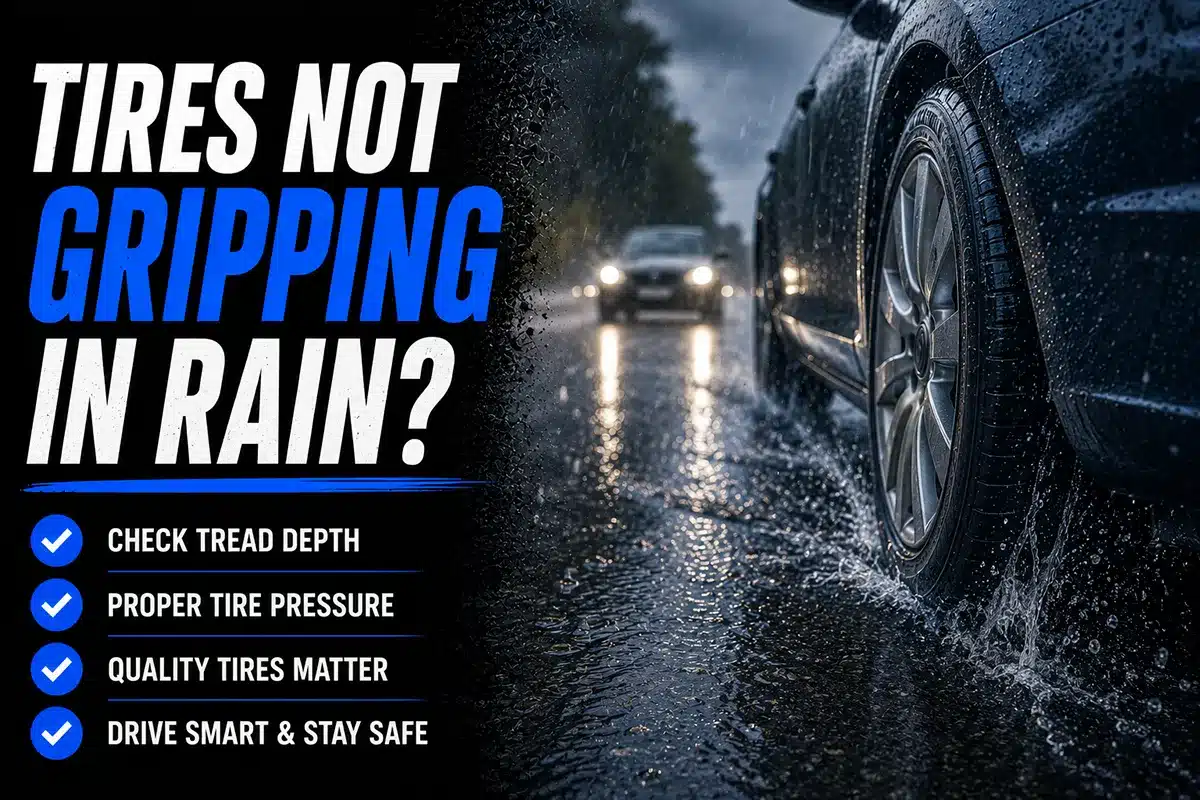
- Why Rain Exposes Tire Problems That Dry Roads Hide
- Step 1: Check Your Tread Depth First — The Quarter Test
- Step 2: Check Tire Age — Rubber Hardens Whether You Drive or Not
- Step 3: Check Your Tire Pressure
- Step 4: Understand What Kind of Tires You Have
- Step 5: Look at Your Tread Pattern — Not All Grooves Are Equal
- What to Do If Your Tires Are the Problem
- Driving Habits That Help in the Rain (Even Before You Replace Tires)
- When to See a Mechanic: Grip Issues That Aren’t Tire-Related
- Frequently Asked Questions
- The Bottom Line
Why Rain Exposes Tire Problems That Dry Roads Hide
Here’s something most drivers don’t think about: your tires are doing something remarkable every time you drive in the rain.
The tread grooves on your tires act like a pumping system — they’re engineered to channel water away from the contact patch (the area actually touching the road) at a rate of several gallons per second at highway speeds.
When that system works, you get grip. When it breaks down — through worn tread, hardened rubber, or mismatched tire design — water builds up under the tire faster than it can escape.
That’s hydroplaning. And it doesn’t take much speed. Studies have shown it can begin at speeds as low as 35 mph on a tire with significantly worn tread.
I learned this the hard way. That I-95 incident happened on tires that still had what looked like “decent” tread to my untrained eye.
They had roughly 3/32″ left — technically legal in most U.S. states, but well past the point where wet weather performance starts falling off a cliff.
Step 1: Check Your Tread Depth First — The Quarter Test
Before you do anything else, spend two minutes on this. Grab a quarter (a U.S. quarter, not a penny — more on that in a second).
Insert the quarter into your tread groove with Washington’s head pointing down into the groove. If you can see the top of Washington’s head, your tread is at or below 4/32″. That’s the threshold where I strongly recommend replacing tires, especially if wet weather grip is a concern.
The old “penny test” that uses Lincoln’s head checks for 2/32″ — the legal minimum in most states. But 2/32″ is dangerously inadequate in the rain.
By the time you’re at 2/32″, your stopping distance in wet conditions has roughly doubled compared to new tires. The quarter test gives you a more realistic safety margin.
What I check for on my own cars:
| Tread Depth | Wet Weather Status |
|---|---|
| 8/32″ – 10/32″ (new) | Excellent wet grip |
| 6/32″ – 7/32″ | Good, watch for wear |
| 4/32″ – 5/32″ | Noticeably reduced wet grip — start shopping |
| 2/32″ – 3/32″ | Dangerous in rain — replace immediately |
| Below 2/32″ | Illegal in most U.S. states |
Check multiple grooves across the tire — inner edge, center, outer edge. Uneven wear (one side significantly lower than another) tells you there’s likely an alignment or inflation issue compounding the grip problem.
Step 2: Check Tire Age — Rubber Hardens Whether You Drive or Not
This one surprises most people. Even if your tread looks perfectly fine, tires older than six years start losing the chemical flexibility that lets rubber conform to the road surface and maintain grip in wet conditions. By year ten, the rubber compound can be so hardened that it behaves more like plastic than rubber.
Tire age matters a lot in hot-climate states. Here in the mid-Atlantic, I’ve seen tires that looked practically new but were eight or nine years old on a car someone kept garaged for years. That rubber had set and stiffened, and the wet performance was genuinely poor.
How to find your tire’s age: Look at the DOT code on the sidewall. The last four digits are the week and year of manufacture. For example, “2319” means the 23rd week of 2019.
If your tires are past the six-year mark, wet weather grip may be compromised regardless of tread depth. Factor that into your decision to replace them.
Step 3: Check Your Tire Pressure
Underinflated tires are one of the sneakiest contributors to poor wet traction. When a tire runs low on pressure, the contact patch shape changes — the center of the tread can actually lift slightly while the outer edges carry more load. This distorts how the grooves channel water and reduces the tire’s ability to maintain consistent road contact.
I make it a habit to check pressure every time the temperature drops more than 15–20°F — for every 10-degree drop in ambient temperature, tire pressure typically drops about 1 PSI.
Going from a warm September into a rainy October can mean your tires are running 3–4 PSI low without any visible change.
Find your correct tire pressure on the sticker inside your driver’s door jamb — not the max PSI printed on the tire sidewall (that’s the tire’s maximum rating, not your car’s recommended operating pressure). Check pressure when the tires are cold (parked for at least three hours or driven fewer than a mile).
Quick pressure check habit:
- Check monthly at minimum
- Check before any long rainy-season road trips
- Check whenever the TPMS warning light comes on — but also even when it doesn’t, since TPMS only alerts you around 25% below recommended pressure
Step 4: Understand What Kind of Tires You Have
Not all tires are created equal when it comes to rain. This is something I see glossed over constantly in generic advice, and it’s genuinely important.
All-Season Tires
The majority of U.S. passenger cars ship from the factory on all-season tires. They’re designed to handle a range of conditions — dry roads, light snow, and rain — but they’re a compromise.
Some all-season tires are excellent in the rain. Others are mediocre. The tread pattern and rubber compound vary enormously from brand to brand and model to model.
All-Weather Tires
Not the same as all-season. All-weather tires carry the Three-Peak Mountain Snowflake (3PMSF) symbol, meaning they’ve passed a more rigorous winter traction test. Many also perform very well in rain because of their siping patterns.
Summer / Performance Tires
Summer tires typically excel in wet performance compared to all-seasons because they use softer, grippier compounds and have tread patterns optimized for wet-road water evacuation.
The trade-off: they’re not meant for temperatures below 44°F and offer very little snow traction.
Dedicated Winter Tires
If you’re experiencing grip issues specifically in cold, rainy weather (40°F and below), winter tires dramatically outperform all-seasons on wet cold pavement — not just in snow. The rubber compound stays soft at low temperatures, which is a significant wet grip advantage.
Step 5: Look at Your Tread Pattern — Not All Grooves Are Equal
Even among tires of the same type, tread pattern design has a massive impact on wet performance. Here’s what to look for:
Circumferential grooves (the large channels running around the tire) are the primary water evacuation highways. More and wider circumferential grooves generally improve wet performance. When I evaluated tires for my daily driver, this was one of the first things I looked at in spec sheets.
Lateral grooves and sipes (thin cuts across the tread blocks) create additional biting edges and water escape routes. Tires with heavy siping tend to perform better on wet surfaces at lower speeds and in light rain.
Asymmetric tread patterns — where the inside half of the tread is different from the outside half — are a common wet-weather optimization. The inside typically handles water evacuation; the outside prioritizes dry grip and cornering stability.
If your current tires have a relatively simple, blocky tread pattern with few lateral channels, they were probably not designed with wet performance as a priority. That’s worth knowing when you’re shopping for replacements.
What to Do If Your Tires Are the Problem
Once you’ve diagnosed the issue, the path forward depends on what you found.
If Tread Depth Is the Issue (Under 4/32″)
Replace your tires. There’s no safe workaround for worn tread depth. I know it’s not the answer people want, but I’ve seen too many drivers try to “make it through the winter” on worn tires.
The risk isn’t worth it — stopping distance increases dramatically, and hydroplaning risk rises steeply.
When shopping for replacements, look for tires with strong wet-weather ratings. I rely on a few sources: Consumer Reports tire ratings, Tire Rack’s independent wet testing data, and actual owner reviews from drivers in similar climates.
Tires consistently praised for wet performance in the all-season category include:
- Michelin CrossClimate2 (also carries the 3PMSF rating)
- Continental PureContact LS
- Bridgestone Turanza QuietTrack
- Goodyear Assurance WeatherReady
I’ve personally driven on the CrossClimate2 in heavy mid-Atlantic rain, and the wet confidence is noticeably better than the budget all-season tires I had before.
That said, budget tires have improved considerably, and if cost is a constraint, tires like the Hankook Kinergy PT or the Cooper Endeavor Plus offer solid wet-weather value.
If Age Is the Issue (Over 6 Years)
Same answer: replace. New tires are the only way to restore the rubber flexibility that provides good wet grip.
If Pressure Is the Issue
Fill your tires to the manufacturer’s recommended spec and re-check grip on your next rainy drive. It’s free and takes ten minutes.
If Your Tire Type Is the Issue
Consider whether your next set should be a different category. If you live somewhere with genuinely cold and rainy winters, an all-weather or dedicated winter tire swap might be worth the investment.
If you want the best possible dry and wet performance and you live in a warm climate, summer tires are worth considering.
Driving Habits That Help in the Rain (Even Before You Replace Tires)
If you’re stuck with less-than-ideal tires while you plan a replacement, there are driving adjustments that meaningfully reduce risk:
Slow down for rain. The posted speed limit is designed for dry roads. In heavy rain, reducing speed by 10–15 mph significantly reduces hydroplaning risk because the tires have more time to channel water away.
Increase following distance. Wet stopping distances are longer. A 3-second dry-road following gap should become 5–6 seconds in rain.
Avoid standing water when possible. Even a few inches of standing water can initiate hydroplaning. If you can’t avoid it, slow down to walking speed before entering.
Turn off cruise control in rain. Cruise control can’t react to sudden grip loss the way your foot can. If your car starts to hydroplane while on cruise control, the system may actually try to accelerate to maintain speed.
Brake gently and earlier. Aggressive braking on wet roads — especially with worn tires — is a recipe for loss of control. Start braking well in advance of stops.
Turn your headlights on. This isn’t about seeing — it’s about being seen. Wet roads and rain reduce visibility for other drivers. In many U.S. states, you’re also legally required to have headlights on when using wipers.
When to See a Mechanic: Grip Issues That Aren’t Tire-Related
Not every wet-weather grip problem lives in the tires. If you’ve checked your tread, age, and pressure — and things still feel off — a few other possibilities are worth investigating:
Worn brake pads or rotors: Grinding or extended stopping in the rain can indicate brake wear rather than tire slip.
Alignment issues: If your car pulls to one side in the rain (or any time), misalignment causes uneven tire loading and accelerated inner or outer tread wear, reducing wet grip.
Suspension wear: Worn shocks or struts allow the tire contact patch to bounce and skip on the road surface, reducing consistent contact — especially pronounced on wet, imperfect pavement.
Wheel bearings: A compromised wheel bearing can introduce instability that feels like grip loss, particularly under lateral load (curves in the rain).
If you’re replacing tires and the shop notices your tires were wearing unevenly, ask them to check alignment before mounting the new set. Putting new tires on a misaligned car is an expensive mistake I’ve made exactly once.
Frequently Asked Questions
How do I know if my tires are hydroplaning?
Can tire shine products affect wet grip?
Is it safe to drive in rain with 3/32″ tread?
Do wider tires perform better in the rain?
What’s the best tire for rain in the U.S.?
How often should I rotate my tires to maintain even wear?
The Bottom Line
Wet weather grip problems almost always come down to four things: tread depth, tire age, inflation pressure, and tire type. The good news is that three of those four are free or very cheap to check and fix — and the fourth (tire replacement) is a cost you can plan for.
I’ve driven on tires at both ends of the spectrum — worn-out budget all-seasons on a rain-soaked highway, and freshly mounted premium all-weathers in a genuine downpour — and the difference in confidence and control is not subtle. It’s significant.
Don’t wait for a close call to tell you your tires aren’t up to the job. The quarter test takes thirty seconds. Tire pressure takes five minutes. Those two checks alone can tell you a lot about where you stand — and whether it’s time to start shopping before the next big rain rolls in.
Have a question about wet weather tires or a specific model you’re considering? Drop it in the comments — I read every one.
I once had a white-knuckle moment on I-95 during a summer downpour — my car drifted a full lane to the right on what felt like a perfectly normal highway curve.
No ice, no gravel. Just rain. That was the moment I realized my tires were quietly failing me, and I had absolutely no idea until it nearly cost me.
TL;DR: If your tires aren’t gripping in the rain, the most likely culprits are worn tread depth, hardened rubber from age, an aggressive all-season compound that doesn’t drain water well, or underinflation. The fixes range from a $1 quarter test to a full tire replacement. I’ll walk you through each one so you can figure out exactly where you stand — and what to do about it.
- Why Rain Exposes Tire Problems That Dry Roads Hide
- Step 1: Check Your Tread Depth First — The Quarter Test
- Step 2: Check Tire Age — Rubber Hardens Whether You Drive or Not
- Step 3: Check Your Tire Pressure
- Step 4: Understand What Kind of Tires You Have
- Step 5: Look at Your Tread Pattern — Not All Grooves Are Equal
- What to Do If Your Tires Are the Problem
- Driving Habits That Help in the Rain (Even Before You Replace Tires)
- When to See a Mechanic: Grip Issues That Aren’t Tire-Related
- Frequently Asked Questions
- The Bottom Line
Why Rain Exposes Tire Problems That Dry Roads Hide
Here’s something most drivers don’t think about: your tires are doing something remarkable every time you drive in the rain.
The tread grooves on your tires act like a pumping system — they’re engineered to channel water away from the contact patch (the area actually touching the road) at a rate of several gallons per second at highway speeds.
When that system works, you get grip. When it breaks down — through worn tread, hardened rubber, or mismatched tire design — water builds up under the tire faster than it can escape.
That’s hydroplaning. And it doesn’t take much speed. Studies have shown it can begin at speeds as low as 35 mph on a tire with significantly worn tread.
I learned this the hard way. That I-95 incident happened on tires that still had what looked like “decent” tread to my untrained eye.
They had roughly 3/32″ left — technically legal in most U.S. states, but well past the point where wet weather performance starts falling off a cliff.
Step 1: Check Your Tread Depth First — The Quarter Test
Before you do anything else, spend two minutes on this. Grab a quarter (a U.S. quarter, not a penny — more on that in a second).
Insert the quarter into your tread groove with Washington’s head pointing down into the groove. If you can see the top of Washington’s head, your tread is at or below 4/32″. That’s the threshold where I strongly recommend replacing tires, especially if wet weather grip is a concern.
The old “penny test” that uses Lincoln’s head checks for 2/32″ — the legal minimum in most states. But 2/32″ is dangerously inadequate in the rain.
By the time you’re at 2/32″, your stopping distance in wet conditions has roughly doubled compared to new tires. The quarter test gives you a more realistic safety margin.
What I check for on my own cars:
| Tread Depth | Wet Weather Status |
|---|---|
| 8/32″ – 10/32″ (new) | Excellent wet grip |
| 6/32″ – 7/32″ | Good, watch for wear |
| 4/32″ – 5/32″ | Noticeably reduced wet grip — start shopping |
| 2/32″ – 3/32″ | Dangerous in rain — replace immediately |
| Below 2/32″ | Illegal in most U.S. states |
Check multiple grooves across the tire — inner edge, center, outer edge. Uneven wear (one side significantly lower than another) tells you there’s likely an alignment or inflation issue compounding the grip problem.
Step 2: Check Tire Age — Rubber Hardens Whether You Drive or Not
This one surprises most people. Even if your tread looks perfectly fine, tires older than six years start losing the chemical flexibility that lets rubber conform to the road surface and maintain grip in wet conditions. By year ten, the rubber compound can be so hardened that it behaves more like plastic than rubber.
Tire age matters a lot in hot-climate states. Here in the mid-Atlantic, I’ve seen tires that looked practically new but were eight or nine years old on a car someone kept garaged for years. That rubber had set and stiffened, and the wet performance was genuinely poor.
How to find your tire’s age: Look at the DOT code on the sidewall. The last four digits are the week and year of manufacture. For example, “2319” means the 23rd week of 2019.
If your tires are past the six-year mark, wet weather grip may be compromised regardless of tread depth. Factor that into your decision to replace them.
Step 3: Check Your Tire Pressure
Underinflated tires are one of the sneakiest contributors to poor wet traction. When a tire runs low on pressure, the contact patch shape changes — the center of the tread can actually lift slightly while the outer edges carry more load. This distorts how the grooves channel water and reduces the tire’s ability to maintain consistent road contact.
I make it a habit to check pressure every time the temperature drops more than 15–20°F — for every 10-degree drop in ambient temperature, tire pressure typically drops about 1 PSI.
Going from a warm September into a rainy October can mean your tires are running 3–4 PSI low without any visible change.
Find your correct tire pressure on the sticker inside your driver’s door jamb — not the max PSI printed on the tire sidewall (that’s the tire’s maximum rating, not your car’s recommended operating pressure). Check pressure when the tires are cold (parked for at least three hours or driven fewer than a mile).
Quick pressure check habit:
- Check monthly at minimum
- Check before any long rainy-season road trips
- Check whenever the TPMS warning light comes on — but also even when it doesn’t, since TPMS only alerts you around 25% below recommended pressure
Step 4: Understand What Kind of Tires You Have
Not all tires are created equal when it comes to rain. This is something I see glossed over constantly in generic advice, and it’s genuinely important.
All-Season Tires
The majority of U.S. passenger cars ship from the factory on all-season tires. They’re designed to handle a range of conditions — dry roads, light snow, and rain — but they’re a compromise.
Some all-season tires are excellent in the rain. Others are mediocre. The tread pattern and rubber compound vary enormously from brand to brand and model to model.
All-Weather Tires
Not the same as all-season. All-weather tires carry the Three-Peak Mountain Snowflake (3PMSF) symbol, meaning they’ve passed a more rigorous winter traction test. Many also perform very well in rain because of their siping patterns.
Summer / Performance Tires
Summer tires typically excel in wet performance compared to all-seasons because they use softer, grippier compounds and have tread patterns optimized for wet-road water evacuation.
The trade-off: they’re not meant for temperatures below 44°F and offer very little snow traction.
Dedicated Winter Tires
If you’re experiencing grip issues specifically in cold, rainy weather (40°F and below), winter tires dramatically outperform all-seasons on wet cold pavement — not just in snow. The rubber compound stays soft at low temperatures, which is a significant wet grip advantage.
Step 5: Look at Your Tread Pattern — Not All Grooves Are Equal
Even among tires of the same type, tread pattern design has a massive impact on wet performance. Here’s what to look for:
Circumferential grooves (the large channels running around the tire) are the primary water evacuation highways. More and wider circumferential grooves generally improve wet performance. When I evaluated tires for my daily driver, this was one of the first things I looked at in spec sheets.
Lateral grooves and sipes (thin cuts across the tread blocks) create additional biting edges and water escape routes. Tires with heavy siping tend to perform better on wet surfaces at lower speeds and in light rain.
Asymmetric tread patterns — where the inside half of the tread is different from the outside half — are a common wet-weather optimization. The inside typically handles water evacuation; the outside prioritizes dry grip and cornering stability.
If your current tires have a relatively simple, blocky tread pattern with few lateral channels, they were probably not designed with wet performance as a priority. That’s worth knowing when you’re shopping for replacements.
What to Do If Your Tires Are the Problem
Once you’ve diagnosed the issue, the path forward depends on what you found.
If Tread Depth Is the Issue (Under 4/32″)
Replace your tires. There’s no safe workaround for worn tread depth. I know it’s not the answer people want, but I’ve seen too many drivers try to “make it through the winter” on worn tires.
The risk isn’t worth it — stopping distance increases dramatically, and hydroplaning risk rises steeply.
When shopping for replacements, look for tires with strong wet-weather ratings. I rely on a few sources: Consumer Reports tire ratings, Tire Rack’s independent wet testing data, and actual owner reviews from drivers in similar climates.
Tires consistently praised for wet performance in the all-season category include:
- Michelin CrossClimate2 (also carries the 3PMSF rating)
- Continental PureContact LS
- Bridgestone Turanza QuietTrack
- Goodyear Assurance WeatherReady
I’ve personally driven on the CrossClimate2 in heavy mid-Atlantic rain, and the wet confidence is noticeably better than the budget all-season tires I had before.
That said, budget tires have improved considerably, and if cost is a constraint, tires like the Hankook Kinergy PT or the Cooper Endeavor Plus offer solid wet-weather value.
If Age Is the Issue (Over 6 Years)
Same answer: replace. New tires are the only way to restore the rubber flexibility that provides good wet grip.
If Pressure Is the Issue
Fill your tires to the manufacturer’s recommended spec and re-check grip on your next rainy drive. It’s free and takes ten minutes.
If Your Tire Type Is the Issue
Consider whether your next set should be a different category. If you live somewhere with genuinely cold and rainy winters, an all-weather or dedicated winter tire swap might be worth the investment.
If you want the best possible dry and wet performance and you live in a warm climate, summer tires are worth considering.
Driving Habits That Help in the Rain (Even Before You Replace Tires)
If you’re stuck with less-than-ideal tires while you plan a replacement, there are driving adjustments that meaningfully reduce risk:
Slow down for rain. The posted speed limit is designed for dry roads. In heavy rain, reducing speed by 10–15 mph significantly reduces hydroplaning risk because the tires have more time to channel water away.
Increase following distance. Wet stopping distances are longer. A 3-second dry-road following gap should become 5–6 seconds in rain.
Avoid standing water when possible. Even a few inches of standing water can initiate hydroplaning. If you can’t avoid it, slow down to walking speed before entering.
Turn off cruise control in rain. Cruise control can’t react to sudden grip loss the way your foot can. If your car starts to hydroplane while on cruise control, the system may actually try to accelerate to maintain speed.
Brake gently and earlier. Aggressive braking on wet roads — especially with worn tires — is a recipe for loss of control. Start braking well in advance of stops.
Turn your headlights on. This isn’t about seeing — it’s about being seen. Wet roads and rain reduce visibility for other drivers. In many U.S. states, you’re also legally required to have headlights on when using wipers.
When to See a Mechanic: Grip Issues That Aren’t Tire-Related
Not every wet-weather grip problem lives in the tires. If you’ve checked your tread, age, and pressure — and things still feel off — a few other possibilities are worth investigating:
Worn brake pads or rotors: Grinding or extended stopping in the rain can indicate brake wear rather than tire slip.
Alignment issues: If your car pulls to one side in the rain (or any time), misalignment causes uneven tire loading and accelerated inner or outer tread wear, reducing wet grip.
Suspension wear: Worn shocks or struts allow the tire contact patch to bounce and skip on the road surface, reducing consistent contact — especially pronounced on wet, imperfect pavement.
Wheel bearings: A compromised wheel bearing can introduce instability that feels like grip loss, particularly under lateral load (curves in the rain).
If you’re replacing tires and the shop notices your tires were wearing unevenly, ask them to check alignment before mounting the new set. Putting new tires on a misaligned car is an expensive mistake I’ve made exactly once.
Frequently Asked Questions
How do I know if my tires are hydroplaning?
Can tire shine products affect wet grip?
Is it safe to drive in rain with 3/32″ tread?
Do wider tires perform better in the rain?
What’s the best tire for rain in the U.S.?
How often should I rotate my tires to maintain even wear?
The Bottom Line
Wet weather grip problems almost always come down to four things: tread depth, tire age, inflation pressure, and tire type. The good news is that three of those four are free or very cheap to check and fix — and the fourth (tire replacement) is a cost you can plan for.
I’ve driven on tires at both ends of the spectrum — worn-out budget all-seasons on a rain-soaked highway, and freshly mounted premium all-weathers in a genuine downpour — and the difference in confidence and control is not subtle. It’s significant.
Don’t wait for a close call to tell you your tires aren’t up to the job. The quarter test takes thirty seconds. Tire pressure takes five minutes. Those two checks alone can tell you a lot about where you stand — and whether it’s time to start shopping before the next big rain rolls in.
Have a question about wet weather tires or a specific model you’re considering? Drop it in the comments — I read every one.
- Why Rain Exposes Tire Problems That Dry Roads Hide
- Step 1: Check Your Tread Depth First — The Quarter Test
- Step 2: Check Tire Age — Rubber Hardens Whether You Drive or Not
- Step 3: Check Your Tire Pressure
- Step 4: Understand What Kind of Tires You Have
- Step 5: Look at Your Tread Pattern — Not All Grooves Are Equal
- What to Do If Your Tires Are the Problem
- Driving Habits That Help in the Rain (Even Before You Replace Tires)
- When to See a Mechanic: Grip Issues That Aren’t Tire-Related
- Frequently Asked Questions
- The Bottom Line
Why Rain Exposes Tire Problems That Dry Roads Hide
Here’s something most drivers don’t think about: your tires are doing something remarkable every time you drive in the rain.
The tread grooves on your tires act like a pumping system — they’re engineered to channel water away from the contact patch (the area actually touching the road) at a rate of several gallons per second at highway speeds.
When that system works, you get grip. When it breaks down — through worn tread, hardened rubber, or mismatched tire design — water builds up under the tire faster than it can escape.
That’s hydroplaning. And it doesn’t take much speed. Studies have shown it can begin at speeds as low as 35 mph on a tire with significantly worn tread.
I learned this the hard way. That I-95 incident happened on tires that still had what looked like “decent” tread to my untrained eye.
They had roughly 3/32″ left — technically legal in most U.S. states, but well past the point where wet weather performance starts falling off a cliff.
Step 1: Check Your Tread Depth First — The Quarter Test
Before you do anything else, spend two minutes on this. Grab a quarter (a U.S. quarter, not a penny — more on that in a second).
Insert the quarter into your tread groove with Washington’s head pointing down into the groove. If you can see the top of Washington’s head, your tread is at or below 4/32″. That’s the threshold where I strongly recommend replacing tires, especially if wet weather grip is a concern.
The old “penny test” that uses Lincoln’s head checks for 2/32″ — the legal minimum in most states. But 2/32″ is dangerously inadequate in the rain.
By the time you’re at 2/32″, your stopping distance in wet conditions has roughly doubled compared to new tires. The quarter test gives you a more realistic safety margin.
What I check for on my own cars:
| Tread Depth | Wet Weather Status |
|---|---|
| 8/32″ – 10/32″ (new) | Excellent wet grip |
| 6/32″ – 7/32″ | Good, watch for wear |
| 4/32″ – 5/32″ | Noticeably reduced wet grip — start shopping |
| 2/32″ – 3/32″ | Dangerous in rain — replace immediately |
| Below 2/32″ | Illegal in most U.S. states |
Check multiple grooves across the tire — inner edge, center, outer edge. Uneven wear (one side significantly lower than another) tells you there’s likely an alignment or inflation issue compounding the grip problem.
Step 2: Check Tire Age — Rubber Hardens Whether You Drive or Not
This one surprises most people. Even if your tread looks perfectly fine, tires older than six years start losing the chemical flexibility that lets rubber conform to the road surface and maintain grip in wet conditions. By year ten, the rubber compound can be so hardened that it behaves more like plastic than rubber.
Tire age matters a lot in hot-climate states. Here in the mid-Atlantic, I’ve seen tires that looked practically new but were eight or nine years old on a car someone kept garaged for years. That rubber had set and stiffened, and the wet performance was genuinely poor.
How to find your tire’s age: Look at the DOT code on the sidewall. The last four digits are the week and year of manufacture. For example, “2319” means the 23rd week of 2019.
If your tires are past the six-year mark, wet weather grip may be compromised regardless of tread depth. Factor that into your decision to replace them.
Step 3: Check Your Tire Pressure
Underinflated tires are one of the sneakiest contributors to poor wet traction. When a tire runs low on pressure, the contact patch shape changes — the center of the tread can actually lift slightly while the outer edges carry more load. This distorts how the grooves channel water and reduces the tire’s ability to maintain consistent road contact.
I make it a habit to check pressure every time the temperature drops more than 15–20°F — for every 10-degree drop in ambient temperature, tire pressure typically drops about 1 PSI.
Going from a warm September into a rainy October can mean your tires are running 3–4 PSI low without any visible change.
Find your correct tire pressure on the sticker inside your driver’s door jamb — not the max PSI printed on the tire sidewall (that’s the tire’s maximum rating, not your car’s recommended operating pressure). Check pressure when the tires are cold (parked for at least three hours or driven fewer than a mile).
Quick pressure check habit:
- Check monthly at minimum
- Check before any long rainy-season road trips
- Check whenever the TPMS warning light comes on — but also even when it doesn’t, since TPMS only alerts you around 25% below recommended pressure
Step 4: Understand What Kind of Tires You Have
Not all tires are created equal when it comes to rain. This is something I see glossed over constantly in generic advice, and it’s genuinely important.
All-Season Tires
The majority of U.S. passenger cars ship from the factory on all-season tires. They’re designed to handle a range of conditions — dry roads, light snow, and rain — but they’re a compromise.
Some all-season tires are excellent in the rain. Others are mediocre. The tread pattern and rubber compound vary enormously from brand to brand and model to model.
All-Weather Tires
Not the same as all-season. All-weather tires carry the Three-Peak Mountain Snowflake (3PMSF) symbol, meaning they’ve passed a more rigorous winter traction test. Many also perform very well in rain because of their siping patterns.
Summer / Performance Tires
Summer tires typically excel in wet performance compared to all-seasons because they use softer, grippier compounds and have tread patterns optimized for wet-road water evacuation.
The trade-off: they’re not meant for temperatures below 44°F and offer very little snow traction.
Dedicated Winter Tires
If you’re experiencing grip issues specifically in cold, rainy weather (40°F and below), winter tires dramatically outperform all-seasons on wet cold pavement — not just in snow. The rubber compound stays soft at low temperatures, which is a significant wet grip advantage.
Step 5: Look at Your Tread Pattern — Not All Grooves Are Equal
Even among tires of the same type, tread pattern design has a massive impact on wet performance. Here’s what to look for:
Circumferential grooves (the large channels running around the tire) are the primary water evacuation highways. More and wider circumferential grooves generally improve wet performance. When I evaluated tires for my daily driver, this was one of the first things I looked at in spec sheets.
Lateral grooves and sipes (thin cuts across the tread blocks) create additional biting edges and water escape routes. Tires with heavy siping tend to perform better on wet surfaces at lower speeds and in light rain.
Asymmetric tread patterns — where the inside half of the tread is different from the outside half — are a common wet-weather optimization. The inside typically handles water evacuation; the outside prioritizes dry grip and cornering stability.
If your current tires have a relatively simple, blocky tread pattern with few lateral channels, they were probably not designed with wet performance as a priority. That’s worth knowing when you’re shopping for replacements.
What to Do If Your Tires Are the Problem
Once you’ve diagnosed the issue, the path forward depends on what you found.
If Tread Depth Is the Issue (Under 4/32″)
Replace your tires. There’s no safe workaround for worn tread depth. I know it’s not the answer people want, but I’ve seen too many drivers try to “make it through the winter” on worn tires.
The risk isn’t worth it — stopping distance increases dramatically, and hydroplaning risk rises steeply.
When shopping for replacements, look for tires with strong wet-weather ratings. I rely on a few sources: Consumer Reports tire ratings, Tire Rack’s independent wet testing data, and actual owner reviews from drivers in similar climates.
Tires consistently praised for wet performance in the all-season category include:
- Michelin CrossClimate2 (also carries the 3PMSF rating)
- Continental PureContact LS
- Bridgestone Turanza QuietTrack
- Goodyear Assurance WeatherReady
I’ve personally driven on the CrossClimate2 in heavy mid-Atlantic rain, and the wet confidence is noticeably better than the budget all-season tires I had before.
That said, budget tires have improved considerably, and if cost is a constraint, tires like the Hankook Kinergy PT or the Cooper Endeavor Plus offer solid wet-weather value.
If Age Is the Issue (Over 6 Years)
Same answer: replace. New tires are the only way to restore the rubber flexibility that provides good wet grip.
If Pressure Is the Issue
Fill your tires to the manufacturer’s recommended spec and re-check grip on your next rainy drive. It’s free and takes ten minutes.
If Your Tire Type Is the Issue
Consider whether your next set should be a different category. If you live somewhere with genuinely cold and rainy winters, an all-weather or dedicated winter tire swap might be worth the investment.
If you want the best possible dry and wet performance and you live in a warm climate, summer tires are worth considering.
Driving Habits That Help in the Rain (Even Before You Replace Tires)
If you’re stuck with less-than-ideal tires while you plan a replacement, there are driving adjustments that meaningfully reduce risk:
Slow down for rain. The posted speed limit is designed for dry roads. In heavy rain, reducing speed by 10–15 mph significantly reduces hydroplaning risk because the tires have more time to channel water away.
Increase following distance. Wet stopping distances are longer. A 3-second dry-road following gap should become 5–6 seconds in rain.
Avoid standing water when possible. Even a few inches of standing water can initiate hydroplaning. If you can’t avoid it, slow down to walking speed before entering.
Turn off cruise control in rain. Cruise control can’t react to sudden grip loss the way your foot can. If your car starts to hydroplane while on cruise control, the system may actually try to accelerate to maintain speed.
Brake gently and earlier. Aggressive braking on wet roads — especially with worn tires — is a recipe for loss of control. Start braking well in advance of stops.
Turn your headlights on. This isn’t about seeing — it’s about being seen. Wet roads and rain reduce visibility for other drivers. In many U.S. states, you’re also legally required to have headlights on when using wipers.
When to See a Mechanic: Grip Issues That Aren’t Tire-Related
Not every wet-weather grip problem lives in the tires. If you’ve checked your tread, age, and pressure — and things still feel off — a few other possibilities are worth investigating:
Worn brake pads or rotors: Grinding or extended stopping in the rain can indicate brake wear rather than tire slip.
Alignment issues: If your car pulls to one side in the rain (or any time), misalignment causes uneven tire loading and accelerated inner or outer tread wear, reducing wet grip.
Suspension wear: Worn shocks or struts allow the tire contact patch to bounce and skip on the road surface, reducing consistent contact — especially pronounced on wet, imperfect pavement.
Wheel bearings: A compromised wheel bearing can introduce instability that feels like grip loss, particularly under lateral load (curves in the rain).
If you’re replacing tires and the shop notices your tires were wearing unevenly, ask them to check alignment before mounting the new set. Putting new tires on a misaligned car is an expensive mistake I’ve made exactly once.
Frequently Asked Questions
How do I know if my tires are hydroplaning?
Can tire shine products affect wet grip?
Is it safe to drive in rain with 3/32″ tread?
Do wider tires perform better in the rain?
What’s the best tire for rain in the U.S.?
How often should I rotate my tires to maintain even wear?
The Bottom Line
Wet weather grip problems almost always come down to four things: tread depth, tire age, inflation pressure, and tire type. The good news is that three of those four are free or very cheap to check and fix — and the fourth (tire replacement) is a cost you can plan for.
I’ve driven on tires at both ends of the spectrum — worn-out budget all-seasons on a rain-soaked highway, and freshly mounted premium all-weathers in a genuine downpour — and the difference in confidence and control is not subtle. It’s significant.
Don’t wait for a close call to tell you your tires aren’t up to the job. The quarter test takes thirty seconds. Tire pressure takes five minutes. Those two checks alone can tell you a lot about where you stand — and whether it’s time to start shopping before the next big rain rolls in.
Have a question about wet weather tires or a specific model you’re considering? Drop it in the comments — I read every one.
I once had a white-knuckle moment on I-95 during a summer downpour — my car drifted a full lane to the right on what felt like a perfectly normal highway curve.
No ice, no gravel. Just rain. That was the moment I realized my tires were quietly failing me, and I had absolutely no idea until it nearly cost me.
TL;DR: If your tires aren’t gripping in the rain, the most likely culprits are worn tread depth, hardened rubber from age, an aggressive all-season compound that doesn’t drain water well, or underinflation. The fixes range from a $1 quarter test to a full tire replacement. I’ll walk you through each one so you can figure out exactly where you stand — and what to do about it.
- Why Rain Exposes Tire Problems That Dry Roads Hide
- Step 1: Check Your Tread Depth First — The Quarter Test
- Step 2: Check Tire Age — Rubber Hardens Whether You Drive or Not
- Step 3: Check Your Tire Pressure
- Step 4: Understand What Kind of Tires You Have
- Step 5: Look at Your Tread Pattern — Not All Grooves Are Equal
- What to Do If Your Tires Are the Problem
- Driving Habits That Help in the Rain (Even Before You Replace Tires)
- When to See a Mechanic: Grip Issues That Aren’t Tire-Related
- Frequently Asked Questions
- The Bottom Line
Why Rain Exposes Tire Problems That Dry Roads Hide
Here’s something most drivers don’t think about: your tires are doing something remarkable every time you drive in the rain.
The tread grooves on your tires act like a pumping system — they’re engineered to channel water away from the contact patch (the area actually touching the road) at a rate of several gallons per second at highway speeds.
When that system works, you get grip. When it breaks down — through worn tread, hardened rubber, or mismatched tire design — water builds up under the tire faster than it can escape.
That’s hydroplaning. And it doesn’t take much speed. Studies have shown it can begin at speeds as low as 35 mph on a tire with significantly worn tread.
I learned this the hard way. That I-95 incident happened on tires that still had what looked like “decent” tread to my untrained eye.
They had roughly 3/32″ left — technically legal in most U.S. states, but well past the point where wet weather performance starts falling off a cliff.
Step 1: Check Your Tread Depth First — The Quarter Test
Before you do anything else, spend two minutes on this. Grab a quarter (a U.S. quarter, not a penny — more on that in a second).
Insert the quarter into your tread groove with Washington’s head pointing down into the groove. If you can see the top of Washington’s head, your tread is at or below 4/32″. That’s the threshold where I strongly recommend replacing tires, especially if wet weather grip is a concern.
The old “penny test” that uses Lincoln’s head checks for 2/32″ — the legal minimum in most states. But 2/32″ is dangerously inadequate in the rain.
By the time you’re at 2/32″, your stopping distance in wet conditions has roughly doubled compared to new tires. The quarter test gives you a more realistic safety margin.
What I check for on my own cars:
| Tread Depth | Wet Weather Status |
|---|---|
| 8/32″ – 10/32″ (new) | Excellent wet grip |
| 6/32″ – 7/32″ | Good, watch for wear |
| 4/32″ – 5/32″ | Noticeably reduced wet grip — start shopping |
| 2/32″ – 3/32″ | Dangerous in rain — replace immediately |
| Below 2/32″ | Illegal in most U.S. states |
Check multiple grooves across the tire — inner edge, center, outer edge. Uneven wear (one side significantly lower than another) tells you there’s likely an alignment or inflation issue compounding the grip problem.
Step 2: Check Tire Age — Rubber Hardens Whether You Drive or Not
This one surprises most people. Even if your tread looks perfectly fine, tires older than six years start losing the chemical flexibility that lets rubber conform to the road surface and maintain grip in wet conditions. By year ten, the rubber compound can be so hardened that it behaves more like plastic than rubber.
Tire age matters a lot in hot-climate states. Here in the mid-Atlantic, I’ve seen tires that looked practically new but were eight or nine years old on a car someone kept garaged for years. That rubber had set and stiffened, and the wet performance was genuinely poor.
How to find your tire’s age: Look at the DOT code on the sidewall. The last four digits are the week and year of manufacture. For example, “2319” means the 23rd week of 2019.
If your tires are past the six-year mark, wet weather grip may be compromised regardless of tread depth. Factor that into your decision to replace them.
Step 3: Check Your Tire Pressure
Underinflated tires are one of the sneakiest contributors to poor wet traction. When a tire runs low on pressure, the contact patch shape changes — the center of the tread can actually lift slightly while the outer edges carry more load. This distorts how the grooves channel water and reduces the tire’s ability to maintain consistent road contact.
I make it a habit to check pressure every time the temperature drops more than 15–20°F — for every 10-degree drop in ambient temperature, tire pressure typically drops about 1 PSI.
Going from a warm September into a rainy October can mean your tires are running 3–4 PSI low without any visible change.
Find your correct tire pressure on the sticker inside your driver’s door jamb — not the max PSI printed on the tire sidewall (that’s the tire’s maximum rating, not your car’s recommended operating pressure). Check pressure when the tires are cold (parked for at least three hours or driven fewer than a mile).
Quick pressure check habit:
- Check monthly at minimum
- Check before any long rainy-season road trips
- Check whenever the TPMS warning light comes on — but also even when it doesn’t, since TPMS only alerts you around 25% below recommended pressure
Step 4: Understand What Kind of Tires You Have
Not all tires are created equal when it comes to rain. This is something I see glossed over constantly in generic advice, and it’s genuinely important.
All-Season Tires
The majority of U.S. passenger cars ship from the factory on all-season tires. They’re designed to handle a range of conditions — dry roads, light snow, and rain — but they’re a compromise.
Some all-season tires are excellent in the rain. Others are mediocre. The tread pattern and rubber compound vary enormously from brand to brand and model to model.
All-Weather Tires
Not the same as all-season. All-weather tires carry the Three-Peak Mountain Snowflake (3PMSF) symbol, meaning they’ve passed a more rigorous winter traction test. Many also perform very well in rain because of their siping patterns.
Summer / Performance Tires
Summer tires typically excel in wet performance compared to all-seasons because they use softer, grippier compounds and have tread patterns optimized for wet-road water evacuation.
The trade-off: they’re not meant for temperatures below 44°F and offer very little snow traction.
Dedicated Winter Tires
If you’re experiencing grip issues specifically in cold, rainy weather (40°F and below), winter tires dramatically outperform all-seasons on wet cold pavement — not just in snow. The rubber compound stays soft at low temperatures, which is a significant wet grip advantage.
Step 5: Look at Your Tread Pattern — Not All Grooves Are Equal
Even among tires of the same type, tread pattern design has a massive impact on wet performance. Here’s what to look for:
Circumferential grooves (the large channels running around the tire) are the primary water evacuation highways. More and wider circumferential grooves generally improve wet performance. When I evaluated tires for my daily driver, this was one of the first things I looked at in spec sheets.
Lateral grooves and sipes (thin cuts across the tread blocks) create additional biting edges and water escape routes. Tires with heavy siping tend to perform better on wet surfaces at lower speeds and in light rain.
Asymmetric tread patterns — where the inside half of the tread is different from the outside half — are a common wet-weather optimization. The inside typically handles water evacuation; the outside prioritizes dry grip and cornering stability.
If your current tires have a relatively simple, blocky tread pattern with few lateral channels, they were probably not designed with wet performance as a priority. That’s worth knowing when you’re shopping for replacements.
What to Do If Your Tires Are the Problem
Once you’ve diagnosed the issue, the path forward depends on what you found.
If Tread Depth Is the Issue (Under 4/32″)
Replace your tires. There’s no safe workaround for worn tread depth. I know it’s not the answer people want, but I’ve seen too many drivers try to “make it through the winter” on worn tires.
The risk isn’t worth it — stopping distance increases dramatically, and hydroplaning risk rises steeply.
When shopping for replacements, look for tires with strong wet-weather ratings. I rely on a few sources: Consumer Reports tire ratings, Tire Rack’s independent wet testing data, and actual owner reviews from drivers in similar climates.
Tires consistently praised for wet performance in the all-season category include:
- Michelin CrossClimate2 (also carries the 3PMSF rating)
- Continental PureContact LS
- Bridgestone Turanza QuietTrack
- Goodyear Assurance WeatherReady
I’ve personally driven on the CrossClimate2 in heavy mid-Atlantic rain, and the wet confidence is noticeably better than the budget all-season tires I had before.
That said, budget tires have improved considerably, and if cost is a constraint, tires like the Hankook Kinergy PT or the Cooper Endeavor Plus offer solid wet-weather value.
If Age Is the Issue (Over 6 Years)
Same answer: replace. New tires are the only way to restore the rubber flexibility that provides good wet grip.
If Pressure Is the Issue
Fill your tires to the manufacturer’s recommended spec and re-check grip on your next rainy drive. It’s free and takes ten minutes.
If Your Tire Type Is the Issue
Consider whether your next set should be a different category. If you live somewhere with genuinely cold and rainy winters, an all-weather or dedicated winter tire swap might be worth the investment.
If you want the best possible dry and wet performance and you live in a warm climate, summer tires are worth considering.
Driving Habits That Help in the Rain (Even Before You Replace Tires)
If you’re stuck with less-than-ideal tires while you plan a replacement, there are driving adjustments that meaningfully reduce risk:
Slow down for rain. The posted speed limit is designed for dry roads. In heavy rain, reducing speed by 10–15 mph significantly reduces hydroplaning risk because the tires have more time to channel water away.
Increase following distance. Wet stopping distances are longer. A 3-second dry-road following gap should become 5–6 seconds in rain.
Avoid standing water when possible. Even a few inches of standing water can initiate hydroplaning. If you can’t avoid it, slow down to walking speed before entering.
Turn off cruise control in rain. Cruise control can’t react to sudden grip loss the way your foot can. If your car starts to hydroplane while on cruise control, the system may actually try to accelerate to maintain speed.
Brake gently and earlier. Aggressive braking on wet roads — especially with worn tires — is a recipe for loss of control. Start braking well in advance of stops.
Turn your headlights on. This isn’t about seeing — it’s about being seen. Wet roads and rain reduce visibility for other drivers. In many U.S. states, you’re also legally required to have headlights on when using wipers.
When to See a Mechanic: Grip Issues That Aren’t Tire-Related
Not every wet-weather grip problem lives in the tires. If you’ve checked your tread, age, and pressure — and things still feel off — a few other possibilities are worth investigating:
Worn brake pads or rotors: Grinding or extended stopping in the rain can indicate brake wear rather than tire slip.
Alignment issues: If your car pulls to one side in the rain (or any time), misalignment causes uneven tire loading and accelerated inner or outer tread wear, reducing wet grip.
Suspension wear: Worn shocks or struts allow the tire contact patch to bounce and skip on the road surface, reducing consistent contact — especially pronounced on wet, imperfect pavement.
Wheel bearings: A compromised wheel bearing can introduce instability that feels like grip loss, particularly under lateral load (curves in the rain).
If you’re replacing tires and the shop notices your tires were wearing unevenly, ask them to check alignment before mounting the new set. Putting new tires on a misaligned car is an expensive mistake I’ve made exactly once.
Frequently Asked Questions
How do I know if my tires are hydroplaning?
Can tire shine products affect wet grip?
Is it safe to drive in rain with 3/32″ tread?
Do wider tires perform better in the rain?
What’s the best tire for rain in the U.S.?
How often should I rotate my tires to maintain even wear?
The Bottom Line
Wet weather grip problems almost always come down to four things: tread depth, tire age, inflation pressure, and tire type. The good news is that three of those four are free or very cheap to check and fix — and the fourth (tire replacement) is a cost you can plan for.
I’ve driven on tires at both ends of the spectrum — worn-out budget all-seasons on a rain-soaked highway, and freshly mounted premium all-weathers in a genuine downpour — and the difference in confidence and control is not subtle. It’s significant.
Don’t wait for a close call to tell you your tires aren’t up to the job. The quarter test takes thirty seconds. Tire pressure takes five minutes. Those two checks alone can tell you a lot about where you stand — and whether it’s time to start shopping before the next big rain rolls in.
Have a question about wet weather tires or a specific model you’re considering? Drop it in the comments — I read every one.