It happened to me on I-66 heading back from a late dinner — a sudden thud, the wheel pulling hard right, and that sinking feeling that tells you exactly what just went wrong.
A flat tire at night is one of those situations where doing the wrong thing in the first 30 seconds can put you in real danger.
TL;DR:
If you get a flat tire at night, don’t brake hard or panic-steer — ease off the gas, grip the wheel firmly, and coast to the shoulder. Get as far off the road as possible, turn on your hazard lights immediately, and never stand between your vehicle and moving traffic. Call for help if you’re on a highway or feel unsafe. Attempting a tire change in the dark on a busy road is riskier than most people realize.
- Why a Flat Tire At Night Is More Dangerous Than You Think
- Step 1: Don’t Panic — Control the Vehicle First
- Step 2: Get As Far Off the Road As You Physically Can
- Step 3: Make Yourself Visible Immediately
- Step 4: Assess Whether Changing the Tire Right Now Is Actually Smart
- Step 5: If You Do Change the Tire — Do It on the Passenger Side
- Step 6: Know the Limits of Your Spare Tire
- What To Keep In Your Car To Handle This Better
- Special Situations Worth Knowing
- How to Avoid a Nighttime Flat in the First Place
- Frequently Asked Questions
- The Bottom Line
Why a Flat Tire At Night Is More Dangerous Than You Think
Most drivers assume the tire change itself is the hard part. It isn’t. The dangerous part is everything that happens in the first few minutes — how you react while the tire is failing, where you end up stopping, and how visible you are to other drivers after you’ve pulled over.
I’ve changed well over a dozen tires over the years — on my own vehicles, on family members’ cars, and once at the side of a Virginia mountain road in near-zero visibility fog.
I’m not writing this to tell you changing a tire is a big deal under normal conditions. It isn’t. But nighttime changes the calculus significantly. Reduced visibility, fatigue, and the proximity of moving traffic turn a routine inconvenience into a genuine hazard.
According to the AAA, over 220 people are killed each year in accidents involving vehicles stopped on the side of the road.
A meaningful portion of those incidents happen in low-light conditions. That number sobered me up the first time I read it, and it’s something I think about every time I’m working roadside after dark.
So let’s go through this the right way — what to do from the moment you feel that flat, all the way to when you’re safely back on the road.
Step 1: Don’t Panic — Control the Vehicle First
The instinct when a tire blows is to slam the brakes. Resist it. Hard braking on a deflated tire can cause you to swerve or spin, especially at highway speeds. What actually works better is counterintuitive: ease off the accelerator, grip the steering wheel firmly with both hands, and let the car slow down on its own.
If a front tire blows, the car will pull hard toward the flat. Steer against it with steady, deliberate pressure — not jerky corrections. If it’s a rear tire, you may feel the back end start to fishtail slightly. Counterintuitive as it sounds, giving a slight, controlled burst of throttle can actually stabilize the rear momentarily while you regain control.
Once you’re below about 30 mph, you can apply the brakes gently. Let the car slow to a crawl and guide it toward the right shoulder — never the left, even if the left shoulder looks more accessible.
The goal at this stage is controlled deceleration, not speed. You can replace a tire. You cannot undo a loss-of-control accident.
Step 2: Get As Far Off the Road As You Physically Can
Once you’re down to a slow roll, your priority is distance from traffic. Most drivers pull just barely onto the shoulder and stop. That’s not far enough.
The shoulder on U.S. highways is typically 8–12 feet wide. That sounds like a lot — it isn’t when an 18-wheeler is blowing by at 70 mph three feet to your left. Whenever pavement, a ramp, an exit, or a wide gravel area is accessible, keep rolling on that rim if you need to. Yes, you may damage the rim. Rims are replaceable. You are not.
When I had my blowout on I-66, I rolled almost a quarter mile past where I first felt the flat before I found a wide exit ramp to stop on. My rim had a small gouge afterward. Worth every penny.
If you’re on a surface road, look for a parking lot, a side street, or at minimum a spot where there’s a guardrail between you and traffic. Flat, level ground also matters — a car on a slope is unstable when you’re jacking it up.
Step 3: Make Yourself Visible Immediately
The moment you’re stopped, hazard lights go on. This one is non-negotiable and it should be automatic. Your hazard lights are the first line of defense between you and a distracted driver who doesn’t see you until the last second.
Beyond hazards, here’s what I carry and genuinely use:
LED road flares or reflective triangles. Physical triangles are fine but require you to stand in or near the road to place them. Modern LED flares are magnetic, compact, and you can toss them without stepping far. I keep three in a small zip pouch in my trunk. They cost about $20 and have been in my kit for four years.
Place them in a line behind your vehicle — ideally the first one about 10 feet back, the second around 50 feet, and the third around 150–200 feet if traffic is moving fast. The goal is to give approaching drivers a visual warning at a distance that gives them time to react.
Your vehicle’s interior light. Leave a door slightly ajar or the interior light on if you have to step out. This adds visibility from approaching angles.
A flashlight or your phone’s torch. Don’t use your phone screen — it ruins your night vision. A decent handheld flashlight is $15 on Amazon and lives in my glovebox permanently.
Step 4: Assess Whether Changing the Tire Right Now Is Actually Smart
Here’s where I push back a little on the standard “here’s how to change a tire” article. Sometimes the right call is not to change the tire yourself — at least not right there, right then.
Ask yourself these questions honestly:
Are you on a high-speed highway?
If you’re on an interstate and the shoulder is narrow, changing the tire there puts you in a genuinely dangerous position. Roadside accidents on interstates are often fatal. Calling AAA, your insurance’s roadside assistance, or even 911 is not a sign of weakness — it’s the smart call.
Is it raining or foggy?
Wet pavement means other drivers have reduced stopping distances. Your visibility is also lower. This is not ideal conditions for kneeling next to your car.
Are you alone and unfamiliar with the process?
There’s no shame in this. A tire change done incorrectly — like a wheel not fully tightened, or a jack placed on the wrong point — can cause a wheel-off situation while driving. If you’re not confident, wait for help.
Is the lighting too poor to work safely?
If you can’t clearly see the jack points on your vehicle, you’re already in trouble.
If any of these apply, lock yourself inside your vehicle with your seatbelt on, keep hazards flashing, and call for assistance. A locked car is a much safer place than standing by the roadside.
Step 5: If You Do Change the Tire — Do It on the Passenger Side
If conditions are reasonable — you’re on a wide, quiet road, traffic is sparse, and you have decent light — then here’s how to execute this safely at night.
Always work on the side of the car away from traffic. This means the passenger side whenever possible. If your flat is on the driver’s side, you’re going to be working in a more exposed position. Be extra aware of traffic, keep your movements controlled, and never step behind the vehicle.
Here’s the sequence I follow:
1. Gather your equipment before leaving the car. Spare tire, jack, lug wrench, and your flashlight. Know where your jack points are — consult your owner’s manual if you’re not certain. Placing a jack under a pinch weld can collapse the vehicle body.
2. Loosen the lug nuts before jacking. This is the step most people skip or do out of order. With the car still on the ground, break the lug nuts loose — don’t remove them, just crack the resistance. Trying to do this with the car in the air risks spinning the wheel.
3. Jack up the vehicle until the flat tire clears the ground by about two inches. No more. You don’t need extra height, and higher jacking is less stable.
4. Remove the flat, mount the spare, hand-tighten the lug nuts in a star pattern. The star pattern (not circular) ensures even seating against the hub.
5. Lower the car, then torque the lug nuts fully. Once weight is on the wheel, fully tighten the nuts in the same star pattern. Without a torque wrench, a firm crank — not a jump-on-the-wrench effort — is appropriate.
6. Check the spare’s pressure before driving. Most compact spares (the “donut”) are rated for 60 psi. Use a gauge from your glovebox. Under-inflated spares handle badly.
Step 6: Know the Limits of Your Spare Tire
A lot of drivers treat the spare like a full replacement. It isn’t — and at night, after a stressful roadside stop, it’s easy to forget this.
Compact temporary spare (“donut”): These are the small, narrow spares found in most modern sedans and SUVs. They’re rated for a maximum speed of 50 mph and a maximum distance of about 50–70 miles. Do not take them on the highway at full speed. Do not forget to get your flat repaired or replaced within a day or two.
Full-size spare (matching or non-matching): Trucks, SUVs, and some older vehicles carry full-size spares. If it’s a matching spare — same brand, size, and tread depth as the other tires — you’re in decent shape for normal driving. A non-matching full-size spare still has limitations: avoid aggressive driving and get it assessed.
Run-flat tires: Some vehicles come equipped with run-flats, which are designed to travel up to 50 miles at reduced speed after pressure loss. Check your vehicle documentation — if you have run-flats, you may not have a spare at all, and the right move is a controlled drive to the nearest tire shop.
No spare at all (foam sealant kit): A growing number of newer vehicles ship with just a can of tire sealant and a small compressor. This is useful for small punctures — a nail in the tread, for example — but it won’t fix a blowout, a sidewall tear, or a large gash. If sealant is all you have and the damage is extensive, you need a tow.
What To Keep In Your Car To Handle This Better
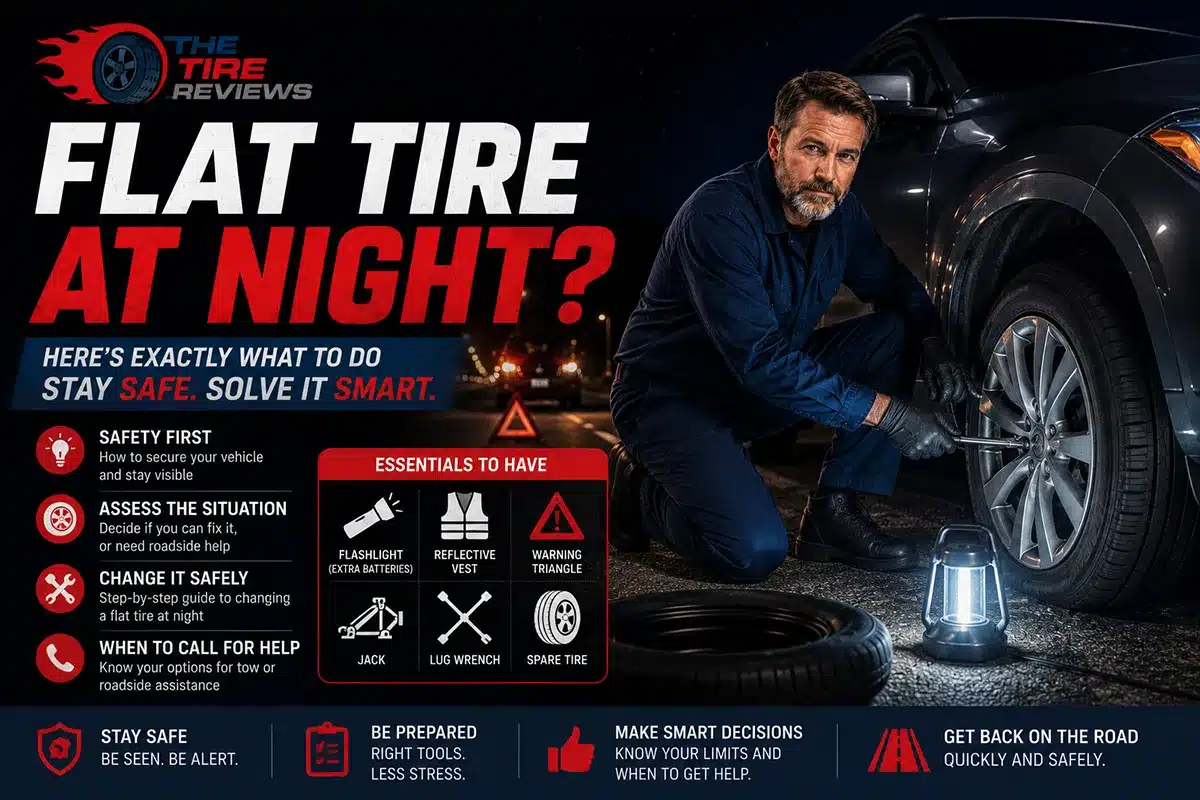
I’ve refined my roadside kit over the years after learning a few things the hard way. Here’s what I actually keep in my car — not a theoretical wish list:
| Item | Why It Matters |
|---|---|
| LED road flares (3-pack) | Visible from 1,000+ feet, no fire risk, magnetic base |
| Compact flashlight with fresh batteries | Better than your phone’s torch for sustained light |
| Reflective safety vest | Costs $5, makes you dramatically more visible to drivers |
| Tire pressure gauge | Check spare before you drive on it |
| Work gloves | A rim in the dark is greasy and sharp |
| Phone charger / portable battery | Your phone needs to survive this |
| Roadside assistance card or app | AAA, your insurance, or a manufacturer plan |
| Owner’s manual | Jack points and spare details are in there |
One thing I’d add: know your roadside assistance coverage before you need it. Most major insurance carriers offer it as a low-cost add-on. AAA Classic membership runs about $60–70/year. When you’re standing in the dark on a highway shoulder, that $60 feels like the best money you ever spent.
Special Situations Worth Knowing
Flat Tire on a Bridge or Tunnel
Do not stop on a bridge or in a tunnel. Keep rolling on the flat — even at walking pace — until you’re clear. The risk of being rear-ended in a confined space, or blocking emergency vehicle access, far outweighs the cost of rim damage.
Flat Tire in an Unsafe Area
If your flat occurs in an area where you feel unsafe stopping — a high-crime neighborhood, an unfamiliar rural stretch, anywhere that triggers your instincts — keep moving slowly with hazards on. A flat tire driven on for a mile or two will destroy the tire and likely the rim, but both are replaceable. Your safety isn’t. Head toward a well-lit area: a gas station, a 24-hour retailer, a fire station.
Flat Tire in Rain or Ice
If roads are wet or icy, treat this like a highway situation even on surface roads. The combination of a compromised vehicle, reduced traction, and drivers with extended stopping distances is genuinely dangerous. Pull as far off the road as possible and call for help.
Flat Tire With Passengers (Especially Children)
Get everyone out of the car on the passenger side — away from traffic — and up the embankment or behind a guardrail if one is present. A stationary car is a target. Children should never be standing near a road shoulder at night.
How to Avoid a Nighttime Flat in the First Place
Prevention is unglamorous advice, but I’d be doing you a disservice if I left it out.
Check your tire pressure monthly. Underinflated tires are far more prone to sidewall failure and blowouts at speed. The TPMS (tire pressure monitoring system) light on your dashboard only illuminates when pressure drops 25% or more below spec — by which point the tire has been running underinflated long enough to cause wear and heat damage. A manual check catches this earlier.
Inspect your tires regularly. Tread depth, sidewall cracking, bulges, and embedded objects. A bulge in the sidewall is a tire that’s telling you it’s about to fail — replace it. Embedded nails in the tread often hold air for days before fully deflating; spotting one early means a $25 plug repair instead of a blown tire at highway speed.
Replace tires before they’re dangerously worn. Tires have a tread wear indicator — small bars molded into the tread grooves — that become flush with the surface at 2/32. At this point the tire is legally worn out. But in wet conditions, 4/32″ is a much more honest threshold for safe braking. A tire-tread depth gauge costs about $5.
Consider tire age, not just tread. Rubber degrades from UV exposure, heat cycles, and ozone even if the tire looks fine. Most manufacturers recommend replacing tires at 6 years regardless of tread, and nearly all advise replacement by 10 years. The manufacture date is molded on the tire sidewall as a 4-digit DOT code — the last four digits tell you the week and year (e.g., 2322 = 23rd week of 2022).
Frequently Asked Questions
What should I do first when I get a flat tire at night?
Don’t brake hard. Ease off the accelerator, keep both hands on the wheel, and guide the car to the right shoulder. Turn on your hazard lights the moment you stop. Your first priority is getting safely off the road and visible to other drivers.
Is it safe to change a tire on the highway at night?
Generally, no — at least not without serious precautions. The risk of being struck by passing traffic is real and significant. On a high-speed highway, I’d recommend calling AAA or roadside assistance rather than attempting a shoulder change. If you must change it, work exclusively on the passenger side, deploy road flares, and keep aware of traffic at all times.
Can I drive on a flat tire to get to safety?
Yes, if the alternative is stopping in a dangerous location. Driving on a flat will damage the rim and destroy the tire, but getting to a safe, well-lit area is worth that cost. Keep your speed under 25 mph, hazards on, and head for a gas station, parking lot, or fire station.
How far can I drive on a donut spare?
Compact temporary spares are rated for about 50–70 miles at a maximum of 50 mph. Don’t push those limits, and get your flat repaired or replaced as soon as possible.
What if I don’t have a spare tire?
Many newer vehicles come with a sealant/inflator kit instead of a spare. This works for minor tread punctures but not sidewall damage or blowouts. If the flat can’t be sealed, you’ll need a tow. This is a good argument for maintaining roadside assistance coverage.
Should I call 911 for a flat tire at night?
If you’re stopped in a dangerous location — a narrow highway shoulder, an area with limited visibility, or somewhere you feel unsafe — yes, calling 911 is appropriate. Highway patrol can assist or provide traffic control. Don’t hesitate to use emergency services if you feel the situation warrants it.
The Bottom Line
A flat tire at night doesn’t have to become a crisis. The drivers who get through it safely are the ones who stay calm in those first few seconds, get the car off the road as far as possible, and make themselves visible before doing anything else.
The tire itself is the least of your problems. The road around you is the real hazard — and respecting it is what keeps you out of danger.
If you’re not confident changing tires, invest $60 in roadside assistance before you need it. Stock a few LED flares in your trunk. Check your spare’s pressure once in a while. These aren’t big asks, and the night you actually need them, you’ll be grateful you did.
Stay safe out there.
Have a question about tires or a roadside situation I didn’t cover? Drop it in the comments — I read and respond to every one.