Here’s something I’ve been thinking about for a while: most of us spend more time choosing a Netflix show than we do researching the four rubber circles that are literally the only part of our car touching the road.
And yet, when I finally stand in front of a tire shop display wall — or scroll through an online retailer — something strange happens inside my brain.
I get anxious. I overthink. I second-guess. And more often than not, I end up defaulting to whatever the salesperson recommends or grabbing the brand I bought last time.
Sound familiar? You’re not alone, and you’re also not irrational. The way we buy tires is deeply shaped by cognitive biases, emotional triggers, and psychological shortcuts that have nothing to do with tread depth or load ratings.
I’ve been reviewing tires for years now, and understanding why people buy what they buy has made me a far better, more intentional shopper — and I want the same for you.
Before we dive in, if you want a solid factual foundation to pair with the psychology, I’d recommend bookmarking our tire buying and maintenance guide — it covers the practical side of all the decisions we’re talking about here.
Here’s the quick version if you’re short on time:
TL;DR
- Your tire buying decisions are heavily influenced by cognitive biases — not just specs.
- The anchoring effect makes the first price you see feel like the “right” benchmark.
- Brand loyalty, social proof, and fear of missing out push you toward familiar choices.
- The paradox of choice creates decision fatigue that leads to poor, rushed decisions.
- Price-quality bias makes you assume expensive = better — which isn’t always true.
- Understanding these biases helps you shop with clarity, confidence, and real savings.
- 1. The Anchoring Effect: Why the First Price You See Becomes Your Compass
- 2. Brand Loyalty: The Comfort of the Familiar (And Why It Costs You)
- 3. The Paradox of Choice: Too Many Options, Too Little Confidence
- 4. Risk Aversion and the “Safety Halo”: Why We Overspend on Fear
- 5. Social Proof: Why Stranger Reviews Move the Needle More Than Expert Opinions
- 6. The Sunk Cost Fallacy: I’ve Always Bought This Brand, So I Should Stick With It
- 7. Recency Bias: One Bad (or Great) Experience Colors Everything
- 8. The Price-Quality Heuristic: Is Expensive Always Better?
- 9. Decision Fatigue: Why You End Up Letting the Shop Decide
- 10. FOMO and the Upsell: “Should I Have Gotten the Run-Flat?”
- Putting It All Together: Buying Tires With Your Whole Brain
1. The Anchoring Effect: Why the First Price You See Becomes Your Compass
The first time I truly noticed how anchoring works on me was at a local tire shop. The salesperson opened by quoting me a set of premium all-season tires at $340 per tire. I winced.
Then he said, ‘But I also have these for $210.’ Instantly, $210 felt like a bargain — even though I had walked in thinking I’d spend around $150 per tire.
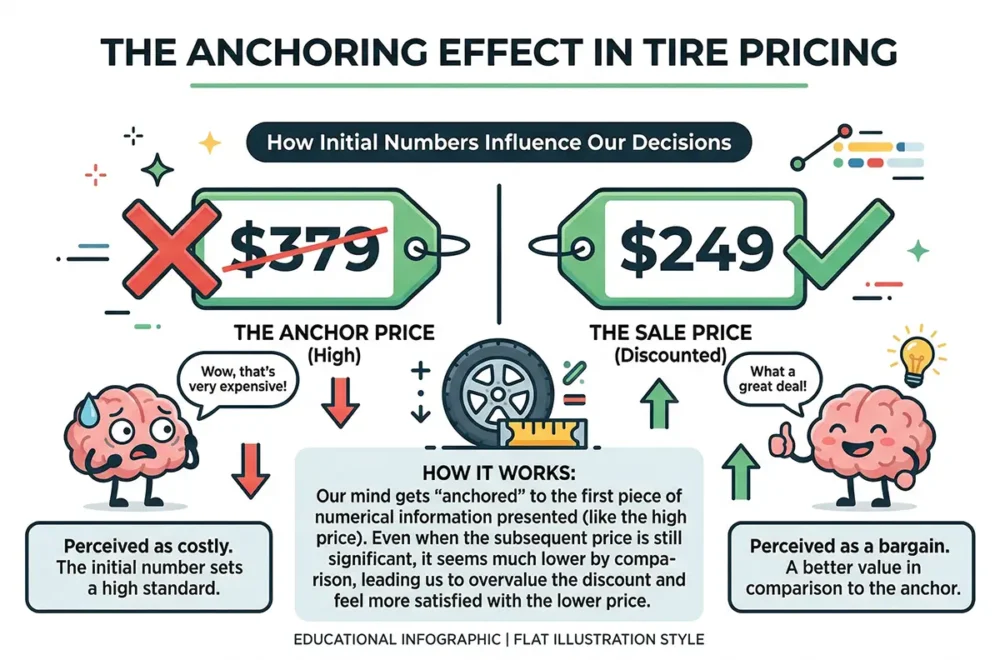
That’s anchoring in action. Behavioral economists Daniel Kahneman and Amos Tversky documented this decades ago: whatever number you encounter first becomes a mental anchor, and every subsequent number gets evaluated relative to it — not objectively.
In a tire shop, anchors are everywhere. Tire retailers know this. Premium brand tires get prominently displayed up front. The ‘original MSRP’ sits crossed out above a ‘sale price.’ Online platforms list a tire at $289 with a tag that says ‘Was $379.’
Your brain does the subtraction automatically — and your perception of value is shaped before you’ve read a single specification.
How to outsmart it:
Before you walk into any store or open any tire website, do your own research. Know the approximate market rate for the tire category you need — all-season, performance summer, all-terrain — for your specific vehicle. When you have your own anchor, the retailer’s anchor loses its grip. I always check two or three independent sources before I even look at a shop’s pricing.
2. Brand Loyalty: The Comfort of the Familiar (And Why It Costs You)
Ask a hundred American drivers what tires they run, and I’d wager a solid 40–50% of them will name the same brand their last car came with. Michelin buyers tend to stay Michelin.
Goodyear loyalists stick to Goodyear. And there’s nothing inherently wrong with that — but it’s worth asking whether you’re choosing that brand because it genuinely outperforms the alternatives for your use case, or simply because it’s familiar.
I’ve been guilty of this myself. For years, I defaulted to one particular all-terrain brand for my truck tires — not because I’d done a rigorous comparison, but because I’d had a good experience once and my brain had filed that brand under ‘safe choice.
Familiarity breeds comfort, and comfort is a powerful buying motivator. Psychologists call this the mere exposure effect: we develop preferences for things simply because we’ve encountered them before.
Tire marketing reinforces this beautifully. Brands spend enormous budgets on consistent visual identity, sponsorship deals, and NASCAR or Formula 1 tie-ins — all designed to increase exposure and, by extension, comfort.
By the time you’re in that tire shop, you’ve already seen that logo hundreds of times. The unfamiliar brand next to it? Your brain is already slightly skeptical of it, even if the specs are identical or better.
How to outsmart it:
Make yourself look at the actual third-party test data — Consumer Reports, TireRack’s survey results, independent automotive publications — for tires you’d never normally consider. I’ve been genuinely surprised more than once by how well lesser-known brands perform in wet braking and treadwear tests against the household names. Challenge your defaults deliberately.
3. The Paradox of Choice: Too Many Options, Too Little Confidence
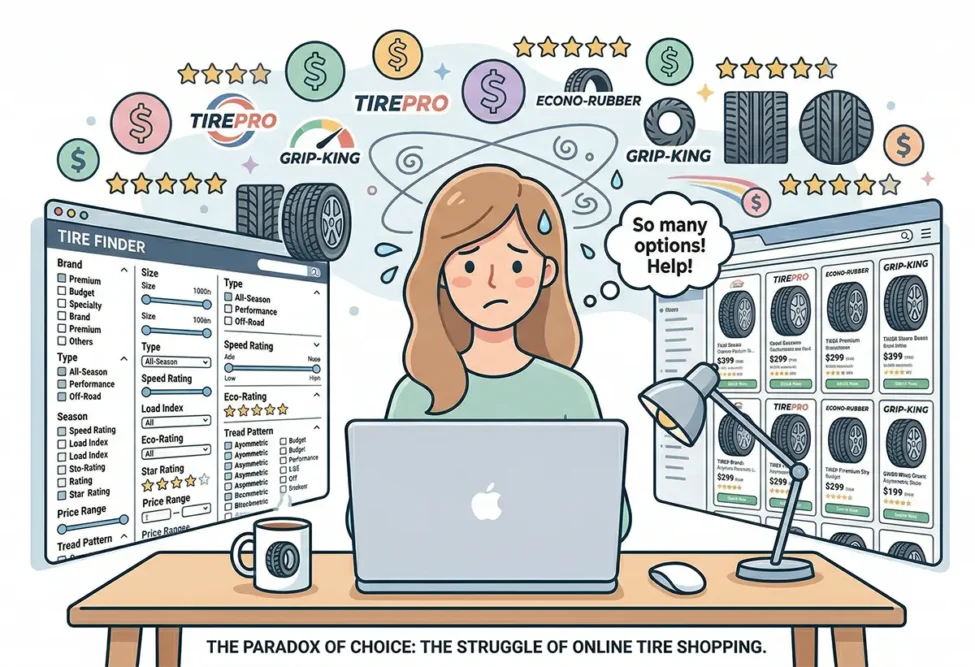
Barry Schwartz’s book The Paradox of Choice captures something every tire shopper instinctively understands: when you have too many options, making a decision becomes harder and less satisfying, not easier.
A tire category search on a major retail site can return 80+ results before you’ve even applied a single filter. All-season? 200 options. Performance summer? Still 60. Load rating W vs Y? Now you need to go back to your owner’s manual.
What happens when we’re overwhelmed by choice? Most of us revert to heuristics — mental shortcuts. We sort by ‘best seller’ and pick the top result. We look for a ‘Best Value’ tag placed by the retailer.
We call the shop and say, ‘Just put on what you recommend.’ These aren’t necessarily bad outcomes, but they’re driven by cognitive overload rather than informed comparison.
I’ve watched this play out in conversations with readers who reach out after getting a set of tires they’re not quite happy with.
In almost every case, the story involves being overwhelmed, running out of research energy, and defaulting to convenience. The paradox of choice isn’t just academic — it costs real money and results in real dissatisfaction.
How to outsmart it:
- Decide on your three non-negotiables before you shop: category (all-season, winter, performance), budget ceiling, and minimum tread life warranty.
- Apply those filters first, narrow to 5–8 options, then compare.
- Ignore everything outside your shortlist. You don’t need to evaluate 80 tires. You need to evaluate your 5.
4. Risk Aversion and the “Safety Halo”: Why We Overspend on Fear
Tires are one of those rare consumer categories where fear is a legitimate and reasonable purchase driver. They affect braking distance, hydroplaning resistance, and cornering grip.
The stakes are real. But what I’ve noticed — both in my own buying behavior and in conversations with readers — is that fear doesn’t always lead us to the objectively safer tire. It leads us to the tire that feels safest, which is a meaningfully different thing.
Premium tire brands have cultivated what I think of as a ‘safety halo.’ Michelin, Bridgestone, and Continental all benefit from decades of safety-forward marketing, OEM partnerships with luxury automakers, and high visibility on Consumer Reports.
When you buy one of those brands, you’re not just buying rubber and cord — you’re buying the psychological reassurance that you made the responsible choice. That reassurance has real value. But it also has a real price tag.
Here’s the thing: mid-tier tires from reputable manufacturers have caught up considerably over the past decade.
A Kumho or Falken all-season that passes the UTQG 500 treadwear rating and performs well in third-party wet-braking tests is a genuinely safe tire.
But it doesn’t carry the safety halo, so it doesn’t trigger the same emotional relief at the point of purchase.
I’m not telling you to skip the premium brands — sometimes they genuinely are the best choice. I’m saying: examine whether you’re buying safety or the feeling of safety, and make sure you can tell the difference.
How to outsmart it:
Look specifically at NHTSA test data and independent wet-braking tests for any tire you’re considering, regardless of brand. Safety performance is measurable. Trust the numbers more than the logo.
5. Social Proof: Why Stranger Reviews Move the Needle More Than Expert Opinions
I find this one fascinating, partly because it’s my industry. You’d think that a detailed expert review — with controlled testing methodology, multiple vehicles, and measured stopping distances — would be more persuasive than a three-sentence Amazon review from ‘TruckDad_Ohio.’ And yet, for most buyers, it isn’t.
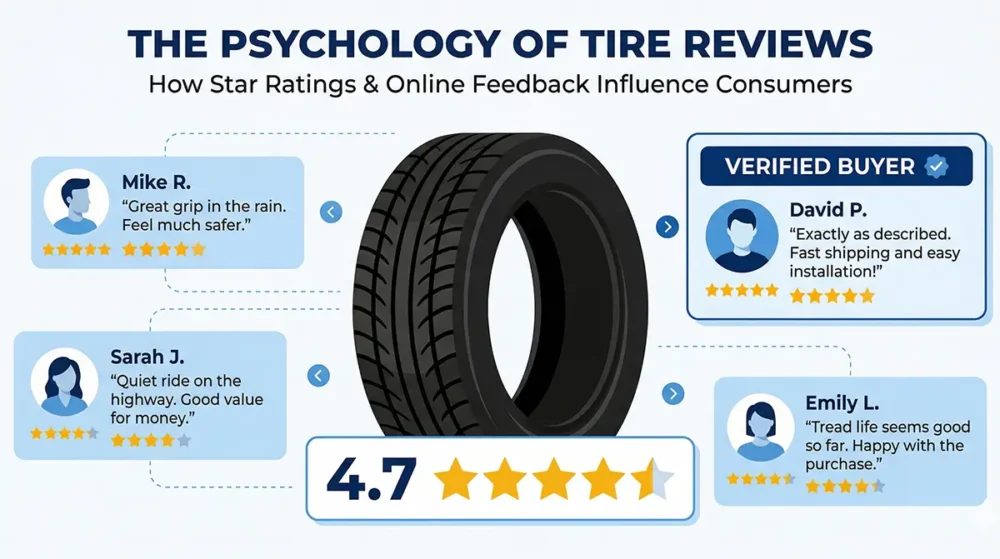
Social proof is one of the most powerful psychological forces in any purchase decision. Humans are social animals. We look to others to validate our choices, and when we see 1,847 reviews averaging 4.6 stars, something in our brain settles.
‘This many people can’t be wrong.’ The logic is imperfect — Amazon reviews can be gamed, OEM buyers skew positive, and review samples don’t match your specific vehicle or climate — but the emotional effect is real.
Tire retailers have learned to leverage this brilliantly. TireRack’s model of pairing technical specs with verified customer reviews across tens of thousands of vehicles is genuinely useful — the sample size makes the data more meaningful than most.
But I still see shoppers using star ratings as a primary filter before checking load ratings or speed ratings that actually match their vehicle’s requirements.
How to outsmart it:
Use reviews as a tiebreaker between technically comparable options, not as your primary selection filter. Look for reviews from drivers in your climate and with a vehicle similar to yours — those are the data points that actually translate. And always verify the tire fits your vehicle’s specifications before you let any review sway you.
6. The Sunk Cost Fallacy: I’ve Always Bought This Brand, So I Should Stick With It
I once talked with a reader who’d been buying the same tire brand for four vehicles over fifteen years. When I asked why, she said, ‘I’ve always had good luck with them.’
Fair enough. But when I dug deeper, she admitted her last set had worn unevenly, she’d had a warranty claim that was slow to resolve, and she’d been quoted a price 20% higher than a comparable competitor. She still went back to the same brand.
That’s the sunk cost fallacy at work — the irrational tendency to continue a behavior because of past investment, even when the current data doesn’t support it.
We conflate past purchases with identity (‘I’m a Michelin driver’) and feel that switching is somehow a betrayal of our own history.
Switching brands also requires us to admit that our previous purchases might not have been optimal, and that’s psychologically uncomfortable.
In the tire world, this often shows up as extreme brand stickiness even when the brand has slipped in quality, raised prices significantly, or been surpassed by competitors in the specific categories you care about.
The tire industry changes — brands get acquired, manufacturing processes shift, new lines launch that underperform legacy models. Your loyalty from 2012 doesn’t mean that brand is still the best choice in 2025.
How to outsmart it:
Treat every tire purchase as a fresh decision. Your new shortlist should start from your current needs and current market options — not from who you bought from last time. Give yourself explicit permission to switch brands if the data supports it. Past money spent is gone regardless of what you buy today.
7. Recency Bias: One Bad (or Great) Experience Colors Everything
Recency bias is the tendency to weigh recent events more heavily than older or broader data. In tire buying, this shows up in predictable ways.
If your last set of tires wore out faster than expected, you’re suddenly very focused on treadwear ratings — even if that one experience might have been caused by improper inflation or a misaligned vehicle rather than a bad tire.
If your last set gave you incredible wet weather confidence, you’ll probably over-index on wet grip for your next purchase even if you live in Phoenix.
I’ve caught myself doing this. A winter where I had one close call on a slippery highway made me dramatically over-prioritize winter traction on my next all-season purchase — at the expense of treadwear, which was actually more relevant to my day-to-day driving on dry Texas roads.
One vivid memory hijacked a rational decision-making process.
The psychology here connects to what Kahneman calls System 1 thinking — fast, emotional, experience-based — overriding System 2, the slower, analytical side of our brains. Buying tires should be a System 2 activity.
But powerful recent memories trigger System 1 almost every time.
How to outsmart it:
Write out your actual driving conditions before you shop: average annual mileage, typical weather, highway vs. city split, and whether you’ve had any mechanical issues (alignment, inflation neglect) that might have skewed your last tire’s performance. Let that objective profile drive your purchase criteria — not the one February morning that still makes you nervous.
8. The Price-Quality Heuristic: Is Expensive Always Better?
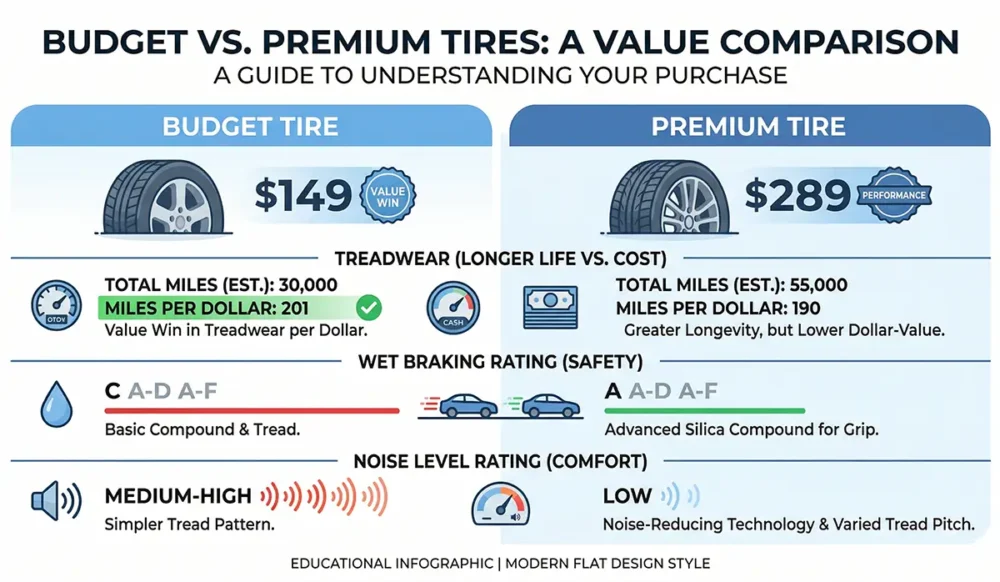
Here’s a bias that costs American drivers real money every tire cycle: the deeply ingrained belief that price is a reliable proxy for quality.
‘You get what you pay for’ is practically a cultural axiom, and in many product categories, it’s reasonably accurate. In tires, the relationship is far messier than that.
Tire pricing is influenced by brand marketing budgets, OEM partnerships, distribution deals, and retailer markup — not just compound quality and engineering.
A premium brand’s entry-level tire may actually perform worse than a mid-tier brand’s flagship in its class. Budget brands from large manufacturers (like Fuzion, which is made by Bridgestone) share manufacturing lines with premium siblings.
The gap between ‘value’ and ‘premium’ tires has narrowed considerably in the past decade.
I’ve personally run tires that cost 40% less than the ‘obvious’ premium choice and been genuinely impressed — better treadwear, comparable wet braking, quieter ride.
I’ve also run expensive tires that disappointed in real-world conditions despite glowing marketing. Price is a signal, not a guarantee.
How to outsmart it:
- Focus on UTQG ratings (treadwear, traction, temperature) as a starting point.
- Look for independent third-party test results — not manufacturer claims — for the specific metrics you care about.
- Calculate cost-per-mile: a $200 tire with a 65,000-mile treadwear warranty often beats a $150 tire with 40,000 miles.
- Don’t treat price as a shortcut for quality research. It isn’t.
9. Decision Fatigue: Why You End Up Letting the Shop Decide
Decision fatigue is a well-documented psychological phenomenon: the quality of our decisions deteriorates after we’ve made a string of choices.
A tire purchase often follows a day of other decisions — what to have for breakfast, which route to take, what to handle first at work.
By the time you’re in the shop or on the website, your mental energy for rigorous evaluation is already partially depleted.
Tire retailers (especially physical shops) know this intuitively. Busy Saturday appointments, fast-talking service advisors, the time pressure of a waiting car lift — all of it accelerates decision fatigue.
‘What do you recommend?’ becomes the path of least resistance. And the salesperson, who has their own commission incentives and inventory pressures, makes the decision for you.
Online shopping has its own version. After filtering through specs, reading ten reviews, watching two YouTube comparisons, and tabbing between three retailer sites, the ‘add to cart’ button on the best-selling option starts looking very attractive — not because it’s the best choice, but because you’re done thinking.
How to outsmart it:
Do your tire research in a separate session from your purchase — ideally the day before or early in a relaxed morning. Arrive at the shop or checkout with a specific tire in mind, including the exact make, model, and size. Treat the purchase moment as execution, not research. The decision should already be made.
10. FOMO and the Upsell: “Should I Have Gotten the Run-Flat?”
The final psychological force I want to talk about is one that happens after the purchase: buyer’s second-guessing, fueled by fear of missing out. You bought a solid set of touring all-seasons.
The salesperson mentioned run-flat tires — ‘They’re really popular on sedans like yours.’ You said no, but now you’re reading about a guy online who got a flat at 2 a.m. on a highway and wished he’d gone run-flat.
FOMO in tire buying often gets activated by the upsell: road hazard protection plans, nitrogen inflation, TPMS sensor replacement packages, tire rotation bundles. Some of these genuinely add value. Others are margin boosters for the retailer.
The psychological challenge is that when you’re already in a committed purchase mindset, the incremental cost of each add-on seems small relative to the total purchase — even if the cumulative add-ons push you 25% over budget.
The road hazard plan is a particularly good example. For drivers who frequently drive on pothole-heavy urban roads or gravel, it can be genuinely worthwhile. For low-mileage highway commuters, the math rarely works out.
But the fear of that one catastrophic pothole strike is emotionally vivid, and ‘peace of mind’ is a powerful sell.
How to outsmart it:
Evaluate every add-on with the same rigor as the tire itself. Ask: ‘What is the actual probability I’ll use this?’ and ‘What would it cost me out of pocket if I needed this service and didn’t have the plan?’ If the plan costs $60 and covers a single $30 repair, the math is bad regardless of how the fear feels.
Putting It All Together: Buying Tires With Your Whole Brain
The surprising thing about tire psychology isn’t that we’re irrational — it’s that our irrationality is so consistent and predictable.
Anchoring, brand loyalty, social proof, decision fatigue — these aren’t character flaws. They’re features of a human brain that evolved to make fast decisions with limited information. The problem is that tire buying rewards slow, deliberate thinking.
The drivers I know who consistently get the best value from their tires share a few habits: they research in advance, they separate the decision from the transaction, they check objective data before emotional responses, and they treat every purchase as a fresh evaluation.
None of that is complicated. All of it requires a small amount of intentional friction to override the shortcuts your brain defaults to.
The tires on your car right now are doing an unglamorous but genuinely important job — stopping your vehicle, keeping you planted through corners, managing water in a rainstorm. They deserve a better decision-making process than most of us give them.
Understanding the psychology behind your tire buying habits is the first step. The second step is using that understanding to shop differently — smarter, calmer, and with a clearer sense of what you actually need versus what the market has been trained to make you want.