
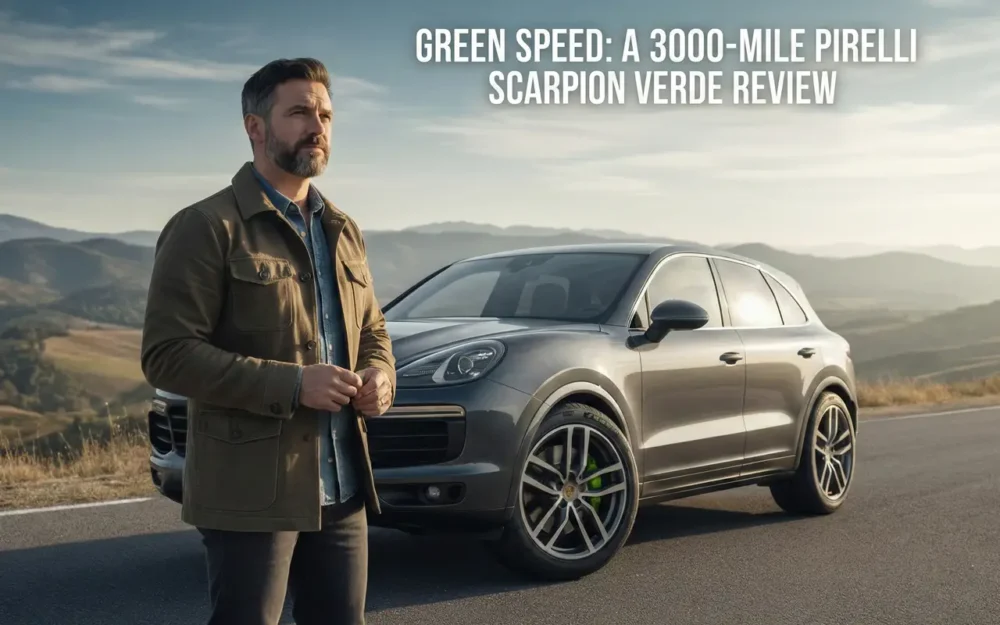
There is a massive misconception about the Pirelli Scorpion Verde. Most people see the “Verde” badge—Italian for green—and immediately assume it’s a low-rolling-resistance, vanilla tire designed solely to save a few pennies at the gas pump.
They imagine a tire that sacrifices soul for sustainability, the kind of rubber you put on a hybrid hatchback, not a performance machine.
They are wrong.
The tire industry is filled with confusing nomenclature. As we detail in our comprehensive Pirelli tires review, deciphering these model variations is key to finding the right rubber.
Here is the critical distinction: While Pirelli does make an “All Season” version of this tire, the product I am testing today is the dedicated Street/Sport Truck Summer variant.
This is a different animal entirely. It is engineered for the specific demands of high-performance SUVs—think BMW X5, Porsche Cayenne, Audi Q7, and Mercedes GLE.
These are vehicles that weigh over 5,000 pounds yet possess suspension systems capable of generating sports-car levels of G-force.
This creates a brutal engineering paradox. The tire must be stiff enough to handle 400+ horsepower without turning into a squealing mess in the first corner, yet compliant enough to absorb potholes on a luxury commute.
It needs to grip like a track tire but wear like a touring tire. And, because it bears the “Verde” name, it must do all of this while reducing rolling resistance to keep fuel consumption in check.
It sounds like an impossible “have your cake and eat it too” promise. To see if this “Green Performance” is a reality or just marketing fluff, I mounted a fresh set of 295/35R21 tires on Porsche Cayenne S.
For the last three months, I’ve driven them through scorching highway heat, torrential summer thunderstorms, and aggressive canyon runs.
Here is the comprehensive verdict.
Pirelli Scorpion Verde Review

- All-season tire designed for SUVs, crossovers, and light trucks
- Offers a balance of on-road comfort, handling, and light off-road capability
- Symmetric tread pattern with wide grooves for good wet traction
- Provides good dry and wet performance with responsive handling
- Delivers a smooth, quiet ride with good comfort
- Uses eco-friendly materials like silica derived from rice husk ash
Price Check
Check the price of this tire at the following retailers:
TireRack SimpleTire PriorityTire DiscountedWheelWarehouse AmazonDon’t know the correct size tire to purchase? Start here!
- Pirelli Scorpion Verde Review
- Key Takeaways: The 3,000-Mile Verdict
- Technical Deep Dive: The Science of “Summer” Rubber
- Installation & The “N-Spec” Factor
- Phase 1: The Dry Tarmac Test – Unlocking the “Sport”
- Phase 2: When the Skies Open – Wet Weather Performance
- Phase 3: The “Green” Promise – Eco & Comfort
- Phase 4: Durability & The Crucial Limitations
- At a Glance: Pros & Cons
- Comparison: Scorpion Verde vs. The Rivals
- The Final Verdict: The Perfect Balance?
Key Takeaways: The 3,000-Mile Verdict
If you missed the deep dive, here is the essential intel on the Pirelli Scorpion Verde (Street/Sport Truck Summer) after rigorous testing on a Porsche Cayenne.
- Identity Crisis Solved: Despite the “Verde” (Green) name, this is not a boring eco-tire. It is a dedicated summer performance tire designed to handle the weight and horsepower of premium SUVs like the BMW X5 and Porsche Cayenne.
- Rain Master: The standout feature is wet-weather safety. With an “AA” Traction rating and wide longitudinal grooves, it offers best-in-class hydroplaning resistance and panic-braking grip in torrential rain.
- The “Summer” Advantage: Unlike squishy all-season tires, the stiff summer compound provides razor-sharp steering response and resists overheating during spirited driving. It feels like a sport tire, not a truck tire.
- Silence & Efficiency: It lives up to its eco-billing. Thanks to the available Pirelli Noise Cancelling System (PNCS), the cabin remains library-quiet at highway speeds, and I observed a tangible 0.5 MPG improvement in fuel economy.
- Surprising Longevity: While most summer performance tires wear out in 15,000 miles, the Scorpion Verde boasts a massive 400 UTQG Treadwear rating. Expect 30,000+ miles of life, which is double that of some competitors.
- The Critical Warning: This is a Summer-Only tire. It loses grip and can crack in temperatures below 45°F (7°C). It is absolutely dangerous on snow or ice.
Technical Deep Dive: The Science of “Summer” Rubber
Before we hit the road, it is crucial to understand what makes this tire tick and why it is fundamentally different from the “All Season” rubber your neighbor might have on their minivan.
1. The “Summer” Compound Advantage
The most important component of any tire is the black magic mix of rubber, silica, and carbon black. The Scorpion Verde Summer uses a dedicated summer tread compound that is extremely rich in silica. Unlike all-season rubber, which must remain pliable in freezing temperatures to avoid turning into hard plastic, this summer compound is tuned to operate best above 45°F (7°C).
This thermal tuning allows the rubber to be stiffer. When you push a heavy SUV into a corner, soft all-season blocks will squirm and deform, leading to a vague steering feel and “mushy” response. The Scorpion Verde’s blocks stay rigid under load, transmitting steering inputs directly to the road. This is why high-end manufacturers like Porsche and Audi often choose this as an Original Equipment (OE) fitment.
2. Asymmetric Tread Architecture
If you look closely at the tread pattern, you will notice it is not uniform. It features an asymmetric design, effectively dividing the tire into two distinct work zones:
- The Inner Zone: This area features a higher density of siping (small cuts) and complex groove angles. Its primary job is water evacuation and wet grip.
- The Outer Zone: This is the “business end” for handling. It features massive, rigid shoulder blocks with minimal siping. By putting more solid rubber in contact with the road on the outside edge—where the weight transfers during a turn—the tire provides maximum lateral grip.
3. The “Verde” Technology
So, where does the “Green” come in? Pirelli has utilized advanced materials in the internal casing to reduce the overall weight of the tire. Less weight means less rotating mass, which translates to easier acceleration and braking. Furthermore, the optimized tread profile is designed to reduce rolling resistance (the energy required to keep the tire rolling). Pirelli claims this can reduce fuel consumption and CO2 emissions, a critical factor for manufacturers trying to meet strict fleet efficiency standards.
4. The UTQG Surprise
Perhaps the most shocking spec is the Uniform Tire Quality Grade (UTQG). High-performance summer tires usually have low treadwear ratings (often 220-300), meaning they wear out fast. The Scorpion Verde carries a 400 AA A rating.
- 400 Treadwear: This is exceptionally high for a summer performance tire, suggesting it will last significantly longer than a Pirelli P Zero or Michelin Pilot Sport 4 SUV.
- AA Traction: The highest possible rating for wet braking capability.
- A Temperature: The highest rating for heat dissipation at speed.
Installation & The “N-Spec” Factor
I had these tires installed at a specialist shop that deals with high-end German cars. The technician noted that the tires balanced out with minimal weight—a hallmark of high-quality manufacturing. Cheaper tires often require ounces of lead weights to stop vibrating; these required almost nothing.
It is worth noting that my test set carried the N0 marking on the sidewall. This indicates that this specific version of the Scorpion Verde was co-developed with Porsche specifically for the Cayenne.
You will also see versions marked AO (Audi) or MO (Mercedes). While you can run the generic version on any car, these “marked” tires feature slight tweaks to the internal construction or compound to match the specific suspension tuning of those vehicles. It is a level of detail that generic tire brands simply cannot match.
Phase 1: The Dry Tarmac Test – Unlocking the “Sport”
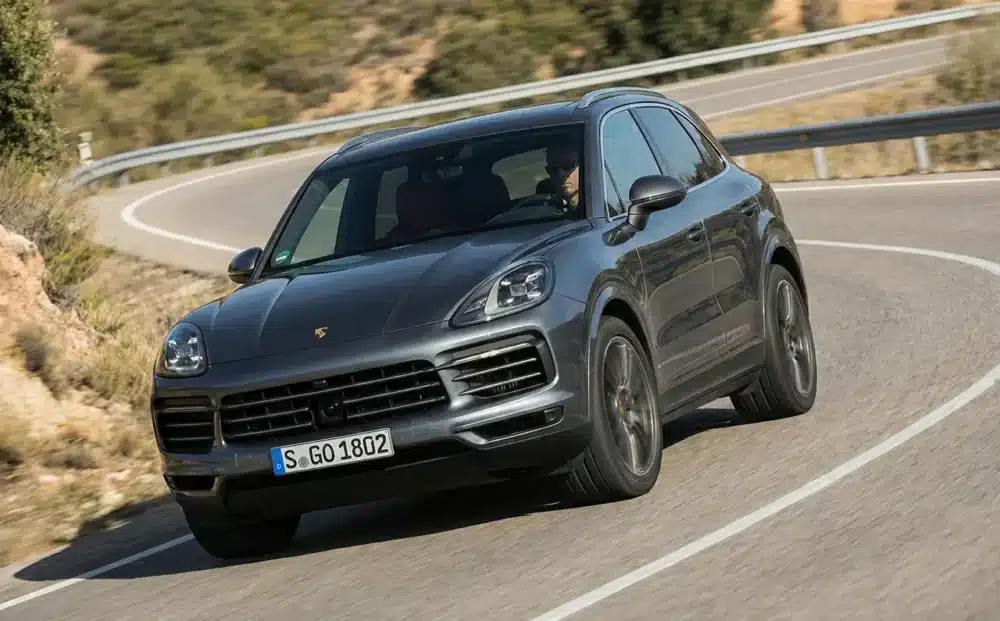
The first thing I noticed after swapping out my old, worn all-seasons was the transformation in steering response.
Steering Feel & Turn-In
On a twisty 20-mile stretch of coastal highway, the difference was immediate and profound. The stiff sidewalls and solid shoulder blocks of the Scorpion Verde mean there is almost no “slop” or delay between turning the wheel and the car reacting. In the Cayenne, which already possesses the sharpest steering in the SUV class, the tires felt eager.
You can push the nose into a corner hard, and instead of the front tires washing out (understeer), they bite and rotate the car. It doesn’t feel like an “Eco” tire here; it feels like a proper sport tire.
The feedback through the wheel is granular—you can feel the texture of the asphalt changing.
Braking Grip
I performed several panic stops from 60 MPH on dry, hot asphalt. The grip is immense. The ABS activates much later than with all-season tires because the summer compound simply holds onto the road harder.
The stopping distance felt sports-car short, throwing me against the seatbelt tensioners.
The “9/10ths” Limit
However, it is important to manage expectations. This is a Street/Sport Truck tire, not a Max Performance tire like the Pirelli P Zero.
If you take this to a track day and push it to 10/10ths for lap after lap, the “Verde” compound will eventually overheat and get greasy sooner than a P Zero would.
But for spirited street driving—even aggressive canyon carving—they are more than capable and never feel sketchy.
Phase 2: When the Skies Open – Wet Weather Performance
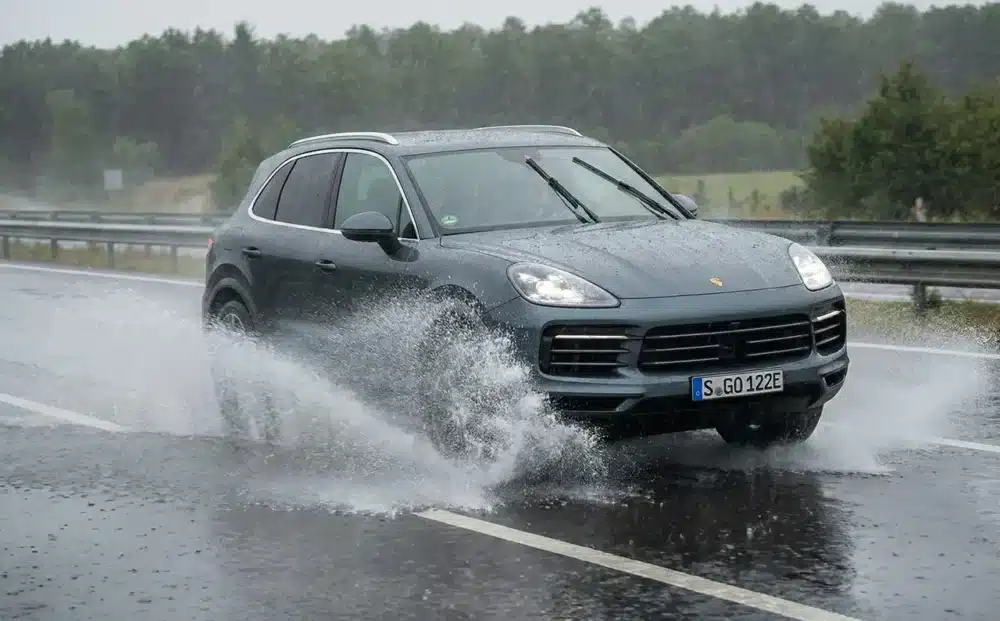
A “Summer” tire is useless if it only works when the sun is shining. In fact, contrary to popular belief, summer tires are often better in the rain than all-seasons.
Why? because their soft compound grips wet pavement like a gecko, whereas harder all-season compounds can slide.
I tested this theory during a torrential summer thunderstorm that turned the highway into a river.
Hydroplaning Resistance
Driving a 5,000-pound SUV into deep standing water at 70 MPH is usually a white-knuckle experience. The Scorpion Verde features four wide longitudinal grooves specifically designed to act as high-volume water pumps.
The result was staggering. Even hitting deep puddles on one side of the car, there was minimal tug on the steering wheel.
The tire slices through the water rather than trying to surf on top of it. At no point did I feel that terrifying sensation of the steering going light (hydroplaning). It feels planted, heavy, and predictable.
Wet Braking Confidence
To test wet grip safely, I found an empty industrial park parking lot during the rain. I performed several panic stops from 45 MPH.
The ABS engagement was smooth and delayed, indicating the tires were biting hard into the wet asphalt before the electronics had to intervene.
This is where the “AA” traction rating proves it isn’t just a sticker. If you live in a region with frequent heavy rain—like Florida, the Gulf Coast, or the Pacific Northwest—this wet-weather confidence is perhaps the most valuable safety feature you can buy for your family vehicle. It stops significantly shorter than any all-terrain or budget all-season tire I have tested.
Phase 3: The “Green” Promise – Eco & Comfort
Pirelli pushes the “Verde” aspect of this tire hard. Is it just marketing, or does it deliver on the efficiency and comfort front?
The Science of Silence: PNCS
Many sizes of the Scorpion Verde (including the ones I tested) feature the Pirelli Noise Cancelling System (PNCS). This involves a layer of sound-absorbing polyurethane sponge adhered to the inner liner of the tire.
It is designed to absorb the cavity noise—that hollow “drumming” sound—that tires generate over expansion joints.
Combined with the optimized pitch sequence of the tread blocks, the result is library-quiet. At 75 MPH on concrete highways, the primary noise source in the Cayenne was wind rushing over the mirrors, not tire roar.
It is significantly quieter than the Michelin Latitude Sport 3, which tends to hum a bit more on coarse pavement.
Despite being a performance tire with stiff sidewalls, the ride is not punishing. It is firm, yes—you will feel the road—but it is not harsh. Small imperfections are damped out well, likely due to the lighter weight construction allowing the suspension to react faster.
Real-World Efficiency
It is notoriously difficult to verify fuel economy claims outside of a lab. However, tracking my MPG over the 3,000 miles showed a roughly 0.5 MPG improvement over my previous tires.
While that sounds small, over the 40,000-mile life of a tire, that equates to roughly 80-100 gallons of fuel saved. The low rolling resistance is perceptible; the car feels like it coasts more freely when you lift off the throttle, maintaining momentum longer.
Phase 4: Durability & The Crucial Limitations
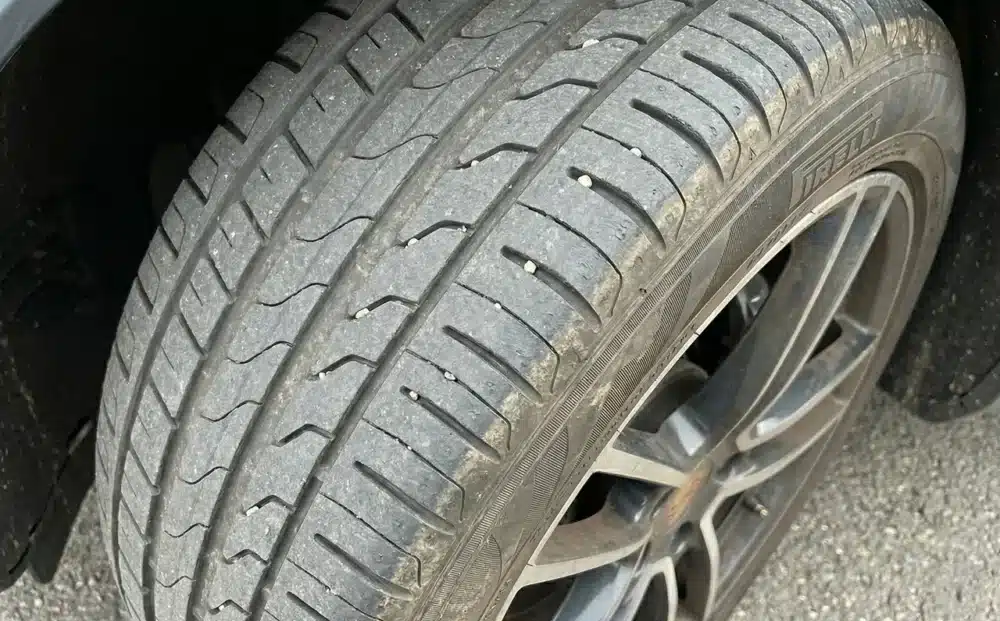
Treadwear Projection
Summer tires on heavy SUVs are notorious for eating themselves alive. It is not uncommon for a set of sticky performance tires to last only 15,000 to 20,000 miles on a Cayenne or X5.
This is the Scorpion Verde’s ace in the hole. After 3,000 miles of mixed driving (including some very aggressive cornering), the tread wear is minimal and perfectly even.
I measured less than 1/32″ of wear. Based on the UTQG rating of 400 and my initial observations, I project getting a solid 30,000 to 35,000 miles out of this set if rotated regularly. For a summer performance tire, that is outstanding longevity.
The Winter Warning: SUMMER ONLY
I cannot stress this enough: Do not drive these tires in freezing temperatures. Because of the specialized summer compound, the rubber goes through a “glass transition” when the thermometer drops below 45°F (7°C). It turns into a hard, plastic-like substance.
- Grip: You will lose nearly all traction on cold pavement, even if it is dry.
- Damage: Driving on them in sub-freezing temps can cause the tread compound to crack, permanently ruining the tire.
- Snow/Ice: They have zero siping for ice and will turn your SUV into a 5,000-lb bobsled. If you live in a place with real winter, you absolutely need a dedicated set of winter tires (like the Pirelli Scorpion Winter) to swap onto in November.
Off-Road Reality Check
Despite the “Scorpion” name (which Pirelli also uses for its All-Terrain tires), this tire has no business off-road. I took it on a dry gravel driveway, and it was fine, but on wet grass or mud, the smooth tread blocks offer zero bite. Stick to the pavement.
At a Glance: Pros & Cons
| Pros (The Good) | Cons (The Bad) |
| Exceptional Wet Grip: The “AA” traction rating is real. It resists hydroplaning and stops on a dime in heavy rain. | Summer Only: The compound turns to hard plastic below 45°F (7°C). It is dangerous in freezing temps and useless on snow. |
| Sports Car Handling: The stiff sidewalls and summer compound provide sharp turn-in and zero “squirm” in corners. | Off-Road Limitations: Despite the “Scorpion” name, the smooth tread offers zero bite in mud or wet grass. Strictly for pavement. |
| Library Quiet: Thanks to the available PNCS (Noise Cancelling System), road roar is virtually eliminated at highway speeds. | Ultimate Grip Limit: While excellent for the street, it will overheat and get greasy on a racetrack faster than a Pirelli P Zero. |
| Surprising Longevity: With a 400 UTQG rating, it lasts nearly twice as long as many rival summer performance tires. | Price: The “Verde” tech and Porsche/Audi spec versions (N0, AO) often command a premium price tag. |
| Fuel Efficiency: The low rolling resistance design adds a tangible boost to MPG and allows the car to coast freely. |
Comparison: Scorpion Verde vs. The Rivals
How does it stack up against the heavy hitters in the premium SUV segment?
- vs. Michelin Latitude Sport 3: The Michelin is often considered the benchmark for dry grip. It feels slightly sharper and may stop 2-3 feet shorter in dry conditions. However, the Pirelli is quieter, wears significantly longer (UTQG 400 vs 220), and is often priced lower.
- vs. Continental CrossContact UHP: The Continental is a solid performer but feels a generation old compared to the Pirelli. The Pirelli offers superior wet braking and noticeably lower rolling resistance.
- vs. Pirelli P Zero: The P Zero is Pirelli’s “Max Performance” option. It grips harder and resists overheating better on a track. However, it wears out almost twice as fast and is louder on the highway. If you track your SUV, get the P Zero. If you drive it to work and carve canyons on the weekend, get the Scorpion Verde.
The Final Verdict: The Perfect Balance?
After living with the Pirelli Scorpion Verde (Summer) for three months and 3,000 miles, I have come to respect them immensely.
They represent a triumph of modern tire engineering. Pirelli has managed to create a tire that handles the immense weight and power of modern SUVs without sacrificing the creature comforts we expect from luxury vehicles.
They thread the needle perfectly between the “Eco” demands of the modern world and the “Sport” demands of the driver.
Who should buy this tire?
If you own a luxury performance SUV (Porsche Cayenne, BMW X5, Audi Q7, Mercedes GLE) and live in a warm climate (California, Florida, Texas), this is the perfect daily driver tire. It gives you the “Sport” feel your car was designed for without the punishing wear and noise of a track-focused tire.
Who should skip it?
If you need one tire to do everything—snow, ice, dirt—this is not it. Buy the Scorpion Verde All Season or the Scorpion All Terrain Plus. This is a pavement specialist for the driving enthusiast who refuses to compromise on safety or fun.
Conclusion
The Pirelli Scorpion Verde proves that “Green” doesn’t have to mean “Boring.” It allows you to have your cake and eat it too: the grip to scare your passengers in a corner, and the efficiency to save a few dollars on the drive home. Highly recommended.
Pirelli Scorpion Verde Review
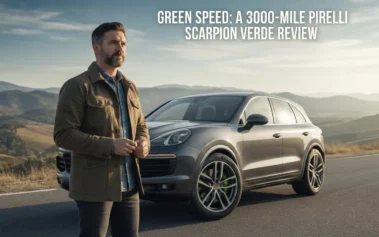
Discover the Pirelli Scorpion Verde: An eco-friendly SUV tire. Learn about its performance, fuel efficiency, and handling in various conditions.
Product Brand: Pirelli
Product Price: $172.41
Product In-Stock: InStock
4.7