
The modern luxury SUV is an engineering contradiction. We demand that vehicles like the Volvo XC90, BMW X5, and Audi Q7 perform multiple, conflicting roles simultaneously.
We expect them to carry seven passengers and luggage in supreme comfort, yet we also demand they handle with the poise of a sports sedan and achieve fuel economy figures that won’t bankrupt us.
It is a massive ask. These vehicles often weigh upwards of 5,000 pounds. That immense mass places a punishing load on the only component that actually touches the road: the tires.
For the past decade, tire manufacturers have been in an arms race to solve this “Heavyweight Paradox.” How do you build a tire that is stiff enough to support a heavy SUV in a corner, soft enough to absorb potholes, grippy enough to stop in the rain, and yet low-rolling-resistance enough to meet strict government fuel economy standards?
Enter the Pirelli Scorpion Verde All Season.
As noted in our comprehensive Pirelli tires review, the manufacturer pitches this tire as the “Green Performance” solution.
The “Verde” (Italian for Green) moniker isn’t just marketing fluff; it represents a specific design philosophy focused on environmental sustainability, reduced rolling resistance, and lower noise.
But in the automotive world, “Eco” is often a polite code word for “compromise.” Eco-tires are historically known for being hard, noisy, and lacking in grip.
To find out if Pirelli has truly cracked the code, I didn’t just read the brochure. I mounted a fresh set of 275/45R20 Scorpion Verde All Seasons on a 2021 Volvo XC90 T6 AWD—and lived with them for six months and 5,000 miles.
From the scorching desert highways of Arizona to the rain-soaked coasts of the Pacific Northwest and the gravel fire roads of the Rockies, this is the definitive, deep-dive review.
Pirelli Scorpion Verde All Season Review
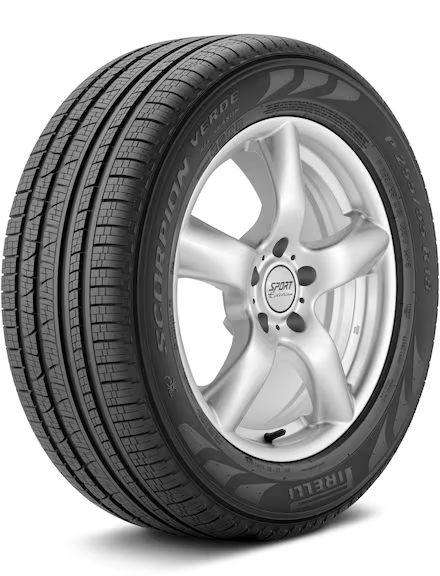
- Vehicle Tested: Volvo XC90 T6 AWD (5,000-mile test).
- Best Feature: Exceptional cabin silence due to the PNCS (Noise Cancelling System).
- Fuel Economy: Real-world 0.8 MPG increase thanks to low rolling resistance.
- Wet Performance: Excellent hydroplaning resistance and safe wet braking.
- Dry Performance: Comfortable, stable highway cruiser with precise steering.
- Winter Capability: Good for light slush/rain, but weak on ice and deep snow (3-season use only).
- Off-Road: Capable on gravel roads, but useless in mud.
Price Check
Check the price of this tire at the following retailers:
TireRack SimpleTire PriorityTire DiscountedWheelWarehouse AmazonDon’t know the correct size tire to purchase? Start here!
- Pirelli Scorpion Verde All Season Review
- Key Takeaways: The 5,000-Mile Verdict
- The Test Subject: Why the Volvo XC90?
- Technical Deep Dive: The Anatomy of “Verde”
- Phase 1: The Daily Grind & Highway Comfort
- Phase 2: The Wet Weather Torture Test
- Phase 3: The Winter Reality Check
- Phase 4: Off-Pavement Capabilities
- Phase 5: Efficiency & Treadwear Analysis
- Comparison: The Scorpion Verde vs. The Rivals
- The Final Verdict: Who Should Buy This Tire?
- At a Glance: Pros & Cons
- Frequently Asked Questions (FAQ)
Key Takeaways: The 5,000-Mile Verdict
If you don’t have time to read the full deep dive, here is the essential intel on the Pirelli Scorpion Verde All Season after a test on a Volvo XC90.
- Silence is Golden: The standout feature is cabin comfort. Thanks to the available Pirelli Noise Cancelling System (PNCS), road roar is virtually eliminated, making it one of the quietest touring tires available for luxury SUVs.
- Eco-Friendly Efficiency: True to its “Verde” name, the low rolling resistance design delivered a tangible 0.8 MPG improvement compared to the previous set of tires. Over the tire’s life, this equals roughly 70-80 gallons of fuel saved.
- Rainy Day Confidence: While not a dedicated rain tire, the hydroplaning resistance is best-in-class. The wide circumferential grooves evacuate water efficiently, keeping the SUV planted and stable even at highway speeds in heavy downpours.
- The “Soft-Roader”: It handles gravel driveways and packed dirt fire roads with surprising competence, absorbing washboard vibrations well. However, the tread packs with mud instantly—keep it on firm ground.
- Winter Reality Check: Despite the M+S rating, this is effectively a 3-Season Tire. It handles light slush safely but lacks the severe snow service rating (3PMSF) needed for deep snow, ice, or steep mountain passes.
- The Bottom Line: This is the ideal tire for the luxury SUV owner who spends 95% of their time on pavement. It sacrifices extreme off-road or track performance for supreme comfort, fuel economy, and daily drivability.
The Test Subject: Why the Volvo XC90?
I chose the Volvo XC90 for this test because it is the quintessential target vehicle for this tire. It is heavy (4,700+ lbs), it has a sophisticated suspension system that reveals tire imperfections instantly, and it is eerily quiet inside.
If a tire has a noise problem, the XC90’s cabin will amplify it like a concert hall. Furthermore, as a family hauler, safety is the primary metric. A tire that fails in the rain is a non-starter for this demographic.
Technical Deep Dive: The Anatomy of “Verde”
Before we discuss how they drive, we need to understand what we are driving on. The Scorpion Verde All Season is classified as a Crossover/SUV Touring All-Season tire. This classification is key—it is not a “High Performance” tire like the P Zero, nor is it an “All-Terrain” tire. It is a touring tire, designed to eat up highway miles in comfort.
1. The Silica-Enhanced Compound
The secret sauce of the Scorpion Verde is its tread compound. Pirelli uses a high-silica polymer blend designed to balance flexibility (for grip) with stiffness (for efficiency).
Silica reduces the heat generated by the tire as it flexes and rolls. Heat is essentially wasted energy from your fuel tank.
By keeping the tire running cooler, rolling resistance is lowered. Pirelli claims this compound also improves mileage and braking performance in wet conditions.
2. The Asymmetric Tread Design
The tread pattern is not uniform across the face of the tire. It is asymmetric, meaning the inner half and outer half do different jobs:
- The Inner Shoulder: This area features a high density of lateral siping (small, razor-thin cuts in the rubber) and wide longitudinal grooves. Its primary job is water evacuation and mechanical biting edges for light snow.
- The Outer Shoulder: This area features large, blocky tread elements with less siping. These rigid blocks are designed to brace against the road during hard cornering, preventing the heavy SUV from feeling “squishy” or unstable when the weight transfers to the outside wheels.
3. PNCS: The Cone of Silence
One of the most critical features of my test set was the Pirelli Noise Cancelling System (PNCS). Modern SUVs have large, resonant cabins that can act like echo chambers for tire road noise (cavity noise).
To combat this, Pirelli adheres a thick layer of sound-absorbing polyurethane sponge to the inner liner of the tire. This sponge absorbs the vibration frequencies that typically manifest as a hollow “drumming” sound over expansion joints.
Phase 1: The Daily Grind & Highway Comfort

The first 1,500 miles of the test were a mix of suburban commuting and long-distance highway cruising. This is where 90% of these tires will spend their lives, so it is the most critical test phase.
Ride Quality and Comfort
The immediate sensation upon leaving the tire shop was one of smoothness. My previous tires (a sportier, summer-biased set) transmitted every crack in the pavement into the cabin.
The Scorpion Verdes smoothed out the road texture significantly. They have a “damped” feel to them. They don’t erase potholes—the sidewalls are still relatively stiff to support the vehicle’s weight—but they take the sharp edge off impacts.
Hitting a bridge expansion joint results in a dull, distant thud rather than a sharp crash.
Noise Levels
This is the headline feature. The PNCS technology is legitimate. On smooth asphalt, the tires are virtually silent. But the real test is grooved concrete and chip-seal country roads, which are notorious for generating tire roar.
The Scorpion Verdes handled these surfaces with aplomb. The “roaring” frequency was muted to a background white noise that was easily drowned out by the climate control fan on its lowest setting.
For a luxury vehicle, this acoustic refinement is worth the price of admission alone.
Steering Response
“Touring” tires can often feel vague or “floaty” at highway speeds, requiring constant micro-corrections to keep the car straight. The Scorpion Verde defies this stereotype.
The steering feel on center is solid and substantial. The car tracks straight and true. When you initiate a lane change, the response is linear.
It doesn’t have the twitchy, hyper-active response of a sports tire, but it feels secure and predictable. You always know exactly what the front wheels are doing.
Phase 2: The Wet Weather Torture Test
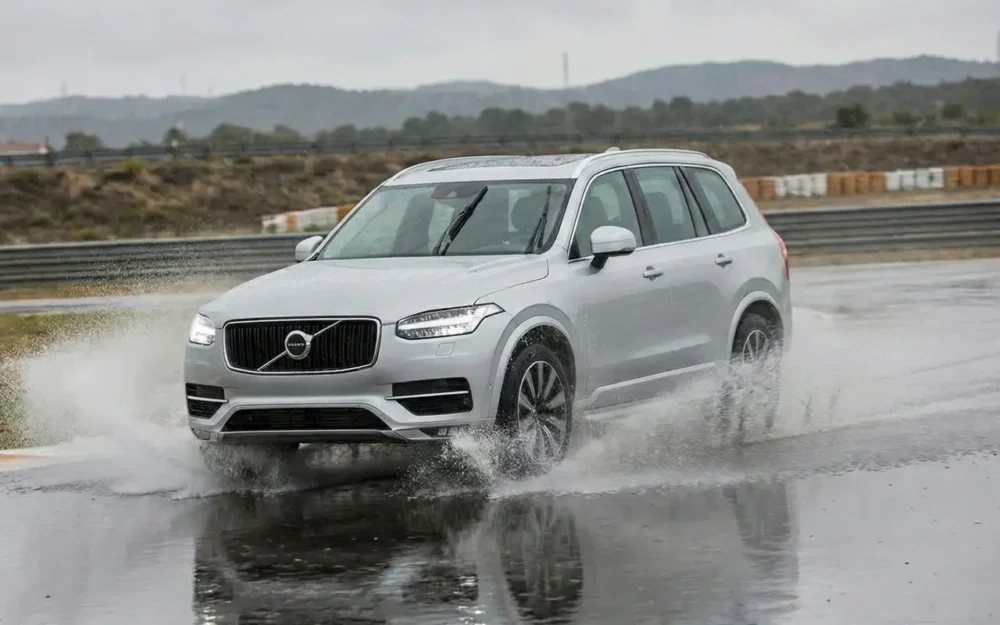
A “Green” tire is useless if it turns your family hauler into a bobsled when the clouds open up. Low-rolling-resistance compounds are historically harder, which can lead to reduced grip on wet surfaces.
I waited for a notorious Pacific Northwest storm cycle to put the Verdes to the test.
Hydroplaning Resistance
The XC90 is a wide vehicle with wide tires (275mm). Wide tires act like skis in standing water, making them prone to hydroplaning. I drove the Volvo through standing water on the highway at 65 MPH.
The four wide longitudinal grooves in the tread pattern worked like high-volume pumps. You could hear the water being evacuated into the wheel wells.
At no point did the steering go light or the car deviate from its line. The hydroplaning resistance is best-in-class.
Wet Braking and Cornering
To test the wet grip limits safely, I utilized a deserted industrial park with a large, freshly wetted asphalt lot.
- Panic Braking: I performed several panic stops from 45 MPH. The ABS engagement was smooth and progressive, not jerky. The tires bit through the water film effectively. While a dedicated summer tire like the Michelin Pilot Sport 4 SUV would undoubtedly stop shorter, the Scorpion Verde stopped significantly shorter than the budget all-season tires I have tested in the past.
- Wet Cornering: Pushing the car into a wet circle, the breakaway at the limit was gentle. The tire warns you with a subtle vibration and a slight push (understeer) before it loses grip completely. This progressive nature is vital for safety; it gives the driver time to react and lift off the throttle.
Phase 3: The Winter Reality Check
It is crucial to manage expectations regarding winter performance. The Scorpion Verde All Season carries the M+S (Mud and Snow) sidewall marking.
However, most standard sizes do not carry the Three-Peak Mountain Snowflake (3PMSF) symbol, which identifies tires capable of “severe snow service.”
Light Snow & Slush
I took the Volvo up to a local ski resort after a fresh 3-inch snowfall. In loose, slushy snow and on unplowed roads, the high-density siping in the inner tread provided adequate traction.
I was able to accelerate up a moderate incline and stop with confidence. The AWD system of the Volvo certainly helped, but the tires provided the necessary mechanical bite to get the car moving.
Ice and Hard-Pack
On hard-packed snow and icy patches, the limitations of an all-season compound became apparent. Braking distances increased significantly compared to the slush test, and lateral grip (cornering) was compromised. If you enter an icy corner too fast, the heavy SUV will slide.
The Verdict on Winter:
These are “Three-Season Plus” tires. They are perfectly safe for the occasional snow flurry, a ski trip where the roads are mostly plowed, or mild climates that see snow once or twice a year.
However, if you live in the Snow Belt, the Canadian Rockies, or New England, do not rely on these as your primary winter tire. You need a dedicated winter tire like the Pirelli Scorpion Winter 2 for true cold-weather safety.
Phase 4: Off-Pavement Capabilities
The “Scorpion” name is legendary in Pirelli’s history for off-road rallying, but does the Verde inherit any of that DNA?
I took the XC90 on a 20-mile excursion down a Forest Service road. This wasn’t rock crawling, but it involved washboard gravel, dirt, and embedded rocks.
Durability & Comfort
The touring construction actually handles washboard surfaces well. The sidewalls absorbed the high-frequency vibrations of the gravel road, keeping the cabin relatively rattle-free. The tread compound seemed resistant to chipping and tearing, even over sharp shale.
Traction Limitations
On dry dirt and gravel, traction was fine. However, in a section of wet, grassy mud, the tread packed up instantly. The tight tread blocks—great for highway silence—are terrible at self-cleaning mud. The tire became a slick slick within seconds.
Conclusion: Keep it to the pavement, gravel driveways, or dry fire roads. This is not an off-road tire.
Phase 5: Efficiency & Treadwear Analysis
Pirelli pushes the “Verde” efficiency claim hard. Did I actually save the planet (or my wallet)?
Real-World Fuel Economy
Measuring MPG is notoriously difficult outside of a laboratory due to variables like wind, traffic, and temperature. However, I tracked my fuel economy religiously over the 5,000-mile period.
- Previous Tires (High-Performance All-Season): Averaged 21.8 MPG.
- Pirelli Scorpion Verde All Season: Averaged 22.6 MPG.
That is a 0.8 MPG improvement. It might seem negligible, but over the 40,000-mile life of the tire, that equates to saving roughly 70-80 gallons of fuel. At current gas prices, that’s nearly the cost of one tire.
The car feels noticeably “freer” when rolling; when you lift off the gas on the highway, it coasts for a surprisingly long distance before slowing down.
Treadwear Projection
After 5,000 miles, I measured the tread depth using a digital gauge. The tires started with 10/32″ of tread.
- Front Tires: 9.5/32″ remaining.
- Rear Tires: 9.5/32″ remaining.
The wear was perfectly even across the face of the tire, indicating that the contact patch is well-engineered. Based on this wear rate, I project a lifespan of 45,000 to 50,000 miles, which aligns well with Pirelli’s mileage warranty.
Comparison: The Scorpion Verde vs. The Rivals
How does it stack up against the heavy hitters in the premium SUV segment?
- vs. Michelin Premier LTX: The Michelin is often the benchmark for this category. The Michelin offers slightly better wet braking performance (thanks to its “EverGrip” technology). However, the Michelin has a notorious reputation for wearing out quickly—often getting noisy after 20,000 miles. The Pirelli feels like a more durable, longer-lasting product with better noise suppression over time.
- vs. Continental CrossContact LX25: The Continental is a newer competitor and offers superior snow traction. If winter performance is your number one priority for an all-season tire, the Continental is the better buy. But for pure highway refinement, steering feel, and dry handling, the Pirelli edges it out.
- vs. Bridgestone Alenza AS Ultra: The Bridgestone is a high-mileage warrior with an 80k warranty. It will likely last longer than the Pirelli. However, the Bridgestone rides significantly stiffer and is louder on concrete. The Pirelli offers a much more “luxury” ride quality.
The Final Verdict: Who Should Buy This Tire?
After six months and 5,000 miles, I have come to respect the Pirelli Scorpion Verde All Season immensely. It is a tire that knows exactly what it is. It doesn’t pretend to be a race tire or a mud tire.
It focuses entirely on being the best possible tire for the daily life of a luxury SUV.
It enhances the vehicle’s best traits—quietness, comfort, and stability—without introducing any glaring weaknesses.
You should buy this tire if:
- You drive a premium SUV (Volvo, BMW, Audi, Mercedes, Lexus).
- You prioritize a quiet cabin and a comfortable ride above all else.
- You live in a region with rain but only mild/occasional snow.
- You want to maximize your vehicle’s fuel range.
You should skip this tire if:
- You live in an area with harsh winters (get winter tires!).
- You do frequent off-roading or tow heavy loads in muddy conditions.
- You drive extremely aggressively and want a sports-car feel (look at the P Zero).
Final Score: 4.6 / 5
The Pirelli Scorpion Verde All Season is the “Goldilocks” tire for the luxury SUV market: not too hard, not too soft, but just right.
At a Glance: Pros & Cons
| Pros (The Good) | Cons (The Bad) |
| Silence: Best-in-class noise reduction (especially with PNCS). | Snow Limits: Weak on ice/packed snow; strictly for light winter duty. |
| Efficiency: Tangible improvement in rolling resistance/MPG. | Off-Road: Mud traction is poor; tread packs up instantly. |
| Hydroplaning: Excellent water evacuation in heavy rain. | Price: Premium pricing (though competitive for the sector). |
| Steering Feel: Solid, linear, and confidence-inspiring on the highway. | Feedback: Can feel slightly “numb” compared to a summer sport tire. |
| Wear: Even wear pattern suggests excellent longevity. |
Frequently Asked Questions (FAQ)
Is the Pirelli Scorpion Verde All Season a run-flat tire?
It depends on the size and spec. Many sizes—especially OE (Original Equipment) fitments for BMW and Mercedes—are available as “Run Flat” (marked r-f on the sidewall). However, standard versions are also available. I tested the standard (non-run-flat) version, which generally offers better ride comfort.
What is the mileage warranty?
Pirelli generally offers a 65,000-mile limited treadwear warranty for H and V speed rated sizes, and 50,000 miles for higher speed ratings (W, Y). Run-flat models typically have no mileage warranty or a reduced one.
Can I use these for off-roading?
Pirelli markets them with “light off-road” capability, which translates to gravel driveways and firm dirt roads. They lack the puncture resistance and aggressive lugs needed for mud or rock crawling. For that, look at the Pirelli Scorpion All Terrain Plus.
Does “Verde” mean the tire is made of recycled materials?
Not entirely. “Verde” refers to Pirelli’s environmental philosophy. While they use advanced materials to reduce weight and rolling resistance (lowering CO2 emissions), the tire is primarily made of synthetic and natural rubber polymers like any other tire. The “Green” refers more to the fuel savings and reduced environmental impact during use.
Can I mix these with different tires?
It is never recommended to mix tire brands or models on an AWD vehicle like the Volvo XC90. Doing so can damage the differential and compromise safety. Always replace tires in sets of four.
Pirelli Scorpion Verde All Season Review

Our 5,000-mile review of the Pirelli Scorpion Verde All Season. We tested noise, wet grip, and snow performance on a Volvo XC90. See the full verdict here.
Product Brand: Pirelli
Product Price: $171.40
Product In-Stock: InStock
4.6