
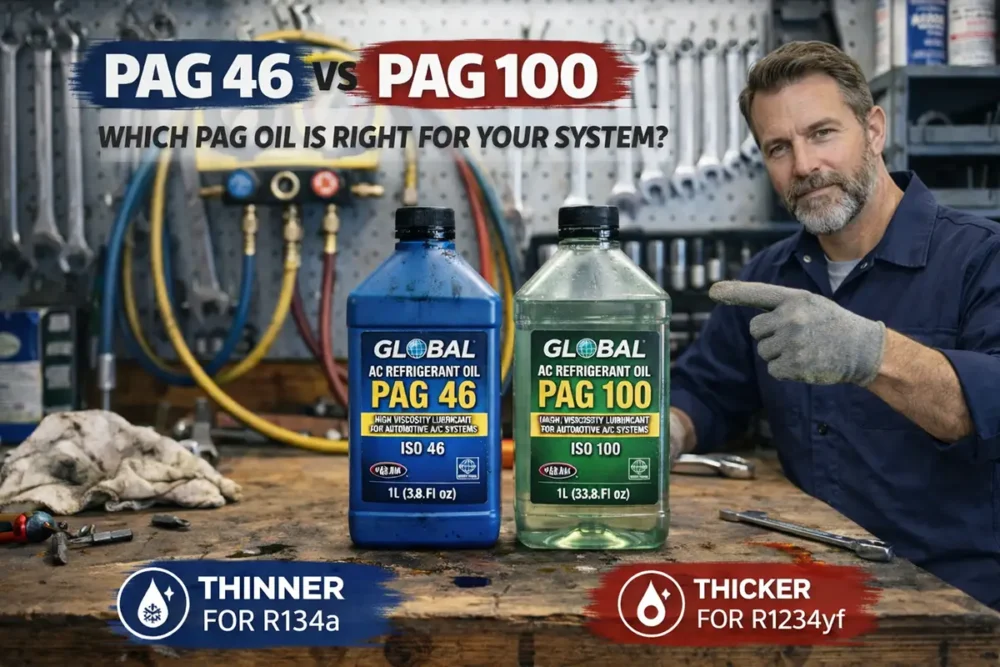
I’ll be honest — the first time I stood in the automotive aisle holding two different bottles of PAG oil, one labeled PAG 46 and the other PAG 100, I had absolutely no idea which one to grab.
The numbers meant nothing to me at the time. I’d just pulled a seized compressor off a customer’s 2014 Honda Accord, and the last thing I wanted to do was make a $400 repair worse by dumping in the wrong lubricant.
That confusion? It’s more common than you’d think. I hear it constantly from DIYers at the parts counter, on forums, and from people who’ve already made the mistake and are trying to figure out why their newly installed compressor is running hot or making noise.
The truth is, PAG oil selection is one of the most overlooked parts of an AC compressor replacement — and getting it wrong can kill a brand-new compressor within months.
Before we dive deep, if you’re also dealing with other car maintenance decisions, I’d recommend bookmarking this tire buying and maintenance guide — it’s a solid companion resource for keeping your vehicle running right from the ground up.
Let’s settle this debate once and for all with real-world experience, not just spec sheets.
TL;DR — PAG 46 vs PAG 100 Quick Summary
| PAG 46 | PAG 100 | |
|---|---|---|
| Viscosity | Lower (thinner) | Higher (thicker) |
| Typical Use | Most modern cars (Honda, Toyota, GM, Ford) | Trucks, SUVs, older vehicles, some Chrysler/Dodge |
| Common Refrigerant Pairing | R-134a, R-1234yf | R-134a |
| Climate Performance | Excellent in moderate to hot climates | Better in extreme heat or high-load systems |
| Compressor Compatibility | Scroll, rotary, swash-plate (most common) | Variable displacement, some piston-type |
| Mixing with Other PAG | Not recommended | Not recommended |
| Price | Slightly lower | Slightly higher |
Bottom line: Most modern passenger cars call for PAG 46. Trucks, larger SUVs, and some Chrysler/Dodge/Jeep applications often spec PAG 100. Always — always — check your compressor label or OEM service manual before adding a single drop.
- My Experience with PAG 46
- Where PAG 46 Is Used
- Pros of PAG 46
- Cons of PAG 46
- My Experience with PAG 100
- Where PAG 100 Is Used
- Pros of PAG 100
- Cons of PAG 100
- Viscosity Differences
- Compatibility with Compressors
- Cooling Efficiency Impact
- Performance in Different Climates
- Longevity & Wear Protection
- Risks of Using the Wrong PAG Oil
What Is PAG Oil?
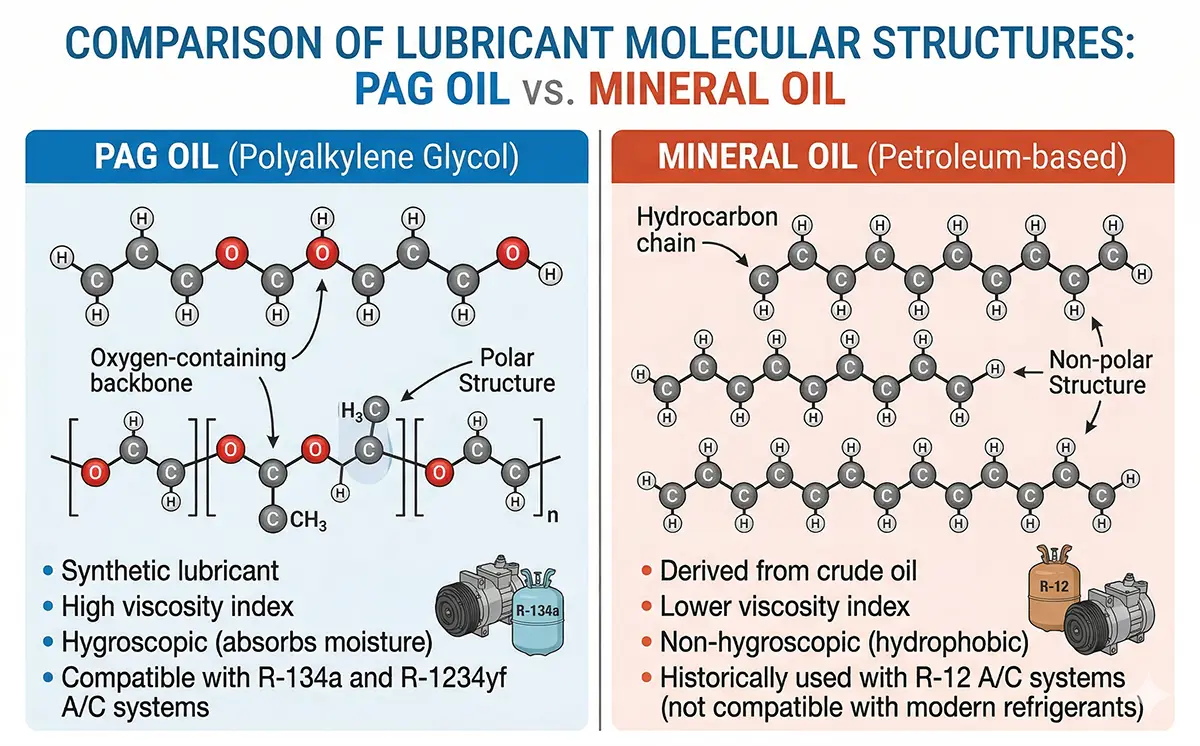
Diagram showing PAG oil molecular structure versus mineral oil
PAG stands for Polyalkylene Glycol. It’s a fully synthetic lubricant specifically engineered for use in automotive air conditioning compressors that use R-134a or R-1234yf refrigerant systems.
Here’s why it exists in the first place: AC compressors aren’t self-contained. The lubricating oil actually travels with the refrigerant throughout the entire AC system — through the condenser, evaporator, expansion valve, and back again.
That means whatever oil you pour into the compressor is going to be circulating through every inch of your AC system.
Unlike the old mineral oils used with R-12 refrigerant (the stuff banned back in the ’90s), PAG oils are hygroscopic, meaning they absorb moisture from the air. That property matters for how you store it and handle it — more on that later.
The number after “PAG” — 46, 100, or 150 — refers to its ISO viscosity grade. Higher number = thicker oil. That’s the core of the whole debate.
Why PAG Oil Matters in Your Car’s AC System
This isn’t just a “top it off” situation like engine oil. AC compressors are precision-machined components spinning at thousands of RPMs, and they rely entirely on the refrigerant/oil mixture circulating through the system for lubrication and sealing.
There’s no separate oil reservoir — the compressor gets lubricated every single time the refrigerant circulates.
I’ve personally seen what happens when this goes wrong. A shop near me had a technician use PAG 150 in a late-model Toyota Corolla that called for PAG 46.
The thicker oil didn’t circulate efficiently, pooled in the evaporator, and the compressor ran dry within two summers. That was a $650 compressor that should have lasted the life of the car.
The right PAG oil affects:
- Compressor longevity — proper film thickness between moving parts
- Cooling efficiency — oil that doesn’t circulate properly reduces refrigerant flow
- Seal integrity — PAG oil conditions the rubber seals and O-rings in the system
- Overall system pressure — viscosity affects how the refrigerant/oil mixture moves under pressure
This is not a place to guess or “use what’s on the shelf.”
PAG 46 Explained
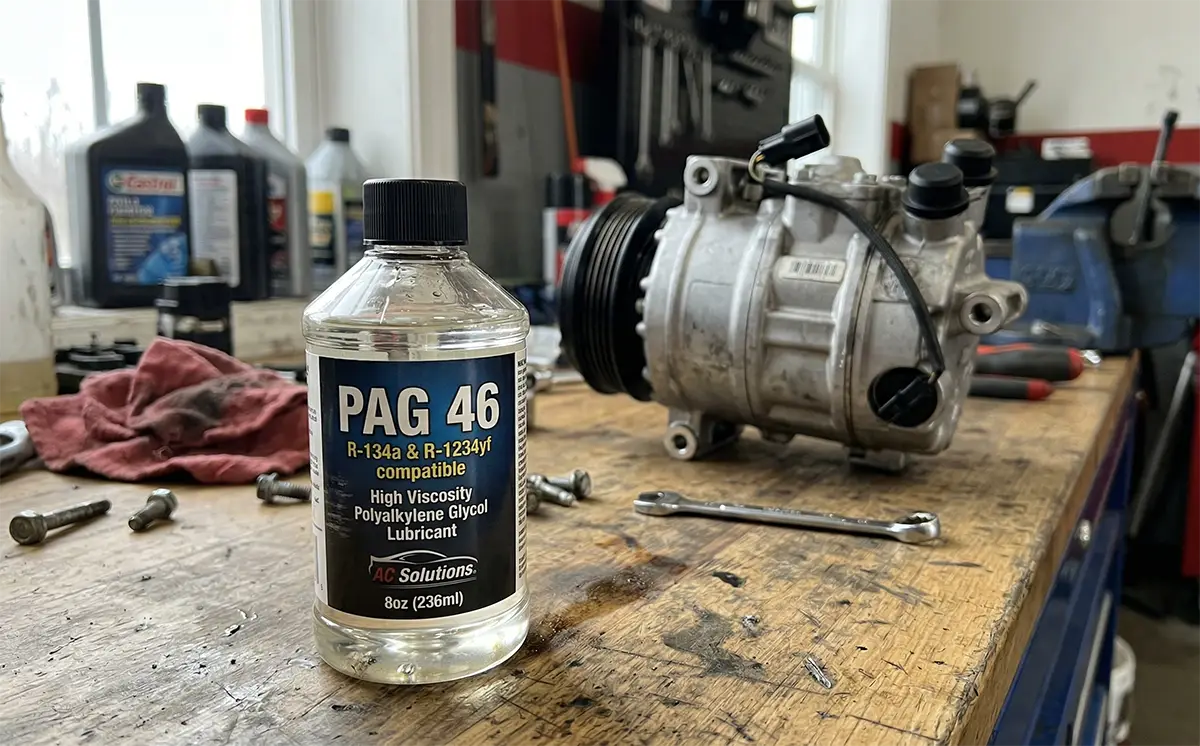
My Experience with PAG 46
PAG 46 is the oil I’ve used most often in my years working on AC systems. I’d estimate about 70% of the passenger cars I’ve serviced — Hondas, Toyotas, Chevrolets, Fords, Hyundais — have called for PAG 46. It’s the workhorse of the PAG family.
One job that sticks out: I replaced the compressor on a 2017 Toyota Camry with 88,000 miles. The OEM spec was clear — PAG 46. I flushed the system, added the correct amount (about 4.5 oz total for that application), pulled a proper vacuum, and recharged it. Three years later, that car is still blowing cold with zero issues. That’s PAG 46 doing its job.
Where PAG 46 Is Used
PAG 46 is the most widely specified AC oil for modern vehicles in the U.S. market. You’ll typically find it called for in:
- Honda/Acura vehicles (almost universally)
- Toyota/Lexus vehicles
- Most GM vehicles (Chevy, GMC, Buick, Cadillac) using scroll-type compressors
- Ford/Lincoln vehicles with Sanden or Delphi compressors
- Hyundai/Kia modern platforms
- Most R-1234yf systems in vehicles post-2015 (though some require PAG 46 YF specifically, a slightly modified version)
Pros of PAG 46
- ✅ Best circulation — flows efficiently through the entire system, including the evaporator
- ✅ Ideal for scroll and rotary compressors — the most common compressor designs today
- ✅ Widely available at AutoZone, O’Reilly, NAPA, and online
- ✅ Compatible with most modern refrigerants including R-134a and R-1234yf systems
- ✅ Lower cost than PAG 100 or PAG 150
- ✅ Good performance in typical U.S. driving conditions
Cons of PAG 46
- ❌ Too thin for high-displacement or older piston-type compressors
- ❌ May not provide adequate film protection in extreme-heat, high-load applications (heavy trucks towing in Arizona summers, for example)
- ❌ Absorbs moisture quickly — don’t leave the bottle open or partially used bottles sitting around
PAG 100 Explained
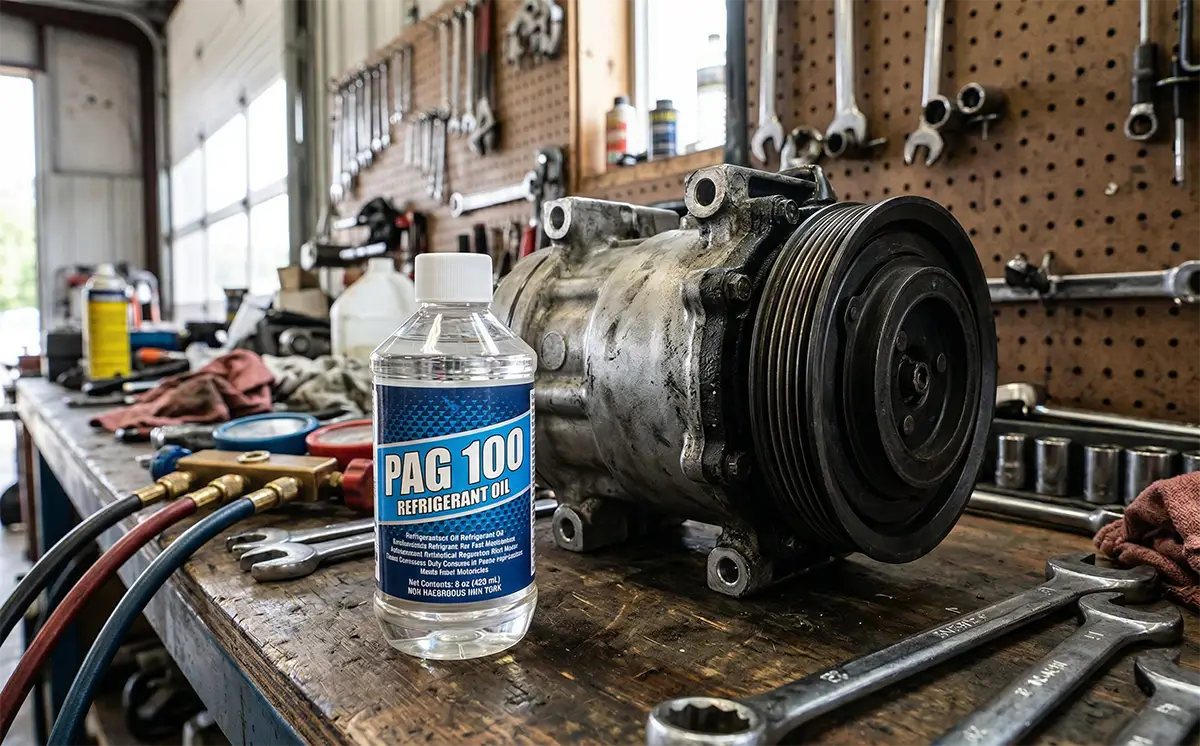
My Experience with PAG 100
My first real hands-on experience with PAG 100 came when I was working on a 2008 Dodge Ram 1500 with a V8 and a Seltec/Tama compressor.
I almost defaulted to PAG 46 out of habit — glad I caught myself. The compressor label clearly said PAG 100, and when I cross-referenced the service manual, it confirmed it.
PAG 100 is noticeably thicker when you pour it — it moves slower, coats surfaces more aggressively, and you can feel the difference in viscosity just by handling the bottle.
For that Ram, it made complete sense. Larger compressor, bigger system, harder working AC unit pulling cabin temps down in a truck cab with a lot of glass exposure.
Another instance: a 2005 Jeep Grand Cherokee 4.7L. Same deal — PAG 100 was the call. Jeep/Chrysler has historically leaned toward PAG 100 across several of its platforms, and the compressors they use are often better matched to the extra film thickness.
Where PAG 100 Is Used
PAG 100 shows up most frequently in:
- Chrysler/Dodge/Jeep/Ram vehicles (very common across the FCA lineup)
- Some Ford F-Series and E-Series trucks with larger displacement compressors
- Older GM trucks (pre-2010 with Harrison or Delphi reciprocating piston compressors)
- Some Mercedes-Benz and European makes (though always verify)
- Commercial vans and fleet vehicles with high-capacity AC systems
- Vehicles with variable displacement compressors requiring heavier oil film protection
Pros of PAG 100
- ✅ Better wear protection for larger, harder-working compressors
- ✅ Maintains viscosity better under sustained high heat and load
- ✅ Stronger film strength — reduces metal-to-metal contact in heavy piston-type compressors
- ✅ Well-suited for trucks and SUVs pulling heavy loads or running AC continuously in hot climates
- ✅ Longer drain intervals in high-demand applications
Cons of PAG 100
- ❌ Too thick for most modern scroll compressors — circulation issues can occur
- ❌ Not appropriate for R-1234yf systems in most cases
- ❌ Slightly more expensive and less universally stocked
- ❌ Can pool in the evaporator if used in systems designed for thinner oil, reducing cooling efficiency
PAG 46 vs PAG 100: Key Differences
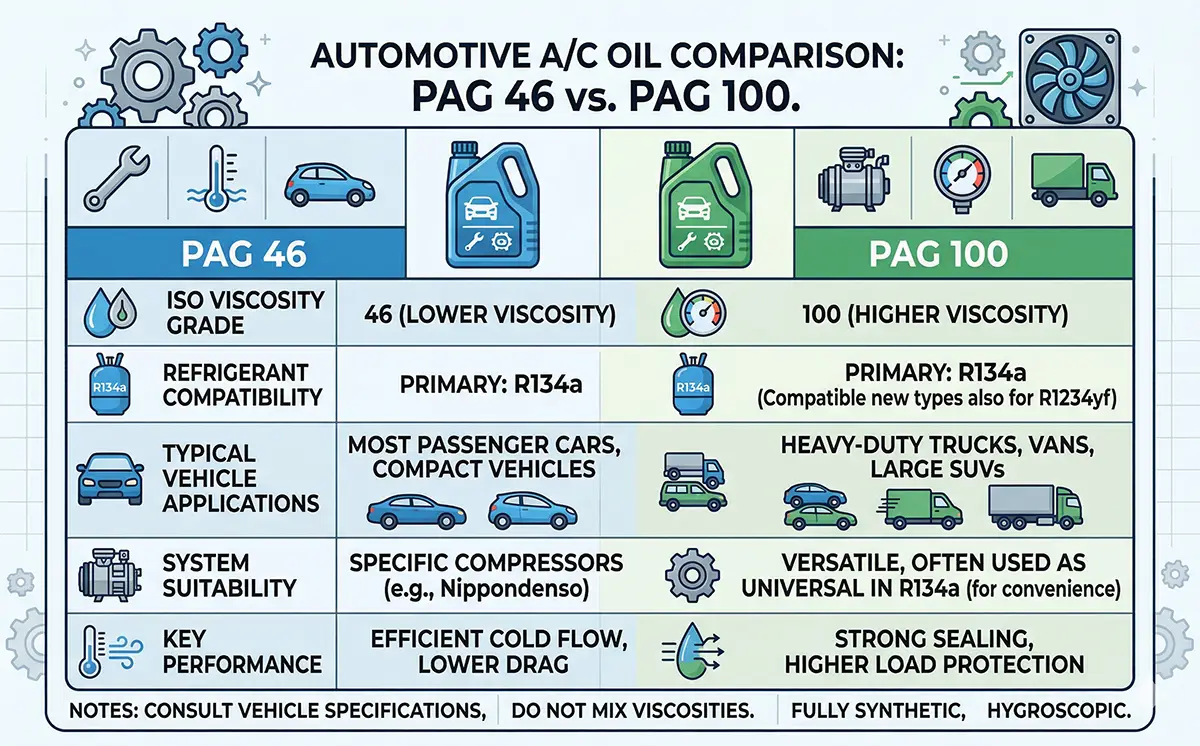
Viscosity Differences
This is the fundamental difference and everything else flows from it. Viscosity is essentially how thick or resistant to flow the oil is at a given temperature.
- PAG 46 has an ISO viscosity grade of 46, meaning it flows more freely
- PAG 100 has an ISO viscosity grade of 100 — more than twice as thick at operating temperature
In practice, this means PAG 46 circulates through narrow passages in the evaporator and condenser more easily, while PAG 100 provides a thicker protective film on compressor internals — which is exactly what certain compressor designs need.
Compatibility with Compressors
This is where most people go wrong. Compressor design determines oil requirement, not vehicle size or age alone.
| Compressor Type | Recommended PAG |
|---|---|
| Scroll type (most modern cars) | PAG 46 |
| Rotary vane type | PAG 46 |
| Swash plate / axial piston | PAG 46 or PAG 100 (check specs) |
| Variable displacement | PAG 100 (often) |
| Fixed displacement piston (older) | PAG 100 or PAG 150 |
I always flip the compressor over and look for the spec label before I start. Most remanufactured compressors will have the correct PAG grade stamped or printed right on the unit. If yours doesn’t — look it up. No excuses.
Cooling Efficiency Impact
Oil viscosity directly affects how well refrigerant moves through your system. If the oil is too thick:
- It doesn’t circulate efficiently
- It can “log” in the evaporator or condenser
- The system must work harder to move refrigerant
- You may notice slightly warmer-than-expected cabin temps even with full refrigerant charge
PAG 46’s lower viscosity means it moves with the refrigerant more cleanly, which is why it’s preferred in modern, tight-tolerance systems that prioritize efficiency.
Performance in Different Climates
Here’s something I’ve observed after working in different regions:
- In moderate climates (Pacific Northwest, Northeast U.S.), PAG 46 performs excellent across most vehicles
- In extreme heat markets (Phoenix, Dallas, Las Vegas), larger vehicles doing heavy AC work can benefit from PAG 100’s extra film protection
- Humidity matters too — both oils absorb moisture, but systems in humid climates (Southeast U.S.) should have desiccant bags replaced during any major AC service
That said — climate doesn’t override manufacturer spec. Even in Phoenix, if your Honda CR-V calls for PAG 46, that’s what goes in.
Longevity & Wear Protection
PAG 100 provides stronger film strength, which theoretically offers better boundary lubrication when two metal surfaces come close to contact.
For heavy piston compressors running hard for hours (think a commercial van running AC all day in Florida), that matters.
For a typical commuter car with a scroll compressor doing moderate AC duty, PAG 46’s lighter film is perfectly adequate — and actually better because it stays in circulation rather than pooling.
Risks of Using the Wrong PAG Oil

This is where I need to be very direct with you:
Using PAG 100 in a system that calls for PAG 46:
- Oil may not circulate properly
- Evaporator pooling can cause refrigerant starvation to the compressor
- Compressor runs hotter, with less lubrication than designed
- Potential compressor failure within 1–2 seasons
Using PAG 46 in a system that calls for PAG 100:
- Insufficient film thickness between metal surfaces
- Accelerated wear on piston rings, cylinder walls, and bearings
- Noise (rattling, knocking) from the compressor
- Premature compressor failure
Neither scenario is cheap. A remanufactured compressor runs $200–$600 depending on the vehicle. Labor on top of that can push you over $1,000. The cost of the right PAG oil? About $10–$20.
Can You Mix PAG 46 and PAG 100?
Short answer: don’t.
Technically, PAG oils of different viscosity grades are chemically compatible in that they won’t have a violent reaction — but mixing them defeats the purpose entirely.
If your system calls for PAG 46 and you add PAG 100 to it, you’ve now got an oil that’s somewhere between the two viscosities. It won’t perform like either one properly.
I’ve seen people justify this with “I only had PAG 100 on hand, so I mixed it 50/50” — and while the system may not immediately blow up, you’re compromising lubrication for a compressor that was precision-engineered for a specific oil viscosity. Don’t do it.
If you need to transition from one to another, the correct procedure is a full system flush.
What Happens If You Use the Wrong PAG Oil?

I want to share a real-world example here because I think it’s more powerful than a spec sheet.
A neighbor of mine — capable DIY mechanic, been doing his own brakes and oil changes for years — installed a new AC compressor on his 2010 Chrysler 300.
He grabbed PAG 46 at AutoZone because the guy at the counter said “most cars use PAG 46.” His Chrysler 300 called for PAG 100.
By the end of that summer, the compressor was making a grinding noise. By fall, it had seized. When we tore it down, the internal components showed clear signs of oil starvation — the kind that happens when a compressor designed for thicker oil is running on something too thin to maintain proper film protection under load.
He paid for that compressor twice. All for a $10 difference in lubricant.
The symptoms of wrong PAG oil often include:
- Unusual compressor noise (whining, grinding, rattling)
- Reduced cooling performance despite correct refrigerant charge
- Excessive compressor cycling
- Metal shavings in the oil — a death sentence for the system
- System contamination requiring full flush and replacement
How to Choose the Right PAG Oil for Your Car
Here’s my step-by-step process whenever I’m doing an AC compressor replacement or major service:
Step 1: Check the compressor label Most new or remanufactured compressors will have the PAG spec printed directly on the unit. This is your first source of truth.
Step 2: Consult the OEM service manual For your specific vehicle year, make, model, and engine. Not a generic Google search — the actual service manual. Autozone’s free RepairPal data, AllDataDIY, or a factory service manual all work.
Step 3: Cross-reference the refrigerant type
- R-134a systems: typically PAG 46, PAG 100, or PAG 150 depending on compressor
- R-1234yf systems: typically PAG 46 YF (a specific formulation — not interchangeable with standard PAG 46)
Step 4: Verify the quantity Just as important as the grade is the amount. Too little oil = compressor wear. Too much oil = reduced cooling efficiency. Most systems spec somewhere between 3–8 oz total system capacity.
Step 5: Don’t trust “universal” PAG oil claims Some products are marketed as “works for PAG 46, 100, and 150” — I’m skeptical of these for compressor replacement jobs. For topping off a functioning system, maybe. For a fresh install? Use the exact spec.
Manufacturer Recommendations: What the Brands Actually Say
Here’s a general reference guide based on what I’ve consistently seen across manufacturer service documentation. Always verify against your specific vehicle’s service manual — this is a starting point, not a substitute.
| Brand | Common PAG Spec | Notes |
|---|---|---|
| Honda / Acura | PAG 46 | Virtually universal across the lineup |
| Toyota / Lexus | PAG 46 | Some hybrid models may differ |
| Ford / Lincoln | PAG 46 | Most models; F-250/350 may vary |
| Chevrolet / GMC | PAG 46 | Modern platforms; older trucks may need PAG 150 |
| Chrysler / Dodge / Jeep / Ram | PAG 100 | Very common across FCA vehicles |
| Hyundai / Kia | PAG 46 | Recent platforms |
| BMW | PAG 46 or specific ND-OIL | Often brand-specific — check carefully |
| Mercedes-Benz | Varies | Some spec PAG 100; others brand-specific oils |
| Nissan / Infiniti | PAG 46 | Most models |
| Subaru | PAG 46 | Confirmed across most platforms |
Important note on R-1234yf systems: If your vehicle uses R-1234yf refrigerant (most vehicles 2015 and newer, and many 2013–2014 models), you may need PAG 46 YF — a formulation specifically designed for compatibility with that refrigerant. Standard PAG 46 may not be fully compatible. Check your system’s refrigerant type first.
Common Mistakes to Avoid
Over the years, I’ve made some of these myself early on, and I’ve watched others make them too. Learn from it:
1. Buying oil based on vehicle size, not compressor spec Big truck = PAG 100 seems logical, but it’s not always true. Always verify.
2. Reusing old oil If you’re flushing a system that had a compressor failure (especially if there are metal shavings present), all the old oil comes out. Every drop. Contaminated oil will destroy a new compressor fast.
3. Leaving bottles open PAG oil is hygroscopic. Even leaving a bottle cracked for an hour in a humid garage introduces moisture. Keep caps on tight, and don’t use oil from a previously opened bottle that’s been sitting around.
4. Overfilling Excess oil reduces the system’s refrigerant capacity and cooling efficiency. Measure precisely — use a graduated measuring cylinder, not eyeballing.
5. Skipping the vacuum pull After any major AC work, pulling a deep vacuum (500 microns or lower, held for 30+ minutes) removes moisture and air from the system. Skipping this step invites acid formation and corrosion.
6. Using PAG oil in an R-12 system Vintage vehicles using R-12 refrigerant require mineral oil. PAG oil is not compatible. If you’re retrofitting an R-12 system to R-134a, a full flush is mandatory.
7. Assuming all PAG 46 products are equal Quality varies between brands. I’ve had good results with Denso, Sanden, and Robinair-branded PAG oils. I tend to avoid very cheap no-name options for compressor replacements specifically.
My Real-World Experience & Lessons Learned
Let me take a minute to be real with you, because I think this section is actually the most useful part of this whole guide.
I’ve done AC work on probably 150+ vehicles over the years — everything from a 1998 Civic with a cracked seal to a 2021 F-150 with an R-1234yf system. The cases where I’ve seen PAG oil go wrong almost always involve one of two things:
Scenario 1: Someone trusted generic advice “Just use PAG 46, it works in everything” is advice that sounds reasonable until you’re replacing a compressor on a Ram 1500 that seized because it needed PAG 100. The automotive internet is full of well-meaning but wrong generalizations.
Scenario 2: Someone guessed at quantities The grade matters, but so does the amount. I once got called in to diagnose a “weak AC” complaint on a Camry where a DIYer had installed a new compressor correctly — right oil grade — but added about double the specified quantity. The excess oil was reducing refrigerant capacity. The system was essentially oil-logged. A proper flush and refill fixed it completely.
My personal rule: The compressor label and the OEM service manual are the only two sources I trust for PAG oil specs. Everything else — forums, YouTube comments, the guy at the parts counter — is secondary, unverified guidance.
I’ve also learned to keep both PAG 46 and PAG 100 on my shelf, in sealed bottles. You never know what’s coming through the door, and having both means I’m never tempted to substitute one for the other because it’s “close enough.”
Final Verdict: PAG 46 vs PAG 100
After all of this, here’s where I land:
Use PAG 46 if:
- You drive a modern passenger car (2005 and newer in most cases)
- Your vehicle is made by Honda, Toyota, Hyundai, Subaru, Nissan, or most GM/Ford platforms
- Your service manual or compressor label specifies PAG 46
- You have an R-1234yf system (use PAG 46 YF specifically)
Use PAG 100 if:
- You drive a Chrysler, Dodge, Jeep, or Ram product — check first, but PAG 100 is very common here
- You have an older truck or SUV with a piston-type or variable displacement compressor
- Your service manual or compressor label explicitly says PAG 100
- You’re working on a high-capacity commercial vehicle AC system
The universal rule: check your compressor label and your service manual. Every time. No exceptions.
PAG oil costs less than a decent lunch. A compressor costs hundreds. The math isn’t complicated.
If you’re doing a full compressor replacement, take your time, flush the system properly, add the correct oil in the correct quantity, pull a proper vacuum, and recharge to spec. Do it right once and you won’t be doing it again for a long time.
Have a question about your specific vehicle’s PAG oil spec? Drop it in the comments — I check them regularly and I’m happy to point you in the right direction.
Frequently Asked Questions (FAQs) – PAG 46 vs. PAG 100
What is the main difference between PAG 46 and PAG 100 oil?
The primary difference lies in their viscosity (thickness) and chemical composition. PAG 46 has shorter polymer chains, giving it a lower viscosity that flows easily, making it great for cold starts and low-temperature environments. PAG 100 has longer polymer chains, resulting in a higher viscosity that provides a thicker protective film for high-temperature and heavy-load applications.
Which oil is right for my vehicle’s A/C system?
It strictly depends on your vehicle’s manufacturer. PAG 46 is often recommended by American manufacturers like Ford, General Motors, and Chrysler, and is common in systems with piston or reciprocating compressors. PAG 100 is typically recommended for newer vehicles and by automakers like Toyota, Honda, and Nissan, and is often preferred for rotary or scroll compressors. Always consult your OEM manual to ensure compatibility.
Can I mix PAG 46 and PAG 100 oils?
No, it is not recommended to mix different types of PAG oils or mix them with non-PAG oils. Doing so can cause compatibility issues, reduce system performance, and potentially damage your A/C compressor. When topping up or replacing oil, always use the exact type originally specified for your system.
How often should I change my PAG oil?
For residential and light commercial systems, PAG 46 should generally be changed every 3 to 5 years (or 15,000 to 20,000 hours of operation). Because PAG 100 is often used in larger, heavy-duty commercial systems and is more resistant to moisture, it typically lasts a bit longer and should be changed every 5 to 7 years (or 20,000 to 30,000 hours).
Which oil is more expensive?
PAG 100 tends to have a slightly higher upfront cost compared to PAG 46. However, because PAG 100 has a longer service life and better resistance to moisture absorption, it may require less frequent changes, potentially offering a better total cost of ownership over time.
Are both oils compatible with common refrigerants?
Yes, but with slight differences in miscibility. PAG 46 is highly miscible (mixes well) with R-134a and R-410A. PAG 100 is also highly miscible with R-410A but is slightly less miscible with R-134a than PAG 46. Both are only partially miscible with older R-22 refrigerants.