Quick Summary: The “Need to Know”
In a rush? Here is the cheat sheet for buying tires in Florida.
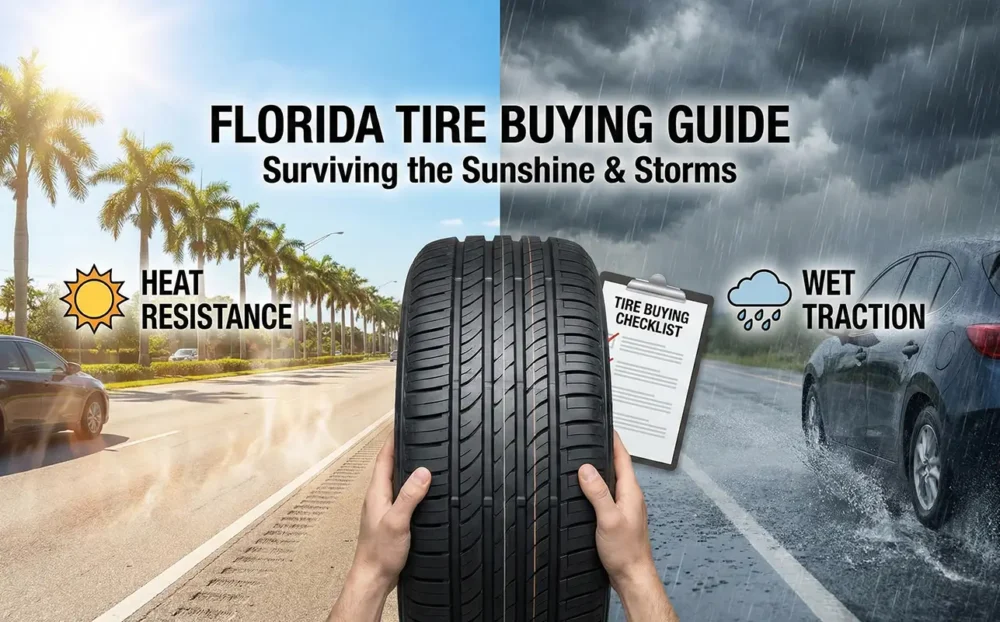
- Heat Kills Tires: Florida roads get incredibly hot. You need tires with a high “Temperature” rating (A is best).
- Rain is the Enemy: Sudden storms cause hydroplaning. You need tires with deep grooves and excellent “Wet Traction” reviews.
- Snow Tires are Useless: Never use winter tires in Florida; the heat will destroy them in weeks.
- Check the Date: Never buy “new” tires that are more than 3-4 years old. Rubber degrades in heat, even on the shelf.
- Best Value: For most family cars, a high-quality “All-Season Touring” tire with an ‘A’ temperature rating is the best balance of long life and safety.
- Quick Summary: The “Need to Know”
- Why Florida Driving is Different (It’s Not Just the Traffic)
- Step-by-Step: How to Read Your Tire Size
- The Great Debate: Summer vs. All-Season Tires
- Critical Safety Ratings for Florida
- Buying Guide: Where and How to Buy
- Budget Tips: Cheap Tires in Florida That Aren’t Junk
- Mistakes to Avoid
- Maintenance Tips for Florida Weather
- Comparison Table: Tire Types for Florida
- Your “Florida Tire Buying” Checklist
- FAQ: Frequently Asked Questions
- Final Conclusion
Why Florida Driving is Different (It’s Not Just the Traffic)
If you just moved here from the North, you might think, “Tires are tires, right?” Wrong. Florida presents a unique torture test for rubber. Understanding this helps you choose the best tires for Florida weather.
1. The Asphalt Oven
In July and August, air temperatures hit the 90s, but asphalt temperatures can exceed 140°F (60°C).
- What this does: Heat increases the pressure inside your tire. It also softens the rubber compounds. If a tire isn’t built to dissipate heat, the internal layers can separate, leading to a catastrophic blowout at highway speeds.
2. The Hydroplane Zone
Florida doesn’t just drizzle; it pours. During hurricane season or afternoon thunderstorms, inches of water accumulate on roads in minutes.
- The Risk: Hydroplaning happens when your tire cannot channel water away fast enough. The tire rides on top of the water like a water skier, and you lose all steering and braking control.
- The Solution: You need tires with wide “circumferential grooves” (the deep lines that go around the tire) to pump water out.
3. Coastal Corrosion
If you live near the beach (Daytona, Miami, Clearwater), salt air is a factor. While it affects your car’s body and wheels more than the rubber, it can seize up your valve stems.
- Tip: Always use plastic valve stem caps, not metal ones, which can rust-weld to the stem.
Step-by-Step: How to Read Your Tire Size
Before you start shopping for cheap tires in Florida, you need to know what fits. Don’t just guess or look at what is currently on the car (the previous owner might have put the wrong ones on!).
Step 1: Open Your Driver’s Door
Look for a sticker on the door jamb (the metal part where the door latches). It will say “Tire and Loading Information.”
Step 2: Decode the Numbers
You will see a code like this: P225/55R17 97T.
- P: Passenger vehicle.
- 225: Width of the tire in millimeters. (Wider isn’t always better in rain; wider tires can hydroplane easier!).
- 55: Aspect ratio (height of the sidewall).
- R: Radial construction (standard).
- 17: Rim diameter in inches. Crucial: You must match this exactly.
- 97: Load Index (How much weight it carries). Never go lower than this number.
- T: Speed Rating.
Why Speed Rating Matters in FL:
Even if you don’t drive 130 mph, a higher speed rating (H, V, or W) usually means the tire is built with stiffer sidewalls and better heat resistance. In Florida, I recommend sticking to H-rated or higher for highway driving.
The Great Debate: Summer vs. All-Season Tires
This is the most common question: “Do I need all-season tires if Florida has no winter?”
Summer Tires
Don’t let the name fool you. These are actually “Wet/Dry Performance” tires.
- Pros: They use a sticky rubber compound that grips hot pavement amazingly well. They usually have the best braking distance in heavy rain.
- Cons: They wear out faster (lower mileage warranty). They crack if the temperature drops near freezing (rare in FL, but possible in the Panhandle).
- Verdict: Great for sports cars and aggressive drivers in South Florida.
All-Season Tires
These are the standard for 90% of cars (Camrys, Civics, SUVs).
- Pros: Long tread life (often 60,000+ miles). They handle heavy rain well if you buy a good brand. They can handle the occasional 40°F morning in January.
- Cons: Not as sticky as summer tires for high-speed cornering.
- Verdict: The best choice for commuters and budget-conscious families. Look for “Touring All-Season” or “Grand Touring All-Season” for the smoothest ride.
What about “All-Weather” Tires?
These are different from All-Season. They are designed for snow usage (they have the mountain snowflake symbol).
- Verdict: Avoid. You are paying for snow technology you will never use, and the rubber may wear out faster in the extreme Florida heat.
Critical Safety Ratings for Florida
When you look at a tire online, scroll down to the “UTQG” (Uniform Tire Quality Grading). This is a government-mandated rating system.
1. Temperature (The Heat Rating)
This measures how well the tire withstands heat buildup.
- Ratings: A, B, C.
- Florida Rule:Only buy tires rated “A.
- A: Withstands high speeds and heat effectively.
- B: Acceptable for city driving, but less ideal for long Florida road trips.
- C: Avoid. These are old tech and risky on hot highways.
2. Traction (The Wet Stop Rating)
This measures how well the tire stops on wet pavement.
- Ratings: AA, A, B, C.
- Florida Rule: Look for “AA” or “A”.
- “AA” is the best wet braking. Since rear-ending someone is a huge risk in sudden Florida storms, this rating is vital.
3. Treadwear (The Mileage Estimate)
This is a number (e.g., 300, 500, 800).
- Higher is longer lasting.
- Note: In Florida heat, tires dry rot faster. Even if you have an 800-rated tire (80,000 miles), the sun might kill the rubber before the tread wears down if you don’t drive much.
Buying Guide: Where and How to Buy
How to choose tires in hot climates isn’t just about the rubber; it’s about the service.
Option 1: Online (Tire Rack, SimpleTire, Amazon)
- Pros: Huge selection, usually cheaper prices, lots of reviews to read.
- Cons: You have to ship them to an installer.
- Strategy: This is great for research. Use these sites to find the tire you want, then see if a local shop will price match.
Option 2: Wholesale Clubs (Costco, Sam’s Club)
- Pros: Excellent prices. The installation usually includes “lifetime” rotation and balancing (crucial for tire life). They fill tires with Nitrogen (which helps maintain stable pressure in heat).
- Cons: Limited brand selection (usually just Michelin, Bridgestone, BFGoodrich). Long wait times.
Option 3: Local Chain Shops (Discount Tire, Tires Plus, etc.)
- Pros: They are everywhere. If you get a flat in Miami or Jacksonville, they can access your warranty.
- Cons: Salespeople work on commission and might push “house brands.”
Pro Tip: Ask for the “Out the Door” price. This includes the tire, mounting, balancing, disposal fees for old tires, and taxes. A $100 tire can easily become $150 installed.
Budget Tips: Cheap Tires in Florida That Aren’t Junk
We all want to save money, but tires are the only thing touching the road. Here is how to save without compromising safety.
1. Avoid “LingLong” or “Chaos” Brands
If you have never heard of the brand, and a set of 4 costs $200, run away. In Florida rain, cheap tires have significantly longer braking distances. It’s not worth the accident risk.
2. Look for Second-Tier Brands
Major manufacturers own smaller brands that use slightly older tech but are very safe.
- Michelin owns: BFGoodrich, Uniroyal.
- Bridgestone owns: Firestone.
- Continental owns: General Tire.
- Buying a General or Uniroyal tire is often a great way to get quality rubber for 20-30% less.
3. Check Manufacturer Rebates
Tire companies love rebates. You can often get a $70-$120 prepaid Visa card when you buy a set of 4. Check the manufacturer’s website before you buy.
4. Buy During Holidays
Memorial Day, Fourth of July, and Black Friday are the absolute best times to buy tires. You can stack store discounts with manufacturer rebates.
5. Beware of Used Tires
In Florida, used tires are risky. You don’t know if they were sitting in a scorching hot backyard for two years, drying out the glue that holds them together.
Mistakes to Avoid
1. Ignoring the Manufacturing Date (DOT Code)
This is the #1 secret tire shops won’t tell you. Rubber expires.
- Look for the DOT code on the sidewall. The last 4 digits tell you the age.
- Example: 3523 means the tire was made in the 35th week of 2023.
- Rule: If a shop tries to sell you a “new” tire that was made 3 years ago, refuse it. It has lost significant life just sitting in the heat.
2. Mixing Tire Types
Don’t put a new summer tire on the left and an old all-season on the right. Your car will handle unpredictably in the rain, potentially causing a spin-out. Always replace in pairs (fronts or rears) or, ideally, all four.
3. Neglecting Alignment
Florida roads are generally flat, but potholes and construction (especially on I-4) are common. If your car pulls to one side, you need an alignment. Putting new tires on a car with bad alignment will ruin the new tires in 5,000 miles.
Maintenance Tips for Florida Weather
The sun is your enemy here.
1. Check Pressure Monthly (In the Morning)
Heat expands air. For every 10°F change in temperature, tire pressure changes by about 1 PSI.
- If you fill your tires to 35 PSI in the cool morning (75°F), they might hit 40 PSI on the hot highway. This is normal.
- Mistake: Don’t bleed air out when the tires are hot! When they cool down, they will be under-inflated. Always check pressure when the car has been sitting for a few hours (cold).
2. Park in the Shade
UV rays break down the chemical bonds in rubber, leading to “dry rot” (tiny cracks on the sidewall). Parking in a garage or under a tree extends tire life.
3. Rotate Regularly
Front-wheel-drive cars (most common) wear out front tires much faster. Rotate every 5,000–7,000 miles (usually every oil change) to ensure they wear evenly.
Comparison Table: Tire Types for Florida
| Tire Type | Best For… | Rain Performance | Heat Resistance | Tread Life | Price |
| All-Season Touring | Most FL drivers, families, commuters | Good | Excellent | High (60k+ miles) | $$ |
| Summer Performance | Sports cars, aggressive drivers | Excellent | Excellent | Low (20k-30k miles) | $$$ |
| All-Weather | Drivers who travel North in winter | Good | Moderate | Medium | $$$ |
| Budget/Economy | Older cars, low mileage city driving | Fair | Good | Medium | $ |
| Winter/Snow | DO NOT USE IN FLORIDA | Poor | Poor | Extremely Low | $$$ |
Your “Florida Tire Buying” Checklist
Screenshot or print this and take it to the tire shop!
- [ ] Check Size: I have confirmed the size on my driver’s door jamb (not just the current tire).
- [ ] Check Needs: I drive mostly (City / Highway).
- [ ] Temperature Rating: I am looking for a tire with UTQG Temp Rating A.
- [ ] Traction Rating: I am looking for UTQG Traction Rating AA or A.
- [ ] Date Code: I will inspect the 4-digit date code to ensure tires are less than 1 year old.
- [ ] Quote Comparison: I have “Out the Door” quotes from at least two sources.
- [ ] Warranty: Does the price include Road Hazard warranty? (Useful for construction zones).
- [ ] Alignment: Have I budgeted for an alignment check?
FAQ: Frequently Asked Questions
1. How often should I replace tires in Florida?
Even with good tread, tires in Florida should be replaced every 5 to 6 years. The heat dries out the oils in the rubber, making them brittle and prone to blowouts, even if they look okay.
2. Are nitrogen-filled tires worth it in Florida?
Yes, if it’s free or cheap (like at Costco). Nitrogen molecules are larger than oxygen, so they leak out slower. More importantly, nitrogen expands less when hot compared to regular air containing moisture. This keeps your tire pressure more stable during hot Florida drives.
3. Can I use winter tires in Florida if I just moved here?
You can, but you shouldn’t. Winter tires are made of a soft compound designed to stay flexible in freezing temps. On hot Florida pavement, they will feel “mushy,” increase your braking distance, and the tread will chew up rapidly. Swap them out ASAP.
4. Why do my tires look cracked?
That is “ozone cracking” or dry rot, caused by Florida’s strong UV rays and heat. If the cracks are deep or you can see the cords underneath, the tire is unsafe and needs immediate replacement.
5. What is the best tire for heavy rain?
Look for tires with “Hydroplaning Resistance” in their description. Brands like Michelin (Defender or CrossClimate2), Continental (PureContact), and Bridgestone (Turanza) often rank highest for wet traction.
Final Conclusion
Choosing the right tires in Florida isn’t just about getting from Point A to Point B; it’s about handling the sudden, blinding rainstorms on I-95 and the blistering heat of the Tamiami Trail.
Don’t overcomplicate it. For 90% of Florida drivers, a high-quality All-Season Touring tire from a reputable brand (Michelin, Continental, Bridgestone, Goodyear, Hankook, Kumho) is the perfect choice. Focus on that “A” Temperature rating and wet traction reviews.
Invest in good rubber. It’s the only thing keeping your car on the road when the afternoon storms roll in. Stay safe out there!