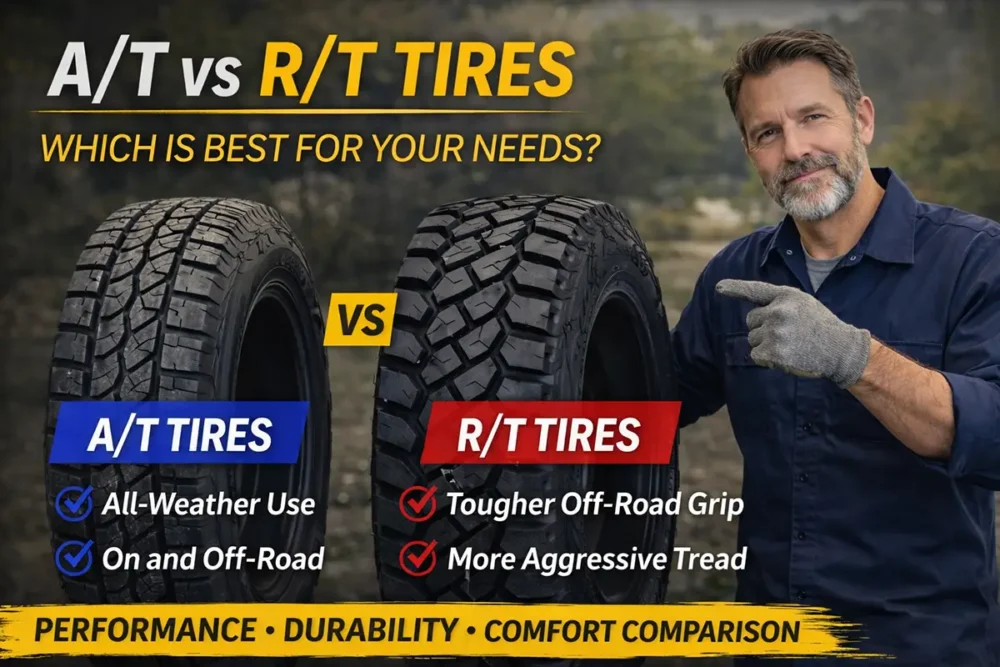
Introduction: The Tire Category Nobody Talks About Enough
Here’s the situation I hear all the time: you walk into a tire shop — or more likely, you’re deep in a rabbit hole on Tire Rack at 11 PM — and you see three options staring back at you.
There’s the highway terrain tire your wife thinks is “perfectly fine,” the all-terrain tire your buddy swears by, and then this weird third category: rugged terrain.
You squint. You Google it. You get three different answers, none of which actually tell you how it drives.
I’ve been there. And honestly, the tire industry hasn’t done a great job explaining the RT category.
So let me cut through the noise — because I’ve put serious miles on both AT and RT tires across everything from the New Mexico high desert to muddy Tennessee back roads to the daily grind of Northern Virginia rush-hour traffic.
Before you buy, I’d also recommend bookmarking my full breakdown of HT vs. AT vs. MT Tires and my deep-dive on HT vs AT Tires — both will give you the full picture of where RT slots in the lineup.
And if you’re already leaning more aggressive, check out my roundup of the best off-road tires before you commit.
This guide is for the guy or gal who’s not sure whether their truck needs capable or actually aggressive. Spoiler: there’s a real difference — and choosing wrong will cost you either off-road confidence or on-road sanity.
TL;DR — AT vs. RT Tires at a Glance
| All-Terrain (AT) | Rugged Terrain (RT) | |
|---|---|---|
| Best for | Mixed daily/weekend use | Frequent off-road with some street |
| On-road comfort | Good | Moderate |
| Off-road capability | Good | Very Good |
| Noise level | Moderate | Higher |
| Wet traction | Very good | Good |
| Snow performance | Moderate to Good | Moderate |
| Fuel economy | Moderate impact | Higher impact |
| Tread life | 50,000–65,000 miles | 40,000–55,000 miles |
| Sidewall protection | Moderate | Reinforced |
| Price range | $150–$280/tire | $170–$310/tire |
Bottom line: AT tires are the smarter daily driver that can handle weekend trails. RT tires are for people who spend a meaningful chunk of their driving off-road and want a tire that can take real punishment — but still be street-legal without destroying your sanity.
- Introduction: The Tire Category Nobody Talks About Enough
- TL;DR — AT vs. RT Tires at a Glance
- What Are All-Terrain (AT) Tires?
- What Are Rugged Terrain (RT) Tires?
- My Real-World Experience Testing AT vs. RT Tires
- AT vs. RT Tires: Key Differences
- Detailed Comparison: Section by Section
- When Should You Choose AT Tires?
- When Should You Choose RT Tires?
- RT vs. MT Tires: Quick Comparison
- Best Vehicles for AT vs. RT Tires
- Who Should Avoid RT Tires?
- Frequently Asked Questions
- Final Verdict: AT vs. RT Tires
What Are All-Terrain (AT) Tires?
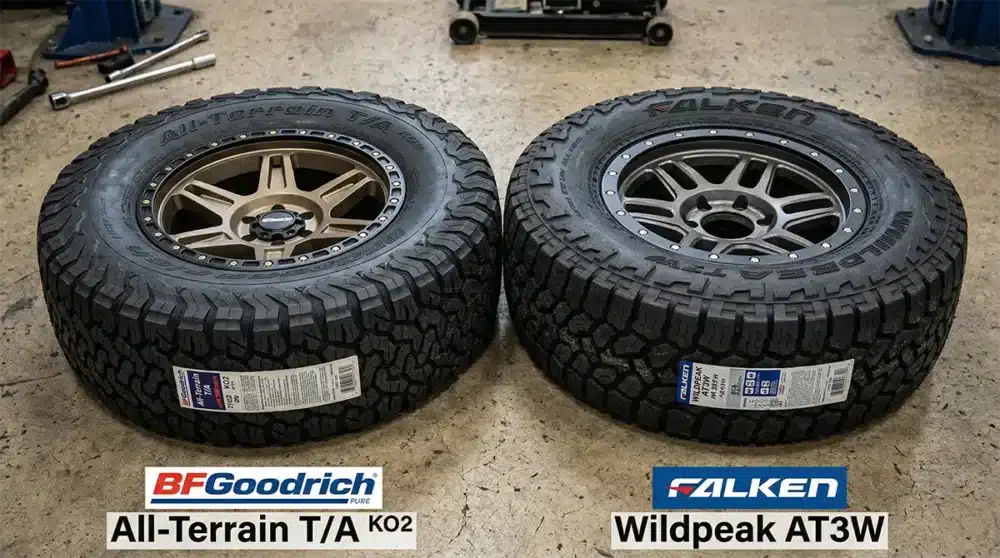
All-terrain tires are the Swiss Army knife of the truck tire world. They’re designed to split the difference between on-road civility and off-road readiness — and for most truck and SUV owners in the U.S., they do that job really well.
The tread pattern on a typical AT tire — think BFGoodrich All-Terrain T/A KO2, Falken Wildpeak AT3W, or Cooper Discoverer AT3 — features a more open, aggressive pattern than a highway tire, with larger tread blocks and channels designed to bite into dirt, gravel, and light mud.
But the blocks aren’t so large or widely spaced that they create a ton of road noise or feel squirrely on wet pavement.
AT tires are engineered around compromise — in a good way:
- Tread compounds are balanced for both wear durability on asphalt and grip in loose terrain
- Siping (those tiny slits in the tread blocks) helps with wet and light snow traction
- Sidewalls are stiffer than HT tires but not as fortress-thick as RT or MT options
- Noise-tuning is a priority — manufacturers spend serious R&D dollars on pitch sequencing to reduce highway drone
I ran the Falken Wildpeak AT3W on F-150 for just over 52,000 miles. 80% highway and suburban driving, 20% fire roads and gravel.
They were genuinely impressive across the board — quiet enough for long road trips, grippy enough in the rain, and capable enough that I never felt in over my head on dirt trails. They’re not exciting tires, but they’re reassuring ones.
What Are Rugged Terrain (RT) Tires?
This is where it gets interesting — and where the industry’s terminology gets genuinely confusing.
Rugged Terrain is a marketing-era category that sits firmly between all-terrain and mud-terrain. It’s not an official SAE or USTMA classification; it’s a label tire brands created to describe tires that are meaningfully more aggressive than AT without being as specialized (and punishing to daily drive) as a full MT.
Think of tires like the Toyo Open Country RT, the Nitto Ridge Grappler, or the Cooper Discoverer Rugged Trek. These tires share some key characteristics:
- More open tread patterns with wider voids for mud evacuation
- Larger, chunkier tread blocks that provide more bite in rocky and loose terrain
- Reinforced or sculpted sidewalls — often with raised lettering and extra rubber to resist punctures and cuts
- Aggressive shoulder lugs that engage when you’re off-camber or in ruts
- Stiffer overall construction to handle load and terrain impact
The Nitto Ridge Grappler is probably the best-known RT-style tire, and it illustrates the category perfectly: it looks like a mud-terrain tire but drives more like an all-terrain.
The center of the tread is relatively tame (two rows of connected blocks for highway stability) while the outer shoulders are wild and lugged for off-road aggression.
What RT tires are NOT:
- They are not mud-terrain tires. Deep, clinging mud will still pack their tread.
- They are not quiet. If you’re noise-sensitive, manage your expectations.
- They are not the right call if 90%+ of your driving is highway/city.
My Real-World Experience Testing AT vs. RT Tires
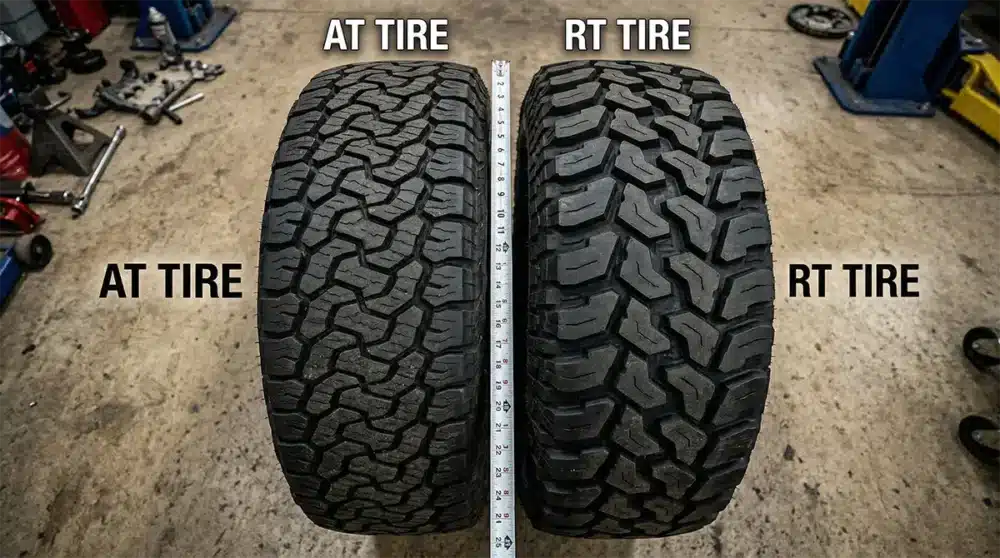
I want to be upfront about how I arrived at my opinions here. Over the past few years, I’ve tested AT and RT tires across multiple vehicles and routes — not just back-to-back on the same day, but in extended real-world use. Here’s the breakdown:
Vehicles tested on:
- 2019 Ford F-150 XLT (4×4) — daily commuter + weekend trail truck
- 2021 Toyota Tacoma TRD Off-Road — overlanding trips + mountain camping
- 2020 Jeep Wrangler Unlimited (Rubicon) — rock crawling + highway segments
Routes covered:
- U.S. 50 / “The Loneliest Road” through Nevada (long-haul highway)
- Uwharrie National Forest, NC (rocky single-track, creek crossings)
- Ouray, Colorado (the Million Dollar Highway, sharp switchbacks, loose shale)
- Moab, Utah — Hell’s Revenge and Poison Spider Mesa (slickrock)
- Rural Tennessee backroads in mud season (February, genuinely disgusting)
- Daily Northern Virginia commuting (I-66, stop-and-go misery)
What I noticed immediately switching from an AT to a Ridge Grappler-style RT on the Tacoma: the truck felt more confident off-road, but I became more aware of the tires on the highway.
The RT wasn’t intolerable — but it was there. A low hum that reminded me I was wearing work boots, not sneakers.
On trail, though? Night and day in certain scenarios. Rocky ledges, loose shale, off-camber sections — the RT just felt more planted.
Whether that’s the sidewall stiffness, the shoulder lugs, or the slightly stiffer compound is hard to isolate. But the confidence was real.
In deep mud? Both got around. The AT packed up faster — I had to manage momentum more aggressively. The RT cleared better, but neither was a mud tire. (If you’re running serious mud regularly, you need to check the Best Mud Terrain Tires list instead.)
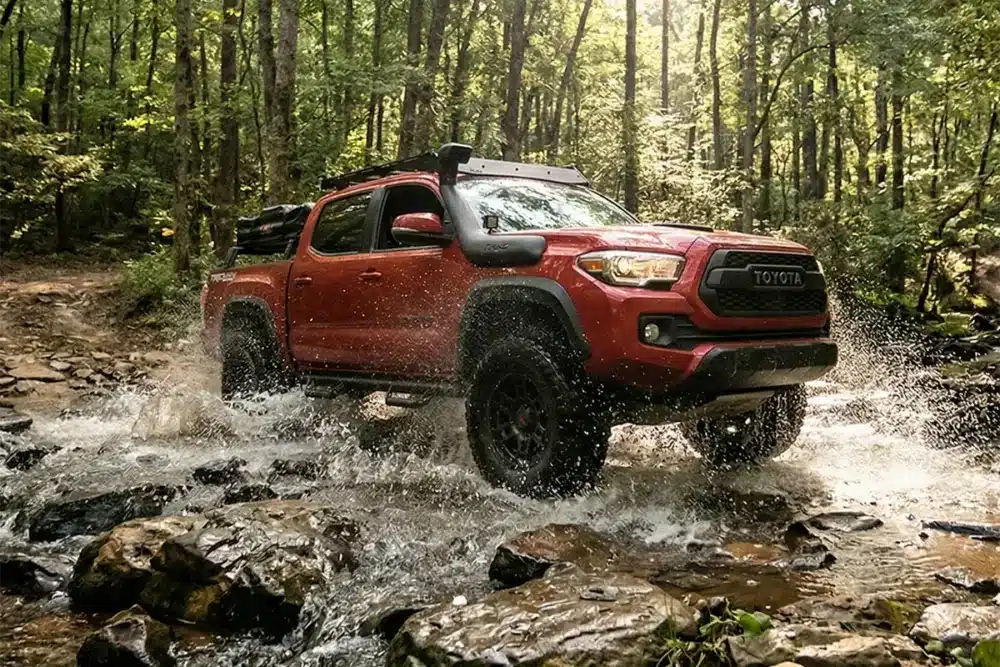
Toyota Tacoma with rugged terrain tires
AT vs. RT Tires: Key Differences
| Feature | AT Tires | RT Tires |
|---|---|---|
| Tread Pattern | Moderate open, patterned blocks | Wide open, aggressive block design |
| Tread Void Ratio | 25–30% | 30–38% |
| Shoulder Lugs | Moderate | Heavy, protruding |
| Sidewall | Standard reinforcement | Heavy-duty, sculpted |
| Road Noise | Low to moderate | Moderate to high |
| Wet Grip | Excellent | Good |
| Mud Performance | Light to moderate | Moderate to good |
| Rock Performance | Good | Very good |
| Snow Traction | Moderate (3PMSF varies) | Moderate |
| Tread Life | 50,000–65,000 mi | 40,000–55,000 mi |
| Fuel Economy Impact | Moderate | Higher |
| Best Use Split | 80% road / 20% trail | 60% road / 40% trail |
| Price (avg per tire) | $150–$280 | $170–$310 |
Detailed Comparison: Section by Section
On-Road Comfort
Let’s not sugarcoat it: AT tires are more comfortable on the road. Full stop. The tread compound is tuned for pavement, the blocks are patterned to reduce harmonic noise, and the ride quality on a well-maintained highway is genuinely good with a quality AT tire.
RT tires have more tread void, more block edge, and stiffer construction. That combination creates more road feedback — not necessarily harsh or jarring, but present. You’ll feel the tires more. If you spend 2+ hours a day commuting, that matters.
On my F-150 with a Ridge Grappler-style RT, I noticed noticeable vibration between 60–70 mph until the tires were properly balanced and broken in (~1,000 miles). After that, it smoothed out — but remained louder than the AT setup I had before.
Winner: AT tires
Off-Road Capability (Mud, Rocks, Sand)
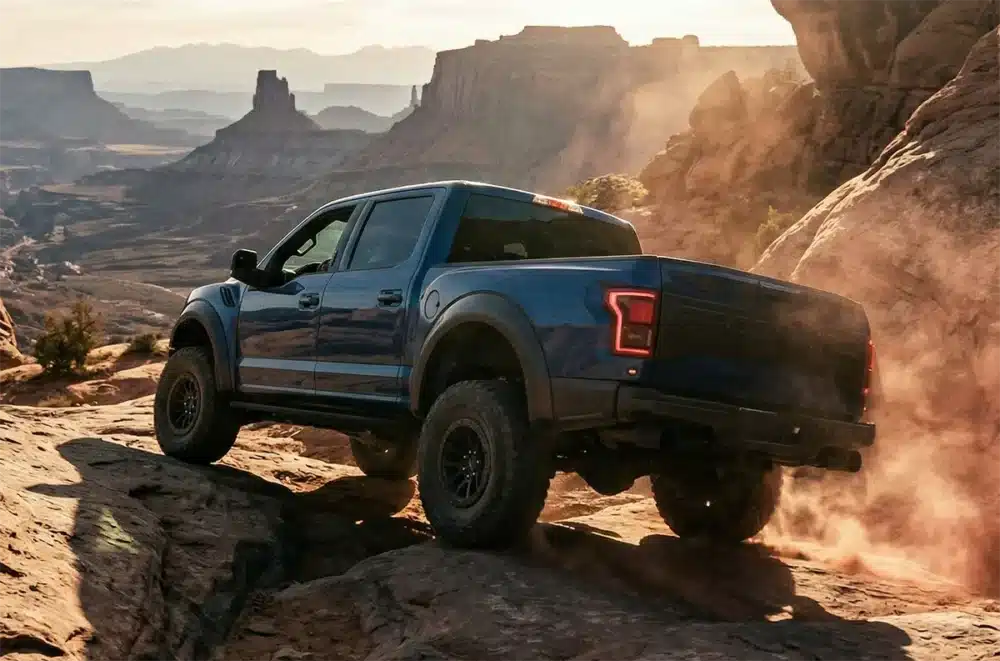
F-150 with rugged terrain tires climbing a steep rocky ledge
Rocks: RT tires have a meaningful advantage. The shoulder lugs provide more grip on off-camber surfaces, and the reinforced sidewalls resist cuts and pinch flats better when you’re grinding against sharp edges. In Moab, I genuinely felt the RT’s confidence on slickrock and ledge climbs.
Mud: RT tires clear better than AT tires, but neither category is designed for serious mud. In Tennessee in February, the RT definitely self-cleaned more effectively — but I was still being selective about which lines I took. A true mud-terrain tire with 38%+ void ratio is a different animal entirely.
Sand: Interestingly, AT tires can hold their own in sand with proper deflation (20–22 PSI). RT tires do fine too — the wider voids can help in certain conditions. Neither dominates here the way a proper sand tire would.
Gravel and Forest Roads: This is where both shine and where RT’s advantage over AT gets smaller. A quality AT tire is outstanding on packed gravel and forest service roads. The RT gives you a little more bite in loose conditions, but the difference is subtle.
Winner: RT tires (meaningful advantage in rocks and moderate mud; minimal elsewhere)
Noise Levels
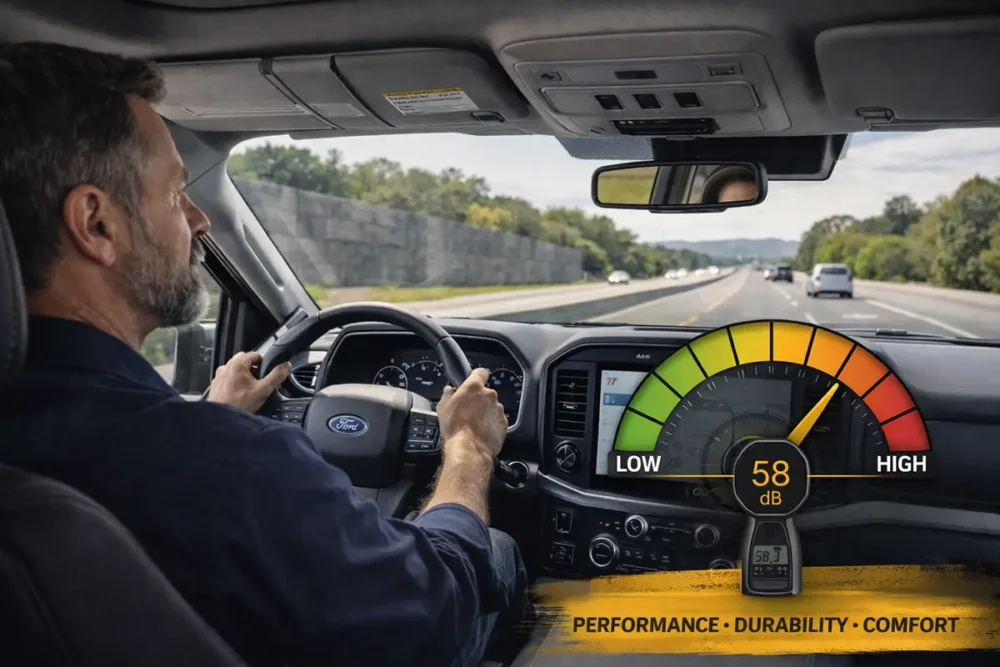
This section gets the most complaints from RT buyers who didn’t do their homework.
RT tires are louder. That’s not an opinion — it’s physics. More tread void, more block edge, more aggressive shoulder pattern = more air turbulence = more noise. On the highway at 70 mph, expect 3–5 dB more cabin noise than a comparable AT tire.
In a Wrangler, it’s less noticeable — that cabin is already loud. In a Tacoma crew cab or an F-150 with a quiet interior, the difference is very real.
Some RT tires are engineered better than others. The Toyo Open Country RT, for example, uses a staggered pitch sequence that reduces drone more effectively than cheaper RT options. It’s still louder than an AT — but it’s a more palatable loud.
If you’re considering an RT tire and noise is a concern, test drive before you buy.
Winner: AT tires (significantly quieter)
Wet Performance
Both categories handle rain well enough for safe driving — but there’s a nuance worth understanding.
AT tires typically have more siping, which helps channel water and maintain contact with wet pavement. The tighter tread pattern also means more rubber in contact with the road, which generally helps wet braking distances.
RT tires with their wider voids do evacuate standing water efficiently — so hydroplaning resistance is often competitive. But wet cornering on smooth pavement can feel less planted in an RT compared to a quality AT.
On my Tacoma running the Nitto Ridge Grappler through a heavy rainstorm on I-81, I had zero safety concerns — but I noticed the truck required a bit more steering input in high-speed lane changes. It wasn’t alarming, but it was a reminder that this tire isn’t optimized for wet pavement dynamics.
Winner: AT tires (better wet cornering and braking on pavement)
Snow Performance
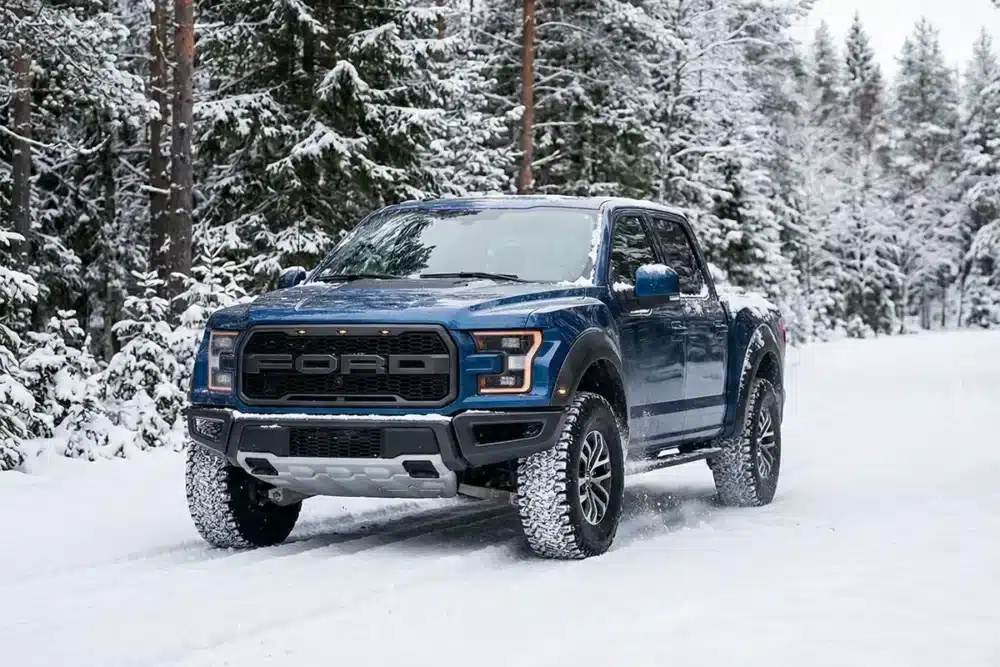
This is one of the most misunderstood aspects of both categories.
Many quality AT tires — especially those with the Three-Peak Mountain Snowflake (3PMSF) symbol — are genuinely capable in packed snow.
The Falken Wildpeak AT3W and Cooper Discoverer AT3 are standout examples. Their siping bites into packed snow effectively and they meet the 3PMSF standard.
Most RT tires are not 3PMSF-rated. The wider tread voids that help in mud don’t help as much in snow — and the lack of micro-sipes reduces biting edges on icy surfaces.
If you live in Minnesota, Michigan, or anywhere that sees real winter, a 3PMSF-rated AT is almost certainly the smarter choice.
There are some RT-adjacent tires (like the Falken Wildpeak AT3W which straddles the line) that achieve the 3PMSF rating — check the specific tire specs rather than assuming by category.
Winner: AT tires (especially 3PMSF-rated options)
Tread Life
AT tires win here — and it’s not particularly close.
The softer, more road-optimized compound in RT tires wears faster on pavement. The aggressive tread pattern also means more tread movement and flexing during highway driving, which accelerates wear.
Most quality AT tires carry 60,000-mile treadwear warranties. RT tires typically land in the 45,000–55,000 mile range.
At the same price per tire, that difference compounds significantly over ownership. Factor in the cost of replacement and an RT set can cost you $200–$400 more over the life of the vehicle compared to a comparable AT set.
Winner: AT tires
Fuel Efficiency
More aggressive tires = higher rolling resistance = worse fuel economy. It’s thermodynamics.
In my testing, switching from a quality AT to an RT-style tire on a half-ton truck resulted in roughly 1–2 MPG decrease in highway driving. That’s consistent with what independent testing by outlets like Tire Rack and Consumer Reports has shown.
Over 50,000 miles at current gas prices, that 1–2 MPG adds up fast. At $3.50/gallon and 20 MPG average, dropping to 18 MPG costs you roughly $972 more in fuel costs per 50,000 miles. Worth knowing before you shop.
Winner: AT tires (less rolling resistance)
Durability & Sidewall Strength
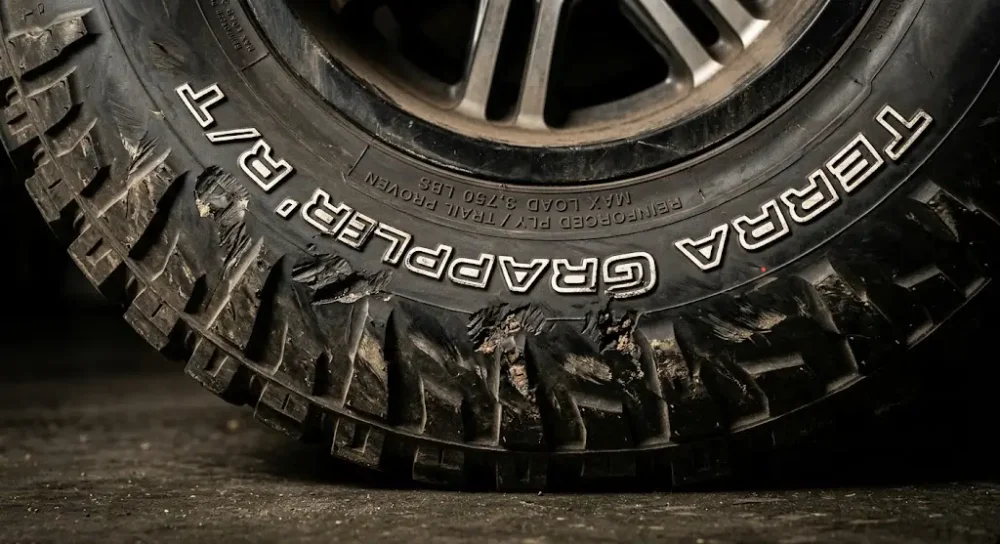
This is the one area where RT tires genuinely earn their premium — and for serious off-road use, it matters a lot.
RT tires are built tougher. Thicker sidewall rubber, reinforced internal ply construction, and in many cases external “armor” or raised lettering that adds physical protection against rock rash.
When I was crawling through rocky canyon terrain in Colorado, I watched my RT-equipped Tacoma scrub sidewalls on sharp granite edges that would’ve been white-knuckle moments on a standard AT.
No tire is puncture-proof. But RT tires are measurably more resistant to the cuts, bruises, and impact damage that trail driving dishes out.
Winner: RT tires
When Should You Choose AT Tires?
AT tires are the right call for you if:
- You drive more pavement than trail. If your split is 80/20 or more toward road driving, AT gives you the best of both worlds without meaningful sacrifice.
- You live in a snow-prone area. A 3PMSF-rated AT tire outperforms most RT options in winter.
- Noise matters to you. Long commutes in a quiet cabin are significantly better on AT rubber.
- Fuel economy is a concern. Towing, hauling, and distance driving are all better served by the lower rolling resistance of an AT tire.
- You have a tight budget. AT tires are generally less expensive and last longer, making the total cost of ownership lower.
- You do light to moderate off-roading. Gravel roads, fire roads, light trail work — a quality AT handles all of this confidently.
Best AT tire picks: Falken Wildpeak AT3W, BFGoodrich All-Terrain T/A KO2, Cooper Discoverer AT3 XLT, Toyo Open Country AT III
When Should You Choose RT Tires?
RT tires make sense for you if:
- You off-road regularly and seriously. If you’re hitting rocky trails, technical terrain, or off-camber sections multiple times per month, the RT’s sidewall protection and shoulder lugs pay off.
- You’re in a rocky or desert environment. The Southwest U.S. — Arizona, Utah, Nevada, New Mexico — is RT territory. The terrain punishes weaker sidewalls.
- You want more aggressive looks with some off-road substance. RT tires look the part and mostly play the part. That’s not nothing.
- You run aired-down regularly. At 18–22 PSI on the trail, RT tires perform exceptionally — the stiffer sidewall balloons without deforming badly.
- Your trails require it. If your trail club is running technical terrain where an AT would leave you hesitant, the RT confidence upgrade is worth the on-road trade-offs.
- Your vehicle is a Jeep Wrangler, older Tacoma, or a known-loud cabin. The extra noise penalty is far less punishing in a vehicle that already has significant road noise.
Best RT tire picks: Nitto Ridge Grappler, Toyo Open Country RT, Cooper Discoverer Rugged Trek, Falken Wildpeak MT01 (bridge tire)
RT vs. MT Tires: Quick Comparison
A lot of buyers asking about RT tires are also looking at mud-terrain options. Here’s the fast breakdown:
| Feature | RT Tires | MT Tires |
|---|---|---|
| Tread void | 30–38% | 38–50%+ |
| On-road noise | Moderate-high | Very high |
| Pavement wear | Faster than AT | Fast |
| Mud capability | Moderate | Excellent |
| Rock capability | Very good | Excellent |
| Daily drivability | Manageable | Challenging |
| Best use case | 60/40 road/trail | 20/80 road/trail |
Short answer: If your trails involve serious mud pits or extreme rock crawling and you can tolerate a rougher daily experience, go MT. If you want aggressive off-road capability without totally abandoning road sanity, RT is your tier.
Best Vehicles for AT vs. RT Tires
AT Tires Fit These Best:
- Ford F-150 (especially higher trims like Lariat, King Ranch — noise matters)
- Toyota Tacoma SR5 / TRD Sport — daily drivers that see occasional trails
- Chevy Silverado / GMC Sierra — work trucks logging highway miles
- Ford Bronco Sport — less aggressive suspension, AT is the better match
- Subaru Outback / Forester — light trail SUVs that don’t need RT aggression
- Honda Ridgeline — pavement-biased platform doesn’t benefit from RT tires
RT Tires Fit These Best:
- Jeep Wrangler (especially JL and JK Rubicon) — born for RT or better
- Toyota Tacoma TRD Pro / TRD Off-Road — suspension travel supports RT capability
- Ford Bronco (full-size) — aggressive platform built for RT use
- Ram 1500 Rebel / TRX — off-road trucks that spend real time off-road
- Chevy Colorado ZR2 — the suspension and lockers justify aggressive tires
- Toyota 4Runner TRD Pro — overlanding-oriented and benefits from RT durability
Who Should Avoid RT Tires?
This is the honest section — because RT tires get oversold sometimes.
Skip the RT if:
- You haul heavy loads on the highway regularly. More rolling resistance + highway miles + heavy payload = significant fuel cost hit.
- You live in snow country and need winter traction. A 3PMSF-rated AT will serve you dramatically better.
- Your off-roading is limited to gravel access roads and campground driveways. An AT handles this perfectly; you don’t need the RT.
- You’re noise-sensitive. Seriously. Test drive one first if you can.
- You drive a family SUV that sees mostly suburban use. The RT’s weight, noise, and fuel impact aren’t justified.
- You’re on a strict budget. The longer tread life of AT tires means you’ll spend less over time.
Frequently Asked Questions
Are RT tires louder than AT tires?
Yes — meaningfully so in most cases. The wider tread voids and chunkier block design create more air turbulence at highway speeds. Expect 3–5 dB more cabin noise compared to a quality AT. Some RT tires (like the Toyo Open Country RT) are engineered to minimize this, but none fully eliminate it.
Are RT tires good for daily driving?
It depends on what you consider “good.” They’re street-legal, handle rain reasonably well, and don’t feel dangerous or unstable on pavement. But they’re louder, harder on fuel economy, and wear faster than an AT. If 90%+ of your driving is daily commuting, you’re paying a daily tax for off-road capability you may not be using.
Is upgrading from AT to RT worth it?
Only if your off-road use justifies it. If you’re running technical terrain regularly — rocky trails, desert washes, moderate mud — and sidewall protection matters to you, yes. If you’re mostly on gravel and fire roads, a quality AT tier tire like the KO2 or Wildpeak AT3W will honestly handle it without the compromises.
What does “rugged terrain” actually mean as a category?
It’s not a certified standard — it’s a marketing term brands use for tires that exceed AT capability but stop short of full mud-terrain. The category is defined more by tread aggression, sidewall reinforcement, and void ratio than any official classification.
Final Verdict: AT vs. RT Tires
After thousands of miles testing both categories across the full spectrum of American driving — from Tennessee mud in February to Moab slickrock in October to Northern Virginia rush hour every single weekday — here’s where I land:
Choose AT tires if you’re a driver who loves adventure but spends more time getting to the adventure than on it. You want capable, trustworthy tires that don’t punish you on the highway. The Falken Wildpeak AT3W and BFGoodrich KO2 are where I’d start.
Choose RT tires if you’ve maxed out what AT tires can do for you and you’re spending real time on technical terrain. You’ve accepted the noise, the fuel hit, and the faster wear as the price of genuine off-road capability. The Nitto Ridge Grappler and Toyo Open Country RT are the standouts here.
Neither choice is wrong — but choosing the wrong one for your driving reality will leave you with buyer’s remorse. Match the tire to your actual life, not your Instagram feed.
Still exploring your options? Check out my full guide to the best off-road tires for detailed picks across every category, and my Best Mud Terrain Tires roundup if you’re ready to go full send.