If you’ve ever stared at a tire sidewall trying to decode all those numbers and letters — trust me, you’re not alone.
I’ve spent years testing and reviewing tires, and the speed rating question is one I get asked almost every week: What’s the difference between a Z and a W speed rating? Sounds simple, but the answer has a few important layers to it.
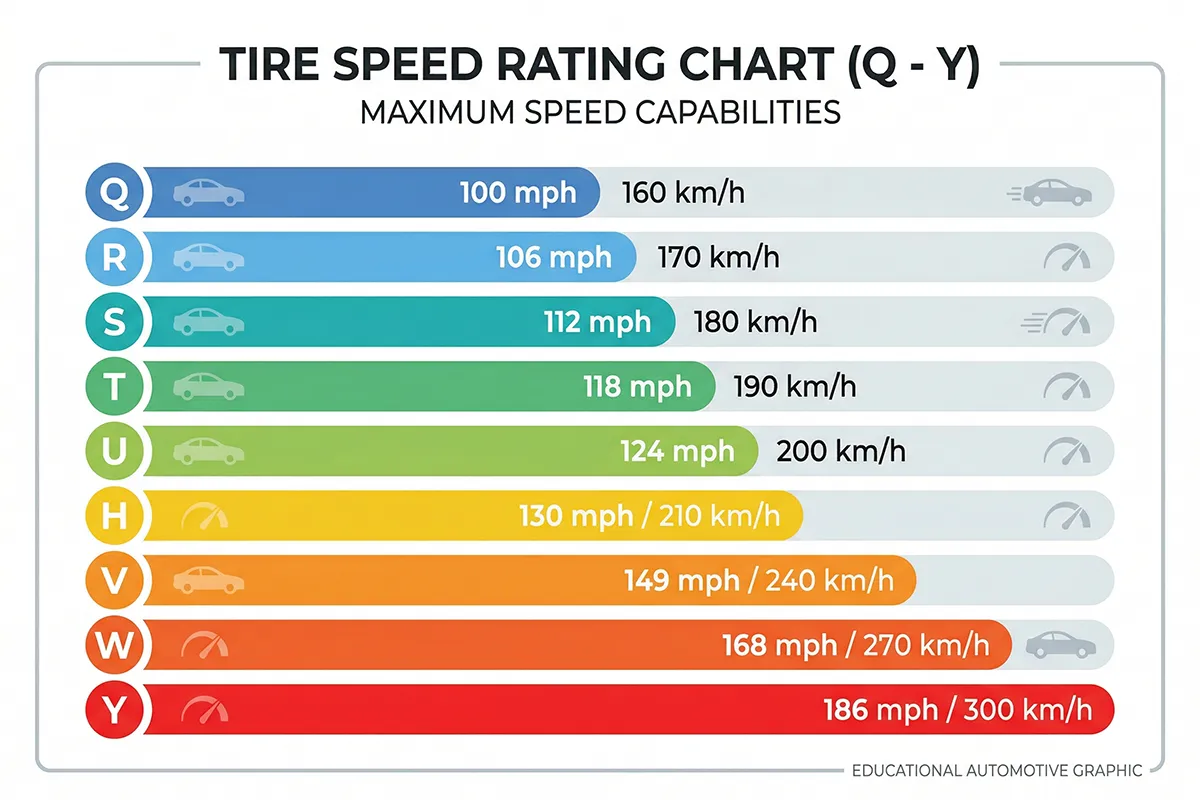
Before I dive in, if you want the full picture on every speed rating from Q all the way to Y, bookmark my tire speed ratings chart — it lays out the complete guide in one place and is a great companion to this article.
TL;DR
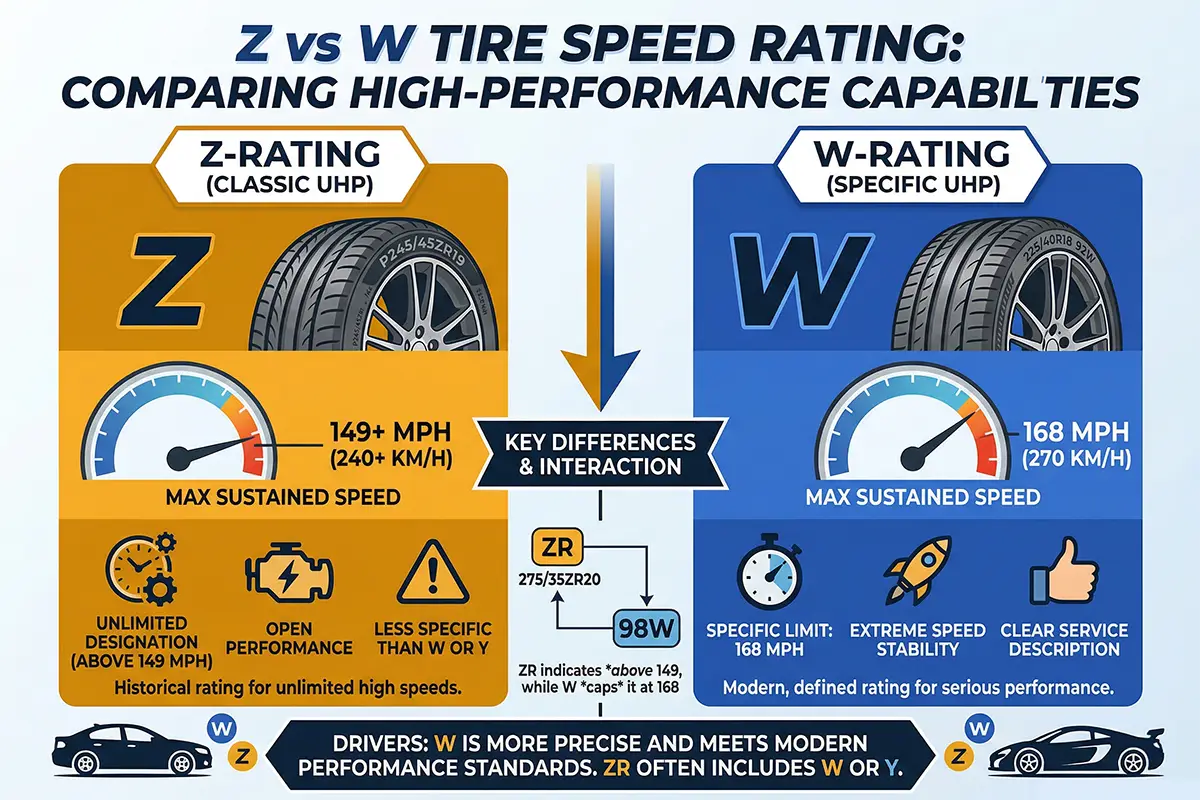
A W speed rating means your tire is tested and certified safe up to 168 mph (270 km/h). A Z speed rating is an older classification that means ‘above 149 mph’ — it’s now mostly a sidewall descriptor for performance tires, and modern tires that carry a Z also carry a more precise W or Y rating. For everyday drivers, W-rated tires offer more than enough capability, better ride quality, and longer tread life than pushing into Y territory. If your car originally came with W-rated tires, stick with W.
First, What Is a Tire Speed Rating?
A speed rating is a standardized letter code that tells you the maximum speed a tire has been certified to sustain for a period of time under load, in controlled test conditions.
The rating was developed by European regulators originally and is now adopted globally by tire manufacturers and vehicle engineers alike.
Here’s why it matters in the real world: your car manufacturer engineers the suspension, steering, and braking systems around tires with specific performance envelopes.
The speed rating is part of that envelope. Fitting a lower speed-rated tire than your car requires can mean the tire runs hotter than it’s designed to at highway speeds, which accelerates wear and — in extreme cases — risks a blowup.
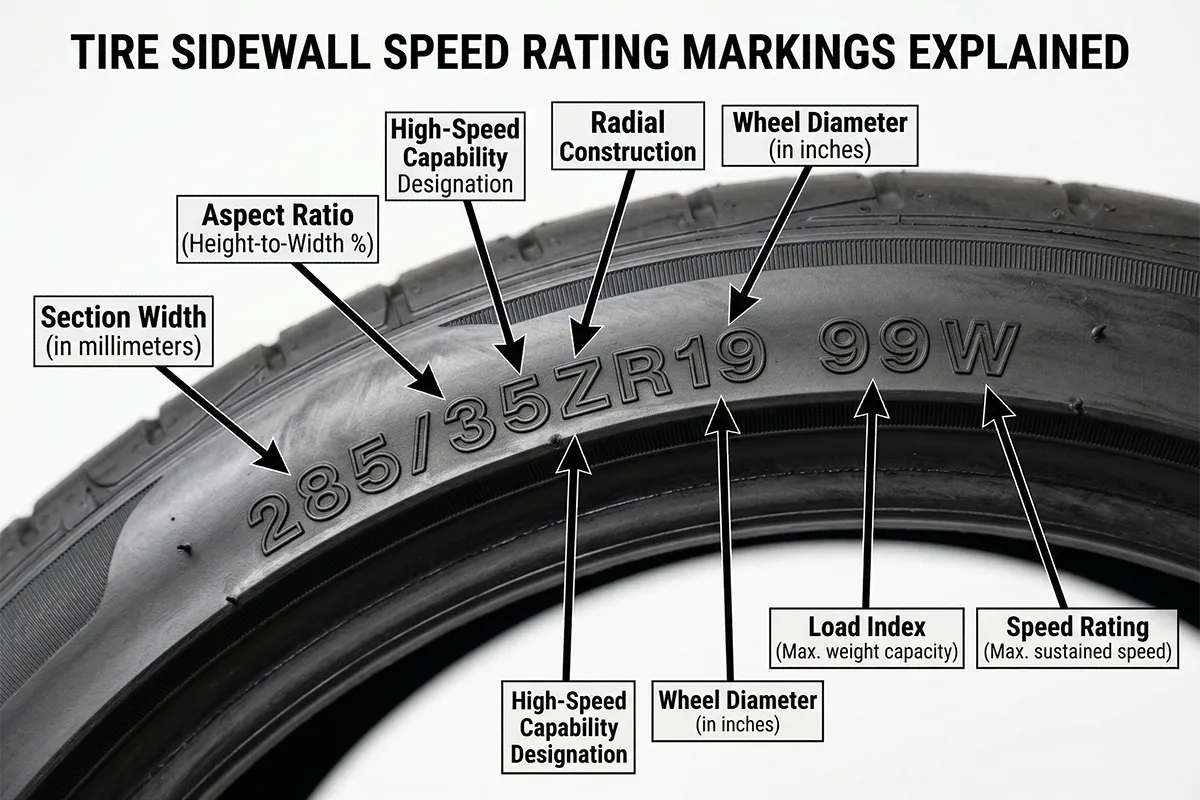
Speed ratings are embedded inside the tire’s size code. A tire marked 245/40ZR18 97W has two speed indicators: the Z in the size description and the W service description in the load/speed index. That’s the quirk I’m going to explain in detail below.
What Does the Z Speed Rating Mean?
The Z speed rating has a history that confuses a lot of people, so let me break it down plainly.
When speed ratings were first introduced, the fastest category available was V, which covered speeds up to 149 mph. Anything above that was simply labeled Z — an open-ended designation that meant ‘above 149 mph.’ At the time, that covered almost every exotic sports car and supercar tire on the market.
As tire technology advanced and more production cars started running well past 150 mph, the industry needed more precision. Two new ratings were introduced: W (168 mph / 270 km/h) and Y (186 mph / 300 km/h).
But here’s where it gets slightly confusing — the Z designation wasn’t retired. Instead, it became a prefix descriptor embedded in the tire size code (e.g., ZR) to indicate a high-performance construction, even as W and Y became the actual certified speed limits.
What ‘ZR’ on the Sidewall Actually Means
Tire Sidewall Speed Rating Markings Explained
When you see ZR in a tire size like 285/35ZR19, the ZR refers to the tire’s speed capability category — essentially a marketing and construction label for tires designed to handle speeds above 149 mph.
The actual maximum certified speed is always shown in the service description at the end: a W or Y in parentheses.
So a tire marked 285/35ZR19 99W is W-rated. A tire marked 285/35ZR19 99Y is Y-rated. The ZR part just tells you the tire is built for ultra-high-performance use — the final letter gives you the specific speed certification.
Bottom line: Z by itself is not a defined speed limit anymore. It lives on the sidewall as a legacy code. W and Y are the specific, defined ratings you should be looking at.
What Does the W Speed Rating Mean?
The W speed rating is one of the two ‘ultra-high performance’ ratings in the modern speed rating system, sitting one step below Y.
A W-rated tire is tested and certified to safely sustain 168 mph (270 km/h) under load in controlled laboratory conditions. That’s the standardized test threshold — not a suggestion, and not a comfortable cruising speed.
It’s the point up to which the tire’s construction, compound, and internal structure have been validated.
In real-world driving, W-rated tires are the standard fitment for a huge range of performance cars — think BMW M cars, Audi S and RS models, Mercedes-AMG vehicles, Porsche Cayenne GTS, and many Corvette trims.
These are not exotic-only tires. W is also the most common speed rating you’ll find on enthusiast sedans and sport-tuned crossovers.
W-Rated Tire Real-World Characteristics
Compared to lower-rated tires, W-rated tires typically feature:
- Stiffer sidewall construction to resist flex at high speed
- Higher-performance tread compounds that stay stable at elevated temperatures
- Tighter manufacturing tolerances for balance and uniformity
- Often (not always) lower tread depth for improved handling response
The tradeoff for those characteristics is that W-rated tires tend to run slightly firmer than H or V-rated alternatives, and they can wear faster if you’re doing a lot of city driving.
On the highway, though, they come into their own — confident, planted, and composed.
Z vs W Speed Rating: Side-by-Side Comparison
Here’s how they stack up on the factors that actually matter when you’re shopping for tires:
| Factor | Z Rating | W Rating |
|---|---|---|
| Max Certified Speed | Undefined (>149 mph) — legacy label | 168 mph / 270 km/h |
| Current Usage | Sidewall descriptor (ZR) — not a standalone speed limit | Active, defined rating for UHP tires |
| Appears On Sidewall As | ZR (in tire size code) | W (in service description) |
| Common Vehicles | Supercars, exotic sports cars (historically) | BMW M, Audi S/RS, AMG, Corvette, Porsche |
| Ride Quality | Firm to harsh (depends on specific tire) | Firm but livable for daily driving |
| Tread Life | Typically shorter — high-performance compound | Moderate — better than Y, shorter than V |
| Price Range | Premium to ultra-premium | Premium |
| Best For | Track-focused or historic collector cars | Performance street driving, spirited highway use |
Does the Average Driver Ever Need to Think About Z Ratings?
Performance Car on Highway with W-Rated Tires
Honestly? Not in the way you might think. Here’s the practical reality:
If you see ZR in your tire size code (which your vehicle owner’s manual or driver’s door jamb sticker will list), your manufacturer designed the car around ultra-high-performance rubber.
You should replace those tires with tires that carry either a W or Y service rating — both of which will show up on ZR-construction tires.
If you see a standalone W in your current tire’s service description, you want to replace with W-rated tires.
Going down to V-rated is a mismatch for performance vehicles; going up to Y is usually unnecessary and costs more money for a capability you’ll never legally use.
The only scenario where the original Z designation matters today is if you’re restoring a classic performance car from the 1980s or 1990s and need to match original equipment specifications. In every other case, look at the W or Y in the service description and match that.
Top W Speed Rated Tires Worth Considering
Over the years I’ve tested or reviewed a lot of W-rated rubber across various vehicle types. Here are the lineups that consistently deliver the best performance for the money:
1. Michelin Pilot Sport 4S (W and Y rated options)
The Pilot Sport 4S is hands-down one of the best all-around performance tires on the market.
The W-rated sizes deliver the same traction and composure as the Y-rated versions but with slightly more compliant ride behavior — a real advantage if you’re daily driving on imperfect pavement.
Dry grip is exceptional, wet performance is class-leading, and tread life is impressive for a max-performance tire.
Best for: Sports coupes, performance sedans, BMW M2/M3/M4, Porsche 911
2. Continental ExtremeContact Sport 02 (W rated)
Continental’s ExtremeContact Sport 02 is a strong choice for drivers who want track-capable grip without completely sacrificing daily drivability.
The W-rated construction gives it plenty of highway confidence, and its wet-weather traction is better than many competitors in the max-performance category.
I’ve found it to be an honest, predictable tire that communicates well through the steering wheel.
Best for: Muscle cars, sport coupes, Dodge Challenger/Charger, Ford Mustang GT
3. Bridgestone Potenza Sport (W and Y rated)
The Potenza Sport is Bridgestone’s flagship performance street tire and it earns its place at the top. W-rated sizes are available across a wide range of fitments, making it accessible for more vehicles than some competitors.
The compound runs stable even in sustained high-speed highway driving — exactly what you want in a W-rated tire.
Best for: Porsche Cayman/Boxster, Audi TT RS, Mercedes C43/C63
4. Pirelli P Zero (W and Y rated)
Pirelli’s P Zero is the OEM tire for a staggering number of performance vehicles — Ferrari, Lamborghini, Maserati, BMW M, and many others.
W-rated versions of the P Zero are the choice for luxury performance vehicles where both handling and ride refinement matter. It’s a tire that feels expensive in the best possible way.
Best for: Luxury performance sedans, GT cars, Alfa Romeo Giulia Quadrifoglio
5. Goodyear Eagle F1 SuperSport (W and Y rated)
Goodyear’s Eagle F1 SuperSport is their ultra-high-performance answer to the Michelin and Continental competition. W-rated fitments are widely available and the tire punches above its price point in dry traction.
Wet performance is solid but not quite at Michelin levels. A great choice if you’re looking for value in the W-rated max-performance segment.
Best for: Ford Mustang GT500, Corvette C7/C8, performance crossovers
6. Yokohama ADVAN Sport V105 (W and Y rated)
The ADVAN Sport V105 is Yokohama’s flagship performance tire and carries both W and Y rated options across its size range.
It delivers strong dry-weather performance with a compound that stays consistent through extended highway driving.
A popular OEM fitment for Porsche and BMW, which tells you what you need to know about its engineering pedigree.
Best for: Porsche Cayenne Turbo, BMW X5 M, performance-tuned SUVs
7. Dunlop Sport Maxx RT2 (W rated)
The Sport Maxx RT2 is Dunlop’s performance street tire that prioritizes responsive handling and feedback.
Available in a solid range of W-rated sizes, it’s a more affordable entry point into the max-performance category without drastically compromising grip.
A good pick if you’re on a tighter budget but still need to match performance vehicle specs.
Best for: Entry-level sports cars, hot hatches, performance-tuned compact sedans
8. Toyo Proxes Sport (W and Y rated)
Toyo’s Proxes Sport has earned a strong reputation in the enthusiast community for delivering genuine performance at a price that undercuts the European premium brands.
W-rated sizes cover a wide range of fitments and the tire delivers confident, balanced handling on both dry and damp roads. A smart buy for spirited drivers who don’t want to over-spend.
Best for: Subaru WRX STI, Mitsubishi Evolution, performance compact cars
When Would You Actually Choose a Z-Marked Tire Over a W?
The honest answer: in normal replacement shopping, you won’t be choosing between Z and W as competing options because Z is no longer a standalone replacement category. But there are scenarios where the ZR designation matters:
If your vehicle’s door jamb sticker specifies ZR tires, you need to replace with tires that carry the ZR construction designation — which will have either a W or Y service rating.
Replacing ZR-specified tires with standard R-construction tires (even if V-rated) could affect handling, load capacity calculations, and potentially void a warranty.
For track-day dedicated cars and purpose-built performance vehicles, going with Y-rated tires is often more appropriate than W — but that’s a W vs Y conversation, which I cover in detail in my post on W vs Y speed rating.
Speed Rating and Temperature: The Connection Nobody Talks About
One thing I want to make sure you understand: speed ratings are intrinsically linked to heat management. A tire’s speed rating tells you how well it’s engineered to dissipate the heat generated at high speeds.
At 168 mph, the forces on a tire are dramatic — the centrifugal stress on the belt structure, the heat generated from the road contact, and the lateral forces in any cornering situation all compound quickly.
A W-rated tire’s compound and construction are specifically designed to handle that thermal load.
A V-rated tire (149 mph max) running at 160 mph will start accumulating heat faster than it can shed it — which is how you end up with catastrophic tire failure.
This is why matching or exceeding your vehicle’s required speed rating on replacements is not optional. It’s a safety specification, not a suggestion.
Explore Other Speed Rating Comparisons
Speed ratings get confusing fast once you start comparing multiple letters. I’ve written detailed breakdowns for every major comparison you’re likely to face when shopping for replacement tires:
- V vs H Speed Rating — For drivers of family sedans and mainstream vehicles trying to decide between these two most common ratings
- V vs W Speed Rating — If you’re stepping up to a more powerful vehicle and wondering whether you need to step up your tires too
- H vs T Speed Rating — Great for minivan, light truck, and economy car owners debating between these two everyday ratings
- W vs Y Speed Rating — The next step up from this article — for exotic sports car owners and serious track enthusiasts
- S vs T Speed Rating — For drivers of standard passenger vehicles, light trucks, and minivans
- H vs S Speed Rating — A common comparison for crossover and standard sedan shoppers
- V vs T Speed Rating — For those stepping down from performance vehicles or upgrading a budget daily driver
- Q vs S Speed Rating — The entry-level comparison for winter tires, light trucks, and spare tires
Can You Mix Z-Marked and W-Rated Tires on the Same Car?
I get this question fairly often and the answer is: no, you should not mix speed ratings on the same axle, and ideally not on the same vehicle at all.
Different speed ratings mean different compounds, different stiffness levels, and different heat management characteristics.
Mixing them creates handling imbalances — especially in emergency maneuvers, hard braking, and cornering.
The faster end of your axle will behave differently from the slower end, and in a split-second situation that matters enormously.
If you need to replace just two tires, always match the speed rating of the remaining two. If budget forces a compromise, it’s better to put the higher-rated tires on the rear axle (for rear-wheel drive) or to replace all four and match specifications.
My Recommendation: Z vs W Speed Rating
If you’re shopping for replacement tires and your current tires are W-rated, replace them with W-rated tires. Simple as that.
Don’t chase Y-rating for a car that doesn’t require it — you’ll pay more money, sacrifice tread life, and ride on a firmer tire without any real-world benefit.
Don’t step down to V-rating on a car that needs W — you’re reducing your safety margin at speed and potentially voiding manufacturer warranty coverage.
The Z designation is more of a historical footnote and a marketing term at this point. What matters is the service rating at the end of the tire code — that’s your actual certified speed limit.
Find the letter your car requires, match it, and invest your budget in a quality tire that delivers within that rating.
For a full chart of every speed rating from A1 to Y, head over to my tire speed ratings chart guide — it’s the most comprehensive breakdown I’ve put together and it answers a lot of the follow-up questions that come up after reading this comparison.
Testing Methodology & How I Research These Comparisons
Tire Speed Rating Chart Infographic
When I write comparison posts like this one, I’m drawing on a combination of hands-on tire testing, manufacturer specification data, and real-world feedback from other enthusiast drivers.
For speed rating comparisons specifically, I review SAE and ECE R30 testing standards, manufacturer load/speed data sheets, and cross-reference with owner community feedback from forums and enthusiast groups.
I don’t get paid by tire manufacturers to recommend specific products. Affiliate links to retailers like Tire Rack, Discount Tire, and Amazon help keep this site running, but my editorial opinions are independent. If a tire earns a recommendation here, it’s because I believe it genuinely delivers value for the money.
Frequently Asked Questions
Is Z speed rating higher than W?
Technically, the original Z designation referred to speeds above 149 mph without a defined ceiling — which theoretically exceeds W’s 168 mph. But in practice, Z is no longer a defined speed rating in the modern system. Tires that would have been classified as ‘Z’ in the 1980s are now specifically W-rated (168 mph) or Y-rated (186 mph). If a tire carries both a ZR construction designation and a W service rating, it’s a W-rated tire — period.
Can I put W rated tires on a car that requires Z tires?
If your car specifies ZR tires, you should replace with ZR-construction tires — which will carry either a W or Y service rating. So yes, W-rated tires are appropriate replacements for ZR-specified vehicles, as long as the tire carries the ZR construction designation in its size code. Always verify with your vehicle’s owner’s manual or door jamb sticker.
Does a higher speed rating mean a better tire overall?
Not necessarily. A higher speed rating means the tire is engineered for higher sustained speeds, which typically involves stiffer compounds and construction. But ‘better’ depends on what you need. A V-rated tire might deliver better ride comfort, longer tread life, and lower rolling resistance than a W-rated tire — making it a smarter choice for a family sedan that never sees a track. Match the rating to your vehicle’s requirement rather than chasing the highest letter.
What happens if I drive faster than my tire’s speed rating?
You risk heat buildup that exceeds the tire’s engineered limits. Initially this causes accelerated wear. In prolonged high-speed driving above the rating, it can lead to tread separation, belt failure, or catastrophic blowout. This is why speed ratings are safety specifications and not mere suggestions.
Are ZR tires only for sports cars?
Originally yes, but today ZR-construction tires are available for a wide range of vehicles including performance-oriented crossovers and SUVs. If your vehicle came equipped with ZR tires from the factory (check the door jamb), you need to replace with ZR-rated fitments regardless of the vehicle type.
Final Thoughts
The Z vs W speed rating comparison really comes down to this: Z is a legacy descriptor that lives on modern tire sidewalls as a construction marker, while W is a precise, actively-defined rating certifying a tire to 168 mph.
For the overwhelming majority of performance car owners in the market for replacement tires, W-rated tires are the correct and sufficient choice.
Don’t let the alphabet soup on a tire sidewall intimidate you. Once you understand that ZR tells you how a tire is built and W tells you what speed it’s certified for, the decision-making becomes a lot clearer.
If you found this helpful, check out the rest of my speed rating comparison series — I’ve covered every major matchup you’re likely to encounter when tire shopping. And if you have a question I didn’t answer here, drop it in the comments below.