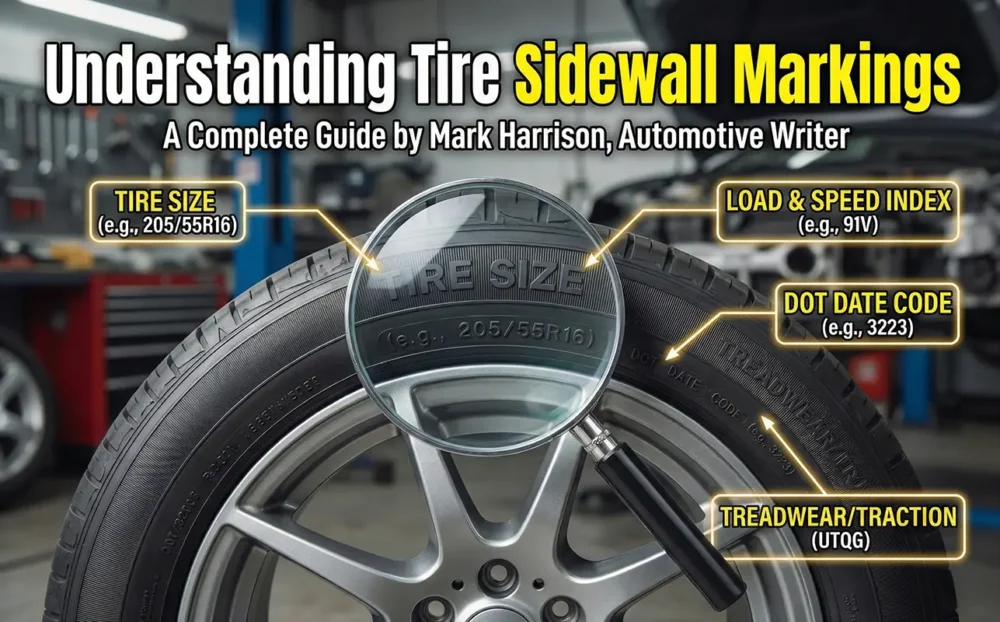
If you have ever crouched down to look at your tires, you have likely been met with a jumble of letters and numbers that looks more like a secret code than a product description.
205/55R16 91V. DOT 4B08. M+S. Treadwear 400.
To the average driver, this “sidewall soup” is gibberish. Most people just ignore it, drive to the tire shop, and say, “Give me whatever fits.
But in my years of working in the automotive industry, I have learned that ignorance is expensive. I have seen SUV owners unknowingly install passenger car tires that couldn’t handle the vehicle’s weight, leading to dangerous blowouts.
I have seen sports car enthusiasts buy expensive “high-performance” tires that were actually five years old and hardened like hockey pucks because they didn’t know how to read the date code.
Your tire’s sidewall is its birth certificate, its resume, and its safety manual all rolled into one. It tells you exactly what that black rubber donut is capable of, how much weight it can carry, how fast it can spin, and when it was born.
In this guide, I am going to decode every single marking on your tire. We will move beyond the basic size and get into the “hidden” data—like the manufacturing date and traction grades—that tire salesmen often gloss over.
- The “Big Sequence”: Decoding Tire Size
- The Service Description: Load & Speed
- The DOT Code: How Old Are Your Tires?
- UTQG Ratings: Predict Your Mileage
- Weather Markings: M+S vs. The Snowflake
- Max Pressure vs. Recommended Pressure
- Original Equipment (OE) Markings
- Common Mistakes When Reading Sidewalls
- Conclusion: Knowledge is Safety
- Frequently Asked Questions (FAQ)
The “Big Sequence”: Decoding Tire Size
Let’s start with the most prominent string of characters on the tire. This is the sequence you need to memorize (or take a picture of) when you are shopping for replacements.
For our example, we will use one of the most common sizes on the road today: P215/60R16 94T.
1. The Prefix (P, LT, or ST)
Sometimes, the sequence starts with a letter.
- P (Passenger): This indicates the tire is designed for passenger vehicles (sedans, minivans, crossovers). It is the standard for everyday driving.
- LT (Light Truck): Found on heavy-duty pickups (Ford F-250, etc.). These tires are built with extra plies and stiffer sidewalls to carry heavy loads and tow trailers.
- ST (Special Trailer): Only for boat or utility trailers. Never put these on a car.
- No Letter (Euro-Metric): If there is no letter (e.g., just “215…”), it is a European standard size. It is functionally very similar to “P” tires but has slightly different load capacity calculations.
2. Section Width (215)
The first number, 215, is the width of the tire in millimeters.
Wait, millimeters? In America? Yes. The tire industry uses a confusing mix of metric and imperial units.
This number measures the tire from sidewall to sidewall (not just the tread touching the road) when it is mounted on the correct rim.
- 215mm = approx 8.46 inches wide.
- 255mm = approx 10 inches wide.
My Professional Advice: Many drivers ask if they can go wider for “better looks” or “more grip.” While you often can go slightly wider (e.g., from 215 to 225), doing so changes the geometry of your suspension. A wider tire might rub against your fender liner or suspension struts during a tight turn. Stick to the stock width unless you are consulting a fitment expert.
3. Aspect Ratio (60)
This is the number that confuses everyone. 60 does not mean 60 millimeters or 60 inches. It is a percentage.
It represents the height of the sidewall as a percentage of the width.
- In our example: The sidewall height is 60% of 215mm.
- Math: 215 x 0.60 = 129mm (approx 5 inches).
Why this matters to you:
- High Number (60, 70, 75): These are “tall” tires. There is more rubber cushion between the rim and the road. This equals a smoother, softer ride and better protection against potholes. This is what you want on a family SUV or commuter car.
- Low Number (35, 40, 45): These are “low profile” tires. The sidewall is very short and stiff. This offers sharper handling and better cornering stability (less “squirm”), but you will feel every crack in the pavement.
If you are looking for tires that offer the best comfort for long drives, you generally want to stick with a higher aspect ratio. Check out our recommendations in the Best Summer Tires guide, where we highlight touring tires designed for comfort.
4. Construction (R)
The “R” stands for Radial. It does not stand for “Rim.”
Radial construction means the internal ply cords run radially (at 90 degrees) across the tire from bead to bead. This has been the industry standard for over 50 years because it offers flexible sidewalls (good ride) and a stable tread (good fuel economy).
You might occasionally see a “D” (Diagonal/Bias Ply) on classic cars or off-road trailers, or a “ZR” on high-performance supercars, but 99% of what you see on the road will be R.
5. Rim Diameter (16)
Finally, we return to inches. 16 indicates that this tire is designed to fit a 16-inch wheel.
Crucial Safety Note: You cannot “stretch” a 16-inch tire onto a 16.5-inch rim, or squeeze a 17-inch tire onto a 16-inch rim. The bead will not seat, and the tire will explode during inflation. I have heard horror stories from shops where inexperienced techs tried to force mismatched sizes. The numbers must match exactly.
The Service Description: Load & Speed
Immediately following the size sequence, you will see a number and a letter, like 94T. This is the Service Description, and for safety purposes, it is even more important than the size.
1. Load Index (94)
The 94 is a code that corresponds to the maximum weight one tire can support when fully inflated.
You have to look this up in a standardized chart, but here are common examples:
- 85 = 1,135 lbs
- 91 = 1,356 lbs
- 94 = 1,477 lbs
- 100 = 1,764 lbs
Why this is critical: If your car weighs 4,000 lbs, and you carry 1,000 lbs of passengers and cargo, your Total Gross Weight is 5,000 lbs. If you buy cheap tires with a Load Index of 85 (1,135 lbs x 4 tires = 4,540 lbs max capacity), you are driving a time bomb. Your tires are physically incapable of supporting the fully loaded vehicle. The sidewalls will overheat, disintegrate, and blow out.
The “EV” Factor: Electric Vehicles (EVs) are heavy due to their battery packs. If you drive a Tesla or a Ford Mach-E, you must pay attention to the Load Index. Replacing an EV tire with a standard passenger tire usually results in rapid wear and potential failure.
2. Speed Rating (T)
The letter “T” represents the maximum speed the tire can sustain safely.
- T = 118 mph
- H = 130 mph
- V = 149 mph
- W = 168 mph
- Y = 186 mph
You might be thinking, “I never drive 118 mph, so who cares?”
The speed rating is about more than just top speed; it is a proxy for the tire’s ability to handle heat and cornering forces. A higher speed rating generally means a stiffer structure and better handling response.
I wrote an entire article comparing the two most common ratings found on daily drivers. If you are debating between saving money with a T-rating or upgrading to H, you need to read H vs T Speed Rating: The Definitive Guide.
Pro Tip: Never downgrade your speed rating below what your manufacturer recommends unless you are installing dedicated winter tires.
The DOT Code: How Old Are Your Tires?
This is the secret weapon of savvy tire buyers.
Somewhere near the rim edge, you will find a code beginning with DOT (Department of Transportation). It usually ends in a 4-digit number, like 3223.
This is the Date Code.
- First two digits (32): The 32nd week of the year.
- Last two digits (23): The year 2023.
So, 3223 means the tire was manufactured in mid-August 2023.
Why you must check this: Rubber degrades (oxidizes) over time, even if the tire is never used. A tire sitting on a shelf for 6 years is essentially “expired.” The rubber becomes hard and brittle, leading to “dry rot” and a loss of grip.
- Buying New: If you buy “new” tires online and they arrive with a date code from 3 years ago, send them back. You are paying for fresh rubber, not old stock.
- Buying Used: If you are buying a used car or used tires, check this code religiously. I tell my readers: If a tire is more than 6 years old, replace it, regardless of how much tread is left.
If you aren’t sure if your tires are safe, combine this age check with a physical tread inspection. Learn the proper techniques in our guide How to Check Tire Tread Depth.
UTQG Ratings: Predict Your Mileage
The Uniform Tire Quality Grade (UTQG) is a set of three ratings usually found on the sidewall, mandated by the U.S. government.
1. Treadwear (e.g., 500)
This is a comparative rating based on testing against a “control tire.”
- 200: Soft, sticky rubber. found on sports cars. Great grip, but wears out fast (maybe 20,000 miles).
- 400-500: Standard all-season tire. Good balance.
- 700-800: Hard, long-lasting compound. found on touring tires.
The Catch: Manufacturers do their own testing for this, so a “500” from Michelin might not be exactly the same as a “500” from a budget brand. However, within the same brand, it is a solid indicator. If you want tires that last 80,000 miles, look for a Treadwear rating of 700 or higher.
2. Traction (AA, A, B, C)
This measures the tire’s ability to stop on wet pavement in a straight line.
- AA: The best.
- A: Excellent (Standard for most premium tires).
- B: Average.
- C: Poor.
Note: This does not measure cornering grip, only straight-line braking.
3. Temperature (A, B, C)
This measures the tire’s resistance to heat buildup.
- A: Excellent heat dissipation (Crucial for high-speed driving).
- B: Average.
- C: Minimum compliant standard.
If you do a lot of highway driving in hot climates (like Arizona or Texas), you absolutely want a Temperature rating of A.
Weather Markings: M+S vs. The Snowflake
Not all “All-Season” tires are created equal. The symbols on the sidewall tell the real story of winter capability.
M+S (Mud and Snow)
You will see M+S, M/S, or M&S on almost every standard all-season tire.
- What it means: The tread pattern has a certain amount of “void area” (grooves).
- The Reality: It is a geometry classification, not a performance test. A tire can have the M+S stamp and still be terrible on ice. It is fine for light dustings of snow, but do not trust it in a blizzard.
3PMSF (Three-Peak Mountain Snowflake)
This is a picture of a snowflake inside a mountain with three peaks.
- What it means: The tire has passed a rigorous industry test for acceleration on medium-packed snow.
- The Reality: This is the gold standard for “All-Weather” tires. If you live in an area with real winter but don’t want to switch to dedicated snow tires, look for the 3PMSF symbol.
For a deeper dive into which tires can handle the cold, see our review of the Best All-Season Tires, where we specifically highlight models that carry the 3PMSF rating.
Max Pressure vs. Recommended Pressure
There is one number on the sidewall that causes more confusion than any other: “Max Press. 50 PSI” (or similar).
DO NOT inflate your tires to this number.
- Max Pressure: This is the absolute bursting limit of the tire. If you inflate to this level, your tire will be rock hard. You will have a terrible ride, the center of your tread will wear out instantly, and you risk a blowout if you hit a bump.
- Recommended Pressure: This is what your vehicle needs. It is found on the yellow and white sticker inside your driver’s door jamb. Usually, it is around 32 to 35 PSI.
Always fill to the number on the door, not the number on the tire.
For a complete checklist on how to maintain your pressure and keep your tires healthy, refer to our Ultimate Tire Maintenance Checklist.
Original Equipment (OE) Markings
Sometimes you will see strange little codes that don’t seem to fit any category. These are OE Markings, indicating the tire was specifically tuned for a certain car manufacturer.
- MO / MOE: Mercedes-Benz Original.
- AO: Audi Original.
- N-Spec (N0, N1, N2): Porsche approved.
- TPC: General Motors approved.
- Star (*): BMW approved.
Do you need to buy OE tires? If you have a high-performance vehicle (like a Porsche 911 or BMW M3), yes. The manufacturer worked with the tire company to tweak the compound for that specific suspension. For a standard daily driver (like a Chevy Malibu with TPC tires), it is less critical. You can switch to a generic high-quality tire without issues, provided the size and load index match.
Common Mistakes When Reading Sidewalls
1. Ignoring the “XL” (Extra Load)
Some tires are marked XL. This means they are reinforced to carry heavier loads at higher pressures than a standard tire. If your car’s door placard calls for an XL tire (common on European sedans), you cannot install a standard load tire. It will feel squishy and unstable.
2. Assuming all brands measure the same
While “215mm” is a standard, different tread designs can make one tire look wider or narrower. A “mud-terrain” 265 tire often looks much beefier than a “highway” 265 tire due to the chunky shoulder lugs.
3. Mixing Tire Types
I wrote a detailed guide on Can I Replace Just One Tire?, but it bears repeating here: Never mix tires with different markings on the same axle.
- Do not mix a V-rated tire with a T-rated tire.
- Do not mix an All-Season with a Summer tire.
- Do not mix a Run-Flat (often marked RFT, SSR, or ZP) with a standard tire.
Mixing specs confuses your car’s traction control system and leads to unpredictable handling in emergencies.
Conclusion: Knowledge is Safety
The writing on your tire sidewall isn’t just bureaucratic clutter. It is a precise engineering document.
By understanding these codes, you empower yourself. You stop being the person who just nods along when the mechanic says, “You need these ones.” You become the person who says, “Actually, I need a higher Load Index for my towing needs,” or “I want a higher UTQG rating because I drive 20,000 miles a year.
Your Action Plan:
- Go out to your car right now.
- Snap a photo of your tire sidewall.
- Compare the Size, Load Index, and Speed Rating to the sticker inside your driver’s door jamb.
- Check the DOT Date Code. Are your tires older than 6 years?
If you find that your current tires are wrong for your vehicle, or if that date code is showing they are ancient history, it is time to shop. Don’t guess. Use our guides to find the perfect match:
- For durability: Best Summer Tires.
- For year-round safety: Best All-Season Tires.
Drive smart, read your sidewalls, and stay safe.
Frequently Asked Questions (FAQ)
Can I put a V-rated tire on a car that came with H-rated tires?
Yes, absolutely. You can always go higher in speed rating (upgrading from H to V). You just should not go lower (downgrading from V to H) unless you are installing winter tires.
What does “Run Flat” look like on the sidewall?
There is no single standard symbol.
Bridgestone: RFT (Run-Flat Technology)
Continental: SSR (Self-Supporting Runflat)
Michelin: ZP (Zero Pressure)
Pirelli: Run Flat If you see these markings, your tire has stiff reinforced sidewalls that allow you to drive about 50 miles at 50mph after a puncture.
My tire says “Max Press 50 PSI” but the door says 32 PSI. Which is right?
The door is right. 32 PSI. The “Max Press” is the safety limit of the tire, not the operating pressure for your specific car.
Where is the tire size on the door jamb?
Open the driver’s side door. Look for a rectangular sticker (usually yellow, white, and black) on the pillar where the door latches. It will list “Front,” “Rear,” and “Spare” tire sizes and pressures.
What does “Directional” mean?
Some high-performance and winter tires are directional, meaning they are designed to roll only one way to pump water effectively. Look for a large ARROW on the sidewall with the word ROTATION. If you mount these backward, they will be dangerous in the rain.