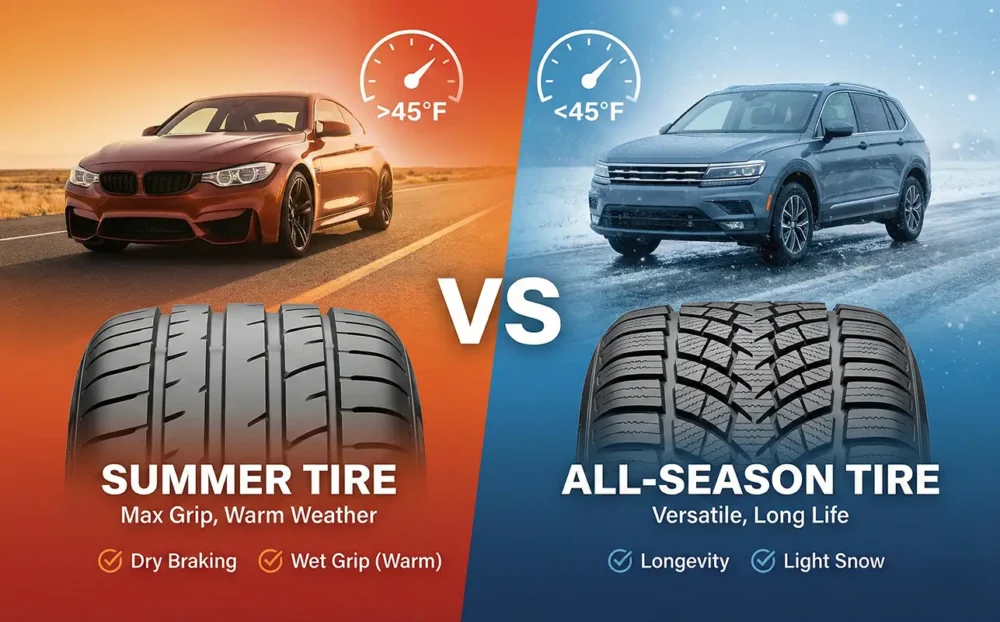
You are standing at the service counter of your local tire shop, or perhaps scrolling through an online retailer, and you are faced with a choice that seems simple but is actually quite complex: Summer Tires vs All-Season Tires?
The names seem self-explanatory. “Summer” sounds like it is only for beach days and heatwaves, while “All-Season” sounds like the perfect, worry-free solution for year-round driving.
Here is the reality: These names are marketing terms, and they can be dangerously misleading.
A “Summer” tire is actually the highest-performing wet-weather tire you can buy—until the temperature drops. An “All-Season” tire is often a “Three-Season” tire that becomes a liability in heavy snow.
Choosing the wrong one can increase your stopping distance by car lengths, destroy your fuel economy, or leave you stranded in a parking lot.
In this definitive guide, we will strip away the marketing jargon. We will explore the molecular chemistry of rubber compounds, analyze independent performance data, and help you decide exactly which tire belongs on your vehicle based on where you live and how you drive.
- Part 1: The Chemistry of Grip (What Makes Them Different?)
- Part 2: The “7-Degree Rule” (Temperature is Everything)
- Part 3: Performance Showdown (Data vs. Assumption)
- Part 4: Tread Life and Economics
- Part 5: The “All-Weather” Variable
- Part 6: Who Should Buy Which? (The Verdict)
- Conclusion: It’s About Compromise
- Frequently Asked Questions (FAQ)
Part 1: The Chemistry of Grip (What Makes Them Different?)
To understand why these tires behave differently, we have to look at them under a microscope. A tire is not just black rubber; it is a highly engineered composite material designed to react to temperature.
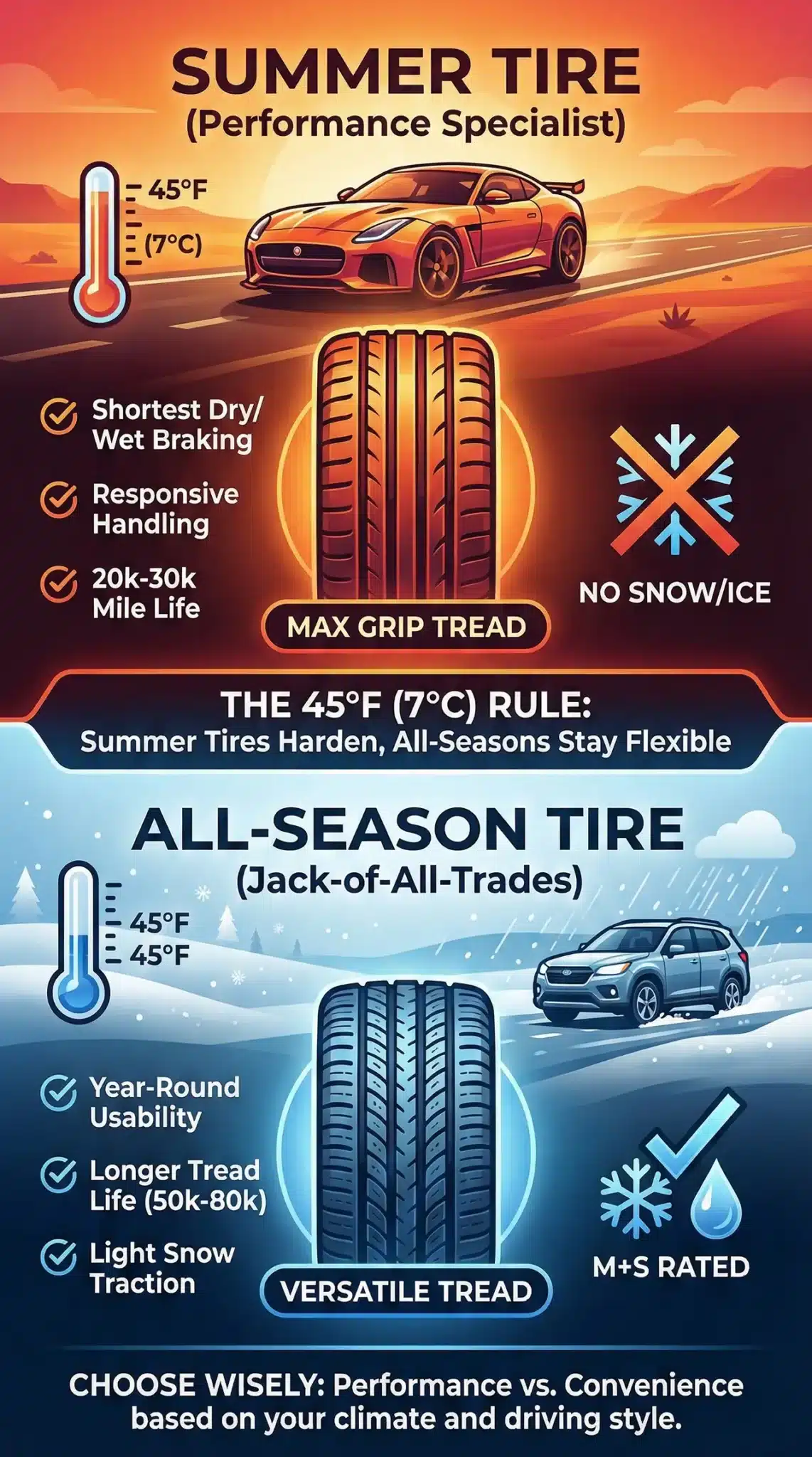
1. Summer Tires (The Performance Specialist)
Think of a summer tire like a stick of chewing gum.
- The Compound: When chewing gum is warm, it is soft, pliable, and incredibly sticky. Summer tires use a specialized rubber blend with a low “glass transition” temperature, meaning they remain soft and flexible at high speeds and high ambient temperatures.
- The Tread Pattern: Look at a summer tire, and you will see massive, solid blocks of rubber. This maximizes the contact patch—the amount of rubber actually touching the road. They have wide channels (circumferential grooves) to pump water away, but very few tiny cuts (sipes).
- The Goal: To provide maximum friction (grip) on dry and wet roads when the temperature is above 45°F (7°C).
2. All-Season Tires (The Jack-of-All-Trades)
Think of an all-season tire like a sturdy leather hiking boot.
- The Compound: Manufacturers add more silica and synthetic polymers to the mix. This creates a harder, more durable compound that resists wear. crucially, it is designed to stay flexible even when the temperature drops towards freezing, preventing the “hockey puck” effect that plagues summer tires.
- The Tread Pattern:
The tread is more complex. You will see hundreds of tiny slits called sipes. These sipes open up as the tire rolls, creating biting edges that can claw into light snow and slush.+1
- The Goal: To provide acceptable performance in a wide window of conditions—from hot asphalt to cold rain and light snow—while lasting as long as possible.
Part 2: The “7-Degree Rule” (Temperature is Everything)
If you take one thing away from this article, let it be the 45°F (7°C) Rule.
Most drivers assume that snow is the deciding factor. It isn’t. Temperature is the deciding factor.
The Summer Tire “Cliff”
When the ambient temperature drops below 45°F (7°C), the specialized compound in a summer tire begins to undergo a process called plasticization. The rubber hardens.
- The Result: It loses its ability to mechanically key into the microscopic imperfections of the road surface. It becomes like hard plastic sliding on concrete.
- The Danger: Even on a dry road, a summer tire at 30°F (-1°C) will have significantly longer stopping distances than an all-season tire. If you hit a patch of ice, you have effectively zero grip.
The All-Season Sweet Spot
All-season tires are formulated to bridge this gap. They perform reliably from 100°F down to roughly 20°F. However, they also have a limit. In extreme sub-zero cold, dedicated Winter Tires (which stay soft even at -30°F) are required for safety.
Part 3: Performance Showdown (Data vs. Assumption)
Let’s look at how these tires compare in the three critical areas of driving: Dry, Wet, and Snow.
Round 1: Dry Performance
Winner: Summer Tires (By a Landslide)
In warm conditions, there is no contest.
- Handling: Summer tires have stiffer sidewalls and larger tread blocks. This translates to sharper steering response. When you turn the wheel, the car reacts instantly. All-season tires, with their flexible sipes and squirmy tread blocks, feel “numb” or delayed by comparison.
- Braking: Independent tests consistently show that from 60 MPH, a premium summer tire (like the Michelin Pilot Sport 4S) stops 5 to 10 feet shorter than a premium all-season tire. That is the difference between a scare and a rear-end collision.
Round 2: Wet Performance (The Misconception)
Winner: Summer Tires (Conditions Apply)
This shocks many drivers. “Summer” tires are often superior rain tires.
- Hydroplaning Resistance: The wide, straight grooves on summer tires are incredibly efficient at evacuating water. They act like pumps.
- Wet Grip: Remember the sticky compound? It sticks to wet pavement just as well as dry pavement. In warm rain, a summer tire will out-corner and out-brake an all-season tire.
- The Caveat: This only applies if it is warm rain. If it is a cold, sleety November rain (below 45°F), the summer tire hardens, and the All-Season takes the lead.
Round 3: Snow and Ice
Winner: All-Season Tires (But barely)
- Summer Tires: Dangerous. Unusable. They will spin helplessly in even a dusting of snow. Braking distances can increase by 300%.
- All-Season Tires: Acceptable for light snow. The sipes allow the tire to hold onto snow (snow-on-snow friction is actually quite grippy). However, in deep snow or on ice, they are significantly inferior to dedicated winter tires.
Part 4: Tread Life and Economics
Your wallet cares about more than just lateral G-forces. This is where All-Season tires shine.
Longevity
Because summer tires use soft, sticky rubber, they wear down faster—much like a pencil eraser.
- Summer Tire Life: Typically 20,000 to 30,000 miles. Most do not come with a mileage warranty.
- All-Season Tire Life: Typically 50,000 to 80,000 miles. The harder compound is designed to resist abrasion.
Fuel Economy
All-season tires are often engineered with Low Rolling Resistance (LRR) technology. They require less energy to roll down the highway, which can improve your fuel economy by 1-3% compared to sticky summer tires. Over the life of the tire, this can pay for the installation cost.
Maintenance Tip: Regardless of which tire you choose, uneven wear will destroy them. Check out our guide on Reading Tire Wear Patterns to catch alignment issues before they ruin your investment.
Part 5: The “All-Weather” Variable
In recent years, a new category has emerged that complicates this debate: the All-Weather Tire.
- What is it? It is a hybrid. It has the durability of an all-season tire but uses a specialized compound that qualifies for the 3PMSF (Three-Peak Mountain Snowflake) symbol.
- The Difference: unlike standard “All-Season” tires (which are M+S rated), All-Weather tires are legally certified for severe snow service.
- Recommendation: If you live in a place like Denver, Chicago, or Boston and only want one set of tires, skip the standard “All-Season” and buy “All-Weather” tires (like the Michelin CrossClimate2 or Nokian WR G4).
Part 6: Who Should Buy Which? (The Verdict)
The decision ultimately comes down to your location, your vehicle, and your willingness to swap tires.
Choose Summer Tires If:
- You Drive a Performance Car: If you own a BMW M3, Porsche 911, or Ford Mustang GT, putting all-season tires on it is like putting hiking boots on a sprinter. You are neutering the car’s performance.
- You Live in the Sun Belt: If you live in Florida, Southern California, or Arizona where temperatures rarely drop below freezing, summer tires offer the best safety and performance year-round.
- You Have a Dedicated Winter Set: This is the gold standard. Run summer tires from April to November for maximum fun and safety, then switch to Winter Tires for the cold months. (Don’t forget to read our Tire Storage Guide to keep your off-season set fresh).
Choose All-Season Tires If:
- You Drive a Daily Commuter: For a Toyota Camry, Honda CR-V, or minivan used for school runs and grocery getting, the longevity and comfort of all-seasons are the logical choice.
- You Want “Set It and Forget It”: You don’t have the space to store a second set of wheels, and you don’t want the hassle of scheduling tire swaps twice a year.
- You Experience Mild Seasons: You live in a region (like the Carolinas or the Pacific Northwest) where it rains often, gets chilly, but rarely snows heavily.
Conclusion: It’s About Compromise
There is no “perfect” tire. Every tire is a compromise between grip, life, comfort, and weather capability.
- Summer Tires sacrifice tread life and cold-weather ability for maximum grip and safety in warm conditions.
- All-Season Tires sacrifice maximum grip for convenience, longevity, and cold-weather versatility.
Before you buy, check the placard on your driver’s door jamb to confirm the correct size and load rating. If you are unsure what those numbers mean, our guide on Tire Sizes Explained will walk you through it.
Final Advice: If you can afford it, the two-tire strategy (Summer + Winter) is statistically the safest way to drive. But if you must stick to one set, be honest about your weather. Don’t let a “Summer” tire catch you on a frozen bridge, and don’t expect an “All-Season” tire to stop on a dime in a heatwave.
Frequently Asked Questions (FAQ)
Can I use summer tires in winter if there is no snow?
We strongly advise against it. Even without snow, the cold temperatures (below 45°F) turn the summer rubber compound hard and brittle. Your braking distance will increase significantly, and you risk “compound cracking,” which permanently destroys the tire.
Are all-season tires okay for SUVs?
Yes, in fact, most SUVs and Crossovers come from the factory with all-season tires. They are designed to handle the extra weight of an SUV while providing a comfortable, quiet ride.
Do summer tires wear out faster?
Yes. Because the rubber is softer to provide that sticky grip, it abrades faster against the road. You can expect about half the tread life of a comparable all-season tire.
How do I know if I have summer or all-season tires?
Check the sidewall. All-season tires will almost always have “M+S” (Mud and Snow) stamped on the sidewall. Summer tires will not have this marking. Also, look at the tread: if it looks like big solid blocks, it’s likely summer. If it has hundreds of tiny cuts (sipes), it’s likely all-season.