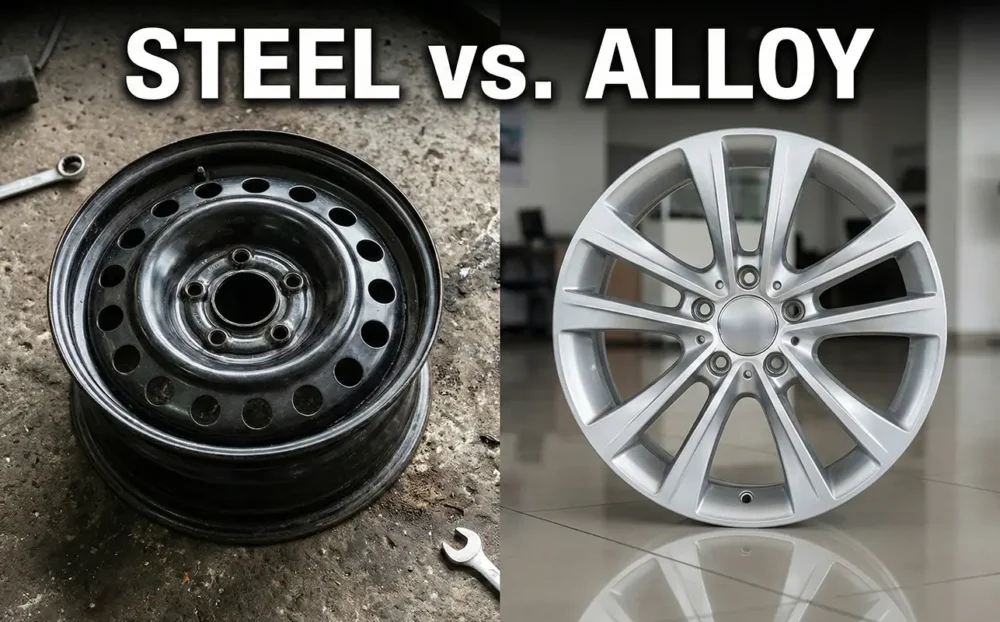
It is the classic automotive debate: Function vs. Form. Or perhaps, Durability vs. Performance.
When you are buying a new car, or shopping for a second set of wheels for winter tires, you are inevitably faced with a choice: Do you go with the utilitarian, bomb-proof Steel Rims, or do you upgrade to the sleek, lightweight Alloy Rims?
For decades, steel was the standard. If you bought a car in the 1980s, it likely came with steel wheels and plastic hubcaps. Today, alloy wheels have become the default for almost every vehicle except base-model work trucks and budget economy cars.
But does that mean Alloy is always better? Not necessarily.
In this definitive guide, we are going to break down the physics, the economics, and the practical realities of Steel vs. Alloy. We will explore why police cars often stick with steel, why race cars rely on alloy, and which one is actually right for your daily commute.
- Part 1: The Contenders Defined
- Part 2: The Heavyweight Battle (Weight & Performance)
- Part 3: Durability (The Bender vs. The Breaker)
- Part 4: Aesthetics & Maintenance (Form vs. Function)
- Part 5: The Cost Analysis (Wallet Impact)
- Part 6: Winter Driving (The Secret Weapon)
- Conclusion: Which One Should You Choose?
- Frequently Asked Questions (FAQ)
Part 1: The Contenders Defined
Before we let them fight, let’s define exactly what we are looking at.
What is a Steel Rim?
Steel wheels are the “old school” option. They are made from an alloy of iron and carbon.
- Manufacturing: They are stamped out in massive presses. A flat sheet of steel is pressed into the shape of the center disc, and another rectangular sheet is rolled into a hoop to form the barrel. The two pieces are welded together.
- The Look: They are almost always utilitarian in appearance—usually painted black or silver. Because stamping intricate shapes into steel is difficult, they typically feature simple, round holes for ventilation. Most drivers cover them with plastic hubcaps (wheel covers) to improve aesthetics.
What is an Alloy Rim?
When we say “Alloy” in the car world, we are referring to Aluminum Alloy.
- Manufacturing: These are made by pouring molten aluminum (mixed with magnesium, silicon, and other metals) into a mold (casting). High-end versions are crushed into shape under massive pressure (forging).
- The Look: Because the metal is melted or machined, alloy wheels can be sculpted into incredibly complex designs. Thin spokes, deep dishes, and intricate mesh patterns are all possible. They are often clear-coated to show off the bare metal or painted in various finishes.
Part 2: The Heavyweight Battle (Weight & Performance)
This is the single biggest difference between the two materials, and it affects how your car drives more than you might think.
Unsprung Weight: The Physics Lesson
To understand why alloys are popular, you have to understand Unsprung Weight. Your car’s suspension (springs and shocks) supports the weight of the chassis, engine, and passengers. Everything above the springs is “Sprung Weight.” Everything below the springs (wheels, tires, brakes, axles) is “Unsprung Weight.”
The Goal: You want unsprung weight to be as low as possible.
- Why? Imagine running with heavy boots vs. light sneakers. Heavy boots make it harder to lift your legs quickly. Similarly, a heavy wheel is harder for the suspension to control. If you hit a bump, a heavy steel wheel has a lot of momentum—it slams upward and then slams back down, often causing the tire to momentarily lose contact with the road.
- The Alloy Advantage: Aluminum is roughly 1/3 the density of steel. A standard 17-inch alloy wheel might weigh 20 lbs, while its steel counterpart weighs 28-30 lbs. That 8-10 lb difference per corner is massive for handling. The suspension can react faster, keeping the tire glued to the pavement.
Acceleration and Braking (Rotational Mass)
It’s not just about up-and-down movement; it’s about spinning.
- Inertia: A heavy steel wheel takes more energy to start spinning (acceleration) and more energy to stop spinning (braking).
- Fuel Economy: Because the engine has to work harder to spin heavy steel wheels, switching to lightweight alloys can actually improve your city MPG slightly (though the difference is often negligible on the highway once momentum takes over).
Verdict: Alloy Wins. If you care about sporty handling, acceleration, or braking distance, alloy is the clear victor.
Part 3: Durability (The Bender vs. The Breaker)
This is where the script flips. While alloy is lighter, steel is tougher in a very specific way.
Steel: The Flexible Tank
Steel is malleable. If you hit a massive pothole at 40 MPH with a steel rim, the metal will likely bend.
- The Benefit: A bent rim often still holds air. You can limp home. Even better, a skilled mechanic (or a resourceful driver with a hammer) can often beat the rim back into shape well enough to balance it again.
- Police & Taxis: This is why you see steel wheels on police cruisers (the Ford Crown Victoria, for example) and taxis. They jump curbs and hit potholes daily. Steel absorbs the abuse without failing catastrophically.
Alloy: The Brittle Beauty
Aluminum is rigid. That rigidity is great for cornering precision, but it has a downside: it is brittle.
- The Failure Mode: If an alloy wheel hits that same pothole, it won’t bend—it will crack.
- The Consequence: A cracked rim usually leaks air immediately, leaving you stranded. Furthermore, you cannot “hammer” an alloy rim back into shape. Welding a cracked alloy wheel is possible, but it compromises the heat treatment and structural integrity. Most safety experts recommend scrapping a cracked alloy wheel.
Cosmetic Durability (Rust vs. Corrosion)
- Steel Rusts: If the paint chips off a steel wheel, it will rust orange. It looks ugly, but surface rust rarely impacts structural integrity. You can sand it and spray paint it for $10.
- Alloy Corrodes: Aluminum doesn’t rust, but it oxidizes. If the clear coat is breached by salt or curb rash, white powdery corrosion will spread under the paint like a spiderweb. This can eventually cause leaks at the tire bead (where the rubber meets the metal).
Verdict: Steel Wins. For pure survival on rough roads, steel is the undefeated champion.
Part 4: Aesthetics & Maintenance (Form vs. Function)
Let’s be honest: Most people choose alloy wheels because they simply look better. But aesthetics aren’t just about vanity; they have functional implications too.
Design Freedom
- Alloy: Because aluminum is cast or forged, it can be shaped into literally any design. Manufacturers can create thin, elegant spokes that show off the brake calipers. They can offer deep concave profiles or complex mesh patterns.
- Steel: You are limited to “round with holes.” The stamping process restricts design to basic structural shapes. This is why almost every steel wheel looks identical: a solid face with small circular cutouts.
The “Hubcap” Factor
To hide the ugliness of steel, carmakers use Plastic Wheel Covers (Hubcaps).
- Pros: They are cheap to replace ($20-40) if you curb them. They can mimic the look of alloy wheels from a distance.
- Cons: They fall off. Hit a big bump, and your hubcap goes flying into a ditch. They also trap brake dust and road grime against the wheel, accelerating rust.
- Alloy: No covers needed. The wheel is the style. However, if you curb an alloy wheel, refinishing it costs $150+.
Brake Cooling Performance
This is a critical performance factor often overlooked.
- Alloy: The open-spoke designs of alloy wheels allow massive airflow to pass through the wheel and cool the brake rotors. This prevents Brake Fade (where the brakes overheat and lose stopping power) during spirited driving or towing.
- Steel: The solid face of a steel wheel acts like a heat shield, trapping thermal energy inside the wheel well. This can lead to warped rotors and reduced braking performance in extreme conditions.
Verdict: Alloy Wins. Better cooling, better looks, and no lost hubcaps.
Part 5: The Cost Analysis (Wallet Impact)
If you are on a budget, the winner is clear.
Initial Purchase Price
- Steel: A brand new 16-inch steel rim typically costs between $50 and $80. A set of four is roughly $200-$300.
- Alloy: An entry-level cast aluminum wheel starts around $150. OEM replacements from the dealership can easily cost $400-$800 per wheel. A high-end forged set can cost $4,000+.
Repair & Replacement Costs
- Steel: If you bend a steel rim in winter, buying a new one is often cheaper than repairing the old one. It is a disposable commodity.
- Alloy: Crack an alloy rim? You are buying a new one. Curb it? Professional refinishing (CNC lathe turning and repainting) starts at $150 per wheel.
Verdict: Steel Wins. It is indisputably the budget-friendly choice.
Part 6: Winter Driving (The Secret Weapon)
This is the specific scenario where the “inferior” steel wheel becomes the superior choice.
In snowy climates, drivers often buy a second set of wheels dedicated to winter tires. Why?
- Weight = Traction: Remember how we said heavy steel wheels are bad for handling? In deep snow, weight is good. The extra unsprung weight helps the tire dig down through the fluff to find traction on the pavement below.
- Corrosion Resistance: Road salt destroys alloy wheels. It eats the clear coat and causes the aluminum to pit and leak. Steel wheels will rust superficially, but a $10 can of Rust-Oleum keeps them going for decades.
- The “Curb Slide”: In winter, you will slide into a curb eventually. Sliding into a curb with a $50 steel rim is an annoyance. Sliding into a curb with a $500 alloy rim is a tragedy.
Many drivers embrace the “Winter Beater” aesthetic—putting their nice alloys in the garage and rocking black steelies from November to April.
Conclusion: Which One Should You Choose?
So, who wins the battle of Steel vs. Alloy?
The Winner: Alloy Rims (For 90% of Drivers) Unless you are specifically looking for a dedicated winter setup or building a budget off-roader, Alloy Wheels are the superior choice.
- They offer better handling, acceleration, and braking.
- They look infinitely better on modern cars.
- They allow for larger brake rotors and better cooling.
The Runner-Up: Steel Rims (For Specific Jobs) Don’t count steel out. It is the perfect choice for:
- Winter Tires: Save your nice alloys from the salt. Buy cheap steelies for November-March.
- Budget Restorations: If you are flipping a cheap car, steel wheels with new hubcaps are $200 cheaper than even the worst alloys.
- Off-Road Beating: If you plan on smashing your wheels into rocks, steel bends instead of cracking, which might be the difference between driving home and walking home.
My Professional Advice: If your car came with steel wheels and you want to upgrade, do not buy cheap, no-name alloy wheels. A cheap cast alloy wheel is often heavier and weaker than a good steel wheel. Stick to reputable brands or OEM take-offs (used wheels from higher trim levels of your same car).
Frequently Asked Questions (FAQ)
Do alloy wheels corrode?
Yes. While aluminum doesn’t “rust” orange like steel, it oxidizes into a white powder if the protective clear coat is damaged. This corrosion can creep under the tire bead, causing slow air leaks over time.
Can I switch from steel to alloy wheels?
Absolutely. As long as the Bolt Pattern (e.g., 5×114.3), Offset (ET), and Center Bore match your vehicle, you can upgrade. Just remember that you might need different lug nuts (steel wheels use conical seat nuts; some alloys use mag seat or ball seat).
Do alloy wheels save gas?
Theoretically, yes. Because they are lighter, the engine uses less fuel to accelerate them. However, in real-world highway driving where momentum takes over, the difference is negligible unless you are switching to ultra-light forged racing wheels.
Are hubcaps necessary for steel wheels?
No. They are purely cosmetic. Many drivers (especially in the off-road and winter driving communities) prefer the rugged, utilitarian look of black steel wheels without covers. Removing them also prevents snow and ice from packing inside the wheel.