If you’ve ever stared at a tire sidewall and wondered what that lone letter at the end of the size code actually means, you’re not alone.
I spent years in automotive journalism before I fully appreciated how much that one character affects the way a tire performs, handles, and holds up under real-world driving.
Before we dive deep into the R vs S debate, I want to point you to my full tire speed ratings chart — it covers every speed rating from L all the way to Y, and it’s a great reference to bookmark alongside this article.
Today, though, we’re zeroing in on two ratings that show up constantly on everyday passenger cars, minivans, SUVs, and light trucks: R and S. On the surface they look nearly identical. In practice, the differences matter — especially if you’re replacing OEM tires or thinking about upgrading.
⚡ TL;DR — R vs S Speed Rating
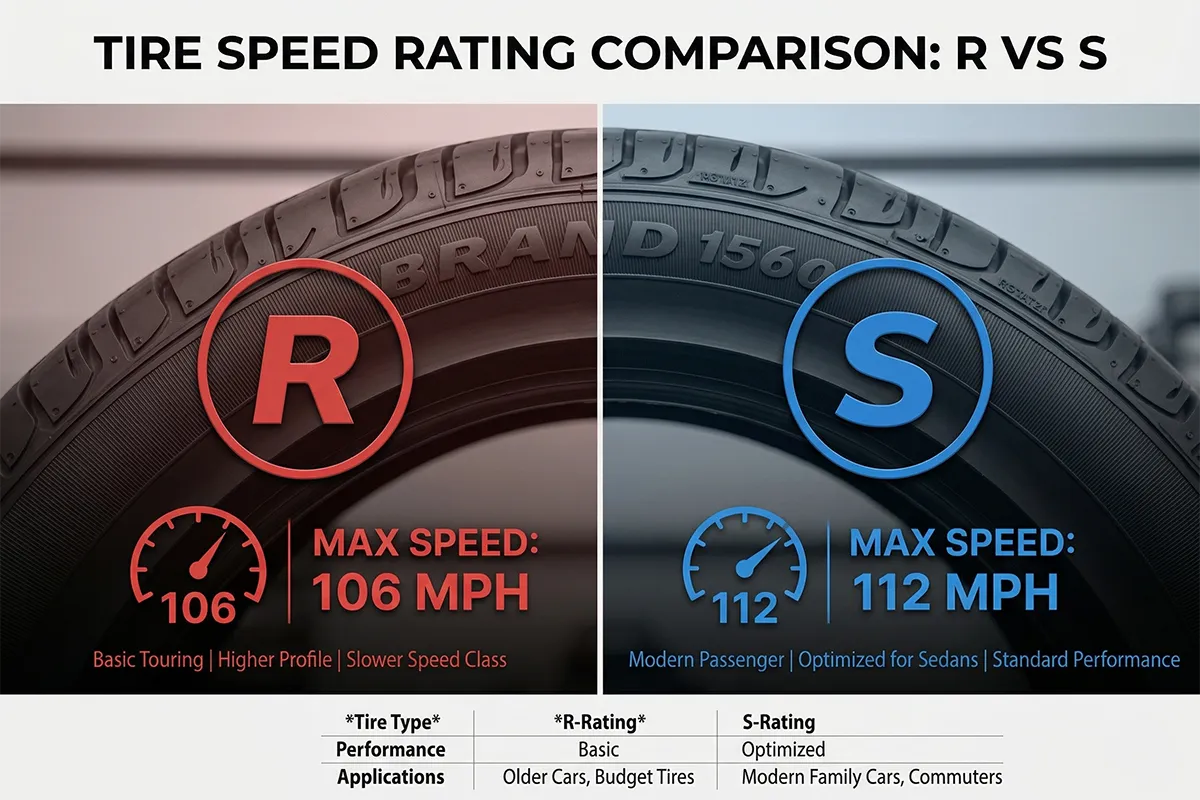
- R speed rating = 106 mph max; S speed rating = 112 mph max.
- S-rated tires are more common on modern passenger cars, minivans, and crossover SUVs.
- R-rated tires suit light trucks, off-road-capable vehicles, and RVs where top speed is less critical.
- Never downgrade your speed rating below the OEM spec — it can void your warranty and create safety risks.
- Upgrading from R to S is generally safe and sometimes beneficial for highway comfort.
- Tire construction, compound, and tread design matter more to real-world ride quality than the speed rating alone.
What Does a Speed Rating Actually Mean?
Before we put R and S side by side, let me give you the 30-second background. A tire’s speed rating is a code that tells you the maximum sustained speed the tire is engineered and tested to handle.
It doesn’t mean the tire explodes if you exceed it by one mph — it means the structural integrity, heat dissipation, and handling characteristics have only been validated up to that speed.
Ratings are established using an indoor drum test where tires are loaded to their max load index and run at progressively higher speeds for set durations.
The letter is assigned based on the highest speed bracket the tire passes. The higher the letter, the higher the speed — but also, generally, the firmer and more performance-oriented the compound.
R Speed Rating: The Details
An R speed rating certifies the tire up to 106 mph (170 km/h). In practice, most drivers whose cars come equipped with R-rated tires will never come close to that ceiling under legal, everyday conditions — the US Interstate speed limit caps out at 85 mph in a handful of states, and most top out at 70–75 mph.
R-rated tires are frequently engineered with a focus on load capacity, durability, and tread life rather than outright speed or lateral grip. That makes them a practical choice for vehicles where payload or longevity takes priority.
Vehicles That Commonly Come with R-Rated Tires
- Light-duty pickup trucks (Ford F-150, Chevy Silverado 1500, Ram 1500) in work-oriented trims
- Full-size SUVs with heavy towing ratings (Chevy Suburban, Ford Expedition in base trims)
- RV trailers and Class C motorhomes
- Older minivans (pre-2010 era)
- Entry-level economy sedans from the late 1990s–early 2000s
I’ve tested multiple R-rated all-season tires on work trucks, and what I consistently notice is that they prioritize a smooth, compliant ride under load. When the truck bed is empty, they can feel a bit floaty on aggressive highway sweepers — but load up the bed or attach a trailer, and they become noticeably more composed.
S Speed Rating: The Details
An S speed rating certifies the tire up to 112 mph (180 km/h) — just 6 mph above an R-rated tire.
That gap sounds trivial, but it reflects a meaningful difference in tire construction, compound stiffness, and heat tolerance at sustained highway speeds.
S-rated tires are among the most common fitments in the United States. Walk through any tire shop and you’ll see S ratings dominating the family car, crossover SUV, and minivan segments.
Manufacturers choose S ratings because they balance cost, ride comfort, tread life, and sufficient speed headroom for the vast majority of American drivers.
Vehicles That Commonly Come with S-Rated Tires
- Family sedans (Honda Accord, Toyota Camry, Nissan Altima)
- Crossover SUVs (Toyota RAV4, Honda CR-V, Ford Escape)
- Minivans (Honda Odyssey, Toyota Sienna, Chrysler Pacifica)
- Compact cars (Toyota Corolla, Honda Civic, Mazda3)
- Station wagons and hatchbacks in non-performance trims
When I put S-rated tires on family haulers for testing, the pattern I see most is solid all-season capability with predictable handling. They’re not trying to be performance tires — and they’re better for it. The compound stays supple in cold weather, wears evenly across typical commuting and highway driving, and typically delivers 50,000–70,000 miles of useful life.
R vs S Speed Rating: Side-by-Side Comparison
| Feature | R Speed Rating | S Speed Rating |
|---|---|---|
| Max Speed | 106 mph (170 km/h) | 112 mph (180 km/h) |
| Code Letter | R | S |
| Typical Use | Light trucks, work vehicles, RVs | Family cars, crossovers, minivans |
| Compound Focus | Durability and load capacity | Balance of comfort and performance |
| Common Tread Life | 50,000–80,000 miles | 50,000–70,000 miles |
| Ride Quality | Smooth under load | Comfortable, all-season optimized |
| Highway Handling | Adequate; softer feel | Stable, predictable |
| Upgrade Path | Can step up to S safely | Can step up to T/H/V |
The Real-World Speed Difference: Does 6 MPH Matter?
When I first started testing tires professionally, I’d have told you that 6 mph separating R and S ratings is basically irrelevant. After thousands of miles behind the wheel evaluating both, I have a more nuanced view.
On public roads — even wide-open Texas interstates where the limit is 85 mph — that margin doesn’t come into play for legal driving.
But it’s not just about top speed. The higher speed rating on S-rated tires indicates a stiffer internal construction that delivers slightly better high-speed stability, particularly around 70–80 mph where most Americans actually cruise.
What I notice on S-rated tires at interstate speeds is a tighter, more controlled feeling when changing lanes or navigating gentle curves.
R-rated tires at the same speed can feel a fraction more relaxed — which is fine for straight-line commuting, but shows up on sweeping on-ramps.
The bottom line: if your car’s OEM spec is R, you can upgrade to S with no downsides. If your spec is S, stepping down to R is not something I’d recommend, particularly for highway-heavy drivers.
Load Index and Speed Rating: How They Work Together
One thing most buyers miss is that the speed rating interacts directly with a tire’s load index. When you look at a tire sidewall, the number before the speed rating letter is the load index — for example, in 215/65R16 98S, the 98 is the load index and S is the speed rating.
Here’s the important nuance: a speed rating is only valid at the tire’s rated load. If you’re significantly overloading your tires — towing beyond capacity, for example — the heat generated by the additional load can exceed what the compound is designed to manage, even if your speed is well below the rated ceiling.
This is especially relevant for truck owners considering R-rated tires. Many R-rated truck tires carry high load indexes (110–120) precisely because load management is the primary engineering goal. The speed ceiling is secondary.
Tire Lineups: Best R-Rated Tires Available Today
Here’s a rundown of the most widely available R-rated tires in the US market, organized by category.
All-Season R-Rated Tires
- Michelin LTX A/T2 — A benchmark all-terrain truck tire with an R speed rating in many LT sizes. Exceptional tread life and wet performance for a truck tire.
- Goodyear Wrangler SR-A — A workhorse all-season tire designed for pickups and full-size SUVs. Excellent load management and a quiet highway ride.
- BFGoodrich Long Trail T/A Tour — Built specifically for light truck and SUV owners who prioritize comfort and durability over off-road capability.
- Continental CrossContact LX25 — In certain truck and SUV sizes this comes R-rated; delivers a refined highway ride and solid wet traction.
- Firestone Destination LE3 — An affordable R-rated option for light trucks with solid all-season credentials and good tread life.
All-Terrain R-Rated Tires
- BFGoodrich All-Terrain T/A KO2 — A favorite among truck owners. The R-rated sizing pairs deep tread blocks with solid durability for mixed-surface use.
- Falken Wildpeak A/T3W — R-rated in LT sizing. Punches above its price point for snow performance and off-road capability.
- Toyo Open Country A/T III — Available R-rated for trucks. A smooth on-road ride with convincing all-terrain bite.
- Cooper Discoverer AT3 4S — R-rated LT sizes available. Strong value for owners who split time between gravel roads and highways.
Tire Lineups: Best S-Rated Tires Available Today
S-rated tires dominate the passenger car and crossover market. Here are the top performers I’ve tested or have tracked through independent data.
All-Season S-Rated Tires
- Michelin Defender2 — One of the best all-season tires on the market in S-rated sizing. Exceptional wet traction, long tread life, and a comfortable ride.
- Continental TrueContact Tour — S-rated in most family car sizes. Excellent dry handling balance and above-average fuel efficiency.
- Bridgestone Ecopia EP422 Plus — An eco-focused S-rated tire with impressive fuel efficiency and solid commuter-duty wear.
- Goodyear Assurance WeatherReady — S-rated all-season with three-peak mountain snowflake certification. Superb all-weather capability for the rating.
- Cooper Endeavor Plus — Quiet, comfortable, and durable. S-rated for family sedans and crossovers at a competitive price.
- Kumho Solus TA11 — A budget-friendly S-rated all-season with respectable wet and dry scores for everyday commuters.
- General AltiMAX RT43 — Solid mid-range S-rated choice. Good value and consistent performance in rain and light snow.
- Firestone WeatherGrip — S-rated with three-peak mountain snowflake certification. Excellent safety-to-cost ratio for family vehicles.
S-Rated Tires for Crossovers and Minivans
- Michelin CrossClimate2 — Available in S-rated crossover sizes. An outstanding all-weather tire that bridges the gap between summer and winter.
- Pirelli Cinturato P7 All Season Plus II — S-rated fitments for mid-size and full-size cars. Strong wet grip and a relaxed highway feel.
- Yokohama Avid Ascend GT — Comfortable, quiet, and reliably S-rated for sedans and crossovers. A tire I frequently recommend to commuters.
- Hankook Kinergy PT H737 — Budget-to-mid-range S-rated all-season for family vehicles. Solid mileage warranty and low road noise.
- Toyo Celsius — An all-weather (not just all-season) S-rated option with three-peak certification. Increasingly popular in the northern US.
Safety: Can You Mix R and S Speed Rated Tires?
This comes up constantly, so I want to be direct: you should not mix speed ratings on your vehicle.
Tire manufacturers and the NHTSA advise against it because mismatched speed ratings can create unpredictable handling behavior, particularly in emergency braking and high-speed cornering scenarios where each axle responds differently.
If you absolutely must mount mismatched speed ratings — for example, you blew a tire and the only available replacement is a different rating — put the higher-rated tires on the rear axle.
Lower-rated tires at the rear in a panic situation can cause dangerous oversteer. Even so, replace the mismatched set as soon as possible.
Also remember: your vehicle’s minimum speed rating is set by the manufacturer. You can always go higher. You should never go lower. That minimum is printed in your owner’s manual and often on the door jamb sticker.
How R and S Compare to Other Speed Ratings
The full speed rating spectrum is worth understanding, especially if you’re shopping across multiple tire models. Here’s where R and S sit in the larger picture:
- If you’re curious how S compares to T (118 mph), check out my detailed breakdown: S vs T Speed Rating
- Wondering about H-rated tires (130 mph) vs S? I cover this in my H vs S Speed Rating article — the difference there is more meaningful for performance car buyers.
- H vs T is another common comparison for family car shoppers: H vs T Speed Rating
- For performance car owners looking at V (149 mph) vs H (130 mph): V vs H Speed Rating
- Truck and SUV owners sometimes compare V vs W for premium fitments: V vs W Speed Rating
- Sports car owners debating W vs Y ratings: W vs Y Speed Rating
- On the lower end, Q vs S is relevant for winter tire shoppers: Q vs S Speed Rating
- Q vs T is also worth knowing if you’re weighing winter vs all-season options: Q vs T Speed Rating
- High-performance tire enthusiasts sometimes research Z vs W: Z vs W Speed Rating
- And V vs T covers a big jump that affects everyday car buyers and performance shoppers alike: V vs T Speed Rating
So Which Should You Choose: R or S?
Here’s my honest, experience-backed recommendation:
Choose R if…
- Your vehicle is a work truck, van, or RV and came with R-rated OEM tires.
- You primarily drive under 75 mph and load your vehicle regularly.
- Tread life and load-carrying capability are your top priorities.
- You want the widest selection of all-terrain and mud-terrain options for an off-road-capable truck.
Choose S if…
- Your vehicle is a family sedan, crossover, or minivan.
- Your owner’s manual specifies S or higher.
- You drive significant highway miles and want the added stability at 70–80 mph.
- You want access to the widest selection of all-season passenger car tires.
- You’re upgrading from an R-rated truck tire and want improved highway manners.
A word on upgrading: I’ve made the jump from R to S on my daily driver truck, and the difference on the highway is subtle but real — a slightly more planted feeling at 75 mph, better response on sweeping ramps. If the S-rated tire you want comes in your size and the price difference is small, it’s usually worth it.
Frequently Asked Questions
Is R or S speed rating better?
Neither is universally better — it depends on your vehicle and driving patterns. S-rated tires offer a slightly higher speed ceiling and are typically better suited to passenger cars and crossovers. R-rated tires are built for trucks and vehicles where load and durability matter more than top-end speed.
Can I replace an R-rated tire with an S-rated tire?
Yes. Upgrading from R to S is safe and sometimes beneficial. S-rated tires meet or exceed the construction standard of R-rated tires. Just make sure the new tire’s load index meets or exceeds your OEM spec — don’t sacrifice load capacity chasing a higher speed rating.
Will R-rated tires cause problems on the highway?
Not if you’re driving at legal speeds. R-rated tires are certified to 106 mph — well above any US highway speed limit. The practical difference is in high-speed stability and handling feel rather than any risk of failure at legal speeds.
Do speed ratings affect tire warranty?
Not directly. Tread life warranties are separate from speed ratings. However, fitting tires with a lower speed rating than your OEM spec can void your vehicle manufacturer’s warranty coverage in cases where a tire failure is involved.
How do I find my vehicle’s required speed rating?
Check three places: your owner’s manual tire specification page, the door jamb sticker (usually on the driver’s side B-pillar), or the fuel cap door in some vehicles. The sticker shows the OEM tire size and, in some cases, the minimum speed rating required.
My Final Take
After years of evaluating tires across all categories, my honest view on R vs S comes down to this: if you drive a modern passenger car, crossover, or minivan, the S speed rating is your natural home.
The tires are designed for you, the compound is optimized for your use case, and you’ll have the widest selection of quality options.
If you drive a light truck or tow a trailer, R-rated tires in LT sizing were literally engineered for your situation. The focus on load management and durability over outright speed ceiling is exactly what you need.
What you should never do is downgrade your speed rating to save a few dollars. The speed rating isn’t just a marketing number — it reflects real differences in construction, heat management, and validated performance. That’s not a risk worth taking to save $20 per tire.
If you want to go deeper on the full spectrum, revisit my tire speed ratings chart for a complete breakdown of every rating from L to Y. And if you’re still on the fence between specific ratings, the comparison articles linked above will help you narrow down exactly what your vehicle needs.