The brochure claims are always bold. Tire manufacturers love words like “uncompromising,” “ultimate,” and “revolutionary.” But as someone who has spent decades feeling the difference between good rubber and great engineering through the seat of my pants, I know that the truth doesn’t live in a marketing pamphlet. It lives on wet asphalt at 70 mph, on a frosty mountain pass, and on a blistering hot track surface.
Today’s performance SUVs and crossovers—vehicles like the Porsche Macan, Audi SQ5, or even higher-trim Subaru Outbacks—present a unique engineering nightmare for tire designers. They are heavy, often pushing 4,500+ pounds, yet their owners expect them to handle like sports sedans, ride like luxury limousines, and handle the occasional dirt road or snow flurry.
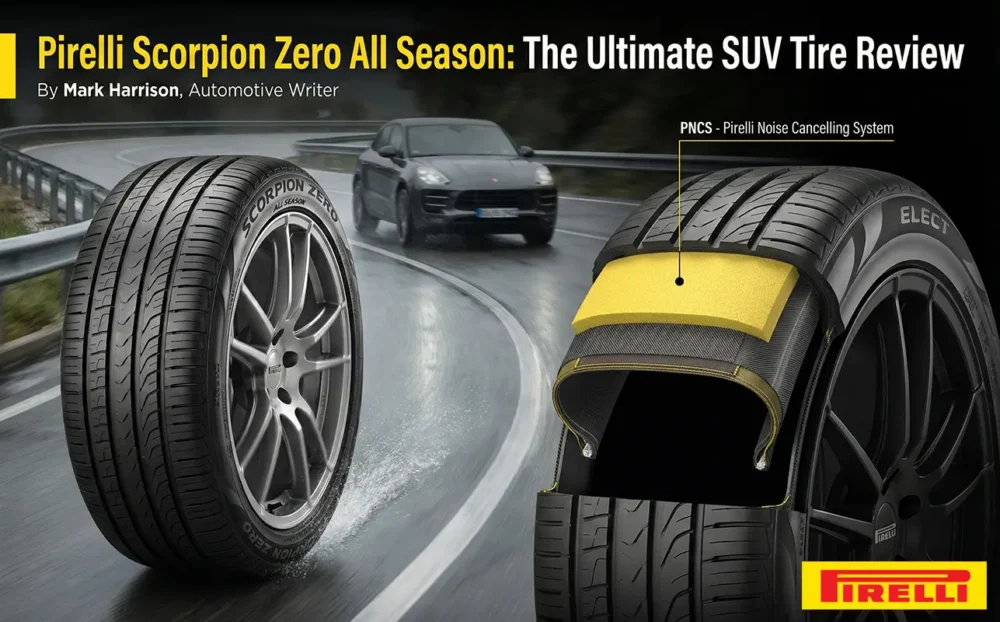
When evaluating Pirelli tires, we expect a certain level of performance pedigree, and their answer to this multi-variable SUV equation is the Scorpion Zero All Season.
It’s an Ultra-High-Performance (UHP) tire designed specifically to manage the high center of gravity and immense loads of modern utility vehicles, while injecting the DNA of Pirelli’s legendary P Zero track tires for handling response.
But does it actually work in the real world?
To find out, I didn’t just read the spec sheet. I mounted a fresh set on our test mule—a capable, AWD Subaru Outback, a vehicle known for being notoriously picky about its tires—and spent the last six months putting them through a torture test encompassing scorching dry heat, torrential autumn rains, light winter trails, and highway droning.
Here is the unvarnished truth about what it’s like to live with the Pirelli Scorpion Zero All Season.
Pirelli Scorpion Zero All Season
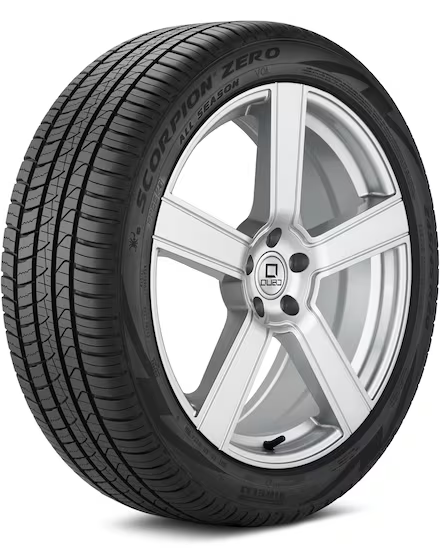
- Best For: High-performance and luxury SUVs (e.g., Porsche Macan, BMW X5, Audi SQ5).
- Driving Feel: Offers sporty, responsive handling that manages heavy SUV weight well.
- Comfort: Features noise-canceling foam (PNCS) for a very quiet cabin.
- Wet Performance: Excellent grip and braking safety in rain.
- Winter Capability: Okay for light snow/slush only; not rated for severe snow or ice (lacks 3PMSF rating).
- Lifespan: Expect 40,000–50,000 miles (trades some longevity for performance).
- Verdict: A top-tier choice for unlocking your SUV’s potential in mild climates, but requires dedicated winter tires for harsh weather.
Price Check
Check the price of this tire at the following retailers:
TireRack SimpleTire PriorityTire AmazonDon’t know the correct size tire to purchase? Start here!
- Pirelli Scorpion Zero All Season
- Key Takeaways
- Product Rating Bar
- What is the Pirelli Scorpion Zero All Season?
- The Setup: What We Are Testing
- Test Phase 1: The Dry Asphalt Torture Test
- Test Phase 2: When the Skies Opened Up
- Test Phase 3: The Noise Factor (The Invisible Test)
- Test Phase 4: The Winter Reality Check
- Test Phase 5: Off the Beaten Path
- Long-Term Impressions: Wear and the AWD Dilemma
- Pros and Cons Summarized
- Pirelli Scorpion Zero All Season vs. The Competition
- The Verdict: The Real-World Takeaway
- Frequently Asked Questions (FAQ)
Key Takeaways
- Ideal for Luxury and Performance SUVs: The tire is specifically engineered to handle the heavy weight and high power of vehicles like the Porsche Cayenne, BMW X5, and Audi SQ5.
- Balances Performance and Comfort: It successfully combines the sporty, responsive handling expected from Pirelli with a quiet and comfortable ride for daily driving (aided by sound-absorbing foam).
- Strong in the Rain: The tire provides excellent grip and braking performance in wet conditions.
- Not for Severe Winters: While it can handle light snow and slush, it lacks a severe snow rating (3PMSF) and is not a substitute for a dedicated winter tire in heavy snow or deep freezes.
- Tread Life Trade-off: Because it is a performance-focused tire, you can expect a shorter tread life (roughly 40,000 to 50,000 miles) compared to standard, harder-compound touring tires.
- The Bottom Line: It is a premium tire that unlocks the true handling capabilities of an expensive SUV in mild-to-moderate climates, but you should look elsewhere if you prioritize maximum tread life or live in an area with harsh winters.
What is the Pirelli Scorpion Zero All Season?
To understand this tire, you have to understand Pirelli’s naming conventions.
- P Zero: This is Pirelli’s legendary track and supercar tire lineage. It represents maximum grip, stiff sidewalls, and aggressive cornering.
- Scorpion: This is Pirelli’s dedicated family of tires designed specifically for the weight and higher center of gravity of SUVs and light trucks.
The Scorpion Zero All Season is the marriage of these two philosophies. It takes the sticky, responsive DNA of a sports car tire and reinforces it to handle the immense load and unique suspension geometry of a premium SUV.
You will frequently see this tire as Original Equipment (OE). When a tire is OE, it means car manufacturers like Jaguar, Land Rover, Audi, and Mercedes-Benz specifically chose (and often co-developed) this exact tire to be installed on their vehicles on the factory assembly line.
If you look closely at the sidewall of a Scorpion Zero All Season on a brand-new Range Rover, you might see special codes indicating this partnership. If you want to learn how to decode those specific manufacturer marks, check out my detailed guide on Understanding Tire Sidewall Markings.
The Setup: What We Are Testing
Before we hit the road, it is crucial to understand what this tire is trying to achieve. The Scorpion Zero All Season is what we call an “asymmetric” tire. If you look at the tread, the inner half looks completely different from the outer half.
The outer shoulder features massive, almost continuous tread blocks. This is the “dry performance zone,” designed to resist folding over when you corner hard. The inner tread is heavily siped (those tiny hair-like cuts) and features wide longitudinal grooves. This is the “foul weather zone,” tasked with biting into snow and evacuating water.
Many versions of this tire also come with PNCS (Pirelli Noise Cancelling System)—a thick layer of acoustic foam glued inside the tire carcass to absorb road boom.
Our goal with this test was simple: push the tire hard enough to see where the compromises lie. Can a tire really be good at everything?
Test Phase 1: The Dry Asphalt Torture Test
We began our testing in late summer, with ambient temperatures hitting 90°F and track surface temperatures soaring well over 120°F. This is where lesser all-season tires turn greasy. The rubber compound gets too hot, becomes overly pliable, and steering response vanishes.
To test the Scorpion Zero’s “Zero” pedigree, I took the Outback through a series of high-speed lane changes and sweeping cornering drills on closed tarmac.
The first thing you notice is the steering response. On standard touring tires, you turn the wheel, wait a beat for the sidewall to compress, and then the car changes direction. With the Scorpion Zero, that delay is virtually eliminated. The reinforced sidewalls are incredibly stiff for an all-season tire. When you initiate a turn, the car noses in immediately.
Pushing harder into sustained sweepers, the grip level is tremendous for a 4,000-lb vehicle on street tires. You can feel those massive outer shoulder blocks digging in. They don’t squirm. The rear of the car follows the front dutifully, feeling planted rather than nervous.
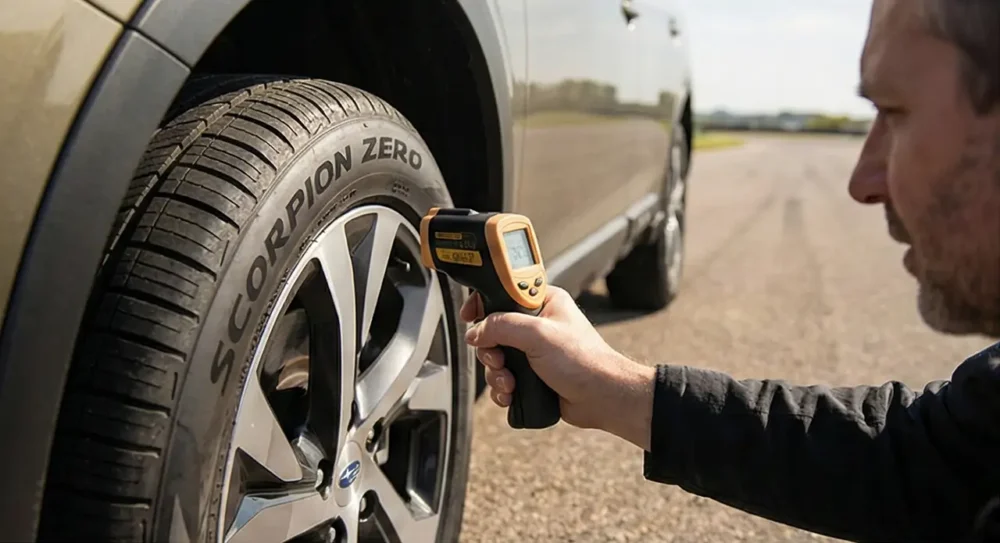
Checking thermal characteristics across the tread block after a rigorous dry-handling session. Even heat distribution indicates an optimized contact patch.
As you can see in the image above, after several aggressive laps, I used a pyrometer to check the temperature spread across the tire tread. What I was looking for was uniformity.
A tire that is struggling will often overheat its shoulders while the center remains cooler. The Pirellis showed a remarkably even heat spread across the entire contact patch.
This tells me the internal structure of the tire is successfully distributing the vehicle’s weight evenly, even under duress. They didn’t get greasy; they just got sticky.
Test Phase 2: When the Skies Opened Up
Dry grip is fun, but wet grip saves lives. The primary enemy of a wide SUV tire in the rain is hydroplaning—the phenomenon where a wedge of water builds up in front of the tire, lifting it off the pavement and turning your car into an uncontrolled boat.
We waited for a torrential autumn downpour to evaluate the tire’s water evacuation capabilities. We ran the Outback through standing water varying from puddles to significant sheeting across the roadway at highway speeds.
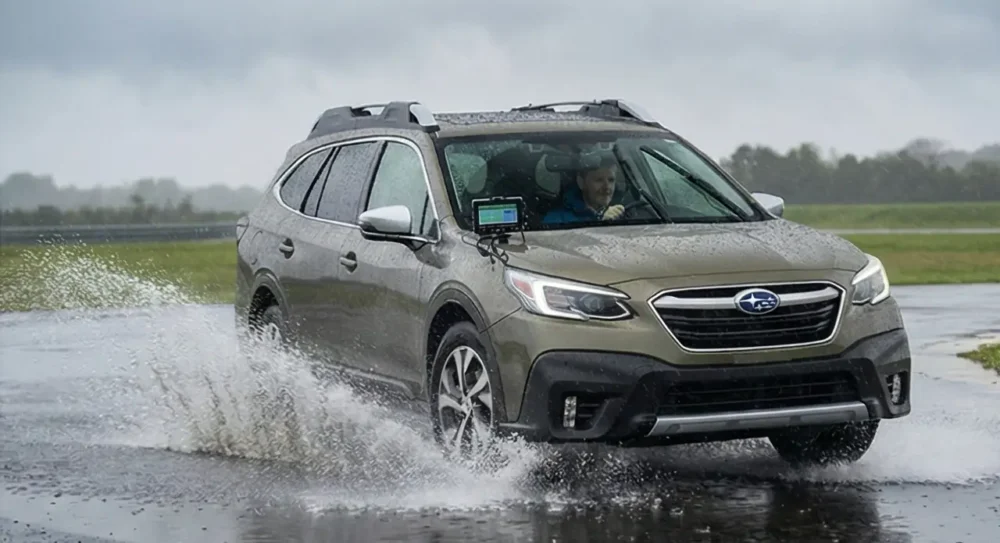
Testing hydroplaning resistance. The four wide longitudinal grooves were highly effective at evacuating water at speed.
The photo above captures the moment the car hit a roughly 2-inch deep pool of standing water at about 55 mph. In many tires, this is a “white-knuckle” moment where the steering wheel tugs violently in your hands as one tire hits the resistance of the water.
With the Scorpion Zero All Season, the drama was minimal. You can feel the resistance, sure, but the tire slices through rather than riding up over the water. Those four massive circumferential grooves you see on the tread pattern act like high-volume pumps, ejecting gallons of water out the back every second.
Braking performance in the wet was equally impressive. Stomp on the pedal on wet asphalt, and the ABS engages later than you expect because the compound is finding grip on the road surface itself, breaking through the water film. It gives you immense confidence in unpredictable weather.
However, a critical safety note from my experience in the shop: This incredible wet performance relies entirely on tread depth. As these deep grooves wear down, their capacity to hold water diminishes rapidly.
I always advise my readers not to wait for the legal minimum to replace their tires. If you don’t know how to measure this, read my guide on How to Check Tire Tread Depth.
Test Phase 3: The Noise Factor (The Invisible Test)
This test is harder to photograph, but it’s arguably the most important for daily driving luxury SUVs. When you spend $60,000+ on a vehicle, you don’t want to hear a constant “roar” from the tires on the highway.
High-performance tires with stiff sidewalls and large tread blocks are notoriously loud. They act like drumskins, transmitting road textures right into the cabin.
Our test tires were equipped with the PNCS acoustic foam. To test this, I took the car on a 200-mile highway loop featuring various surfaces, from smooth new blacktop to noisy, grooved concrete.
The difference is uncanny. The “booming” cavity noise usually associated with low-profile SUV tires is practically gone. It’s not dead silent—you still hear wind noise—but the tire roar is muted to a distant white noise that is easily drowned out by the radio at low volume.
If you own an electric SUV like a Tesla Model X or Audi e-tron, where there is no engine noise to mask tire hum, this feature is an absolute game-changer. Pirelli even makes specific versions of this tire marked “ELECT” for EVs, designed to handle their instant torque and extra weight.
Test Phase 4: The Winter Reality Check
Here is where we need to manage expectations. The tire is named “All Season.” On the sidewall, it is stamped M+S (Mud and Snow). But does that mean it’s a true winter tire?
Absolutely not. And our testing proved why the distinction matters.
We took the Outback up into the mountains as the first significant snows of the season were packing down onto the roads.
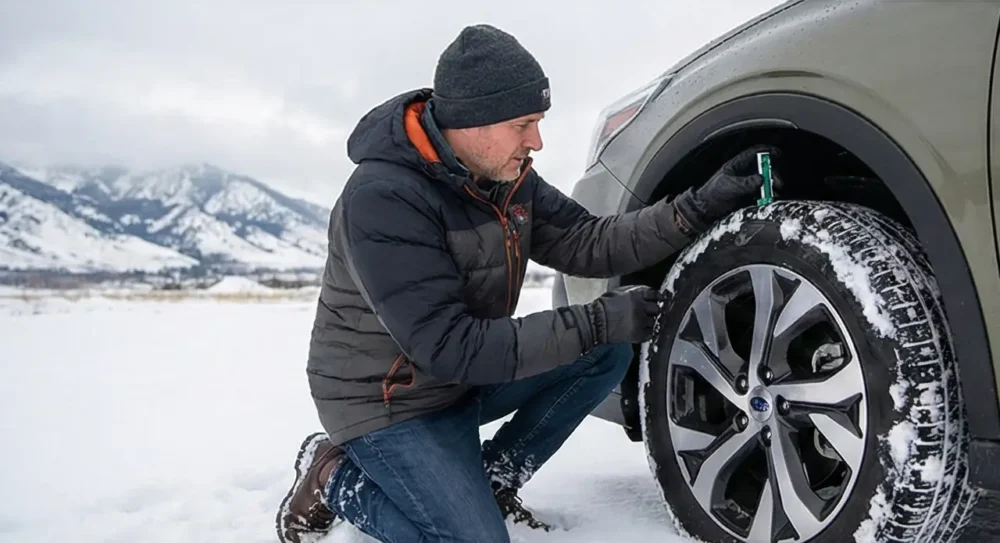
Evaluating winter traction in packed snow. While the sipes provide some bite, the compound stiffens significantly in freezing temperatures compared to a dedicated winter tire.
As shown in the image above, we subjected the tire to packed snow and slushy, freezing conditions. In slush and light, fresh powder (an inch or two), the high density of sipes on the inner tread does a commendable job. They bite into the snow, providing adequate acceleration and reasonable braking capabilities for getting around town during a light winter storm.
However, when temperatures dropped into the low 20s (°F) and the snow became hard-packed and icy, the limitations became clear. The UHP rubber compound, which was so brilliant on the dry track, began to stiffen up. It lost the pliability needed to conform to the microscopic irregularities of ice.
Stopping distances on packed snow were significantly longer than they would be with a dedicated winter tire carrying the 3PMSF (Three-Peak Mountain Snowflake) symbol. The rear of the car was much looser in corners, and the ABS worked overtime.
My professional verdict: If you live in a climate with mild winters where snow melts in a day or two, these are fine year-round. But if you live in the snowbelt or plan on driving through mountain passes in January, do not rely on these. You need dedicated winter rubber. You can see my top recommendations for true cold-weather tires in my Top Rated Winter Tires guide.
Test Phase 5: Off the Beaten Path
SUV owners like to know they can leave the pavement, even if they rarely do. To finish our testing, we took the Outback down some unmaintained fire roads, involving loose gravel and some slick, muddy sections after the rain.
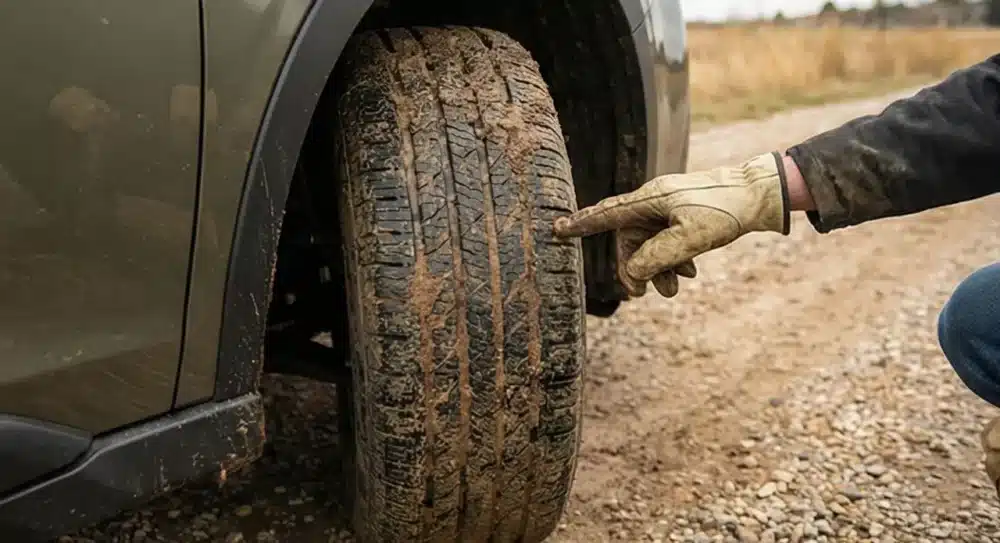
Checking tread clearing capabilities after a light off-road excursion. The tire handled gravel well, but deep mud is outside its design parameters.
The tire performed surprisingly well on dry gravel. The stiffness that helps on the track also protects the tire from stone drilling, and the grip was predictable.
In slick mud, as pictured above, the tire reaches its limit quickly. The tread pattern is designed for tarmac, not for self-cleaning thick clay. The grooves pack up with mud, and the tire essentially becomes a slick. It got us through, thanks to the Subaru’s AWD system, but it wasn’t happy about it.
This is a road tire that tolerates dirt; it is not an all-terrain tire.
Long-Term Impressions: Wear and the AWD Dilemma
At the conclusion of our 5,000-mile hard-use test, I measured the tread depth. We had lost approximately 1.5/32” of tread. Given the abuse they took on the dry handling course, this is respectable wear.
Pirelli typically backs these tires with a 50,000-mile treadwear warranty (depending on the specific sub-model, like the ‘Plus 3’). Based on my wear rates, that mileage is achievable if you are just commuting on the highway. If you drive enthusiastically in a heavy SUV, expect closer to 35,000 to 40,000 miles.
A crucial note for owners of AWD vehicles like our test Subaru, or Audis and BMWs: These high-performance AWD systems are incredibly sensitive to differences in tire circumference. If you blow out one of these Pirellis after 20,000 miles, you cannot just buy one new one.
The difference in tread depth between the new tire and the three old ones can destroy your car’s differential. Before you find yourself in that expensive situation, read my explanation: Can I Replace Just One Tire?.
Pros and Cons Summarized
To synthesize my technical analysis and shop experience, here is the honest breakdown of the Pirelli Scorpion Zero All Season:
The Pros:
- Exceptional Handling: Turns heavy SUVs into precise, agile machines. Cornering stability is best-in-class.
- Incredible Comfort: The PNCS foam technology drastically reduces cabin drone, making it ideal for luxury vehicles and EVs.
- Wet Safety: The massive longitudinal grooves provide excellent resistance to hydroplaning at highway speeds.
- Technological Integration: Available with ELECT for EVs, Run-Flat for safety, and Seal Inside technology.
The Cons:
- Price: This is a premium UHP tire, and it carries a premium price tag.
- True Winter Limits: Despite the “All Season” name, it is not suitable for heavy snow or deep ice.
- Foam Repair Issues: If a PNCS tire gets a simple nail puncture, some shops refuse to patch it because removing and re-gluing the acoustic foam is labor-intensive.
Pirelli Scorpion Zero All Season vs. The Competition
If you are dropping a thousand dollars or more on a set of SUV tires, you want to make sure you are making the right choice. Here is how the Scorpion Zero All Season stacks up against two of the biggest heavyweights in the market.
vs. Michelin CrossClimate 2
This is a battle of differing philosophies. The Michelin CrossClimate 2 is an “All-Weather” tire, meaning it carries the Three-Peak Mountain Snowflake (3PMSF) rating. If you live in an area that gets real, measurable snow, the Michelin will run circles around the Pirelli. The CrossClimate 2 also boasts a longer tread life.
However, the Pirelli wins on refinement and driving dynamics. The Michelin’s aggressive, V-shaped directional tread can become noticeably noisy as it wears down. The Pirelli, equipped with its PNCS sound-absorbing foam, is significantly quieter on the highway and provides a sharper, more engaging steering feel for performance SUVs.
The Verdict: Buy the Michelin if you prioritize winter safety and longevity. Buy the Pirelli if you prioritize a quiet, sporty ride in milder climates.
vs. Continental ExtremeContact DWS06 Plus
The Continental ExtremeContact DWS06 Plus is the undisputed king of the Ultra-High-Performance All-Season category. When compared to the Pirelli, the Continental delivers noticeably shorter braking distances in the wet and noticeably better grip in light snow and slush. Furthermore, the Continental generally offers a longer tread life and often comes in at a slightly lower price point.
Where the Pirelli holds its ground is in ultimate luxury comfort. While the Continental is fantastic, the Scorpion Zero All Season’s tread blocks and internal construction are hyper-focused on managing the sheer mass of heavy luxury SUVs while keeping the cabin whisper-quiet.
The Verdict: The Continental is the better all-around value and performance tire for most drivers. But if you drive a top-tier luxury SUV and want to preserve the absolute quietest cabin possible without giving up cornering stability, the Pirelli remains a highly attractive, specialized option.
Head-to-Head: Scorpion Zero All Season vs. The Competition
| Feature / Spec | Pirelli Scorpion Zero All Season | Michelin CrossClimate 2 | Continental ExtremeContact DWS06 Plus |
| Category | Ultra-High Performance All-Season | Grand Touring All-Weather | Ultra-High Performance All-Season |
| Key Strength | Sporty SUV handling & quiet ride (PNCS foam) | Exceptional snow/wet traction & longevity | Best-in-class wet grip & overall value |
| Biggest Weakness | Winter/Snow grip & shorter tread life | Numb steering feel & tread noise as it wears | Slightly softer sidewall feel |
| Winter Rating | M+S (Mud & Snow only) | 3PMSF (Severe Snow Rated) | M+S (Mud & Snow only) |
| Treadwear Warranty | 50,000 Miles | 60,000 Miles | 50,000 Miles |
The Verdict: The Real-World Takeaway
After living with the Pirelli Scorpion Zero All Season through heat, rain, and snow, I have come to a clear conclusion: This tire is a master of asphalt performance, who happens to be competent in bad weather.
It is not a “jack of all trades, master of none.” It is a master of dry handling, steering response, and highway comfort. It transforms a heavy SUV, making it feel 500 pounds lighter in the corners. It is vastly superior to a standard touring tire if you enjoy driving.
The compromises are real but manageable. It is expensive, it will likely wear faster than a generic touring tire, and it is not a substitute for a real snow tire in severe winter climates.
Who should buy this tire? If you own a luxury or performance SUV—a BMW X5, a Range Rover Sport, a Porsche Cayenne, or even a higher-horsepower Ford Explorer ST—and you actually enjoy driving it, this is the tire for you. It unlocks the suspension capability that you paid so much money for, without making your daily commute miserable with road noise.
Just remember to check your speed ratings and load indexes before buying to ensure you are getting the right spec for your heavy hauler. If those terms are confusing, check my guide on H vs T Speed Rating.
It’s a premium tire for a premium experience, and after thousands of hard miles, I can say it earns its reputation.
Frequently Asked Questions (FAQ)
Are Pirelli Scorpion Zero All Season tires good in the snow?
They are capable in light snow and slush due to their high sipe density and M+S rating. However, they lack the 3PMSF rating, meaning the rubber compound is not optimized for deep freezes or heavy, packed snow. For severe winters, dedicated winter tires are required.
What is the difference between the Scorpion Zero All Season and the Scorpion Zero Asimmetrico?
The All Season is the much newer, technologically advanced evolution. It features 93% more sipes for better winter traction, a revised compound for longer wear, and often includes newer tech like PNCS foam, which the older Asimmetrico model lacked.
Can I patch a Pirelli tire with PNCS foam inside?
Technically, yes, but it requires a skilled technician. The mechanic must carefully cut away a section of the foam, properly buff and patch the inner liner, and then ideally glue the foam back in place. Many quick-lube tire shops will refuse to do this and insist on a replacement, so you may need to visit a dedicated Pirelli dealer for repairs.
What does the “XL” on the tire size mean?
XL stands for Extra Load. It means the internal cords of the tire are reinforced to carry a heavier load at a higher air pressure than a standard passenger tire. Because modern SUVs and EVs are extremely heavy, XL-rated tires are usually a strict requirement to prevent blowouts.
How many miles will these tires last?
Depending on your driving style and vehicle weight, you can expect between 40,000 and 50,000 miles. Regular rotations (every 5,000 miles) and proper alignment are critical to reaching that upper mileage limit.
Pirelli Scorpion Zero All Season
We tested the Pirelli Scorpion Zero All Season on a heavy SUV for 6 months. Discover its pros, cons, and how it compares to Michelin and Continental.
Product Brand: Pirelli
Product Price: $209.57 to $909.32
4.6