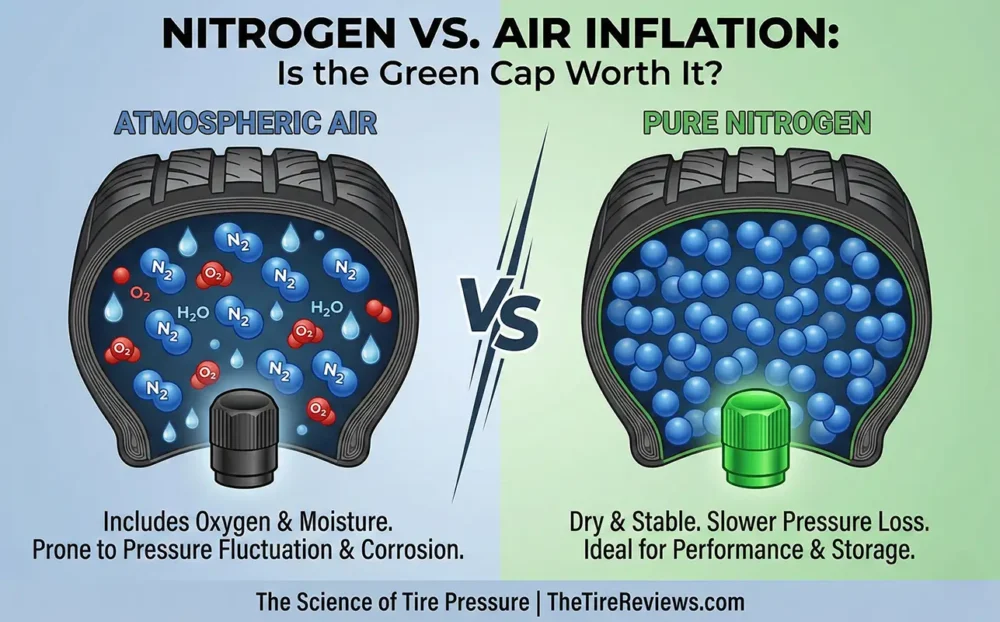
Walk into any modern dealership or high-end tire shop, and you will likely be pitched an upgrade before you even hand over your keys: Nitrogen inflation.
Often signaled by a distinct green valve stem cap, nitrogen is marketed as a miracle gas derived from Formula 1 technology that will save you fuel, extend your tire life, and keep your pressure stable forever. But is this science, or is it just high-margin salesmanship?
If you are driving a daily commuter car, an SUV, or a light truck, the answer isn’t a simple yes or no. It is a calculation of cost versus benefit.
In this comprehensive guide, we will strip away the marketing fluff and look at the molecular science of tire inflation. We will analyze the real-world benefits, the logistical downsides, and help you decide if you should stick with good old-fashioned air or pay the premium for nitrogen.
The Chemistry Class: What is “Air” Anyway?
To understand the debate, we first need to understand what is currently inside your tires. When you use a standard compressor at a gas station or in your garage, you are filling your tires with atmospheric air.
Atmospheric air is not a mystery substance. It is composed of:
- 78% Nitrogen
- 21% Oxygen
- 1% Other gases (Argon, Carbon Dioxide, Neon, etc.)
- Water Vapor (Humidity, which varies wildly)
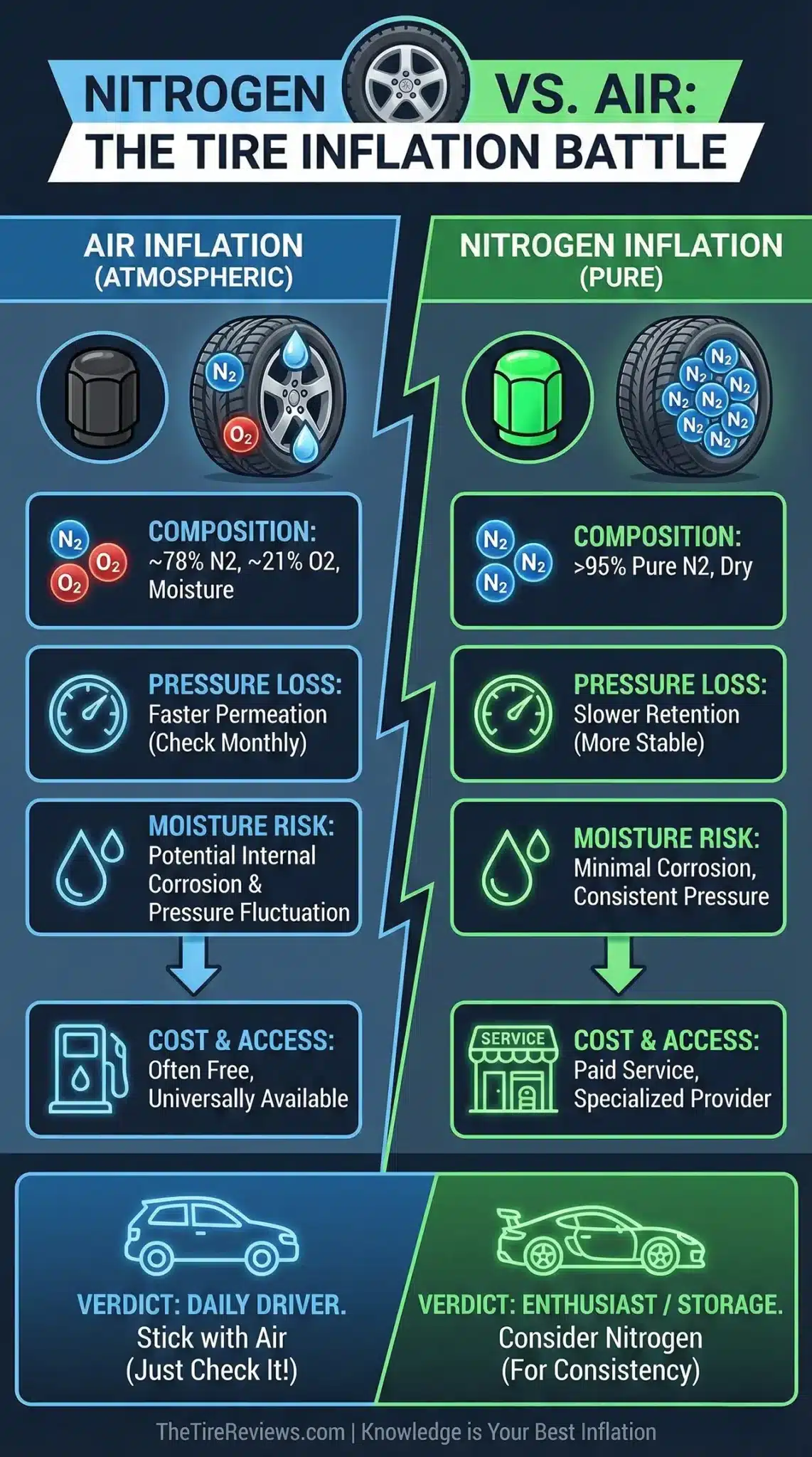
The Critical Takeaway: Standard air is already mostly nitrogen. When you pay for a “Nitrogen Fill,” you are essentially paying to remove that 21% oxygen and the trace water vapor to achieve a purity of roughly 93% to 99% nitrogen. The debate, therefore, isn’t “Nitrogen vs. Air,” but rather “99% Nitrogen vs. 78% Nitrogen.”
The 4 Main Claims of Nitrogen Inflation
Proponents of nitrogen—and the service advisors trying to sell it to you—usually rely on four main arguments. Let’s break them down scientifically.
Claim 1: Nitrogen Maintains Pressure Longer
The Theory: Nitrogen molecules are larger than oxygen molecules, so they don’t leak out of the tire rubber as fast.
The Science: This is true. Through a process called permeation, gas molecules slowly migrate through the microscopic pores of your tire’s rubber sidewall. It’s why a perfectly healthy tire will still lose 1-2 PSI per month. A nitrogen molecule is slightly larger (about 300 picometers) compared to an oxygen molecule (about 292 picometers). Because it is “fatter,” it struggles to squeeze through the rubber structure.
The Verdict: A tire filled with 99% nitrogen will lose pressure about 30% to 40% slower than a tire filled with compressed air. However, it will still lose pressure. It is not a “set it and forget it” solution. You still need to perform your monthly safety checks as outlined in our ultimate tire buying and maintenance guide.
Claim 2: Improved Fuel Economy
The Theory: Nitrogen keeps tires properly inflated, and properly inflated tires get better gas mileage.
The Science: This is a classic case of correlation, not causation. Nitrogen itself does not make your car roll more efficiently. However, because nitrogen resists permeation (pressure loss) better than air, nitrogen-filled tires are more likely to stay at their optimal PSI for longer periods between checks. Under-inflated tires increase rolling resistance, which kills fuel economy. By staying inflated, you save gas.
The Verdict: True, but misleading. You can achieve the exact same fuel economy with standard air if you simply check your tire pressure once a month.
Claim 3: Prevention of Wheel Corrosion and Tire Rot
The Theory: Oxygen and water are the enemies of steel and rubber. Removing them prevents rust.
The Science: This is nitrogen’s strongest argument. Standard compressed air contains water vapor. If the compressor at the gas station hasn’t been drained recently, you might actually be pumping liquid water into your tire.
- Oxygen causes “oxidation” (rust) on steel wheels and belts, and it chemically degrades the rubber inner liner over years.
- Water Vapor accelerates this corrosion. Nitrogen is an “inert” gas, meaning it is very dry and doesn’t react with the rubber or the steel rim.
The Verdict: Valid, but mostly for long-term storage. For a daily driver, the tread will likely wear out long before the rubber oxidizes from the inside out. However, if you are storing a vehicle for months, this is crucial (more on this in the “Classic Car” section below).
Claim 4: Consistent Pressure During Heat Buildup
The Theory: Nitrogen pressure doesn’t spike when tires get hot.
The Science: This is why NASCAR, Formula 1, and aircraft use nitrogen. The issue isn’t the air; it’s the water. When a tire heats up (due to friction and braking), any moisture inside turns from liquid to gas (steam). This phase change causes a massive, unpredictable spike in tire pressure. Dry nitrogen has no water, so the pressure rise is predictable and linear (governed by the Ideal Gas Law).
The Verdict: Vital for race cars driving at 200mph. Irrelevant for a minivan driving to soccer practice.
The Hidden Downsides of Nitrogen
While the science supports nitrogen as a “superior” gas, the logistics of living with it are often ignored.
1. The Convenience Factor
The biggest drawback to nitrogen is accessibility. If your tire pressure monitoring system (TPMS) light comes on while you are on a road trip, you cannot simply pull into any gas station. Most stations only have standard air. If you are low on pressure, you have two choices:
- Find a specialty shop that sells nitrogen (which might be closed).
- Top off with standard air (which dilutes your expensive nitrogen purity, turning it back into normal air).
2. The Cost
Standard air is usually free, or maybe $1.50 at a gas station pump. Nitrogen inflation packages at dealerships can range from $40 to $100 for four tires. When you calculate the cost per PSI over the life of the tire, nitrogen is exponentially more expensive.
3. The False Sense of Security
This is the most dangerous downside. Drivers who pay for nitrogen often believe the myth that they never need to check their tires again. They ignore their pressure for six months, assuming the “Green Cap” is magic. Nitrogen does migrate, and tires can still pick up nails or have valve leaks. A nitrogen-filled tire that isn’t checked is far less safe than an air-filled tire that is checked monthly.
Scenario Analysis: Do YOU Need Nitrogen?
The answer depends entirely on what you drive and how you drive it. Let’s break it down by driver profile.
The Daily Commuter (Sedans, SUVs, Minivans)
Recommendation: NO If you drive a Honda CR-V, Ford F-150, or Toyota Camry for normal commuting, the benefits of nitrogen are negligible.
- Why: You will wear through the tire tread long before oxidation damages the inside of the tire.
- Alternative: Buy a high-quality digital pressure gauge for $10 and check your air monthly. You will get the same fuel economy and safety benefits for free.
The “Weekend Warrior” & Track Enthusiast
Recommendation: YES If you drive a Corvette, Porsche, or track-prepped Miata and participate in AutoCross or Track Days, nitrogen is valuable.
- Why: Consistency. When you are cornering at the limit, a 3 PSI spike due to water vapor expansion can change the handling balance of the car. Nitrogen ensures your “hot pressure” is predictable lap after lap.
- Note: If you are running high-performance rubber, check out our guide on tire speed ratings to ensure your tires can handle the heat you are generating.
The Classic Car Collector
Recommendation: YES If you own a vintage ’69 Mustang or a classic Mercedes that sits in a garage for 5 months out of the year, nitrogen is a smart investment.
- Why: Lack of movement. When a car sits, moisture in standard air settles at the bottom of the tire, causing rim corrosion and rubber rot. Nitrogen is dry, protecting those expensive vintage wheels and hard-to-find tires while they sit in storage.
- For more on maintaining older rubber, see our vintage tire guide.
The RV and Trailer Owner
Recommendation: YES RVs and travel trailers are the perfect use case for nitrogen.
- Why: They combine “sitting for long periods” (corrosion risk) with “heavy loads at highway speeds” (heat risk).
- Safety: Trailer tires are notorious for blowouts. Keeping the pressure stable and the moisture out helps mitigate heat buildup. (Also, ensure you are choosing the right construction—learn more in our radial vs bias ply tire comparison).
The “Purity” Problem: Are You Getting What You Paid For?
Here is a dirty secret of the industry: Not all nitrogen fills are created equal.
To see the benefits of nitrogen, the purity inside the tire needs to be above 95%. However, when a shop installs your new tires, the tire is full of atmospheric air (21% oxygen) before they even seat the bead. If they just inflate it with nitrogen on top of that air, you end up with a mix that is only about 90% nitrogen.
To get a proper fill, the technician must purge the tire. This involves:
- Filling with nitrogen.
- Deflating the tire.
- Filling with nitrogen again.
- Deflating again.
- Filling a third time.
If you are paying for nitrogen, ask the shop: “Do you use a purge cycle system?” If they just top it off once, you are wasting your money.
Frequently Asked Questions (FAQ)
Can I mix air and nitrogen in tires?
Yes, absolutely. It is perfectly safe. There is a myth that mixing them causes a chemical reaction or damages the tire. This is false. Remember, air is already 78% nitrogen. Adding air to a nitrogen tire simply lowers the purity.
Scenario: You have nitrogen tires, but your pressure is low and you are at a gas station.
Action: Top it off with regular air. It is safer to drive on a properly inflated tire with a mix of gases than an under-inflated tire with pure nitrogen.
Does nitrogen affect the Tire Pressure Monitoring System (TPMS)?
Nitrogen generally helps TPMS sensors last longer. Because nitrogen is dry, it prevents the moisture corrosion that often kills the valve stem sensors used in modern TPMS.
How much should I pay for nitrogen?
If you are buying a new set of tires, many reputable shops (like Costco) include nitrogen inflation for free. If a dealership tries to charge you $199 for a “Nitrogen Protection Package” on a new car purchase, decline it. That is a massive markup for $5 worth of gas. A fair price for a conversion on existing tires is roughly $5 to $10 per tire.
Do nitrogen tires need to be checked?
Yes. Nitrogen migrates slower than air, but it still leaks. You should still check your pressure at least once a month and before any long road trips.
What do the Green Valve Caps mean?
The green cap is the universal industry signal that a tire is filled with nitrogen. It warns technicians not to top it off with standard air unless necessary, preserving the purity. If you switch back to standard air, you should replace the green caps with standard black or chrome ones to avoid confusion.
The Final Verdict: Air or Nitrogen?
For the vast majority of drivers, standard air is good enough.
The benefits of nitrogen are rooted in science, but in the real world of potholes, nails, and daily commuting, the practical difference is minimal. The money you spend on nitrogen would be better spent on a high-quality portable tire inflator and a digital gauge.
Stick with Standard Air If:
- You check your tire pressure monthly (as you should).
- You drive a standard passenger vehicle.
- You want the convenience of filling up anywhere.
- You are looking to save money.
Switch to Nitrogen If:
- You own a classic car that sits in storage.
- You own an RV or heavy trailer.
- You drive a track car where 1 PSI makes a difference in handling.
- The shop offers it for free with your tire purchase.
Ultimately, the most important gas in your tire is not nitrogen or oxygen—it is pressure. A tire filled with standard air to the correct PSI is infinitely safer and more efficient than a nitrogen-filled tire that is 5 PSI low.
Don’t rely on the green cap. Rely on your pressure gauge.
Looking for more ways to maintain your vehicle?
- Check out our guide on how to book a tire appointment at Walmart if you are looking for affordable installation (standard air included).
- Need to know if your tires are worn out? See our guide on signs you need new tires.
- Buying all-season tires? Read our review of the Mastercraft Stratus HT.