If you walk through any parking lot in America and look closely at the tires, you will see something terrifying. I do it out of habit—hazard of the trade, I guess. I glance at the wheel wells of the cars parked next to me at the grocery store, and more often than not, I see smooth, bald rubber staring back.
The drivers of those cars probably have no idea. They likely assume that because the tire is holding air, it is “fine.”
But here is the reality I’ve learned from years of analyzing crash data and tire mechanics: Tread depth is the single most critical factor in whether you stop in time or slide into the bumper ahead of you.
It isn’t just about avoiding a flat tire. It is about water evacuation. At highway speeds in the rain, your tires need to pump gallons of water out of the way every second.
If the grooves are too shallow, the water has nowhere to go. The tire rides up on top of the water (hydroplaning), and your steering wheel becomes a useless prop.
The good news? Checking your tread depth takes less than 60 seconds, costs zero dollars (if you have a penny in your pocket), and is the easiest DIY maintenance task you can perform.
In this guide, I will walk you through the professional methods for checking tread depth, explain why the “legal limit” might not actually be safe, and help you interpret what your tread wear is telling you about your car’s health.
- Why Tread Depth Actually Matters (The Science)
- The “Legal” Limit vs. The “Safe” Limit
- Method 1: The Penny Test (The Classic)
- Method 2: The Quarter Test (The Expert’s Choice)
- Method 3: The Wear Bars (The Built-In Tool)
- Method 4: Using a Tread Depth Gauge (Pro Accuracy)
- How to Check: A Step-by-Step Walkthrough
- Reading the Warning Signs: Uneven Wear
- Common Mistakes People Make
- Conclusion: When to Replace
- Frequently Asked Questions (FAQ)
Why Tread Depth Actually Matters (The Science)
To understand why we check depth, we have to understand what the tread actually does.
On dry pavement, racing slicks (tires with no tread) actually offer the best grip because they put the maximum amount of rubber in contact with the road. But we don’t drive on racetracks. We drive in the real world, where there is rain, snow, slush, and mud.
The grooves in your tire are essentially channels. Their job is to accept water and eject it out the sides and back of the tire as it rolls.
The Hydroplaning Equation
When a tire is new (usually 10/32” to 12/32” deep), these channels are deep canyons. They can handle a massive volume of water.
- At 10/32”: The tire cuts through standing water easily.
- At 4/32”: The channels are shallow. The tire struggles to clear water fast enough.
- At 2/32”: The channels are almost gone. The water builds up a “wedge” in front of the tire, lifting it off the asphalt. You are now water-skiing.
In my experience testing tires, the drop-off in performance isn’t linear—it’s exponential. A tire with 4/32” of tread takes significantly longer to stop on wet pavement than a new tire. This is why knowing your exact measurements is vital, especially if you prioritize safety features like those found in high-speed ratings. (See our guide on H vs T Speed Ratings for more on how speed capability relates to safety).
The “Legal” Limit vs. The “Safe” Limit
This is the most controversial topic in the tire industry, and it is where my advice might differ from the bare minimum you see in state handbooks.
The Legal Limit: 2/32”
In most U.S. states, a tire is considered legally worn out when it reaches 2/32 of an inch (approximately 1.6mm). If you are inspected and your tires are below this, you can fail safety inspections or even get a ticket.
- Pros: It maximizes the life of the tire.
- Cons: It is dangerous in anything other than perfectly dry conditions.
The Safe Limit: 4/32”
Most tire experts, including myself and major manufacturers like Continental and Michelin, recommend replacing tires when they reach 4/32 of an inch if you drive in rain, and 5/32” to 6/32” if you drive in snow.
Why the difference? Tests have shown that a car braking from 60 mph on wet pavement takes nearly 100 feet longer to stop with tires at 2/32” compared to tires at 4/32”. That 100 feet is the difference between a panicked stop and a totaled car.
If you are approaching the winter months, do not wait for 2/32”. Check out our Top Rated Winter Tires and make the switch early.
Method 1: The Penny Test (The Classic)
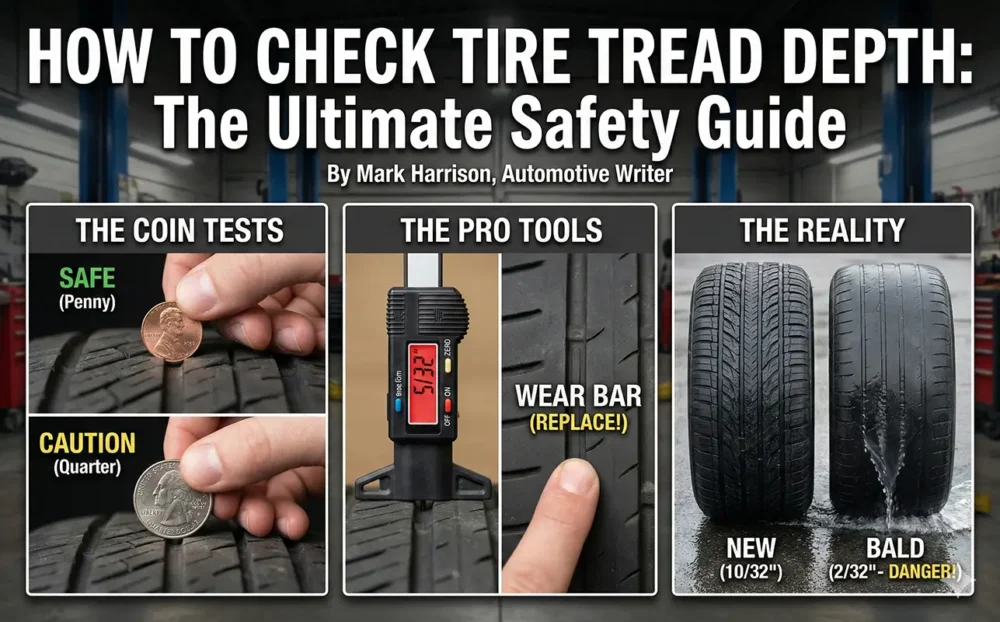
This is the method everyone knows. It’s quick, it requires no special tools, and it checks for the legal limit (2/32”).
How to do it:
- Take a standard U.S. penny.
- Turn Lincoln upside down (so his head is facing the tire).
- Insert the penny into the tread groove at the lowest point.
The Verdict:
- If you can see ALL of Lincoln’s head: Your tread is less than 2/32”. The tire is bald. Replace immediately.
- If part of Lincoln’s head is covered: You have more than 2/32”. You are legally safe (for now).
My Take: The Penny Test is better than nothing, but it sets the bar too low. It tells you when you are already in the danger zone. I prefer the Quarter Test.
Method 2: The Quarter Test (The Expert’s Choice)
If you value stopping distance and wet-weather safety, use a quarter instead of a penny. This tests for the 4/32” safe limit.
How to do it:
- Take a U.S. quarter.
- Turn Washington upside down.
- Insert the quarter into the tread groove.
The Verdict:
- If the tread touches Washington’s head: You have at least 4/32” of tread remaining. Your tires still have decent wet-weather capability.
- If you can see the gap above Washington’s head: You are below 4/32”.
Why I recommend this: If you pass the Penny Test but fail the Quarter Test, you are in the “Yellow Zone.” You don’t need to panic and replace them today, but you should start budgeting for new tires immediately. This gives you time to research and find the best deal, rather than being forced to buy whatever the shop has in stock because you failed an inspection.
If you find yourself in this “Yellow Zone,” start reading up on replacements now. Our guide to the Best All-Weather Tires is a great place to start planning your next purchase.
Method 3: The Wear Bars (The Built-In Tool)
Did you know your tires have a gauge built right into them? They are called Tread Wear Indicator Bars.
How to find them: Look closely at the grooves of your tire. Every 10 to 12 inches, you will see a small, raised rubber bar running across the bottom of the groove. It looks like a little bridge connecting the tread blocks.
These bars are molded to be exactly 2/32” high.
The Verdict:
- If the tread is higher than the bar: You are good.
- If the tread is flush (level) with the bar: Your tire is at the legal limit. It creates a seamless strip of rubber across the tire.
Pro Tip: Sometimes it is hard to see these bars if your tires are dirty. Run your finger across the groove. If you feel a “bump,” that is the wear bar. If your finger slides smoothly from the tread block across the groove without dipping down, you are flush with the bar and need to replace the tire.
Method 4: Using a Tread Depth Gauge (Pro Accuracy)
If you are a car enthusiast or just like precision, spend $5 at an auto parts store and buy a Tread Depth Gauge.
This is what we use in the shop. It eliminates the guesswork of “Is that Lincoln’s hair or his forehead?”
How to use it:
- Push the metal probe all the way out.
- Place the flat plastic bar across the top of the tread blocks.
- Push the probe down until it hits the bottom of the groove.
- Read the measurement in /32nds of an inch or millimeters.
Why buy one? A gauge allows you to track wear over time. If you measure 8/32” in January and 6/32” in June, you can predict exactly when you’ll need new tires. It also helps you spot uneven wear early (more on that below).
How to Check: A Step-by-Step Walkthrough
Checking your tires isn’t just about sticking a coin in one spot and walking away. To do it right—the way a mechanic would—follow this routine.
Step 1: Park on a Flat Surface Ensure your emergency brake is on. You want the car stable.
Step 2: Turn the Wheel This is the step most people skip.
- Turn your steering wheel all the way to the right (lock-to-lock).
- This exposes the tread of the front tires so you can easily see the inner edge, center, and outer edge without crawling on the ground.
Step 3: Check the Front Tires (3 Points) Insert your coin or gauge in three places:
- The outer groove.
- The center groove.
- The inner groove.
Critical Note: If the center reads 6/32” but the inner edge reads 2/32”, you need a new tire. A tire is only as good as its weakest point. Inner edge wear is sneaky—you can’t see it from the curb, but it can lead to a blowout just as easily.
Step 4: Check the Rear Tires You can’t turn the rear wheels, so you’ll have to kneel down. Check all visible grooves. Rear tires often wear differently than fronts, especially on RWD or AWD vehicles.
Step 5: Inspect for Damage While you are down there, look for:
- Cracks in the sidewall (Dry rot).
- Bulges or bubbles (Impact damage).
- Nails or screws embedded in the rubber.
If you find damage on just one tire, you face a dilemma. Can you replace just that one? Or do you need a pair? Read our detailed guide: Can I Replace Just One Tire? before you head to the shop.
Reading the Warning Signs: Uneven Wear
Your tires are like a report card for your car’s suspension and alignment. The way they wear tells a story. When checking depth, look for these patterns:
1. Center Wear Only
- The Look: The middle of the tire is bald (2/32”), but the edges have plenty of tread (6/32”).
- The Cause: Over-inflation. You are pumping too much air into the tire, causing it to balloon out in the middle. The contact patch is too small.
- The Fix: Check your door jamb placard for the correct PSI and let some air out.
2. Both Edges Worn (Shoulder Wear)
- The Look: The center has good tread, but both inner and outer edges are smooth.
- The Cause: Under-inflation. The tire is sagging, putting all the weight on the sidewalls.
- The Fix: Inflate your tires immediately! Under-inflation generates excessive heat and is a leading cause of blowouts.
3. One-Side Wear (Camber Wear)
- The Look: The inside edge is bald, but the outside looks brand new (or vice versa).
- The Cause: Alignment issues (Camber). Your wheels are tilted inward or outward.
- The Fix: You need a professional wheel alignment. No amount of tire rotation will fix this.
4. Cupping or “Scalloping”
- The Look: The tire has dips or scoops in the tread, looking like hills and valleys. It often makes a loud “wub-wub-wub” noise when driving.
- The Cause: Worn suspension parts. Your shocks or struts are shot, and the tire is literally bouncing down the road.
- The Fix: New shocks/struts.
- Related Reading: If your tires are making strange noises, check out Reducing Road Noise with the Right Tires for more diagnostics.
For a full breakdown of how to keep your tires wearing evenly, print out our Ultimate Tire Maintenance Checklist and keep it in your glovebox.
Common Mistakes People Make
In my years helping customers, I see the same errors repeated. Avoid these traps:
1. Checking only one spot. As mentioned above, if you only check the outer edge, you might miss dangerous wear on the inside edge caused by poor alignment. Always check the full width of the tire.
2. Ignoring the spare tire. You check your four main tires, they look great. But what about the spare in the trunk? I have seen people get a flat, pull out their spare, and find it is flat too because it hasn’t been checked in 5 years. Check your spare’s pressure and tread annually.
3. Thinking “A little bald is okay.” I hear people say, “It’s only bald on the side, the rest is fine.” That “side” is what holds you in a corner. If the shoulder is gone, your structural integrity is compromised.
4. Relying on the TPMS. Your Tire Pressure Monitoring System (TPMS) tells you about air pressure, not tread depth. The light on your dashboard will not warn you that your tires are bald. You have to look with your own eyes.
Conclusion: When to Replace
So, you have done the Penny Test, the Quarter Test, and looked for wear bars. When do you actually pull the trigger on new tires?
The Mark Harrison “Green-Yellow-Red” Rule:
- 🟢 GREEN (6/32” or more): You are safe. Check again in 3 months.
- 🟡 YELLOW (4/32” to 5/32”): Caution.
- If you live in a rainy or snowy climate (like Montana), Replace Now.
- If you live in a dry climate (like Arizona), you can drive a bit longer, but start shopping.
- 🔴 RED (3/32” or less): Danger.
- Replace Immediately. You are a hazard to yourself and others.
Remember, tires are the only thing connecting your 4,000-pound vehicle to the road. The contact patch for each tire is about the size of a human hand. Don’t gamble with it.
If your check revealed that it’s time for fresh rubber, don’t just buy the first thing you see. Do your homework. Start with our guide to How to Read Tire Size to ensure you get the right fit, and then browse our top picks for Best All-Season Tires.
Drive safe, and check those tires!
Frequently Asked Questions (FAQ)
How often should I check my tire tread depth?
I recommend checking once a month, at the same time you check your air pressure. At a bare minimum, you must check before any long road trip and before the winter season begins.
Can tires expire even if they have good tread?
Yes! This is called “Dry Rot.” Rubber degrades over time due to UV exposure and oxidation. Most manufacturers recommend replacing tires after 6 to 10 years, regardless of tread depth. Check the DOT date code on the sidewall to find the age of your tires.
My tires are at 4/32″, but it’s summer. Can I wait?
You can, but be careful. While dry traction might be okay, summer storms can lead to flash flooding. If you encounter standing water with 4/32″ tires, you are at higher risk of hydroplaning. If you can afford it, replacing them earlier is always safer.
Do front tires wear faster than rear tires?
On Front-Wheel Drive (FWD) cars, yes. The front tires handle the power, the steering, and the majority of the braking. They can wear 2x faster than rears. This is why Tire Rotation every 5,000 to 7,000 miles is crucial to extend the life of your set.
Is the penny test accurate for all tire types?
It is a general rule of thumb for passenger tires. However, for specialized tires like Winter Tires or Off-Road/All-Terrain Tires, the legal limit might be higher (often 4/32″ or 6/32″) to maintain effectiveness in deep snow or mud. For these tires, rely on the specific “snow platforms” (special wear bars) built into the tread design.