When it comes to buying new tires, most drivers I talk to focus on the obvious specs: tire size, brand, and usually the price tag. You check the sidewall, match the numbers—205/55R16, for example—and assume you’re good to go.
But there is a small, often overlooked letter at the end of that sequence that plays a critical role in your vehicle’s safety and performance: the speed rating.
In my years of researching automotive maintenance and analyzing tire performance data, I’ve found that the confusion between H and T ratings is one of the most common pitfalls for car owners.
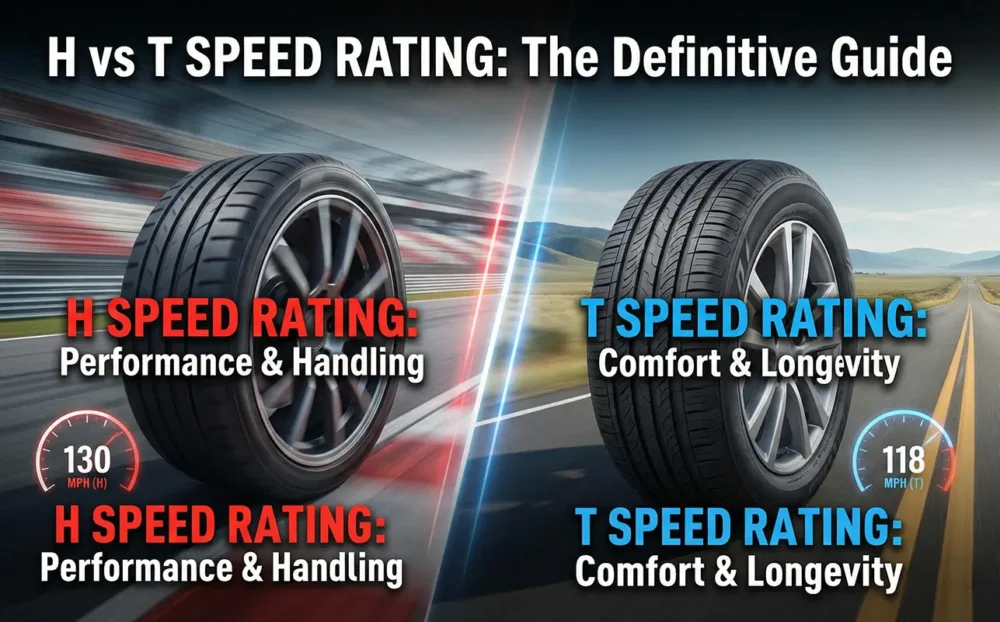
At a glance, the difference seems negligible. One is rated for 130 mph, the other for 118 mph. Since most of us rarely drive above 80 mph on the highway, does it really matter which one you choose?
The short answer is yes. The H vs T speed rating debate isn’t just about top speed; it’s about handling, heat resistance, ride comfort, and the structural integrity of your tires under stress.
In this detailed guide, I will break down everything you need to know about H and T speed ratings, helping you make an informed decision for your next set of tires—just like I would for my own vehicle.
- What Exactly is a Tire Speed Rating?
- The History of Speed Ratings
- T-Rated Tires: The Daily Commuter’s Choice
- H-Rated Tires: Performance and Precision
- H vs T: The Core Differences
- Can You Mix H and T Rated Tires?
- Can I Downgrade My Speed Rating?
- How to Find Your Vehicle’s Speed Rating
- Conclusion: Which One Should You Choose?
- FAQs About H vs T Speed Ratings
What Exactly is a Tire Speed Rating?
Before diving into the H vs T comparison, it is vital to understand what a speed rating actually represents. A tire’s speed rating is the maximum speed at which the tire can carry a load safely for a sustained period without failing.
It is important to note that this rating is determined via laboratory testing under controlled conditions. It does not mean you should drive at that speed on the highway, nor does it account for real-world variables like under-inflation, road damage, or overloaded vehicles.
Speed ratings are denoted by a letter on the tire sidewall, typically following the load index. For example, in a tire marked 215/60R16 95T, the “95” is the load index, and the “T” is the speed rating.
For a deeper dive into reading these codes, check out our guide on Understanding Tire Sidewall Markings.
The Science Behind the Letter
As tires spin, they generate heat. The faster they spin, the more heat they generate. If a tire cannot dissipate that heat effectively, the internal components—belts, plies, and rubber compounds—can separate, leading to a catastrophic blowout.
Higher speed ratings (like H, V, W, and Y) indicate that the tire is constructed with premium materials and stiffer sidewalls to handle high-speed heat buildup. Lower ratings (like S and T) are designed for standard operating conditions where extreme heat generation is less of a concern.
The History of Speed Ratings
The system we use today originated in Europe in the 1960s to categorize tires based on the top speeds of vehicles on the Autobahn. Initially, there were only three ratings: S (Speed), H (High Speed), and V (High Velocity).
- S was for standard sedans (up to 112 mph).
- H was for sports cars (up to 130 mph).
- V was for high-performance vehicles (up to 149 mph).
Over time, as vehicle technology advanced, the alphabet was filled in to accommodate a wider range of speeds. This is why “H” sits awkwardly between “U” and “V” in the speed rating chart, disrupting the alphabetical order. It is a legacy of its original “High Speed” designation.
Understanding this history helps explain why H-rated tires are still associated with “performance” touring, while T-rated tires (which came later to fill the gap for family vehicles) are associated with standard passenger use.
For more on the evolution of tire tech, read our article on the History of Tire Safety Standards.
T-Rated Tires: The Daily Commuter’s Choice
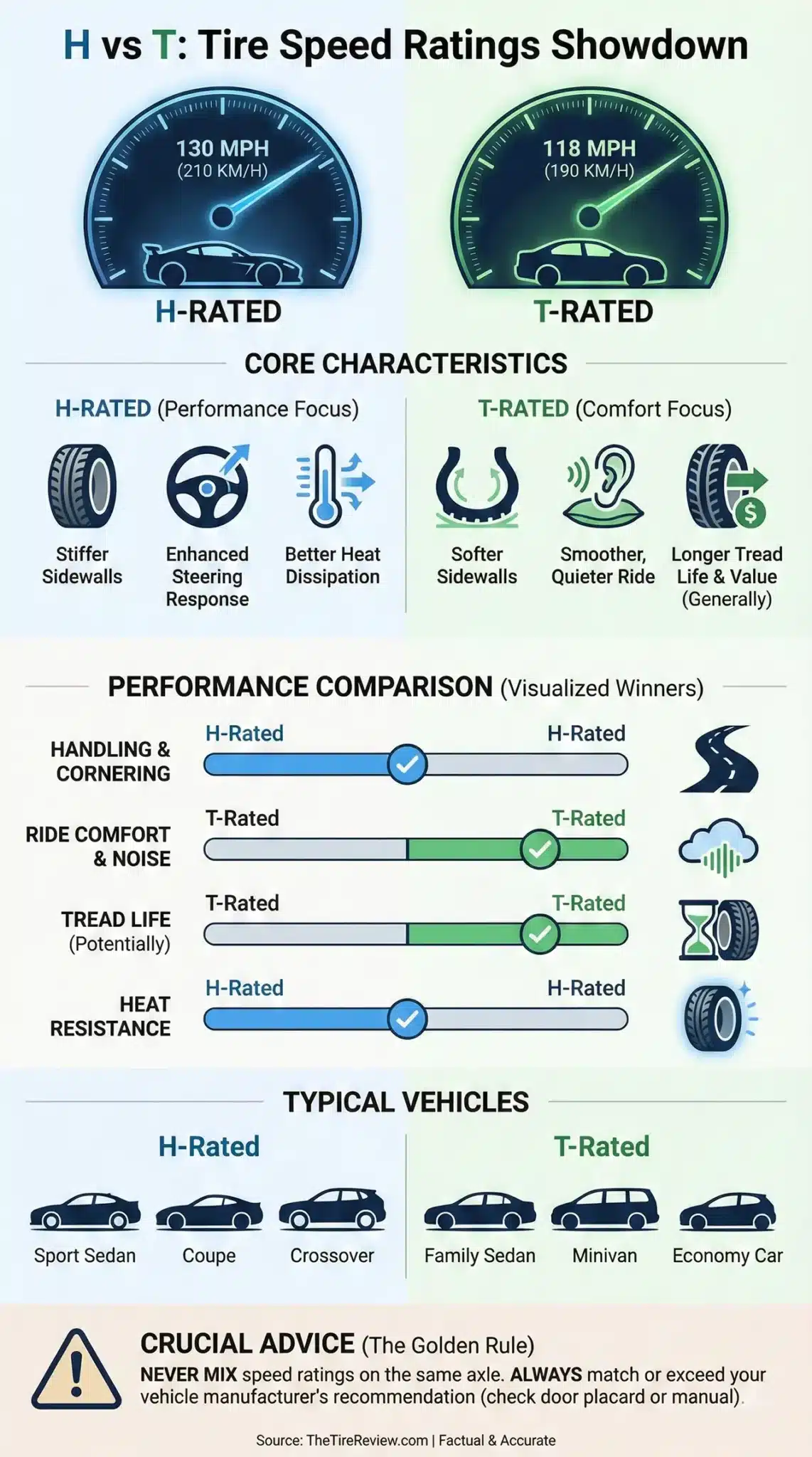
Maximum Speed: 118 mph (190 km/h) Typical Vehicles: Minivans, family sedans, compact SUVs, and economy cars.
T-rated tires are the workhorses of the passenger vehicle world. If you drive a Toyota Camry, a Honda Odyssey, or a Ford Escape, there is a good chance your vehicle came from the factory with T-rated tires.
Characteristics of T-Rated Tires
- Comfort-Focused Construction: T-rated tires generally feature softer sidewalls. Since they don’t need to remain as rigid at 130+ mph, manufacturers can tune the casing to absorb road imperfections, potholes, and bumps more effectively.
- Longer Tread Life: The rubber compounds used in T-rated tires are often harder and more durable. This focus on longevity makes them ideal for drivers who want to get the most miles out of their purchase.
- Cost-Effective: Generally, T-rated tires are less expensive to manufacture and purchase than their higher-speed counterparts.
If you are a driver who prioritizes a plush ride and high mileage over cornering grip, T-rated tires are often the best fit. For recommendations on long-lasting rubber, see our list of the Best Summer Tires for 2026.
H-Rated Tires: Performance and Precision
Maximum Speed: 130 mph (210 km/h) Typical Vehicles: Sport sedans, coupes, crossovers, and some luxury touring vehicles.
H-rated tires are a step up in the performance hierarchy. While 130 mph is the theoretical limit, the real benefit of an H-rated tire is not the speed capability itself—it’s the handling capability that comes with it.
Characteristics of H-Rated Tires
- Stiffer Sidewalls: To maintain stability at 130 mph, H-rated tires require a more rigid internal structure. This reduces tire flex during cornering.
- Enhanced Steering Response: Because the tire doesn’t “roll over” as much when you turn the steering wheel, H-rated tires feel more responsive. The car reacts faster to your inputs.
- Better Heat Resistance: H-rated tires are built with materials (often including nylon cap plies) that dissipate heat more efficiently than T-rated tires.
These tires are often categorized as “Grand Touring” tires. They bridge the gap between a standard passenger tire and a dedicated high-performance tire. If you enjoy spirited driving on back roads or want that “planted” feel on the highway, H is usually the starting point.
H vs T: The Core Differences
Now that we’ve defined the players, let’s pit them against each other in a head-to-head comparison. This is where the decision is made for most buyers.
Handling and Cornering
Winner: H-Rated
This is the most noticeable difference for the average driver. An H-rated tire offers superior cornering stability. When you take a highway off-ramp or navigate a winding road, an H-rated tire will hold its line better than a T-rated tire.
T-rated tires, with their softer sidewalls, tend to experience more “sidewall rollover.” This can make the steering feel vague or “mushy” during quick maneuvers. If you drive a car known for good handling (like a Mazda 3 or a BMW 3-series), putting T-rated tires on it will noticeably degrade the driving experience.
Ride Comfort and Road Noise
Winner: T-Rated
The stiffness that gives H-rated tires their handling edge works against them in the comfort department. A stiffer tire transmits more road irregularities into the cabin. You might feel more cracks in the pavement or expansion joints on bridges.
T-rated tires are designed to soak up these impacts. If your daily commute involves rough city streets or miles of straight, flat highway where you just want to cruise in peace, a T-rated tire will generally offer a smoother, quieter ride.
However, modern tire technology is closing this gap. Many premium H-rated tires now feature noise-canceling tread patterns. To learn more about keeping your ride quiet, check out our guide on Reducing Road Noise with the Right Tires.
Tread Life and Durability
Winner: T-Rated (Generally)
There is a general rule of thumb in the tire industry: Performance and Tread Life are inversely related.
- H-Rated tires often use softer, “grippier” rubber compounds to improve traction at speed. Soft rubber wears down faster.
- T-Rated tires often use harder compounds designed to resist abrasion.
While this isn’t a universal law (a cheap T-rated tire will wear out faster than a premium H-rated tire), T-rated tires generally come with higher mileage warranties. It is common to see T-rated tires with 80,000-mile warranties, while comparable H-rated versions might be capped at 60,000 or 70,000 miles.
If you want to maximize the time between tire changes, T-rated is usually the way to go. Be sure to maintain them properly to get that full mileage—read our Ultimate Tire Maintenance Checklist.
Heat Dissipation
Winner: H-Rated
Heat is the enemy of tires. H-rated tires are engineered to run cooler than T-rated tires. This is achieved through the use of specific materials in the belt package and tread cap.
While this is crucial for driving at 130 mph, it also provides a safety margin at normal highway speeds (70-80 mph), especially in hot climates or during long summer road trips. An H-rated tire is less stressed at 75 mph than a T-rated tire is at the same speed. If you live in a region with extreme summer heat (like Arizona or Nevada) and do a lot of highway driving, the extra heat resistance of an H-rated tire is a valuable safety feature.
Can You Mix H and T Rated Tires?
The Golden Rule: Never mix speed ratings on the same axle, and ideally, do not mix them on the same vehicle.
If you find yourself in a situation where you must mix ratings (for example, you have a blowout and the only replacement available is a different rating), there are strict guidelines:
- Do not mix on the same axle: This can cause the vehicle to pull to one side and behave unpredictably during braking.
- Lower speed rating on the front (Maybe?): Some mechanics suggest if you must mix, put the higher rated tires on the rear axle to prevent oversteer. However, most manufacturers advise against mixing entirely.
- The lowest rating rules all: If you have three H-rated tires (130 mph) and one T-rated tire (118 mph), your vehicle is now limited to the capabilities of the T-rated tire. You cannot drive safely above the limit of your weakest tire.
Mixing tires can also confuse your vehicle’s traction control and stability systems. Modern cars are calibrated to specific tire rigidities. Mixing H and T tires can send conflicting data to the car’s computer, potentially engaging ABS or stability control when it isn’t needed.
For more on replacing individual tires, read Can I Replace Just One Tire?.
Can I Downgrade My Speed Rating?
This is one of the most common questions we receive at The Tire Review. A customer owns a car that came with V or H rated tires, but they see a T-rated option that is $30 cheaper per tire. Can they make the switch?
The Technical Answer
Technically, yes, if the T-rated tire’s maximum speed (118 mph) is still higher than the speed limits you drive at.
The Safety & Legal Answer
We do not recommend downgrading your speed rating below the manufacturer’s recommendation. Here is why:
- Handling Dynamics: Your car’s suspension was tuned using the stiffness of the original equipment (OE) tires. If your Honda Accord came with V-rated tires and you switch to T-rated, the car will feel “floaty.” The steering will be less precise, and emergency avoidance maneuvers (swerving to miss a deer, for instance) might become sloppy.
- Insurance Liability: In some countries (and potentially in U.S. civil court cases), using a tire with a lower speed rating than the manufacturer specified can be seen as “improper maintenance.” If an accident occurs due to tire failure or loss of control, an insurance company could theoretically deny a claim or a lawyer could argue negligence.
- Speed Limiter: Many cars have electronic speed limiters set to match the factory tire speed rating. If your car is limited to 130 mph and you install 118 mph (T) tires, you have created a dangerous mismatch where the car can physically outrun its tires.
Exception for Winter Tires: The one universally accepted exception is winter tires. It is common and safe to drop one speed rating for winter tires (e.g., going from H to T, or V to H). Winter tires utilize soft compounds and deep treads that naturally have lower speed limits. Since people rarely drive at top speeds in snow and ice, this trade-off is acceptable.
If you are shopping for winter rubber, don’t miss our Top Rated Winter Tires Guide.
How to Find Your Vehicle’s Speed Rating
Before you buy, you need to know what your car actually needs. Do not just look at the tires currently on the car—if you bought it used, the previous owner might have put on the wrong ones!
The Owner’s Manual
This is the bible for your car. Look under the “Tires” or “Specifications” section. It will list the recommended size, load index, and speed rating.
The Door Jamb Placard
Open the driver’s side door. You will see a sticker (usually yellow and white) that lists the recommended tire pressure and tire size.
- It might look like:
P205/55R16 89H - In this case, 89 is the load index and H is the speed rating.
The Tire Sidewall
If you are confident the current tires are correct, look for the service description on the sidewall. It is the last bit of the sequence.
225/50R17 94V-> Speed rating is V.195/65R15 91T-> Speed rating is T.
If you are confused by the numbers, our tool on How to Read Tire Size can help decode the rest of the sidewall.
Conclusion: Which One Should You Choose?
The battle of H vs T speed rating ultimately comes down to your driving style and your vehicle type.
Choose T-Rated Tires If:
- You drive a standard family sedan, minivan, or crossover.
- You are a relaxed driver who rarely exceeds speed limits.
- You prioritize ride comfort, low noise, and maximum tread life.
- You are on a tight budget and want the most cost-effective option.
- Recommendation: Look for premium “Standard Touring All-Season” tires.
Choose H-Rated Tires If:
- You drive a sportier sedan, coupe, or a car with a firmer suspension.
- You enjoy “spirited” driving and value steering precision.
- You do a lot of highway driving, especially in hot weather.
- Your vehicle manufacturer specifies an H rating (never downgrade!).
- Recommendation: Look for “Grand Touring All-Season” tires.
At the end of the day, tires are the only thing connecting your car to the road. Whether you choose H or T, ensure you are buying from a reputable brand and keeping them properly inflated. A cheap, under-inflated H-rated tire is far more dangerous than a high-quality, properly maintained T-rated tire.
Ready to shop? Browse our extensive reviews of the Best All-Season Tires to find the perfect match for your vehicle, regardless of the speed rating you choose.
Safe driving!
FAQs About H vs T Speed Ratings
If you still have questions about which tire is right for you, here are quick answers to the most common queries we receive at The Tire Review.
What is the exact MPH difference between H and T rated tires?
The difference is 12 mph. A T-rated tire is approved for speeds up to 118 mph (190 km/h), while an H-rated tire is approved for speeds up to 130 mph (210 km/h).
Is an H-rated tire “safer” than a T-rated tire at normal highway speeds?
Yes, generally speaking. Because an H-rated tire is engineered to handle extreme heat at 130 mph, it runs significantly cooler and has a larger safety margin at standard highway speeds (65-80 mph) compared to a T-rated tire. It also typically offers better stability during sudden emergency maneuvers.
My car came with T-rated tires. Can I upgrade to H-rated tires?
Yes, absolutely. You can always safely install a tire with a higher speed rating than what your manufacturer recommends. Moving from T to H will likely give your car slightly sharper steering response, though you might notice a minor increase in road noise or ride stiffness.
My car specified H-rated tires, but T-rated tires are cheaper. Is it okay to downgrade?
We strongly advise against this. Your vehicle’s suspension, braking, and stability control systems were calibrated assuming the stiffness and performance characteristics of an H-rated tire. Installing a T-rated tire can make handling feel “mushy” and may compromise safety in emergency situations. In some regions, it can also affect insurance liability.
Do H-rated tires wear out faster than T-rated tires?
As a general rule, yes. H-rated tires often use softer rubber compounds to achieve better grip at high speeds, which naturally wear down faster. T-rated tires are usually designed with harder, longer-lasting compounds focused on mileage. However, always check the specific tire’s treadwear warranty for the best indicator of longevity.
Why is ‘H’ a higher rating than ‘T’ if T comes later in the alphabet?
It’s a historical quirk. The original European system only had three ratings: S (Standard), H (High Speed), and V (Very High Speed). As vehicle capabilities grew, other letters (like T, U, and W) were slotted in to fill the gaps, disrupting the alphabetical order.
Does the speed rating matter for dedicated winter tires?
Yes, but industry standards generally accept downgrading your speed rating by one level for winter tires (e.g., going from an H summer tire to a T winter tire). Drivers rarely approach top speeds in icy or snowy conditions, and winter tires require softer constructions to remain pliable in freezing temperatures.