It is the scenario every driver dreads. You are driving down the highway, perhaps a little later than you should be, and you hit it—a pothole deep enough to swallow a small sedan. Or maybe it’s a stray nail in a construction zone.
The result is the same: One ruined tire.
You pull into the tire shop, hoping for a quick patch. But the mechanic shakes his head. “Sidewall damage,” he says. “It’s toast.”
Then comes the real pain. You ask for a replacement, and the service advisor drops the bomb: “We can’t just replace one. We recommend replacing all four.”
Is this a scam? Is the shop just trying to upsell you three extra tires you don’t need?
As someone who has spent years in the automotive industry, analyzing tire performance and safety data, I hear this question constantly. The financial sting of buying four tires when you only “need” one is real.
But here is the honest truth: While replacing just one tire is physically possible, it is rarely the safe or correct choice.
In this comprehensive guide, I will walk you through exactly why replacing a single tire is risky, the specific mechanics of how it damages your car, and the very few “unicorn” scenarios where you might actually get away with it.
- The Short Answer: Can You Do It?
- The Science: Why Tire Circumference Matters
- The AWD Danger Zone: A $2,000 Mistake
- The 2WD Rule: Front vs. Rear Wheel Drive
- The “New Tire on the Rear” Rule Explained
- The Solution: What is Tire Shaving?
- Risks of Mixing Brands and Tread Patterns
- When Is It Okay to Replace Just One?
- Conclusion: A Decision Checklist
- Frequently Asked Questions (FAQ)
The Short Answer: Can You Do It?
If you are in a rush and need the bottom line, here it is:
You should never replace just one tire if your other tires are significantly worn.
- If you have an All-Wheel Drive (AWD) vehicle: You typically cannot replace just one tire. Doing so can destroy your drivetrain. You must replace all four, or “shave” the new tire to match the tread depth of the old ones.
- If you have a Front-Wheel (FWD) or Rear-Wheel Drive (RWD) vehicle: You can technically replace just one, but it is highly recommended to replace them in pairs (both fronts or both rears). If you absolutely must buy only one, it must be an exact match to the others, and it generally belongs on the rear axle.
The reason isn’t just about grip—it’s about the geometry of your car and the physics of the differential. Let’s dig into the “why,” because understanding this can save you thousands of dollars in repairs later.
The Science: Why Tire Circumference Matters
To understand why a single new tire is a problem, we need to look at tread depth.
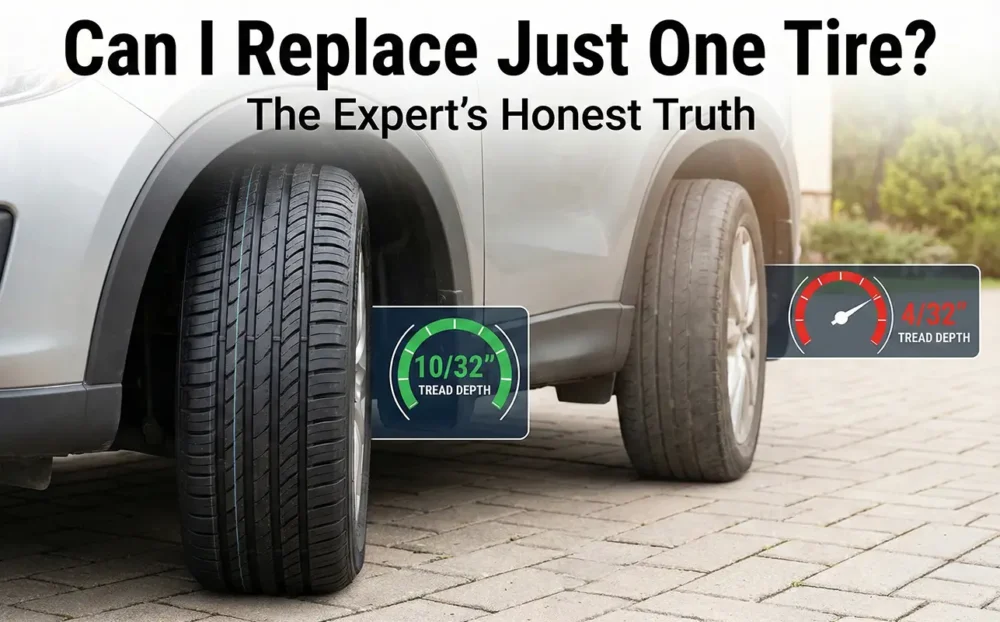
New passenger tires typically start with 10/32” to 12/32” of tread depth. As you drive, that rubber wears away. If your old tires are worn down to 4/32”, they are significantly smaller in diameter than a brand new tire starting at 10/32”.
The Math of the “Rolling Radius”
It might seem like a few millimeters of rubber doesn’t matter. But your car’s computer and mechanical gears are incredibly sensitive.
- Tire A (New): Has a larger circumference. It travels further with each rotation.
- Tire B (Old): Has a smaller circumference. It must spin faster to keep up with Tire A.
If you put one new tire on a car with three old ones, that one new tire will spin at a different speed than the others, even when you are driving in a perfectly straight line.
This constant difference in rotational speed creates stress. That stress has to go somewhere, and it usually goes to your differential.
For a deeper dive into how tire specs work, read our guide on Understanding Tire Sidewall Markings to see where these measurements come from.
The AWD Danger Zone: A $2,000 Mistake
If you drive a Subaru, Audi (Quattro), BMW (xDrive), or any modern AWD crossover, stop right now. This section is critical for you.
AWD systems are designed to send power to all four wheels constantly. They rely on a center differential or a viscous coupling to manage power between the front and rear axles. These systems assume that all four tires are rotating at the exact same speed.
The “Tolerance” Trap
Manufacturers have strict tolerances for tread depth differences.
- Subaru: Often requires tires to be within 2/32” of each other in tread depth.
- Audi: often allows up to 4/32” depending on the model, but tighter is better.
If you replace just one tire on a Subaru Outback that has 20,000 miles on the other three tires, the new tire is too big. The AWD system will detect that one wheel spinning slower than the others. It interprets this as “slippage” (like you are stuck in mud) and engages the differential to “fix” it.
Since the size difference is permanent, the AWD system works overtime, 100% of the time. This causes the differential fluid to overheat and the gears to grind.
The result? You might save $200 by buying one tire, but you will likely face a **$2,000 to $4,000 bill** for a new transmission or differential a year later.
My Advice: If you have an AWD vehicle and damage one tire, check the tread depth of the remaining three. If the difference is greater than 2/32”, you are looking at replacing all four.
The 2WD Rule: Front vs. Rear Wheel Drive
If you drive a standard Honda Civic (FWD) or a Ford Mustang (RWD), you have a little more flexibility. Your front and rear axles are not mechanically connected in the same way an AWD car is.
However, the “Pair Rule” still applies.
Why You Should Replace in Pairs
If you replace just one tire on the front axle of a Front-Wheel Drive car:
- Acceleration Pull: The car will pull to one side when you hit the gas because one tire has more grip and a larger diameter than the other.
- Braking Instability: Under hard braking, the new tire will bite the road differently than the worn tire, potentially causing the car to dart to the side.
Therefore, the industry standard is to replace the opposing tire on the same axle. If you blow out the front-left tire, you should replace the front-right as well. You can keep the old front-right as a full-size spare if it’s still in decent shape.
This ensures your steering and braking remain balanced.
For tips on keeping your remaining tires in good shape, check out our Ultimate Tire Maintenance Checklist.
The “New Tire on the Rear” Rule Explained
Let’s say you decide to buy two new tires for your front-wheel-drive car. Common sense suggests you should put them on the front, right? That’s where the engine is, that’s where the steering happens, and that’s where the tires wear out fastest.
Wrong.
Major tire manufacturers (Michelin, Bridgestone) and safety organizations agree: New tires should always go on the REAR axle.
The Physics of Oversteer vs. Understeer
- New Tires on Front (Old on Rear): The front has great grip. The rear has poor grip. If you hit a puddle (hydroplane) or take a curve too fast, the rear tires will lose traction first. This causes the back of the car to swing out (Oversteer). Oversteer is incredibly difficult for the average driver to control and often leads to spin-outs.
- New Tires on Rear (Old on Front): The rear is planted. The front has less grip. If you lose traction, the car will plow forward (Understeer). Understeer is easier to manage: you naturally lift off the gas, and the car regains grip.
So, if you buy two tires (or even just one, against my advice), the deepest tread must go on the back axle to prevent hydroplaning spin-outs.
Learn more about choosing the right rubber for wet conditions in our guide to the Best All-Season Tires for Rain.
The Solution: What is Tire Shaving?
Remember the AWD nightmare scenario? You have three perfectly good tires with 6/32” of tread, and one blown tire. Do you really have to throw away three good tires?
Not necessarily. There is a solution called Tire Shaving.
Tire shaving is exactly what it sounds like. A specialized machine shaves the rubber off a brand new tire to reduce its tread depth to match your existing tires.
The Pros:
- You save money by not buying a full set of four.
- You protect your AWD system from damage.
The Cons:
- You are paying full price for a new tire and then paying someone to remove 30-40% of its lifespan immediately.
- Availability: Very few local tire shops do this anymore. It is a dying art. However, huge online retailers like Tire Rack still offer this service for a small fee (usually $25-$35) before shipping the tire to you.
If you are in that “Subaru danger zone,” ordering a shaved tire online is often the smartest financial move.
Risks of Mixing Brands and Tread Patterns
Sometimes, the problem isn’t just wear—it’s availability. You blew out a “Michelin Defender,” but the shop only has a “Continental ControlContact” in stock.
Can you mix brands?
Ideally, No. Different tire models have:
- Different Rubber Compounds: One heats up faster than the other.
- Different Water Evacuation Channels: One might hydroplane at 50mph, the other at 60mph.
- Different Handling Characteristics: One might have a stiff sidewall (like an H-rated tire), and one might be soft (T-rated). Mixing these creates unpredictable handling.
If you absolutely must mix brands (emergency situation to get home), follow the same rules: keep the matched pair on the rear axle, and replace the mismatched tire with the correct one as soon as possible.
Also, be wary of speed ratings. Never mix speed ratings on the same axle. Read more on why this matters in our article H vs T Speed Rating: What You Need to Know.
When Is It Okay to Replace Just One?
I don’t want to be a doom-monger. There are legitimate times when buying one tire is perfectly fine.
You can replace just one tire IF:
- The Car is New: If your car has less than 2,000 or 3,000 miles on it, the tread wear on the other three tires is negligible (less than 2/32” loss). You can safely mix a brand new tire with them.
- The Tire is Shaved: As mentioned above, if the new tire is mechanically altered to match the size of the others.
- It’s a Spare/Emergency: If you are just replacing a donut spare to get to a shop, obviously one tire is fine.
- Budget Crisis: Look, I’ve been there. Sometimes you literally do not have the money for two tires. If you must replace just one on a 2WD car, put the new one on the rear, and drive cautiously until you can afford to match it. But please, check your other tires regularly using a penny test.
If you aren’t sure how to check your wear, read our guide on How to Read Tire Size and Check Tread Depth.
Conclusion: A Decision Checklist
I know that tires are a “grudge purchase.” Nobody wakes up excited to spend $800 on rubber. But they are the only thing touching the ground.
Before you make a decision at the counter, run through this mental checklist:
- Is my car AWD?
- Yes: Are the other tires worn more than 2/32″?
- Yes: Buy 4 tires OR buy 1 shaved tire. DO NOT buy 1 unshaved tire.
- No: Buy 1 exact matching tire.
- Yes: Are the other tires worn more than 2/32″?
- Is my car FWD or RWD?
- Yes: Are the other tires worn?
- Yes: ideally buy 2 tires for the same axle. Put them on the rear.
- No: Buy 1 exact matching tire.
- Yes: Are the other tires worn?
By following these rules, you aren’t just saving your differential or your transmission—you’re ensuring that when you slam on the brakes in the rain, your car stops straight and true.
Stay safe out there.
Frequently Asked Questions (FAQ)
Can I replace one tire with a used tire?
Yes, this is actually a great “hack.” If you can find a used tire shop that has the exact same model of tire with similar tread depth to your remaining three, this is a safe and cheap solution. Just check the “DOT Date Code” to ensure the used tire isn’t more than 6 years old.
Will replacing just one tire void my warranty?
It might. Many vehicle manufacturer warranties (especially on AWD cars) state that damage caused by mismatched tires is not covered. Additionally, tire manufacturer mileage warranties often require that tires be rotated and worn evenly; mixing one new tire in might void the mileage claim for the set.
How do I measure my tread depth at home?
You can buy a cheap gauge for $5, or use a Lincoln penny. Insert the penny into the tread with Lincoln’s head facing down. If you can see all of Lincoln’s head, your tread is too low (approx 2/32”) and needs replacing.
My mechanic says I need an alignment with my new tire. Is that necessary?
If your old tire died because of uneven wear (like the inside edge was bald but the outside was fine), then yes, absolutely. If you hit a pothole hard enough to blow a tire, you likely knocked the suspension out of alignment, so checking it is a smart move to protect your new investment.