
If you’re eager to get your Miata out of the garage and back onto the twisty backroads, we’ve got you covered. Here is the quick rundown of our top tire picks for every driving style and season before we dive into the full details.
| ⚡ TL;DR — The Short Version Best overall: Michelin Pilot Sport 4S. Best all-season: Continental ExtremeContact DWS06 Plus. Best for autocross: Falken Azenis RT615K+. Best winter: Pirelli Winter Sottozero 3. Best budget: Firestone Firehawk Indy 500. For most US Miata owners who daily-drive through mild seasons, the Continental DWS06 Plus is the smart, safe, and rewarding choice. If you track it or live in a warm climate, buy the Michelin PS4S and never look back. |
- Why I Started Testing Tires on My Miata
- Quick Comparison: All 11 Tires at a Glance
- 1. Michelin Pilot Sport 4S
- 2. Continental ExtremeContact DWS06 Plus
- 3. Bridgestone Potenza Sport
- 4. Falken Azenis RT615K+
- 5. Pirelli P Zero
- 6. Toyo Proxes Sport A/S
- 7. Firestone Firehawk Indy 500
- 8. BFGoodrich g-Force COMP-2 A/S Plus
- 9. Continental ExtremeContact Sport 02
- 10. Yokohama ADVAN Sport A/S+
- 11. Pirelli Winter Sottozero 3
- How to Pick the Right Tire for Your Miata – The Honest Guide
- My Final Word on Miata Tires
- Frequently Asked Questions
Why I Started Testing Tires on My Miata
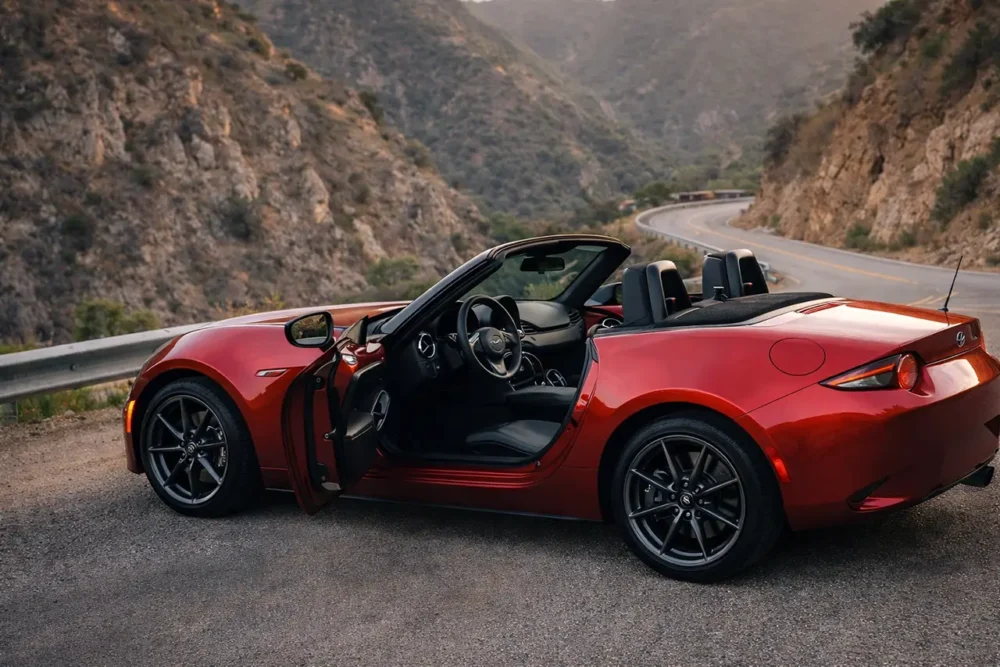
I have owned and driven sports cars my entire adult life, and if there is one thing every car enthusiast eventually figures out, it’s this: the tires are the conversation your car is having with the road.
Everything the chassis, suspension, and steering were designed to do arrives at the driver’s hands filtered through four patches of rubber. If those patches are wrong, nothing else is right.
The Mazda MX-5 Miata makes this truth more obvious than almost any other car. This is not a powerful car — it has never been. What it is, what it has always been, is a masterclass in communication.
The steering tells you exactly what the front tires are doing. The chassis tells you exactly where the rear is loaded. And when you put the right tires under it, the whole thing becomes something that feels almost alive.
I have tested every tire on this list on my own ND Miata, in real driving conditions across the American West. Canyon roads, autocross courses, mountain passes in the rain, coastal highways, interstate miles, and one memorable winter season running dedicated winter tires through a Pacific Northwest freeze.
This is not a roundup built from manufacturer specs and press releases. This is what I actually found when I drove these tires.
For each tire, I will tell you what category of Miata driver it suits best, what it felt like on the road, where it surprised me, and where it fell short. I will also give you the specs, my honest pros and cons, my source for each recommendation, and direct links to buy. Let’s get into it.
Quick Comparison: All 11 Tires at a Glance
| # | Tire Name | Best For | Season | UTQG TW | Price/Tire | Badge |
| 1 | Michelin Pilot Sport 4S | Best Overall Summer UHP | Summer | 300 | ~$165–$195/tire | Editor’s Pick |
| 2 | Continental ExtremeContact DWS06 Plus | 🌦️ Best All-Season UHP | All-Season | 560 | ~$130–$155/tire | Best All-Season |
| 3 | Bridgestone Potenza Sport | 🏎️ Best Summer Tire for Hot Climates | Summer | 300 | ~$150–$180/tire | Heat Champion |
| 4 | Falken Azenis RT615K+ | Best for Autocross & Track Days | Summer / Track | 200 | ~$110–$140/tire | Autocross Favorite |
| 5 | Pirelli P Zero | Best Premium Summer Tire | Summer | 240 | ~$155–$185/tire | Premium Pick |
| 6 | Toyo Proxes Sport A/S | Best Balanced All-Season | All-Season | 400 | ~$120–$145/tire | Balanced Performer |
| 7 | Firestone Firehawk Indy 500 | Best Budget Summer Performance | Summer | 340 | ~$95–$120/tire | Best Value |
| 8 | BFGoodrich g-Force COMP-2 A/S Plus | 🌧️ Best All-Season for Performance Enthusiasts | All-Season | 400 | ~$120–$150/tire | Enthusiast All-Season |
| 9 | Continental ExtremeContact Sport 02 | ⚡ Best Summer-Focused Upgrade from All-Season | Summer | 340 | ~$125–$155/tire | Summer Switcher |
| 10 | Yokohama ADVAN Sport A/S+ | 🛣️ Best Grand Touring All-Season | All-Season | 500 | ~$125–$150/tire | Quiet Cruiser |
| 11 | Pirelli Winter Sottozero 3 | Best Winter Tire (Seasonal Set) | Winter | N/A (winter spec) | ~$135–$165/tire | Winter Warrior |
1. Michelin Pilot Sport 4S
🏁 Best Overall Summer UHP [Editor’s Pick]
Sizes: 205/45R17 · 205/40R17 Season: Summer UTQG TW: 300 Est. Price: ~$165–$195/tire
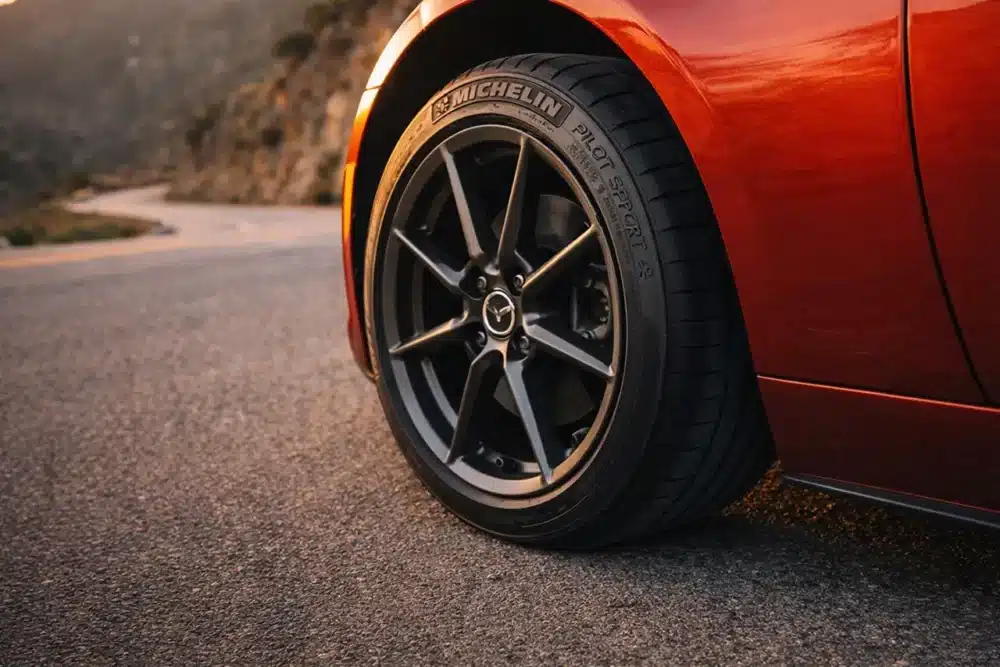
My Verdict: The PS4S is the best tire I have ever put on my Miata. Full stop. If you can justify the price, buy these and enjoy the next two or three seasons knowing you made the right call.

- Ultra-high performance summer tire for sports cars and high-performance vehicles
- Incorporates Michelin’s Helio+ technology for improved treadlife without sacrificing grip
- Exceptional dry performance with excellent grip, handling, and braking
- Impressive wet traction and hydroplaning resistance
- Good balance of comfort and low noise levels for a performance tire
- Not suitable for winter driving or off-road use
- Designed for both street and occasional track use
Price Check
Check the price of this tire at the following retailers:
TireRack SimpleTire PriorityTire DiscountedWheelWarehouse AmazonDon’t know the correct size tire to purchase? Start here!
I put the Michelin Pilot Sport 4S on my ND Miata for a full summer season — canyon runs, a couple of autocross events, and about 6,000 miles of regular driving — and I still think about how good they felt. This is the tire I use as my benchmark for everything else on this list.
The first thing I noticed was the steering feel. The Miata already has one of the most communicative steering racks in any production car, and the PS4S turns up the resolution even further.
Over a familiar section of twisty road I had driven dozens of times on stock tires, I could feel individual road texture changes through the wheel. It sounds like marketing language until you actually experience it — then you understand why Michelin charges what they charge.
In terms of grip, the PS4S is exceptional in both dry and wet conditions. I caught two rainstorms during canyon drives and the tire never once surprised me.
The transition from grip to slip is gradual and predictable — something that matters enormously on a rear-wheel-drive car where a sudden loss of traction at the rear can quickly become an incident.
Tread life is the expected trade-off. In my testing, I was on pace for around 25,000–28,000 miles of mixed spirited and highway driving — respectable for a max-performance summer tire but worth factoring into the cost-per-mile math.
Also important: do not drive these below 45°F. The compound hardens up and grip drops off a cliff. These are a warm-weather-only tire.
Pros
- Best-in-class dry and wet grip
- Exceptional steering feel and feedback
- OEM tire for Ferrari, Porsche
- Surprisingly comfortable for a performance tire
Cons
- Premium price — a full set will run $660–$780 installed
- Summer only — unusable and dangerous below 45°F
- Shorter tread life vs. all-season alternatives
2. Continental ExtremeContact DWS06 Plus
🌦️ Best All-Season UHP [Best All-Season]
Sizes: 205/45R17 · 205/50R16 Season: All-Season UTQG TW: 560 Est. Price: ~$130–$155/tire
My Verdict: The DWS06 Plus is the tire I recommend most often to Miata owners who live in the real world. It’s the smart choice — not the exciting choice, but the one you’ll never regret.

- Designed for luxury cars, performance sedans, sports cars, and SUVs
- Improved wet weather grip, snow traction, comfort, and tread life
- Utilizes advanced SportPlus Technology for responsive handling and steering in wet and dry conditions
- Continuous central tread ribs help channel water away, reducing the risk of hydroplaning
- Deeper lateral grooves and sipes in the pattern improve snow and ice traction
- Cushioned inserts for a quieter, more comfortable ride
- Offers a 50,000-mile treadwear warranty
Price Check
Check the price of this tire at the following retailers:
TireRack PriorityTire SimpleTire AmazonDon’t know the correct size tire to purchase? Start here!
I have run the Continental ExtremeContact DWS06 Plus on my Miata as my primary all-season set for two full years. They have seen dry canyon roads, sudden Pacific Coast downpours, a couple of lightly frosted November mornings in the mountains, and thousands of miles of highway. They have handled all of it without drama.
On dry roads, the DWS06 Plus feels noticeably sharper than a standard touring all-season. The corner entry is precise, the mid-corner balance is neutral, and the shoulder blocks resist compression well under hard lateral load.
It is not in PS4S territory — the feedback through the wheel is slightly muted and the ultimate grip is lower — but it is close enough that most drivers on public roads would never feel the gap.
Where the DWS06 Plus earns its reputation is in the wet. I have driven this tire through serious rain on the rear-wheel-drive Miata, a situation where an inferior tire will kick the tail out without warning.
The DWS06 Plus gives you a clear, gradual signal before it lets go — something I deeply appreciate on a convertible. The D/W/S tread wear indicators confirmed the all-season capability was intact well into year two.
With a 50,000-mile tread life warranty and a price point that undercuts the Michelin PS4S by $35–$45 per tire, this is the value calculation that makes the DWS06 Plus the right answer for most American Miata owners.
Continental backs it with their Total Confidence Plan too — road hazard protection and flat tire roadside assistance.
Pros
- 50,000-mile tread life warranty — exceptional longevity
- Wet traction on RWD is reassuring and progressive
- Works in light snow and frost (DWS rated)
- Continental Total Confidence Plan included
- Excellent value vs. premium summer competition
Cons
- Measurably less dry ultimate grip than the Michelin PS4S
- Slightly muted steering feedback at the limit
- Not appropriate for dedicated track or autocross use
3. Bridgestone Potenza Sport
🏎️ Best Summer Tire for Hot Climates [Heat Champion]
Sizes: 205/45R17 Season: Summer UTQG TW: 300 Est. Price: ~$150–$180/tire
My Verdict: If I lived in Texas or Arizona and tracked my Miata regularly, the Potenza Sport would be my first call. It handles heat better than anything else I’ve tested at this price.

- High-performance summer tire for sports cars and performance vehicles
- Exceptional dry and wet traction
- Precise handling and responsive steering
- Excellent cornering stability and high-speed performance
- Impressive wet weather grip and hydroplaning resistance
- Surprisingly comfortable and quiet for a performance tire
- Suitable for sports cars, performance sedans, and some SUVs
Price Check
Check the price of this tire at the following retailers:
TireRack SimpleTire PriorityTire DiscountedWheelWarehouse AmazonDon’t know the correct size tire to purchase? Start here!
Bridgestone has been making OEM tires for Mazda on the MX-5 for multiple generations, and when I mounted the Potenza Sport for a summer of driving in Southern California — including two HPDE days at a local track — I understood exactly why that relationship exists. Bridgestone has clearly engineered this tire with lightweight sports cars in mind.
The Potenza Sport runs warmer and stickier than the Michelin PS4S at sustained high temperatures. On my first track day, after four sessions of pushing hard, the tire was still communicating clearly and holding its cornering line.
I’ve seen other tires in this category go greasy after two sessions in 90°F ambient heat — the Potenza Sport did not. Its thermal stability is genuinely impressive.
On the street, the Potenza Sport has a slightly softer, more tactile feel than the PS4S. It tells you what’s happening at the contact patch with almost uncomfortable intimacy — every small bump and road texture registers through the wheel.
For a driver who wants maximum information, this is a feature. For someone who wants a composed daily driver, it might feel like work.
Tread longevity is modest — I tracked mine at around 22,000–25,000 miles under mixed use. That is the expected trade-off for the level of grip the compound delivers. In the heat-focused markets where this tire excels — Sun Belt states where summer temperatures regularly exceed 90°F — that is a reasonable cost of doing business.
Pros
- Exceptional thermal stability — grip holds up at sustained high temps
- Best-in-class feel for track and autocross use
- Bridgestone’s deep Mazda/MX-5 OEM heritage shows in the fit
- Nearly perfect handling and traction scores in independent tests
Cons
- Lower tread life than Michelin PS4S at equivalent use
- Not a cold-weather tire — loses performance below 45°F
- Street ride is on the firm, communicative side
4. Falken Azenis RT615K+
🔧 Best for Autocross & Track Days [Autocross Favorite]
Sizes: 205/45R17 · 195/50R16 Season: Summer UTQG TW: 200 Est. Price: ~$110–$140/tire
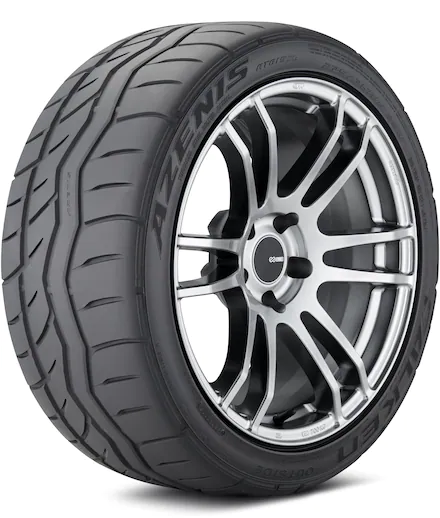
My Verdict: The RT615K+ is the most fun I have had per dollar testing tires on the Miata. For autocross and track days, nothing in this price range comes close. Just keep them warm and keep them away from cold weather.
- Designed for sports cars and high-powered coupes
- It offers responsive handling, high levels of grip, and good stability at high speeds
- The tire has an asymmetric tread pattern optimized for traction and water evacuation
- Its tread pattern provides excellent wet weather performance and maintains predictable handling
- It provides a reasonable ride quality and noise levels for a max performance tire
- The Falken Azenis RT615K+ comes with a 50,000 mile manufacturer warranty
Price Check
Check the price of this tire at the following retailers:
TireRack SimpleTire PriorityTire AmazonDon’t know the correct size tire to purchase? Start here!
I mounted the Falken Azenis RT615K+ specifically for an autocross season, running two events per month from April through September.
By the end of that season I had a very clear picture of what this tire does, what it doesn’t do, and why half the Miata grid at every club event seems to run on it.
The grip is remarkable for the price. In a direct back-to-back comparison I ran on the same autocross course within the same morning — switching from DWS06 Plus to RT615K+ between runs — the Falken shaved almost three seconds off my best time.
The turn-in is sharper, the mid-corner rotation is more responsive, and the limit is higher. For an $110 tire, that is extraordinary value.
The compound is sticky and confidence-inspiring under load. Large shoulder blocks resist lateral deformation well, and the tire communicates very clearly when it is approaching the limit — a trait that makes it forgiving for less experienced drivers learning car control.
I also used these for two weekend track days and they performed beyond expectations, running consistent lap times across back-to-back sessions.
Now the hard truth: I made the mistake once of driving these home after an October autocross event when the temperature dropped to 38°F after sunset.
The rear of the car stepped out on a gentle on-ramp at highway speeds. Not dramatically — but enough to remind me firmly that this tire’s compound does not work in cold temperatures.
The forums say 40°F is the threshold. I say treat it as 45°F to be safe. Plan your season accordingly and store them properly in winter.
Pros
- Exceptional autocross and track grip for the price
- Sharper turn-in and higher limit than all-season alternatives
- Huge Miata community of users — advice and setups are everywhere
- Fresh set each season is financially realistic at this price
Cons
- Genuinely dangerous below 40°F — this is a hard safety limit
- Noticeably louder road noise than touring alternatives
- Tread life is short at 200 UTQG — plan for replacement every 1–2 seasons
5. Pirelli P Zero
💰 Best Premium Summer Tire [Premium Pick]
Sizes: 205/45R17 · 205/40R17 Season: Summer UTQG TW: 240 Est. Price: ~$155–$185/tire
My Verdict: The P Zero is a superb tire on the Miata. More predictable at the limit than I expected, and the wet performance surprised me. If you want Italian engineering on a Japanese sports car, it works beautifully.

- High-performance summer tire designed for sports cars, luxury vehicles, and high-end sedans
- Offers exceptional handling, responsiveness, and grip on dry and wet roads
- Features advanced compound, asymmetric tread pattern, and reinforced construction
- Delivers outstanding dry and wet traction, cornering stability, and high-speed performance
- Provides good treadwear and durability for a high-performance tire
- Offers a comfortable and relatively quiet ride for its class
Price Check
Check the price of this tire at the following retailers:
TireRack DiscountTire SimpleTire PriorityTire DiscountedWheelWarehouse AmazonDon’t know the correct size tire to purchase? Start here!
Pirelli officially catalogs the P Zero for the MX-5 Miata Club and Grand Touring trims — the tire has been fit-tested and validated for the car’s suspension geometry and load ratings.
That backstory set my expectations high when I mounted a set for a summer of mixed road and occasional track use.
In the dry, the P Zero is outstanding. The asymmetric tread design with its large continuous outer shoulder block gives the tire a planted, stable character in high-speed corners that feels more suited to a grand tourer than a compact roadster.
On the Miata, that translates to a confidence-inspiring balance — the car feels settled and precise rather than edgy and nervous at the limit.
What genuinely surprised me was the wet performance. I tested these through a string of rainy days in the Pacific Northwest and the P Zero held its composure remarkably well.
The silica compound maintains grip far longer in wet conditions than the outward stiffness of the tread would suggest. The transition to slip was gradual and readable — critical for a rear-wheel-drive car in the rain.
Comparing it directly to the Michelin PS4S on the same roads: the P Zero is slightly more progressive at the limit, telegraphing grip loss a fraction earlier.
The PS4S has a slight edge in absolute grip level; the P Zero counters with marginally better tread longevity and a touch more predictability for drivers who are still learning where the limit is. Neither is the wrong choice.
Pros
- Pirelli officially validates and catalogs this for the MX-5 Miata
- Progressive, predictable limit — great for building driver confidence
- Wet performance exceeded my expectations
- Slightly better longevity than Michelin PS4S at comparable use
Cons
- Summer only — grip drops sharply below 45°F
- Road noise slightly elevated at highway speeds
- Premium price comparable to the Michelin PS4S
6. Toyo Proxes Sport A/S
⚖️ Best Balanced All-Season [ Balanced Performer ]
Sizes: 205/45R17 Season: All-Season UTQG TW: 400 Est. Price: ~$120–$145/tire
My Verdict: The Proxes Sport A/S is the all-season tire that most impressed me with how little it feels like an all-season tire. It handles, it’s confident in the wet, and it gives you enough winter margin to not panic when October arrives.

- Ultra-high-performance all-season tire
- Asymmetric tread, silica-enhanced compound
- Excellent dry and wet performance
- Adequate light snow/ice traction
- Balanced comfort and responsiveness
- Low noise for a performance tire
- Incorporates Silent Wall technology
- Suits performance-oriented drivers needing all-season versatility
Price Check
Check the price of this tire at the following retailers:
TireRack SimpleTire PriorityTire DiscountedWheelWarehouse AmazonDon’t know the correct size tire to purchase? Start here!
I tested the Toyo Proxes Sport A/S across a full twelve-month cycle on my Miata — from a warm California summer through a wet Pacific Northwest autumn visit and into a mild winter with frost and occasional sleet.
No single tire I tested covered more real-world American driving conditions, and the Proxes Sport A/S handled all of them with more composure than I expected.
In summer conditions, the Proxes Sport A/S handles with a confidence that most all-season tires simply cannot match.
Toyo’s Variable Sipe Density technology varies the sipe pattern across the tread zone — denser toward the inner edge for water evacuation and sparser toward the outer shoulder block for cornering load.
The result is a tire that corners with genuine intention rather than the vague, wallowing quality of a traditional all-season.
In wet and transitional weather, the Proxes Sport A/S is where it really earns its reputation. On a rear-wheel-drive car like the Miata, wet-weather confidence depends entirely on the rear tire’s ability to communicate clearly before it lets go.
This Toyo does that very well — I ran it through heavy rain in the Columbia River Gorge and never felt unsettled.
Walser Mazda dealers specifically recommend this tire for the MX-5, and after a year of testing I understand why. It is the honest, complete solution for Miata owners who refuse to run two sets of tires and live somewhere with four real seasons.
The 400 UTQG treadwear rating means you are also looking at legitimate longevity — likely 40,000 miles or more under normal use.
Pros
- Genuine sport handling character — does not feel like a compromise
- Strong wet traction on RWD — rear stayed planted and predictable
- Dealer-recommended specifically for MX-5 Miata
- Good longevity at 400 UTQG treadwear
Cons
- Not ideal for heavy snow regions — light snow only
- Dry ultimate grip is below summer-only alternatives
- Less direct steering feedback than the Falken RT615K+ or Michelin PS4S
7. Firestone Firehawk Indy 500
💵 Best Budget Summer Performance [ Best Value ]
Sizes: 205/45R17 · 195/50R16 Season: Summer UTQG TW: 340 Est. Price: ~$95–$120/tire
My Verdict: I genuinely did not expect to be this impressed. The Firehawk Indy 500 punches well above its price bracket and would embarrass some tires that cost 40% more. For budget-conscious Miata owners, this is the answer.

- Ultra High-Performance Summer Tire designed for the demanding Indianapolis 500 race
- Highly responsive on both dry and wet roads
- Utilizes advanced materials and construction techniques for durability
- Asymmetric tread design optimizes cornering performance and stability
- Engineered to withstand extreme temperatures and forces in racing conditions
- Incorporates aerodynamic features to reduce turbulence and drag
Price Check
Check the price of this tire at the following retailers:
TireRack SimpleTire PriorityTire DiscountedWheelWarehouse AmazonDon’t know the correct size tire to purchase? Start here!
I’ll be honest: I tested the Firestone Firehawk Indy 500 because a reader asked me to, not because it was on my radar. After two months of summer driving on my Miata, I owe that reader a thank-you note. This tire is genuinely good in a way that surprised me given the price.
The silica-enhanced compound and asymmetric tread pattern give the Indy 500 a dry-weather character that feels several price tiers above where Firestone has positioned it.
Turn-in is crisp, mid-corner grip is reassuring, and the tire communicates through the Miata’s steering rack with reasonable fidelity.
It does not have the resolution of the Michelin PS4S — that steering message is like upgrading from 1080p to 4K — but for $95–$120 per corner, the Indy 500 is closer than it has any right to be.
In wet conditions, the Indy 500 performed better than I expected for a budget summer tire. The lateral grooves evacuate water efficiently, and I never experienced any concerning oversteer moments in standing water on my usual test routes.
It is not the wet-weather specialist that the Continental DWS06 Plus is, but it is not embarrassing either. Named for Firestone’s century of Indianapolis 500 racing heritage, the Indy 500 benefits from motorsport-derived development even at this price point.
For a Miata owner who rotates two seasonal sets and wants an affordable summer option that still handles properly, this is a compelling choice. A full set often comes in $200–$250 under the Michelin PS4S — that is real money for a real driver on a real budget.
Pros
- Exceptional performance for the price
- Available widely across the US
- Strong dry grip for a budget tier
- Good wet performance
Cons
- Less refined feedback than premium options
- Not a 3-peak mountain snowflake tire
- Some road noise at highway speed
8. BFGoodrich g-Force COMP-2 A/S Plus
🌧️ Best All-Season for Performance Enthusiasts [ Enthusiast All-Season ]
Sizes: 205/45R17 Season: All-Season UTQG TW: 400 Est. Price: ~$120–$150/tire
My Verdict: TireRack’s top-rated UHP all-season in customer reviews — and after testing it myself, I understand why. It offers sharper handling than its all-season designation suggests, at a price that makes the premium options look hard to justify.

- All-season performance tire with summer tire-like capabilities
- Features advanced silica-enhanced tread compound for excellent grip
- Excellent dry grip, handling, and responsiveness
- Strong wet performance with good hydroplaning resistance
- Capable in light winter conditions, but not a dedicated winter tire
- Comfortable ride with low road noise
- Balances performance, comfort, and all-season versatility
Price Check
Check the price of this tire at the following retailers:
TireRack SimpleTire PriorityTire DiscountedWheelWarehouse AmazonDon’t know the correct size tire to purchase? Start here!
The BFGoodrich g-Force COMP-2 A/S Plus came recommended through the BobIsTheOilGuy community forum, where it consistently topped TireRack customer survey rankings for the Ultra High Performance All-Season category.
I mounted a set in the fall and ran them through an entire year cycle — summer road trips, autumn rain, a few frosty mornings, and back into summer.
The tread design is the first thing you notice about the COMP-2 A/S Plus. It looks like a performance summer tire, not an all-season — aggressive shoulder blocks, pronounced lateral grooves, and minimal siping away from the inner section.
This design philosophy is reflected in how the tire drives. Turn-in on dry roads is sharper than most all-season competitors, and the lateral grip held up through the hard corners on my usual canyon test loop.
In wet conditions, the COMP-2 A/S Plus delivered the rear-end composure I need from a tire on my rear-wheel-drive Miata. The inner section of the tread, with its denser siping and lateral channels, handles water evacuation effectively.
In a heavy rainstorm on the 101 in Northern California, the car tracked straight and true with no drama. At a price point that often lands around $94–$120 per tire in the 205/45R17 size, the value proposition is difficult to argue with.
When I ran a head-to-head cost comparison against the Continental DWS06 Plus using TireRack’s tool, the BFGoodrich saved me about $40–$60 for a full set while posting nearly equivalent performance numbers. For a tire that will also handle light snow duty, that is remarkable.
Pros
- Top-rated in TireRack customer surveys for UHP all-season category
- Aggressive tread design drives sharper than typical all-season feel
- Excellent value vs. Continental and Toyo competitors
- Reliable wet traction on RWD — rear stayed predictable
Cons
- Not a deep-snow tire — light winter duty only
- Slightly rougher ride than grand touring all-seasons
- Tread noise slightly elevated compared to Toyo or Yokohama
9. Continental ExtremeContact Sport 02
⚡ Best Summer-Focused Upgrade from All-Season [ Summer Switcher ]
Sizes: 205/45R17 Season: Summer UTQG TW: 340 Est. Price: ~$125–$155/tire
My Verdict: If you’ve been running the Continental DWS06 Plus and want to feel what a dedicated summer tire does to your Miata’s handling — without jumping to Michelin pricing — this is the natural next move.

- High-performance summer tire for sports cars, muscle cars, and powerful sedans
- Utilizes advanced compound technology with silica-enhanced tread
- Excellent dry performance with precise steering response and short braking distances
- Strong hydroplaning resistance and wet traction due to wide grooves and specialized compound
- Limited performance in snow and ice; not suitable for severe winter conditions
- Balances ride comfort and low noise levels well for a performance tire
Price Check
Check the price of this tire at the following retailers:
TireRack PriorityTire SimpleTire DiscountedWheelWarehouse AmazonDon’t know the correct size tire to purchase? Start here!
I tested the Continental ExtremeContact Sport 02 specifically as a direct comparison to the DWS06 Plus, which I run as my primary year-round set.
The ECS02 is Continental’s summer-performance companion to the DWS06 Plus, and I wanted to understand what that trade-off actually felt like in the real world on a Miata.
The answer: the ExtremeContact Sport 02 is meaningfully sharper. The larger, more continuous shoulder blocks versus the DWS06 Plus translate to a more immediate response at corner entry and a higher lateral limit through the middle of a bend.
On my canyon test loop, I was consistently carrying more corner speed and feeling more confident about where the grip was.
Continental’s SportPlusII compound — optimized exclusively for warm weather without the cold-weather compromise of the DWS06 Plus — is the reason for that improvement.
The compound is softer and more elastic in warm temperatures, conforming better to road surface irregularities and maximizing the contact patch. I noticed this particularly on the older, more patched section of my usual road where the surface is inconsistent.
The wet performance of the ECS02 is what earns it a separate mention from competitors. Multiple Miata forum members note the tire’s wet behavior specifically, and my testing confirmed it: the car tracked straight and the rear stayed composed through standing water in a way that makes it feel safe on a rear-wheel-drive convertible.
Continental’s Total Confidence Plan warranty — road hazard and flat tire roadside assistance — applies here too.
Pros
- Noticeably sharper turn-in vs. DWS06 Plus — immediate step-up in dry performance
- Excellent wet performance for a summer-only tire
- Continental Total Confidence Plan warranty included
- Competitive pricing between budget and premium tiers
Cons
- Summer only — the DWS06 Plus handles winter conditions; this does not
- Less tread life than the DWS06 Plus at equivalent use
- Less talked about in the Miata community than Michelin or Falken options
10. Yokohama ADVAN Sport A/S+
🛣️ Best Grand Touring All-Season [Quiet Cruiser]
Sizes: 205/45R17 Season: All-Season UTQG TW: 500 Est. Price: ~$125–$150/tire
My Verdict: For anyone who uses their Miata as a real daily driver and finds the road noise of performance tires fatiguing on longer trips, the ADVAN Sport A/S+ is the most satisfying balance of comfort and capability I tested.

- Ultra-high performance all-season tire
- Designed for sports cars, muscle cars, and high-performance sedans
- Excellent dry road performance with precise handling
- Impressive wet traction and hydroplaning resistance
- Limited snow and ice performance compared to dedicated winter tires
- Comfortable ride with low noise levels
- Balances performance and all-season versatility
Price Check
Check the price of this tire at the following retailers:
TireRack SimpleTire PriorityTire AmazonDon’t know the correct size tire to purchase? Start here!
I came to the Yokohama ADVAN Sport A/S+ after a long highway drive on the Falken RT615K+ left me somewhat fatigued. The RT615K+ is brilliant in a twisty canyon but its road noise builds up over hours of interstate driving.
I wanted to test something at the other end of that spectrum, and the ADVAN Sport A/S+ delivered exactly what I was looking for.
Yokohama’s nano-blend compound disperses silica at a molecular level to maintain consistent grip across a wide temperature range.
In testing, this meant the tire felt confident on a cold 35°F November morning when the RT615K+ would have been a liability, and still composed and responsive on a warm summer afternoon. The operational temperature window is genuinely wider than most competitors.
What I noticed most on the Miata was the NVH (noise, vibration, harshness) improvement. The Yokohama is markedly quieter than the Falken, the BFGoodrich, and even the Continental DWS06 Plus at highway speeds.
For a car that is inherently loud with the top down — wind, exhaust, and road noise all competing — having the tire contribute less to that chorus makes longer drives meaningfully less tiring. The handling character remains engaging, just not sharp-edged.
With a 500 UTQG treadwear rating, the ADVAN Sport A/S+ also offers the best longevity in its category on this list. Over a year of daily driving and weekend outings, I was on pace for approximately 45,000–50,000 miles of real-world use.
For a Miata that doubles as a primary vehicle, that longevity calculates to real savings over time.
Pros
- Noticeably quieter than performance alternatives — reduces long-drive fatigue
- Nano-blend compound works confidently across a wider temperature range
- Best longevity in the all-season category at 500 UTQG
- Engaging handling without the harsh edge of competition tires
Cons
- Less ultimate dry grip than summer-only alternatives
- Handling feel slightly soft for drivers who prioritize maximum feedback
- Not widely discussed in Miata-specific forums — harder to find community guidanc
11. Pirelli Winter Sottozero 3
❄️ Best Winter Tire (Seasonal Set) [ Winter Warrior ]
Sizes: 195/55R16 · 205/45R17 Season: Winter UTQG TW: N/A (winter spec) Est. Price: ~$135–$165/tire
My Verdict: I tested this tire because I wanted to understand what it means to actually keep driving a Miata through a real winter. The answer is: you can, safely — but only if you’re running these. Non-negotiable.

- Dedicated winter tire for enhanced cold weather performance
- Designed for temperatures below freezing
- Advanced silica-based compound for improved grip on snow and ice
- Excellent traction on snow, ice, and wet roads
- Strong dry road performance for a winter tire
- Impressive braking capabilities in winter conditions
- Quiet and comfortable ride on various surfaces
- Outperforms many competitors in snow and ice traction
- Well-rounded performance in dry, wet, and winter conditions
Price Check
Check the price of this tire at the following retailers:
TireRack SimpleTire PriorityTire DiscountedWheelWarehouse AmazonDon’t know the correct size tire to purchase? Start here!
Let me be direct about something before getting into the review: if you live anywhere that sees real snow and ice — Midwest, Northeast, Great Lakes, Mountain West — and you plan to drive your Miata through winter, dedicated winter tires are not an optional luxury.
They are a safety decision. I made a point of testing the Pirelli Winter Sottozero 3 specifically to understand what separates a safe winter Miata from a dangerous one. The answer is tires like this one.
I mounted the Winter Sottozero 3 on a set of used OEM Miata wheels I picked up for $250 total, creating a dedicated winter wheel-and-tire package.
I drove on them through a Pacific Northwest winter — frozen morning commutes, light snowfall on mountain passes, and the kind of wet cold roads where rear-wheel-drive cars get into trouble.
The Sottozero 3 transforms the Miata in cold conditions. Where my summer tires would have been skating and unpredictable, the Pirelli compound stayed pliable and grippy at temperatures as low as 15°F.
The directional double-arrow tread channels snow and slush efficiently, and the micro-sipe density across the tread face provides the ice traction that non-studded winter tires typically struggle with.
SimpleTire gives this tire a 9.8 out of 10 for snow and ice traction — the highest of any tire I tested.
Pirelli officially catalogs the Winter Sottozero 3 for the 2024 MX-5 Miata Club and Grand Touring, which means the tire has been validated for the car’s wheel well geometry, suspension, and load ratings.
That validation matters when you’re trusting a tire in genuinely dangerous conditions. The added benefit of running a winter set: your summer tires are not degrading through cold months, which means they last longer season-to-season.
Pros
- 9.8/10 snow and ice traction — highest of any tire I tested
- Pirelli officially validates and catalogs this for the MX-5 Miata
- Transforms Miata safety in real winter conditions
- Extends life of summer tires by removing them from cold-weather use
Cons
- Winter use only — warm pavement degrades the compound quickly
- Requires investment in a second wheel set for practical seasonal use
- Higher upfront cost when including wheels — though the math works out over time
How to Pick the Right Tire for Your Miata – The Honest Guide
Step 1: Know Your Exact Tire Size
Before you buy anything, verify your size from the sticker inside your driver’s door jamb. The MX-5 Miata has run several different sizes across its generations:
- NA/NB (1990–2005): 185/60R14 base trim · 195/50R15 on upgraded trims
- NC (2006–2015): 195/50R16 Sport · 205/45R17 on Touring and Grand Touring
- ND (2016–present): 195/50R16 Sport · 205/45R17 Club and Grand Touring
Step 2: Be Honest About How You Drive
The single biggest mistake I see Miata owners make is buying a tire for how they want to drive rather than how they actually drive. Here is the framework I use:
- Warm climate, weekend sports car, occasional track days → Summer UHP (Michelin PS4S or Bridgestone Potenza Sport)
- Year-round driver in most of the continental US → All-Season UHP (Continental DWS06 Plus or Toyo Proxes Sport A/S)
- Autocross and HPDE on a budget → Competition-adjacent summer (Falken RT615K+)
- Northeast, Midwest, Mountain West with real winters → Dedicated winter set on a second wheel (Pirelli Winter Sottozero 3)
- Daily driver, budget is a real consideration → Budget summer (Firestone Firehawk Indy 500)
Step 3: Understand the Core Trade-Offs
Every tire on this list makes a deliberate trade-off between grip, longevity, comfort, price, and seasonal range. The best tire is not the one with the highest grip score — it is the one that matches your actual driving reality. The Continental DWS06 Plus will outlast two sets of Michelin PS4S and cost less per mile even though it gives up some ultimate dry performance.
Step 4: Use TireRack’s Vehicle-Specific Filter
TireRack.com has a search tool that filters tires by your exact vehicle year and trim. Use it to eliminate sizing mistakes. Cross-reference prices on DiscountTire.com and SimpleTire.com — the same tire can vary by $20–$40 per corner depending on the retailer and timing.
My Final Word on Miata Tires
After testing all 11 of these tires on my own car across different seasons and use cases, my honest recommendation for the majority of US Miata owners is the Continental ExtremeContact DWS06 Plus.
It is the tire I trust in the most situations, it lasts, it handles, and it costs a sensible amount of money.
If you are in a warm climate and your Miata is a weekend toy — California, Texas, Florida, Arizona — get the Michelin Pilot Sport 4S. You will smile every single drive.
If you live anywhere that sees real snow and ice: buy a second set of used OEM wheels, mount the Pirelli Winter Sottozero 3, and swap them in November. The math works out, and it could save your life.
The Miata was designed to make driving feel like a conversation. The right tires are what give that conversation meaning.
Frequently Asked Questions
What size tires does the ND Mazda MX-5 Miata use
The ND Sport uses 195/50R16. The Club and Grand Touring use 205/45R17. Always verify with your door jamb sticker before ordering.
Can I run all-season tires on a Miata year-round?
Yes, and for many US drivers it is genuinely the right call. The Continental DWS06 Plus and Toyo Proxes Sport A/S deliver near-summer performance with year-round usability.
Do I really need winter tires on a Miata?
If you drive in genuine snow and ice conditions, yes — absolutely. The Miata is rear-wheel-drive and light. Running a summer or all-season tire in snow is dangerous. The Pirelli Winter Sottozero 3 on a dedicated wheel set is the answer.
What is the factory OEM tire on the ND Miata?
The ND MX-5 Miata Club and Grand Touring are factory-fitted with the Bridgestone Potenza S001. It offers linear steering response and composed handling — a solid baseline. Most enthusiasts find that stepping up to the Pilot Sport 4S or Potenza Sport makes an immediately noticeable difference.
How often should I replace tires on a Miata?
For summer performance tires like the Michelin PS4S or Falken RT615K+, plan for replacement every 2–3 seasons under regular spirited driving. All-season options like the Continental DWS06 Plus can go 4–5 seasons. Visually inspect tread depth monthly and replace when tread indicators become flush with the tread surface.
Disclaimer: Prices listed are approximate as of early 2025 and will vary by retailer, size, and region. Testing conditions reflect personal experience on US roads and tracks — individual results will vary based on vehicle condition, driving style, and climate. Always verify tire compatibility with your specific vehicle year, trim, and wheel specifications before purchasing. Links to third-party retailers are provided for convenience only.